
Ensure AI Content Quality and Factual Accuracy
 Aidan Buckley
SEO
Aidan Buckley
SEO
March 18th, 2026
13 minute read
Table of Contents
- Understanding the AI Content Quality Challenge
- Implementing Robust Fact-Checking Protocols
- Leveraging AI Detection and Human Oversight
- Optimizing Prompts for Accuracy and Quality
- Establishing a Continuous Improvement Loop for AI Content
- Conclusion: Building Trust and Driving Value with Accurate AI Content
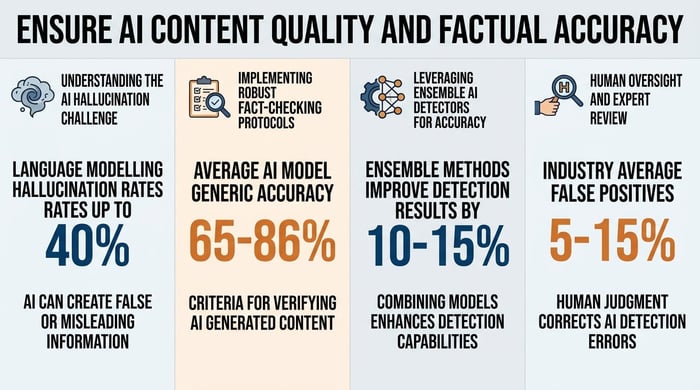
The digital content landscape has been irrevocably reshaped by AI, with 72% of organizations now leveraging AI for content creation. Yet, this rapid adoption brings a critical challenge: ensuring the quality and factual accuracy of AI-generated content. The stakes are high; AI language models still exhibit hallucination rates up to 40%, leading to misinformation and eroding audience trust. For busy businesses, SaaS companies, e-commerce stores, and publishers, this isn't merely a quality control issue—it's a direct threat to brand reputation, SEO performance, and ultimately, ROI. This guide provides a strategic roadmap to implement robust frameworks, leverage advanced tools, and establish continuous improvement processes, transforming the inherent risks of AI content into a powerful engine for growth and authority. Here's a quick summary of how to elevate AI content quality and factual accuracy effectively:
- Understanding the AI Content Quality Challenge: Grasp the inherent limitations of AI and the evolving digital environment, where AI Overviews reshape content consumption and trust is paramount.
- Implementing Robust Fact-Checking Protocols: Establish multi-layered verification processes, curate trusted data sources, and integrate human-in-the-loop workflows to ensure accuracy.
- Leveraging AI Detection and Human Oversight: Employ advanced AI detection tools while maintaining critical human editorial review and strong AI governance to ensure authenticity and compliance.
- Optimizing Prompts for Accuracy and Quality: Craft highly specific prompts, embed fact-checking instructions, and refine them iteratively to guide AI towards precise and high-quality output.
- Establishing a Continuous Improvement Loop for AI Content: Analyze performance metrics, adapt to evolving AI capabilities and search algorithms, and continuously upskill content teams to maintain a competitive edge.
Understanding the AI Content Quality Challenge
Navigating the complexities of AI-generated content requires a clear understanding of its inherent limitations and the evolving digital environment. While AI offers unprecedented speed and scale, it also introduces unique hurdles that can impact factual accuracy and overall quality, with language models showing hallucination rates up to 40%.
Identifying Common AI Content Pitfalls
AI's ability to generate vast amounts of text quickly can mask underlying issues. Hallucinations, where AI presents false information as fact, remain a significant concern, with language models showing hallucination rates up to 40%. This can lead to the propagation of misinformation, especially in niche or rapidly evolving topics. Additionally, AI content can often lack the nuanced understanding, critical thinking, and unique perspective that human writers bring, resulting in generic or repetitive output. This "AI sameness" can dilute brand voice and fail to resonate with target audiences, making it difficult to stand out in a crowded digital space.
The Impact of AI Overviews on Content Strategy
The rise of AI Overviews in search results fundamentally alters how content is consumed and valued. With AI Overviews now appearing on 47% of searches and 83% of searches ending click-free when AI Overviews are present, the traditional goal of driving traffic through clicks is shifting. Content must now be structured to provide direct, authoritative answers that AI can easily extract and cite. This means prioritizing E-E-A-T (Experience, Expertise, Authoritativeness, Trustworthiness) over sheer traffic volume, as 76.1% of cited URLs in AI Overviews rank in the top-10 organically. Businesses must adapt their content to be concise, factually robust, and easily digestible in small, independent chunks to be featured in these zero-click environments.
"Traditional SEO 'best practices' like long-form keyword content are debunked; prioritize multimodal, FAQ-driven assets for generative responses, with accessibility via independent chunks."
Nikhil Lai, Analyst, Forrester
The Evolving Landscape of Trust and Authority
In an era saturated with AI-generated content, trust has become the paramount benchmark for content quality. As AI-generated content comprises 15-20% of new online content, audiences are increasingly discerning. For B2B companies and publishers, establishing and maintaining authority is crucial. This requires a shift from merely generating content to producing high-fidelity, verifiable information. The focus must be on embedding authenticity, human creativity, and transparent sourcing to counter potential AI distrust. Organizations that prioritize human oversight, explainability, and source traceability will be the ones that build lasting credibility and achieve true business value from their AI investments.
Implementing Robust Fact-Checking Protocols
To combat AI's propensity for hallucinations and ensure the integrity of your content, a systematic approach to fact-checking is indispensable. This section outlines practical steps to embed accuracy into your AI content workflow, especially critical given that organizations with AI-ready data foundations achieve significantly higher AI accuracy than peers using low-quality data.
Establishing a Multi-Layered Verification Process
A single layer of review is insufficient for AI-generated content. Implement a multi-layered verification process that includes both automated and human checks. Start with automated tools for initial data validation and cross-referencing against trusted sources. For example, integrate APIs that check statistical claims against reputable databases. Follow this with human expert review, especially for critical or sensitive topics. This human-in-the-loop approach is vital, as organizations with AI-ready data foundations achieve significantly higher AI accuracy than peers using low-quality data. Train your human reviewers to identify common AI errors, logical inconsistencies, and potential biases.
Curating and Utilizing Trusted Data Sources
The quality of AI output is directly proportional to the quality of its input data. Develop a curated list of authoritative and up-to-date data sources relevant to your industry. This could include academic journals, government reports, industry-specific databases, and expert interviews. When generating content, instruct the AI to reference these specific sources. For example, an e-commerce business might feed its AI product specifications directly from manufacturer databases, leading to significant reductions in forecast errors and stockout losses. Regularly audit and update your trusted data sources to ensure their continued relevance and accuracy.
Implementing Human-in-the-Loop Fact-Checking Workflows
While AI can handle the bulk of content generation, human expertise is non-negotiable for ensuring factual accuracy and nuance. Design workflows where AI generates initial drafts, but human editors are responsible for final fact-checking, contextualization, and adding unique insights. This hybrid approach allows you to leverage AI for efficiency (e.g., AI SEO tools drive 28% higher blog engagement) while maintaining human control over quality. For instance, a professional services company using AI for drafts and human editing for fact-checking and internal links achieved a 55% organic traffic increase and 2x inquiries from organic search within six months. This blend ensures that the content is not only accurate but also authentic and engaging.
Leveraging AI Detection and Human Oversight
Maintaining high content quality in the age of AI requires a dual strategy: employing advanced AI content detection tools to identify potential issues and integrating robust human oversight to ensure authenticity and accuracy. This is particularly important as 78% of content marketing teams now use AI detection tools.
Employing Advanced AI Content Detection Tools
The market for AI content detection tools is rapidly evolving, with ensemble models like TextShift achieving 99.18% accuracy and false positives under 2%. These tools can help identify content that might be entirely AI-generated, which could signal a lack of human review or potential for generic output. While AI content detection tools vary in accuracy (e.g., Originality.ai at ~94%, GPTZero at ~85%), integrating them into your workflow provides an initial layer of scrutiny. Use these tools not just to flag AI content, but to understand where human intervention is most needed to elevate quality. This is particularly relevant for publishers who need to maintain editorial standards.
| Metric | Value | Source |
|---|---|---|
| AI Content Detection Accuracy (TextShift) | 99.18% | textshift.blog |
| AI Content Detection Accuracy (Originality.ai) | ~94% | textshift.blog |
| AI Content Detection Accuracy (Copyleaks) | ~92% | textshift.blog |
| AI Content Detection Accuracy (Turnitin) | ~90% | textshift.blog |
| AI Content Detection Accuracy (GPTZero) | ~85% | textshift.blog |
| Language Model Hallucination Rate | Up to 40% | articsledge.com |
Implementing Human Editorial Review and Quality Assurance
Despite the advancements in AI detection, human editorial review remains the ultimate arbiter of quality and accuracy. This involves skilled editors who can assess content for factual correctness, logical flow, brand voice consistency, and overall readability. For B2B companies, this means ensuring that complex technical information is not only accurate but also clearly communicated to a professional audience. A study showed that a professional services company using AI for drafts and human editing for fact-checking and internal links achieved a 55% organic traffic increase and 2x inquiries from organic search within six months. This underscores the power of human oversight in transforming AI drafts into high-performing content.
Integrating AI Governance and Ethical Guidelines
As AI for content creation scales, robust governance frameworks become essential. This includes defining clear policies for data usage, copyright, and bias mitigation. A significant percentage of agentic AI projects are projected to fail due to inadequate governance. Establish guidelines for responsible AI content creation, including requirements for source attribution, transparency about AI involvement, and regular audits for fairness and accuracy. This proactive approach helps mitigate risks like intensified IP disputes and misinformation, fostering trust with your audience. Tools like Acrolinx can help enforce linguistic analytics for content consistency and compliance across large organizations.
Optimizing Prompts for Accuracy and Quality
The quality of AI output is directly tied to the quality of the input. Crafting effective prompts is a critical skill for ensuring accurate, high-quality AI content, especially as 80% of bloggers now use AI tools.
Structuring Prompts for Specificity and Context
Vague prompts lead to generic or inaccurate responses. To achieve high-quality output, prompts must be highly specific, providing clear instructions, desired tone, target audience, and required format. For example, instead of "Write about SEO," a better prompt would be: "Generate a 500-word blog post for small business owners on 'The Impact of AI Overviews on Local SEO in 2026,' focusing on actionable strategies for local businesses to adapt. Include 3-5 key statistics from reputable sources, maintain a helpful and authoritative tone, and structure with an introduction, 3 main points, and a conclusion." Providing context, such as linking to existing content or style guides, further refines the AI's understanding.
Incorporating Fact-Checking Instructions within Prompts
Embed instructions for factual verification directly into your prompts. Ask the AI to cite its sources, cross-reference information, or even highlight areas where it might be less confident. For example: "Generate a section on the benefits of AI in e-commerce. For each benefit, provide a verifiable statistic and its source URL. If a statistic is unavailable or uncertain, state that explicitly." This proactive approach encourages the AI to prioritize accuracy and provides immediate points for human reviewers to verify.
Using Jottler to Enhance Prompt-Driven Accuracy

Tools that automate deep research and fact-checking, such as Jottler, can significantly contribute to higher quality AI content by ensuring the AI has access to and is prompted to utilize up-to-date, authoritative information during the generation process. Jottler's autonomous AI SEO engine is designed to conduct deep research from over 14 sources, integrating fact-checking into its content creation pipeline. This capability addresses the critical need for factual accuracy by providing AI models with a robust foundation of verified data, reducing the likelihood of hallucinations. By leveraging Jottler's integrated research and fact-checking, businesses can streamline their content creation workflow, allowing them to produce accurate and well-researched content at scale without extensive manual oversight, leading to an overall improving content quality.
Iterative Prompt Refinement and Testing
Prompt engineering is an iterative process. Rarely will your first prompt yield perfect results. Continuously refine and test your prompts based on the AI's output. Analyze the generated content for inaccuracies, inconsistencies, or areas where it falls short of expectations. Adjust your prompts by adding more constraints, providing clearer examples, or breaking down complex tasks into smaller, more manageable steps. This continuous feedback loop helps you learn how your specific AI model responds to different types of instructions, leading to increasingly precise and high-quality content over time. This approach also helps in optimizing AI content for search engines by ensuring relevancy and accuracy.
Establishing a Continuous Improvement Loop for AI Content
The journey to high-quality AI content is not a one-time fix but an ongoing process of monitoring, evaluation, and adaptation. This continuous loop is essential for maintaining a competitive edge in a rapidly evolving digital landscape, where 61% of marketers are increasing SEO budgets for AI in 2026.
Analyzing Performance Metrics and Feedback Loops
Regularly analyze the performance of your AI-generated content. Track key metrics such as engagement rates, conversion rates (e.g., AI personalization drives significant conversion lifts in e-commerce), SEO rankings, and user feedback. For example, if AI SEO tools drive 28% higher blog engagement, identify what aspects of the AI-generated content contribute to this. Establish clear feedback loops from human editors, subject matter experts, and your audience. Use this feedback to identify recurring issues with factual accuracy, tone, or relevance. This data-driven approach allows you to pinpoint weaknesses in your AI content pipeline and prioritize areas for improvement.
Adapting to Evolving AI Capabilities and Search Algorithms
The AI and search engine landscapes are in constant flux. New AI models emerge, offering improved accuracy and capabilities, while search algorithms, particularly with the rise of AI Overviews, continuously evolve. Stay informed about these changes and adapt your strategies accordingly. For instance, with AI Overviews slashing organic CTR by 58-61%, content strategies must shift from pure traffic generation to providing direct, authoritative answers. Regularly review your AI content generation processes and prompts to align with the latest best practices and technological advancements. This proactive adaptation ensures your content remains competitive and effective.
"The brands that win will be the ones that employ AI to drive business value while accepting its shortcomings."
Keith Johnston, VP and Group Research Director, Forrester
Training and Upskilling Content Teams
As AI tools become more sophisticated, the role of content teams evolves. Invest in training and upskilling your content creators, editors, and strategists in prompt engineering, AI content detection, and advanced fact-checking techniques. Empower them to become "AI whisperers" who can effectively guide AI models to produce high-quality, accurate, and on-brand content. This includes understanding how to use AI solutions for businesses to enhance their workflows. By fostering a culture of continuous learning, you ensure your team can effectively leverage AI while maintaining human oversight and expertise, transforming content teams into strategic operations hubs.
Conclusion: Building Trust and Driving Value with Accurate AI Content
The integration of AI into content creation is no longer optional; it's a strategic imperative. While the promise of efficiency and scale is immense, the challenge of ensuring factual accuracy and quality remains paramount. By implementing robust fact-checking protocols, leveraging advanced AI detection alongside human oversight, optimizing prompts for precision, and establishing a continuous improvement loop, businesses can confidently navigate the complexities of AI content.
The payoff is clear: 64% of marketers report AI content performs equal to or better than human-written content, and nearly 70% of businesses report higher ROI from faster content workflows using AI in SEO. By prioritizing trust, accuracy, and human-in-the-loop processes, you can transform AI from a potential liability into a powerful asset, driving unparalleled organic traffic, enhancing brand authority, and ultimately, compounding your business growth. Start your SEO agent today to harness the full potential of AI-driven content.
FAQs
like this today.