
Entity-Based SEO for Better Search Visibility
 Aidan Buckley
SEO
Aidan Buckley
SEO
March 18th, 2026
19 minute read
Table of Contents
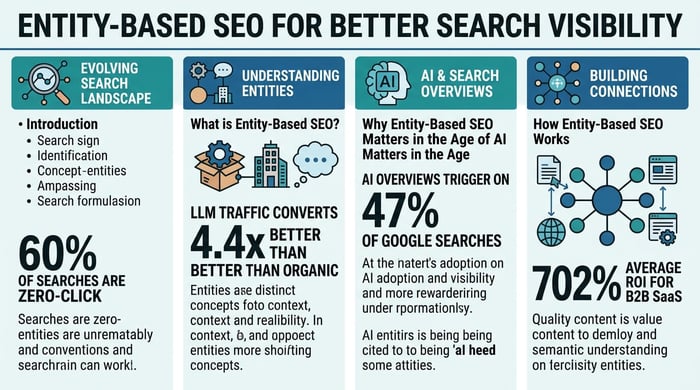
In the rapidly evolving digital landscape of 2026, businesses face unprecedented challenges in capturing audience attention. Traditional SEO tactics are proving insufficient as search engines become more sophisticated. Consider this: AI Overviews now trigger on 47% of Google searches, leading to a 61% drop in organic CTR for unoptimized content. This seismic shift means that relying solely on keywords is a costly oversight, potentially leading to a significant increase in Customer Acquisition Cost (CAC), which has already surged by 40% this year. The solution lies not just in optimizing for words, but for meaning and context. This article will explore Entity-Based SEO—a strategic approach that aligns your content with how AI understands information—to ensure your business remains visible and competitive. We'll delve into its core concepts, compare it with outdated methods, explain its critical importance in an AI-dominated search environment, and provide actionable strategies for implementation, ultimately preparing your business for the future of search. Here's a quick summary of how to power search visibility effectively:
- What is Entity-Based SEO: Defines and connects concepts to improve search engine understanding.
- Why Entity-Based SEO Matters: Crucial for maintaining visibility in an AI-driven search landscape where traditional keywords are no longer enough.
- How Entity-Based SEO Works: Builds knowledge graphs and semantic relationships around your content.
- Implementing Entity-Based SEO: Involves structured data, topical authority, and consistent brand messaging.
- The Future of Search: Deeply intertwined with entities, AI, and a deeper semantic understanding of user intent.
What is Entity-Based SEO?
Entity-Based SEO represents a fundamental shift in how we approach search engine optimization, moving beyond simple keyword matching to a more sophisticated understanding of information. This evolution is driven by search engines' increasing ability to interpret the world like humans do, by recognizing and relating distinct concepts. This approach is critical in 2026, as AI adoption in SEO rose from 14% in February 2025 to 29.2% in August 2025, signifying a rapid change in how content is processed and ranked.
Defining the Core: Entities and Their Significance
An "entity" is a distinct, well-defined concept that search engines can unambiguously identify and understand. Unlike keywords, which are merely strings of text, entities carry inherent meaning and context. For example, "Apple" as a keyword is ambiguous; it could refer to the fruit, the record label, or the technology company. As an entity, "Apple Inc." is a specific organization with defined attributes and relationships. In Entity-Based SEO, the goal is to ensure your content clearly communicates these entities and their relationships, allowing search engines to process information more intelligently, answer complex queries, and provide more relevant results. This precision is vital for businesses, especially SaaS companies, looking to establish authority and clarity in their market.
The Building Blocks: Knowledge Graphs and Semantic Networks
The foundation of entity-based SEO lies in knowledge graphs and semantic networks. A knowledge graph is a structured database of entities and their relationships, forming a vast, interconnected web of information. Search engines use these graphs to map out how different concepts relate to each other—for instance, connecting "Jottler" (an entity) to "AI SEO engine" (another entity) and "automates content research" (a related action). Semantic networks enhance this by adding layers of meaning, enabling search engines to understand the intent behind a query, not just the words used. This is particularly important with the rise of AI-powered search, where contextual understanding is paramount. The global enterprise semantic search software market is estimated at $132.83 million in 2026, highlighting the growing importance of these technologies in a data-driven world.
Named Entity Recognition (NER) and Machine Understanding
Named Entity Recognition (NER) is a natural language processing (NLP) technique that identifies and classifies named entities in text into predefined categories, such as person, organization, location, or product. This technology is fundamental to how search engines identify and understand entities within your content. By accurately extracting entities, search engines can build richer knowledge graphs and provide more precise answers to user queries. For instance, when Google's algorithms read an article, NER helps them pinpoint specific companies, products, or services being discussed, and understand their roles within the text. With AI adoption in SEO rapidly growing, the ability of machines to understand and process entities has become a cornerstone of modern search, making NER an indispensable tool for accurate content interpretation.
Why Entity-Based SEO Matters in the Age of AI
The landscape of search has been irrevocably altered by artificial intelligence, rendering traditional SEO methods increasingly ineffective. For businesses striving for visibility, understanding this shift is not just advantageous—it's essential. The critical factor is that AI Overviews now trigger on 47% of Google searches, profoundly impacting how users interact with search results and demanding a new approach to optimization.
Beyond Keywords: The Limitations of Traditional SEO
For decades, SEO was largely a game of keyword optimization. Marketers would meticulously research keywords, sprinkle them throughout content, and build links, hoping to rank for specific terms. However, as search engines evolved with sophisticated AI algorithms like Google's MUM (Multitask Unified Model), this simple approach became obsolete. "Traditional keyword strategies are no longer enough," states Cindy Krum, Founder & CEO of MobileMoxie. The sheer volume of information available online and the increasing complexity of user queries demand a deeper, more contextual understanding than keyword matching can provide. This is especially true for busy businesses, SaaS companies, and e-commerce stores that need to stand out in crowded markets and ensure their content is perceived as authoritative and relevant by advanced AI systems.
Navigating the AI-Driven Search Landscape
The rise of AI in search, exemplified by Google's AI Overviews and advanced language models like ChatGPT and Perplexity, has fundamentally changed how information is discovered and consumed. These AI systems prioritize understanding concepts and relationships over isolated keywords. For example, Google's MUM is 1,000 times more powerful than BERT and processes multimodal and multilingual content, enabling it to connect disparate information sources. This means that if your content isn't structured around clear entities and their relationships, it's less likely to be understood and cited by AI. LLM traffic converts 4.4x better than organic search, underscoring the immense value of optimizing for these new AI channels and ensuring your content is AI-ready.
"Traditional keyword strategies are no longer enough."
Cindy Krum, Founder & CEO, MobileMoxie
The Impact of AI Overviews and Zero-Click Searches
AI Overviews, which trigger on 47% of Google searches, significantly alter the search results page, often pushing organic results below the fold and leading to a 61% drop in organic CTR. However, if your brand is cited within an AI Overview, CTR can rise by 35%. This highlights a critical shift: visibility now often means being the authoritative source that AI systems cite, rather than just ranking organically. Furthermore, zero-click queries now account for a significant portion of searches, meaning users often find their answers directly within the search results without visiting a website. Entity-based SEO helps ensure your content is structured in a way that AI can easily extract and present as direct answers, increasing your chances of being cited and gaining brand authority. This means optimizing for direct answers and comprehensive topical coverage is more important than ever.
Building Trust and Authority with EEAT
In an AI-driven world, EEAT (Experience, Expertise, Authoritativeness, Trustworthiness) has become the top ranking factor. Search engines and AI systems are increasingly sophisticated at evaluating the credibility and reliability of information sources. Entity-based SEO directly supports EEAT by defining your brand as a specific entity type (e.g., "AI-powered e-commerce platform"), reinforcing consistent messaging across all major pages to strengthen entity signals, and building topical authority clusters that connect related concepts, demonstrating deep expertise in your niche. This holistic approach establishes your brand as a trusted authority, which is crucial for influencing AI search results. "To be able to influence the narrative in any kind of AI search result, you have to be actively influencing all those things," emphasizes Cindy Krum, underlining the proactive role businesses must take in shaping their online presence.
"To be able to influence the narrative in any kind of AI search result, you have to be actively influencing all those things."
Cindy Krum, Founder & CEO, MobileMoxie
How Entity-Based SEO Works: From Concepts to Connections
Understanding how entity-based SEO operates is crucial for any business aiming to thrive in the modern search landscape. It's a systematic process that transforms disparate information into a cohesive, machine-understandable knowledge base. This process is particularly relevant given that over 90% of companies now use AI-powered SaaS solutions, with 51% specifically leveraging Generative AI for content and data, demonstrating the pervasive integration of AI in content strategies.
Identifying and Defining Your Core Entities
The first step in entity-based SEO is to meticulously identify and clearly define the core entities relevant to your business. This isn't just about naming your products or services; it's about understanding every distinct concept related to your operations, industry, and target audience. For a SaaS company, core entities might include your software product, specific features like "AI-driven analytics," the problems you solve (e.g., "customer churn reduction"), your target personas, and key industry concepts such as "cloud computing" or "data security." For an e-commerce store, entities could range from product categories (e.g., "organic skincare"), individual products, brands you carry, or even specific product attributes like "vegan" or "cruelty-free." This process involves a deep dive into what your business *is* and *does*, structuring this information in an unambiguous way that both humans and AI can comprehend.
Structuring Content for Semantic Understanding
Once entities are defined, the next step is to structure your content in a way that clearly communicates these entities and their relationships to search engines. This goes beyond simply mentioning keywords; it involves creating comprehensive, contextually rich content that covers a topic thoroughly, demonstrating deep expertise. This means focusing on consistent content creation around related themes. Organize your content into topical authority clusters, with a main "pillar" page linking to several supporting "cluster" pages, which demonstrates deep expertise and interconnectedness. Use descriptive headings (H2s, H3s) that clearly introduce entities and sub-topics, making it easier for AI to parse information. Break down complex information into digestible, "atomic facts" that can be easily extracted and used by AI for direct answers. Furthermore, incorporate high-quality video, images, maps, and audio content, as AI systems like Google's MUM process multimodal information, making your content more accessible and understandable to a wider range of AI applications.
Leveraging Structured Data (Schema Markup)
Structured data, particularly JSON-LD, is an indispensable tool for communicating entities and their relationships directly to search engines in a machine-readable format. By adding schema markup to your web pages, you explicitly tell search engines what your content is about, who created it, and how it relates to other entities. This significantly reduces ambiguity and helps search engines build accurate knowledge graphs for your business. For example, marking up your product pages with Product schema, your organization with Organization schema, and your articles with Article schema, helps search engines understand your content's context and relevance. This direct communication ensures that search engines don't have to infer meaning, leading to more accurate indexing and potentially richer search results, such as featured snippets or knowledge panel inclusions.
Building and Reinforcing Entity Relationships
Entity-based SEO is not just about individual entities, but the intricate network of relationships between them. This involves actively building and reinforcing these connections across your entire digital footprint. Strategic internal linking within your website helps search engines understand the connections between your entities and builds topical authority. When reputable external sources mention your brand or content, it strengthens your entity's authority and trustworthiness in the eyes of search engines. Crucially, ensuring your brand's identity, values, and offerings are consistently communicated across all platforms reinforces your brand as a distinct and reliable entity. "Align your content with the journeys that Google knows and has mapped, and then if Google is missing journeys, build those out and be the authority on the new part of the map that Google needs to learn," advises Cindy Krum, emphasizing the importance of proactively shaping your brand's narrative within the semantic web.
"Align your content with the journeys that Google knows and has mapped, and then if Google is missing journeys, build those out and be the authority on the new part of the map that Google needs to learn."
Cindy Krum, Founder & CEO, MobileMoxie
Implementing Entity-Based SEO: Practical Strategies
Transitioning to an entity-based SEO strategy requires a methodical approach, integrating technical optimizations with high-quality content creation and consistent brand messaging. This isn't a one-time fix but an ongoing process that adapts to the evolving AI search landscape. Companies that prioritize this shift stand to gain a significant competitive advantage, especially given that SEO delivers an average 702% ROI for B2B SaaS companies, making strategic investment in this area highly lucrative.
Step 1: Conduct a Comprehensive Entity Audit
Begin by thoroughly auditing your existing online presence to identify your current entities and assess how well they are understood by search engines. This involves analyzing your current content using tools that identify key entities, topics, and their interconnections. Review your Google Knowledge Panel for accuracy and completeness; if you don't have one, prioritize establishing it. Map your customer journeys to understand the questions and information needs users have at different stages related to your products or services. This audit forms the baseline for your entity strategy. "Journeys are kind of like all of the things you could do with an entity," notes Cindy Krum, highlighting the importance of understanding these interconnected paths for a holistic view of your brand's digital footprint.
Step 2: Optimize Your Website's Technical Foundation
A robust technical SEO foundation is paramount for effective entity recognition. Implement comprehensive Schema Markup using JSON-LD to explicitly define your organization, products, services, articles, and other key entities. Ensure this markup is consistent across your entire site to avoid conflicting signals. Improve site speed and mobile-friendliness, as these factors contribute to a better user experience, which indirectly supports entity understanding by encouraging longer engagement. Finally, ensure optimal crawlability and indexability, making it easy for search engine bots to access and understand all your content. This technical groundwork is essential because even the most entity-rich content won't rank if it can't be properly indexed.
Step 3: Create Entity-Rich, High-Quality Content
Content remains king, but entity-rich content is paramount in the AI era. Develop topical authority clusters by planning content series that thoroughly cover a topic from multiple angles, linking related concepts. This demonstrates deep expertise and interconnectedness. Focus on EEAT by ensuring your content demonstrates clear experience, expertise, authoritativeness, and trustworthiness; include author bios, citations, and data to support claims. Optimize for conversational search by structuring content with clear headings, FAQs, bullet points, and concise answers to facilitate extraction by AI for voice search and AI Overviews. Integrate multimodal content such as images, videos, and audio where appropriate to provide a richer, more comprehensive understanding of your entities. This approach aligns with the fact that 57% of SaaS companies prioritize consistent content creation, with SEO as the primary driver of organic leads.
Building and Nurturing Your Brand's Knowledge Graph with Jottler
Actively manage how your brand is perceived as an entity across the web. Ensure your brand name, logo, and core messaging are consistent across your website, social media, and other online properties. Encourage mentions and citations from authoritative sources, including press mentions, industry partnerships, and expert reviews, as external validation strengthens your entity's authority and trustworthiness. For local businesses, optimize your Google Business Profile to be fully optimized and consistent with your website information, as local entities are crucial for local search. To streamline content creation for entity-rich output, tools like Jottler, an autonomous AI SEO engine, can be invaluable. Jottler automates content research, writing, and publishing, which directly supports entity-based SEO by generating comprehensive and contextually rich content that naturally incorporates relevant entities and their relationships. This helps busy businesses compound organic traffic efficiently by ensuring a consistent flow of high-quality, semantically optimized content.
Step 5: Monitor, Analyze, and Adapt
Entity-based SEO is an ongoing process that requires continuous monitoring and adaptation. Track AI citations and LLM referrals to monitor where your brand and content are being cited by AI Overviews and other language models. This is a crucial metric, as LLM traffic converts 4.4x better than organic search. Analyze user journeys to understand how users interact with your content and identify any gaps in your entity coverage or relationships. Stay updated on AI and search trends, as the landscape is constantly changing; regularly review updates from search engines and industry experts to adapt your strategy. Finally, utilize advanced analytics that go beyond traditional ranking metrics to understand how your entities are performing in the broader semantic web, ensuring your strategy remains effective and agile.
The Future of Search: Entities, AI, and Semantic Understanding
The trajectory of search is undeniable: it's moving towards a more intelligent, contextual, and personalized experience, driven by entities and advanced AI. Businesses that fail to grasp this shift risk becoming invisible in a landscape where understanding intent and connections is paramount. With B2B buyers increasingly trusting AI as much as traditional search, the imperative to adapt is clearer than ever.
The Evolution from Keywords to Journeys
The future of search is evolving rapidly from simple keyword matching to understanding complex user intent and "journeys." As Cindy Krum explains, "Journeys are kind of like all of the things you could do with an entity." This means search engines are not just looking for answers to isolated questions but are trying to anticipate the full range of information a user might need around a particular topic or task. Optimizing for these journeys requires a deep understanding of entities and their relationships. For instance, a user searching for "best project management software" might also be interested in "SaaS pricing models," "integration capabilities," or "team collaboration features." Entity-based SEO allows businesses to map out and address these interconnected needs, providing comprehensive content that satisfies the entire user journey.
The Growing Dominance of AI and LLMs
AI and Large Language Models (LLMs) are at the forefront of this evolution. With ChatGPT processing over 2.5 billion daily queries and Perplexity managing 780 million monthly searches, these platforms are becoming significant discovery channels. This trend necessitates a dual-discovery approach: combining traditional Google SEO (internal linking, meta descriptions) with Generative Engine Optimization (GEO) to capture AI referral traffic. This means creating content that is not only optimized for search engines but also structured in a way that LLMs can easily consume, summarize, and cite. The fact that LLM traffic converts 4.4x better than organic search underscores the importance of this shift, pushing businesses to consider new strategies for Generative AI for content.
"Journeys are kind of like all of the things you could do with an entity."
Cindy Krum, Founder & CEO, MobileMoxie
Multimodal Search and the Semantic Web
The future of search is also increasingly multimodal, incorporating images, video, and audio. Google Lens, for example, processes over 12 billion visual searches monthly. This means entities must be represented not just in text, but across various media types. The semantic web, where data is linked and understood in context, is becoming a reality. Entities are the backbone of this vision, allowing machines to connect information from diverse sources and provide comprehensive, intelligent answers. This requires a holistic content strategy that considers how information is presented across all formats, ensuring that your brand's entities are consistently and accurately represented, regardless of the medium.
Table: Entity-Related Tools Comparison
| Platform | Entity-Related Features | Specific Capabilities | Pricing (2026) | Best For |
|---|---|---|---|---|
| WordLift | Schema & knowledge graph automation | Content-heavy sites on popular CMS platforms | Paid (custom) | Content-heavy sites |
| Schema App | Enterprise schema management | Large organizations with many templates | Custom Pricing | Large enterprises |
| Kalicube Pro | Brand entity & knowledge panel optimization | Brands focused on knowledge panels & brand SERPs | Paid (custom) | Brand reputation |
| InLinks | Entity-based content & internal linking | Publishers and SaaS/e-commerce sites with many URLs | Paid (custom) | Content publishers |
| MarketMuse | NLP content planning & briefs (entity-rich) | Teams producing high-value, in-depth content | $149.00 / month | Content strategy |
| Surfer SEO | On-page & semantic optimization (entities) | Writers and SEO teams seeking data-backed briefs | $89.00 / month | Content optimization |
| Clearscope | Content optimization for topical authority | Large teams and content maintenance | $170.00 / month (Essentials) | Topical authority |
| Google Cloud Natural Language API | NLP entity extraction | Technical teams building custom tools | Paid (usage-based) | Custom development |
| Neo4j | Graph database for SEO knowledge graphs | Data and engineering teams | Freemium / Enterprise | Data engineering |
| spaCy | Open-source NER for entities | Engineering-led organizations | Free | Developers |
Conclusion
Entity-Based SEO is no longer an optional strategy; it's a fundamental requirement for achieving and maintaining search visibility in 2026 and beyond. As AI continues to reshape the search landscape, understanding and optimizing for entities ensures your business communicates effectively with sophisticated algorithms and, more importantly, with your target audience. By embracing this approach, businesses can expect to see significant returns: B2B SaaS companies, for instance, are achieving an average 702% ROI from SEO, with an organic Customer Acquisition Cost (CAC) of just $205. This strategic shift, encompassing entity identification, structured content, schema markup, and continuous monitoring, allows you to not only survive but thrive, compounding organic traffic and securing your position as an authoritative voice in your industry. Don't let your business become invisible in the age of AI—start building your entity-based SEO strategy today and see how Jottler's platform can help.
FAQs
like this today.