Future-Proof Your Content with AI SEO Agents
 Aidan Buckley
SEO
Aidan Buckley
SEO
March 17th, 2026
20 minute read
Table of Contents
- The Shifting Landscape of SEO: Why AI Agents Are Essential
- Understanding AI SEO Agents: Beyond Basic Automation
- Key Benefits of Integrating AI SEO Agents into Your Strategy
- Practical Steps to Implement AI SEO Agents for Content Creation
- Measuring Success: KPIs and ROI for AI-Powered Content
- Future-Proofing Your Content: Adapting to Evolving AI Search
- Conclusion
The digital landscape of 2026 demands more than traditional SEO; it requires intelligent automation. Businesses are grappling with an environment where almost 70% of businesses report higher ROI from using AI in SEO, yet many struggle to adapt. The stakes are high: without leveraging advanced AI, companies risk becoming "technically invisible" to generative AI models, potentially losing valuable organic traffic and conversion opportunities. The solution lies in embracing AI SEO agents that automate content research, writing, and publishing, transforming how businesses compound organic traffic. This guide will explore the essential role of AI SEO agents, their benefits, practical implementation steps, and how to measure their impact to future-proof your content strategy.
- The Shifting Landscape of SEO: AI agents are essential for maintaining visibility, especially as Google resolves over 60% of searches without clicks.
- Understanding AI SEO Agents: These sophisticated systems go beyond basic automation, with 79% of companies adopting them to deliver value.
- Key Benefits of Integrating AI SEO Agents: They unlock unprecedented efficiency, enhance content quality, and drive superior organic traffic with AI-referred visitors converting up to 23x higher.
- Practical Steps to Implement AI SEO Agents: Strategic planning, platform selection, and workflow integration are crucial for leveraging AI to achieve 70-80% cost savings for B2B companies.
- Measuring Success: KPIs and ROI for AI-Powered Content: Tracking metrics like AI Overview mentions and conversion rates is vital, as content marketing delivers $7.65 per $1 invested.
- Future-Proofing Your Content: Continuous adaptation, human-AI collaboration, and diversifying channels are key to thriving in a dynamic AI search environment.
The Shifting Landscape of SEO: Why AI Agents Are Essential
The way users interact with search engines is fundamentally changing, making AI SEO agents not just advantageous, but essential. Google now resolves over 60% of searches without clicks through AI Overviews, featured snippets, and ecosystem products. This radical shift means traditional ranking strategies are no longer sufficient; content must be optimized for AI-first visibility to remain competitive.
The Rise of AI Overviews and Zero-Click Searches
The era of the "ten blue links" is rapidly fading. According to Rand Fishkin, by the end of 2026, users will consume 10X more content via AI summaries than through direct article clicks. This means that even if your content ranks well, if it's not structured for AI extraction, it risks being bypassed entirely. Content needs to be concise, factual, and easily digestible for generative AI models to pull and present in their summaries, highlighting the urgency for businesses to adapt their SEO strategies immediately.
"AI Overviews aren't killing SEO. They're filtering it." Rand Fishkin, Co-Founder, SparkToro
The Invisibility Crisis for Traditional SEO
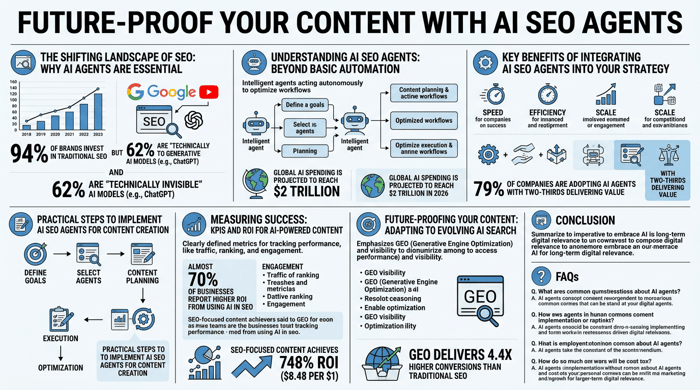
Despite 94% of brands investing heavily in traditional SEO, a staggering 62% are "technically invisible" to generative AI models like ChatGPT, as reported by the Fuel AI Index in 2026. This statistic reveals a critical disconnect: content optimized solely for human-readable search engine results pages (SERPs) may not be discoverable by the AI systems that are increasingly shaping search outcomes. Without a specialized AI SEO and content strategy, companies risk losing valuable organic traffic and conversion opportunities, making AI-first optimization a matter of digital survival.
Efficiency and ROI Demands in 2026
Businesses are under immense pressure to maximize efficiency and demonstrate clear ROI. Almost 70% of businesses report higher ROI from using AI in SEO, primarily attributed to faster content workflows such as topic planning, drafting, and publishing. The overall content marketing landscape delivers a compelling $7.65 per $1 invested, with SEO-focused content for B2B achieving an impressive 748% ROI due to compounding traffic. AI agents offer a clear pathway to achieve these gains by automating repetitive tasks, freeing up human resources for strategic work, and driving tangible financial benefits.
"Almost 70% of businesses report higher ROI from using AI in SEO, primarily attributed to faster content workflows (topic planning, drafting, publishing)."
Understanding AI SEO Agents: Beyond Basic Automation
The evolution of AI in marketing has moved beyond simple tools to sophisticated, autonomous agents. These systems are not just assisting; they are actively driving content strategy and execution. By 2026, 40% of enterprise apps will leverage AI agents, a significant leap from less than 5% in 2025, according to Gartner predictions, underscoring their growing importance.
Defining Autonomous AI SEO Agents
Autonomous AI SEO agents are advanced software systems that leverage artificial intelligence to independently perform complex SEO tasks. Unlike basic AI writing assistants or keyword tools that require constant human direction, these agents can autonomously conduct in-depth content research, generate optimized content, and even manage publishing workflows. They are designed to learn, adapt, and execute multi-step processes to achieve specific SEO objectives, such as increasing organic visibility and driving conversions, with minimal human intervention.
The Evolution from AI Tools to AI Agents
The market is witnessing a rapid transition from general AI tools to specialized, intelligent AI agents. A notable 79% of companies are already adopting AI agents, with two-thirds reporting that these agents are already delivering significant value. Furthermore, 75% of companies using AI for marketing plan to shift to AI agents, indicating a clear industry trend towards more integrated, intelligent, and autonomous systems. This evolution signifies a move towards AI solutions that can handle entire content lifecycles, from initial topic planning and competitive analysis to content generation, optimization, and performance analysis, offering a more holistic approach to SEO.
Core Capabilities of Advanced AI SEO Agents
Advanced AI SEO agents possess a range of capabilities that set them apart from earlier generations of AI tools. These include:
- Comprehensive Content Research: AI agents can analyze vast amounts of data, including SERPs, trending topics, and competitor content, to identify high-potential keywords and semantic topic clusters. They leverage "real-time keyword data" to ensure content remains fresh and competitive.
- Optimized Content Generation: These agents produce high-quality, SEO-friendly content that adheres to E-E-A-T principles and is structured for AI extractability. They can generate initial drafts, outlines, and even full articles, significantly accelerating the content creation process.
- Personalization at Scale: AI agents enable hyper-personalization, tailoring content to specific audience segments based on their preferences and behaviors. This capability is crucial, as personalized content boosts click-through rates by 39% and AI-driven segmented campaigns generate 57% more revenue.
- Automated Publishing and Optimization: Many advanced agents integrate with Content Management Systems (CMS) to automatically publish content and continuously optimize it based on real-time performance data.
- Technical SEO Enhancements: They can implement critical technical SEO elements such as schema markup, optimize metadata, and ensure clean information architecture, all of which improve content discoverability by both traditional search engines and generative AI models.
Key Benefits of Integrating AI SEO Agents into Your Strategy
Integrating AI SEO agents into your content strategy offers a multitude of benefits that extend beyond mere efficiency, touching on quality, personalization, and significant ROI. These agents are transforming content creation, allowing businesses to achieve results that were previously unattainable with human-only teams.
Unlocking Unprecedented Efficiency and Scale
The primary draw of AI SEO agents is their ability to drastically reduce the time and resources required for content creation and optimization. By automating labor-intensive tasks like topic planning, keyword research, and initial drafting, these agents enable businesses to produce a higher volume of high-quality content without needing to expand their human teams. This efficiency translates into substantial cost savings, with AI agents priced at $2,000-$5,000/month per seat delivering 70-80% cost savings for B2B companies with high-value products (over $10k deal size). Mike from Lumenalta notes, "Efficiency gains... allow teams to focus on high-value strategic work," underscoring how automation frees up human talent for more strategic and creative endeavors.
Enhancing Content Quality and Relevance
There's a common misconception that AI-generated content is inherently low-quality. However, advanced AI SEO agents are designed to produce content that is highly relevant, optimized, and aligned with E-E-A-T (Experience, Expertise, Authoritativeness, Trustworthiness) principles. They achieve this by:
- Prioritizing Originality and First-Person Expertise: Modern AI agents focus on generating "original insight," "net new information," and integrating expert quotes or original data to differentiate content.
- Optimizing for AI-First Visibility (GEO/AEO): Content is structured with clear headings, bullet points, FAQs, and schema markup to be easily extracted and cited by AI systems like Google's AI Overviews.
- Leveraging Real-Time Data: Agents incorporate "real-time keyword data" to ensure content is always fresh, relevant, and competitive in dynamic search environments.
This focus on quality ensures that AI-powered content not only ranks but also provides genuine value to the reader and AI models alike.
Driving Superior Organic Traffic and Conversions
The impact of AI SEO agents extends beyond efficiency to tangible business outcomes, significantly boosting organic traffic and conversion rates. AI-referred visitors convert up to 23x higher than organic search traffic, indicating a higher intent and quality of lead. Generative Engine Optimization (GEO) delivers 4.4x higher conversions than traditional SEO. Furthermore, users from AI-powered search spend 8% longer on-site, browse 12% more pages, and see bounce rates drop by 23% compared to traditional referrals. These metrics clearly demonstrate that AI-driven content not only attracts more traffic but also more engaged and valuable visitors, translating directly into improved business performance.
Achieving Hyper-Personalization at Scale
Personalization is no longer a competitive advantage but a fundamental expectation, with 89% of marketing decision-makers viewing it as essential over the next three years. AI agents make hyper-personalization achievable at an unprecedented scale, allowing businesses to:
- Tailor Content to Individual Preferences: Nearly half of marketers now use AI for personalized content, with 35.08% repurposing AI-generated content across multiple channels to reach diverse segments effectively.
- Boost Engagement and Revenue: Personalized content has been shown to boost click-through rates by 39%, and AI-driven segmented campaigns can generate an impressive 57% more revenue.
- Reduce Customer Acquisition Costs (CAC): AI-driven marketing automation can significantly cut CAC by up to 40%, making customer acquisition more efficient and cost-effective.
As Fuze7 predicts, "AI will make personalization so advanced that it borders on predictive," allowing businesses to anticipate and meet customer needs with unparalleled precision.
Practical Steps to Implement AI SEO Agents for Content Creation
Implementing AI SEO agents is a strategic undertaking that requires careful planning and execution. The goal is to integrate AI seamlessly into your existing workflows to maximize efficiency and impact, ultimately compounding your organic traffic.
Define Your Content Strategy and Objectives
Before deploying any AI SEO agent, it is crucial to clearly define your overarching content strategy and specific objectives. This foundational step ensures that your AI agents are aligned with your overall business goals and deliver measurable results. What are your target audiences? What unique value do you aim to provide? What are your desired outcomes, such as lead generation, brand awareness, or direct sales? Answering these questions will guide your AI implementation.
- Identify Target Audience Needs: Deeply understand their pain points, information gaps, and preferred content formats.
- Map Content to the Buyer's Journey: Plan content that addresses questions and needs at every stage of your sales funnel.
- Set Measurable Goals: Establish clear Key Performance Indicators (KPIs) that directly align with your content objectives, such as increased organic traffic, higher conversion rates, or improved topical authority.
Select the Right AI SEO Agent Platform
The market for AI SEO agents is rapidly expanding, with various platforms offering diverse capabilities and pricing tiers. When choosing a platform, consider your specific needs, budget, and the desired level of automation. For busy businesses seeking to automate content research, writing, and publishing to compound organic traffic, an autonomous AI SEO engine like Jottler offers a comprehensive, end-to-end solution.
- Evaluate Core Features: Look for platforms that offer robust keyword research, content generation, optimization, and seamless publishing integrations with your existing CMS.
- Consider Scalability: Ensure the platform can grow with your content needs, handling increasing volumes of articles and complex strategies.
- Assess Integration Capabilities: Check for compatibility with your existing CMS (e.g., WordPress, Webflow, Shopify) and other marketing tools to ensure a smooth workflow.
Jottler: Autonomous Content Creation
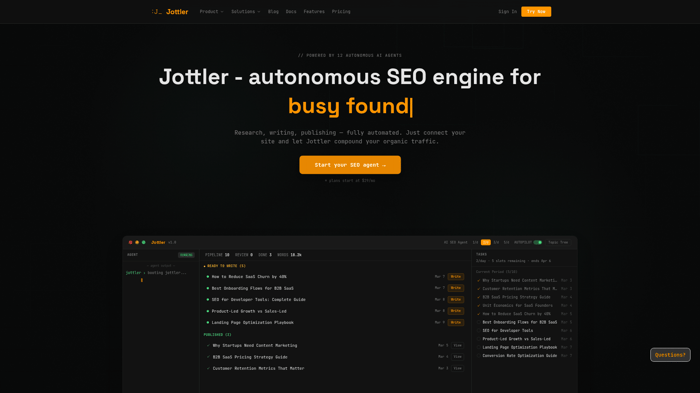
Jottler is designed to automate the entire content lifecycle, from initial ideation to final publication. Its suite of 12 AI agents works autonomously to perform deep research from 14+ sources, ensuring factual accuracy and mitigating AI hallucinations. This allows businesses to consistently publish daily long-form articles (3,000+ words) that are fully optimized for SEO, including AI keyword research, topic clustering, smart internal linking, and SEO meta/FAQ schema generation. The platform also handles AI-generated featured images and automatic CMS publishing, making it a hands-off solution for compounding organic traffic.
By connecting your website and setting your desired article frequency, Jottler takes care of the rest, freeing up valuable time and resources for strategic initiatives. Its focus on high-quality, long-form content that serves as source material for AI models ensures that your content remains visible and authoritative in the evolving search landscape.
Integrate AI Agents into Your Content Workflow
Seamless integration is crucial for maximizing the benefits of AI SEO agents. This involves defining how AI will interact with your human teams and existing processes to create a synergistic workflow.
- Automate Research and Topic Planning: Use AI to identify high-potential keywords, analyze SERPs, and generate semantic topic clusters, providing a data-driven foundation for your content.
- Streamline Content Drafting: Leverage AI to generate initial drafts, outlines, and even full articles, significantly accelerating the content creation process. This allows human writers to focus on refining, adding unique insights, and ensuring brand voice.
- Implement Human Oversight and QA: While AI can generate content, human editors remain indispensable for reviewing for accuracy, maintaining brand voice, and ensuring compliance with E-E-A-T principles. As Lily Ray cautions, "Using generative AI to scale content really quickly... almost always crashes and burns" without proper human oversight.
- Automate Publishing and Technical Optimization: Configure AI agents to publish content directly to your CMS and apply technical SEO elements like schema markup, clean metadata, and internal linking, ensuring content is always search-engine ready.
Optimize for AI-First Visibility (GEO/AEO)
To ensure your content is discoverable and cited by generative AI models, you must optimize for AI-first visibility, also known as Generative Engine Optimization (GEO) or Answer Engine Optimization (AEO). This goes beyond traditional keyword density to focus on structure, clarity, and factual accuracy.
- Structure Content for Extraction: Use clear, hierarchical headings (H1, H2, H3), bullet points, numbered lists, FAQs, and tables to make your content easily digestible and extractable by AI systems.
- Enhance Technical SEO: Implement schema markup (e.g., FAQ schema, Article schema), clean metadata, and AI-readable alt text/captions for images and videos. This provides structured data that AI models can readily understand and utilize.
- Focus on E-E-A-T Signals: Ensure your content demonstrates verifiable expertise, experience, authoritativeness, and trustworthiness. This includes transparent author credentials, original research, and citing credible sources, which are increasingly prioritized by Google and AI models.
Measuring Success: KPIs and ROI for AI-Powered Content
As AI reshapes the search landscape, measuring the success of your AI-powered content requires a refined approach. Traditional ranking metrics are still relevant, but new KPIs focused on AI interaction and conversion value are emerging as critical indicators. Only 21% of marketers accurately measure content ROI, highlighting a significant opportunity for those who can effectively quantify their AI SEO efforts.
Key Performance Indicators for AI SEO
To accurately gauge the effectiveness of your AI SEO strategy, it's essential to track a comprehensive set of KPIs that reflect the nuances of AI search behavior.
- AI Overview Mentions/Citations: Track how often your content is cited or summarized in AI Overviews, Google's SGE, ChatGPT, or other generative AI responses. Search Logistics' case study showed 157 AI Overviews mentions for an e-commerce client.
- AI Referral Traffic and Conversion Rates: Monitor traffic originating specifically from AI search interfaces and its associated conversion rates. AI-referred visitors convert up to 23x higher than organic search traffic, and GEO delivers 4.4x higher conversions than traditional SEO.
- On-Site Engagement Metrics: Analyze the behavior of AI-referred visitors. Users from AI-powered search spend 8% longer on-site, browse 12% more pages, and see bounce rates drop by 23% compared to traditional referrals.
- Brand Mentions and Share of Voice: As direct clicks decrease, brand mentions across various platforms (social media, forums, other websites) become critical indicators of authority and influence.
- Topical Authority Score: Assess your content's depth, breadth, and interconnectedness within specific topic clusters, which is vital for proving expertise to AI models.
Calculating the Return on Investment (ROI)
Quantifying the financial impact of your AI SEO efforts is crucial for demonstrating value and securing future investments.
- Cost Savings from Automation: Calculate the reduction in labor costs for content research, drafting, optimization, and publishing that AI agents enable. AI agents can deliver 70-80% cost savings for B2B companies.
- Increased Lead Generation: Compare the volume and quality of leads generated by AI-powered content versus traditional methods. Content marketing generally generates 3x more leads per dollar than paid ads.
- Revenue Attribution: Directly link sales and revenue to content that was created or significantly optimized by AI agents. SEO-focused content for B2B achieves an impressive 748% ROI.
- Customer Lifetime Value (CLTV): Analyze if AI-powered personalization and engagement lead to higher CLTV. AI-driven segmented campaigns generate 57% more revenue.
| Benchmark | ROI Ratio | Segment | Source |
|---|---|---|---|
| B2B Content | 3:1 ($3/$1) | General | Genesys Growth |
| Overall Content | $7.65/$1 | All | Incremys |
| SEO Content | 748% ($8.48/$1) | B2B | Genesys Growth |
| B2B All Channels | 5:1 ($5/$1) | General | Genesys Growth |
| Micro-Influencers | $6.40/$1 | Influencer | Incremys |
Tools and Methodologies for Tracking
To effectively track and analyze the performance of AI-powered content, businesses should leverage a combination of advanced analytics platforms, specialized AI SEO tools, and custom dashboards.
- Google Analytics 4 (GA4): Essential for detailed traffic, engagement, and conversion data, allowing you to segment and analyze AI-referred visitors.
- AI SEO Platforms: Many AI SEO tools offer built-in analytics for tracking AI Overview mentions, content performance scores, and competitor insights. Tools like Semrush or Surfer SEO provide valuable data.
- CRM Integration: Connect your content performance data with your CRM to attribute leads and sales directly to AI-generated or optimized content, providing a clear picture of ROI.
- A/B Testing: Continuously test different AI-generated content variations, headlines, and calls to action to optimize performance and identify what resonates best with your audience and AI models.
Future-Proofing Your Content: Adapting to Evolving AI Search
The AI landscape is characterized by its rapid pace of change. To truly future-proof your content, a strategy of continuous adaptation, human-AI collaboration, and diversification is paramount. Relying solely on static SEO tactics is no longer viable in 2026.
Embracing Adaptability and Continuous Learning
The AI landscape is dynamic, with new models, search interfaces, and user behaviors emerging constantly. Future-proofing your content strategy means embracing a culture of adaptability and continuous learning within your organization.
- Stay Informed on AI Advancements: Regularly monitor updates from key players like Google, OpenAI, and other AI research institutions. Understanding foundational changes will inform your strategy.
- Experiment with New AI Capabilities: Be willing to test new AI tools, platforms, and approaches as they become available. Early adoption and experimentation can provide a significant competitive edge.
- Iterate Based on Data: Use performance data from your AI SEO efforts to refine your strategies, content creation processes, and optimization techniques. This iterative approach ensures your content remains relevant and effective.
The Importance of Human-AI Collaboration
While AI agents offer significant automation and scale, human oversight and strategic input remain indispensable. The most successful content strategies in 2026 will be those that foster a strong human-AI collaboration.
- Human for Strategy and Creativity: AI is a powerful assistant for data processing and content generation, but humans are needed for high-value strategic work, creative differentiation, understanding nuanced customer context, and injecting unique perspectives. As the HubSpot Blog author notes, "In a world flooded with AI-generated content, the only way to cut through the noise is with data that an LLM doesn’t have: customers’ real-time context."
- AI for Efficiency and Scale: Leverage AI for tasks like research, drafting, identifying patterns, and technical optimization, allowing your human team to focus on unique insights, brand storytelling, and building genuine connections.
- E-E-A-T and Authenticity: Ensure your content maintains strong E-E-A-T signals, as Google increasingly prioritizes "first-person experience and demonstrated expertise." Human input is crucial for injecting this authenticity.
"AI agents priced at $2,000-$5,000/month per seat deliver 70-80% cost savings for B2B companies with high-value products ($10k+ deal size)."
Diversifying Your Content and Distribution Channels
Relying solely on Google for traffic is an increasingly risky strategy in the age of AI Overviews and zero-click searches. Diversifying your content and distribution channels is critical for long-term visibility and audience engagement.
- Multi-Platform Influence: Pivot to podcasts, social media platforms (like YouTube and Reddit), and other audience-specific channels. As Gareth Cunningham and Maurice White of Mod Op advise, "Treat search as a team sport," encompassing all relevant platforms.
- Build Brand Authority: Focus on generating brand mentions and building topical authority across the web. As direct clicks shrink, backlinks and overall brand strength become even more critical for AI models.
- Optimize for All Search Engines: Broaden your optimization efforts beyond Google to include "everywhere people search — Google, ChatGPT, or Reddit," ensuring your content is discoverable across the evolving search ecosystem.
The Ethical Considerations of AI Content
As AI becomes more prevalent in content creation, ethical considerations around its usage and transparency are paramount for maintaining trust and credibility.
- Transparency with AI Usage: Clearly disclose when AI has been used in content creation, especially for sensitive topics or when generating information that might be perceived as human-authored.
- Guard Against Bias and Misinformation: Implement robust QA processes to prevent the spread of biased, inaccurate, or harmful information generated by AI. Fact-checking and human review are essential.
- Maintain Brand Voice and Values: Ensure that all AI-generated content aligns with your brand's unique voice, values, and ethical guidelines. AI should augment, not dilute, your brand identity.
Conclusion
The year 2026 marks a pivotal moment for SEO and content strategy, with AI SEO agents transforming how businesses acquire and engage their audiences. The shift towards AI Overviews and zero-click searches necessitates a proactive approach, where content is not just optimized for keywords but for AI extractability, E-E-A-T, and hyper-personalization. Businesses that embrace this change can achieve remarkable results, including 748% ROI for B2B SEO content and conversion rates up to 23x higher from AI-referred traffic.
By strategically implementing AI SEO agents, defining clear objectives, and continuously adapting to the evolving AI landscape, businesses can future-proof their content and compound organic traffic. Autonomous AI SEO engines like Jottler are at the forefront of this revolution, automating the entire content lifecycle from research to publishing. The future of content is intelligent, automated, and deeply integrated with AI. Start your SEO agent today to navigate this new era of digital visibility.
FAQs
How is AI impacting SEO traffic in 2026?
What is the average ROI for content marketing in 2026, and how does AI affect it?
How does AI impact content quality assessment in 2026?
like this today.