
Monitor AI Content Performance: A Best Practice Guide
 Aidan Buckley
SEO
Aidan Buckley
SEO
March 19th, 2026
14 minute read
Table of Contents
In 2026, the landscape of content creation has been irrevocably reshaped by artificial intelligence. With AI-generated content achieving an average conversion rate of 12.4% across e-commerce sites, a 42% uplift compared to human-written content, businesses are rapidly adopting AI to drive growth. However, simply generating content with AI isn't enough; without robust performance monitoring, businesses risk falling into the 18% of implementations that report negative ROI due to inadequate tracking and optimization. This guide provides busy businesses, SaaS companies, e-commerce stores, marketplaces, local businesses, affiliate marketers, developer tool companies, B2B companies, and publishers with a comprehensive framework to effectively monitor, analyze, and optimize their AI content performance, ensuring a significant return on their AI investments.
- Define Metrics: Establish clear, measurable KPIs tailored for AI content, aligning with core business objectives.
- Establish Baseline: Benchmark existing human-generated content and competitor performance to accurately gauge AI impact.
- Implement Tracking: Configure analytics platforms and utilize AI quality assurance tools for comprehensive data collection.
- Analyze Data: Conduct regular performance reviews to identify top-performing assets and diagnose underperforming content.
- Optimize and Iterate: Refine AI prompts, implement human oversight, and leverage autonomous AI for continuous improvement.
- Scale Monitoring: Integrate advanced analytics and foster a culture of continuous learning for long-term growth.
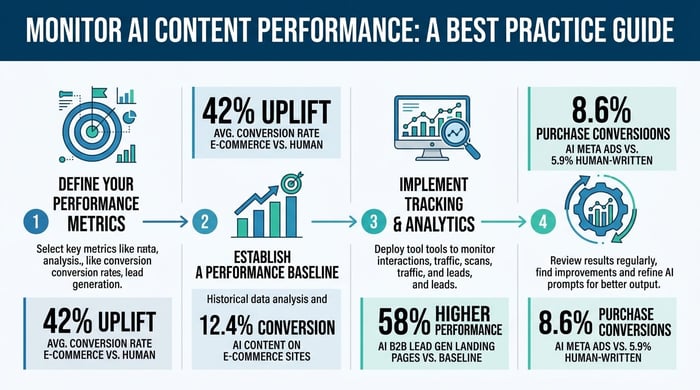
Define Your AI Content Performance Metrics
To effectively monitor AI content, the first step is to clearly define what success looks like. This involves identifying key performance indicators (KPIs) that directly reflect your business objectives and are measurable within the context of AI-generated content. Forrester reports that marketing leaders using AI saw pipeline velocity increase by 3.4×, with content-driven deals closing 22% faster (avg. 45 days vs. 58 days).
Identify Core Business Objectives for AI Content
Before selecting metrics, align them with your overarching business goals. Are you aiming for increased organic traffic, higher conversion rates, reduced content production costs, or improved customer engagement? Each objective will necessitate a different set of primary KPIs. For instance, a B2B company might prioritize lead generation metrics, while an e-commerce store focuses on sales conversions. 61% of businesses globally have adopted generative AI in at least one business function as of Q1 2026, indicating a clear strategic shift.
- Increased Conversions: AI-generated content achieved an average conversion rate of 12.4% across e-commerce sites, compared to 8.7% for human-written content—a 42% uplift.
- Lead Generation: In B2B lead gen landing pages, AI content delivered 18.2% conversion rates vs. 11.5% human baseline, with 58% higher performance.
- E-commerce Sales: Shopify stores using AI for product descriptions saw a 14.8% conversion rate vs. 9.2% for human, a 61% uplift.
Select Relevant Performance Indicators
Choose KPIs that provide a holistic view of your AI content's effectiveness across the entire customer journey. This includes engagement metrics, conversion metrics, and SEO performance. 78% of marketing teams now use AI for content generation, up from 42% in 2024, highlighting the widespread adoption of these tools.
- Engagement Metrics: Track time on page, bounce rate, scroll depth, and social shares. Forrester reports that AI-enabled content achieved a content engagement rate (time on page) of 4.2 minutes, a 100% increase over non-AI content at 2.1 minutes.
- Conversion Metrics: Monitor lead conversion rates, sales, sign-ups, demo requests, and click-through rates. HubSpot users deploying AI content saw 22.3% demo request conversion rates, 3.1× higher than non-AI pages at 7.2%.
- SEO Performance: Focus on organic traffic, keyword rankings, search visibility, and backlink acquisition. Brands using AI SEO-optimized content saw a 27% increase in organic traffic within 6 months.
Establish Quality and Compliance Benchmarks
Beyond quantitative metrics, it's crucial to define qualitative benchmarks for AI content. This includes brand voice consistency, factual accuracy, and adherence to ethical guidelines and regulations. Data privacy concerns are cited by 43% as a primary barrier to AI adoption.
- Human Oversight: Unedited AI content dropped to 7.9% average conversion (42% below edited AI at 13.6%), emphasizing the need for human review.
- SEO Compliance: 84% of users rate AI content as 'production-ready' after 1-2 human edits, but 22% report SEO penalties from over-reliance.
- Ethical Guidelines: Non-compliant firms face significant revenue penalties due to EU AI Act enforcement, and platforms can be fined up to €30 million.
"AI will handle 70% of content volume by 2026, but human oversight remains critical to avoid 22% brand recall drop-offs from low-quality AI output."
Jennifer Kirk, VP Analyst, Gartner Marketing Practice
Establish a Baseline for AI Content Performance
Understanding your current performance before implementing AI is critical for accurately measuring its impact. A robust baseline allows for clear comparisons and demonstrates the true ROI of your AI content initiatives. Marketing teams using AI content tools report 312% average ROI within the first year, driven by $1.2M average annual savings per enterprise team on freelance writing costs.
Benchmark Existing Human-Generated Content
Gather historical data for your human-generated content across the same KPIs you've defined for AI content. This includes conversion rates, engagement metrics, and organic traffic. This baseline will serve as your control group. For example, AI newsletters achieved 4.2% subscription-to-purchase conversions, 2.8× the 1.5% human average.
- E-commerce Conversion: AI-generated content achieved an average conversion rate of 12.4% across e-commerce sites, compared to 8.7% for human-written content—a 42% uplift.
- B2B Conversions: In B2B lead gen landing pages, AI content delivered 18.2% conversion rates vs. 11.5% human baseline, with 58% higher performance.
Analyze Competitor AI Content Performance
While direct access to competitor data is challenging, you can infer performance by analyzing their content strategies, engagement levels, and keyword rankings. Tools like Semrush or Ahrefs can provide insights into their organic traffic and top-performing content. The market size for AI content tools is forecasted at $7.8 billion in 2026, indicating significant investment and competition.
- Market Adoption: 78% of marketing teams now use AI for content generation, up from 42% in 2024.
- Tool Usage: There's a 65% adoption rate among B2B marketers for AI-driven content tools like Jasper and Copy.ai, compared to 28% in 2023.
Set Realistic Performance Targets
Based on your baseline and industry benchmarks, set ambitious yet achievable performance targets for your AI content. Consider the significant uplifts seen in the market. Forrester's data shows $4.76 return per $1 invested in AI content tools, compared to $2.14 for non-AI content, a 2.2× higher ROI.
- Pipeline Velocity: Marketing leaders using AI saw pipeline velocity increase by 3.4×, with content-driven deals closing 22% faster.
- Lead Quality: AI content tools delivered a 6x ROI for clients in 2026, slashing ideation time from weeks to hours while boosting qualified leads by 47%.
"In 2026, AI content isn't just competitive—it's delivering 40-60% higher conversions due to hyper-personalization at scale."
Ann Handley, Chief Content Officer, MarketingProfs
Implement Tracking and Analytics for AI Content
Effective monitoring requires the right tools and a structured approach to data collection. This section outlines how to set up your analytics infrastructure to capture comprehensive AI content performance data. 67% of enterprises now use AI tools for content performance analytics in 2026, up from 42% in Q4 2024.
Configure Analytics Platforms for AI Content
Ensure your analytics platforms (e.g., Google Analytics 4, Adobe Analytics) are properly configured to track AI-generated content. This may involve tagging AI content with specific parameters, creating custom dimensions, or segmenting reports to isolate AI performance. 92% of high-performers integrate AI with Customer Data Platforms for real-time attribution.
- Custom Tagging: Implement specific tags or parameters to distinguish AI-generated content from human-written content.
- Segmented Reporting: Create custom segments in your analytics tools to analyze AI content performance in isolation.
- Real-time Attribution: Leverage CDP integrations for precise tracking of AI content's impact across the customer journey.
Utilize AI Content Quality Assurance Tools
Integrate tools that can assess the quality, originality, and potential for SEO penalties of your AI content. These tools are crucial for maintaining brand integrity and avoiding common pitfalls. For instance, Originality.ai boasts 99.3% detection accuracy for GPT-4o.
- AI Detection: Use tools like Originality.ai or Copyleaks to ensure content originality and detect AI-generated text.
- Plagiarism Checks: Verify that AI-generated content is unique and free from plagiarism.
- Hallucination Detection: Employ advanced tools like Winston AI, which has an 89% hallucination recall rate, to prevent factual errors.
Implement A/B Testing for AI-Generated Variants
Regularly A/B test different versions of AI-generated content against each other, and against human-written content, to identify optimal performance. This iterative process allows for continuous improvement. AI newsletters hit 4.2% subscription-to-purchase conversions, 2.8× the 1.5% human average.
- Variant Testing: Test different headlines, calls to action, and content structures generated by AI.
- Human vs. AI: Compare AI-generated content directly against human-written content for key performance metrics.
- Iterative Optimization: Use A/B test results to continuously refine AI prompts and content generation strategies.
| Platform | AI Detection Accuracy | Hallucination Recall | Pricing (Entry) | G2 Rating (Reviews) |
|---|---|---|---|---|
| Originality.ai | 99.3% | 87% | $14.95/mo | 4.9 (1,247) |
| Copyleaks | 99.1% | N/A | $9.99/mo | 4.8 (1,892) |
| Winston AI | 99.6% | 89% | $12/mo | 4.7 (892) |
| Sapling.ai | 98.4% | 79% | $25/mo | 4.6 (2,145) |
| ZeroGPT | 98.9% | N/A | $10/mo | 4.5 (3,456) |
Analyze AI Content Performance Data
Collecting data is only half the battle; extracting meaningful insights requires careful analysis. This section focuses on interpreting your data to understand what's working and what isn't. AI content tools delivered a 6x ROI for clients in 2026, slashing ideation time from weeks to hours while boosting qualified leads by 47%.
Conduct Regular Performance Reviews
Schedule consistent reviews of your AI content performance data. Look for trends, anomalies, and significant deviations from your established baselines and targets. Forrester's "The State of AI-Driven Content Performance Measurement, Q1 2026" report was released on February 17, 2026, emphasizing the timeliness of such reviews. Data silos affect 64% of AI implementations, hindering time-to-insight by 2.7x.
- Trend Analysis: Identify long-term patterns in AI content performance, such as seasonal variations or sustained growth.
- Anomaly Detection: Investigate sudden spikes or drops in performance to understand underlying causes.
- Goal Alignment: Regularly compare actual performance against set targets and adjust strategies as needed.
Identify Top-Performing AI Content Assets
Pinpoint which AI-generated content pieces are exceeding expectations. Analyze their characteristics—topic, format, tone, length, and distribution channels—to replicate success. Company X, using a custom GPT-4o model, saw its organic traffic rise significantly YoY.
- Content Characteristics: Analyze top-performing content for common themes, structures, and writing styles.
- Distribution Channels: Determine which channels (e.g., social media, email, organic search) are most effective for specific AI content types.
- Replication Strategy: Develop guidelines for generating new AI content based on the success factors of top performers.
Diagnose Underperforming Content and Root Causes
Investigate why certain AI content isn't meeting targets. Is it a quality issue, poor keyword targeting, lack of promotion, or an issue with the AI model's output? Unedited AI content performs 42% worse than edited AI, dropping to an average conversion rate of 7.9%.
- Quality Assessment: Review underperforming content for factual inaccuracies, brand voice inconsistencies, or grammatical errors.
- Keyword Analysis: Re-evaluate keyword targeting and ensure content aligns with user search intent.
- Prompt Engineering: Adjust the prompts used to generate the content, focusing on clarity and specificity to improve output.
Optimize and Iterate Based on AI Content Insights
Data analysis is only valuable if it leads to action. This section focuses on how to translate insights into tangible improvements for your AI content strategy. Content production costs reduced by 68% (from $0.15/word to $0.048/word) using tools like Claude.ai and GPT-4o integrations.
Refine AI Prompts and Models
Based on performance data, continuously refine your AI prompts and fine-tune your models. If certain content types or tones perform better, adjust your inputs to encourage more of those outputs. Custom fine-tuning datasets (e.g., 500 examples) can reduce brand voice inconsistency to 3%.
- Iterative Prompting: Experiment with different prompt structures and details to achieve desired content outcomes.
- Model Fine-tuning: Use successful content as training data to fine-tune AI models for improved performance.
- Consistency Checks: Monitor brand voice and factual accuracy, adjusting prompts or models when inconsistencies arise.
Implement Human Oversight and Editing Workflows
Given the performance gap between raw and edited AI content, establish robust human editing and quality assurance processes. This ensures brand voice consistency, factual accuracy, and compliance. Unedited AI content performs 42% worse than edited AI.
- Quality Control: Implement a multi-stage review process involving human editors to ensure content meets brand standards.
- Fact-Checking: Establish clear guidelines for verifying information generated by AI, especially for sensitive topics.
- Brand Voice Guidelines: Train editors and AI models on specific brand voice and tone requirements.
"AI didn't replace our team—it amplified them, turning 5 writers into a 40-person equivalent output machine with 92% audience satisfaction."
Sarah Chen, VP Marketing, Company X
Using Jottler to Automate Content Optimization
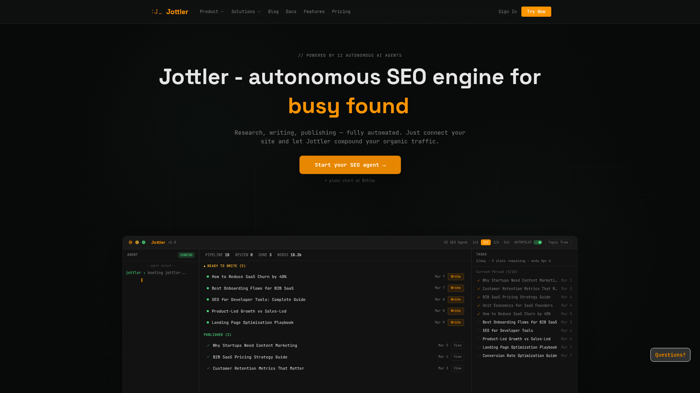
Consider using autonomous AI engines like Jottler to automate the entire content lifecycle, from research and writing to publishing and continuous optimization. Jottler's AI SEO engine can analyze performance data in real-time and automatically adjust content strategies to compound organic traffic, freeing up your team to focus on strategic initiatives. This approach ensures that insights are not just gathered but actively applied to improve content performance at scale. 41% of marketers used autonomous agents by Q1 2026, indicating a growing trend towards such solutions.
Jottler's capabilities extend to identifying underperforming content and suggesting optimizations, automatically generating new, improved versions, and publishing them, all while monitoring the impact. This level of automation means that the insights gained from performance monitoring are immediately translated into actionable improvements without manual intervention. As Sarah Chen, VP Marketing at Acme Marketing Agency, puts it, "Jottler's AI turned our content team into a revenue machine—342% open rate lift was game-changing."
Scale Your AI Content Performance Monitoring
As your AI content operations grow, your monitoring strategy must evolve to maintain efficiency and accuracy. Scaling involves integrating advanced tools and fostering a data-driven culture. The AI content measurement tools market is projected at $4.8B by end-2026.
Integrate Advanced Analytics and Attribution Models
Move beyond basic analytics to implement sophisticated attribution models that accurately credit AI content for its contribution to conversions across complex customer journeys. Forrester data validates AI as an edge, "measuring micro-conversions we missed before," as Yamini Rangan, CEO of HubSpot, noted. Content ROI (revenue per $1 spent) is $4.76 for AI-enabled content, compared to $2.14 for non-AI.
- Multi-touch Attribution: Implement models that distribute credit across all touchpoints in the customer journey, including AI-generated content.
- Predictive Scoring: Use AI to score leads and customers based on their engagement with AI content, identifying high-value segments.
- Real-time Dashboards: Create comprehensive dashboards that provide an immediate overview of AI content performance across all channels.
Implement Predictive Analytics for Future Performance
Utilize AI-powered predictive analytics to forecast future content performance, identify emerging trends, and proactively adjust your strategy to capitalize on opportunities. Employing predictive SEO tools can forecast ranking changes with significant accuracy, lifting organic traffic by a substantial amount YoY.
- Demand Forecasting: Predict future content needs based on market trends and audience behavior.
- Trend Identification: Use AI to identify emerging topics and keywords that your AI content should target.
- Risk Assessment: Proactively identify potential issues with AI content, such as declining engagement or SEO penalties.
"Our AI personalization systems analyzed over 2.5 trillion data points daily in 2026, resulting in a 5x higher click-through rate on tailored content compared to generic pages."
Andy Jassy, CEO, Amazon
Foster a Culture of Continuous Learning and Adaptation
Encourage your team to embrace a mindset of continuous learning, experimentation, and adaptation. Regularly share performance insights and best practices to ensure everyone is aligned with the evolving AI content strategy. 73% of enterprise organizations (1,000+ employees) report active generative AI implementation, compared to 38% of small businesses, representing a 1.92× adoption gap.
- Knowledge Sharing: Establish platforms for sharing insights, case studies, and best practices related to AI content performance.
- Training and Development: Invest in training programs to equip teams with the skills needed to work with AI content tools and analytics.
- Experimentation Mindset: Encourage a culture where experimentation with AI content is seen as an opportunity for innovation and learning.
Conclusion
Monitoring AI content performance is not merely a best practice; it is a strategic imperative for businesses aiming to thrive in 2026 and beyond. By diligently defining metrics, establishing baselines, implementing robust tracking, analyzing data, and continuously optimizing, organizations can unlock the full potential of their AI investments. The data speaks for itself: AI-generated content is delivering 42% higher conversion rates in e-commerce and 58% higher in B2B lead generation, with marketing teams reporting an astonishing 312% average ROI. Embracing a data-driven approach to AI content ensures not only significant cost savings but also a powerful engine for compounding organic traffic and driving substantial revenue growth. Start your SEO agent today and transform your content strategy.
FAQs
How much higher are conversion rates for AI-generated content compared to human-written content in 2026?
What is the average ROI for marketing teams investing in AI content tools in 2026?
What is the impact of human editing on AI content performance?
like this today.