
Monitor Autonomous Content Performance: Best Tips
 Aidan Buckley
SEO
Aidan Buckley
SEO
March 16th, 2026
15 minute read
Table of Contents
- Step 1: Define Clear Performance Metrics for Autonomous Content
- Step 2: Implement Real-time Monitoring Dashboards
- Step 3: Leverage AI for Anomaly Detection and Predictive Analytics
- Step 4: Integrate Performance Data Across Your Content Stack
- Step 5: Optimize Content Distribution and Syndication
- Step 6: Continuously Refine AI Models and Content Strategies
- Step 7: Utilize an Autonomous AI SEO Engine for Holistic Performance
- Step 8: Conduct Regular A/B Testing and Experimentation
- Conclusion
The landscape of content creation is undergoing a seismic shift, with autonomous AI playing an increasingly central role. By 2026, the AI content creation and optimization software market is projected to reach USD 2.3 billion, fundamentally reshaping how businesses generate and manage their digital presence. For busy businesses, SaaS companies, e-commerce stores, and publishers alike, the promise of AI-driven efficiency is immense. However, the true value of autonomous content isn't just in its creation, but in its performance. Without robust monitoring, businesses risk pouring resources into content that fails to deliver, potentially losing out on significant ROI—AI content generation delivers 25–45% higher ROI than traditional methods with clean data. This article outlines the essential strategies for effectively monitoring autonomous content performance, ensuring your AI-powered efforts translate into tangible business growth.
- Define Performance Metrics: Establish clear, AI-centric metrics beyond traditional SEO, focusing on AI visibility and business impact.
- Real-time Monitoring: Implement centralized dashboards and automated alerts for immediate insights into content performance.
- AI for Analytics: Leverage AI for advanced anomaly detection and predictive forecasting to anticipate and address issues proactively.
- Integrated Data: Connect performance data across your entire content stack for a unified view and automated feedback loops.
- Optimize Distribution: Strategically distribute and syndicate content for maximum AI visibility across dominant channels.
- Continuous Refinement: Regularly retrain AI models, A/B test content variations, and adapt to evolving AI search algorithms.
- Autonomous AI SEO Engine: Utilize a solution like Jottler for automated content creation, integrated monitoring, and continuous learning.
- A/B Testing & Experimentation: Conduct regular tests on AI-generated content variations and distribution channels to validate strategies.
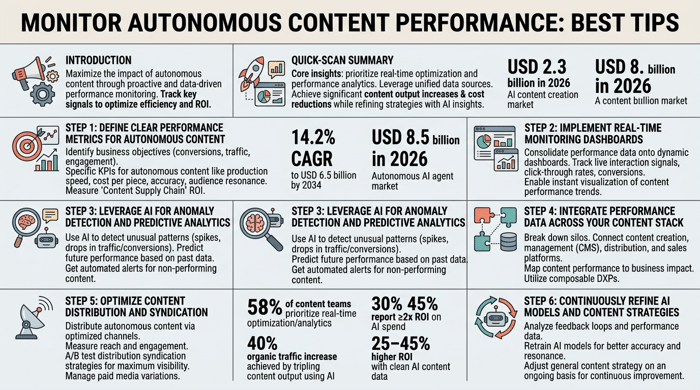
Step 1: Define Clear Performance Metrics for Autonomous Content
The shift to autonomous content demands a re-evaluation of what constitutes "performance." Traditional metrics are no longer sufficient in a world dominated by AI overviews and zero-click experiences. Businesses must establish a comprehensive set of metrics that reflect the unique ways AI-generated content interacts with audiences and search algorithms. 58% of content teams prioritize real-time optimization and performance analytics in their 2024 tech roadmaps.
1.1 Beyond Traditional SEO: AI Visibility & Engagement
Focus on metrics that capture how your content performs within AI-driven search environments. This includes tracking prompt-level visibility, citation analysis, and share-of-voice across multi-LLM platforms like ChatGPT, Gemini, and Google AI Overviews. Rand Fishkin deems traditional rank tracking "full baloney" due to unreliability in the AI search era. Instead, prioritize metrics like total impressions, average position in AI summaries, brand searches, featured snippet appearances, and mentions within AI results. Zero-click experiences will dominate online journeys in 2026, with AI summaries driving significantly more content consumption than long-form pages.
1.2 Quantifying Business Impact: ROI and Conversions
Ultimately, autonomous content must drive business outcomes. Track ROI metrics specific to AI content generation, which can deliver 25–45% higher ROI than traditional methods. Monitor sales conversions, lead generation (MQLs/SQLs), and engagement rates (e.g., time on page, bounce rate, interaction with AI-powered features like chatbots or recommendation engines). For instance, AI personalization boosts sales conversions and engagement by 20–30%. A B2B SaaS marketing team tripled content output from 4 to 12 articles/month using AI, achieving a 40% organic traffic increase over 6 months.
1.3 Ethical AI & Compliance Metrics
With increasing regulations, monitoring ethical AI performance is crucial. Track compliance with AI content labeling requirements, provenance tracking, and adherence to new laws like the Federal Take It Down Act (effective May 19, 2026) or the EU AI Act (transparency rules apply by August 2, 2026). This includes monitoring for inaccurate or misleading AI outputs, which 89% of data and analytics leaders with AI in production report experiencing.
"Technological capability does not equal economic inevitability."
Ann Handley, Chief Content Officer, MarketingProfs
Step 2: Implement Real-time Monitoring Dashboards
In the fast-paced world of autonomous content, delayed insights are missed opportunities. Real-time monitoring dashboards are essential for busy businesses to quickly identify trends, anomalies, and performance shifts. The AI content creation and optimization software market is projected to reach USD 2.3 billion in 2026, underscoring the rapid adoption of tools enabling such monitoring.
2.1 Centralized Data Visualization
Consolidate data from various sources—SEO tools, analytics platforms, social media, and internal CRM—into a single, intuitive dashboard. This provides a holistic view of content performance. 58% of content teams prioritize real-time optimization and performance analytics in their 2024 tech roadmaps, highlighting the urgency of this approach. This centralization is key to understanding the full impact of AI-generated content.
2.2 Customizable Alerts and Notifications
Set up automated alerts for significant changes in key metrics, such as sudden drops in AI visibility, spikes in negative sentiment, or unexpected traffic shifts. This allows teams to react proactively. For example, if an AI-generated article suddenly loses its featured snippet position, an alert can trigger an immediate investigation. This proactive stance is critical in maintaining competitive advantage, as 62% of organizations are piloting AI in 2026.
2.3 Granular vs. High-Level Views
Dashboards should offer both high-level overviews for executives and granular drill-down capabilities for content managers and SEO specialists. This ensures that everyone, from strategic decision-makers to operational teams, has access to the insights they need. This dual-level reporting helps translate complex data into actionable strategies, supporting the significantly high percentage of large marketing teams already using AI for content.
Step 3: Leverage AI for Anomaly Detection and Predictive Analytics
Autonomous content monitoring should be powered by AI itself. AI-driven anomaly detection and predictive analytics move beyond reactive reporting to proactive insight generation, helping businesses anticipate and address issues before they escalate. The autonomous AI agent market is estimated at USD 8.5 billion in 2026, indicating the growing reliance on such intelligent systems.
3.1 Automated Anomaly Detection
Implement AI systems that continuously scan performance data for unusual patterns or deviations from expected behavior. This can identify issues like sudden drops in engagement, unexpected keyword cannibalization from new AI content, or shifts in audience sentiment. These systems should be able to detect emerging content performance issues in real time, enabling alerts within hours or days of a trend developing. This is crucial given that 89% of data and analytics leaders with AI in production report experiencing inaccurate or misleading AI outputs.
3.2 Predictive Performance Forecasting
Utilize AI to forecast future content performance based on historical data and current trends. This helps in strategic planning, identifying content gaps, and optimizing content calendars. For instance, predictive analytics can suggest which topics are likely to gain traction in AI search based on emerging queries and competitor activity. "Future tools will focus on usability and enabling non-technical users to make predictions based on their data," highlighting the shift towards more accessible AI tools.
3.3 Sentiment Analysis for Brand Perception
Deploy AI-powered sentiment analysis tools to monitor how autonomous content is perceived across various platforms. This is critical for maintaining brand reputation and quickly addressing any negative feedback or misinformation generated by AI. As 63% of marketers used generative AI as a co-pilot by 2025, understanding public sentiment towards AI-generated content becomes paramount.
Step 4: Integrate Performance Data Across Your Content Stack
Siloed data hinders effective monitoring. Integrating performance data across your entire content stack—from CMS to analytics to CRM—creates a unified view and enables more intelligent automation. By 2026, a significant percentage of businesses will use composable DXPs instead of monolithic suites, emphasizing the need for integrated systems.
4.1 Unified Content Operations
Connect your AI content creation and optimization software platforms with your analytics tools, headless CMS, and distribution channels. This allows for seamless data flow, enabling a comprehensive understanding of how content is created, published, and consumed. The headless CMS market is projected to grow from $3.94 billion in 2026 to $22.28 billion by 2034, indicating significant investment in these flexible architectures.
4.2 Automated Feedback Loops
Establish automated feedback loops where performance data directly informs content creation and optimization. For example, if an AI-generated article underperforms on a specific metric, the system can automatically flag it for revision or generate alternative content variations. This iterative process is vital for continuous improvement, especially as 94% of B2B marketers plan to use AI for content creation.
4.3 Tool Consolidation for Observability
Prioritize tool consolidation to achieve unified performance data. 84% of IT leaders are pursuing tool consolidation for unified performance data, recognizing the benefits of a streamlined tech stack. This reduces complexity and improves data accuracy, aligning with the trend of 96% of IT leaders expecting observability spending to hold steady or grow in 2026.
| Metric | AI Content Generation Benchmark | Context |
|---|---|---|
| ROI Uplift | 25–45% higher vs. traditional | With clean data; 20–30% from personalization |
| Content Volume | 3x increase (4 to 12 articles/month) | B2B SaaS, same team size |
| Traffic Growth | 40% over 6 months | Organic from AI workflow |
| Cost per Article | $180 (AI + edit) vs. $800 agency | B2B SaaS |
| ROAS Improvement | 15–30% in 60 days | Ad copy variations |
| Production Time | 30% reduction | Creative processes |
| Cost Savings | 40% on concepts; 25–35% operational | Automation |
| Investment Return | 60% of teams report ≥2x on AI spend | Marketing teams tracking ROI |
Step 5: Optimize Content Distribution and Syndication
Monitoring autonomous content performance extends beyond your owned properties. How your content is distributed and syndicated, especially in AI-driven environments, significantly impacts its reach and effectiveness. Google processes over 5 trillion searches yearly, with a notable percentage featuring AI overviews, highlighting the shift in how content is consumed.
5.1 AI-First Distribution Channels
Focus on optimizing content for distribution channels where AI plays a dominant role, such as Google AI Overviews, generative AI chatbots, and personalized content recommendation engines. Ensure your content is structured and tagged in a way that makes it easily discoverable and digestible by AI. For example, Adobe was recognized by Gartner for its personalization engines in 2026, showcasing the importance of intelligent distribution.
5.2 Strategic Syndication for AI Visibility
Identify strategic syndication partners and platforms that can amplify your autonomous content's reach and improve its AI visibility. This could include industry-specific news aggregators, content marketplaces, or platforms known for strong AI integration. As zero-click experiences will dominate online journeys in 2026, strategic syndication can help ensure your content still gains traction even without direct clicks.
5.3 Performance Tracking Across External Platforms
Implement tracking mechanisms to monitor the performance of your autonomous content on external platforms. This includes engagement metrics, referral traffic, and mentions within AI summaries or responses generated by third-party AI systems. This is crucial because "perfect digital attribution is collapsing" due to privacy changes, walled gardens, and platform overreporting, necessitating a broader view of performance.
Step 6: Continuously Refine AI Models and Content Strategies
Autonomous content is not a "set it and forget it" endeavor. Continuous refinement of your underlying AI models and content strategies, driven by performance data, is crucial for sustained success. Organizations adopting holistic AI for content supply chains report 22% higher ROI on development and 30% on GenAI integration.
6.1 Data-Driven Model Training
Use performance data to retrain and fine-tune your AI content generation models. For example, if certain content types consistently underperform, analyze the data to understand why and adjust the AI's parameters or training data accordingly. This iterative process ensures the AI learns and improves over time, supporting the 60% of marketing teams that report a return of ≥2x on their AI spend.
6.2 A/B Testing for AI-Generated Content
Conduct regular A/B tests on different versions of AI-generated content, headlines, or calls-to-action. This helps identify what resonates best with your audience and performs optimally in AI search environments. For example, test two AI-generated article variations to see which achieves higher engagement or AI visibility. This proactive testing is more effective than traditional rank tracking, which Rand Fishkin deems "full baloney" due to its unreliability.
6.3 Adapting to AI Search Algorithm Changes
Stay abreast of changes in AI search algorithms and adapt your content strategies accordingly. As zero-click experiences dominate online journeys in 2026, with AI summaries driving significantly more content consumption than long-form pages, your strategy must evolve to capture this new form of engagement. This requires constant vigilance and adjustment, as highlighted by Ann Handley's emphasis on "the slower, deeper work of thinking" beyond just faster content creation.
Step 7: Utilize an Autonomous AI SEO Engine for Holistic Performance
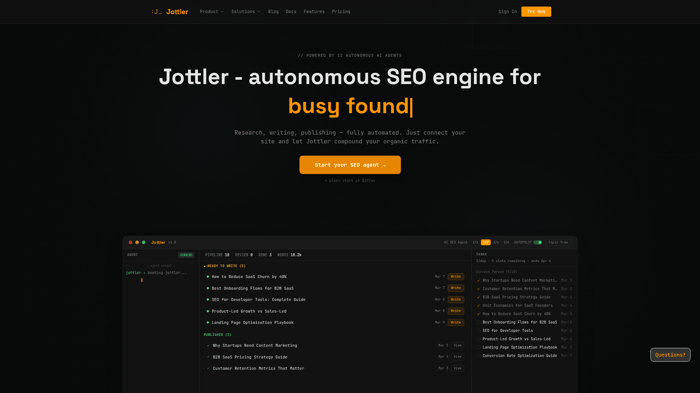
For busy businesses seeking a comprehensive solution, an autonomous AI SEO engine like Jottler provides a holistic approach to monitoring and improving content performance. Jottler automates the entire content lifecycle, from research to publishing, with built-in performance monitoring.
7.1 Automated Content Research and Generation with Jottler
Jottler's core strength lies in automating content research and writing. This means your content is generated with SEO best practices in mind from the outset, based on real-time data. This automation can triple content output, as seen in a B2B SaaS marketing team case where output increased from 4 to 12 articles/month, achieving a 40% organic traffic increase over 6 months and reducing cost per article from $800 to $180. This efficiency allows businesses to scale their content efforts without significant manual overhead.
7.2 Integrated Performance Monitoring and Optimization with Jottler
Jottler provides integrated dashboards that track key performance indicators relevant to autonomous content, including AI visibility, organic traffic, engagement, and conversions. It leverages AI to analyze these metrics and offer actionable insights for optimization. This eliminates the need for disparate tools and provides a unified view of your content's health, aligning with the 84% of IT leaders pursuing tool consolidation for unified performance data.
7.3 Continuous Learning and Adaptation through Jottler
As an autonomous AI agent market solution, Jottler continuously learns from your content's performance data. It automatically refines its content generation strategies, adapts to algorithm changes, and identifies new opportunities for organic growth, ensuring your content remains competitive and effective without constant manual intervention. This adaptability is crucial in a landscape where AI search benchmarks are constantly evolving, and the autonomous AI agent market is estimated at USD 8.5 billion in 2026.
Step 8: Conduct Regular A/B Testing and Experimentation
In the dynamic world of autonomous content, assumptions can be costly. Regular A/B testing and experimentation are vital for validating strategies, optimizing performance, and uncovering new opportunities. This iterative approach is key to achieving the 25–45% higher ROI that AI content generation can deliver.
8.1 Test AI-Generated Content Variations
Beyond simple headlines, A/B test different structures, lengths, tones, and calls-to-action within your AI-generated content. For example, test whether a more conversational AI tone leads to higher engagement than a formal one, or if a longer AI summary performs better in Google AI Overviews. Marketers using Jasper, an AI content creation platform, created significantly more content, providing ample material for such testing.
8.2 Experiment with Distribution Channels
Don't assume all distribution channels yield the same results for autonomous content. Experiment with different syndication partners, social media platforms, and even novel AI-powered content delivery methods to see where your content gains the most traction and ROI. This proactive experimentation helps businesses adapt to the fact that zero-click experiences will dominate online journeys in 2026.
8.3 Measure Impact on Zero-Click Metrics
As zero-click experiences become more prevalent, design experiments specifically to measure their impact. Test how different content formats or summaries perform in AI search results, focusing on metrics like impressions, AI result mentions, and brand searches, rather than just organic clicks. Original data and statistics now drive disproportionate traffic from AI sources: articles based around original data or stats accounted for 50% of clicks from AI sources, compared to 5% of clicks from organic search.
"Efficiency is only the first chapter of the AI marketing story – not the ending. Actually, maybe it’s the prologue. AI is like giving every marketer a turbo-charged typewriter. Hooray! We can all crank out words faster. But the bigger prize is what we do with the time saved: the slower, deeper work of thinking."
Ann Handley, Chief Content Officer, MarketingProfs
Conclusion
Monitoring autonomous content performance in 2026 is no longer an option but a necessity for businesses aiming to thrive in an AI-first digital landscape. By defining clear, AI-centric metrics, implementing real-time dashboards, leveraging advanced AI for insights, and integrating data across your tech stack, you can transform raw data into actionable intelligence. The strategic adoption of solutions like Jottler, an AI content generation engine, further streamlines this process, automating both creation and optimization. Businesses that embrace these strategies can expect significant returns, with AI content generation delivering 25–45% higher ROI and AI personalization boosting sales conversions by 20–30%. The future of content is autonomous, and effective monitoring is the key to unlocking its full compounding organic traffic potential.
FAQs
What is the projected market size for AI content creation and optimization software in 2026?
How much ROI can businesses expect from AI content generation in 2026?
How is AI changing search engine optimization (SEO) in 2026?
like this today.