
Pick the Right Autonomous Content Platform for You
 Aidan Buckley
SEO
Aidan Buckley
SEO
March 19th, 2026
14 minute read
Table of Contents
In the rapidly evolving digital landscape of 2026, businesses face unprecedented pressure to produce high-quality, SEO-optimized content at scale. The digital content creation platform market is projected to reach USD 5.65 billion in 2026, with the generative AI in content creation market soaring to USD 24.08 billion in the same year. Yet, the sheer volume and complexity of content demands can overwhelm even the most dedicated teams, leading to missed opportunities, stagnant organic growth, and significant operational costs. Businesses that fail to adapt risk falling behind competitors who are leveraging AI to achieve significantly more content at a significantly lower cost per article. This guide will navigate the intricate world of autonomous content platforms, providing a strategic roadmap for busy businesses, SaaS companies, e-commerce stores, and more, to identify and implement the ideal solution that drives compounded organic traffic and measurable ROI.
- Understanding Autonomous Content Platforms: Define what these platforms are and their market context.
- Key Features to Look For in an Autonomous Content Platform: Essential functionalities for content automation and optimization.
- Assessing Your Content Needs and Goals: Aligning platform capabilities with specific business objectives.
- Evaluating Platform Integrations and Scalability: Ensuring seamless operation within existing tech stacks.
- Considering Cost and ROI: Analyzing financial implications and expected returns.
- Implementation and Support: Planning for successful adoption and ongoing assistance.
Understanding Autonomous Content Platforms
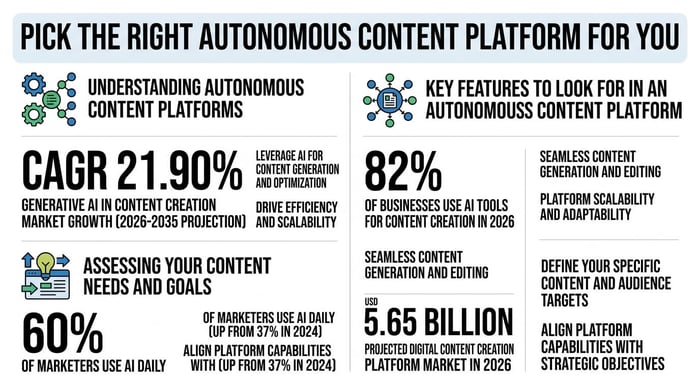
Autonomous content platforms represent the next frontier in digital marketing, leveraging artificial intelligence and automation to streamline the entire content lifecycle—from research and creation to optimization and publishing. These platforms are designed to reduce manual effort, accelerate content velocity, and enhance SEO performance, allowing businesses to scale their content operations efficiently. The digital content creation platform market is projected to reach USD 5.65 billion in 2026, growing from USD 5.15 billion in 2025 at a CAGR of 9.7% through 2034.
The Rise of AI in Content Creation
The market for AI-powered content creation is experiencing explosive growth. The generative AI in content creation market is projected to reach USD 24.08 billion in 2026, growing from USD 19.75 billion in 2025 at a CAGR of 21.90% from 2026-2035. This surge is driven by the undeniable efficiency gains AI offers. Businesses using AI tools for content creation report 59% faster content creation and 77% higher output volume. This shift is not merely about speed; it's about strategic advantage.
"AI's value isn't just in producing more content faster, but in accelerating... testing, learning, and iteration."
Cathy, CMO, unnamed
Defining Autonomy in Content Workflows
True autonomous content platforms go beyond simple AI writing assistants. They integrate multiple AI capabilities to handle complex tasks with minimal human intervention. This includes automated keyword research, content generation, SEO optimization (meta descriptions, schema), internal linking, and even direct publishing to a CMS. The goal is to create a self-sustaining content engine that continuously drives organic traffic. The digital content creation platform market is projected to reach USD 5.65 billion in 2026, growing from USD 5.15 billion in 2025 at a CAGR of 9.7% through 2034. This market growth underscores the increasing demand for end-to-end content solutions.
Key Takeaways:
- Autonomous platforms automate the full content lifecycle.
- AI adoption is rapidly accelerating across industries.
- The market for AI-powered content creation is expanding significantly.
Key Features to Look For in an Autonomous Content Platform
Selecting the right platform requires a deep dive into its core functionalities. The most effective autonomous content platforms offer a comprehensive suite of features that address every stage of the content journey. For instance, Averi AI, an end-to-end content engine, covers strategy, generation, publishing, and analytics, with optional human review, demonstrating the breadth of modern platform capabilities.
Advanced AI Content Generation and Optimization
Look for platforms that offer sophisticated AI models capable of generating high-quality, long-form content that is both engaging and SEO-optimized. This includes features like:
- Daily Long-Form Articles: The ability to consistently produce extensive content.
- AI Keyword Research: Automated identification of high-intent keywords.
- Deep Research with Fact-Checking: Ensuring accuracy and credibility from 14+ sources.
- Smart Internal Linking: Automatically connecting related content for improved SEO and user experience.
- SEO Meta/FAQ Schema: Automated generation of metadata and structured data for better search visibility.
- AI-Generated Featured Images: Creation of relevant visuals to accompany content.
How Jottler Approaches Autonomous Content Generation
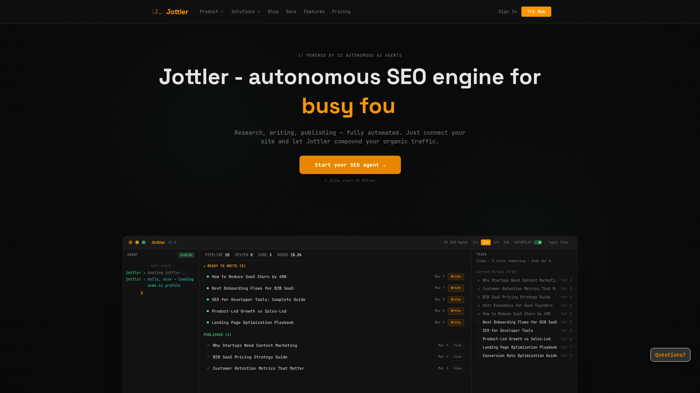
Jottler exemplifies a platform offering comprehensive features for autonomous content generation. It specializes in producing daily long-form articles, typically 3,000+ words, a crucial aspect for deep topical authority. The platform integrates advanced AI keyword research and topic clustering, ensuring content targets high-value search queries. Furthermore, Jottler's deep research capabilities, drawing from over 14 sources with built-in fact-checking, address the critical need for accuracy and credibility in AI-generated content. It also automates smart internal linking, SEO meta/FAQ schema generation, and even AI-generated featured images, significantly reducing manual effort for content teams.
A key differentiator for Jottler is its automatic CMS publishing feature, supporting popular platforms like WordPress, Webflow, and Shopify. This end-to-end automation allows businesses to connect their website and set their desired article frequency, letting Jottler's 12 AI agents handle the entire content lifecycle from research to publishing. This approach helps businesses use AI tools for content creation to compound organic traffic without extensive manual intervention, aligning with the trend of AI enabling significantly more content at a significantly lower cost per article.
Seamless Publishing and Workflow Automation
An autonomous platform should integrate effortlessly with your existing content management system (CMS) and marketing tools. The headless CMS sector is projected at $3.94 billion in 2026, growing to $22.28 billion by 2034, indicating a strong trend towards decoupled content architectures that autonomous platforms can leverage.
- Automatic CMS Publishing: Direct publishing capabilities to platforms like WordPress, Shopify, or custom CMS.
- Workflow Automation: Features that automate content approval processes, scheduling, and distribution.
- Content Calendar Management: Tools to plan, track, and manage content production at scale.
Performance Tracking and Analytics
The ability to measure the impact of your autonomous content is crucial for continuous improvement. Businesses using AI writing tools report 47% better conversion rates, highlighting the importance of data-driven insights.
- Organic Traffic Monitoring: Tracking keyword rankings, impressions, and clicks.
- Conversion Tracking: Measuring how content contributes to leads, sales, or other business goals.
- ROI Reporting: Providing clear insights into the financial return of your content investment.
Checklist for Features:
- AI-powered long-form content generation
- Automated keyword research
- Fact-checking capabilities
- Smart internal linking
- SEO meta and FAQ schema generation
- AI-generated visuals
- Direct CMS publishing
- Workflow automation and approval
- Integrated performance analytics
Assessing Your Content Needs and Goals
Before diving into platform specifics, a clear understanding of your organization's unique content requirements and strategic objectives is paramount. This foundational step ensures that the chosen platform aligns perfectly with your business model and growth aspirations. AI allows for significantly more content at significantly lower cost per article, making it critical to define what kind of content you need to scale.
Identifying Your Target Audience and Content Volume
Different businesses have varying content needs. A local business might prioritize hyper-local SEO content, while a SaaS company might focus on in-depth guides and comparison pages. Consider the volume of content you aim to produce. AI allows for significantly more content at significantly lower cost per article. This means scaling from dozens to hundreds or even thousands of articles per month is now feasible.
- Busy Businesses & Local Businesses: May need high volumes of localized, informational content.
- SaaS Companies & Developer Tool Companies: Require detailed technical articles, use cases, and solution-oriented content.
- E-commerce Stores & Marketplaces: Benefit from product descriptions, category pages, and buying guides.
- Affiliate Marketers & Publishers: Need consistent, high-quality reviews, comparisons, and informational articles.
Defining Your SEO and Business Objectives
What do you want your content to achieve? Organic search drives 44.6% of B2B revenue, making clear objectives essential for any content strategy.
- Organic Traffic Growth: A SaaS company achieved 6x organic traffic growth (from 1,000 to 6,000 monthly visitors) starting in August 2024, yielding an estimated R240,000/month in traffic value by leveraging AI content.
- Lead Generation: Long-form content (2,000+ words) generates 56% more leads.
- Conversion Rate Optimization: Comparison pages convert 3.2x higher than feature pages. Businesses using AI tools for content creation report 47% better conversion rates.
- Brand Authority: Establishing your business as a thought leader in your niche.
"Growth comes from AI when it helps us better understand our customers."
Michael, CMO, unnamed
Budget and Resource Allocation
Autonomous content platforms offer significant cost savings. Businesses using AI writing tools report 42% lower production costs. However, initial investment and ongoing subscription costs vary widely.
- AI-assisted article costs in 2026 are estimated at $50–$150 for general AI, and 75-85% lower for advanced engines (implying ~$12.50–$37.50).
- Consider the internal resources (human oversight, strategists) still required, even with automation.
Key Takeaways:
- Tailor platform selection to your specific audience and content volume needs.
- Clearly define measurable SEO and business objectives.
- Evaluate the platform's cost-effectiveness against your budget and potential ROI.
Evaluating Platform Integrations and Scalability
A truly effective autonomous content platform doesn't operate in isolation. Its ability to integrate seamlessly with your existing technology stack and scale with your business growth is critical for long-term success. The autonomous data platform market is projected to reach USD 2.60 billion in 2026, growing at a CAGR of 20.72%, underscoring the importance of robust data integration.
Integration with Existing Tech Stack
Your content platform should be a central hub, not an isolated silo. The headless CMS sector is projected at $3.94 billion in 2026, indicating a strong trend towards decoupled content architectures that autonomous platforms can leverage.
- CMS Integration: Direct publishing to your CMS (WordPress, Shopify, custom solutions) is essential to avoid manual transfers.
- CRM and Marketing Automation: Integration with CRM (e.g., Salesforce, HubSpot) allows for personalized content delivery and lead nurturing.
- Analytics Tools: Connecting with Google Analytics, Search Console, or other SEO tools provides a holistic view of content performance.
- API Access: For bespoke integrations and advanced customization, robust API documentation is a major plus.
Scalability for Future Growth
As your business expands, your content needs will too. The platform must be able to handle increased volume and complexity. 70% of businesses are adopting composable DXPs by 2026, highlighting the demand for flexible and scalable solutions.
- Content Volume: Can the platform generate hundreds or thousands of articles per month without performance degradation?
- Team Collaboration: Features for multiple users, roles, and approval workflows are important for growing teams.
- Multi-Language Support: If international expansion is on your roadmap, check for multi-language content generation and optimization capabilities.
- Composable Architecture: Platforms built on composable principles (like headless CMS) offer greater flexibility and future-proofing.
"To scale personalization, marketers need to move beyond channel-by-channel execution and toward platforms that orchestrate customer journeys across channels."
Ryan Nelsen, CMO at StackAdapt
Data Security and Compliance
With increasing AI regulations, data security and compliance are non-negotiable. By 2026, 47 countries will enact AI advertising regulations, making compliance a critical factor.
- Data Privacy: Ensure the platform adheres to regulations like GDPR, CCPA, and upcoming AI-specific laws.
- IP Protection: Understand how the platform handles intellectual property generated by AI.
- Ethical AI Use: Verify the platform's commitment to ethical AI practices, including bias mitigation and transparency.
Checklist for Integrations & Scalability:
- Direct CMS integration
- CRM/Marketing automation integration
- Analytics platform connectivity
- Robust API for custom integrations
- High content volume capacity
- Multi-user and role management
- Multi-language content support
- Adherence to data privacy and IP laws
Considering Cost and ROI
Investing in an autonomous content platform is a strategic decision that requires a thorough analysis of both the financial outlay and the potential return on investment. The goal is not just to save money, but to generate significantly more value. AI-assisted content automation boosts ROI for 68% of businesses, enabling 2x+ higher profitability within 60-90 days.
Understanding Pricing Models
Autonomous content platforms typically offer various pricing structures. The AI SEO pricing landscape varies significantly, reflecting different feature sets and usage limits.
- Subscription Tiers: Based on usage (e.g., number of articles, word count, features).
- Enterprise Solutions: Custom pricing for large organizations with specific needs.
- Feature-Based Pricing: Higher tiers unlock more advanced functionalities.
| Tool | Starting Price | Key Features/Limits |
|---|---|---|
| SEObot | $45/month | 15 articles/month, full AI SEO, CMS publishing |
| Sight AI | $39/month | 100K AI words, AI content generation |
| Surfer SEO | $89/month | 30 articles, content optimization |
| Clearscope | $170/month | Semantic content optimization, unlimited seats |
| SE Ranking | $65/month | Full SEO suite, rank tracking, audits |
| Alli AI | $299/month | Technical SEO automation, schema deployment |
| Hygraph | $0/month | GraphQL-native, AI Assist, MACH-certified (Hobby tier) |
Calculating Potential ROI
The ROI from autonomous content platforms can be substantial, driven by increased efficiency and improved performance. B2B SaaS companies achieve a 702% ROI from SEO and content marketing over 3 years, with organic search driving 44.6% of B2B revenue.
- Cost Savings: AI-assisted content automation boosts ROI for 68% of businesses, enabling 2x+ higher profitability within 60-90 days. Businesses using AI writing tools report 42% lower production costs.
- Increased Traffic and Leads: A SaaS company achieved 6x organic traffic growth (from 1,000 to 6,000 monthly visitors) starting in August 2024, yielding an estimated R240,000/month in traffic value by leveraging AI content.
- Higher Conversion Rates: Businesses using AI writing tools report 47% better conversion rates.
- Time Savings: Businesses using AI writing tools report 59% faster content creation.
Long-Term Value and Future-Proofing
Consider the platform's roadmap and its ability to adapt to future AI advancements and SEO changes. The AI content generation market is growing at a 25% CAGR, necessitating continuous platform evolution.
- Continuous Improvement: Does the vendor regularly update its AI models and features?
- Expert Support: Access to knowledgeable support can be invaluable for maximizing your investment.
Checklist for Cost & ROI:
- Transparent pricing model
- Clear understanding of included features per tier
- Documented case studies or ROI benchmarks
- Potential for significant cost savings
- Ability to drive measurable traffic and conversions
- Vendor's commitment to ongoing development and support
Implementation and Support
A successful autonomous content platform adoption goes beyond just selecting the right software; it hinges on effective implementation and robust ongoing support. This ensures that your team can fully leverage the platform's capabilities and achieve desired outcomes. 84% of marketers increased AI usage over the past year, and 82% plan further increases, making smooth implementation crucial for capitalizing on this trend.
Onboarding and Setup Process
A smooth start is crucial for user adoption and immediate impact. The initial setup should be as frictionless as possible to integrate the new system into existing workflows.
- Ease of Integration: How straightforward is it to connect the platform with your CMS, analytics, and other tools?
- Guided Setup: Does the platform offer tutorials, documentation, or dedicated onboarding specialists?
- Data Migration: If you have existing content or keyword data, assess the ease of importing it into the new platform.
"The strongest brands are treating AI as operations, not experiments."
Stephanie Mace, Partner Management at Shopify
Training and User Adoption
Even the most advanced platform is ineffective if your team doesn't know how to use it. Clear communication and training are essential to overcome potential skepticism and ensure widespread adoption. 84% of marketers increased AI usage over the past year, and 82% plan further increases, indicating a willingness to learn new tools.
- Training Resources: Look for comprehensive guides, video tutorials, and live webinars.
- User-Friendly Interface: An intuitive UI reduces the learning curve and encourages adoption.
- Change Management: Plan for internal communication and training to address potential skepticism or job security fears among team members.
Ongoing Support and Community
Reliable support is essential for troubleshooting and maximizing long-term value. As AI technologies evolve rapidly, continuous access to expert assistance and community knowledge can be invaluable.
- Technical Support: Availability (24/7, business hours), channels (chat, email, phone), and response times.
- Account Management: For larger enterprises, a dedicated account manager can provide strategic guidance.
- Community Forums/Knowledge Base: Peer support and self-service resources can be invaluable.
- Regular Updates and Feature Releases: A platform that continuously evolves ensures you stay ahead of the curve.
Checklist for Implementation & Support:
- Clear integration instructions and support
- Comprehensive onboarding resources
- Intuitive user interface
- Structured training programs for your team
- Responsive technical support
- Active community or knowledge base
- Regular platform updates and new features
Conclusion
The journey to selecting the right autonomous content platform in 2026 is a strategic imperative for any business aiming to thrive in a content-saturated digital world. By understanding the market, evaluating key features, aligning with your specific needs, and planning for seamless integration and support, you can unlock unparalleled efficiency and growth. The market is clear: 82% of businesses use AI tools for content creation in 2026, and those who embrace it see remarkable returns. With AI-assisted content automation boosting ROI for 68% of businesses and enabling 2x+ higher profitability within 60-90 days, the competitive edge is undeniable. Moreover, top performers are achieving significant traffic growth in just six months. Don't just keep pace; lead the charge by empowering your content strategy with an autonomous platform that drives compounded organic traffic and transforms your digital presence.
FAQs
What is the projected market size for AI-powered content creation platforms in 2026?
What is the average ROI for B2B SaaS companies using content marketing and SEO in 2026?
How much faster can businesses create content using AI tools in 2026?
like this today.