
Pillar-Cluster Model for Scalable SEO Growth
 Aidan Buckley
SEO
Aidan Buckley
SEO
March 17th, 2026
22 minute read
Table of Contents
- Understanding the Pillar-Cluster Model for Modern SEO
- Why the Pillar-Cluster Model is Essential for Scalable Growth
- Building Your Pillar-Cluster Strategy: A Step-by-Step Approach
- Content Creation and Optimization for Pillar and Cluster Pages
- Measuring Success: KPIs and ROI of Your Pillar-Cluster Strategy
- Advanced Pillar-Cluster Tactics and Future Trends
- Overcoming Common Challenges in Pillar-Cluster Implementation
- Conclusion
Organic traffic growth can reach 67% in just 3 months with optimized strategies, yet many businesses struggle to scale their content efforts effectively. Without a structured approach, companies risk wasting resources on fragmented content that fails to rank, missing out on significant ROI. This guide introduces the pillar-cluster model, a proven strategy for building topical authority and compounding organic traffic. We'll explore its mechanics, step-by-step implementation, and how it drives scalable, high-ROI growth for busy businesses, SaaS companies, e-commerce stores, and more in 2026. Here's a quick summary of how to achieve scalable organic growth effectively:
- Understanding the Pillar-Cluster Model: Define core components like pillar pages and cluster content, and how they build topical authority for modern search engines.
- Why the Pillar-Cluster Model is Essential: Discover how this model drives significant organic traffic, enhances SEO ROI, and adapts to the AI-driven search landscape of 2026.
- Building Your Pillar-Cluster Strategy: Learn to identify core pillar topics, map cluster content, and structure pages for optimal on-page SEO and user experience.
- Content Creation and Optimization: Master crafting high-quality, E-E-A-T driven content, strategic internal linking, and leveraging AI for efficient production and optimization.
- Measuring Success: Identify key performance indicators (KPIs) and methods for calculating and demonstrating the ROI of your pillar-cluster strategy.
- Advanced Pillar-Cluster Tactics and Future Trends: Explore integrating pillar-clusters with broader SEO strategies, future-proofing with AI, and diversifying search presence beyond Google.
- Overcoming Common Challenges: Address issues like content silos, scalability, and adapting to algorithm updates in your pillar-cluster implementation.
Understanding the Pillar-Cluster Model for Modern SEO
In the rapidly evolving search landscape of 2026, where AI plays an increasingly dominant role, a structured approach to content is no longer optional. The pillar-cluster model provides a robust framework for organizing content, enhancing topical authority, and capturing a broader range of search queries. This model is crucial because it aligns with how modern search engines, powered by sophisticated AI, understand and rank information, moving beyond simple keyword matching to comprehensive thematic understanding. Businesses adopting this model see significant improvements in search visibility and user engagement.
Defining Pillars, Clusters, and Topical Authority
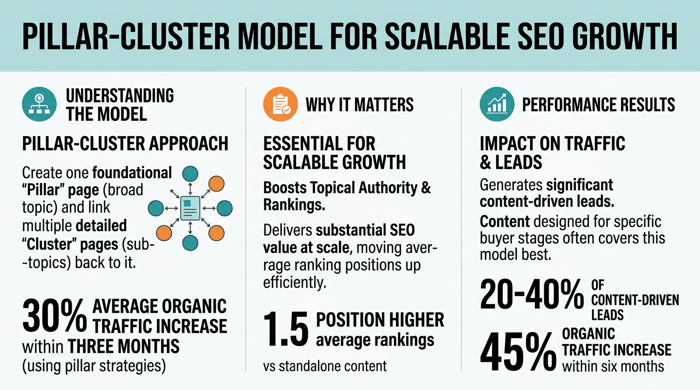
At its core, the pillar-cluster model is about creating a symbiotic relationship between broad, foundational content and detailed, supporting articles. A pillar page is a comprehensive, high-level overview of a broad topic, serving as the central hub of a content cluster. Think of it as a definitive guide that covers all facets of a subject without going into excessive detail on any single subtopic. From this central hub, cluster content branches out—these are detailed articles that dive deep into specific subtopics related to the pillar page, each linking back to it. This interconnected web of content collectively builds topical authority, which is the demonstrated expertise and comprehensive coverage of a subject area. By signaling to search engines that your site is a go-to resource for a particular topic, you significantly improve your chances of ranking for a wide array of related keywords.
The Evolution from Keywords to Topics
Search engines have undergone a profound transformation, evolving from simple keyword-matching algorithms to sophisticated systems that understand semantic relationships and user intent. This shift is at the heart of the pillar-cluster model's effectiveness. Semantic SEO now prioritizes thematic relevance over individual keywords, meaning Google's algorithms look for a holistic understanding of a topic rather than just the presence of specific phrases. This necessitates structuring content around broad intent, not single keywords, to align with this evolution. As a result, content creators must think like users, anticipating their questions and providing comprehensive answers. Focusing on topics allows for a more natural and user-friendly content experience that search engines reward.
"Pillar pages represent the future of SEO content strategy. Instead of competing for individual keywords, we’re now competing for topics and demonstrating comprehensive expertise across entire subject areas." — Rand Fishkin, SEO Expert, Koanthic
How the Model Enhances Search Engine Visibility
The pillar-cluster model provides both technical and strategic benefits for SEO. The robust internal linking structure is a primary driver of enhanced visibility. Bidirectional linking, where every cluster post links back to the pillar and the pillar links out to all cluster posts, creates a strong web of interconnected content. This strengthens SEO signals by distributing link equity and demonstrating clear relationships between topics, which helps search engine bots understand your site's architecture for improved crawlability and indexing. Furthermore, comprehensive topical coverage signals E-E-A-T (Experience, Expertise, Authoritativeness, Trustworthiness) to search engines. In an era where AI-driven search prioritizes credible and authoritative sources, demonstrating deep expertise across an entire subject area is crucial for building trust and maintaining ranking resilience against algorithm updates. This approach is particularly effective for AI-resilient strategies in 2026, where E-E-A-T is more important than ever.
Why the Pillar-Cluster Model is Essential for Scalable Growth
The pillar-cluster model isn't just an organizational tool; it's a strategic imperative for businesses aiming for scalable growth in 2026. This approach directly impacts key business metrics, from organic traffic and lead generation to overall ROI, while also future-proofing content strategies against the rapid advancements in AI-driven search.
Driving Significant Organic Traffic and Lead Generation
One of the most compelling reasons to adopt the pillar-cluster model is its proven ability to significantly boost organic traffic and generate leads. Research indicates that pillar clusters can lift traffic by 10-35% per quarter. Specifically, HubSpot research shows a 30% average organic traffic increase within three months for companies effectively using pillar strategies. Over a slightly longer period, these strategies can achieve 15-30% organic traffic growth within 6 months. Beyond just traffic, pillar clusters are highly effective at converting visitors into prospects, generating 20-40% of content-driven leads. These figures highlight the model's capacity to not only attract more visitors but also to engage them with relevant, in-depth content that moves them down the sales funnel. Content-driven leads are a crucial metric for businesses seeking to maximize their content investment.
Enhanced SEO ROI and Business Performance
The financial benefits of a well-executed pillar-cluster strategy are substantial. B2B SEO content strategies, when structured effectively, deliver an average ROI of 702-748% over three years. This impressive return is often realized quickly, with the break-even point for B2B SEO typically occurring within 6-12 months, and positive ROI peaking in years 2-3. SEO is a powerhouse for B2B revenue, driving 44.6% of B2B revenue, and leads generated through SEO close at a remarkable 14.6%, significantly outperforming the 1.7% for outbound leads. This efficiency translates directly to the bottom line, with qualified organic leads yielding 67-89% larger deal sizes. These statistics underscore how the pillar-cluster model, by optimizing content for search and user intent, becomes a highly profitable engine for business growth. For more on maximizing your returns, explore effective B2B SEO content strategies.
Adapting to the AI-Driven Search Landscape of 2026
The rise of AI in search engines fundamentally reshapes SEO, making the pillar-cluster model more critical than ever for future-proofing content strategies. With the advent of AI Overviews, the landscape is shifting: Position 1 CTR is now 34.5% lower with AI Overviews, and 60% of searches yield zero clicks. This necessitates a move towards Answer Engine Optimization (AEO), where content is structured specifically for AI systems. This means using snippet-friendly formats like FAQs, step-by-step guides, and data tables that AI can easily parse and present. The pillar-cluster model naturally supports AEO by providing comprehensive, well-organized content that addresses user queries thoroughly.
"By 2026, AI Mode will replace traditional SERPs as the dominant form of search. SEO will evolve into Relevance Engineering." — Garrett Sussman, Director of Marketing, iPullRank.
This shift highlights the importance of adapting content strategies to be cited by AI platforms, not just ranked by traditional algorithms. Understanding AI integration in SEO is key to navigating this new reality.
Building Your Pillar-Cluster Strategy: A Step-by-Step Approach
Implementing a successful pillar-cluster strategy requires a methodical approach, starting with identifying the right topics and meticulously structuring your content. This process ensures that every piece of content contributes to your overall topical authority and SEO goals.
Identifying Core Pillar Topics
The foundation of any effective pillar-cluster strategy lies in selecting the right core pillar topics. This process begins with in-depth audience research to understand your target audience's pain points, questions, and search intent. What problems are they trying to solve? What information do they seek? Next, leverage keyword research and topic clustering tools to identify broad, high-volume topics that are relevant to your business and have a significant number of related subtopics. These tools help uncover the thematic landscape of your industry. Finally, conduct a thorough competitive analysis to see what your competitors are ranking for and identify any content gaps you can fill. This three-pronged approach ensures your pillar topics are not only relevant but also offer a strategic advantage. This foundational work is essential for building a robust pillar-cluster model.
Mapping Cluster Content to Pillars
Once your pillar topics are established, the next step is to organize your subtopics under these main pillars. This involves a comprehensive content inventory & gap analysis, where you review all existing content to see what can be repurposed, updated, or retired, and identify opportunities to create new cluster pages. The goal is to ensure every subtopic is covered in detail, with no redundancy. Then, create a content map, a visual representation of the relationships between your pillar pages and their corresponding cluster content. This helps in understanding the entire ecosystem and ensuring logical flow. Finally, prioritize which clusters to build out first based on business goals, search volume, and competitive landscape. Focusing on high-impact clusters will yield the quickest results and build momentum for your strategy.
Structuring Your Pillar and Cluster Pages
Effective structuring is critical for both search engine crawlability and user experience. A pillar page structure should be long-form, typically 2,000-4,000 words, offering a comprehensive overview. It must feature clear H2s and H3s, extensive internal links to all relevant cluster pages, and a strong call to action. The goal is to be the definitive resource for that broad topic. For example, Betterworks's 4,400-word Performance Management Guide uses sticky navigation to enhance user experience and traffic. Conversely, cluster page structure should be shorter, usually 500-1,500 words, focusing on a specific subtopic. Each cluster page must include a clear link back to its parent pillar page and other relevant cluster pages, reinforcing the internal linking structure. Crucially, emphasize User Experience (UX) with sticky navigation, clear headings, and multimedia integration for better engagement, as these factors contribute to higher time on page and lower bounce rates, signaling content quality to search engines.
Content Creation and Optimization for Pillar and Cluster Pages
Creating content for the pillar-cluster model goes beyond mere writing; it demands a strategic approach to quality, linking, and leveraging advanced tools to maximize impact. The goal is to produce content that is not only comprehensive but also highly authoritative and discoverable by both users and AI.
Crafting High-Quality, E-E-A-T Driven Content
In 2026, the emphasis on content quality and authority is paramount. Search engines increasingly prioritize content that demonstrates E-E-A-T (Experience, Expertise, Authoritativeness, Trustworthiness). This means prioritizing expert-driven depth, verifiable facts, and original data or insights to avoid what's often termed "AI slop." Content must be comprehensive, ensuring cluster pages thoroughly address their specific subtopics, leaving no stone unturned. This depth signals true expertise. Furthermore, multimedia integration plays a crucial role. Optimizing video, social content, and visual search elements with AI-readable alt text and captions can significantly influence AI recommendations and visibility. By focusing on genuine value and verifiable information, you build trust with both human readers and sophisticated AI algorithms, which is essential for thriving in the current search environment.
Strategic Internal Linking and External Referencing
The power of the pillar-cluster model is amplified through strategic linking. Bidirectional linking is non-negotiable: every cluster post should link back to the pillar, and the pillar should link out to all cluster posts. This creates a powerful network that distributes link equity and reinforces topical relevance across your site. Dynamic RSS integration can further enhance scalability for this linking strategy. These links should be contextual, placed naturally within the content where they provide genuine value to the reader, guiding them through related topics. Beyond internal links, external referencing to authoritative external sources is crucial. Citing reputable sources boosts your own credibility and E-E-A-T, signaling to search engines that your content is well-researched and trustworthy. This balanced approach to linking not only improves SEO but also enhances the user's journey through your content.
Leveraging AI for Efficient Content Production and Optimization
AI tools are no longer a luxury but a necessity for streamlining content production and optimization within a pillar-cluster framework. AI-powered research can automate keyword research, topic clustering, and content brief generation, significantly reducing the manual effort involved in the initial stages. For content generation & optimization, AI tools can assist with drafting, optimizing for content scores, and ensuring comprehensive topical coverage. For instance, Jottler automates content research, writing, and publishing, specifically highlighting its AI keyword research and topic clustering capabilities to streamline the creation of pillar and cluster content. This allows teams to focus on refining and adding unique value rather than starting from scratch.
"The efficiency gains from AI-powered SEO aren’t just about doing things faster... It’s about allowing your team to focus on high-value strategic work." — Unattributed, Lumenalta.
By leveraging AI, businesses can scale their content efforts while maintaining quality and relevance.
Jottler: AI-Powered Content Scaling for Pillar-Cluster Strategies
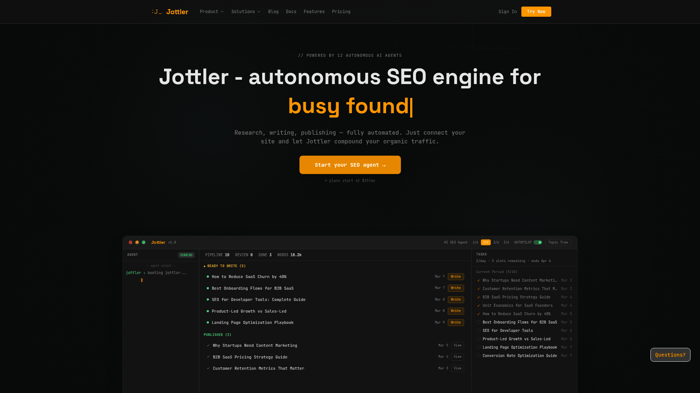
Jottler's autonomous AI SEO engine is designed to handle the entire content workflow, from initial topic identification to final publication, which is particularly beneficial for complex pillar-cluster strategies. Its AI agents perform deep research across 14+ sources, ensuring that content is not only comprehensive but also fact-checked, addressing a common pain point of AI hallucination. For businesses aiming to consistently publish high-quality, long-form articles (3,000+ words) and build topical authority, Jottler's automated keyword research and topic clustering features are invaluable. This allows for the systematic expansion of cluster content around core pillar pages without extensive manual effort.
Furthermore, Jottler integrates smart internal linking and SEO meta/FAQ schema, which are critical components for the technical optimization of pillar and cluster pages. These features ensure that the content is not only semantically rich but also technically sound for search engine indexing and AI interpretation. The platform's ability to generate AI-powered featured images and automatically publish to various CMS platforms (WordPress, Webflow, Shopify, etc.) further streamlines the process, enabling busy businesses to scale their content production and maintain a consistent publishing schedule without the need for a large in-house content team.
Measuring Success: KPIs and ROI of Your Pillar-Cluster Strategy
To truly understand the impact of your pillar-cluster strategy, it's essential to define and track key performance indicators (KPIs) and rigorously calculate your return on investment (ROI). This data-driven approach ensures that your content efforts are aligned with business objectives and deliver tangible results.
Key Performance Indicators for Pillar-Cluster Success
Measuring the effectiveness of your pillar-cluster model requires a focus on specific metrics that reflect both organic visibility and user engagement. First and foremost is organic traffic growth, monitoring increases in overall organic traffic and, more granularly, traffic to individual pillar and cluster pages. Pillar clusters have been shown to lift traffic by 10-35% per quarter. Equally important is tracking keyword rankings, observing improvements for both broad pillar keywords and more specific long-tail cluster keywords. SEMrush data indicates a 25% organic traffic increase and 1.5 position higher average rankings for cluster pages versus standalone content. Beyond traffic and rankings, engagement metrics such as time on page, bounce rate, and pages per session provide insights into content quality and user satisfaction. Finally, tracking conversions & leads that originate from pillar and cluster content is crucial, as pillar clusters generate 20-40% of content-driven leads, directly impacting your sales funnel.
Calculating and Demonstrating ROI
Quantifying the financial return of your pillar-cluster strategy is vital for justifying investment and demonstrating value. A thorough cost-benefit analysis compares the investment in content creation and optimization against the revenue generated. The break-even point for B2B SEO is typically within 6-12 months, with positive ROI peaking in years 2-3, making it a sustainable long-term strategy. To accurately measure the impact, employ attribution modeling. Using multi-touch attribution can provide 37% higher accuracy and lead to 15-30% lower CAC (Customer Acquisition Cost) compared to traditional last-click models. This comprehensive approach ensures that the true value of your pillar-cluster content is recognized and optimized.
| Tool | Starting Price | Key Optimization Features |
|---|---|---|
| Surfer SEO | $89/mo | On-page NLP, Topical Map, SERP analysis, Content Score (1-100) |
| Clearscope | $129/mo | Keyword clusters, readability, content briefs, Content Score |
| Semrush | $139/mo | SEO Writing Assistant, keyword depth, overall score (1-10) |
Tools for Tracking and Reporting
Effective monitoring and reporting are powered by the right tools. Google Analytics/GA4 is indispensable for granular data on traffic, engagement metrics (like time on page and bounce rate), and conversion tracking. For keyword performance, impressions, clicks, and identifying technical SEO issues, Google Search Console provides critical insights directly from Google. Finally, comprehensive SEO platforms such as Semrush or Ahrefs offer advanced capabilities for keyword tracking, in-depth competitor analysis, backlink monitoring, and site audits. Integrating these tools allows for a holistic view of your pillar-cluster strategy's performance and facilitates data-driven adjustments.
Advanced Pillar-Cluster Tactics and Future Trends
As the digital landscape continues to evolve, advanced pillar-cluster tactics are crucial for maintaining a competitive edge. This involves integrating the model with broader SEO strategies, leveraging AI and automation, and diversifying your search presence beyond traditional Google rankings.
Integrating with Broader SEO Strategies
A pillar-cluster model is most effective when it's not an isolated strategy but rather a cornerstone of a holistic SEO approach. This means ensuring robust technical SEO is in place, covering aspects like site speed, mobile-friendliness, and proper technical SEO implementation. Technical SEO provides a significant ROI of 117% and 1.35 ROAS with a 6-month break-even. Furthermore, high-quality pillar and cluster content serves as an excellent foundation for link building, naturally attracting backlinks from authoritative sources, as demonstrated by companies like 3PL Central. Finally, continuous User Experience (UX) optimization, through enhanced site navigation, readability, and overall user journey, improves engagement signals that search engines value. These integrated efforts create a powerful synergy that amplifies the impact of your pillar-cluster content.
Future-Proofing with AI and Automation
The future of SEO is inextricably linked with AI and automation, and the pillar-cluster model is uniquely positioned to benefit. AI-powered content audits can identify content gaps, opportunities for optimization, and outdated information with remarkable efficiency. In fact, 85% of top-performing SEO teams rely on AI-powered automation for content audits and reporting in 2026. Generative AI for content scaling can significantly reduce production costs by up to 40% and increase output by 300% for mid-sized enterprises, allowing for rapid expansion of cluster content. Tools like Jottler can help with automation and scaling by streamlining the entire content workflow from research to publishing, ensuring high-quality, brand-aligned content.
"The efficiency gains from AI-powered SEO aren’t just about doing things faster... It’s about allowing your team to focus on high-value strategic work." — Unattributed, Lumenalta.
This shift also introduces the concept of AI Share of Voice (SOV), where the focus moves from traditional rankings to being cited by AI platforms. Embracing these technologies is key to future-proofing your content strategy.
Jottler: Advanced Automation for Pillar-Cluster Strategies
Jottler's autonomous AI SEO engine directly addresses the need for automation and scaling in advanced pillar-cluster tactics. By continuously monitoring search trends and competitor strategies, Jottler helps identify new subtopics and content gaps that can be developed into cluster pages, ensuring the pillar-cluster model remains comprehensive and up-to-date. Its AI agents are trained on proprietary data, allowing for the generation of high-quality, brand-aligned content that covers full keyword strategies without losing quality, a critical factor when scaling content production.
Furthermore, Jottler's ability to automate internal linking and schema markup ensures that the technical aspects of the pillar-cluster model are consistently optimized. This is vital for improving crawlability, indexability, and signaling E-E-A-T to search engines. For businesses looking to expand their topical authority and maintain a strong presence across a diversifying search landscape, Jottler provides the infrastructure to scale content production efficiently and effectively, allowing marketing teams to focus on higher-level strategic initiatives rather than manual content creation. This positions Jottler as a strategic partner in navigating the complexities of AI-driven SEO in 2026.
Diversifying Search Presence Beyond Google
The search landscape of 2026 is no longer monolithic; it's fragmented across various platforms and generative tools. Acknowledging that search happens everywhere—social media, apps, marketplaces, and generative AI tools—is essential for a comprehensive strategy. Therefore, diversifying beyond Google is critical. This involves adopting multi-platform optimization strategies. For instance, optimizing for AI Overviews and chatbots is paramount, especially given that 35% of U.S. Gen Z uses AI chatbots for search. This shift necessitates a focus on Answer Engine Optimization (AEO), structuring content to be easily digestible and quotable by AI systems.
"It’s not about inventing a new name for SEO, but understanding that we must optimize everywhere people search for information—whether in Google, ChatGPT, or Reddit." — Rand Fishkin, Founder, SparkToro.
By broadening your optimization efforts, you ensure maximum visibility in a fragmented search ecosystem.
Overcoming Common Challenges in Pillar-Cluster Implementation
While the pillar-cluster model offers immense benefits, its implementation is not without challenges. Addressing common pitfalls like content silos, scalability issues, and adapting to algorithm changes is crucial for sustained success.
Avoiding Content Silos and Duplication
One of the primary challenges in large content ecosystems is the risk of creating content silos or duplicating efforts. To combat this, regular content audits are essential. Implementing monthly internal linking audits using tools like Screaming Frog and Ahrefs can help identify broken links, orphaned pages, or redundant content. Furthermore, establishing clear content guidelines prevents overlapping topics and ensures each piece serves a distinct purpose within the cluster. This requires meticulous planning and a shared understanding across the content team. Finally, fostering cross-functional collaboration between SEO, content, and development teams ensures alignment on strategy and implementation, preventing isolated efforts that lead to silos. This coordinated approach is vital for maintaining a cohesive content structure.
Managing Scalability and Resource Allocation
Scaling content production to support a comprehensive pillar-cluster model can be resource-intensive. The solution lies in strategic prioritization and leveraging technology. Begin with strategic prioritization, focusing on high-impact pillars and clusters first to generate early wins and demonstrate ROI. This iterative approach allows for gradual expansion. Critically, leveraging AI tools for content ideation, drafting, and optimization can significantly reduce manual workloads by as much as 55%. This frees up human resources for strategic oversight, editing, and adding unique insights.
"When your competitors... say, ‘Hey, there’s no way that we can scale content quality like this... now you have a competitive advantage.’" — Rand Fishkin, Co-Founder & CEO, MOZ.
By automating repetitive tasks, businesses can scale their content efforts without proportional increases in staffing or budget.
Adapting to Algorithm Updates and AI Changes
The SEO landscape is in constant flux, driven by frequent algorithm updates and rapid advancements in AI. Staying agile is key. A continuous E-E-A-T focus is essential, requiring regular audits for E-E-A-T gaps and a commitment to producing original, expert-driven content. This builds resilience against updates that penalize low-quality or generic content. Closely monitoring AI Overviews is also crucial to understand how they impact your SERP visibility and to adjust your content strategy to be cited by AI platforms. This means optimizing for direct answers and structured snippets. Ultimately, an agile content strategy is required, one that is prepared to pivot based on Google updates and evolving AI capabilities. This proactive approach ensures your pillar-cluster model remains effective and relevant in a dynamic search environment.
Conclusion
The pillar-cluster model is not just a trend; it's a foundational strategy for achieving scalable SEO growth in 2026 and beyond. By organizing your content around comprehensive topics, you can significantly boost organic traffic by 10-35% per quarter, generate 20-40% of content-driven leads, and achieve an average ROI of 702-748% over three years. Embrace this model to build topical authority, enhance user experience, and future-proof your digital presence in an AI-driven search landscape. Start by identifying your core pillar topics, meticulously mapping your cluster content, and leveraging AI tools to streamline production and optimization, ensuring your content ecosystem is robust and ready for the future of search.
FAQs
What is the expected ROI for B2B SEO content strategies in 2026?
How much traffic growth can be expected from implementing a pillar-cluster model?
How does AI impact content production costs and output?
like this today.