
ROI from Automated SEO Content Publishing Systems
 Aidan Buckley
SEO
Aidan Buckley
SEO
March 16th, 2026
17 minute read
Table of Contents
In an increasingly competitive digital landscape, businesses face immense pressure to generate high-quality, SEO-optimized content at scale. The challenge is stark: Google's AI Overviews now increase zero-click searches to significantly erode traditional organic traffic, significantly eroding traditional organic traffic. This shift means that relying on manual, slow content production processes is no longer sustainable, leading to missed opportunities for visibility and engagement. However, a powerful solution has emerged: automated SEO content publishing systems. These advanced platforms leverage AI to streamline the entire content lifecycle, from research and writing to optimization and publishing, promising not just efficiency but a substantial return on investment. This article will explore what these systems are, why they are crucial for modern businesses, how they drive measurable ROI, and the best practices for their implementation.
- Automated SEO Content Publishing Systems: Leverage AI to streamline content creation, optimization, and distribution for enhanced search visibility.
- Why Automated Systems Matter for ROI: Vital for businesses to maintain relevance and capture attention in a search environment increasingly dominated by AI Overviews and zero-click results.
- How Automated Systems Drive ROI: Deliver significant cost reductions, increased content velocity, improved SEO performance, and enhanced content quality.
- Measuring Automated SEO Content ROI: Involves tracking key metrics like traffic growth, conversion rates, cost savings, and content team productivity.
- Future of Automated SEO Content: Involves deeper integration, advanced personalization, and a focus on original, authoritative content that influences AI models.
What Are Automated SEO Content Publishing Systems?
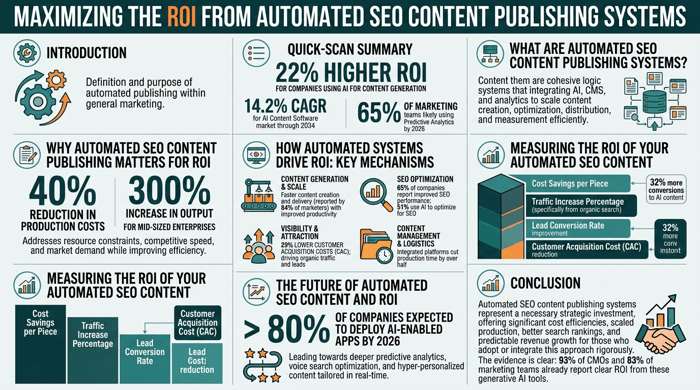
Automated SEO content publishing systems are advanced software solutions that leverage artificial intelligence (AI) and machine learning (ML) to automate various stages of the content creation, optimization, and publishing workflow, specifically designed to improve search engine visibility. These systems go beyond simple content generation, encompassing a holistic approach to SEO content strategy and execution. Over 68% of marketers now use AI-powered tools to enhance search rankings and deliver tailored content experiences, underscoring their growing importance.
Defining Automated SEO Content Publishing
At its core, an automated SEO content publishing system is a platform that uses AI to perform tasks traditionally done manually by content teams. This includes keyword research, topic ideation, content brief generation, drafting articles, optimizing for on-page SEO factors, internal linking, and even direct publishing to content management systems (CMS). The goal is to produce high-quality, relevant, and search-engine-friendly content at a scale and speed unattainable through human-only efforts. Around 65% of marketing teams could be using predictive analytics tools by 2026 to guide their content strategies, indicating a move towards more data-driven automation.
Key Characteristics and Capabilities
Modern automated SEO content publishing systems possess several distinguishing characteristics:
- AI-Powered Content Generation: Utilizing large language models (LLMs) to draft articles, product descriptions, social media posts, and other content formats based on specified keywords, topics, and brand guidelines.
- SEO Optimization Features: Integrating tools for real-time content scoring, keyword density analysis, semantic SEO, and competitive analysis to ensure content is optimized for search engines and AI models.
- Workflow Automation: Automating repetitive tasks such as content scheduling, internal linking suggestions, meta-data generation, and image optimization.
- Direct Publishing Integrations: Seamlessly connecting with popular CMS platforms like WordPress or Webflow for one-click publishing, eliminating manual copy-pasting.
- Performance Tracking and Analytics: Providing dashboards to monitor content performance, organic traffic, keyword rankings, and other relevant SEO metrics.
- Scalability: Designed to handle large volumes of content production, enabling businesses to scale their content output significantly without proportional increases in human resources.
Distinguishing from Traditional Content Creation and Basic AI Tools
Unlike traditional content creation, which relies heavily on manual research, writing, and optimization, automated systems significantly reduce human effort and time. While basic AI content generators might produce raw text, automated SEO content publishing systems offer a more comprehensive, end-to-end solution. They integrate SEO best practices, competitive analysis, and publishing capabilities, transforming raw AI output into fully optimized, publish-ready assets. The global automated SEO content publishing market, specifically the AI content creation and optimization software market, is projected to reach USD 2.3 billion in 2026, growing from USD 1.8 billion in 2025, underscoring the rapid shift towards these integrated solutions.
Why Automated SEO Content Publishing Matters for ROI
The shift towards automated SEO content publishing is not merely a trend; it's a strategic imperative driven by the undeniable potential for significant return on investment (ROI). In 2026, with the digital landscape evolving rapidly, businesses across all sectors must adapt to new search behaviors and content consumption patterns. 51% of marketers already use AI tools specifically to optimize content for SEO, demonstrating widespread adoption.
The Evolving Search Landscape in 2026
The search landscape is undergoing a profound transformation, largely due to advancements in AI. Google's AI Overviews (formerly SGE) are fundamentally changing how users interact with search results. These AI-generated summaries provide direct answers, leading to an increase in zero-click searches, which now account for a significant portion of all queries. This means that traditional organic click-through rates (CTRs) can drop by up to 60% for informational queries. Publishers have reported 10% overall search traffic declines due to AI Overviews. In this environment, simply ranking high is no longer enough; content must be designed to be featured and cited within AI Overviews, or to drive users to click through by offering unique value.
"Ten years from now, there will be far fewer clicks available than there are today. I think this is the biggest shift SEOs are undergoing right now. AI is secondary to zero-click."
Rand Fishkin, Co-founder, SparkToro
Addressing Challenges of Manual Content Production
Manual content production is inherently slow, expensive, and difficult to scale. Businesses struggle with:
- High Costs: Hiring and managing large content teams, including writers, editors, and SEO specialists, incurs significant operational expenses.
- Slow Turnaround Times: The manual process from ideation to publication can take weeks or even months, making it challenging to respond quickly to market trends or algorithm changes.
- Inconsistent Quality and Optimization: Ensuring every piece of content is consistently high-quality and perfectly optimized for SEO is a monumental task for human teams, often leading to missed opportunities.
- Scalability Limitations: Expanding content output often means proportionally increasing headcount, which is not always feasible or cost-effective.
The Promise of Compounding Organic Traffic
Automated systems offer a solution to these challenges by enabling businesses to produce a high volume of consistently optimized content. This leads to a compounding effect on organic traffic. More high-quality, relevant content means more opportunities to rank for a wider array of keywords, capture long-tail search demand, and establish topical authority. This continuous influx of optimized content helps businesses not only maintain but grow their search visibility in an AI-dominated world. The broader SEO services market, which includes automated solutions, is valued at USD 108.28 billion in 2026, representing a a 16.8% CAGR, highlighting the industry's investment in solutions that promise sustained growth.
How Automated Systems Drive ROI: Key Mechanisms
Automated SEO content publishing systems don't just promise efficiency; they deliver tangible ROI through several key mechanisms that optimize content production, enhance search performance, and reduce operational costs. 72% of global organizations use AI for content creation, demonstrating its widespread impact on operational effectiveness.
Cost Reduction and Efficiency Gains
One of the most immediate and impactful ways automated systems drive ROI is by significantly reducing content production costs and boosting efficiency. AI-generated content reduces production costs by up to 40% while increasing output volume by 300% for mid-sized enterprises. This is achieved by automating labor-intensive tasks:
- Automated Content Research: Systems can quickly analyze vast amounts of data to identify trending topics, relevant keywords, and competitor strategies, saving hours of manual research.
- Streamlined Content Writing: AI models can generate initial drafts of articles, product descriptions, and other content types, drastically cutting down writing time.
- Accelerated Publishing Workflows: Direct integrations with CMS platforms mean content can be published with minimal human intervention, accelerating time-to-market.
"87% of B2B marketers using AI for content creation report improved productivity," and "84% of marketers note faster content delivery speed."
Source: The Digital Elevator, Arvow
Enhanced SEO Performance and Visibility
Automated systems are purpose-built to improve SEO performance, which directly translates to increased organic traffic and ROI. 65% of companies report improved SEO performance with AI content.
- Optimized Content for AI Overviews: By focusing on entity clarity, freshness, and hyper-local precision, automated systems can increase the likelihood of content being included in AI Overviews. Ads show a significantly higher CTR when brands are organically cited in AI Overviews, emphasizing the value of this visibility.
- Scalable Keyword Targeting: These systems can identify and target a much broader range of keywords, including long-tail variations, allowing businesses to capture niche traffic that might be overlooked by manual efforts.
- Improved On-Page SEO: Automated tools ensure consistent application of on-page SEO best practices, from meta-data generation to internal linking.
- Topical Authority Building: By consistently publishing comprehensive content on a wide array of related topics, automated systems help establish topical authority, a critical factor for ranking in modern search algorithms.
Using Jottler for Automated Content Research and Publishing
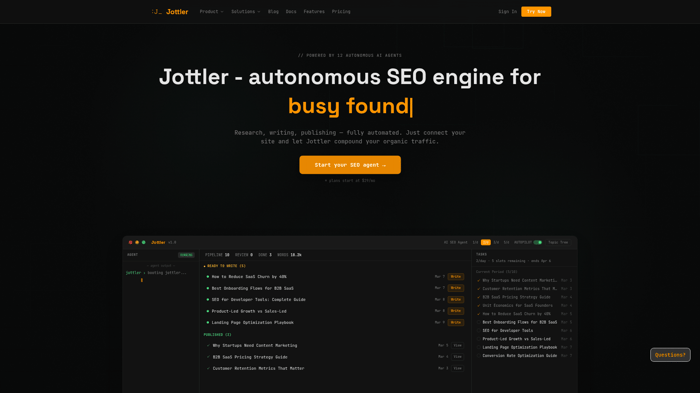
Jottler is an autonomous AI SEO engine designed to automate content research, writing, and publishing to compound organic traffic for busy businesses. It leverages 12 AI agents to manage the entire content lifecycle. This includes deep research from over 14 sources with fact-checking, ensuring accuracy and relevance in generated content. For on-page SEO, Jottler automatically handles smart internal linking and generates SEO meta and FAQ schema, crucial elements for improving search engine visibility and AI model understanding.
The platform also integrates direct CMS publishing capabilities for platforms like WordPress, Webflow, and Shopify. This feature eliminates manual copy-pasting and significantly accelerates the time-to-market for new content. By automating these critical steps, Jottler helps businesses scale their content efforts, improve SEO performance, and reduce the operational burden associated with manual content production, directly contributing to a higher ROI through increased efficiency and organic traffic growth.
Increased Content Volume and Quality at Scale
The ability to produce more content, faster, without sacrificing quality is a cornerstone of automated systems' ROI. 64% say AI content performs equally or better than human-generated.
- Higher Output: Automated systems enable businesses to publish significantly more content than traditional methods. For example, an e-commerce platform saw a significant increase in blog production and a 7% overall site traffic rise within 6 months using AI copywriting.
- Consistent Quality: While AI generates drafts, advanced systems incorporate quality checks and optimization features to ensure the content meets specific standards and brand guidelines.
- Personalization: AI can dynamically tailor content based on user behavior and intent, leading to higher engagement. A financial services firm using an AI-driven personalization engine saw a significant increase in content engagement rates and a significant improvement in email click-through rates.
Competitive Advantage and Market Share Growth
Adopting automated SEO content publishing systems provides a significant competitive edge. By 2026, >80% of companies are expected to deploy AI-enabled apps, indicating the widespread adoption necessary to remain competitive.
- Agility: Businesses can react faster to market changes, competitor moves, and emerging search trends by rapidly deploying new content.
- Dominating SERPs: By consistently publishing optimized content at scale, businesses can increase their footprint in search engine results pages (SERPs), outcompeting rivals who rely solely on manual processes.
- Brand Building: A steady stream of valuable, optimized content builds brand awareness, authority, and trust with the target audience.
Measuring the ROI of Your Automated SEO Content
To truly understand the value of automated SEO content publishing systems, businesses must establish clear metrics and a robust framework for measuring ROI. Without proper measurement, the benefits, though often substantial, can remain anecdotal. Only 20% of organizations measure GenAI ROI, despite 95% expecting its centrality in five years, highlighting a critical gap.
Key Performance Indicators (KPIs) for Automated Content
Measuring the success of automated content requires tracking a blend of traditional SEO metrics and new, AI-specific indicators. 65% of companies report improved SEO performance with AI content.
- Organic Traffic Growth: This remains a fundamental KPI. Monitor the increase in visitors from search engines over time. Integrated martech platforms are expected to grow organic traffic by about 30% compared to using separate tools.
- Keyword Rankings and Visibility: Track improvements in keyword positions and overall search visibility for targeted terms.
- Conversion Rates: Ultimately, content should drive business outcomes. Measure how many visitors convert into leads, sales, or other desired actions after engaging with automated content. AI content generation leads to 32% more conversions and 29% lower customer acquisition costs.
- Content Production Volume and Velocity: Quantify the increase in published content and the reduction in time from ideation to publication. A B2B software firm using AI SEO tools achieved significant organic traffic growth and enabled significantly more high-quality blog content published.
- Cost Savings: Calculate the reduction in labor costs, freelance expenses, and time saved compared to manual content creation. AI-generated content reduces production costs by up to 40%.
- Content Engagement Metrics: Track metrics like time on page, bounce rate, and social shares to gauge content quality and relevance. A financial services firm saw a significant increase in content engagement rates and a significant improvement in email click-through rates with AI-driven personalization.
- AI Overview Inclusion Rate: Monitor how often your content is cited or featured in Google's AI Overviews, as this indicates influence over AI models.
Calculating ROI: Formulas and Frameworks
Calculating the ROI for automated content involves comparing the gains from the system against its costs. The average return per $1 invested in generative AI across organizations is $3.70.
- Basic ROI Formula:(Total Benefits - Total Costs) / Total Costs * 100%
- Total Benefits: This includes increased revenue from conversions, estimated value of organic traffic, and cost savings from reduced labor.
- Total Costs: This includes the subscription fees for the automated system, any integration costs, and the cost of human oversight/editing.
- Attribution Modeling: Use analytics tools to attribute conversions and revenue directly to specific content pieces or content clusters generated by the automated system.
- Time-to-Value (TTV): Measure how quickly the investment in the automated system starts generating positive returns.
| Metric | Value |
|---|---|
| Higher ROI vs. traditional campaigns | 22% |
| More conversions | 32% |
| Lower customer acquisition costs | 29% |
| Return per $1 invested in GenAI | $3.70 |
| Marketers reporting faster content delivery | 84% |
| Marketers saying AI content performs equally or better | 64% |
| Companies reporting improved SEO performance | 65% |
Tools and Technologies for ROI Tracking
Several tools can aid in tracking the ROI of automated SEO content:
- Google Analytics 4 (GA4): For comprehensive website traffic, user behavior, and conversion tracking.
- Google Search Console: For keyword performance, impressions, clicks, and core web vitals.
- SEO Platforms (e.g., Semrush, Ahrefs): For competitive analysis, keyword tracking, and backlink monitoring.
- CRM Systems: To track lead progression and sales conversions originating from content.
- Dedicated AI Analytics Dashboards: Many automated content platforms offer built-in analytics to track content performance and AI-specific metrics.
Best Practices for Continuous Optimization
Measuring ROI is not a one-time activity but an ongoing process of monitoring, analyzing, and adapting. This ensures that the investment continues to yield maximum returns. Over 60% of teams tracking AI ROI report at least 2x return on investment.
- Set Clear Goals: Define specific, measurable, achievable, relevant, and time-bound (SMART) goals before implementation.
- A/B Test Content: Experiment with different content types, formats, and optimization strategies to identify what performs best.
- Regular Reporting: Establish a cadence for reviewing performance reports and sharing insights with stakeholders.
- Iterate and Refine: Use data to continuously refine content strategies, AI prompts, and system configurations to maximize ROI.
- Focus on Information Gain: Prioritize content that delivers concise, value-led summaries, making it easily extractable by LLMs and increasing its chances of being cited.
The Future of Automated SEO Content and ROI
The landscape of automated SEO content publishing is dynamic, with continuous innovation shaping its future trajectory and potential for ROI. As AI technologies advance, so too will the sophistication and impact of these systems. Gartner predicts that by 2027, generative AI agents will pose the first real challenge to mainstream productivity tools in 30 years, leading to a significant market disruption.
Emerging Trends in AI Content Automation
Several key trends are poised to redefine automated SEO content in the coming years:
- Autonomous AI Agents: The rise of autonomous AI agents will enable systems to independently plan, execute, and optimize content workflows from ideation to publishing without constant human input. These agents will integrate memory, external tools, and adaptive learning to generate scalable, brand-consistent content.
- Deeper Personalization and Dynamic Content: AI will enable hyper-personalized content experiences, dynamically tailoring articles, product recommendations, and website copy based on individual user behavior and intent. ServiceMax, for example, reduced bounce rates by a significant amount and doubled time on site by leveraging AI for personalized content recommendations.
- Multi-Modal Content Generation: Beyond text, automated systems will increasingly generate multi-modal content, including images, videos, and interactive elements, all optimized for SEO.
- AI Visibility Tracking: New tools will emerge to specifically track how content performs within AI Overviews and other AI-driven search experiences, providing crucial insights into "AI visibility" rather than just traditional rankings. Rand Fishkin projects the AI visibility tracking market will exceed a significant amount in 2026.
The Role of Originality and Authority in an AI-Driven World
As AI becomes more ubiquitous, the value of truly original, authoritative content will only increase. Google continues to reward content that demonstrates Experience, Expertise, Authoritativeness, and Trustworthiness (EEAT).
- Prioritizing Human-Crafted, Original Content: Automated systems will need to be guided to produce content that reflects unique insights, proprietary data, and genuine human experience.
- Investing in Proprietary Data and Studies: Producing original research, case studies, and expert opinions that AI cannot replicate will be crucial for standing out. This type of content is more likely to be cited by LLMs and gain significant authority.
- Focus on Information Gain Rate: Content that provides concise, value-led summaries and minimizes cognitive load will be favored, as it is easily extractable and digestible by AI models.
"Content volume alone no longer confers advantage... models increasingly look for material they cannot create themselves."
Filip, Specialist, SUSO Digital
Strategic Imperatives for Maximizing Future ROI
To maximize ROI from automated SEO content in the future, businesses must adopt strategic imperatives. 94% of marketers plan AI use for blogs/SEO in 2026.
- Develop a "Brand Core" for AI Agents: Ingest website data, product information, voice guidelines, and past content into AI systems to ensure consistent brand identity and compounding intelligence across all automated outputs.
- Integrate AI Tools for End-to-End Workflows: Utilize platforms that offer integrated content generation, optimization, and direct CMS publishing to cut production time by more than half and grow organic traffic by about 30%.
- Automate Measurement of New Metrics: Shift focus from solely traditional SEO metrics to include brand mentions, homepage visits, and search volume for your name, especially given the rise of zero-click searches.
- Structure Content for AI Extraction: Write paraphrase-resistant sentences and clearly structured content to facilitate AI extraction and citation, as being cited by AI models becomes a critical measure of influence.
Conclusion
Automated SEO content publishing systems represent a pivotal advancement for businesses seeking to thrive in the complex digital landscape of 2026 and beyond. By leveraging AI to streamline content creation, optimize for evolving search behaviors, and reduce operational costs, these systems offer a clear path to substantial ROI. Companies using AI for content generation achieve 22% higher ROI compared to traditional campaigns, along with 32% more conversions and 29% lower customer acquisition costs. The average return per $1 invested in generative AI across organizations is $3.70. As the digital world continues its rapid evolution, embracing automated SEO content publishing is not just about efficiency; it's about securing a competitive advantage, compounding organic traffic, and building a resilient, future-proof content strategy. Businesses should explore platforms like Jottler to start their SEO agent and unlock this growth.