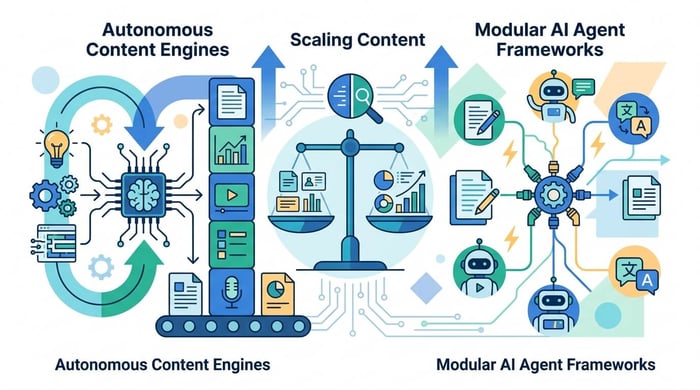
AI Agent Models for Scalable Content: A Comparison
 Aidan Buckley
SEO
Aidan Buckley
SEO
March 19th, 2026
15 minute read
Table of Contents
- Quick-Scan Summary of AI Agent Models for Content
- Understanding AI Agent Models for Content
- Autonomous Content Engines: End-to-End Content Automation
- Modular AI Agent Frameworks: Flexible Content Orchestration
- Key Differences and Use Cases
- Choosing the Right AI Agent Model for Your Content Strategy
- Conclusion
The demand for high-volume, high-quality content has never been greater, yet businesses struggle with the sheer scale required. Traditional content creation methods are proving insufficient, with 72% of companies using AI tools for content marketing efficiency and workflow streamlining, highlighting a clear shift towards automation. The cost of inaction—missed organic traffic, stagnant SEO, and an inability to keep pace with market demands—is substantial. In 2026, the solution lies in leveraging advanced AI agent models that can automate and optimize content production at scale. This article compares two primary approaches: fully autonomous content engines and modular AI agent frameworks, offering a strategic guide for businesses looking to compound their organic traffic and achieve significant ROI.
Quick-Scan Summary of AI Agent Models for Content
- Understanding AI Agent Models: The AI content generation market is projected to reach USD 7.09 billion in 2026, driven by the need for scalable content.
- Autonomous Content Engines: Solutions like Jottler offer end-to-end automation, enabling businesses to produce significantly more content at a lower cost.
- Modular AI Agent Frameworks: These provide high customization and flexibility for complex workflows, integrating with over 450 existing tools.
- Key Differences and Use Cases: A direct comparison reveals that autonomous engines excel in rapid, large-scale output, while modular frameworks suit unique, complex content needs.
- Choosing the Right Model: Aligning with content goals and SEO strategy, such as optimizing for GEO (weighted at 35%), is crucial for successful implementation.
- Strategic Implications of AI-Driven Content: The market is projected to grow at a CAGR of 39.3%, underscoring the long-term value of these technologies.
- Frequently Asked Questions: Addressing common queries about market size, ROI, and how AI is changing SEO strategies.
Understanding AI Agent Models for Content
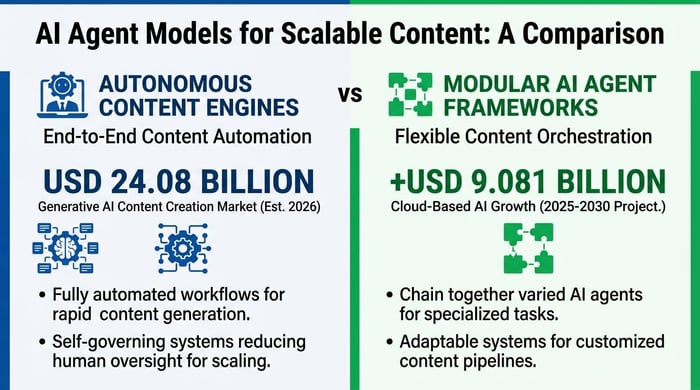
The AI content generation market is experiencing explosive growth, projected to reach USD 7.09 billion in 2026, with some broader estimates for generative AI in content creation reaching USD 24.08 billion. This surge is driven by the increasing need for businesses to produce vast amounts of content efficiently. Early AI tools focused on basic text generation, but 2026 marks a turning point where AI agents move beyond simple tasks to orchestrate complex content workflows, from research to publication.
The Evolution of AI in Content Creation
The journey of AI in content creation has evolved rapidly. Initially, tools focused on automating simple tasks like grammar checks and basic sentence generation. Now, the landscape is dominated by sophisticated AI agents capable of understanding context, conducting research, and even adapting tone. This evolution is critical as businesses seek to scale their content operations without compromising quality. The market for AI-powered SEO/content is projected to reach $2.8 billion in 2026, growing to $7.3 billion by 2031 at a 34% CAGR, underscoring the strategic importance of AI-driven content scaling.
"Through 2026, atrophy of critical-thinking skills due to GenAI use will push 50% of global organizations to require 'AI-free' skills assessments."
Gartner
Core Principles of AI Agent Models
AI agent models are characterized by their ability to perform tasks autonomously, often involving planning, reasoning, and tool use. For content, this means agents can conduct keyword research, generate outlines, write drafts, optimize for SEO, and even publish, all with minimal human intervention. The underlying principle is to offload repetitive and data-intensive tasks to AI, freeing human teams for strategic oversight and creative refinement. This shift is critical as 91% of CMOs cite efficiency gains from AI, and 90% cite cost/time savings.
- Autonomy: Agents can execute tasks independently, reducing manual intervention.
- Reasoning: They can understand context and make informed decisions, improving content relevance.
- Tool Use: Integration with various tools allows agents to perform diverse functions, from SEO analysis to CMS publishing.
- Adaptability: AI agents can learn and adapt to new information and feedback, continuously improving content quality.
The Strategic Imperative for Scalable Content
In a competitive digital landscape, scalable content is not just an advantage; it's a necessity. Businesses, from e-commerce stores to B2B companies, need to consistently produce high-quality, SEO-optimized content to capture organic traffic. The demand for textual content generation alone is projected to contribute +USD 3.719 billion in growth between 2025-2030. This growth highlights the pressure on businesses to scale content production, making AI agent models a critical investment for maintaining competitive relevance and achieving significant ROI.
Autonomous Content Engines: End-to-End Content Automation
Autonomous content engines are comprehensive AI systems designed to manage the entire content lifecycle with minimal human input. These platforms integrate various AI agents and tools to perform tasks ranging from initial topic ideation and keyword research to content generation, SEO optimization, and even publishing. Their core value proposition is to provide a "set it and forget it" solution for content production, enabling businesses to scale their organic presence without a massive increase in manual effort. This approach is gaining traction, with 80%+ of businesses now using AI for content generation.
Defining Autonomous Content Engines
An autonomous content engine orchestrates a series of AI agents to handle every stage of content creation. This includes identifying trending topics, performing in-depth keyword analysis, generating comprehensive outlines, drafting articles, optimizing content for search engines, and even publishing directly to a content management system (CMS). The goal is to create a seamless, automated workflow that consistently produces high-quality, SEO-optimized content. This end-to-end automation allows businesses to achieve unparalleled scalability, producing content at a volume and speed impossible with traditional methods.
Jottler: A Prime Example of an Autonomous Content Engine
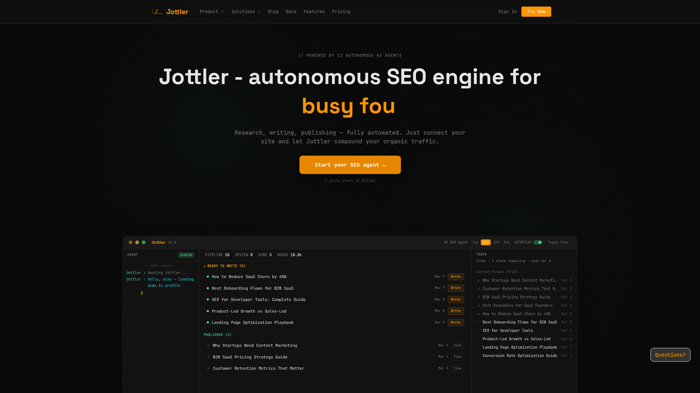
Jottler stands out as a leading autonomous AI SEO engine that automates content research, writing, and publishing to compound organic traffic for busy businesses. As an autonomous content engine, Jottler embodies the vision of end-to-end content automation. It conducts in-depth keyword analysis, identifies content gaps, generates SEO-optimized articles, and can even schedule and publish content directly to a CMS. This integrated approach ensures consistency in brand voice, adherence to SEO best practices, and continuous content output, allowing businesses to focus on higher-level strategy. For instance, advanced teams using AI can produce significantly more content at a lower cost per article, directly reflecting the efficiency gains offered by such platforms.
Advantages of Autonomous Content Engines
The benefits of adopting autonomous content engines are substantial, particularly for businesses aiming for rapid growth and market penetration. These systems significantly reduce operational overhead while boosting content output and quality.
- Unparalleled Scalability: These engines can produce content at a volume and speed impossible for human teams alone. Advanced teams can produce significantly more content at a lower cost per article using AI.
- Operational Efficiency: By automating the entire workflow, they drastically reduce the time and resources spent on content creation. 90% of CMOs cite cost/time savings from AI.
- Consistent Quality and SEO Performance: Built-in SEO capabilities ensure content is optimized for search engines from the ground up, leading to better rankings and organic traffic. Businesses report higher returns from AI in SEO.
- Reduced Human Error: Automation minimizes the potential for human oversight in repetitive tasks.
- Compounding ROI: The continuous production of optimized content leads to a compounding effect on organic traffic and conversions. Content marketing can reach 1,100% ROI by month 36.
Potential Limitations of Autonomous Content Engines
While powerful, autonomous content engines may have limitations that businesses need to consider before full implementation. These often revolve around customization and integration challenges.
- Less Customization: Their integrated nature can sometimes mean less flexibility for highly niche or experimental content strategies.
- Initial Setup Complexity: Integrating with existing systems and fine-tuning for specific brand voices can require an initial investment of time.
- Dependence on Platform: Businesses become reliant on a single platform for their content operations.
- Human Oversight Still Required: Despite automation, human review is essential for high-stakes content and adding unique insights, as AI handles a significant portion of writing, but human oversight ensures quality and nuance.
Modular AI Agent Frameworks: Flexible Content Orchestration
Modular AI agent frameworks provide a more flexible, component-based approach to content automation. Instead of a single, monolithic system, these frameworks allow businesses to assemble and orchestrate individual AI agents, each specialized in a particular task (e.g., research, writing, editing, SEO analysis). This approach empowers users to build highly customized content workflows tailored to their exact needs, integrating best-of-breed tools and models. The market for AI agents is rapidly expanding, with 40% of enterprise apps expected to feature task-specific AI agents by 2026, up from less than 5% in 2025.
Defining Modular AI Agent Frameworks
Modular AI agent frameworks operate on the principle of composability, allowing businesses to select and combine specialized AI agents to construct unique content pipelines. Each agent performs a specific function, such as keyword research, content generation, image creation, or SEO auditing. This architecture enables greater control and adaptability, as companies can swap agents, integrate new technologies, or modify workflows as their content strategy evolves. The flexibility offered by these frameworks is crucial for organizations with complex content needs or those that prefer to leverage a diverse ecosystem of AI tools.
Examples of Modular Frameworks and Their Applications
Platforms like FlowHunt, Gumloop, Activepieces, and Kore.ai exemplify modular AI agent frameworks. These tools provide the building blocks for creating highly tailored content automation solutions.
- FlowHunt: Offers a no-code visual builder for multi-model AI content workflows with built-in RAG/knowledge bases, excelling in ease of use for enterprise no-code content workflows.
- Gumloop: Provides a visual agent builder for marketing and SEO automations, including content scraping and an SEO Blog Optimizer Agent for keyword analysis via Semrush integration.
- Activepieces: Offers custom AI agents for content analysis/automation with over 450 integrations, making it highly versatile for beginners to enterprise content operations.
- Kore.ai: Specializes in multi-agent orchestration with agentic RAG/tool-use for complex content reasoning, offering 250+ connectors for enterprise content and operations.
These frameworks are ideal for businesses that require granular control over each step of their content pipeline or need to integrate AI capabilities into highly specific existing systems.
Advantages of Modular AI Agent Frameworks
The primary draw of modular frameworks is their unparalleled adaptability, allowing businesses to construct precise tools for their unique challenges. This contrasts with the more generalized approach of autonomous engines.
- High Customization: Businesses can pick and choose agents and tools to create bespoke workflows.
- Flexibility and Adaptability: Easily modify or swap out agents as needs evolve or new AI technologies emerge.
- Integration with Existing Tools: Seamlessly connect with a wide array of existing marketing, SEO, and publishing platforms, with some offering over 450 integrations.
- Specialized Performance: Leverage agents that are hyper-optimized for specific tasks, potentially leading to higher quality in those areas.
- Vendor Agnostic: Reduces reliance on a single vendor, offering more control over technology stack.
Potential Limitations of Modular AI Agent Frameworks
While offering significant flexibility, modular frameworks also come with their own set of challenges, primarily related to complexity and resource requirements.
- Increased Complexity: Building and managing custom workflows requires more technical expertise and ongoing maintenance.
- Higher Overhead: Orchestrating multiple agents and ensuring seamless communication can be resource-intensive.
- Integration Challenges: While flexible, ensuring all components work together perfectly can be a significant undertaking.
- Slower Time-to-Value: The setup and customization process can be longer compared to ready-to-use autonomous engines.
Key Differences and Use Cases
Understanding the fundamental distinctions between autonomous content engines and modular AI agent frameworks is crucial for making an informed decision. Each model serves different strategic needs and operational contexts, impacting scalability, flexibility, and implementation complexity.
Direct Comparison: Autonomous Engines vs. Modular Frameworks
| Feature / Model Type | Autonomous Content Engines (e.g., Jottler) | Modular AI Agent Frameworks (e.g., FlowHunt, Gumloop) |
|---|---|---|
| Core Functionality | End-to-end content lifecycle automation (research to publish) | Orchestration of specialized AI agents for custom workflows |
| Ease of Use | Generally higher (ready-to-use solution) | Lower (requires building and configuring workflows) |
| Customization Level | Moderate to high (platform-dependent configurations) | Very high (build bespoke workflows from components) |
| Scalability | Excellent for high-volume, standardized content | Excellent for high-volume, highly specialized content |
| Integration | Often built-in, or limited to specific CMS/APIs | Extensive (connects many tools via individual agents) |
| Technical Expertise | Lower (user-friendly interfaces) | Higher (requires understanding of agent orchestration) |
| Time-to-Value | Faster (pre-built workflows) | Slower (requires setup and customization) |
| Best For | Businesses needing rapid, large-scale content output with minimal oversight | Businesses with unique, complex content needs or existing tech stacks |
Use Cases for Autonomous Content Engines
Autonomous content engines are particularly well-suited for scenarios demanding high volume and consistency with minimal human intervention. Their end-to-end capabilities make them ideal for scaling content efforts across various industries.
- E-commerce Stores: Generating thousands of unique product descriptions, category pages, and blog posts to capture long-tail SEO traffic. Amazon's AI recommendations generate a significant portion of sales.
- Publishers: Automating news summaries, evergreen content updates, and localized articles to maintain a constant stream of fresh content.
- Affiliate Marketers: Producing high volumes of review articles, comparison guides, and informational content for various niches.
- Busy Businesses: Any business lacking dedicated content teams but needing to maintain a strong organic presence.
Use Cases for Modular AI Agent Frameworks
Modular AI agent frameworks shine in environments where customization and integration with existing complex systems are paramount. They empower businesses to build highly specialized solutions.
- Developer Tool Companies: Building custom agents to generate technical documentation, code examples, or API usage guides based on real-time code changes.
- B2B Companies: Integrating specialized agents for lead magnet creation, personalized outreach content, or industry-specific research reports. Organizations personalizing messaging see 16% more impact on commercial outcomes.
- Marketplaces: Developing agents to analyze user-generated content, optimize listings, and create dynamic promotional copy.
- SaaS Companies: Orchestrating agents to produce detailed feature guides, release notes, and customer support documentation that integrates with product updates.
"By 2027, generative AI agents will challenge mainstream productivity tools for the first time in 35 years, driving a $58 billion market disruption."
Gartner
Choosing the Right AI Agent Model for Your Content Strategy
Selecting the optimal AI agent model is a strategic decision that should align with your organization's unique needs, resources, and long-term content goals. The wrong choice can lead to inefficiencies, while the right one can unlock significant growth. A thorough assessment is essential, as a portion of planned AI spending will be delayed into 2027 due to ROI shortfalls and governance needs, according to Forrester.
Assessing Your Business Needs and Resources
The first step in choosing an AI agent model is a thorough assessment of your organization's specific requirements. This involves evaluating your current content production capabilities, team expertise, and desired outcomes.
- Content Volume and Velocity: How much content do you need to produce, and how quickly? If the answer is "a lot, fast," an autonomous engine might be more suitable.
- Content Complexity and Niche: Does your content require deep subject matter expertise, nuanced tone, or highly specialized data integration? Modular frameworks offer more control for such needs.
- Technical Capabilities: Do you have the in-house technical expertise to build and manage custom AI workflows, or do you prefer a more plug-and-play solution?
- Budget and Time-to-Value: Consider the initial investment and ongoing costs, as well as how quickly you need to see results.
"AI traffic's +632% YoY volume surge, positioning it as a high-intent channel akin to paid search."
Aligning with Content Goals and SEO Strategy
Your content goals should dictate your choice, particularly concerning how you plan to leverage AI for search engine optimization and audience engagement. The shift towards AI-driven search means new optimization strategies are critical.
- SEO Dominance: If your primary goal is to dominate specific topic clusters and achieve high rankings, ensure the chosen model supports advanced SEO features like E-E-A-T optimization, GEO, and AEO. GEO is weighted at 35% in scoring models, emphasizing its importance.
- Brand Voice and Consistency: Evaluate how well each model can be trained and maintained to reflect your unique brand voice across all generated content.
- Personalization at Scale: If hyper-personalization is key, consider frameworks that allow for dynamic content generation based on user data. Organizations personalizing messaging see 16% more impact on commercial outcomes.
- Regulatory Compliance: Ensure the chosen model can log every action for audit trails, especially with new regulations like the EU AI Act requiring high-risk AI systems to comply by August 2, 2026.
Practical Recommendations for Implementation
Once you've chosen a model, successful implementation requires a strategic approach that balances automation with human oversight and continuous improvement.
- Start Small, Scale Up: Regardless of the model, begin with a pilot project to test effectiveness and refine workflows.
- Human-in-the-Loop: Always maintain human oversight for quality control and strategic input, especially for high-stakes content. While AI handles a significant portion of writing, human review ensures nuance.
- Integrate with Existing Systems: Look for solutions that can seamlessly integrate with your current CMS, CRM, and analytics platforms to maximize efficiency.
- Monitor and Iterate: Continuously track performance metrics (traffic, conversions, engagement) and use data to refine your AI content strategy.
Conclusion
The landscape of content creation in 2026 is irrevocably shaped by AI agent models. Whether opting for the comprehensive automation of an autonomous content engine like Jottler or the flexible, custom orchestration of a modular AI agent framework, businesses have unprecedented opportunities to scale their content efforts. The choice hinges on a clear understanding of organizational needs, technical capabilities, and strategic content goals. By strategically deploying these advanced AI solutions, businesses can achieve remarkable efficiency gains, drive significant organic traffic, and unlock compounding ROI, positioning themselves for sustained growth in an increasingly AI-driven digital world. The market is projected to grow at a CAGR of 39.3% to reach USD 26.73 billion by 2030, underscoring the long-term value of investing in these technologies.
FAQs
What is the projected market size for AI content generation in 2026?
How are businesses adopting AI for content marketing, and what ROI are they seeing?
How is AI changing SEO strategies for content in 2026?
like this today.