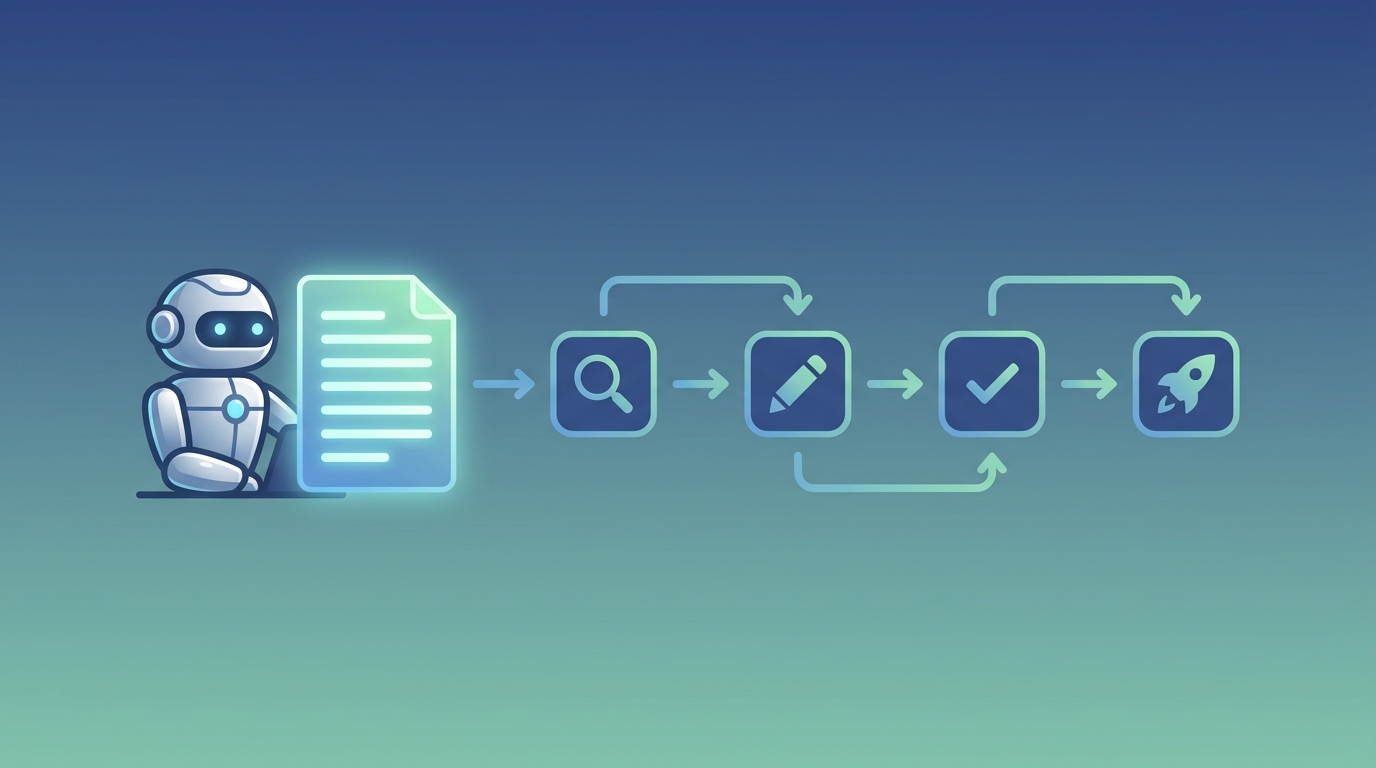
Most AI article generators produce content that reads like a Wikipedia summary rewritten by a college sophomore. It checks the word count box. It hits publish. Then it sits on page seven of Google collecting dust.
The problem is not AI itself. The problem is that most tools skip the steps that actually matter for rankings: keyword research, SERP analysis, entity coverage, and internal linking. They generate text. They do not generate articles designed to rank.
Key Takeaways
- Only AI article generators with built-in SEO research (SERP analysis, keyword data, entity extraction) produce content that consistently ranks on Google.
- The five tools in this list were selected because they output long-form, publish-ready articles with structural SEO baked in, not short-form copy or marketing blurbs.
- Price ranges span from $9/month to $299/month, but cost-per-article matters more than the monthly fee when you are scaling content production.
- The biggest differentiator between tools is research depth: generators that pull live SERP data and cite real sources outperform those that rely on pre-trained knowledge alone.
What Makes an AI Article Generator Rank-Worthy?
Before the list, it helps to understand what separates a tool that generates articles from a tool that generates articles that rank. There are three non-negotiable requirements.
First, real keyword data. The generator needs to pull actual search volume, keyword difficulty, and related terms from a live database. Tools that guess at keywords based on training data produce content that targets phrases nobody searches for.
Second, SERP-aware structure. The best tools analyze what is already ranking for your target keyword. They extract heading patterns, content length benchmarks, and semantic entities from the top 10 results. This is how they build outlines that match search intent instead of inventing structure from scratch.
Third, publish-ready output. A ranking article needs more than body text. It needs meta descriptions, proper heading hierarchy (H2s and H3s), internal links, and featured images. Tools that dump 1,500 words of unformatted prose into a text box leave most of the SEO work for you.
According to a 2025 study covered by Search Engine Land, 13% of top-performing Google content is now AI-generated, up from just 2.3% before GPT-2. But the gap between AI content that ranks and AI content that doesn't comes down to these structural details.
1. Jottler: The Autonomous SEO Content Pipeline
Jottler is not a writing assistant you prompt and babysit. It is an autonomous agent pipeline that handles keyword research, article writing, image generation, and CMS publishing without human intervention.
You connect your CMS (WordPress, Webflow, Shopify, or Framer), set a publishing frequency, and Jottler runs. Every article goes through a 12-agent pipeline that includes real keyword research using DataForSEO data, web scraping for source material, and structured long-form output at 3,000+ words.
What sets it apart for rankings:
- Data-driven topic selection. Jottler builds a topic tree with real search volume and keyword difficulty scores. You are not guessing at what to write about.
- Source-backed research. Every article cites real sources pulled from the web, not hallucinated references from training data.
- Full publishing automation. Articles go from idea to published post with featured images, meta tags, and internal links. The autopilot mode handles everything on a schedule you set.
- Scale pricing. Plans start at $29/month for 15 articles. The Scale plan covers 100 articles for $149/month, making it one of the lowest cost-per-article options available.
The trade-off is control. Jottler is designed for teams that want volume and consistency without managing each article manually. If you need to edit every sentence before publishing, a more hands-on tool might be a better fit.
2. Koala AI: SERP-First Content for Niche Sites
Koala AI has built its reputation on one specific strength: reverse-engineering what Google already rewards. Before writing a single word, KoalaWriter scans the top-ranking pages for your target keyword, extracts entities and semantic keywords, and identifies content gaps.
The result is an article that is structurally modeled after pages that already rank. That approach works well for niche blogs and affiliate sites targeting specific long-tail queries.
Key features for SEO rankings:
- Real-time SERP analysis. Koala pulls data from the top 10 results for your keyword and builds the article outline around what is already working.
- Deep Research Mode. This feature pulls from significantly more real-time context than standard generation, citing authoritative sources.
- Automatic internal linking. The platform indexes your entire site and adds contextual internal links during generation.
- Affordable entry point. Plans start at $9/month, making it accessible for solo bloggers and niche site builders.
Koala works best when you have a specific keyword and want a single, well-optimized article. Its bulk generation exists but is less developed than tools built specifically for scale. The output length tends to run shorter than dedicated long-form generators, so you may need to extend articles manually for competitive keywords.
3. Junia AI: Full-Stack SEO Content System
Junia AI positions itself as a complete SEO content system rather than just an article generator. The platform handles keyword research, content creation, meta data, image generation, and publishing in one workflow.
What makes Junia different from a generic AI writer is its focus on search intent matching. The tool analyzes current Google trends in real time, identifies ranking opportunities, and structures articles around the intent behind each query (informational, commercial, navigational, or transactional).
Ranking-focused features:
- Keyword analysis built in. Junia checks how well your content matches target keywords and provides optimization scores.
- Bulk generation with SEO optimization. You can upload a list of topics or keywords and generate optimized articles at volume, each with internal links, external links, and meta data.
- Real-time trend integration. The platform surfaces trending topics in your niche and suggests content opportunities before they become competitive.
- Multi-format support. Beyond blog articles, Junia generates product descriptions, landing page copy, and social content, all SEO-aware.
The platform scored 8.3/10 in independent reviews, with users noting strong output quality for informational content. Pricing lands in the mid-range for this category, and the learning curve is minimal for teams already familiar with SEO workflows.
4. SEOWriting.AI: Budget-Friendly Bulk Generation
If your primary constraint is budget, SEOWriting.AI delivers an unusual value proposition. At roughly $0.28 per article on the standard plan ($14 for 50 articles), it undercuts nearly every competitor in cost-per-article.
The tool combines content generation with real-time SERP analysis. As you generate articles, SEOWriting.AI scores your content against the current top results for your keyword, highlighting gaps in coverage and suggesting improvements.
SEO capabilities worth noting:
- Live SERP scoring. Each article gets a content score based on how it compares to currently ranking pages, so you can identify weak spots before publishing.
- Bulk article generation. Upload a CSV of keywords and generate articles in batch, each with unique structure and keyword targeting.
- WordPress auto-publishing. Articles can publish directly to WordPress, including meta tags and featured images.
- Permanent free tier. Five articles per month at no cost, no credit card required. Useful for testing before committing.
The trade-off is predictable: output quality does not match premium tools. Articles tend to be shorter and less research-backed than what you get from Koala or Jottler. For competitive keywords in established niches, you will likely need to edit and expand the output. But for programmatic SEO campaigns targeting hundreds of low-competition, long-tail keywords, the economics are hard to beat.
5. Byword: Scale-Focused Article Production
Byword is built for content teams and agencies that measure output in hundreds of articles per month. The platform supports CSV upload for bulk keyword processing, generates articles using GPT and Claude models, and publishes directly to WordPress, Webflow, and other CMS platforms.
More than 85,000 content teams use Byword, and the tool has carved out a strong position in the programmatic SEO space where volume matters as much as individual article quality.
Features that support rankings at scale:
- Multi-model generation. Byword uses GPT, Claude, and Gemini models, letting you choose which AI backbone produces the best results for your niche.
- Automatic internal linking. The platform identifies linking opportunities within your generated content and adds contextual links.
- DALL-E image generation. Each article gets an AI-generated featured image, eliminating the need for stock photo sourcing.
- Multi-language support. Generate articles in 10 languages for international SEO campaigns.
Pricing starts at $99/month for 25 articles ($3.96 per article), with the Standard plan at $299/month for 80 articles. The Scale plan reaches $999/month for 300 articles. These are higher price points than most tools on this list, though Byword's consistency and CMS integration make it popular with agencies managing multiple client sites.
The main limitation is research depth. Byword generates well-structured articles, but it does not perform the same level of live SERP analysis that Koala or Jottler offer. For highly competitive keywords, you may want to pair it with a separate SEO optimization tool for content scoring.
How to Choose the Right AI Article Generator
The five tools above serve different use cases. Here is a quick framework for matching a tool to your situation.
Choose based on your primary constraint:
- Budget is tight, volume matters most. SEOWriting.AI at $0.28/article is the clear winner for teams running programmatic SEO on low-competition keywords.
- You want zero-touch automation. Jottler's autopilot publishing handles everything from research to CMS posting without manual steps.
- You need deep SERP analysis per article. Koala AI's reverse-engineering approach produces the most SERP-aligned individual articles.
- You want a full SEO content system. Junia AI bundles keyword research, trend monitoring, and multi-format content into one platform.
- You run an agency or manage multiple sites. Byword's multi-model approach and high-volume plans are designed for this workflow.
According to DemandSage, 94% of marketers plan to integrate AI into their content creation workflows in 2026. The question is no longer whether to use an AI article generator, but which one matches your content strategy.
What to Watch For in AI-Generated Articles
Even the best generator will not produce perfect content every time. Before publishing, check for these common issues.
Factual accuracy. AI models sometimes cite sources that don't exist or state statistics that are outdated. Verify any specific claims, especially numbers and dates.
Keyword stuffing. Some generators over-optimize by repeating the target keyword in every paragraph. Read the article aloud. If a phrase feels forced, rewrite it.
Thin sections. Watch for H2 sections that are only two or three sentences long. These signal that the AI ran out of relevant information. Either expand the section with your own expertise or merge it with an adjacent topic.
Missing internal links. Even tools with automatic internal linking miss opportunities. Review each article and add links to your most important pages. A well-linked article with five to seven internal links will outperform an isolated page every time.
Frequently Asked Questions
Can AI-generated articles actually rank on Google?
Yes. According to Search Engine Land, 13% of top-performing Google content is now AI-generated (2025 data). Google's guidelines permit AI content as long as it is helpful, reliable, and people-first. The key is pairing AI generation with real keyword research, proper structure, and editorial review before publishing.
What is the difference between an AI article generator and an AI writing assistant?
An AI article generator produces complete, long-form articles from a keyword or topic input, often including SEO metadata, images, and publishing. An AI writing assistant (like ChatGPT or Grammarly) helps you write or improve text but does not handle the full research-to-publish workflow. Generators are built for scale, while assistants are built for collaboration.
How many articles should I generate per month for SEO?
Consistency matters more than volume. Publishing 8 to 12 well-optimized articles per month is enough to build topical authority in most niches within six months. Some teams using tools like Jottler publish 40 to 100 articles monthly for faster coverage, but quality and topical relevance should guide volume, not arbitrary targets.
Do I need to edit AI-generated articles before publishing?
For competitive keywords, yes. AI generators handle structure and coverage well, but they can miss nuance, include outdated information, or sound generic. A 10 to 15 minute editorial pass (checking facts, adding personal insights, and improving transitions) significantly improves ranking potential. For low-competition keywords, publish-ready output from premium tools often ranks without edits.
Are free AI article generators worth using?
Free tools like Grammarly's article writer and TinyWow produce coherent text, but they lack the SEO infrastructure (SERP analysis, keyword data, internal linking) that drives rankings. They work for drafting ideas or generating filler content. For articles you want to rank, invest in a tool with built-in SEO features.
How long would it take your team to publish 40 articles this month? With the right AI article generator, the answer could be one afternoon. Start a free trial at jottler.co and see the difference real research makes.