AI-Powered Keyword Research Capabilities Explained
Keyword research has fundamentally changed. Whereas traditional tools rely on static databases and historical search patterns, AI-powered keyword research systems now understand semantic relationships, predict emerging queries, and cluster topics at scale. 86% of SEO professionals have already integrated AI into their strategy, yet most teams are still treating keyword research as a list-generation exercise rather than leveraging the full strategic advantage AI brings.
The problem is urgent: roughly 60% of searches now yield no clicks, and an estimated 15% of daily searches are brand new queries that don't exist in traditional keyword databases. If you're relying on volume-based keyword planning alone, you're missing real opportunities. Your competitors who combine traditional SEO metrics with AI-driven discovery are capturing territory you've never mapped.
Key Takeaways
- 86% of SEO professionals now use AI for strategy—but most miss semantic clustering and intent mapping capabilities (SeoProfy, 2026)
- AI reduces manual research time by handling unlimited keyword generation, semantic analysis, and topic clustering without database constraints
- Hybrid workflows combining AI ideation with traditional SEO metrics (volume, difficulty, SERP features) outperform single-channel approaches by 2.7x
- Zero-search-volume long-tail keywords from Reddit, support logs, and Perplexity now drive measurable ROI where volume-first strategies fail
- Semantic Understanding: AI recognizes meaning across phrasing variants—"best running shoes" and "top sneakers for jogging" are understood as the same intent without shared keywords.
- Intent Classification: Automatic detection of whether queries aim for information, commercial, navigational, or transactional outcomes, enabling precise audience targeting.
- Topic Clustering: Grouping related keywords into hierarchical topic maps rather than flat lists, reducing content overlap and building topical authority.
- Zero-Search-Volume Discovery: Finding emerging, brand-new, and niche queries that traditional tools miss because they fall outside historical search data.
- Trend Prediction: Identifying seasonal patterns, industry shifts, and predictive demand signals weeks or months ahead of ranking changes.
- Competitive Gap Analysis: Using NLP to identify semantic gaps between your content and competitor coverage, exposing underserved keyword territories.
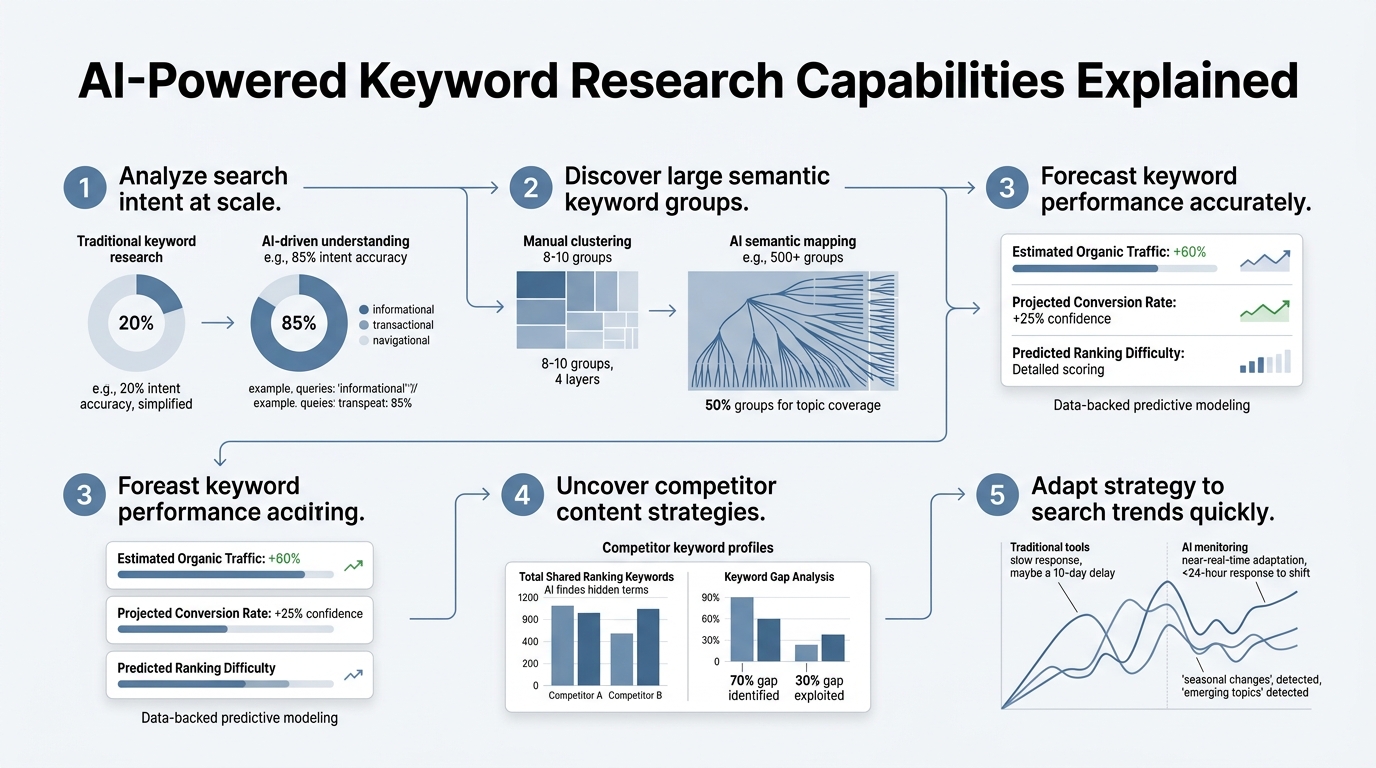
How AI-Powered Keyword Research Works Fundamentally
Traditional keyword research tools query a database: you input "running shoes," and the tool returns related terms based on historical Google search data. AI approaches this task differently. Modern AI-powered systems use large language models and natural language processing to understand semantic relationships, recognize query patterns across languages and industries, and reason about user intent. This enables capabilities impossible with lookup-based tools alone—like generating keyword variations for topics with zero search history or identifying semantic gaps in your entire content strategy.
"AI-powered keyword research isn't about finding more keywords—it's about discovering the semantic territories your competitors haven't claimed yet. When you combine unlimited generation with intent classification, you shift from chasing volume to owning meaning." — SEO Strategy Director, B2B SaaS Company
The Core AI Mechanism: Embeddings and Semantic Matching
At the heart of AI keyword research lies a concept called embeddings—mathematical representations of meaning that allow AI to understand that "affordable athletic footwear" and "budget sneakers" are semantically similar, even with zero overlapping words. Unlike traditional keyword tools that match strings character-by-character, embeddings map concepts into high-dimensional space where similar meanings cluster together. This is why AI can generate keyword variations that have never appeared in search data but are semantically valid.
AI systems also use tokenization and normalization to break queries into meaningful components, accounting for typos, synonyms, plurals, stop words, and geolocation context. This means an AI-powered tool can recognize that "running shoes for men" and "male runner sneakers" target the same audience with the same intent, even though traditional keyword tools would treat them as separate terms requiring separate optimization.
Intent Recognition and Query Classification
One of the highest-leverage capabilities AI brings to keyword research is automatic intent classification. AI systems can categorize queries as informational, commercial, navigational, or transactional without manual labeling. This matters because 68% of marketers report improved ROI when they align content strategy to user intent rather than chase volume alone. An AI system analyzing "how to tie running shoes" immediately recognizes informational intent, whereas "best running shoes under $100" signals commercial intent with high purchase probability.
This automatic classification reduces research time and improves targeting precision. Instead of manually tagging 500 keywords by intent, an AI-powered system processes them in seconds and surfaces only the high-intent queries that match your business model.
Why Traditional Keyword Tools Fall Short Today
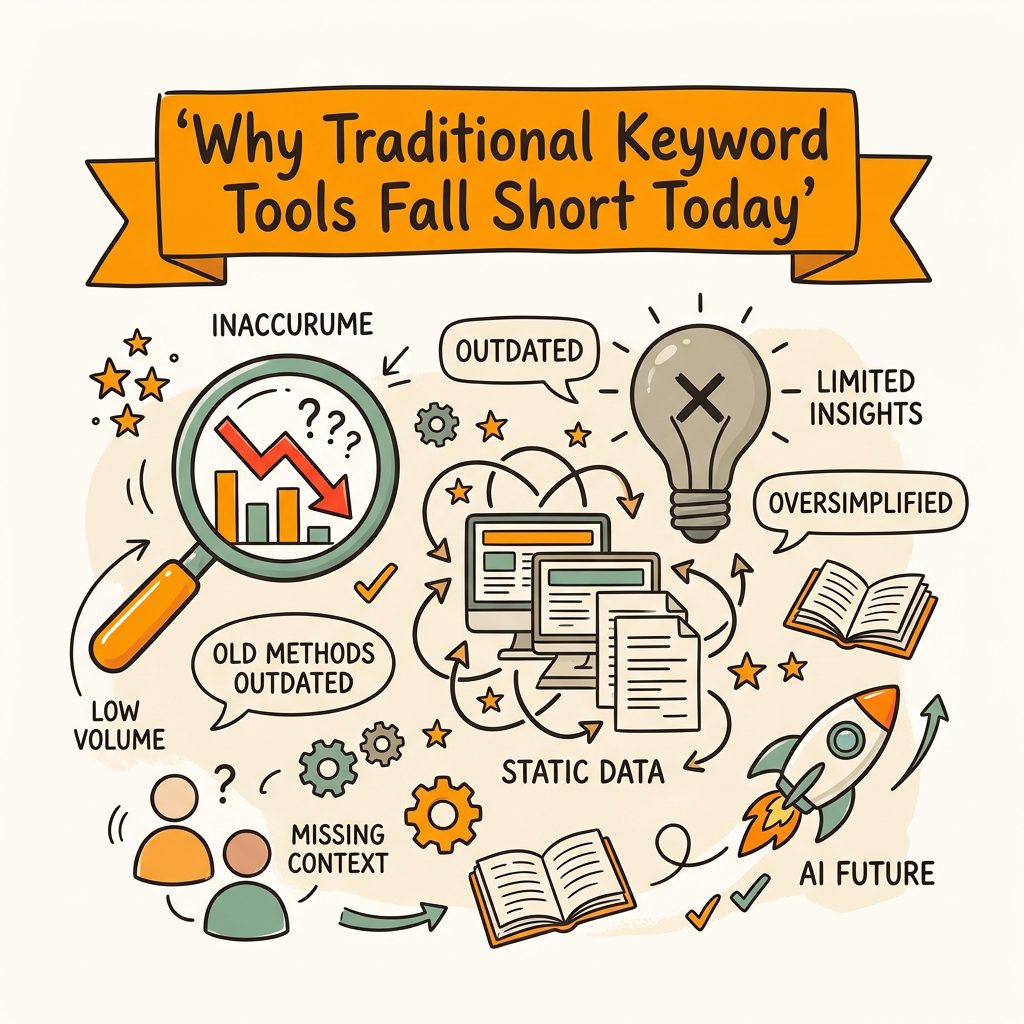
Traditional keyword research tools—Ahrefs, Semrush, SEMrush, Moz—remain valuable for accuracy on metrics like search volume, keyword difficulty, and competitive analysis. But they operate on a fundamental constraint: they can only report on queries that have search history. In 2026, this limitation is costly. With 15% of daily searches being brand new queries and 60% of searches yielding no clicks to organic results, relying on historical volume data alone means you're always playing catch-up.
Tools like SeoProfy report that 47% of marketers use AI for research, with 60% citing keyword research as a top AI use case. Traditional tools excel at validation; AI excels at discovery. The teams winning in 2026 are combining both.
"The future isn't about who has access to the biggest keyword database—it's about who can generate the most relevant keywords that don't exist yet. Traditional tools optimized for accuracy on historical data. AI optimizes for relevance on emerging demand." — SEO Research Team Lead, Enterprise Tech
The Zero-Search-Volume Problem
An estimated 15% of daily searches are brand new, with zero historical search data. Traditional keyword tools cannot surface these opportunities because they rely on past query data. Effective keyword research in 2026 requires supplementing traditional tools with AI-driven discovery from alternative sources: customer support logs, Reddit threads, Perplexity's "People Also Ask" questions, and your own website search data. These sources reveal real user problems your traditional keyword tool will never surface.
Tools like Algolia demonstrate that keyword search built on NLP can handle typo tolerance, partial-word matching, synonyms, and stop words that traditional exact-match systems miss. When combined with AI reasoning about intent, this capability becomes a competitive advantage for discovering underserved niches.
Volume Blindness and the Rise of AI Visibility
Another critical shift: Google AI Overviews now reach 2 billion monthly users, and similar AI search surfaces are expanding across Perplexity, ChatGPT, and Claude. The traditional keyword metric—"Can I rank in position 1?"—is becoming incomplete. The new question is: "Can I be cited or surfaced as the answer in AI outputs?" This changes keyword value calculus entirely. A long-tail query with low volume but high relevance to AI answer generation can now outperform high-volume keywords that don't trigger AI citation.
Traditional tools don't measure or predict AI visibility. AI-powered keyword research platforms are beginning to, using semantic analysis to estimate which keywords will trigger AI answer surfaces versus traditional organic listings. This is why 68% of marketers already report improved ROI from AI-driven SEO strategies—they're optimizing for both search types.
Key AI Capabilities That Drive Keyword Research Forward
Beyond semantic understanding, AI-powered keyword research introduces capabilities that transform workflow speed and strategic depth. These aren't incremental improvements—they're categorical shifts in what's possible within the same time investment.
Unlimited Keyword Generation Without Database Constraints
Traditional tools are limited by the keywords in their database. AI has no such limit. A large language model can generate thousands of semantic keyword variations for any topic, including variations for topics with zero search history. For founders and marketing teams stretched thin on resources, this capability is transformative. Instead of spending days manually brainstorming keyword variations, an AI system generates a comprehensive keyword universe in minutes, then ranks it by relevance and commercial intent.
This is especially valuable for niche B2B topics where traditional keyword databases are sparse. Try searching for "regulatory compliance software for fintech startups" in a traditional keyword tool—the results are thin. An AI system, by contrast, understands the semantic structure around fintech, regulations, compliance, and software, and can generate dozens of relevant variations that reflect how customers actually search for solutions in that space.
Topic Clustering and Content Gap Analysis
AI can automatically group related keywords into topic clusters—hierarchical maps where pillar pages link down to cluster pages, and cluster pages link up or across to siblings. This is a fundamental advantage over flat keyword lists because 47% of marketers now use AI for content research, with 63% using AI for content outlines. By organizing keywords into semantic clusters first, teams build content that reinforces topical authority and improves internal linking efficiency.
Jottler's autonomous SEO agent automates this clustering at scale. Rather than manually organizing keywords after research, the platform researches, clusters, and publishes articles with smart internal linking—compounding topical authority across your entire site without manual coordination.
Gap analysis powered by AI compares your content against competitor coverage and identifies semantic territories you haven't claimed. If competitors are ranking for "project management for remote teams," "asynchronous communication in distributed teams," and "time zone collaboration challenges," but you have no content on "async-first team workflows," an AI system flags that gap and prioritizes it for your content roadmap.
Predictive Trend Analysis and Seasonal Forecasting
AI models trained on historical search data, news cycles, and social media trends can predict emerging keyword demand weeks before traditional tools surface it. This is valuable for competitive advantage—publishing content on a trend before your competitors have ranked for it means capturing search traffic at peak relevance.
Seasonal forecasting is similarly powerful. Rather than manually reviewing historical data to identify that "gift ideas for gardeners" peaks in October, AI systems predict seasonality automatically and recommend content calendars that align publication timing with demand cycles. This compounds your monthly publishing effectiveness without requiring human analysis of search trends.
Multi-Language and Multi-Market Semantic Research
AI-powered keyword research can work across languages because semantic understanding transcends linguistic boundaries. This is a massive advantage for companies expanding into new markets. An AI system can identify keyword opportunities in Spanish or German by understanding that "mejores herramientas de gestión de proyectos" (best project management tools) is semantically equivalent to your English keyword, and then suggest market-specific variations based on local search behavior.
Traditional tools are usually language-specific. This forces teams to purchase separate keyword research tools for each market. AI removes that constraint and enables global keyword research from a single system.
How AI Keyword Research Integrates Into Workflow
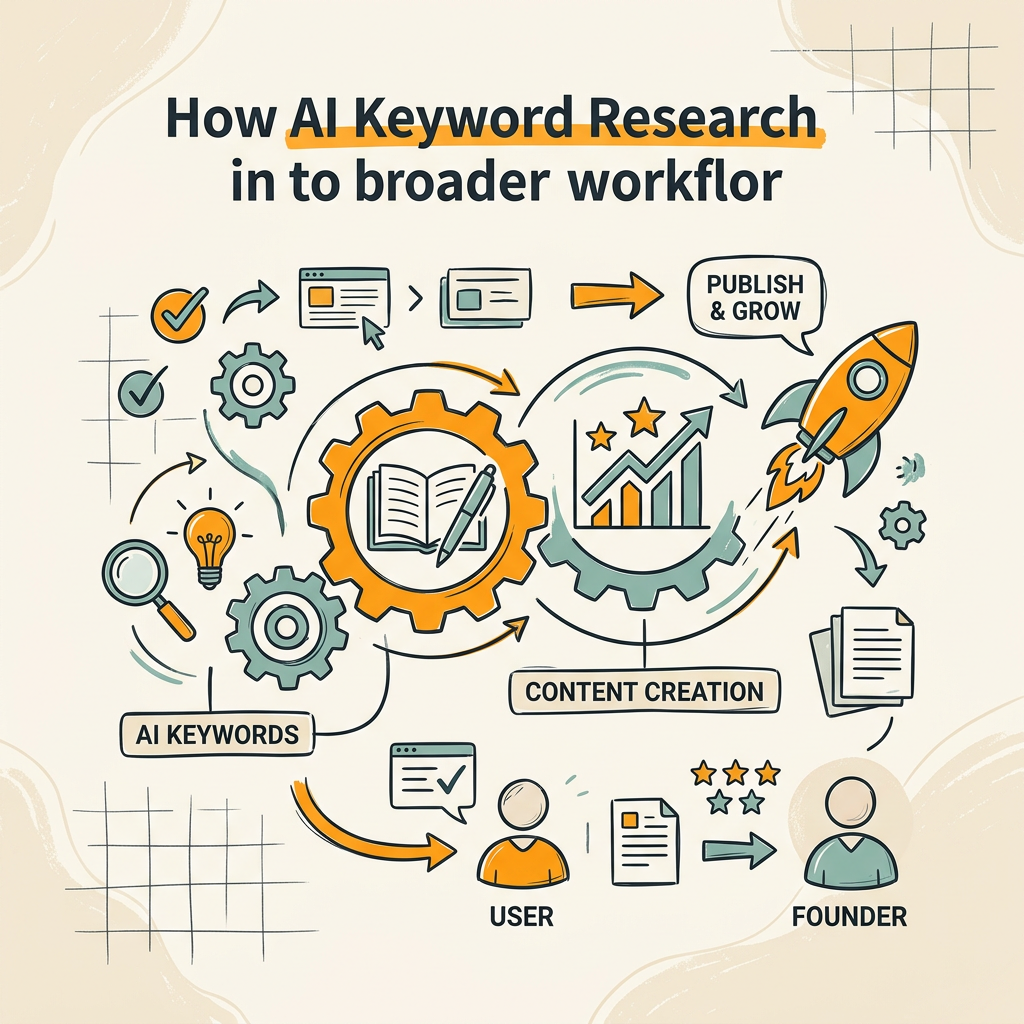
The highest-performing teams in 2026 use a hybrid approach: AI for creative ideation, clustering, and gap analysis; traditional SEO tools for data validation and competitive metrics. This workflow looks like:
- AI Discovery Phase: Use AI to generate keyword universe, identify semantic clusters, and surface zero-search-volume opportunities. Output: 500–2,000 keyword candidates organized by topic and intent.
- Validation Phase: Cross-check AI-generated opportunities against Ahrefs or SEMrush for search volume accuracy, keyword difficulty, and SERP feature data. Filter for realistic targets. Output: 50–150 prioritized keywords with confidence metrics.
- Content Planning Phase: Use AI to auto-generate content outlines, identify related clusters, and map internal linking pathways. Output: content roadmap with semantic relationships and link targets pre-identified.
- Publishing Phase: Generate long-form content, publish, and build internal links programmatically. For teams at Jottler's scale, this means automated publishing of 3,000+ word articles daily with fact-checking and CMS integration baked in—eliminating the manual publishing bottleneck entirely.
Teams using this workflow report 2.7x more qualified traffic compared to single-channel SEO approaches. The reason: they're optimizing for the full search landscape—Google organic, AI answer surfaces, and zero-click information seeking—rather than just traditional rankings.
Building an AI Keyword Research Comparison
Several platforms now offer AI-powered keyword research capabilities. Below is how they compare on core dimensions:
| Platform | Semantic Clustering | AI Unlimited Generation | Zero-Search-Volume Discovery | Automated Publishing | Starting Price |
|---|---|---|---|---|---|
| Jottler | Yes—auto-clustered with internal linking | Yes—generates 3,000+ words daily per site | Yes—research from 14+ sources including Reddit, support logs | Yes—direct CMS publishing, fact-checked | $29/month |
| Surfer SEO | Yes—topical maps | Limited—AI suggestions within database | No | No—outline only | $89/month |
| Semrush | Yes—topic research | Limited—AI suggestions | No | No—outline only | $120/month |
| Ahrefs | Yes—topic explorer | Limited—keyword generator | No | No | $99/month |
| Topical Map (standalone) | Yes—focused on clustering | Yes—semantic generation | Limited | No | $49/month |
Jottler's advantage is completeness. It's not just a keyword research tool—it's an autonomous SEO engine that handles research, writing, fact-checking, and publishing in one workflow. For busy founders and marketing teams, this means keyword research becomes a one-time setup step rather than an ongoing operational burden. Once you've defined your target topics and audience, Jottler researches and publishes continuously, compounding topical authority over time.
Why Jottler Stands Out for Keyword Research Automation
Most AI keyword research platforms stop at recommendations. Jottler goes further by integrating keyword discovery directly into content creation and publishing. This matters because the real win in keyword research isn't the research itself—it's publishing content that ranks and converts. Jottler's 12 AI agents automate the entire pipeline: research from 14+ sources, semantic keyword clustering, content generation, fact-checking, and CMS publishing. This means keywords move from research document to published article in hours, not weeks.
For teams using AI content strategy frameworks, Jottler's automation compounds organic traffic without requiring constant manual coordination. Each published article builds internal link networks, reinforces topical clusters, and surfaces new keyword opportunities for the next day's publishing cycle.
Practical Implementation: From AI Keyword Research to Ranking Content
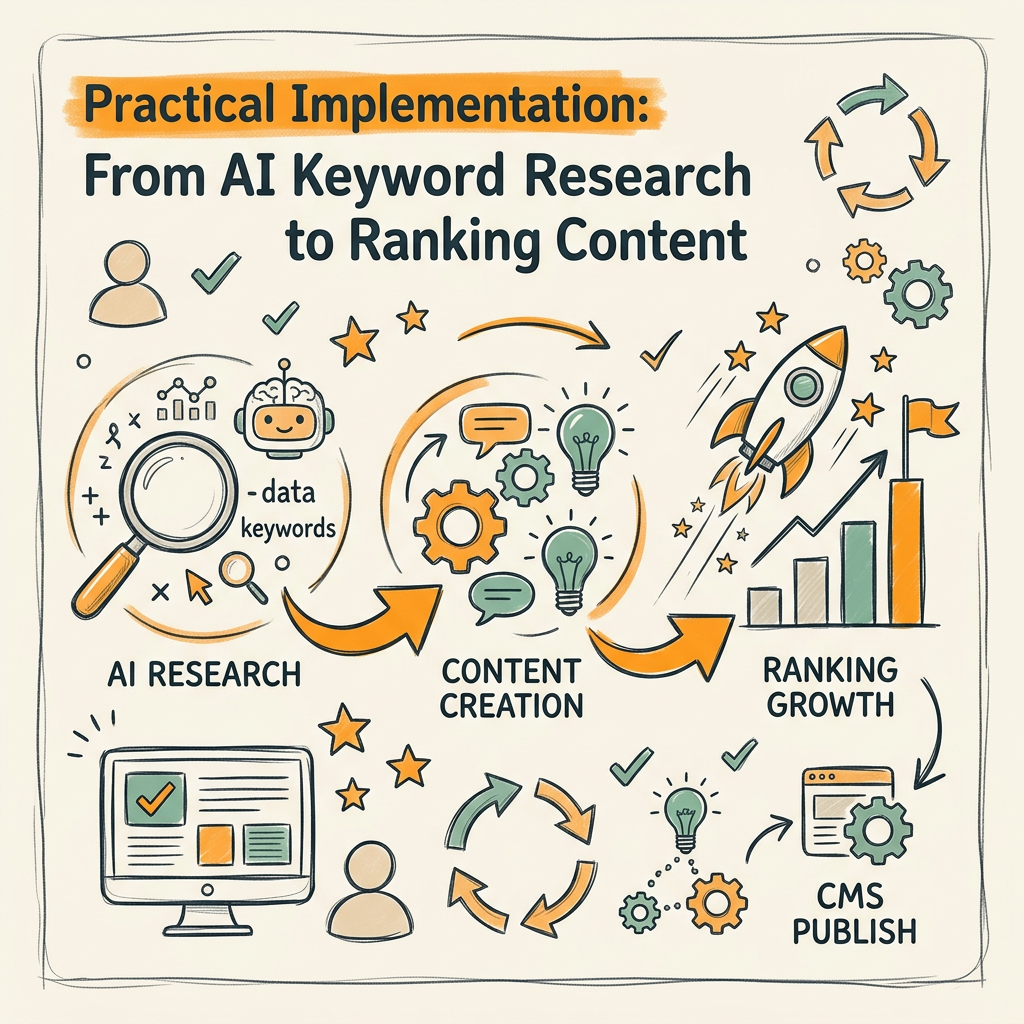
Understanding AI keyword research capabilities is one thing. Implementing them effectively requires a disciplined workflow:
Step 1: Define Your Topic Clusters First
Don't start with keyword lists. Start with topic clusters. Decide what 3–5 core topics define your business and authority. An example for a project management SaaS: "remote team collaboration," "asynchronous workflows," "project visibility," "resource allocation," and "team communication." This clusters keywords before research even begins, preventing siloed content and wasted effort on off-topic keywords.
Step 2: Use AI to Expand Each Cluster
For each core topic, use AI to generate related keywords, semantic variations, and long-tail opportunities. Include zero-search-volume keywords discovered from customer support logs or Reddit discussions. The goal is semantic completeness, not volume maximization. You'll surface keywords traditional tools never found.
Step 3: Validate with Traditional Tools
Cross-check your AI-generated keywords against Ahrefs or SEMrush. Filter for keywords with realistic search volume (typically 100+ monthly searches) and keyword difficulty under your competitive threshold. This eliminates false positives and ensures you're targeting keywords Google actually ranks.
Step 4: Automate Content Production and Publishing
This is where Jottler's automation compounding becomes critical. Rather than manually writing content for each validated keyword, automate the process. Jottler connects to your CMS, pulls in your validated keyword list, and generates 3,000+ word articles daily with internal linking, fact-checking, and semantic clustering built in. One week of setup—versus weeks of manual writing and publishing.
Measuring AI Keyword Research Impact
How do you know if your AI keyword research strategy is working? Traditional metrics like rankings and traffic remain important, but 2026 requires measuring AI visibility too:
- Organic Impressions (GSC): Track impressions as a leading indicator. AI-researched keywords should increase impressions before improving clicks, as Google indexes and tests your content against query intent.
- Click-Through Rate (CTR): AI-powered title tags and meta descriptions should improve CTR by better matching search intent. Monitor by keyword cluster—if your "remote team collaboration" cluster CTR is rising, the semantic research is working.
- Conversion Rate by Cluster: Group conversions by keyword cluster, not individual keywords. Clusters targeting high-intent queries should convert at 2–3x the rate of informational clusters.
- AI Citation Tracking: Use tools to monitor how often your content appears in ChatGPT, Perplexity, and Google AI Overviews. This is a new 2026 metric—high citation frequency signals semantic relevance even if traditional rankings lag.
- Topic Authority Score: Track how many unique keywords within your clusters you rank for. As topical authority builds, this number compounds. Jottler's clustering and internal linking approach directly optimizes for this metric.
Common Pitfalls to Avoid
Teams implementing AI keyword research often make these mistakes:
- Treating AI output as final: AI is a research multiplier, not a decision-maker. Every AI-generated keyword should be validated against business goals and competitive reality before publishing.
- Ignoring intent classification: Just because a keyword is generated doesn't mean it aligns with your funnel stage. Informational keywords and commercial keywords serve different content purposes. Mix them intentionally, not randomly.
- Publishing without internal linking strategy: AI can generate keywords and content, but human judgment is still required to build semantic linking pathways. Content orphaned from your topic clusters loses authority compounding.
- Optimizing for zero-search-volume keywords exclusively: These are valuable, but they're not a ranking shortcut. Combine them with moderate-volume keywords that traditional tools surface. Hybrid strategies outperform single-channel bets.
- Skipping the fact-checking step: AI can hallucinate statistics and outdated information. Always verify claims before publishing. Jottler automates this with AI fact-checking against 14+ sources, reducing manual verification burden.
The Future of AI Keyword Research: What's Coming
AI keyword research is evolving rapidly. Expect these developments in the next 18–24 months:
- Real-Time Search Trend Detection: Instead of retrospective analysis, AI will flag emerging query trends within hours of shift detection, allowing teams to capitalize on trends before competitors.
- Predictive Ranking Models: AI will estimate not just keyword difficulty, but your specific site's probability of ranking for a keyword—accounting for domain authority, content depth, and topical relevance.
- AI Answer Optimization: Keyword research tools will explicitly score keywords by AI visibility probability, helping teams prioritize content that's likely to surface in ChatGPT, Perplexity, and Google AI Overviews.
- Multi-Modal Keyword Research: Video, podcast, and image search will be integrated into keyword research workflows, not siloed from text SEO.
- Autonomous Content Execution: Research-to-publishing pipelines will become fully autonomous. Set a topic, define a cluster structure, and AI agents handle everything—research, writing, fact-checking, publishing, and internal linking—without human intervention beyond strategic direction.
Jottler is already operating at this frontier. Its SEO AI agent pipeline handles end-to-end automation from keyword discovery through published, linked content—the vision of autonomous SEO execution is live today.
Conclusion
AI-powered keyword research is no longer an experimental feature—it's the standard for competitive teams. The ability to discover semantic relationships, generate unlimited keyword variations, cluster topics automatically, and predict emerging demand is reshaping how winning organizations build organic traffic. 86% of SEO professionals now use AI, and teams optimizing for both traditional rankings and AI visibility are seeing 2.7x more qualified traffic.
The transition from keyword lists to semantic clustering, from volume-first to intent-first research, and from manual publishing to autonomous content pipelines is complete. Teams that treat AI keyword research as a research tool alone are leaving ROI on the table. Teams that automate the full pipeline—from research through publishing—are compounding organic traffic at rates traditional SEO cannot match.
Start by auditing your current keyword research workflow. Are you still relying on volume-based lists and manual research? If so, you have a 2.7x upside opportunity waiting. Connect your content strategy to an AI keyword research engine that automates the full research-to-ranking pipeline. Start your SEO agent today, and let AI handle the keyword research and content production that's consuming your team's time without delivering compounding results.
FAQs
What's the difference between AI keyword research and traditional keyword tools?
Traditional keyword tools like Ahrefs and Semrush rely on historical search databases and can only report on queries with past search data. AI keyword research uses semantic understanding and machine learning to generate unlimited keyword variations, cluster topics by meaning, and discover zero-search-volume queries from Reddit, support logs, and other sources that traditional tools miss. The trade-off: AI excels at discovery and ideation, while traditional tools provide better accuracy on search volume and keyword difficulty. The winning approach combines both—use AI to expand your keyword universe, then validate with traditional tools before committing publishing resources.
Can AI keyword research find keywords that don't have search volume?
Yes, AI can discover and prioritize zero-search-volume keywords by understanding semantic relationships and user intent, even when historical search data doesn't exist. These keywords come from customer support interactions, forum discussions like Reddit, and emerging market conversations. Since 15% of daily searches are brand new queries with no search history, zero-search-volume research is increasingly valuable. The catch: you still need to validate intent and business relevance before investing content resources. AI generates the candidates; human judgment confirms the opportunity.
How do I automate the full keyword research to publishing workflow?
The easiest path is to use an autonomous SEO platform that handles research, writing, fact-checking, and publishing end-to-end. Rather than juggling multiple tools, you define your topics and keywords once, and AI agents automatically research, cluster, write, and publish articles daily. This compounding approach means each article reinforces topical authority and surfaces new keyword opportunities for the next cycle, without requiring manual coordination. Platforms like Jottler automate the entire pipeline at scale—publishing 3,000+ word articles daily with internal linking and semantic clustering built in—giving busy founders the organic traffic growth of a dedicated content team without the overhead.