AI-Powered Keyword Research: Features That Drive Results
Keyword research still feels like a manual, time-intensive grind for most marketing teams. Yet 86% of SEO professionals have already integrated AI into their strategy, and 68% of marketers report higher ROI from AI-assisted workflows. The gap between teams moving fast and those stuck grinding spreadsheets keeps widening.
The difference isn't luck. It's choosing the right AI-powered keyword research features—the ones that actually save hours, uncover profitable long-tail keywords, and cluster intent correctly. This guide breaks down which features move the needle and how to spot them.
Key Takeaways
- 86% of SEO professionals use AI in strategy—it's mainstream, not optional (SeoClarity, 2025)
- Automated keyword clustering by intent replaces manual spreadsheet work and surfaces topical authority gaps
- AI visibility tracking across ChatGPT, Gemini, and answer engines is now a must-have feature for competitive positioning
- Intent-Driven Keyword Clustering: AI groups keywords by search intent instead of raw volume, letting you build topic clusters and content hubs faster.
- Multi-Source Keyword Discovery: Modern tools pull from Google Search Console, Reddit, autocomplete, and community data—not just traditional SEO databases.
- SERP-Aware Traffic Modeling: Real traffic estimates tied to search intent and competitive landscape, not guesswork.
- Semantic Entity Extraction: AI identifies missing topics, entities, and subtopics your content should cover to rank.
- AI Search Visibility Tracking: Monitor how your brand and keywords appear in ChatGPT, Gemini, and other AI answer engines.
- Integrated Content Briefing: AI creates optimized briefs from keyword data, eliminating the research-to-writing handoff.
What Makes AI Keyword Research Different From Traditional Tools?
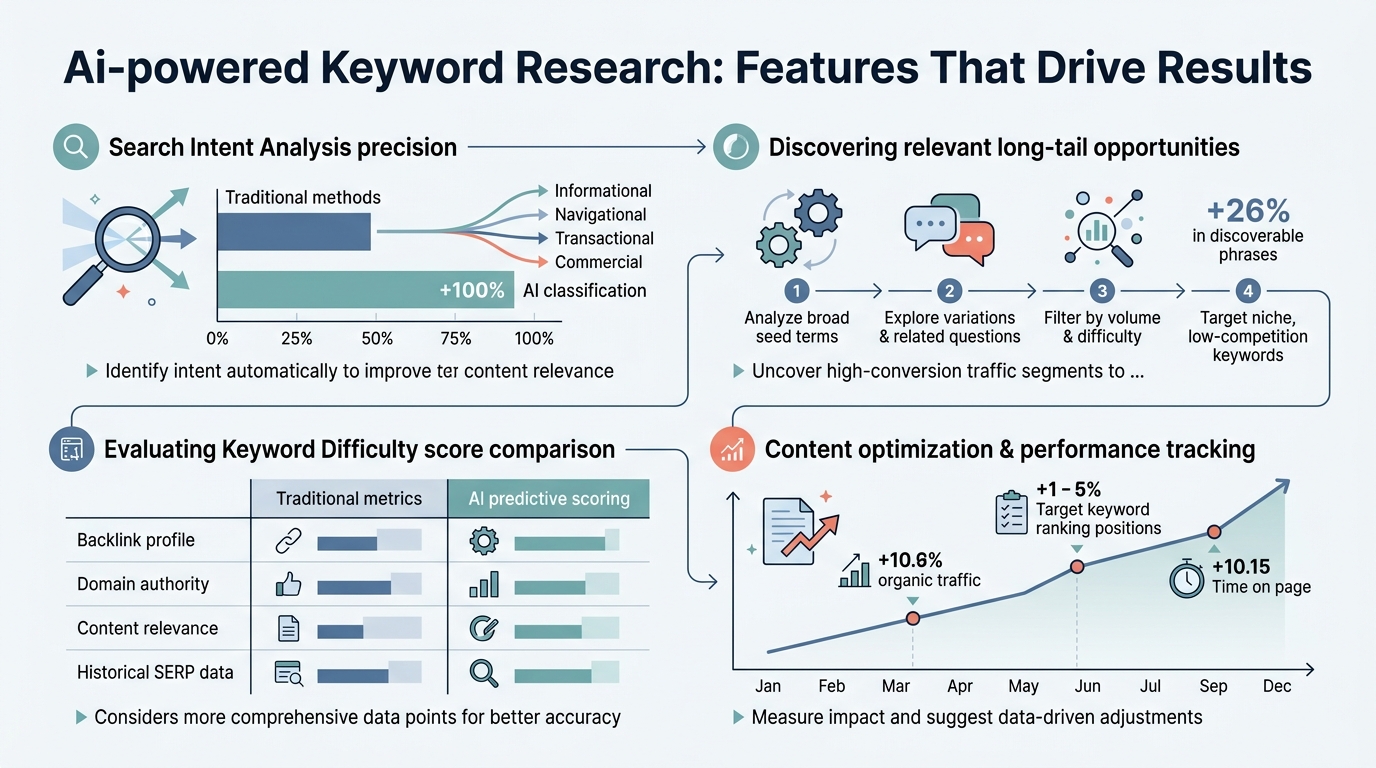
Traditional keyword research tools give you volume, difficulty, and CPC. AI-powered tools do that—but they layer on intent modeling, semantic relationships, and real-time SERP analysis. 90% of content marketers plan to use AI to support content marketing in 2025, driven by this exact shift.
The biggest practical difference? Traditional tools ask "How many people search for this?" AI keyword research asks "What are they actually trying to do, what subtopics matter, and how do I build topical authority around this?" Recent analysis from Siege Media shows this intent-first approach is reshaping how content teams prioritize.
"AI keyword research fundamentally changes the question from 'What gets searched?' to 'What does the searcher need to find?'"
— Industry analysis, 2025
Beyond Raw Search Volume
Search volume alone is a trap. A keyword with 1,000 monthly searches might convert zero customers if the searcher intent is informational and your product is transactional. AI keyword research tools analyze the actual SERP results, the entities mentioned, and the language patterns to predict whether a keyword will drive real business value.
Tools like Jottler's AI agents for keyword research can validate intent against your site structure, automatically grouping keywords into content pillars and subtopics—without manual clustering spreadsheets.
Speed of Keyword Expansion
Manually brainstorming and validating 200+ keywords takes weeks. AI-powered tools expand seed keywords into hundreds of relevant variations, long-tail queries, and question-based searches in minutes. Teams using AI-assisted ideation report 47% more published content monthly, partly because keyword discovery no longer bottlenecks the content pipeline.
How Does Intent-Driven Clustering Work?
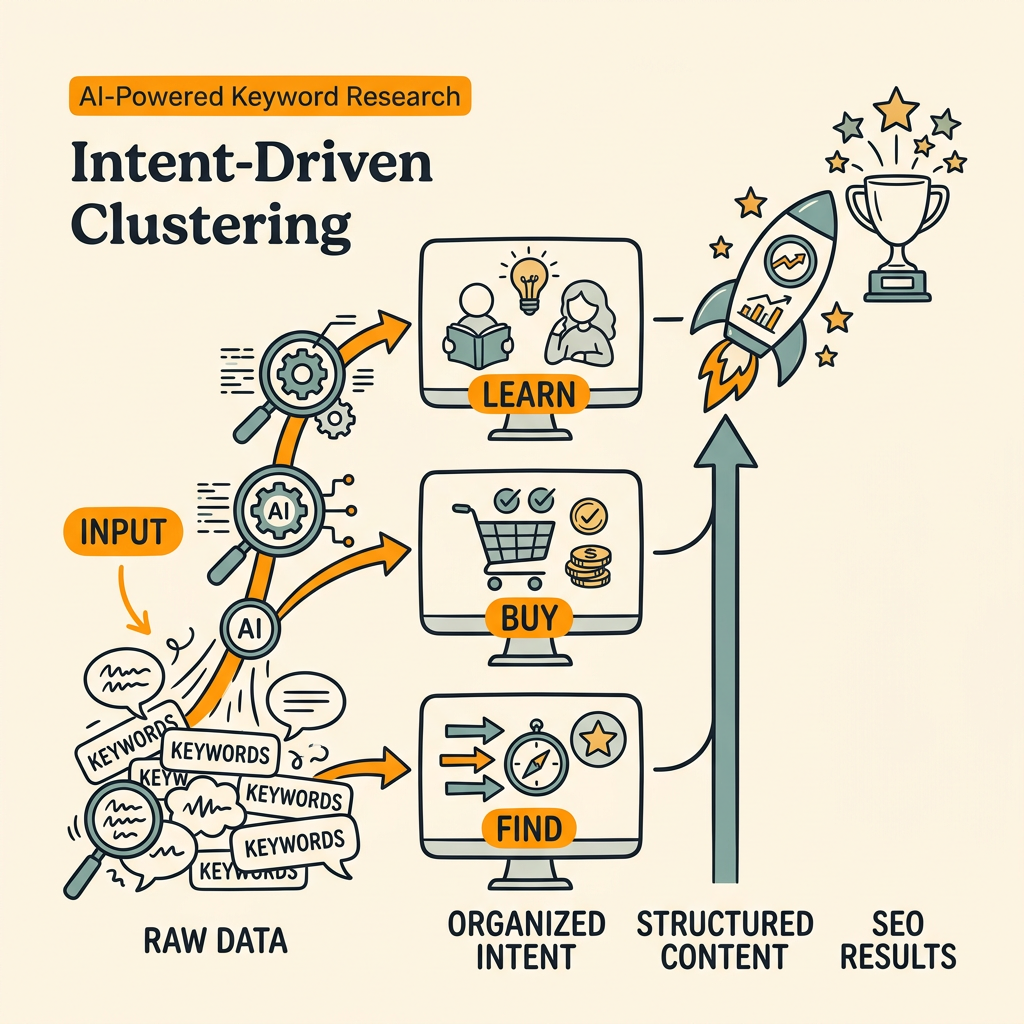
Intent clustering is the feature that separates good keyword research from great. Instead of grouping keywords alphabetically or by volume, AI algorithms group them by what the searcher is actually trying to accomplish. 71.7% of content teams use AI for outlining, and intent clusters are the foundation of that outlining—they tell you what subtopics and supporting content each pillar page needs.
Informational vs. Transactional vs. Commercial Intent
AI keyword research tools automatically classify each keyword into intent buckets. "How to fix a leaky faucet" is informational; "buy plumbing services near me" is transactional. When you have 500 keywords, this classification matters—it determines content type, page structure, and CTA placement. The tool should surface this for you, not make you guess.
Jottler's AI agents run SERP analysis and intent detection alongside keyword research, so every keyword comes tagged with predicted intent. This eliminates the back-and-forth: keyword research is complete when it arrives at the writing team, with structure already implied.
"The teams that win are the ones where keyword research output is actionable content briefs, not spreadsheets waiting for manual processing."
— Content operations leader, B2B SaaS, 2025
Building Topic Clusters Automatically
Once keywords are clustered by intent, the next leap is automatic topic modeling. The AI identifies pillar topics and subtopics—what should be a 3,000-word cluster page, and what should be supporting satellite content. A strong AI keyword research tool creates the topic map for you, not a list you have to manually organize into a map.
This is where tools that combine keyword research with AI content strategy shine. Instead of "here are 200 keywords," you get "here's a 12-article topic cluster with internal link recommendations." That's the feature that actually saves weeks.
Which Features Directly Impact SEO Performance?
Not all AI keyword research features matter equally. 65% of businesses report better SEO results using AI, but they're likely using specific high-impact features, not toy features. Here's what to prioritize.
SERP-Aware Difficulty Scoring
Keyword difficulty scores are only useful if they predict whether your site can actually rank. Traditional difficulty scores look at backlink profiles of top-ranked sites; AI-powered difficulty scoring also analyzes SERP layout, featured snippet presence, and content freshness requirements. A keyword might have low traditional difficulty but high AI difficulty if every result is a news article or Wikipedia page—meaning your blog post won't break through.
This feature saves you from ranking thousands of keywords no human will ever click. It steers you toward keywords where real traffic is possible, not just technical ranking positions.
Real-World Traffic Potential, Not Just Volume
AI-powered tools now estimate actual click-through traffic, not just search volume. This accounts for SERP features (featured snippets, ads, People Also Ask) that reduce click-through rates. A keyword with 10,000 volume but 8 SERP features might only deliver 200 actual clicks. Tools that integrate clickstream data show realistic traffic potential, letting you prioritize keywords by actual business impact.
When choosing an AI keyword research tool, ask: does it estimate traffic or just volume? The answer changes your entire content strategy.
Key questions to evaluate traffic modeling capabilities:
- Does the tool account for SERP features (featured snippets, People Also Ask, ads) that reduce organic clicks?
- Can you compare estimated traffic across keywords to identify high-impact targets?
- Does it show historical traffic trends or only current estimates?
- Can you validate estimates against your own Google Analytics data?
Semantic Entity Extraction
Semantic entity extraction identifies the concepts, entities, and subtopics that top-ranking pages cover for a given keyword. If you're ranking for "project management tools," the AI finds that every top page covers "team collaboration," "task automation," "reporting," and "mobile access." These aren't separate keywords—they're semantic requirements embedded in top pages.
This feature is especially powerful for content optimization. Your AI keyword research tool should tell you not just what keyword to target, but what else you must cover on that page to compete. Tools that bundle this with AI content strategy briefing (like Jottler) eliminate the gap between research and writing.
AI Search Visibility: The New Competitive Advantage
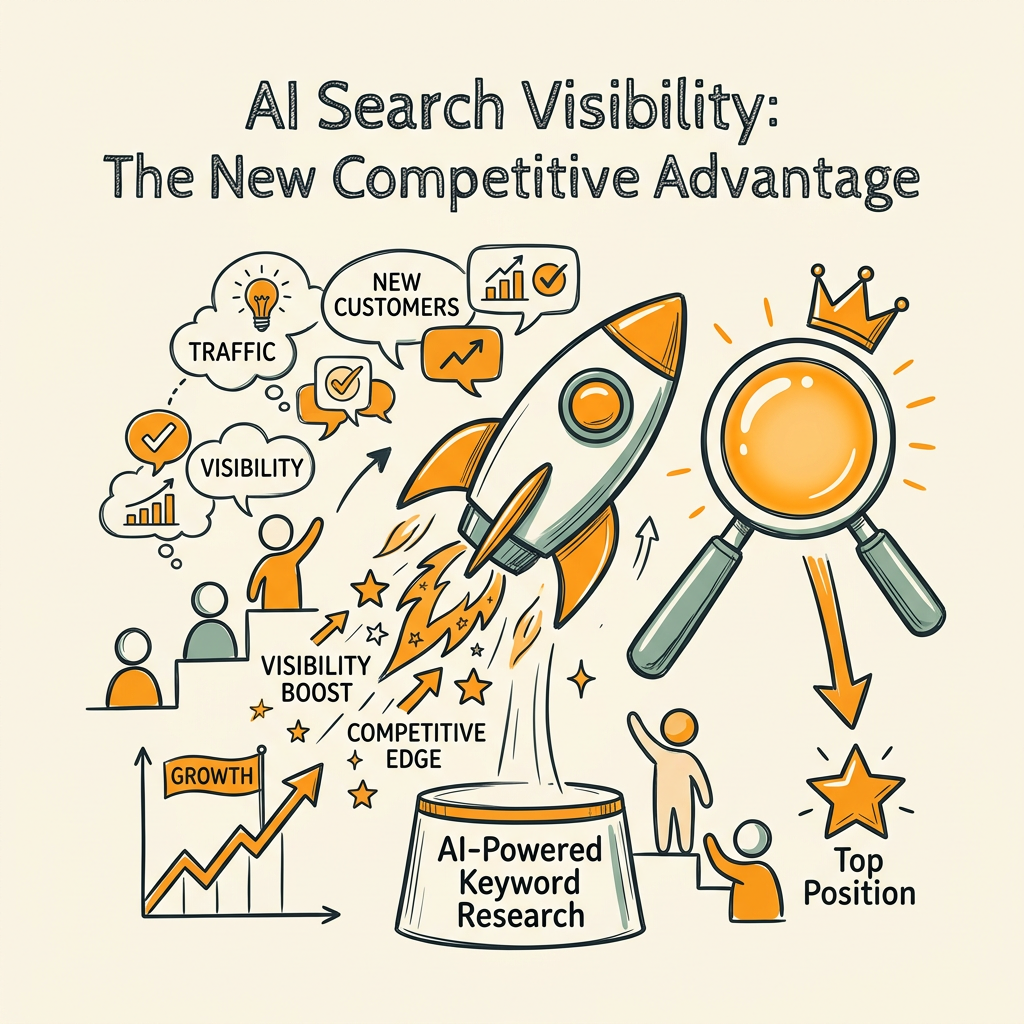
Ranking in Google organic results is half the battle. The other half is appearing in ChatGPT, Gemini, and other AI answer engines. AI visibility tracking is now described as a non-negotiable enterprise feature in 2026 evaluations—and it's reshaping keyword research priorities.
Monitoring Brand Citations in AI Models
Advanced tools now track whether your brand is cited in AI-generated answers. A keyword might rank #1 in Google but appear nowhere in ChatGPT answers. Sophisticated keyword research tools show you this gap—which keywords have high "Share of Model" (SoM) across AI discovery surfaces, and which don't. This tells you where to invest content for long-term visibility as search evolves.
Tracking AI visibility involves monitoring multiple surfaces:
- ChatGPT citations: Does your brand or content appear in ChatGPT responses for target keywords?
- Gemini visibility: How often do you appear in Google's Gemini AI responses?
- Perplexity and other answer engines: What's your presence across emerging AI search platforms?
- Citation frequency trends: Is your share of model growing or declining over time?
Optimizing for AI Search vs. Blue-Link Ranking
AI search engines have different content preferences than traditional SEO. They value depth, authority citations, and answer-oriented content. Keyword research tools that flag "AI optimizable keywords" help you build content that works across both surfaces. According to recent evaluations from Single Grain, the strongest 2026 tools integrate AI visibility tracking as a core metric. Instead of choosing between ranking in Google and appearing in ChatGPT, AI keyword research reveals keywords where you can win in both.
Comparison of Key Features Across Leading Approaches
| Feature | Jottler | Semrush | Ahrefs | Surfer SEO |
|---|---|---|---|---|
| Intent-Driven Clustering | ✓ AI agents handle full analysis | ✓ Keyword Magic Tool groups by intent | ✓ Keywords by Intent grouping | ✓ SERP-aware clustering |
| Real-Time SERP Analysis | ✓ Per article during generation | ✓ Separate tool, requires clicks | ✓ Built-in clickstream modeling | ✓ Core to optimization |
| Semantic Entity Extraction | ✓ AI identifies in content briefs | ✓ Limited, manual review needed | ✓ Keyword Ideas, some limitations | ✓ Primary feature of platform |
| AI Search Visibility Tracking | Planned feature | ✓ Via SEO Toolkit | ✓ Brand Radar (paid add-on) | Limited visibility |
| Integrated Content Briefing | ✓ Automatic from keyword data | Separate step, manual input | Separate step, manual input | Limited, optimization-focused |
| Publishing Automation | ✓ Writes and publishes 3,000+ words daily | None (research tool only) | None (research tool only) | None (optimization tool only) |
| Pricing Starting Point | $29/mo | $120/mo | $99/mo | $99/mo |
The table shows a clear pattern: specialized research tools (Semrush, Ahrefs, Surfer) excel at one dimension each—intent grouping, realistic metrics, semantic optimization. But only end-to-end platforms like Jottler combine keyword research, content creation, and publishing automation, eliminating the handoffs that slow down organic growth.
For busy founders and scaling teams, this matters. You don't just need better keywords—you need a system that goes from keyword research to published, optimized content automatically. That's where SEO automation compounds.
How to Evaluate AI Keyword Research Tools for Your Team
Not every AI keyword research tool is built for every team. Agencies, publishers, and SaaS teams have different needs. Here's how to evaluate which features matter for your context.
Match Features to Your Team Structure
If you have dedicated SEO specialists, a research-focused tool like Semrush or Ahrefs makes sense—they excel at deep analysis and competitive research. If you're a founder or small marketing team trying to scale content output without hiring, you need research + writing + publishing bundled together. Jottler's approach—AI agents that research, write, and publish 3,000+ word articles daily—is built for the latter.
The wrong tool becomes expensive overhead. The right tool becomes a time multiplier.
Test the Clustering Quality
The best way to evaluate keyword clustering is hands-on: plug in 3-5 seed keywords in each tool and see how it groups them. Does it understand intent? Does it surface long-tail questions? Does it create a sensible topic map? Some tools cluster like spreadsheets; great tools cluster like a strategic marketer would.
Evaluation checklist for clustering quality:
- Does the tool group similar intent keywords together logically?
- Are long-tail variations surfaced and categorized by intent level (informational, commercial, transactional)?
- Can you export the clustered data in a usable format for content planning?
- Does it identify pillar topics and satellite content relationships automatically?
- Can you customize or override clustering based on your business needs?
Validate Traffic Estimates Against Your Own Data
Take a keyword you already rank for, check what the tool estimates for traffic, and compare to your actual Google Analytics. If the tool says 500/month and you get 50, it's overestimating. Consistency matters more than absolute accuracy—if it's consistently off by 10x, you can adjust. If it's random, it's not useful.
Conclusion
AI-powered keyword research has moved past "nice to have" into baseline competitive requirement. 86% of SEO pros are already using it, and teams that don't are leaving organic traffic and qualified leads on the table. The keywords you find matter, but the features you rely on matter more—intent clustering, SERP-aware difficulty, semantic entity extraction, and AI search visibility are the modern forces that drive real SEO results.
The teams winning now combine AI keyword research with automated content creation. They research, write, and publish at a pace that makes manual SEO look antiquated. If you're still researching keywords manually or outsourcing to writers who start from scratch, you're losing 6-12 months of potential organic compound growth every year.
Start by auditing which features your current keyword research setup actually gives you—and which critical gaps exist. Then pick a tool or platform that fills those gaps without adding complexity. For teams focused on organic growth without the capacity to manage 5+ tools, Jottler's autonomous approach (research + writing + publishing in one AI system) eliminates the fragmentation and gets your best keyword research to published articles in days, not months.
Start your SEO agent and see how AI keyword research compounds when it's tied to fast content production.
FAQs
What are the top AI keyword research features in 2026?
The most impactful features are intent-driven clustering, SERP-aware difficulty scoring, semantic entity extraction, and AI search visibility tracking. Intent clustering replaces manual spreadsheet grouping and surfaces which keywords belong in the same topic cluster. SERP analysis tells you realistic traffic potential, not just volume. Semantic extraction identifies missing subtopics your content must cover to rank. And AI visibility tracking shows whether your brand appears in ChatGPT and Gemini answers, not just Google. These four features directly impact SEO performance and content strategy.
How much faster is AI keyword research than manual research?
Manual keyword research for a single topic takes 4-8 hours; AI-powered research on the same topic takes 15-30 minutes. Expanding 10 seed keywords into a full topic cluster and content map manually takes a week; AI tools do it in an hour. The time savings compound when research is connected to content creation—platforms that generate briefs and outlines from keyword data eliminate handoff delays entirely, letting content teams go from keyword to draft in 1-2 days instead of 2-3 weeks.
Do AI keyword research tools work for niche or B2B SEO?
Yes, but with caveats. Broad consumer keywords have abundant SERP data; niche and B2B keywords have less training data, so AI models may miss nuance. The best approach for B2B is combining AI keyword discovery with human validation—use AI to expand seed keywords and cluster intent, then review for business relevance and sales alignment manually. Tools that bundle SERP analysis and customer research (like Jottler's integration of Search Console and competitor analysis) work better for B2B because they ground keyword research in your actual business data, not just generic intent models.