AI Powered SEO: Transforming Every Stage of Search
The SEO world has fundamentally shifted. A few years ago, SEO meant ranking pages on Google. Today, success means getting cited by ChatGPT, Perplexity, and Google AI Overviews. Your ranking position matters less. Your citation frequency matters more.
AI has infiltrated every layer of SEO: keyword research, content creation, technical audits, on-page optimization, and publishing. But most marketers treat AI as a writing tool. That's leaving money on the table. Real AI-powered SEO transforms your entire workflow, from strategy to execution to measurement.
Key Takeaways
- AI-powered SEO uses machine learning to automate keyword research, content creation, technical audits, and competitor analysis at scale.
- Over 2 billion monthly users engage with Google AI Overviews, fundamentally changing where content gets discovered and cited.
- 68% of marketers confirm AI has improved their SEO ROI, with 40% reporting 6-10% revenue increases after implementation.
- Citation frequency (mentions in AI-generated answers) is now as important as traditional Google rankings.
- Successful AI-powered SEO requires optimizing for both traditional search engines and generative AI models simultaneously.
What AI-Powered SEO Actually Is
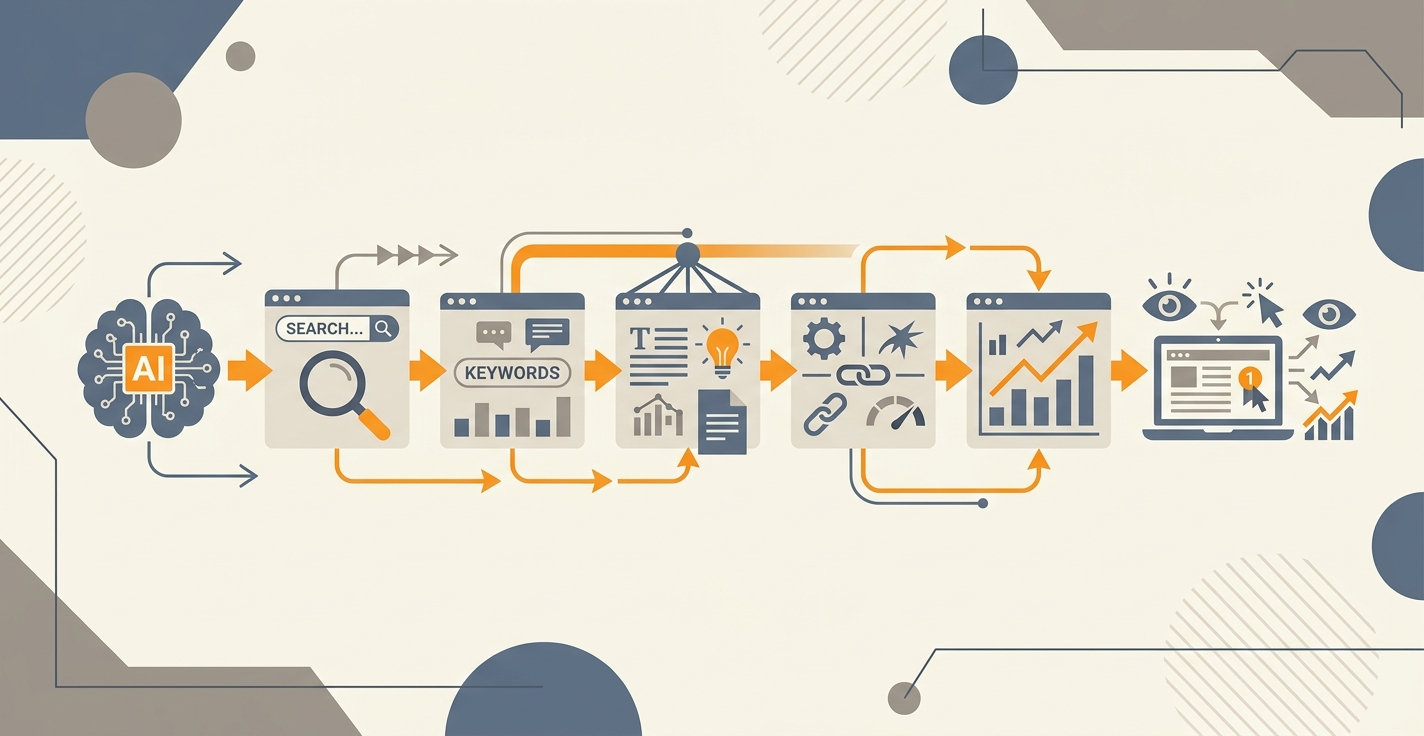
AI-powered SEO isn't ChatGPT writing your blog post. It's a coordinated pipeline of machine learning agents that handle research, writing, optimization, publishing, and measurement. Often, this happens without human intervention.
The difference between generic AI and AI-powered SEO tools is research. ChatGPT hallucinates. Real AI SEO platforms connect to live keyword databases, search engine APIs, and web scrapers. Every article is built on actual search volume, keyword difficulty, competitor analysis, and semantic trends. The platform conducts real research before writing begins.
Example: An AI-powered SEO platform pulls real DataForSEO keyword data and competitor research. It then writes 3,000+ word articles from that research, auto-generates featured images, suggests internal links based on topical clusters, and publishes directly to your CMS. The entire process is data-driven, not guesswork.
The platform coordinates 12 specialized AI agents: keyword research, content strategy, outline building, writing, SEO optimization, image generation, internal linking, and fact-checking. Each operates independently but passes output to the next. The human defines the topic, target volume, and publish frequency. The agents do the rest.
Why Traditional SEO Metrics Are Becoming Obsolete
For decades, SEO success meant organic click-through rate. Rank #1, get the most clicks. Rank #5, get fewer. Simple math.
In 2026, that math is breaking. Google AI Overviews now appear in search results for over 2 billion monthly queries. Users don't click links. They read AI-synthesized answers directly in the SERP. If your site isn't cited in that answer, your ranking position is irrelevant.
Research shows a 61% drop in organic CTR as AI Overviews cannibalize traditional link clicks. The impact is real and measurable across most niches. But here's the flip side: AI-referred traffic converts 23 times higher than traditional search traffic. The users who click through from an AI reference are already sold on your credibility. They've been explicitly told your content is authoritative enough to cite in an AI answer.
This creates a new SEO hierarchy. Cited in AI answers is most valuable. Ranking #1-3 for traditional search is valuable but declining. Ranking #4-10 has declining value. Ranked but not cited is noise.
How AI Changes Keyword Research
Traditional keyword research uses SEMrush or Ahrefs to find keywords with decent search volume and low competition. Write content. Hope Google ranks you.
AI-powered keyword research is different. Machine learning analyzes search behavior across Google, ChatGPT, Perplexity, and other AI platforms. It identifies not just volume, but intent shifts, emerging long-tail opportunities, and topic clusters Google rewards with featured snippets.
AI tools can process millions of keywords in minutes. They spot patterns humans miss: seasonal shifts in search intent, emerging subtopics before they trend, question-based queries that indicate AI search interest, and semantic connections between keywords that signal topical authority.
According to Demandsage research, 47% of marketers now use AI to identify emerging search trends. The remaining 53% are playing catch-up.
The speed advantage is brutal. An AI agent can research 100 long-tail keywords, identify the 10 most valuable clusters, and build a content calendar in hours. A human researcher needs weeks.
The Content Creation Revolution
AI content writing has two reputations: either magical or worthless. The truth is more mixed. Generic ChatGPT prompts produce thin, derivative content that ranks nowhere. But AI research combined with AI writing, human editing, and AI optimization equals content that ranks faster and converts better than traditional SEO writing.
Here's what changes. Speed goes from 2-5 days per 3,000-word article to 20-30 minutes. Consistency improves. Every article follows the same structure, includes the same number of stats, optimizes for the same on-page factors. Human writers drift into style inconsistencies.
Depth increases. AI tools research competitors, extract their top-performing sections, and write better. They identify semantic gaps competitors miss. The resulting article is often richer and more detailed than hand-written pieces.
Citation readiness improves. AI-powered platforms specifically optimize for AI citability: answer-first formatting, clear definitions, structured lists, self-contained paragraphs that LLMs can extract verbatim.
The catch: you still need human oversight. AI gets names wrong, conflates statistics, and occasionally invents facts. The best workflow is: AI draft, then human edit, then AI optimization. You get 80% of the efficiency gain with 95% of the quality.
According to Search Engine Land, 72% of SEO roles will be impacted by generative AI. But that's not job elimination. It's job transformation. Tedious work gets automated. Strategic work becomes the bottleneck.
Optimizing for AI Overviews and Generative Search
This is the new frontier. Traditional SEO still works. But getting cited by AI is a separate optimization challenge.
Citing preferences are measurable. ChatGPT prefers content with high entity density (specific names, numbers, dates). Comparison tables with 3+ sections earn 25.7% more citations. Lists with 8+ items earn 26.9% higher citation rates. Concise language with short sentences earns 18.8% higher citation rates. Definite phrasing (not vague) gets cited more.
Why? LLMs are trained to cite authoritative sources. Content that's clear, specific, and structured is easier to cite. Content that's vague or filled with filler is harder to extract.
The technical gap: most SEO tools optimize for Google's traditional ranking factors. Few optimize for AI citability. Purpose-built AI-powered SEO platforms win here. They analyze your content against known AI preferences and rewrite it for higher citation likelihood. They restructure paragraphs, shorten sentences, clarify vague claims, and add entity mentions.
Result: your content gets cited more often by LLMs, even if your ranking position shifts.
Automating the Entire Content Operations Workflow
The real power of AI-powered SEO emerges when you stop thinking in single articles and start thinking in pipelines.
Manual workflow for one article takes 24.5 hours: brainstorm (4 hours), research (6 hours), outline (2 hours), write (8 hours), edit (2 hours), optimize (1 hour), create image (1 hour), publish (0.5 hours).
AI-powered workflow: set publishing frequency once (5 minutes), then agents handle everything. Monthly oversight: 0.5 hours.
This isn't hyperbole. AI SEO platforms let you configure publishing frequency (1-10 articles per day). The system handles keyword research, writing, visuals, internal linking, and publishing automatically. Try Jottler's autopilot to see this in action.
At scale, this changes your content economics. Traditional agencies cost $4,000-8,000 per month for 4-8 articles. Freelancers cost $2,000-4,000 per month for 8-16 articles. AI-powered SEO costs $149 per month for 100 articles.
Cost per article drops from $500-2,000 to $1.50. That transforms content production economics.
Measuring Success Beyond Rankings
This requires a mindset shift. You're no longer measuring success by positions and CTR. You're measuring citation frequency (how often content appears in AI-generated answers), entity mentions (brand mentions across sources), answer engine traffic (conversions from ChatGPT and Perplexity), topic coverage (depth in a given vertical), and semantic relevance (how well your cluster covers a topic).
Traditional Google Analytics doesn't track AI referrals well. Most SEO tools miss AI referral sources. You need specialized platforms to measure AI visibility accurately.
The business impact, though, is real. 68% of marketers report improved ROI from AI-powered SEO. 40% report 6-10% revenue increases after implementation.
Most startups see measurable impact in 30-60 days. Mature sites with existing authority see faster results (14-30 days). Sites in competitive verticals may take 90+ days before ranking shifts.
Common Mistakes With AI-Powered SEO
Mistake one: treating it as a replacement for human strategy. AI executes strategy faster, not better. You still need to decide which topics matter, which competitors to benchmark against, and how to position your brand. AI is the hammer. Strategy is the blueprint.
Mistake two: publishing thin, generic content at scale. 100 mediocre articles will rank worse than 10 great ones. AI speeds up execution, but the quality bar remains. Garbage in equals garbage out. You need editorial oversight on every piece or quality suffers.
Mistake three: ignoring E-E-A-T signals. Experience, Expertise, Authoritativeness, Trustworthiness. AI can write on any topic, but Google and AI models reward sites with demonstrable authority. AI-powered SEO works best when you're building in a vertical where you have credibility.
Mistake four: forgetting that Google is still a search engine. AI is the future, but today, Google still drives 90% of organic traffic. Don't obsess over AI optimization at the cost of traditional SEO. Optimize for both.
The Future: From SEO to Search Excellence
AI-powered SEO is transitioning the industry from Search Engine Optimization (gaming one platform's algorithm) to Search Excellence (dominating across all search surfaces: Google, ChatGPT, Perplexity, Google AI, YouTube, Amazon).
Tools that can't operate at this breadth will become niche. The new generation of SEO platforms will coordinate visibility across every search surface, not just Google.
What does that look like? One content piece is optimized for Google rankings, ChatGPT citations, and Perplexity discovery simultaneously. Topics are planned based on data from all search engines, not just Google. Performance is measured across all referral sources, not just organic. Publishing frequency and cadence are optimized by AI, not guessed by humans.
This transition is happening now. Sites that adapt in 2026 will dominate their verticals in 2027-2028. Sites that ignore it will lose relevance.
To automate this process, explore how topical authority builds the SEO foundation that AI optimizes. Or use an AI-powered content engine to coordinate visibility across all search surfaces.
Frequently Asked Questions
What's the difference between AI SEO and generative engine optimization?
AI SEO is the broader category: using machine learning across all SEO tasks. Generative Engine Optimization (GEO) is a specific subset: optimizing content to be cited by AI models like ChatGPT and Perplexity. All GEO is AI SEO, but not all AI SEO is GEO. A well-rounded AI-powered SEO strategy includes both traditional ranking optimization and GEO for complete search visibility.
Can I use ChatGPT for SEO without paying for dedicated AI SEO tools?
ChatGPT is a content writer, not an SEO platform. It doesn't have access to keyword data, SERP analysis, competitor research, or publishing integrations. You can write drafts, but you'll spend hours on manual research, fact-checking, and optimization. Dedicated tools include these capabilities built-in, cutting your time by 80%.
How long does it take to see results from AI-powered SEO?
Most sites see measurable traffic increases within 30-60 days. Mature sites with existing authority often see results in 14-30 days. Competitive niches may take 90+ days. The faster you publish high-quality, optimized content, the faster you'll see results. One article per day compounds faster than one per week.
Is AI content trusted by Google?
Yes, if it's high-quality and original. Google doesn't penalize AI-written content. It penalizes low-quality, thin, or duplicate content. Well-researched, fact-checked AI content ranks as well as human-written content. The key is editorial oversight.
What's the best AI SEO tool for my site?
That depends on your needs. For full-stack automation (research, writing, publishing, optimization), purpose-built platforms excel. For optimization-only, Surfer SEO is strong. For research-only, SEMrush has the most data. Identify your primary pain point, then choose a tool that solves it.