AI Writing Tool Features Every Content Marketer Should Know
Content marketers face a brutal math problem: 97% of content teams plan to adopt AI writing tools in 2026, yet most aren't using them strategically. They're treating AI as a replacement for writers instead of a force multiplier for their entire workflow. The stakes are clear: teams that understand what AI writing tools actually do gain 42% higher monthly content volume and publish 4.1x more content per marketer per month than those who don't. The gap between smart adoption and wasted spend is a feature set away.
Key Takeaways
- 97% of content marketers plan to use AI writing tools in 2026, with teams averaging 11 hours of time savings per week and 42% higher monthly content output.
- The must-have features are SEO optimization (keyword clustering, SERP analysis), research automation (fact-checking, source attribution), and CMS integration for hands-off publishing.
- Content drafting remains the top use case at 78% weekly adoption, but audience research and SEO brief generation are growing fastest at +23 and +17 percentage points year-over-year.
- SEO Optimization Features: Keyword clustering, SERP-driven outlines, and real-time readability scoring reduce manual research time from hours to minutes.
- Research and Fact-Checking: Built-in source attribution, plagiarism detection, and citation suggestions keep content accurate and defensible against AI skepticism.
- Multi-Format Content Generation: Long-form articles, email subject lines, ad copy, and social media variants from a single AI engine cut tool sprawl and setup friction.
- Deep Research Integration: Tools that pull from 10+ sources automatically and verify claims against data reduce the fact-decay risk that kills SEO rankings.
- CMS Publishing and Internal Linking: Autonomous publishing directly to WordPress, HubSpot, or custom CMSs with intelligent internal linking compounds organic traffic without manual workflows.
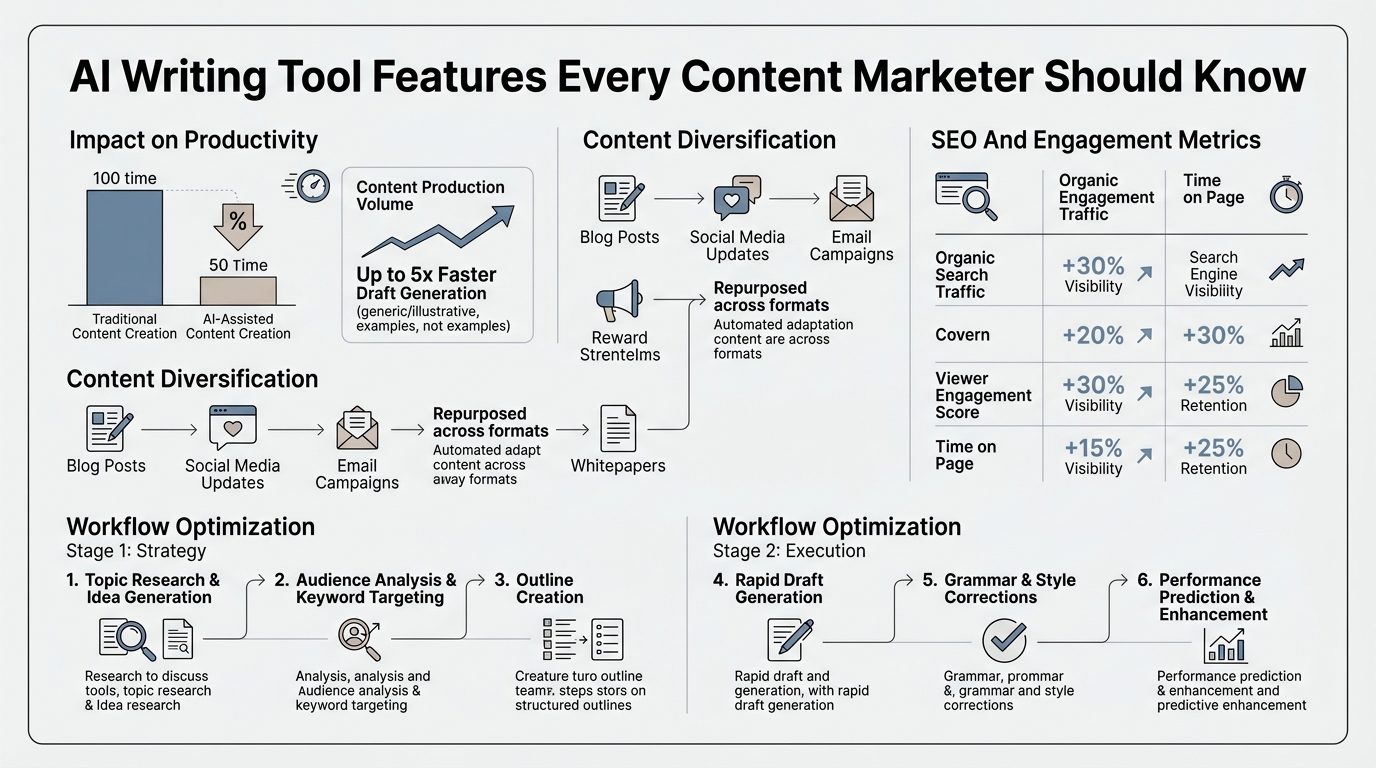
What Features Separate Effective AI Writing Tools From The Rest?
The AI writing tool market has fractured into two categories: commodity generators that churn out forgettable copy, and strategic systems that drive measurable SEO and content compound growth. The gap between them is four core feature clusters that determine whether your tool saves time or costs you rankings.
"The most effective AI writing tools share a fundamental architecture: they integrate deep research capabilities with SEO optimization, then automate the publishing layer so content reaches your CMS and audience without human handoff."
Tools that miss even one of these layers leave your team doing the work they adopted AI to eliminate.
Research Depth: Why Most AI Tools Fail Here
44% of AI users report regularly fixing AI-generated mistakes, a sign that surface-level generation without research backing is still rampant. The best AI writing tools solve this with multi-source research pipelines that pull from 14+ authoritative sources, fact-check claims against those sources, and attribute each statistic back to a real citation. This isn't optional for content marketers—it's the difference between content that compounds your authority and content that erodes it.
Tools like those built on autonomous research agents (pulling from industry reports, academic databases, news sources, and proprietary data) can generate a 2,000-word article with real citations attributed throughout, cutting the fact-checking phase from days to minutes. The alternative is publishing content that passes a grammar check but fails credibility in an AI-saturated landscape where readers demand proof.
SEO Optimization Built Into The Generation Process
SEO optimization at scale requires three sub-features working in concert: keyword clustering that groups semantically related terms, SERP analysis that shows what the top-ranking pages actually do, and real-time readability scoring aligned to your target keyword's difficulty. 53% of content marketers now use AI for SEO brief and outline generation, the fastest-growing single use case, because this combination cuts content planning time by half.
"Tools that analyze the top 10 SERP results for each target keyword and generate outlines that match ranking patterns before the writer even touches the keyboard represent algorithmic alignment with proven ranking patterns, not keyword stuffing."
Tools missing this layer force your team to do SERP analysis manually, which negates most of the time savings the AI promises.
Multi-Format Content In One Engine, Not Five Separate Tools
The feature creep trap: buying a long-form article generator, then adding an email copywriter, social media variant tool, ad copy generator, and video script writer. That's five subscription bills, five logins, five training curves, and five separate quality standards. The best AI writing tools compress this into unified content generation where a single brief generates article, email subject lines, 3-5 social variants, and a 30-second video script from a shared knowledge base about your brand voice and audience.
- Single knowledge source: Update your brand voice once, and it applies to every format the AI generates.
- Content lifecycle integration: Generate the article, then extract social teasers and email hooks from the same research data—no re-briefing required.
- Consistency without handoff: All formats share the same facts, sources, and brand positioning, eliminating the version conflicts that plague multi-tool stacks.
How Do SEO Features in AI Writing Tools Actually Work?
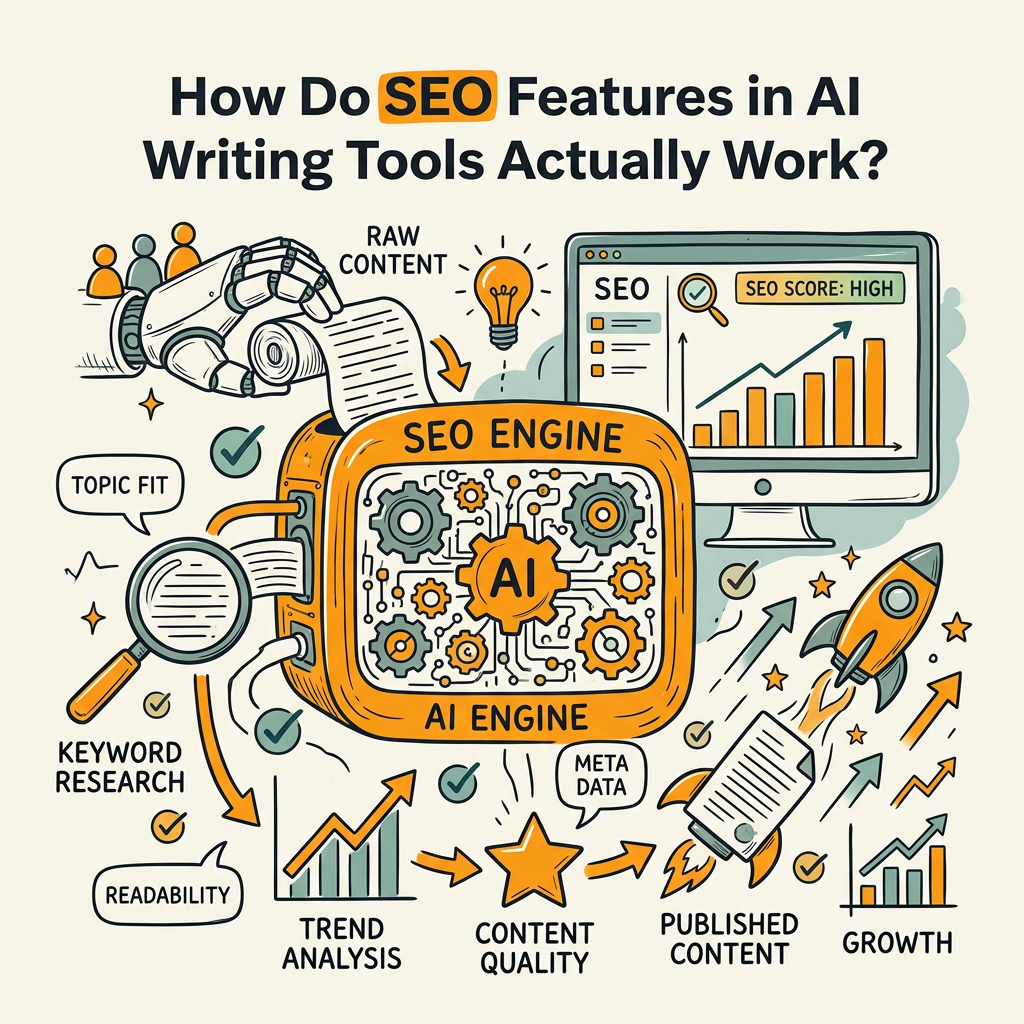
Modern AI writing tools embed SEO directly into the generation process by analyzing what ranks and then generating content that matches those patterns. This isn't guesswork—it's pattern recognition applied to search results. The mechanism works in three stages: pre-generation research, real-time optimization during drafting, and post-generation verification.
Keyword Clustering and Intent Mapping
The first layer is keyword research that goes beyond single-term volume data. Advanced AI writing tools cluster related keywords into semantic families based on search intent. A tool analyzing "best AI writing tools" won't just find that keyword—it will surface "AI content generator," "AI blog writer," "AI copywriter," and "AI writing assistant" as related intent buckets. Then it maps these into outline sections.
This prevents the common mistake of targeting too narrow a keyword and missing traffic from adjacent intent clusters. Tools like Conductor highlight how SERP-driven intent clustering helps teams see not just where traffic is, but what different audiences are actually asking for. The AI then generates outlines that address multiple intent clusters in a single long-form piece, compounding your traffic potential.
Real-Time SERP Analysis and Structural Recommendations
As the AI drafts, effective tools perform live SERP analysis: they check your word count against the top 10 competitors, recommend heading structures that match ranking patterns, and suggest keyword placement in headings and the opening paragraph. This automated optimization is what separates tools that save time from tools that save time AND improve rankings.
The mechanism is straightforward—analyze top-ranking content for each keyword target, extract structural and semantic patterns, feed those as constraints to the generation model, and produce content that's pre-aligned with what Google has already ranked. Jottler builds this into its core research pipeline: 12 specialized agents analyze search results, content structure, and competitive patterns before the writing agent even begins drafting.
Readability and Tone Scoring Against Your Target Audience
SEO optimization has a readability ceiling—content that ranks but doesn't convert is a waste of effort. The best AI tools score readability in real time, showing whether your Flesch-Kincaid score aligns with your audience's reading level, whether your paragraph lengths vary for scanability, and whether your call-to-action is present and prominent. Some tools integrate this with brand voice scoring, ensuring every generated piece sounds like your company, not a generic AI output.
Why Research Automation Beats Manual Fact-Checking for Content Marketers
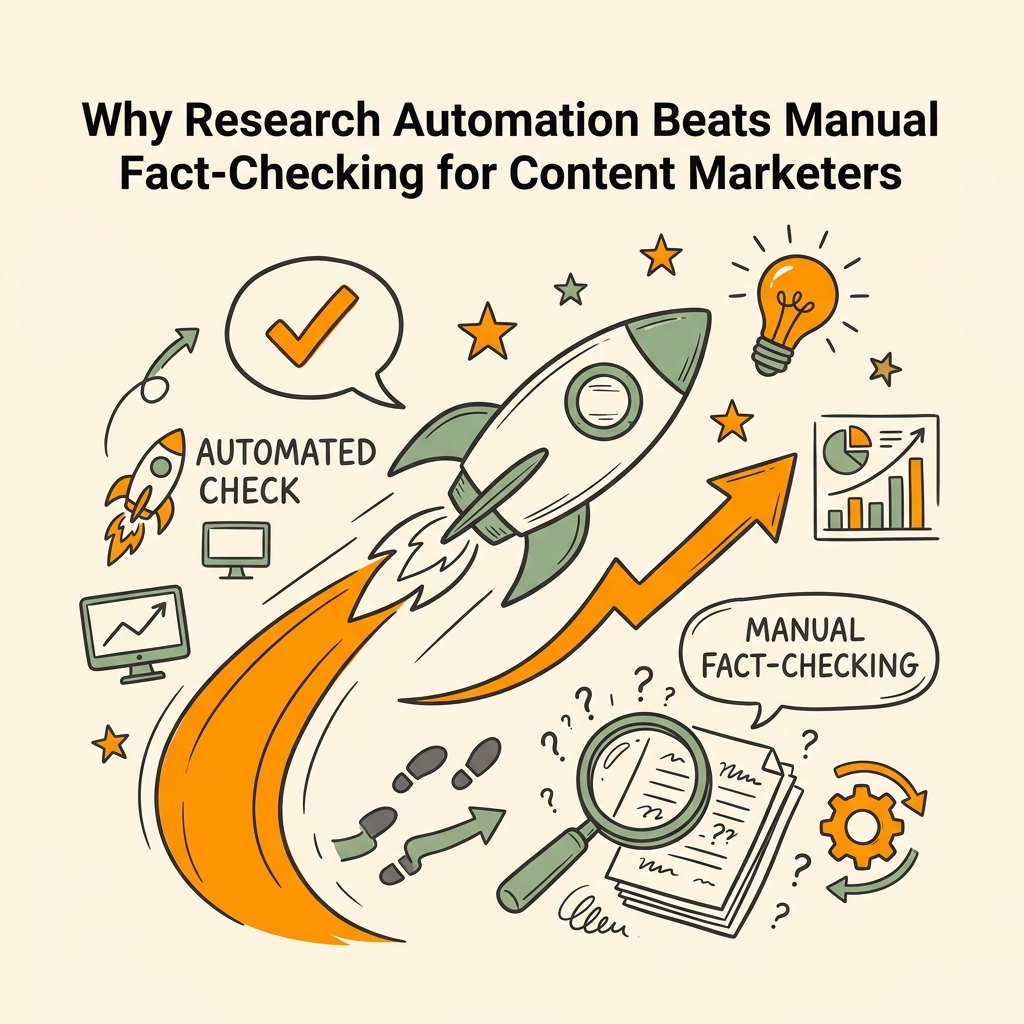
Content that contains shaky claims decays quickly in search results. 91% of pages cited in AI Overviews contain some level of AI-generated content, and search algorithms are increasingly tuned to reward sources with high citation quality. This creates a paradox: you need to publish more content faster, but you can't sacrifice factual accuracy. Automated research automation solves this by making fact-checking a real-time layer in content generation, not a post-publication phase.
Deep Source Integration and Fact Verification
The difference between commodity AI writing tools and strategic ones is source depth. A basic tool might generate a claim like "78% of marketers use AI tools," but a tool with deep research integration will pull that exact statistic from the original source, verify the methodology, and include an attribution in the content. This serves three purposes: it keeps your content accurate, it builds link equity by citing authoritative sources, and it inoculates your content against the "AI-generated spam" label that's starting to damage traffic.
"The best approach combines internal research agents pulling from your own data, case studies, and company knowledge with external data integration from industry reports, academic databases, and government statistics."
Tools pulling from 14+ authoritative sources and cross-referencing claims before including them dramatically reduce the fact-decay that hurts long-term SEO performance.
Citation Formatting and Plagiarism Detection
Automated citation in multiple formats (Chicago, APA, MLA) plus built-in plagiarism detection ensures content passes both human review and algorithmic checks. This is especially critical for research-heavy content like guides, tutorials, and authority pieces where improper attribution tanks credibility. AI tools that format citations automatically and flag any plagiarism risk before publication eliminate a major bottleneck in content quality assurance.
| AI Writing Tool Feature | Impact on Content Quality | Time Saved Per Article | Ranking Performance |
|---|---|---|---|
| Deep research integration (10+ sources) | Fact-checked claims with citations | 4-6 hours | Higher authority scoring, better AI Overview selection |
| Keyword clustering and intent mapping | Multi-intent outline generation | 2-3 hours | Wider topical coverage, more traffic clusters |
| Real-time SERP analysis | Structural alignment with top 10 results | 1.5-2 hours | Faster ranking velocity, better CTR patterns |
| CMS publishing automation with internal linking | Zero manual publish workflow | 30-45 minutes | Consistent link structure, better site crawlability |
| Multi-format content generation | Unified brand voice across all channels | 3-4 hours | Consistent messaging, reduced version conflicts |
CMS Integration and Publishing Automation: The Hidden Multiplier
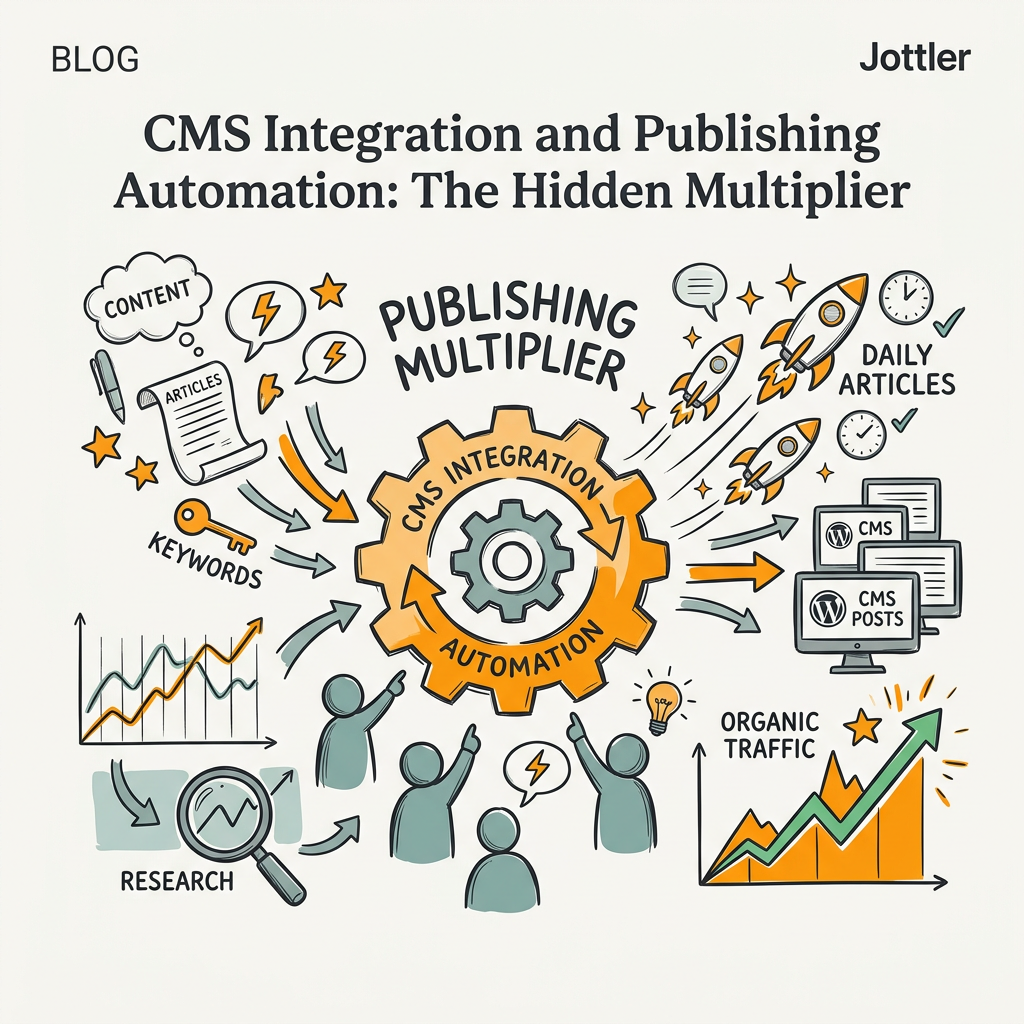
The features that save the most time aren't always the obvious ones. Organizations using AI writing tools save an average of 11 hours per week, but that number shifts dramatically depending on whether your tool integrates with your CMS or requires manual publish workflows. A tool that can write, fact-check, and publish a 2,000-word article directly to WordPress with internal links already inserted is fundamentally different from one that drops a Google Doc for your team to manually edit, format, and publish.
Direct CMS Integration Removes The Publish Bottleneck
The publish bottleneck is real: even a 30-second CMS login and format-paste task, multiplied across 3-5 daily articles, adds up to hours of busywork. Tools that authenticate directly with WordPress, HubSpot, Ghost, or custom CMS instances can publish fully formatted articles, including featured images, internal links, and metadata tags, without human intervention. This also eliminates the "lost in Google Drive" problem where content draft gets forgotten or loses track of review status.
Intelligent Internal Linking Strategy
Internal linking is one of the highest-leverage SEO signals that most content teams neglect because it's tedious to do manually. The best AI writing tools analyze your existing content library and automatically insert contextual internal links from your article to relevant existing pages on your site. This serves two purposes: it compounds your topical authority by linking related articles together, and it distributes page authority more efficiently across your site structure.
Jottler's approach to internal linking stands out in the content marketing automation space: it maintains a knowledge base of your entire published content, understands the topical relationships between articles, and inserts links not just where they're opportunistic, but where they're contextually valuable for both the reader and your site structure. This transforms what used to require manual spreadsheet management into an autonomous layer that improves your site's SEO health with every new article published.
Metadata, Schema, and SEO Tag Automation
Beyond article publication, advanced tools automate the metadata layer: generating SEO titles and meta descriptions optimized for click-through rate, adding schema markup for content type and author, and setting canonical tags to prevent duplicate content issues. This is grunt work that teams often skip, but it compounds over time. An AI writing tool that handles this automatically ensures every piece of content is fully optimized for search algorithms before it even goes live.
Why Content Marketers Need to Understand These Features Now
The market is moving fast. 45% of marketers plan to increase spending on AI-powered marketing tools in 2026, and the feature gaps between leading platforms and commodity tools are widening. A tool that only generates text is already outdated. The tools winning in 2026 are those combining research automation, SEO optimization, and publishing integration into a single workflow that doesn't require your team's constant intervention.
This matters for your hiring and tool stack strategy. Rather than building internal processes to fact-check, optimize, and publish AI-generated content, forward-thinking marketing teams are switching to platforms that embed these capabilities into the generation process itself. The economic advantage is substantial: teams using AI tools with deep research integration and SEO optimization report 3.2x ROI on content generation, compared to teams using basic AI writers that require heavy post-editing.
Understanding which features to look for also inoculates you against vendor oversell. Many tools claim "SEO optimization," but what they mean is a readability check. Others promise "research integration" but only pull from public web results. The distinction matters. A tool that analyzes SERP results and generates content aligned to top-ranking patterns is fundamentally different from a tool that generates text and lets you manually optimize it afterward.
How to Evaluate AI Writing Tools Against These Core Features
When assessing an AI writing tool for your team, use these core features as your evaluation framework. Don't rely on marketing copy or free trial limits that don't reveal the tool's real capabilities.
- Research depth test: Request a sample article and ask which sources are cited. If you don't see real citations formatted in the body, the tool isn't doing research-backed generation.
- SERP analysis test: Ask the tool to generate an outline for your target keyword and compare it against the actual top 10 results. Does the outline address the same heading structure and content clusters? If not, the SERP analysis is superficial.
- CMS integration test: Does it publish directly to your CMS, or does it drop content into a Google Doc? Direct publishing saves hours per week and removes version control chaos.
- Internal linking test: Does the tool analyze your existing content and suggest relevant internal links? Tools that don't do this are leaving SEO value on the table.
- Brand voice test: Generate the same brief in multiple formats (article, email, social). Does each format sound like your company, or do they read like generic AI output? Inconsistency across formats is a red flag.
Conclusion
The AI writing tools that will define content marketing in 2026 aren't the ones that generate text fastest—they're the ones that eliminate the most repetitive work from your team's workflow. The core features that matter are deep research integration with fact-checking, SEO optimization built into generation (not as an afterthought), and CMS publishing automation with intelligent internal linking. Teams adopting tools with these capabilities are publishing 4.1x more content per marketer per month while maintaining quality standards that actually drive rankings and conversions.
The majority of marketing teams are still treating AI as a writing automation tool. The forward-thinking ones are treating it as a content operations system that handles research, optimization, and publishing simultaneously. If your current tool requires manual fact-checking, separate SEO optimization, and human publishing workflows, you're still stuck in the first generation of AI writing tools. Start your SEO agent at https://jottler.co/auth/signup today and see how autonomous research, SEO-first generation, and hands-off publishing compounds your content output and organic traffic growth.
FAQs
What are the most important features in an AI writing tool for SEO content?
The three critical features are SERP-driven keyword optimization that analyzes top-ranking results and generates outlines aligned to proven patterns, deep research integration with fact-checking and source attribution to ensure content stays authoritative, and CMS publishing automation with internal linking to eliminate manual workflows. Tools missing any of these require post-generation work that negates most of the time savings. Keyword clustering also matters—it ensures your content addresses multiple search intents in a single article, dramatically increasing your traffic potential.
Can AI writing tools replace manual fact-checking?
Not entirely, but research-backed AI tools dramatically reduce the fact-checking burden. Tools that pull from 10+ authoritative sources, verify claims against those sources, and include citations in the draft eliminate the need to verify every statistic from scratch. Your team still reviews the final output for brand tone and specific claims relevant to your business, but the basic factual accuracy layer is automated. This hybrid approach—AI research plus human review—is more efficient than either approach alone and produces content that's both fast and credible.
Is multi-format content generation worth the additional cost?
Yes, if the tool generates multiple formats from a shared research base. The time savings of generating a 2,000-word article, 5 social media variants, email subject lines, and a video script from a single AI brief is substantial—roughly 3-4 hours per piece. The consistency benefit is equally important: when all formats pull from the same research and brand voice database, you eliminate the version conflicts that plague teams using separate tools. For busy marketing teams, the ability to generate a full content suite from one brief without juggling five separate platforms makes the per-month cost irrelevant next to the operational overhead it eliminates.