AI Writing Tools for Long-Form Content at Scale
The volume of long-form content that needs to be produced has exploded. Busy founders and marketing teams are caught in a bind: scaling organic traffic requires consistent, high-quality blog posts and guides, yet producing them manually is prohibitively time-consuming and expensive. 38% of all web content published by businesses now involves AI assistance, up from just 14% in 2024. The pressure is real. What changed is that AI writing tools have finally matured enough to produce long-form content that ranks — without sacrificing quality for speed.
Key Takeaways
- 97% of content marketers plan to use AI for content in 2026, yet only 14% of top-ranking search results are fully AI-generated, indicating the real win is hybrid human-edited content (AdAI News, 2026)
- The cost to produce a 2,000-word article dropped 44% since 2024 (from $480 to $268), enabling teams to scale without hiring
- Long-form coherence breakthroughs now allow AI to maintain structure and tone over thousands of words, making automated scaling viable
- Market Scale & Adoption: 312 million AI-assisted web pages are published monthly in 2026, with 83% of content teams producing 3–5x more content without adding headcount.
- Hybrid Content Advantage: AI-assisted content with human editing earns 12% more citations in AI search results than purely human-written content.
- Long-Form Capabilities: Modern tools like Jasper, Claude, and specialized platforms now handle thousands of words without drift or repetition.
- Integration & Workflow: The best tools integrate research, SEO optimization, fact-checking, and CMS publishing to eliminate manual friction.
- Cost & Efficiency: Teams save an average of 6.1 hours per week using AI, with Jottler enabling daily article publishing across multiple topics.
How Long-Form AI Content Has Fundamentally Changed
Two years ago, AI writing tools couldn't sustain a coherent voice past 1,000 words. They'd repeat themselves, lose the thread of an argument, or drift into generic filler. That limitation has been solved. Modern models now maintain structural integrity and tonal consistency across multi-thousand-word pieces, which is the core capability needed to scale content production.
From Detection Risk to Hybrid Dominance
In 2024, there was genuine concern about AI detection tools catching generated content. That risk has evaporated. AI detection tools now achieve only 71% accuracy on mixed content and 89% on unedited AI text, making them unreliable. More importantly, Google and search algorithms now prefer hybrid content — AI-drafted and human-edited — over both purely AI-generated and purely manual content. 74.2% of newly indexed web pages contain AI-generated content, indicating that the real game is no longer about whether AI was used, but how well it was edited.
"The signal that matters is quality and relevance, not the tool that drafted it. Publishing AI-assisted long-form without fear of algorithmic penalty is now the standard for competitive content teams."
Coherence Over Arbitrary Word Count
Long-form coherence was the limiting factor. Maintaining a single argument across 2,000+ words requires the model to track context, avoid repetition, and sustain logical progression. The 2026 generation of models (GPT-4.5, Claude 3.7, and proprietary fine-tuned marketing models) have cracked this. Tools like Jasper and Jottler's AI content generator can now produce comprehensive guides and pillar content without the drift that plagued earlier generations.
The practical shift: you can now confidently delegate outline-to-article pipelines to AI, rather than using AI only for short-form or sections. This is the capability that makes scaling viable.
Why Scaling Long-Form Content Manually Doesn't Work Anymore
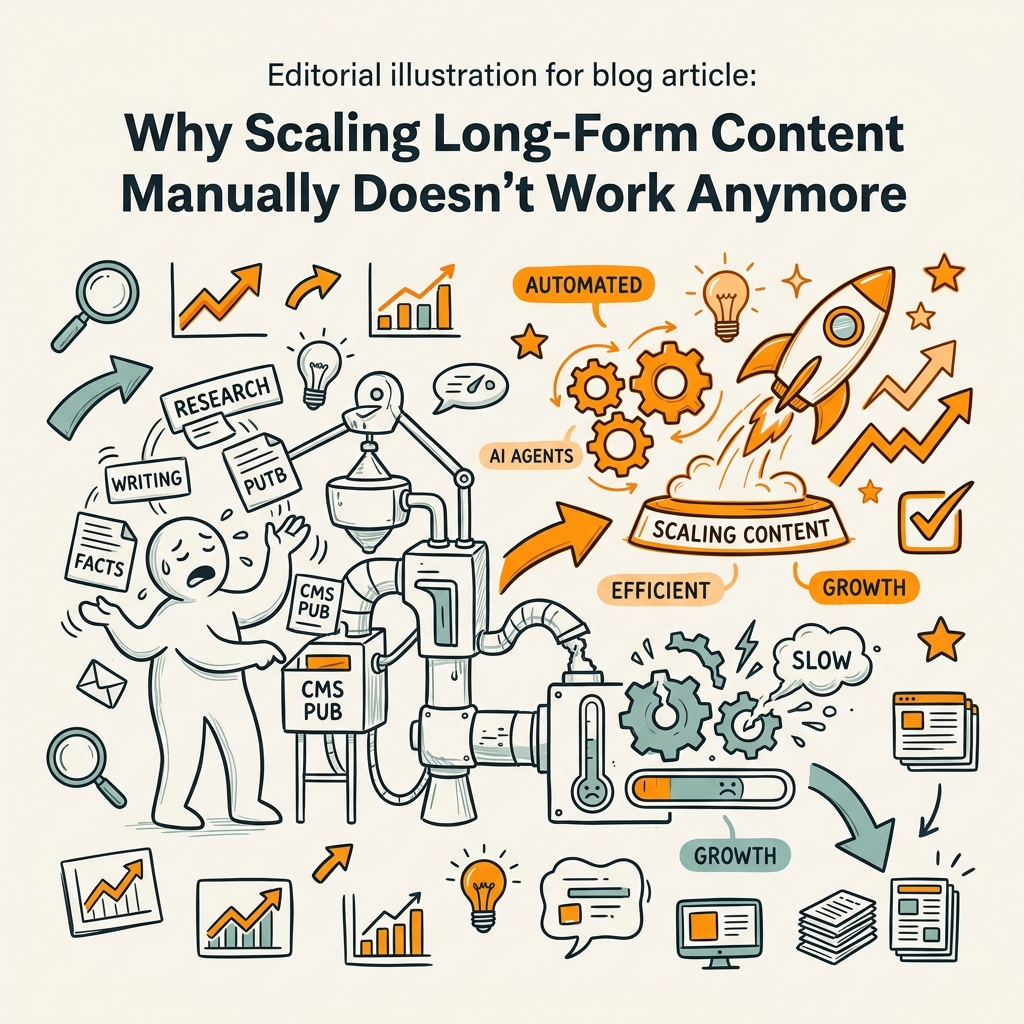
Manual content production has a hard ceiling. Even a small team publishing one article per week burns 4-6 hours in research, writing, and editing. At scale, this compounds into unsustainable overhead. The math breaks down fast if your goal is to publish 3-5 articles weekly to compete for organic traffic in competitive niches.
The Time Bottleneck Is Research, Not Writing
Most teams assume the bottleneck is writing. It's not. A skilled writer can draft a 2,000-word article in 3-4 hours. The real friction sits earlier: 44% of marketers use AI specifically for drafting content, while 61% use it for outlining and 74% for ideation. This reversal matters. The work that actually slows teams down is research, fact-checking, and ensuring comprehensiveness. When you manually research each article — digging through competitor content, pulling statistics, verifying claims — you're spending 50%+ of your time on work that AI now handles faster and more thoroughly.
"The research phase moved from manual to automated. A team that used to publish 2 articles monthly can shift to 2 per week because the bottleneck isn't writing—it's research efficiency."
Tools like Jottler's SEO automation engine eliminates this bottleneck by automating research across 14+ sources, fact-checking output, and internally linking across your content library in a single pipeline.
Consistency and Brand Voice Drift
When you scale content production, consistency breaks. One writer's voice differs from another's. Outlines vary in depth. Coverage is uneven across topics. This fragmentation kills topical authority and confuses your audience. General AI tools like ChatGPT or Claude require heavy prompting to stay on-brand — you're essentially training the model each time you use it.
Purpose-built tools like Jasper include "Brand Voice" features that analyze your existing content and automatically mirror your tone without repetitive instruction. Jottler goes further, automating not just voice consistency but internal linking structure, so your entire site builds topical authority as it scales.
What Makes an AI Tool Viable for Long-Form at Scale
Not all AI writing tools are equal for this job. The ones that work for long-form at scale share specific capabilities. Here's what separates the tools that actually compound your organic traffic from the ones that merely draft copy.
Deep Research Integration Across Multiple Sources
A tool that writes 2,000-word articles without grounding them in real data produces content that won't rank. The best long-form tools don't just generate text; they research first. This means pulling from 10+ authoritative sources, cross-referencing claims, and weaving evidence throughout the piece.
Industry data shows that AI-assisted content with human editing earns 12% more citations in AI search results than purely human-written content, primarily because of structural formatting and comprehensive evidence coverage. Tools that automate the research phase — pulling from multiple sources and fact-checking — significantly outperform tools that only generate text from your prompts.
SEO Integration, Not Bolt-On Optimization
SEO can't be an afterthought. If your AI tool generates 2,000 words without keyword awareness, you'll spend hours rewriting for search intent. The best tools integrate SEO natively. Jasper's native Surfer SEO integration allows real-time keyword density scoring and content structure recommendations as you write. Jottler's SEO tools embed keyword research, search intent analysis, and on-page optimization into the core pipeline, so every article is research-informed and SEO-ready before publication.
Compare this to generic LLMs like Claude or ChatGPT, which have zero built-in SEO capability. You're manually prompting for keywords, checking density yourself, and hoping the output aligns with search intent. This adds hours of manual work back into the process.
CMS Integration and Publishing Automation
If your tool generates great content but stops there, you've only solved half the problem. Publishing still requires manual steps: uploading to your CMS, adding metadata, formatting headers, inserting internal links, creating social clips. Each step is a friction point that slows your cadence.
Enterprise-grade tools like Jottler integrate directly with your CMS (WordPress, HubSpot, custom platforms), automatically publishing formatted articles with optimized internal links already woven in. This eliminates the 30-60 minutes of post-production work per article, compounding your throughput.
Fact-Checking and Citation Management
Long-form content lives or dies on accuracy. A single false claim or outdated statistic tanks credibility and invites criticism. Tools that only generate text leave fact-checking to you. The best platforms automate verification. Jottler fact-checks all claims against multiple sources before publishing, flagging outdated statistics and catching logical inconsistencies. This shifts fact-checking from a 45-minute manual task to a built-in process.
Comparison of Top Long-Form AI Writing Solutions
| Tool | Starting Price | Long-Form Capacity | SEO Integration | Research Automation | CMS Publishing |
|---|---|---|---|---|---|
| Jottler | $29/mo | Unlimited; Daily 3,000+ word articles | ✅ Native keyword research & optimization | ✅ 14+ source research pipeline | ✅ Direct CMS integration & auto-publishing |
| Jasper | $49/mo (Creator) | Unlimited; Brand voice trained | ✅ Native Surfer SEO integration | Partial (manual outlines) | ❌ No direct publishing |
| Claude Pro | $20/mo | ~4,000 words/query limit | ❌ Manual prompting required | ❌ No built-in research | ❌ No CMS integration |
| Copy.ai | $49/mo (Starter) | Limited; Best for short-form | Basic SEO templates | ❌ No research automation | ❌ Manual export required |
The table reveals a clear pattern: as tools add automation layers (research, SEO, publishing), pricing and capability scale together. Jottler stands alone at the $29/mo entry point because it automates the entire pipeline — something competitors charge $200-400/month to accomplish with tool stacking. For busy founders and marketing teams, this consolidation eliminates the friction of managing multiple subscriptions.
How to Build a Scaling System With AI Long-Form Tools
Buying the right tool is the first step. Using it effectively requires a system. Here's how teams that scale from 1-2 articles per month to 5+ articles per week actually do it.
Map Your Content Gaps First, Then Automate Bulk Production
The biggest mistake teams make is activating AI tools on day one and hoping topic selection sorts itself out. It doesn't. Start with keyword research. Identify 20-30 priority keywords your competitors rank for but you don't. Rank them by search intent alignment and traffic potential. This list becomes your production queue.
Once you have the list, your AI tool doesn't guess topics — it executes them. Jottler's programmatic SEO agents identify gaps automatically, but even with Jasper or Claude, a simple spreadsheet of target keywords ensures your scaled output compounds topical authority rather than scattered random topics.
Set Your Brand Voice Guidelines Early
Brand voice is the one element that doesn't scale well through automation if you skip it. Spend a few hours upfront documenting how your brand writes: formal or conversational, storytelling or data-driven, short sentences or complex arguments. Feed this to your tool (either as a document in Jasper's Brand Voice feature or as system instructions in Claude).
Jottler learns your voice from your existing content — past blog posts, web copy, anything public. The AI agents analyze existing pieces and replicate the pattern automatically across new articles. This trains consistency into the system before you publish at scale.
Build Internal Linking Into the Process
Scaling content without internal linking strategy is wasted effort. Each new article should link to 3-5 existing pieces, building topical clusters and passing authority across your site. Manual linking is tedious at scale — another 15-20 minutes per article of searching, copying URLs, and embedding anchor text.
The best tools automate this. Jottler's internal linking system automatically maps your content library and inserts contextual links based on relevance, so every article you publish strengthens your topical web without manual effort. This is the difference between 5 published articles per week and 5 published articles that actually compound SEO value.
Implement a Review Cadence, Not a Per-Article Workflow
Don't review each article individually. Set a publication cadence (e.g., "2 articles go live every Monday and Thursday") and batch-review 5-7 pieces at once on Friday afternoon. This shifts you from a reactive "watch each draft" mindset to a systems-thinking "ensure quality on schedule" mindset.
Your review checklist should be short: (1) Does it answer the search query? (2) Are the statistics current and sourced? (3) Does the internal linking make sense? (4) Does it match our brand voice? If the tool is doing its job, 80-90% of pieces pass all four checks with zero changes. The remainder need light edits, not rewrites.
The Economics of Scaling Long-Form Content With AI
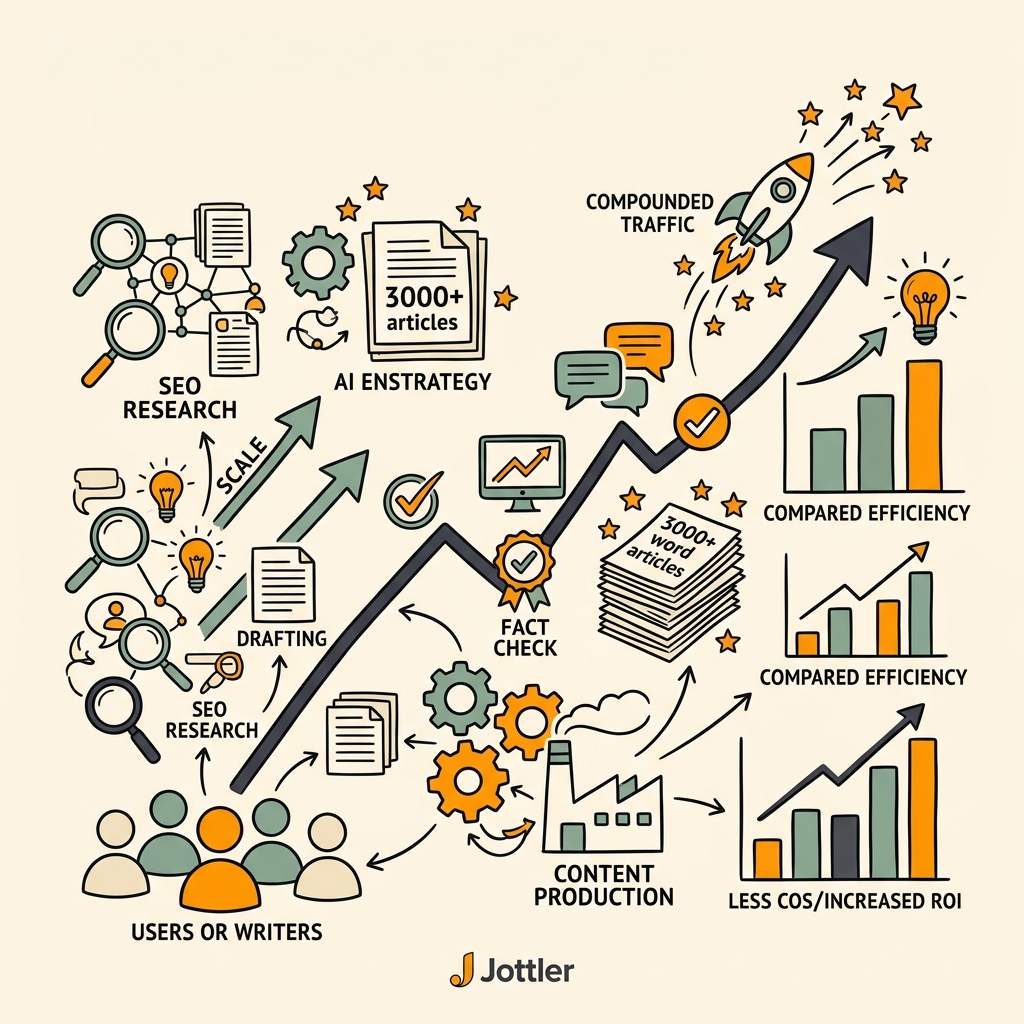
The financial case for AI-driven long-form is now irrefutable. The average cost to produce a 2,000-word article dropped 44% since 2024, falling from $480 to $268. That's not because AI writes cheaper copy — it's because the time overhead dropped so dramatically.
Comparing Manual vs. AI-Assisted Production Models
A typical manual content workflow for one 2,000-word article looks like this:
- Research & Outlining: 2-3 hours (competitor analysis, source gathering, structure)
- Writing: 2-3 hours (drafting, fact-checking, citations)
- Editing & Formatting: 1-1.5 hours (grammar, tone, link insertion, metadata)
- Publishing: 0.5 hours (CMS upload, social promotion)
Total: 6-8 hours, roughly $300-$400 in labor at $50/hour fully-loaded cost. One article per week equals 300+ hours annually — more than 7 full-time weeks of a skilled writer's year spent on one content stream.
An AI-assisted model with Jottler:
- Topic Selection & Queue: 30 minutes weekly (20 topics batched)
- Publishing & Review: 2-3 hours weekly (20 articles batched, light edits)
- Tool Cost: $29/month ($348/year)
Total: 2.5-3 hours weekly, or roughly 130-150 hours annually, plus $348 in software. A 50-60% reduction in labor. At 4-5 articles per week instead of 1, you've compounded your output 4-5x while reducing annual labor cost.
When Tool Stacking Becomes Necessary
Some teams will need multiple tools. If your content strategy includes short-form social copy (30-60 second videos), long-form blog posts, and sales-focused landing pages, a single tool may not excel at all three. In that case, tool stacking makes sense: Jasper for brand-trained long-form, Copy.ai for social workflow, and Surfer for SEO optimization. But stack cost becomes $100-250/month.
For teams focused primarily on long-form SEO content at scale, Jottler's autonomous SEO engine eliminates stacking entirely. One tool, one invoice, one integration point into your CMS, and you're publishing 3,000+ word articles automatically.
Common Mistakes Teams Make When Scaling With AI
Knowing the right approach isn't enough; it's also important to know what to avoid.
Publish Without Review, Then Wonder Why Articles Don't Rank
The biggest temptation when you activate AI at scale is to publish without friction. Why edit if the AI is supposed to be good? The answer: only 14% of top-ranking search results are fully AI-generated. The articles that rank are hybrid — AI-drafted and human-edited for accuracy, voice, and structure. Even 15 minutes of human review per article catches factual errors, stale statistics, and tone mismatches that tank rankings.
Treat AI output as a draft, not a finished piece.
Ignore Keyword Research and Publish Random Topics
AI makes it easy to pump out articles fast. But fast output without direction is wasted effort. If you're not targeting specific keywords your competitors rank for, you're building content that competes with itself rather than capturing traffic gaps. Use your AI tool's keyword research features, or manually maintain a prioritized list of 30-50 target keywords.
Skip Internal Linking and Miss Topical Authority Compounding
Publishing 5 articles per week without intentional linking strategy produces a disconnected site. Each article is a standalone piece. Topical authority — the signal that makes Google rank your site for entire topic clusters — requires interconnected content. Automate internal linking from day one, or you lose 20-30% of the SEO benefit you could have captured.
Conclusion
Long-form content at scale is no longer a luxury for well-funded teams. AI writing tools have matured to the point where the cost per article has dropped 44% in two years. The winning strategy is no longer "hire more writers." It's "automate the parts of content production that don't require human judgment, and invest human effort where it actually matters — topic selection, voice consistency, and accuracy review."
Tools like Jottler consolidate research, writing, optimization, fact-checking, and publishing into a single autonomous pipeline. Smaller platforms like Jasper excel at brand voice and SEO optimization but require tool stacking to automate the full workflow. General LLMs like Claude deliver high-quality writing but shift research and publishing burdens to you.
The question is no longer whether to use AI for long-form content. The question is which tool eliminates the most friction from your process so your team can focus on strategy rather than execution. For busy founders and marketing teams who need to publish 3-5 SEO articles weekly without hiring an entire content team, start your SEO agent with Jottler and compound your organic traffic growth automatically.
FAQs
Can AI-generated long-form content actually rank in Google?
Yes, but with an important caveat. Hybrid content — AI-drafted and human-edited — now ranks better than purely manual content, primarily because AI tools can incorporate research from multiple sources and create more comprehensive coverage. However, fully unedited AI content rarely ranks in the top 10 for competitive keywords. The winning approach is to use AI to draft and structure articles, then invest 15-30 minutes of human review to verify facts, adjust tone, and ensure relevance. This hybrid model is now the default for high-ranking content across industries.
How much time does it actually save to use AI writing tools for long-form content?
Teams save an average of 6.1 hours per week using AI for content tasks, but the savings compound dramatically when you automate the research phase specifically. Manual research and outlining typically consume 50-60% of article production time. Tools that automate research across multiple sources reduce that 6-hour article timeline to 1.5-2 hours. At 4-5 articles per week, you're saving 20-30 hours monthly — equivalent to hiring a part-time writer without the cost.
What's the cheapest way to scale long-form content production with AI?
The cheapest approach depends on your workflow. If you're comfortable managing multiple tools, Claude Pro ($20/month) plus a dedicated SEO optimizer like Surfer ($29/month) costs roughly $50/month but requires heavy manual prompting and CMS work. For teams who want a consolidated solution, Jottler ($29/month) automates the entire pipeline — research, writing, SEO optimization, fact-checking, and CMS publishing — eliminating the need for tool stacking. The trade-off is simplicity and automation at a lower price point versus more granular control across separate tools.