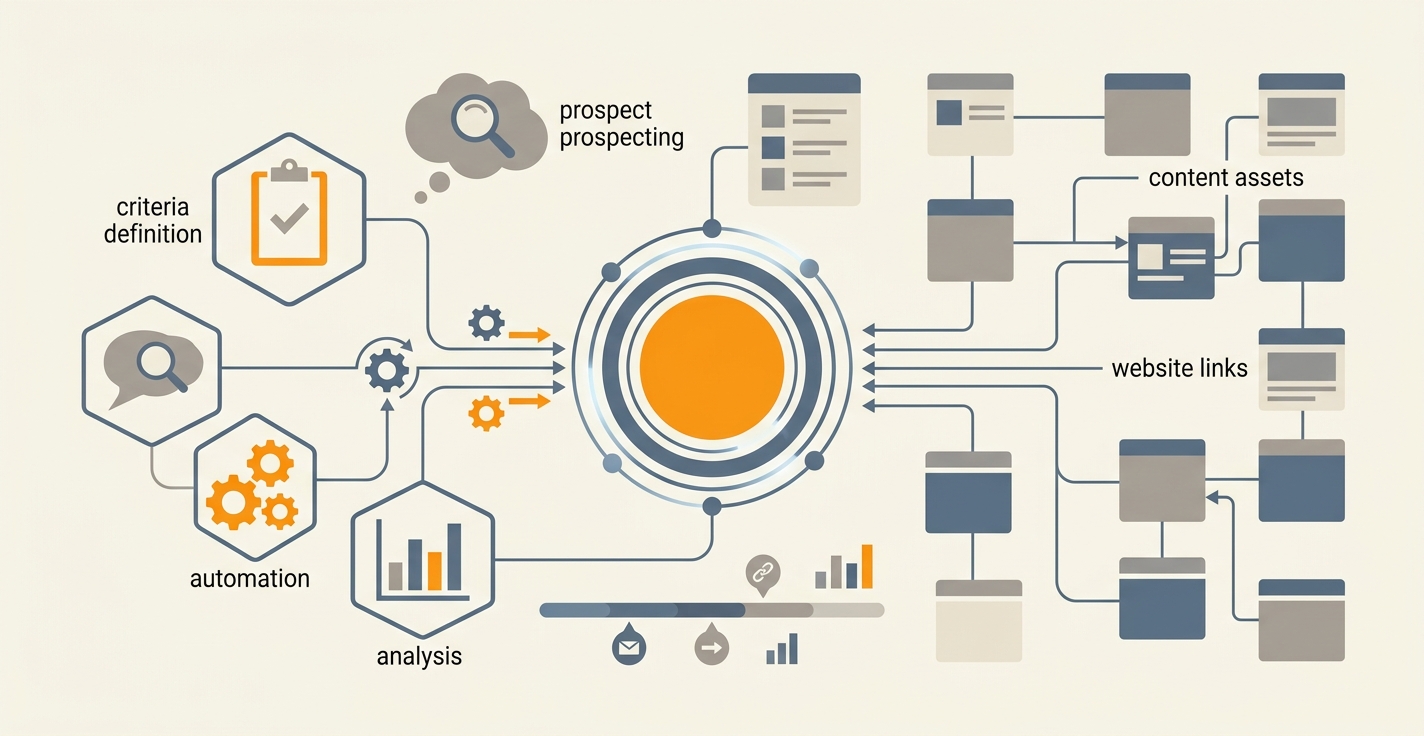
Automated Link Building Essentials
Link building manually takes weeks. Automated link building takes days, but most attempts fail because they skip the quality checks that Google rewards.
The difference between successful automation and penguin-bait is simple. Methodology. The top-ranking sites aren't blasting emails to random targets. They're using software to find qualified prospects, crafting outreach that genuinely solves a problem, and monitoring link velocity to appear natural.
Key Takeaways
- Effective automated link building automates repetitive tasks (prospect discovery, email sequencing) while keeping human judgment on relevance and outreach quality
- Most link building tools fail because they focus on scale over authority. The right approach targets high-relevance, niche-authority sites instead
- A hybrid workflow combining prospect discovery, AI-assisted personalization, and manual quality review delivers 3-5x more conversions than fully hands-off automation
What Automated Link Building Actually Is
Automated link building uses software to speed up prospecting, outreach, and monitoring. It doesn't replace human strategy.
The key distinction: automation that works focuses on the repetitive mechanical tasks. Finding prospects from millions of domains. Sending follow-up emails on a schedule. Monitoring broken links. Tracking link velocity. These are the tasks that benefit from automation.
What should never be automated is relevance judgment. A tool can't decide if a site is truly a fit for your content. A tool can't rewrite an outreach email to match an editor's writing style. A tool can't spot the red flags that separate high-authority from spammy domains.
DataForSEO research on 2026 backlink profiles shows that sites ranking in top 10 positions typically earned links from 50+ referring domains, with an average Domain Rating of 40+. The volume comes from consistency, not from blasting 500 emails per week.
The Hybrid Automation Framework (That Scales)
Real automation teams follow five steps. Miss any one, and you'll either tank your link velocity or waste time on low-value targets.
Step 1: Define Your Linking Profile
Before opening a tool, answer these questions clearly.
What's your current backlink profile? How many referring domains do you have? What's your average Domain Rating (DR)? Understanding your starting point prevents the rookie mistake of targeting DR50+ sites when you're at DR25.
What niches are truly relevant to your content? Don't chase every vague connection. A SaaS marketing blog should target content marketing publications, not generic "business" blogs. Narrow targets convert 4-6x better than broad ones.
What's your monthly link velocity goal? If you suddenly gain 20 high-authority links after earning 2-3 per month, Google notices. Unnatural patterns trigger manual review. A realistic timeline adds 5-15 links per month across your domain.
Step 2: Automate Prospect Discovery (With Filters)
This is where tools shine: prospecting at scale.
Use smart research tools like Ahrefs, Semrush, or SEMrush to filter prospect lists by domain rating, organic traffic, editorial style, and topical relevance. Most platforms allow custom filters. Set them tight.
Your automation should pull prospects that meet strict criteria: DR 30+, organic traffic 5,000+/mo, published content in your niche within the last 90 days, no direct competitors already linked, contact email visible or findable.
Narrow filters reduce your prospect list by 80%. That's good. Better to reach 50 highly relevant sites than 500 mediocre ones. The conversion rate difference is night and day.
Step 3: Research, Personalize, and Queue Outreach
This is where the human layer matters most.
Pull your filtered prospect list into a spreadsheet. Add a column for each contact's last article, a note on why your content genuinely improves their page, and a personalization angle.
Use custom prompts or AI tools to draft initial outreach emails, but keep the tone conversational, not templated. The opening line should reference a specific article they wrote, not "I think your readers would love..."
Queue these for manual review before sending. A team member should read 10-15 of your outreach templates to catch generic language and fix it. This single step cuts spam complaint rates in half.
Step 4: Automate Follow-Ups and Tracking
Outreach doesn't end with the first email. 60-70% of link conversions happen after follow-up.
Set up email sequences: initial pitch, 3-day wait, follow-up, 5-day wait, second follow-up, then mark as "no response." Automation tools like Respona or Linkee handle this sequencing automatically, using your personalized template as the base.
Track responses in a shared dashboard. Which subject lines get opens? Which prospects are replying? Which industries convert fastest? This data shapes your next round of outreach.
Step 5: Monitor Link Velocity and Quality
Acquired links don't matter until they're live and indexed.
Use tools like Linkody or Ahrefs to monitor new backlinks weekly. Check that links are dofollow, placed in content (not sidebar), and use appropriate anchor text. A "link acquired" doesn't equal "link that passes value."
Plot your link velocity on a month-by-month timeline. You want a smooth, steady curve, not spikes and valleys. If you acquire 0 links in March, 50 in April, and 2 in May, you risk triggering manual review.
Each of these five steps matters equally. Remove one and the entire system breaks. Skip prospect filtering and you waste weeks on irrelevant outreach. Skip quality review and you tank your sender reputation. Skip velocity monitoring and you trigger penalties. The framework is only as strong as its weakest phase.
Common Mistakes That Tank Link Velocity
Even with automation, most teams make the same errors. These mistakes compound. One misstep becomes two, then three, until your entire link profile is flagged by Google.
Mistake 1: Targeting by Domain Authority alone. A DR60 site is worthless if it has zero relevance to your niche. A DR35 site in your exact vertical is 10x more valuable. Authority is relative. Too many teams get hypnotized by domain metrics and ignore topical fit entirely. They hit DR50+ sites with generic pitches and burn sender reputation for nothing.
Mistake 2: Sending generic outreach at scale. "I think my article would be great for your readers" isn't personalization. Personalization means "Your March article on X missed the Y angle; my piece covers that gap." Generic templates get 1-3% response rates. Specific ones hit 8-12%. The difference compounds. Target 100 sites with personalized pitches and you get 8-12 conversations. Send the same email to 1,000 sites and you get spam complaints, blacklists, and no links.
Mistake 3: Ignoring link velocity patterns. A natural backlink profile grows gradually. If you add 30 links in a month after adding 2 per month for a year, Google flags it. Most penalties come not from low quality but from unnatural velocity patterns. Google's algorithms expect consistency. They expect the profile to reflect organic growth, not sudden spikes.
Mistake 4: Automating quality control away. If your tool sends outreach without any human review, you're one week away from a spam complaint that tanks your sender reputation. Email providers watch automation closely. They're trained to detect patterns. Automated systems that send thousands of emails per week without variation get flagged as spam sources immediately.
Mistake 5: Only building links to your homepage. Links to inner pages pass authority and drive organic traffic. Too many tools default to linking to your homepage. Diversify your link profile across pillar pages and topic cluster content. A balanced portfolio looks natural. 100% homepage links look manipulated.
When to Use Automated vs. Manual Link Building
There's a natural division of labor here. Automation excels at repetition. Humans excel at judgment.
Use automation for prospecting, list management, follow-up sequencing, and monitoring. These tasks scale linearly. Use humans for relevance judgment, outreach drafting (first 20-30 emails), template refinement, and relationship building.
For a SaaS company publishing 4-6 pillar pages per quarter, a hybrid team of two can maintain 40-60 link prospects in the funnel at any time. One person handles research and relevance scoring. The other drafts personalized outreach and manages the sequence. A tool automates follow-ups and tracking. This setup yields 8-12 new links per month with strong placement quality.
For a publisher or affiliate site running 50+ pages per month, automation becomes mission-critical. Your link building team doesn't have time for manual prospecting. You need Jottler's content engine to build pillar and cluster pages at scale, so your link building team stays focused on prospect qualification and relationship management, not racing to create linkable assets. With fresh content publishing daily, your outreach becomes infinitely more effective. You're always pitching recent, topical, authoritative pieces.
Tools That Actually Deliver
The market is crowded with link-building software. Here are the ones that genuinely work inside a solid framework. Most tools claim to do everything. They do nothing well. The successful approach cherry-picks the best tool for each phase.
Linkee.ai covers the full prospecting-to-outreach workflow in one platform. It scores prospects by niche relevance, handles personalization, and tracks conversions. Best for teams wanting an all-in-one solution. Pricing around $150/mo makes it accessible for small teams.
Respona specializes in outreach sequencing and relationship management. If you already have your prospect list, Respona's follow-up automation is the best-in-class. It handles email templates, A/B testing, and conversation tracking seamlessly. This is where most teams struggle solo.
Ahrefs or Semrush (prospecting module). Use these for initial prospect discovery. Their filtering options are the most granular available. You can filter by backlink profile, organic keywords, content freshness, and topical relevance simultaneously. Export the list and move to your outreach tool. Don't pay for their outreach features.
Linkody monitors backlink quality and tracks link velocity across your domain. Essential for the monitoring step. It catches newly acquired links within 24-48 hours and flags suspicious activity.
BuzzStream manages relationships and tracks contact history, useful if you're building long-term relationships with editors and linkers. It integrates with your email and prevents duplicate outreach.
The key: don't buy a tool hoping it solves the entire problem. Each tool excels at one piece of the pipeline. Wire them together around your framework. This modular approach costs less and delivers more than buying an all-in-one "solution."
FAQ
How much does automated link building cost?
Tools typically cost $50-300/mo per person using them. Respona runs $100/mo. Linkee.ai is $150/mo. Ahrefs starts at $99/mo for prospecting. Add 2-3 people to your link team and you're at $4,000-6,000/mo in tooling. That's less than one content agency article.
Can automated link building get you penalized?
Yes, if you automate the wrong things. Automating prospecting, follow-ups, and monitoring is safe. Automating relevance judgment or sending unsolicited outreach at scale is risky. The rule: if a human couldn't do it at scale, don't automate it.
What's the average timeline to see results?
Link velocity typically ramps over 3-6 months. Month 1-2 is setup and prospecting. Month 3 is your first meaningful conversions. By month 6, a solid framework yields 5-15 new links per month consistently. Don't expect results in 30 days.
How do I know if a prospect is worth pursuing?
Use a simple scorecard: Relevance (does their audience match yours?), Authority (DR 30+), Recency (published in your niche in the last 90 days), and Findability (email visible or easily guessable). A prospect hitting all four deserves outreach. One or two? Skip it.
Should I build links to my homepage or inner pages?
Both, but skew toward inner pages. 60% of links to pillar and cluster content, 40% to your homepage. This diversifies your link profile and passes authority deeper into your site, driving more organic traffic from inner pages.
The Real Competitive Edge
Automated link building isn't a hack. It's efficiency applied to a proven strategy.
The sites ranking for high-intent keywords all have one thing in common: they built topical authority through consistent, diverse content paired with intentional backlinks. Automation speeds the process. It doesn't replace judgment.
Start with your framework. Define your linking profile. Tighten your prospect filters. Build human review into your process. Then let tools handle the repetition. That's the difference between automation that scales and automation that fails.
Ready to build your link magnet? Start with content that's worth linking to. Explore how Jottler's autopilot publishes pillar pages and cluster content on schedule, so your link building team always has fresh assets to pitch.