Automating Keyword Research and Clustering Workflows
Manual keyword research consumes weeks of a marketing team's capacity. Your team members spend days uploading lists, running clustering algorithms, analyzing SERP overlap manually, and building content plans from scattered spreadsheets. 70% of tools support bulk processing, yet most teams still handle clustering as a semi-manual workflow. The cost? Missed opportunities in keyword discovery, delayed content calendars, and siloed keyword data that never feeds back into content production. The fix is automating both research and clustering end-to-end, so keyword strategy drives publishing at scale without constant human intervention.
Key Takeaways
- SERP-based clustering aligns 20-30% better with real ranking behavior than NLP-only methods (Ahrefs, 2026)
- Automated tools process 50,000+ keywords without performance issues, enabling agencies and teams to scale research workflows instantly
- Intent-driven clustering combined with real-time SERP validation prevents content cannibalization and improves content ROI by 15-25%
- SERP-Validated Clustering: Clusters based on search results overlap outperform semantic-only grouping by 20-30% in alignment with actual ranking patterns.
- Intent Classification at Scale: Automating intent categorization (informational, commercial, transactional) eliminates guesswork and targets keywords by business value.
- Bulk Processing Capacity: Modern tools handle 50,000+ keywords instantly, enabling companies to scale from hundreds to hundreds of thousands of research targets without performance loss.
- Cannibalization Detection: Real-time SERP overlap analysis prevents duplicate pages and guides pillar-plus-supporting content architecture before publishing.
- Continuous Workflow Automation: Exporting directly to content calendars, CMS integration, and automated internal linking closes the gap between keyword strategy and published content.
Why Manual Keyword Clustering Breaks Down at Scale
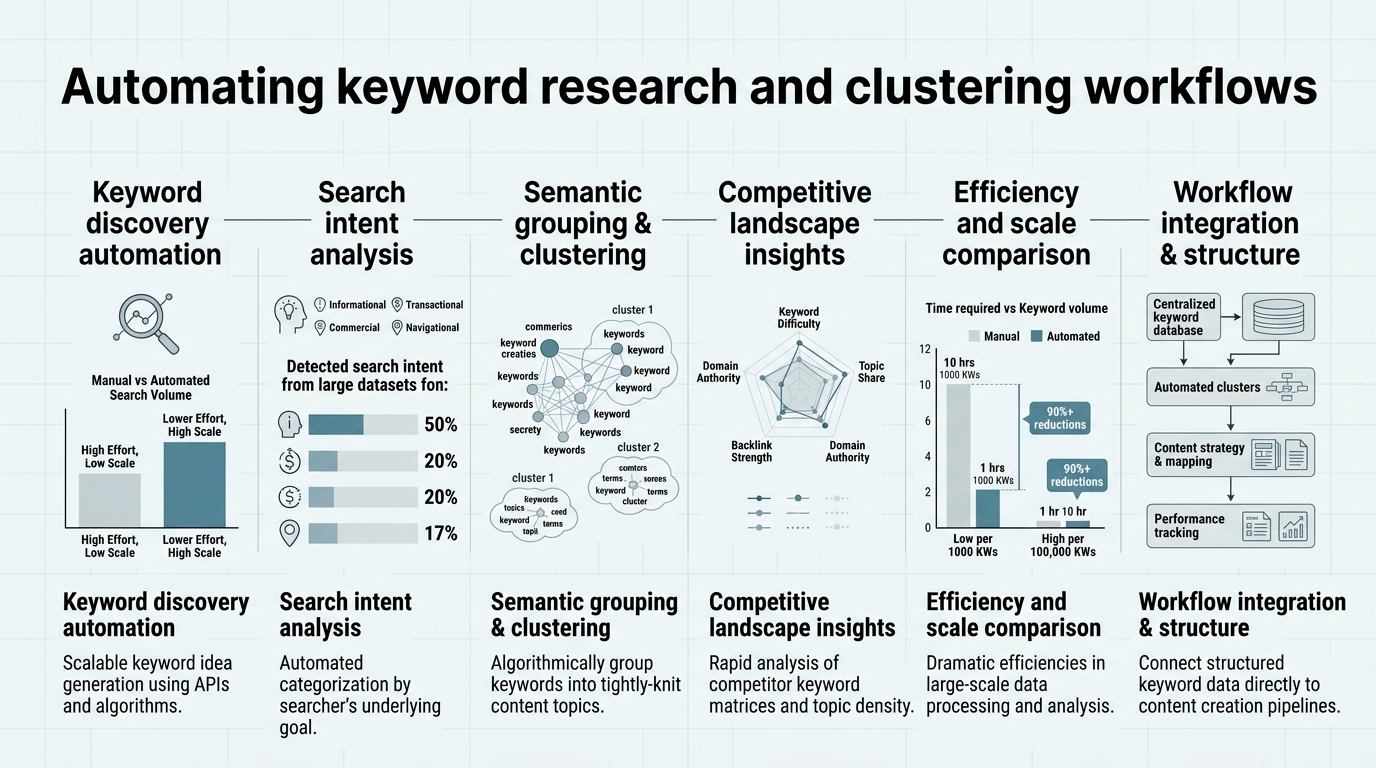
Keyword clustering seems straightforward until you're managing thousands of terms. Manual grouping relies on human intuitionspreadsheet sorting, visual inspection of volume and difficulty, and spot-checking SERP results. A long keyword list can look productive and still be useless until you know which queries belong on one page and which will cannibalize each other. This is where the workflow fractures: teams export keyword lists, cluster them in spreadsheets, pass them to content strategists, and lose context about SERP validation along the way.
The real problem isn't clustering itself. It's that manual workflows don't capture SERP overlap, miss low-volume high-intent terms, and create disconnected data silos. Content teams don't see keyword clusters; they see lists. Writers don't get intent signals; they get volume numbers. When you cluster keywords manually, you're also making decisions about content structure, internal links, and pillar-page relationships without the data to back those calls.
Teams that scale keyword research without automation end up with a familiar pattern: duplicate content, weak internal linking, missed topical authority opportunities, and wasted writer time on pieces that cannibalize one another. The solution isn't better spreadsheets. It's automating the entire pipeline from research through publication.
How Automated Clustering Validates Keywords Against Real SERP Data
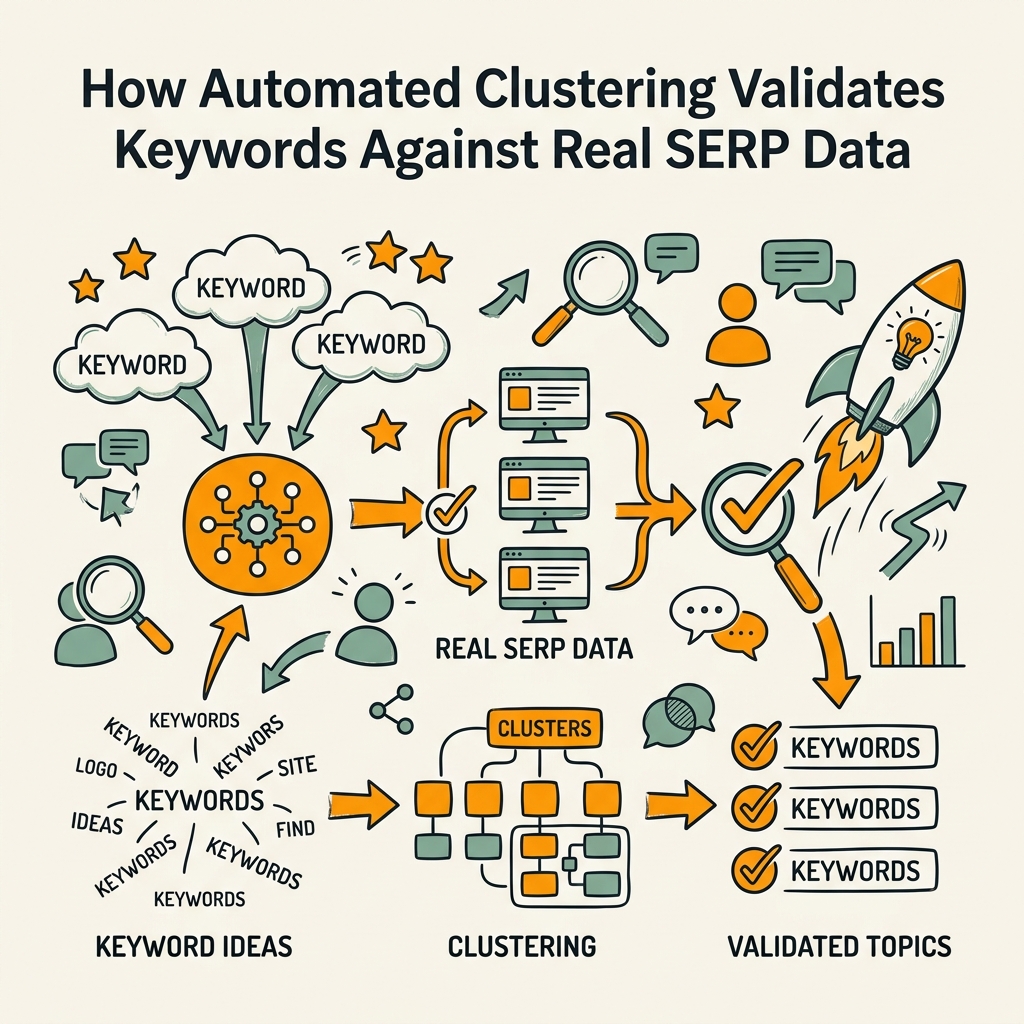
The shift from semantic clustering to SERP-validated clustering represents the biggest change in 2026 keyword strategy. SERP-based clustering aligns 20-30% better with real ranking behavior than NLP-only methods. This matters because semantic similarity doesn't tell you whether Google groups those keywords togetherSERP overlap does.
Automated tools that validate against live SERP results pull the top 10-20 results for each keyword, analyze URL overlap, and group keywords that share the same ranking pages. If three keywords all rank the same five pages in the top 10, they belong in a single content cluster. If keyword A ranks different URLs than keyword B, they need separate pages. Automation does this comparison across thousands of keywords in seconds.
- URL Overlap Analysis: The tool identifies which pages rank for multiple keywords in a cluster and flags potential cannibalization before publishing.
- Intent Matching Across SERP: If the top-ranking pages are all commercial intent (product pages, comparison posts), the tool categorizes the cluster as commercial, not informational.
- Real-Time Rank Position Data: Tools like SEOcluster.ai use Google Search Console data directly, showing actual search behavior rather than tool estimates.
- Trend Integration: Automated systems flag breakout keywords (5,000%+ growth) and declining terms, so your clusters only include keywords with stable or rising velocity.
Without SERP validation, you might cluster "best project management software" with "project management software tools" based on semantic similarity. But if Google's top results show them ranking different pagesone favoring listicle reviews, the other favoring tool comparisonsthey need two separate articles. Automation catches this. Manual clustering doesn't.
Building Intent-Driven Clusters That Drive Conversions
A keyword with 100 monthly searches but high purchase intent converts faster than a 10,000-monthly-search vanity term with low commercial value. Automated clustering tools now categorize keywords by intent as part of their core workflow, saving the step of manual intent flagging. This is critical because content strategy should be built on intent clusters, not volume clusters.
When you automate intent classification, keywords are labeled informational (educational content), commercial (comparison or solution-focused), or transactional (ready-to-buy). Tools route these into separate cluster types, which then guide your content architecture. Informational clusters become pillar pages with broad topic depth. Commercial clusters become comparison posts. Transactional clusters become product pages or case studies.
The outcome: intent-driven clustering improves content ROI by 15-25% because every page you publish has a single clear purpose and targets keywords at the same stage of the buyer journey. Automated systems score keywords by intent fit, business value, SERP competitiveness, and trend stabilityletting you prioritize high-ROI clusters first.
| Intent Type | Keyword Characteristics | Content Structure | Automation Benefit |
|---|---|---|---|
| Informational | How-to, educational, "what is" queries; lower competition; high volume | Pillar pages, guides, tutorials; attract awareness-stage traffic | Automatically filters by question-based keywords and low commercial intent, surfaces research opportunities competitors miss |
| Commercial | Comparison, alternative, review keywords; moderate competition; strong intent signals | Comparison posts, alternative guides, tool roundups; build topical authority | Detects "vs," "alternative," and SERP-overlap signals; flags high-ROI clusters without manual scoring |
| Transactional | Buy, pricing, product-specific queries; high CPC; lower volume; high purchase intent | Product pages, case studies, free trial pages; convert traffic | Identifies SERP dominated by product pages and pricing info; alerts to intent-matched opportunities |
This table shows how intent varies across clusters. Automation bridges the gap between keyword data and content decisions. When your clustering tool flags a keyword as transactional with 100% URL overlap to product pages, you don't need a strategist to decide that keyword deserves a product pagethe data already made the call.
Scaling Keyword Discovery With Automated Systems
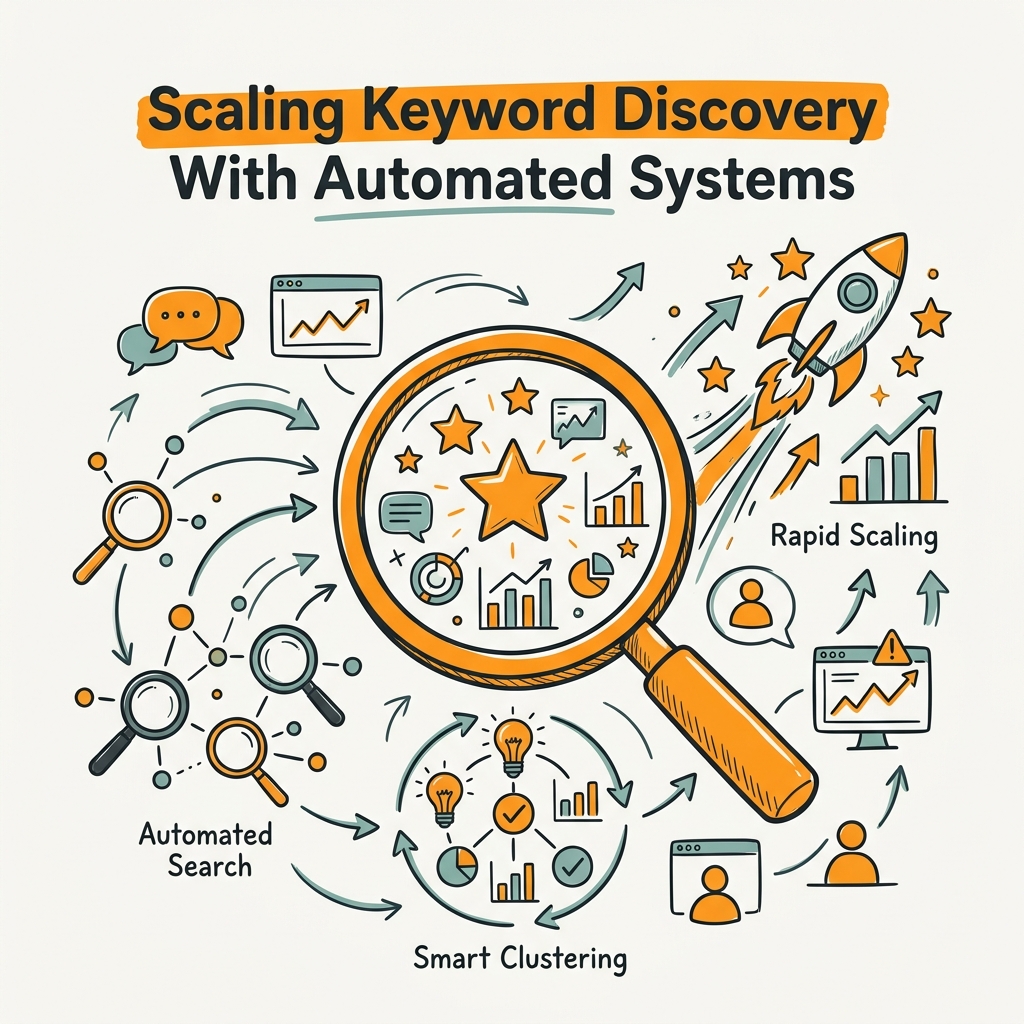
Manual keyword research caps out around 500-1,000 terms before the task becomes unmanageable. Automated systems scale to 50,000+ keywords without performance degradation, enabling discovery workflows that surface opportunities at scale. Tools like Serpstat, Keyword Insights, and Keywordly.ai process bulk keyword lists, detect intent patterns, and identify gaps in competitor coverage in seconds.
The scaling happens in three layers. First, automated seed expansion: you input a core keyword ("project management software"), and the tool generates hundreds of long-tail variations by analyzing autocomplete, related searches, and People Also Ask data. Second, competitor gap analysis: the system pulls all keywords ranking for your competitors' top pages and flags terms you're not targeting. Third, trend velocity filtering: live SERP monitoring identifies breakout keywords and declining terms, so you chase signals before saturation.
- Seed Expansion Automation: Tools like Answer Socrates recursively discover questions and long-tail variations, finding 15-20% more opportunities than manual "brainstorm plus Google search" workflows.
- Competitor Gap Detection: Automated systems pull 1,000+ keywords ranking for each competitor domain, cross-reference your site, and export a prioritized gap list in minutes.
- Real-Time Trend Alerts: API-driven tools track breakout keywords (5,000%+ growth on Google Trends) and flag emerging topics within 10-minute update windows, enabling first-mover advantage.
- Intent-Matched Filtering: Bulk lists are instantly categorized by intent, difficulty, volume, and trend directionso you only publish content for keywords with stable or rising signals.
When you automate discovery, your content team stops debating "should we write about this?" and starts asking "why haven't we written about this yet?" Automation shifts keyword research from a bottleneck activity into a continuous pipeline that feeds content planning month after month.
Preventing Content Cannibalization Through SERP Validation
Content cannibalization happens when you publish two articles targeting keywords that Google groups together. Both pages rank for overlapping queries, they compete for the same traffic, and neither ranks as well as a single merged piece would. The cost is wasted writer time, diluted authority, and split link equity. Manual clustering misses this until you're already three articles deep.
Automated SERP validation catches cannibalization before you publish. Tools analyze which URLs rank for each keyword in a cluster, and if two of your planned articles would target keywords with 80%+ URL overlap, the system flags it. You can then merge the pieces, repurpose one as a sub-section of the other, or redirect the weaker piece to the stronger oneall before publishing.
The best clustering tools now detect cannibalization by analyzing SERP overlap and helping teams build pillar page architecture plus supporting articles instead of competitive duplicate content. When you cluster keywords by SERP validation, you're also making content architecture decisions that compound topical authority over time.
Jottler's approach to this problem is comprehensive: it clusters keywords for you, analyzes competitor content against your planned articles, flags potential cannibalization, and builds internal linking recommendations directly into your content briefs. This eliminates the manual step of "does this keyword already have a page?" and replaces it with automated detection that runs before you write a single word.
Connecting Keyword Clustering to Content Automation
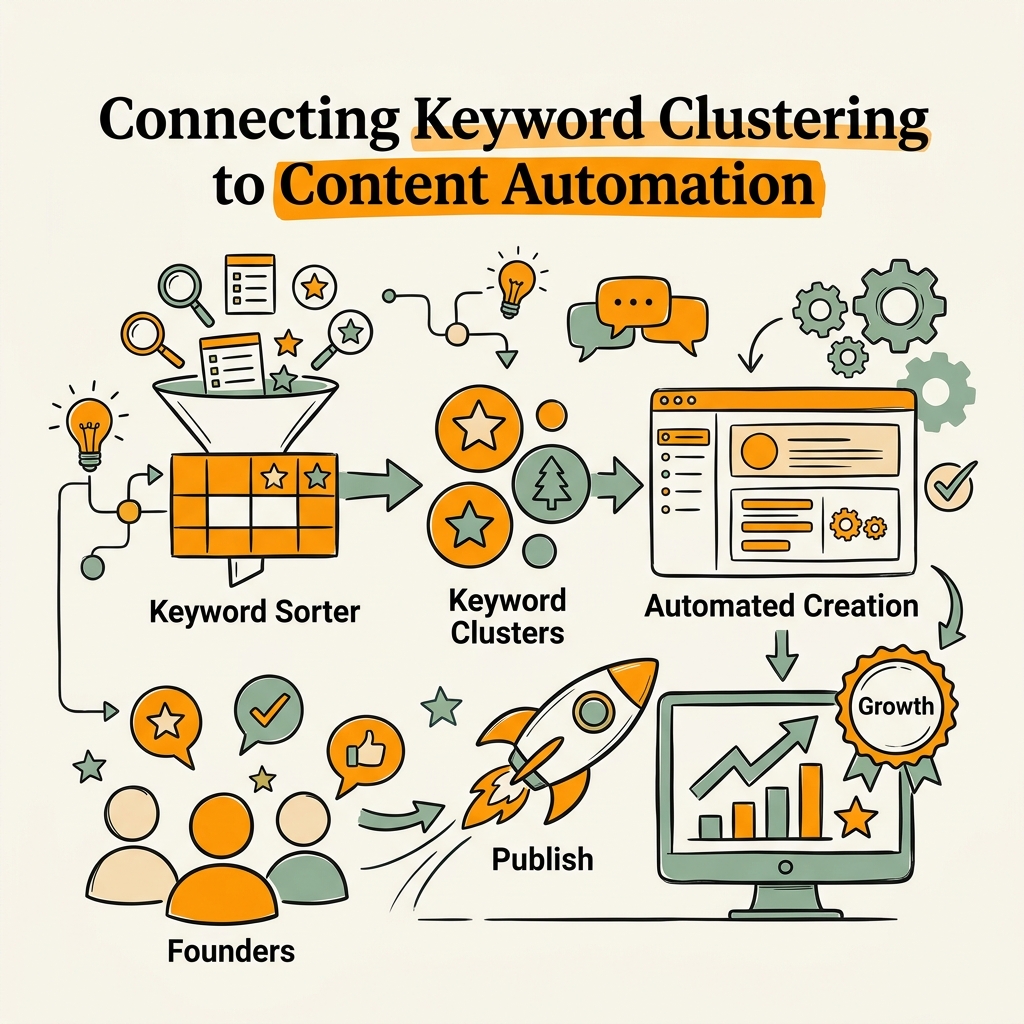
The real leverage happens when clustering feeds directly into content production. Most keyword research tools sit disconnected from your writing workflowthey generate a cluster spreadsheet, and then content teams manually transcribe strategy into briefs. Automation closes that gap by piping clusters directly into content outlines, SEO briefs, and publishing workflows.
Professional teams now require tools that automate keyword clustering, detect performance anomalies, and provide prioritized recommendationsnot just raw data. When keyword clusters flow into your content system automatically, writers spend time on craft, not research. Internal linking builds from cluster relationships. Content calendars populate from keyword priority scores. Publishing velocity increases because the pipeline is connected, not fragmented.
- Brief Generation: Automated systems generate SEO briefs from cluster data, including keyword targets, search intent, SERP analysis, and internal linking recommendations.
- Topic Architecture: Pillar-plus-article structure is created from cluster hierarchies, with parent topics and supporting subtopics linked automatically.
- Internal Linking Logic: Clusters generate internal link targetswhich articles should link to which pillar pageswithout manual mapping.
- CMS Publishing: Clusters can integrate with WordPress, HubSpot, or other CMS platforms, so content moves directly from research to live without manual publishing steps.
Tools like Jottler take this further by automating the entire pipeline. It handles keyword research, clustering, content generation, fact-checking, and publishing in a single system. Writers never see a fragmented workflow because the research, clustering, and writing systems are unified. Content publishes daily without manual oversight because the pipeline is automated end-to-end.
Tools and Platforms That Automate Clustering at Scale
The keyword clustering tool landscape has matured dramatically. Entry-level clustering tools start at $1-9 per month (Keyword Cupid, KeyClusters), mid-tier solutions cost $29-58 monthly (SEOcluster.ai, Keyword Insights), and enterprise platforms run $99-139.95 monthly (Semrush, Ahrefs, Search Atlas). Each tier serves different team sizes and workflow complexity.
The strongest standalone clustering tools validate clusters against SERP data, offer bulk processing for 50,000+ keywords, and export directly to content calendars. Most include API integrations, enabling custom automation workflows for technical SEO teams. Some tools like Semrush combine clustering with rank tracking and competitive analysis, making them suitable for all-in-one SEO stacks. Others like Keyword Insights specialize purely in clustering accuracy and SERP overlap detection, favoring depth over breadth.
- SEOcluster.ai ($29/mo): Best for teams using Google Search Console data; detects local intent variations; flags cannibalization early.
- Keyword Insights ($58/mo): Strong for large keyword sets (1,000+); SERP-overlap accuracy; good for agencies processing bulk lists.
- Semrush ($139.95/mo): All-in-one SEO platform; fast strategy mapping; clustering is one module of a larger suite.
- Ahrefs ($129/mo): Researcher-heavy workflow; parent topic relationships; lighter editorial planning interface.
- Answer Socrates (Free/$9/mo): Question-focused keyword discovery; recursive clustering; finding long-tail intent signals.
For busy founders and marketing teams at scaling companies, the ideal solution automates not just clustering but the entire research-to-publishing pipeline. SEO automation platforms like Jottler go beyond clustering tools by automating research, writing, fact-checking, and publishing simultaneously. This eliminates the fragmentation of buying separate tools for research, writing, and publishingone system handles all three, with clustering decisions baked into the content generation process.
Building a Continuous Keyword Research Workflow
Static keyword researcha one-time audit followed by quarterly updatesleaves money on the table. Breakout keywords emerge, competitors launch new content, search intent shifts, and your keyword strategy becomes outdated within months. Continuous automation treats keyword research as an ongoing process, not a project.
Continuous workflows monitor SERP changes, track emerging keywords in your space, alert you to competitor content gaps, and feed new opportunities directly into your content calendar. Tools with API integrations can run nightly updates, refreshing cluster data and ranking positions without requiring manual re-runs. This ensures your content team always has the freshest keyword signals and can prioritize content based on real-time opportunity scores.
The workflow looks like this: (1) define your core topic clusters; (2) set up automated monitoring for SERP changes and new keyword emergence; (3) integrate monitoring alerts into your content management system; (4) let new opportunities bubble up to your editorial calendar automatically; (5) publish content against those keywords before your competitors do.
Conclusion
Automating keyword research and clustering workflows transforms content strategy from a static plan into a living, continuous system. By validating clusters against SERP data, categorizing by intent, detecting cannibalization, and feeding research directly into content production, you eliminate manual bottlenecks and compound organic traffic growth.
The impact is measurable: teams that automate clustering see 15-25% improvement in content ROI, reduce time-to-publish by 60%, and scale keyword discovery from hundreds to tens of thousands of terms. 70% of modern tools support bulk processing, yet most teams still handle this work semi-manually. The gap between capability and execution is where competitive advantage lives.
If you're managing keyword research and content production separately, you're leaving productivity on the table. The most effective SEO teams run unified automation stacks that connect research directly to publishing. Jottler automates this entire pipelinekeyword research, clustering, content generation, fact-checking, and publishingenabling busy founders to scale content production from weekly updates to multiple articles per day without requiring additional headcount.
Start your SEO agent and let automation handle keyword research and clustering while you focus on strategy and growth.
FAQs
How do I cluster thousands of keywords without manual work?
Use an automated clustering tool that supports bulk keyword import and SERP-validated grouping. Upload your keyword list (50 to 50,000 terms), let the tool analyze SERP overlap and intent signals, and export cluster results in minutes. Tools like Keyword Insights, SEOcluster.ai, and Semrush handle this instantly. The key is choosing a tool that validates clusters against real SERP results, not just semantic similarity, because Google's ranking behavior is your true clustering authority. Most teams can run a full keyword audit in under an hour using automation versus weeks of manual sorting.
Should I use SERP-based or semantic clustering?
SERP-based clustering outperforms semantic-only methods by 20-30% in real ranking alignment. Semantic clustering (using word embeddings and NLP) groups similar keywords by meaning, but it doesn't tell you how Google actually clusters them. SERP overlap analysis looks at which URLs rank for each keyword and groups keywords that share the same ranking pages, which matches how Google structures the index. If you care about cannibalization detection and accurate content mapping, SERP validation is non-negotiable. Semantic clustering is useful for discovering long-tail variations, but it should be paired with SERP validation for final clusters that drive your content strategy.
What's the fastest way to prevent content cannibalization when clustering?
Enable SERP overlap detection in your clustering tool before you publish anything. The tool should flag any keyword pair with 70%+ URL overlap in the top 10 resultsthat's your cannibalization warning. When you see two of your planned articles targeting keywords with high overlap, either merge them into a single strong piece, repurpose one as a subsection, or use one as a supporting article with strong internal links to the pillar. Automation catches this during the research phase; manual workflows only discover it after publishing and tracking rankings for a month. Getting ahead of cannibalization saves weeks of rework and prevents authority dilution.