Automating Keyword Research Workflows for Teams
Manual keyword research takes teams 12 hours or more per week to complete effectively. That time disappears the moment automation enters the workflow. 73% of marketing teams now use some form of content automation, and those who've automated their keyword research report reducing that 12-hour task to just 30 minutes (Sedestral, 2026). The payoff isn't just speed; it's consistency. Teams that automate keyword discovery, clustering, and prioritization compound organic traffic month after month without burning out.
Key Takeaways
- Automated keyword workflows reduce research time from 12 hours to 30 minutes weekly (Sedestral, 2026)
- 75% of companies increased marketing automation budgets in 2025, signaling strong ROI on automation systems (Gartner, 2025)
- Modern teams combine AI discovery, data validation, semantic clustering, and continuous monitoring—not isolated point tools
- Centralized Discovery Pipeline: Seed keywords flow from competitors, search trends, and analytics—automated, deduplicated, and grouped by intent within the platform.
- Intent-Based Clustering: Keywords automatically cluster by search intent, topic, and buyer stage rather than requiring manual sorting into buckets.
- Prioritization by Opportunity: Automation scores keywords by volume, difficulty, traffic potential, and competitive gap—surfacing only realistic, high-value targets.
- Continuous Monitoring: Tools watch competitors, spot keyword volume spikes, and flag emerging gaps instead of waiting for quarterly research sprints.
- Direct Content Mapping: Keyword research output flows directly into content briefs, outlines, and publishing workflows without manual handoff.
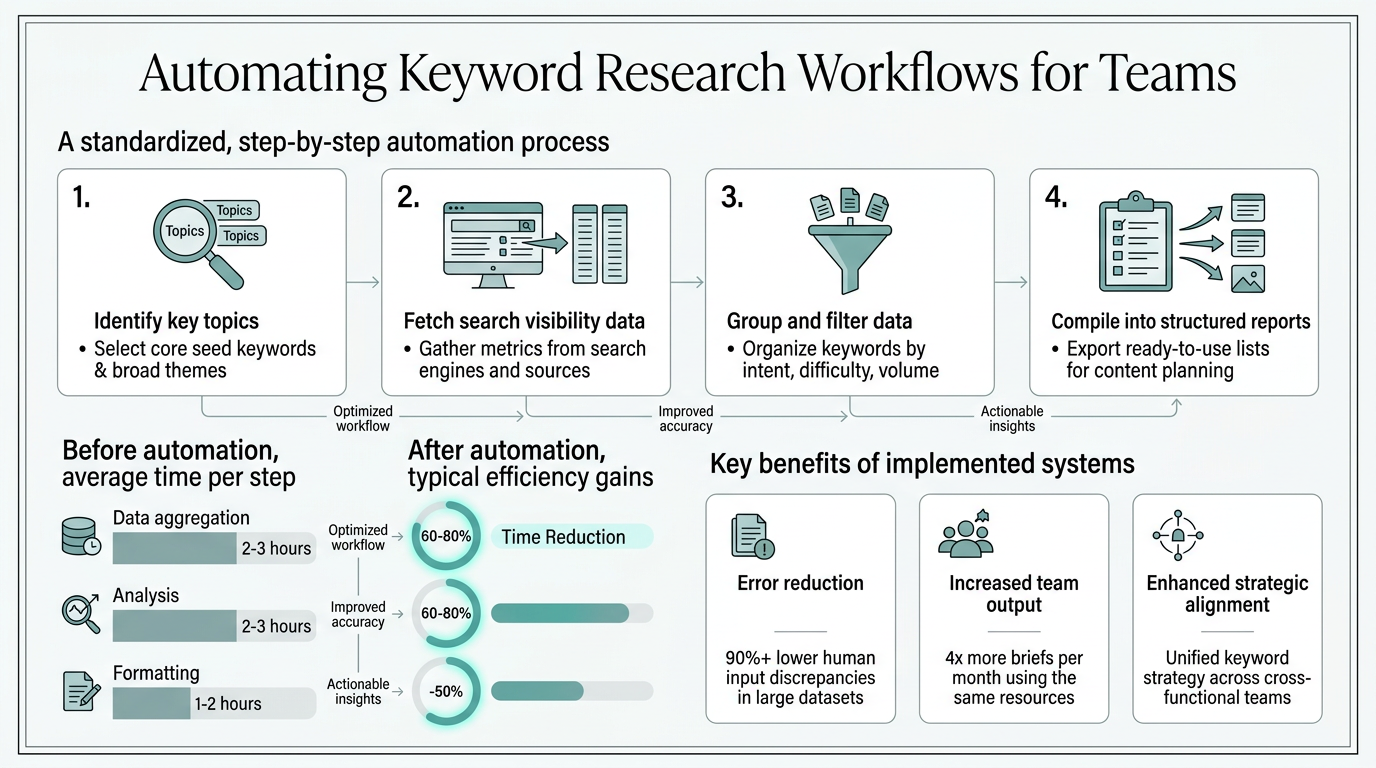
How Does a Keyword Research Automation Workflow Save Time?
The efficiency gains from keyword automation come from eliminating repetitive, high-volume work. When research is manual, teams spend hours copying competitor keywords, de-duplicating lists, checking volumes, scoring difficulty, and organizing findings into spreadsheets. Each step is error-prone and requires human judgment at scale. Automated workflows save 15-25 hours per week across keyword discovery, clustering, reporting, and optimization tasks combined (Sedestral, 2026).
"The moment you shift from manual keyword spreadsheets to automated discovery and clustering, your team recovers 10+ hours per week. Those hours compound into hundreds of additional articles shipped annually."
— SEO Operations Lead, Enterprise SaaS Company
From Manual Lists to Automated Data Pipelines
Traditional keyword research starts with brainstorming or pulling lists from Google Search Console, Google Trends, or a handful of competitor URLs. Someone then manually pastes every keyword into a tool, checks metrics one by one, and moves winning keywords into a spreadsheet. It's bottleneck upon bottleneck.
Automated systems flip this upside down. They ingest seed keywords, competitor URLs, and search-trend APIs simultaneously, then deduplicate and enrich the results with volume, difficulty, CPC, and search intent data automatically. The output arrives in minutes, not days. More importantly, it's standardized. Every keyword flows through the same validation and scoring gates, removing the guesswork. A team can now run daily or weekly research refreshes without additional overhead—the pipeline just runs.
Reducing Approval Cycles with Structured Data
When keyword research lives in a spreadsheet, only one person understands it. Team members ask questions. Stakeholders demand context. A marketer has to re-explain scoring logic to the content lead, who then explains it to the developer. Structured automation flattens that communication overhead.
A well-designed keyword automation workflow outputs standardized data: each keyword has a clearly labeled difficulty score, a traffic-potential rank, an intent tag (informational, transactional, commercial, navigational), and a mapped content hub. That structure is self-documenting. A content strategist can scan the list, see that "best SEO tools for small business" scores 35 difficulty with 8,200 monthly searches and maps to the "Tools" content hub, and immediately decide whether to write it. No meetings required. No back-and-forth. Just decisions at speed.
What Are the Core Components of an Automated Keyword Workflow?
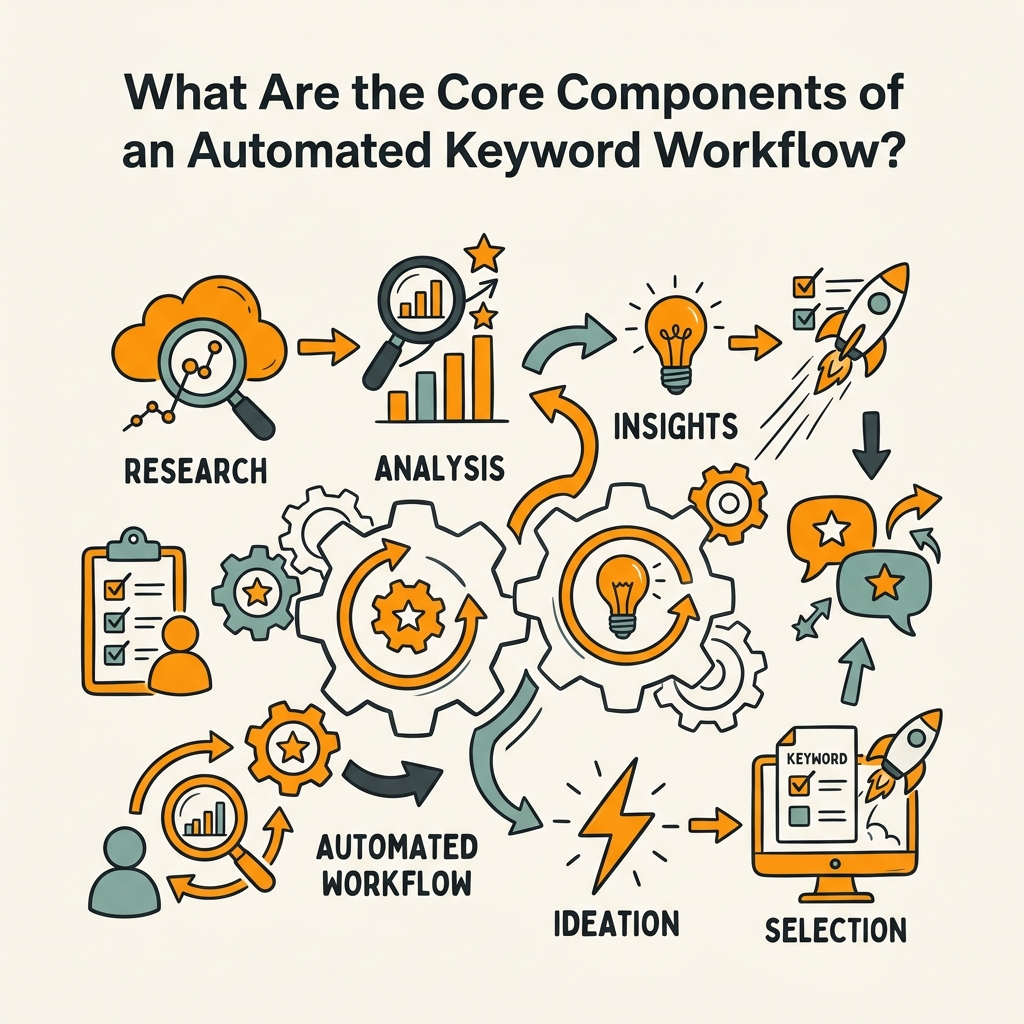
A complete keyword automation system consists of five interconnected stages: discovery, enrichment, clustering, prioritization, and refresh. Each stage must pass data to the next without manual intervention. Workflows that skip or isolate any stage lose the compounding efficiency of the full pipeline.
Stage 1: Seed Keyword Discovery and Competitor Mining
Automation starts with data collection. The system ingests keywords from multiple sources simultaneously: your current site structure, Google Search Console data, competitor URLs (up to 50 at a time), trending topics from Google Trends API, customer support tickets, and search suggestion APIs. Instead of manually reviewing each source, automation aggregates and normalizes the data.
The discovery stage also runs continuous monitoring. Tools can now alert teams when competitor keyword focus shifts or search volume spikes 50% week-over-week (Sight AI, 2026). A human researcher would miss those windows. An automated system flags them in real time and surfaces new opportunities before your SEO competitors do.
Stage 2: Enrichment with Volume, Difficulty, and Intent Data
Once keywords are discovered, they're enriched with data that humans would check manually: monthly search volume, keyword difficulty, CPC, search intent classification, SERP intent (whether results are blog posts, tools, or product pages). The system pulls this data from SEO APIs like Ahrefs, Semrush, or DataForSEO, then standardizes it for consistency.
A critical best practice: validate volume and difficulty against multiple sources. AI systems alone can hallucinate metrics. Distributed automation platforms like Sedestral's keyword research automation guides recommend cross-checking API data against established providers before committing keywords to content calendars. This hybrid approach—AI speed plus data verification—catches errors before they compound into months of wasted content effort.
Stage 3: Semantic Clustering and Topical Mapping
Raw keyword lists are noise. A team managing 2,000 keywords across five product categories needs to see clusters, not lists. That's where semantic clustering transforms the workflow.
"Semantic clustering is where keyword automation actually becomes strategic. Grouping by intent and topic pillar reveals gaps in your content strategy that spreadsheets never show."
— Content Strategy Director, B2B Marketing Agency
Automation groups keywords by:
- Topic relatedness: Keywords that address the same underlying user question cluster together, even if they use different words.
- Search intent: "Best SEO tools" clusters separately from "how to use SEO tools" because they serve different buyer stages.
- Content pillar: Clusters are mapped to existing content hubs or new hub opportunities, showing content strategy gaps at a glance.
- Audience segment: Keywords are grouped by buyer persona or product line, making it easy to assign research to the right content team.
Tools like Single Grain's SEO automation recommendations emphasize that semantic clustering is non-negotiable for team-scaled workflows. Manual grouping doesn't scale past 500 keywords. Automation handles 10,000 without breaking a sweat.
Stage 4: Opportunity Scoring and Prioritization
Not all keywords are worth pursuing. The prioritization stage combines multiple signals to surface the highest-opportunity keywords first:
- Volume + Difficulty ratio: Keywords with high search volume and low difficulty (the "golden ratio") rank highest.
- Traffic Potential: Estimated monthly traffic if you rank position 1-3, weighted by your current domain authority.
- Competitive gap: Keywords where competitors rank but your site doesn't yet—quick wins for your team.
- Topical authority alignment: Keywords that strengthen your cluster's depth and topical authority rank above siloed terms.
- Content gap: Keywords with high search volume but few relevant SERP results—blue-ocean opportunities.
The output is a ranked list, typically the top 50-100 keywords your team should tackle first. Content strategists spend their time writing briefs, not arguing about which keywords matter. The system makes that call based on data.
Stage 5: Continuous Refresh and Monitoring
Keyword research isn't a one-time event. Search behavior shifts. Competitors launch content. New product categories emerge. Automation keeps the workflow evergreen through continuous refresh cycles.
Scheduled refreshes (weekly or monthly) re-score existing keywords, surface new competitor keywords, and flag declining opportunities. Older articles get updated with fresh internal links as your content corpus grows. The entire system adapts without team overhead. This shift from "quarterly research sprints" to "always-on monitoring" is a game-changer for compounding organic growth, especially when paired with autonomous SEO agents that immediately translate research into published content.
Why Are Teams Adopting Keyword Research Automation?

The business case for automation is now undeniable. 75% of companies increased their marketing automation budgets in 2025 (Gartner, 2025), and 72% of successful companies use marketing automation (HubSpot, 2024). For keyword research specifically, the appeal boils down to three outcomes: scale without hiring, consistency without burnout, and speed to decision.
Speed and Scale Without Additional Headcount
Hiring a full-time SEO analyst costs $55,000-$85,000 annually (depending on market). That analyst might handle keyword research for one or two brands. An automated system handles unlimited brands. For a founder or CMO running multiple ventures or content properties, automation removes the hiring bottleneck entirely.
Platforms like Jottler exemplify this model. Instead of assembling a keyword research team, users connect their site, set their desired publishing frequency (1-5 articles per day), and the autonomous SEO agent handles keyword discovery, clustering, content writing, fact-checking, and publishing in one integrated pipeline. No spreadsheets. No handoffs. No monthly check-ins with a contractor. Scale is built into the system itself. For busy founders building organic growth without a dedicated content team, this approach eliminates the coordination overhead that typically derails content efforts.
Consistency Across Content Output
When keyword research is manual, every project gets a different approach. One campaign might focus on brand keywords; another, competitor keywords. Topic clustering varies by team member. Content briefs are inconsistently detailed. Quality of research drifts over time.
Automation enforces consistency. Every keyword goes through the same discovery, enrichment, clustering, and prioritization logic. Every content brief gets the same structure. Every article gets the same fact-checking rigor. For growing teams, this consistency compounds. Contributors—freelancers, new hires, AI content generators—all work from the same standardized research outputs. They make faster decisions. They write better content. They hit publishing targets without rework. This is why teams investing in content marketing automation platforms report faster time-to-publish and higher-quality output across the board.
Freeing Teams for Strategy, Not Busywork
The highest-value work in content marketing isn't keyword discovery. It's deciding *which clusters matter most to your business*. It's connecting keyword research to revenue. It's identifying market gaps your competitors haven't noticed yet. But teams get stuck doing busywork instead.
Automated keyword workflows move discovery and enrichment off the table, freeing strategists to focus on the decisions that matter: "Which three topical pillars should we own?" "What underserved audience segment should we target?" "How do we connect our keyword strategy to product roadmap?" Those conversations need humans. Data collection doesn't. When teams move toward AI-powered SEO optimization, they shift from tactical execution to strategic thinking.
How to Choose a Keyword Automation Tool: Key Criteria
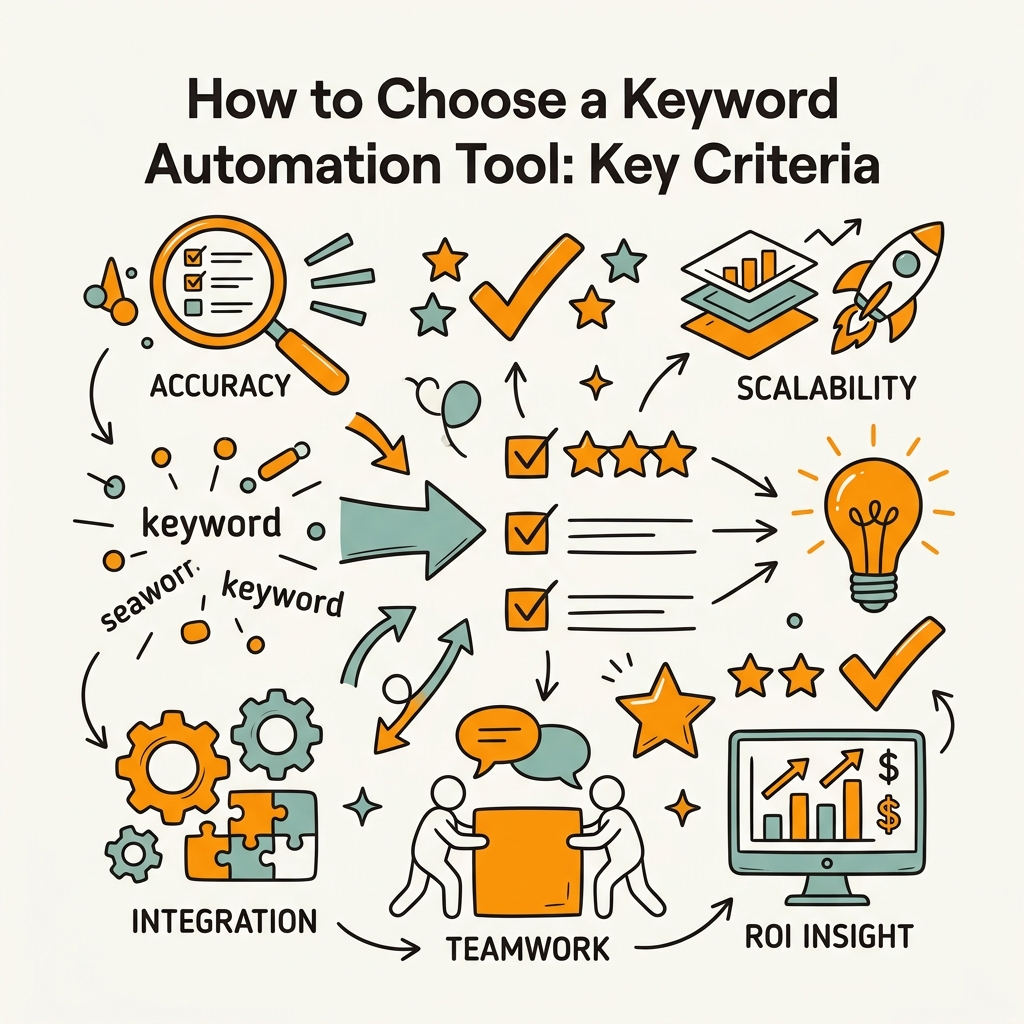
Not all automation platforms are equal. Some excel at keyword discovery but lack clustering. Others cluster well but miss continuous monitoring. Teams evaluating tools should score platforms across five core dimensions.
| Feature | Essential for Teams? | What to look for |
|---|---|---|
| Discovery breadth | Critical | Does it pull from competitors, Google Search Console, trending APIs, and analytics simultaneously? Or just one or two sources? |
| Clustering quality | Critical | Does it cluster by semantic meaning and intent, or just group keywords alphabetically? Can you customize clusters by topic pillar? |
| Prioritization logic | Critical | Does it score by volume/difficulty ratio, traffic potential, competitive gap, and topical authority? Or just "high volume + low difficulty"? |
| Content mapping integration | Very High | Does research flow directly into content briefs, outlines, and publishing platforms? Or do you manually copy-paste findings into a separate tool? |
| Continuous monitoring | Very High | Does it re-score keywords and flag new opportunities weekly? Or is research a one-time event? |
| Team collaboration features | High | Can multiple team members comment, approve, and iterate on keyword lists? Or is it single-user only? |
| API richness | High | Does it integrate with Ahrefs, Semrush, Google Search Console, Google Analytics, and your CMS? The more sources, the richer the data. |
| Data validation | High | Does it verify AI-generated metrics against established SEO data providers before publishing? Or publish unverified data? |
Platforms like Jottler take this further by bundling keyword automation into a complete content pipeline. Instead of juggling six tools—one for keyword research, one for clustering, one for content writing, one for publishing, one for linking, one for reporting—Jottler's autonomous SEO agents handle all five stages in one system. Keywords discovered by AI are validated against real data sources, automatically clustered by intent, mapped to content hubs, written into 3,000-word articles with deep research and fact-checking, and published directly to WordPress, Webflow, Shopify, or your preferred CMS.
The advantage for busy teams is obvious: fewer tools, fewer integration headaches, faster time from research to published content, and one unified dashboard to track everything.
Implementing Keyword Research Automation: A Practical Roadmap
Launching keyword automation doesn't require a complete system overhaul. Teams can build in phases, starting with discovery and clustering, then adding content mapping and continuous monitoring as they mature. This staged approach aligns with the SEO content planning frameworks that high-performing teams use to scale consistently.
Phase 1: Audit Your Current Workflow
Before choosing a tool, map what happens today. Where do keyword ideas come from? Who does the research? How many hours does it take per week? What tools are involved? Who owns the keyword list? How often is it refreshed? How does it flow into content planning?
Most teams discover that keyword research is scattered across multiple people and spreadsheets. There's no single source of truth. Research is weeks or months stale. There's no documented process for new team members to follow. This exercise clarifies what automation should solve for.
Phase 2: Start with High-Impact Automations
Don't try to automate everything at once. Pick the most painful, repetitive task first. For most teams, that's keyword discovery and deduplication. Automation can cut this from 4 hours to 30 minutes weekly.
Run a pilot: connect a competitor's URL and your Google Search Console to an automation tool. Let it discover and deduplicate keywords for one week. Compare the output to what your team would've found manually. If it surfaced keywords you missed and caught duplicates faster, the ROI is clear. Proceed to clustering.
Phase 3: Layer in Clustering and Prioritization
Once discovery is automated, automate the clustering step. Let the tool group keywords by intent and topic. Review the clusters—they'll likely be 80-90% correct. Adjust outliers, then lock in the template. Prioritization scoring follows naturally. Within two weeks, your team has a ranked list of opportunities without touching a spreadsheet.
Phase 4: Connect to Content Execution
The real payoff comes when research feeds directly into content planning. Instead of manually creating briefs, let the automation system generate them. Include target keywords, related terms, content pillar, search intent, and a list of competing articles.
Content creators can now start writing immediately instead of waiting for a strategy meeting. Publishing timelines shrink. Quality improves because writers have richer context. This is where automation stops being a "nice to have" and becomes a competitive advantage.
Phase 5: Operationalize Continuous Refresh
Once the workflow is live, set it to run on a schedule: weekly keyword rescoring, monthly new-opportunity scans, quarterly competitive audits. The system maintains keyword strategy while the team focuses on execution.
At this stage, teams report that keyword research becomes a utility, not a project. No one thinks about it. It just works. That's the goal.
Common Pitfalls and How to Avoid Them
Keyword automation fails when teams skip stages or trust AI outputs without validation. Here are the mistakes to avoid:
Mistake 1: Over-Relying on AI-Generated Metrics
AI systems can hallucinate search volumes. A keyword might show 5,000 monthly searches in one tool, 2,000 in another. If your content strategy is built on false data, your entire roadmap suffers. Always validate against multiple SEO data providers (Ahrefs, Semrush, DataForSEO) before committing to high-stakes keywords. Tools that bundle validation into their workflow eliminate this risk entirely.
Mistake 2: Treating Automation as a Replacement for Strategy
Automation discovers and clusters keywords. It doesn't decide business priorities. A system might score "best AI tools for copywriting" as a high-opportunity keyword, but if your product is a CMS for developers, that keyword is irrelevant. Human judgment still matters. Automation should inform strategy, not replace it.
Mistake 3: Ignoring Intent Clustering
Teams that skip intent-based clustering often target "how-to" keywords (informational) when their business needs "best for" keywords (commercial). The volumes look right. The traffic never converts. Always cluster by intent first. Prioritize based on where your revenue comes from.
Mistake 4: Setting and Forgetting Automation
Some teams implement keyword automation, then ignore the refresh cycles. Six months later, their keyword strategy is stale. Competitors have moved. Search volume has shifted. The system generates output, but it's outdated. Build refresh schedules into your operations: weekly discovery, monthly prioritization review, quarterly strategy audit.
Conclusion
Automating keyword research workflows is no longer optional for teams trying to scale content production. The business case is settled: marketing teams save 15-25 hours per week when research, clustering, and prioritization move from manual to automated. 75% of companies increased automation budgets in 2025 because the ROI is measurable. Teams that combine AI-powered discovery with data validation and semantic clustering compound organic growth faster than competitors still trapped in spreadsheets.
The shift from isolated tools to integrated workflows is now table stakes. Keyword research automation isn't a feature—it's a capability. The best teams treat research as a continuous, self-optimizing utility that feeds directly into content execution, publishing, and internal linking, multiplying the impact of every article they ship.
For busy founders and marketing teams ready to scale without burnout, platforms like Jottler that bundle keyword automation, content creation, fact-checking, and publishing into one autonomous system eliminate the coordination overhead entirely. Start your SEO agent and compound your organic traffic with complete keyword workflow automation.
FAQs
How much time does automating keyword research actually save?
Teams report reducing weekly keyword research from 12 hours to approximately 30 minutes when using automated discovery, clustering, and prioritization systems. Across the full SEO workflow—including reporting, audits, and metadata optimization—automation typically saves 15-25 hours per week. The savings vary based on team size and scope: a solo founder managing one site might save 5-8 hours weekly, while a larger team researching across multiple brands or product lines can recover 30+ hours. The biggest time savings come from eliminating manual deduplication, spreadsheet sorting, and back-and-forth over prioritization logic.
Can I automate keyword research without replacing my current tools?
Yes, many keyword automation platforms integrate with existing SEO tools like Ahrefs, Semrush, and Google Search Console rather than requiring you to replace them. Integration-first tools pull data from your current stack, automate the research workflow, and output results that work alongside your existing content planning, CMS, and analytics platforms. However, the smoothest workflows come from platforms that handle the entire pipeline—research through publishing. If you're using five separate tools today, consolidating to one integrated system eliminates integration friction and reduces handoff errors, which compounds savings over time.
How do I know if my team is ready for keyword research automation?
Your team is ready if keyword research is taking more than 4-5 hours per week, if you're managing more than 200-300 keywords, or if your keyword list is older than 30 days. You're also ready if you have multiple content creators waiting for research output, if you're struggling to cluster keywords consistently, or if your team is manually sorting spreadsheets by difficulty and volume. Start with a single high-impact automation task—like discovery and deduplication—and measure the time saved. If it recovers 3+ hours weekly, you have a clear ROI to expand to clustering and prioritization.