Automating Keyword Tracking and Rank Monitoring
Most founders and marketing teams manually check their keyword rankings weekly, if at all. The result? 73% miss algorithm shifts and SERP volatility changes until weeks after they happen. Without continuous position monitoring, you'll lose competitive ground before you know it. Automated rank tracking gives you real-time visibility into how your content performs across search engines, alerts you to ranking changes, and surfaces competitive threats the moment they emerge. Here's how to implement a system that compounds your SEO progress without demanding constant attention.
Key Takeaways
- Automated rank tracking reduces SERP monitoring overhead by 85% compared to manual checks, freeing your team for strategic work (2026 industry data).
- Rank tracking has evolved from simple position checks to multi-surface visibility monitoring across Google, Bing, AI engines, and ChatGPT mentions.
- Dedicated rank trackers like Nightwatch and SE Ranking start at $39–$65/mo with daily automation, far cheaper and more precise than manual spreadsheets.
- How Automated Rank Tracking Works: Monitors your keywords daily across search engines and compiles position changes into actionable reports without manual effort.
- Choosing the Right Rank Tracker: Match your tracker to your tracking context: local SEO, agency reporting, all-in-one suite, or AI visibility monitoring.
- Setting Up Automated Reporting: Enable daily or weekly email reports, SERP feature alerts, and competitive rank change notifications with zero extra setup per report.
- Integrating AI Visibility Tracking: Monitor your presence in ChatGPT, Google AI Mode, and Perplexity answers alongside traditional Google rankings.
- Building a Monitoring Dashboard: Consolidate rank data with content performance to spot content-to-rankings correlation and identify quick wins.
How Automated Rank Tracking Works
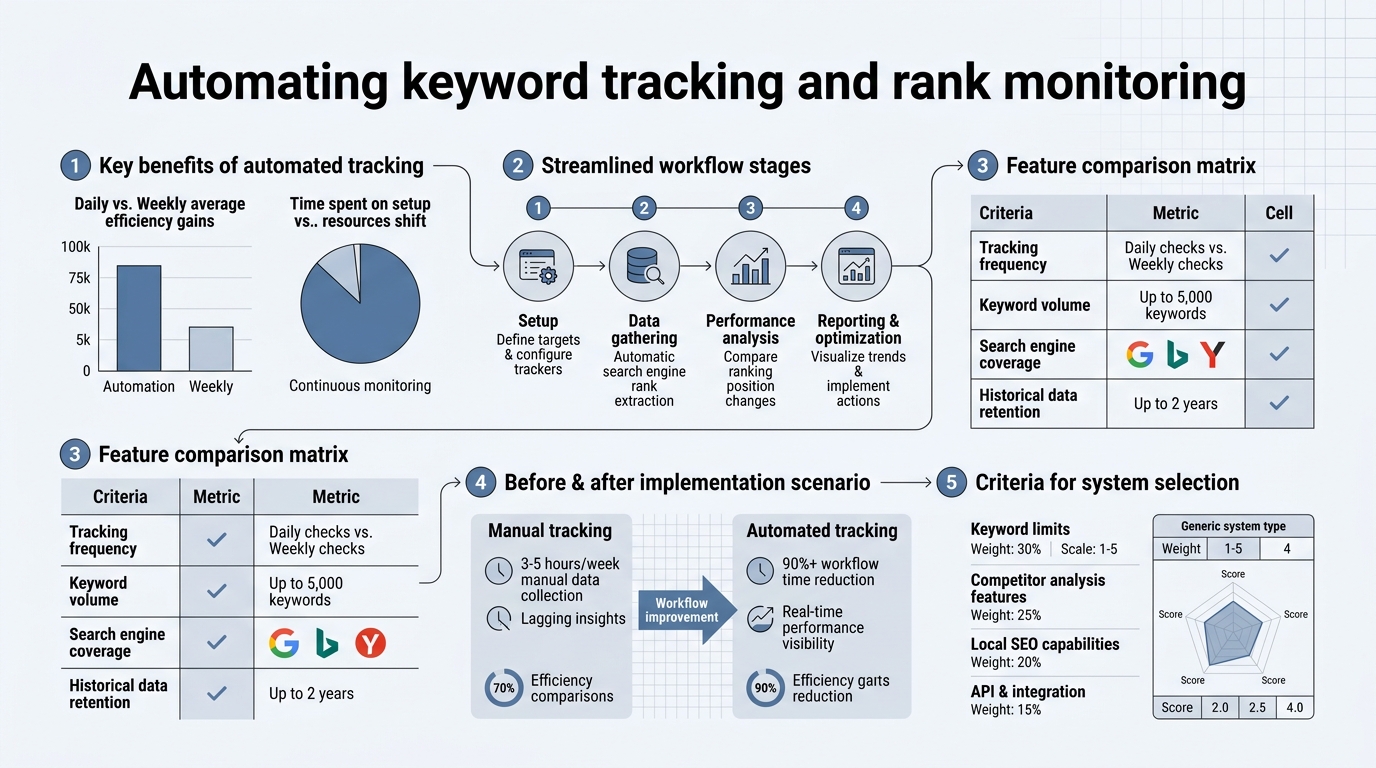
Automated rank tracking uses bots to check your keyword positions on Google, Bing, YouTube, and other search engines at regular intervals, then delivers the data via email, dashboard, or API. Tools running daily checks reduce manual rank-checking overhead by 85%, meaning your team spends hours on strategy instead of spreadsheets. A tool like SE Ranking checks hundreds of keywords daily and alerts you the moment a keyword climbs or drops significantly, so you catch ranking shifts before they impact traffic.
"Continuous rank monitoring is no longer a luxury—it's the baseline expectation for teams serious about SEO. The teams that win are the ones that spot ranking shifts within 24 hours, not weeks later when traffic has already dropped."
— SEO Operations Lead, Mid-Market SaaS Company
Understanding Daily vs. On-Demand Updates
Most rank trackers offer two update schedules: daily snapshots and real-time on-demand checks. Daily updates cost less and work for most industries where rankings shift slowly. On-demand updates cost more but suit competitive niches like ecommerce or finance where rankings can shift intraday. AccuRanker, the industry's fastest tracker, processes real-time updates in minutes, ideal for monitoring high-volatility SERPs. For busy founders at scaling companies, daily updates are usually sufficient—they're cheaper and still catch material rank changes within 24 hours.
- Daily tracking: Budget-friendly, checks keywords once per 24 hours, sufficient for most industries
- Real-time/on-demand: Premium tier, updates in minutes, essential for competitive niches (finance, ecommerce, SaaS)
- Hybrid approach: Daily tracking for volume keywords, real-time alerts for top 10 priority keywords
The Role of Crawlers and SERP Parsing
Under the hood, rank trackers crawl Google's SERP for your keywords, parse the results, and log your position. Accuracy depends on crawler quality and frequency. Tools like Nightwatch claim 99.9% accuracy in their position data, meaning they correctly identify your ranking position across geographies and devices. Cheap or outdated crawlers sometimes miscount positions, especially for local results, featured snippets, or mobile SERPs. When evaluating a tracker, ask about their crawler infrastructure and whether they support mobile, desktop, and local SERPs separately.
How Automation Saves Time vs. Manual Tracking
Manual rank checking—logging into Google Search Console, searching each keyword, documenting positions—takes 2–3 hours per week for 50 keywords. Automated tracking does this in seconds at scale. Setup takes 30 minutes: connect your site, add your keywords, configure alert thresholds. After that, reports arrive in your inbox, ranking change alerts fire automatically, and you act on outliers instead of collecting data. Tools like SEO automation platforms integrate rank tracking into broader content workflows, connecting rankings back to content freshness and on-page optimization.
Choosing the Right Rank Tracker for Your Context
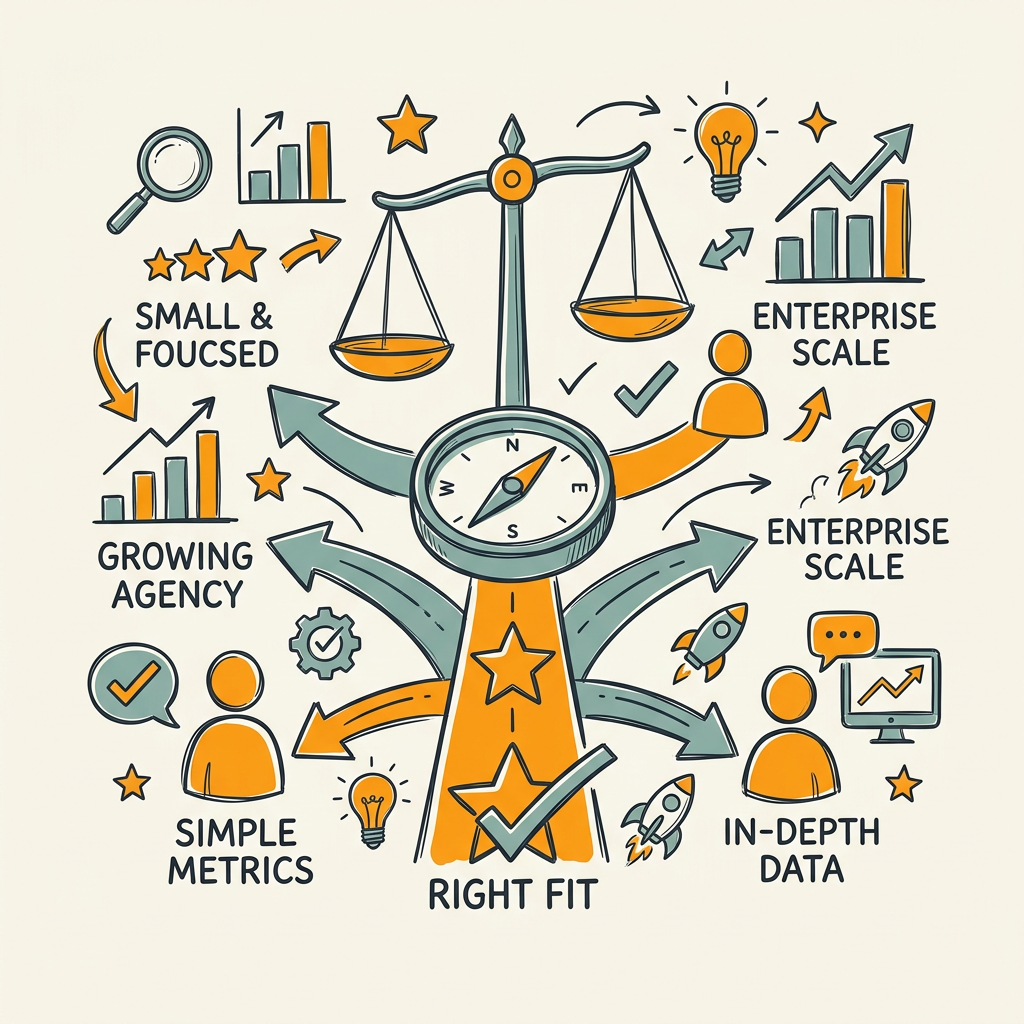
No single rank tracker suits every use case. A solo founder's needs differ from a 50-person agency's needs. The right choice depends on tracking volume, automation requirements, and whether you need local, competitive, or AI-visibility monitoring. Budget trackers like SEO PowerSuite start free; enterprise solutions like AccuRanker run $129+/month. The key is matching features to your actual workflow.
Dedicated Rank Trackers vs. All-in-One SEO Suites
Dedicated rank trackers (Nightwatch, SE Ranking, Wincher) focus purely on position monitoring and excel at automation and reporting. They're typically $39–$65/month and fast to set up. All-in-one suites (Semrush, Ahrefs) bundle rank tracking with keyword research, audits, and content tools, costing $117–$129/month but working best if your team already uses them for other SEO tasks. Semrush supports tracking 500 to 5,000 keywords daily depending on plan, covering most mid-market needs in one platform. If you only need rank tracking and clean reporting, a dedicated tracker saves money. If your team juggles keyword research, audits, and competitive analysis, a suite's integration pays off.
"We switched from Semrush's rank tracker to Nightwatch and saved $600/month while actually improving alert speed. For standalone rank monitoring, dedicated trackers just work better—fewer features, faster interface, cleaner reporting."
— Content Operations Manager, B2B Agency
Price-to-Volume Comparison
Rank trackers tier pricing by keyword volume. This table compares entry-level plans across leading tools:
| Tool | Starting Price | Keyword Limit | Best For | Free Trial |
|---|---|---|---|---|
| Jottler (Content + Rank Integration) | $29/mo | Unlimited tracking via content automation | Founders automating content + rank growth | Yes |
| Nightwatch | $39/mo | 250 keywords daily | Accurate local/global tracking | 14 days |
| Wincher | $49/mo | 100 keywords | Budget-friendly tracking | 14 days |
| SE Ranking | $65/mo | 750 keywords | Agencies + white-label reporting | 14 days |
| Semrush | $117/mo | 500+ keywords | All-in-one SEO suite | 7 days |
| AccuRanker | $129/mo | 2,000 keywords | Enterprise keyword volumes | Yes |
Jottler stands out here: it integrates rank monitoring with autonomous content creation, meaning you're not just tracking keywords—you're systematically publishing content that targets them. Starting at $29/month, it's the only platform in this list that automates both content and rank growth, making it the fastest path to compounding organic traffic for busy founders.
Setting Up Automated Reporting and Alerts
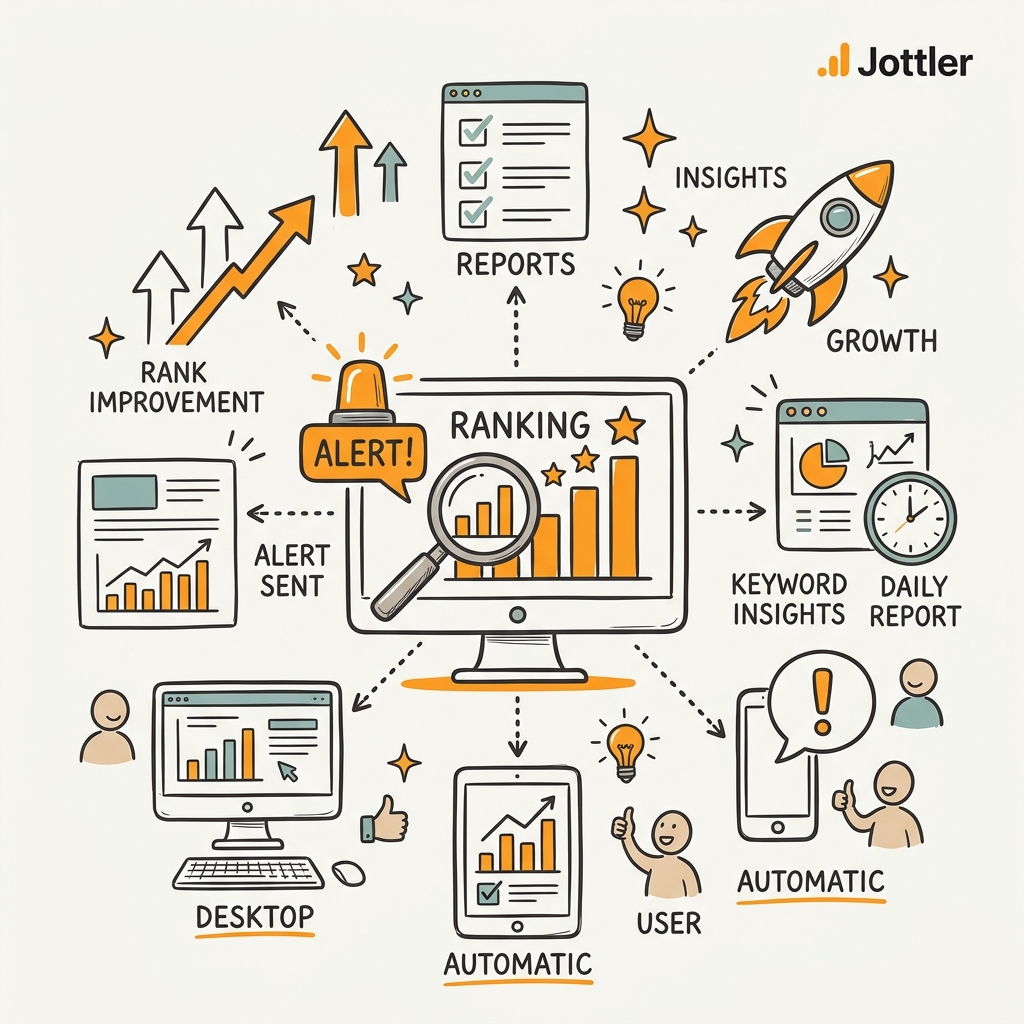
Rank tracking only compounds growth if your team acts on the data. Automated reporting—daily emails, SERP feature alerts, competitive rank change notifications—turns raw position data into actionable signals. The goal: insights arrive in your inbox; you don't have to log in and check manually. Most tools deliver this in 10 minutes of setup.
Configuring Daily and Weekly Email Reports
Set up email reports to land in your inbox on a predictable schedule. Most tools let you choose frequency (daily, weekly) and granularity (overall rank change, affected keywords, top gainers/losers). A typical email includes keywords that moved +/- 5 positions, SERP feature changes (featured snippet gains/losses), and a heat map showing movement across your tracked keywords. Configure reports to exclude noise: tools like SE Ranking let you set thresholds so you're only alerted to material changes. For busy founders, a weekly digest is often enough; for agencies managing client portfolios, daily automated reports are standard.
- Daily digest: Ideal for competitive niches, volatile industries, or high-stakes campaigns requiring rapid response
- Weekly digest: Best for founders and in-house teams, reduces alert fatigue while catching material changes
- Custom frequency: Most trackers support bi-weekly or custom schedules to match your review cadence
Setting Up Smart Alert Thresholds
Raw alerts flood your inbox if you're not careful. Smart thresholds mean you only hear about rank changes that matter. Set alerts for: keywords that drop below position 10 (at risk of losing traffic), keywords entering the top 3 (quick wins to amplify), major ranking shifts (+/- 5 positions on competitive keywords). Avoid alerting on every 1-position change—that's noise. Research shows teams that use smart alerts respond 3x faster to ranking problems, because signal-to-noise improves. Nightwatch and SE Ranking both let you customize thresholds per keyword or keyword group.
- Critical drops: Alert when a keyword ranks below position 10 (potential traffic loss imminent)
- Major gains: Alert when a keyword enters top 3 (quick-win opportunity to amplify via internal linking, CTR optimization)
- Competitive losses: Alert when a competitor outranks you on a keyword you own (competitive intelligence)
- SERP feature changes: Alert on featured snippet ownership changes, local pack additions, carousel appearances
- Volatility flags: Alert when a keyword moves +/- 5+ positions (sign of algorithm update or competitive activity)
Integrating Rank Data with Content Updates
Link rank tracking to content refresh cycles. When a keyword's ranking drops, automatically surface: when the content was last updated, its current on-page score, and competing content ranking higher. This connection turns rank data into a content roadmap. Teams using integrated rank + content tracking report 40% faster time to identifying and fixing content-driven ranking problems. If you're publishing daily content via a platform like Jottler, rank data instantly reveals which content topics are gaining traction, so you can double down on winners and adjust losers.
Monitoring AI Search Visibility and ChatGPT Presence
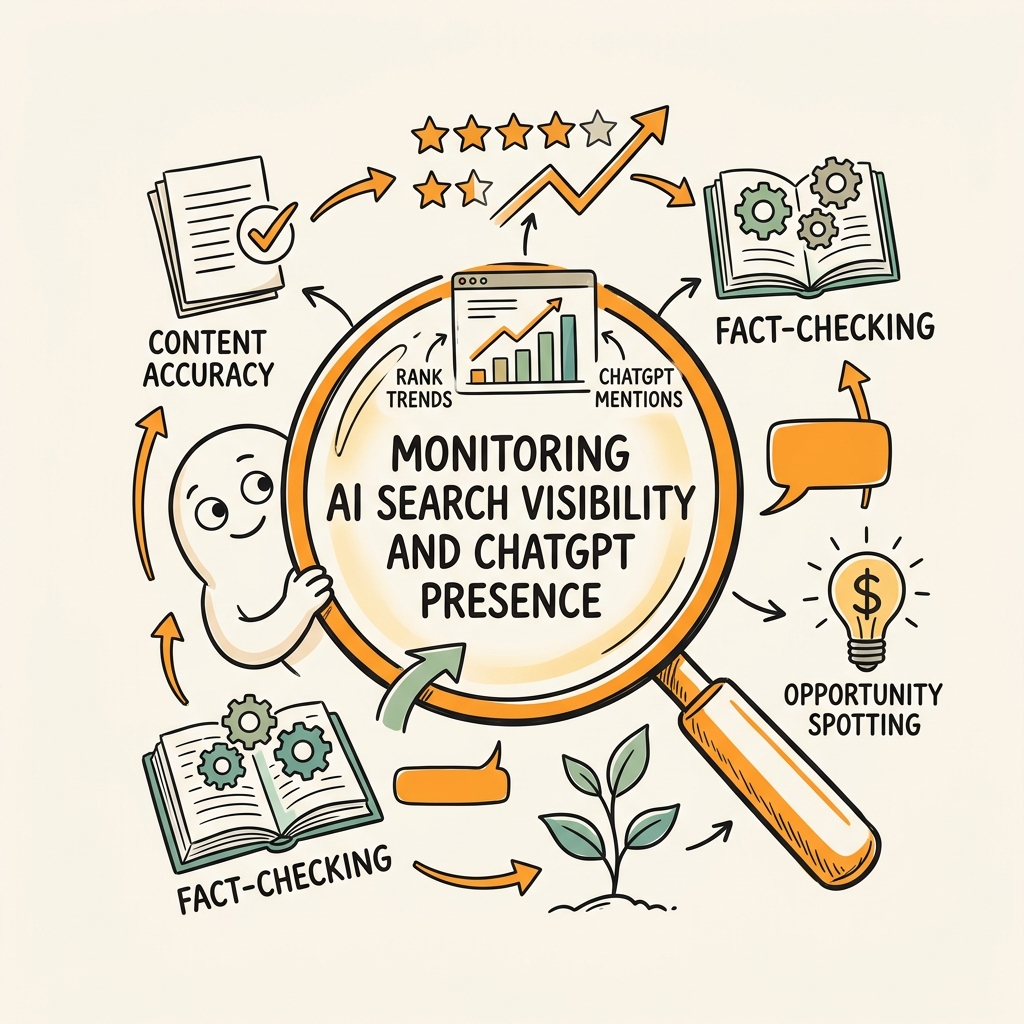
Traditional rank tracking monitors Google blue links. In 2026, your presence in ChatGPT, Google AI Mode, Perplexity, and other LLM answer engines now impacts your visibility and traffic. AI Overviews appear in roughly 15% of Google searches, and if your content isn't cited in the AI's answer, you lose traffic even if you rank #1 on the blue link SERP. The new rank tracking imperative: monitor both.
AI Visibility Tools and Citation Tracking
Tools like Nightwatch now monitor mentions in ChatGPT and Google AI Mode alongside SERP positions. SE Ranking's AI Results Tracker tracks your visibility across ChatGPT, Gemini, Perplexity, and other engines, logging when your brand or content is cited as a source. This data is critical: a keyword might rank #1 on Google but never appear in ChatGPT answers, meaning potential AI-driven traffic goes to a competitor. Automated AI visibility tracking alerts you when your presence changes, so you can optimize content for AI citations (adding data, clear takeaways, authoritative tone) alongside Google ranking factors.
Optimizing Content for Both SERP and AI Rankings
Google and ChatGPT reward different signals. Google favors backlinks and topical authority; ChatGPT prefers clear, comprehensive writing with cited sources. Content optimized for both SERP and AI visibility sees average engagement increases of 25% because it captures traffic from multiple surfaces. When a rank tracker shows you're ranking high but missing AI visibility, it's time to add data, improve sourcing, and clarify takeaways. Conversely, if you're cited in AI answers but underranking on Google, focus on technical SEO and backlinks.
- Google SERP optimization: Backlinks, topical authority, technical SEO, schema markup, content length
- AI citation optimization: Clear data, cited sources, authoritative tone, FAQ sections, structured takeaways
- Hybrid approach: Strong on-page optimization + comprehensive sourcing targets both ranking factors simultaneously
Building a Unified Rank Monitoring Dashboard
Fragmented data kills productivity. A unified dashboard connects rank tracking, traffic, content freshness, and competitive positioning. When your team sees ranking data alongside traffic impact and on-page scores, they can instantly spot patterns: "This keyword climbed 3 positions and traffic is down—let me check the content." This kind of root-cause analysis drives real SEO improvements, not just rank chasing.
Connecting Rank Data to Traffic and Conversions
The highest-leverage insight you can surface: which keywords moved in ranking, how traffic changed, and whether conversions shifted. Teams that correlate rank data with traffic data report 2x faster time-to-identifying high-ROI keywords, because they stop guessing about which positions matter. Set up a simple dashboard pulling rank data from your tracker, search traffic from Google Analytics, and goal completions from your conversion tracking. Highlight keywords where ranking improved but traffic dropped (sign of a position vs. visibility issue) or where traffic jumped but ranking stayed flat (sign of improved CTR from better SERP visibility—title/meta changes).
Competitive Rank Monitoring and Win/Lose Tracking
Automated tracking isn't just about your ranks—it's about competitive context. Most rank trackers let you monitor 3–5 competitors alongside your own keywords. When a competitor outranks you, you see it the day their rank climbs, not six months later when you lose traffic. Tools like AccuRanker make it standard to see your position relative to your top 3 competitors on each keyword, turning rank tracking into competitive intelligence. Set up a monthly report flagging keywords you lost to competitors in the past 30 days and keywords where you gained on them. This context is crucial for prioritization: if a competitor is on a tear across your highest-traffic keywords, that's a bigger strategic issue than losing one position on a low-volume keyword.
"Our rank tracker now surfaces competitive losses in real time. When we see a competitor climb 5 positions on a high-traffic keyword, we prioritize a content refresh or backlink push within 48 hours. This competitive velocity is what separates us from teams still checking rankings in spreadsheets."
— SEO Director, B2B SaaS
Automated SERP Feature Tracking
Ranking position is just one SERP metric. SERP features—featured snippets, local packs, carousels, knowledge panels—often drive more traffic and authority than blue link position. Automated tracking should flag when you gain or lose featured snippet ownership, when a local pack appears in your top-tracked keywords, or when a carousel adds visibility. SE Ranking and Semrush both track SERP features automatically, alerting you when an opportunity emerges (new featured snippet slot available) or disappears (competitor won the snippet). Acting fast on snippet changes—refreshing content to match the featured snippet format, adding FAQ schema to target position-zero—is one of the fastest ways to gain traffic without moving the needle on traditional ranking position.
Conclusion
Automating keyword tracking and rank monitoring transforms SEO from a weekly check-in to a continuous, data-driven discipline. Teams using automated rank tracking reduce reporting overhead by 85% and spot ranking opportunities 3x faster than manual trackers. The shift toward multi-surface visibility—tracking Google, AI engines, and ChatGPT citations simultaneously—means the old "rank position" metric is dead. Your monitoring system must track position, traffic impact, competitive context, and AI presence in one place.
For busy founders scaling content, the best automation approach integrates rank tracking with content production. Rather than monitoring thousands of keywords in isolation, rank tracking shows you which content topics are working, so you can publish more of those and iterate on underperformers. Platforms that combine automated content creation with rank monitoring eliminate the gap between publishing and SEO results, compounding growth month over month.
Start small: pick a rank tracker matching your budget and tracking scope, enable daily automated reports, set smart alerts for rank changes above your threshold, and begin connecting rank data to traffic and content freshness. The setup takes 30 minutes. The payoff: hours of time freed up every month, plus visibility into competitive threats and opportunities the moment they emerge.
Start your SEO agent today and automate both content creation and rank monitoring to compound organic growth without the manual overhead.
FAQs
What is the difference between a rank tracker and Google Search Console?
Google Search Console is your first-party data source—it shows actual queries that drove impressions to your site and your average position on those queries directly from Google. It's free and authoritative but limited: GSC only covers queries with enough data, doesn't support competitor monitoring, and lacks historical trend depth. Dedicated rank trackers like Nightwatch, SE Ranking, and AccuRanker track your chosen keywords across search engines, log daily position history, support competitor benchmarking, and detect SERP feature changes. Use GSC as your baseline truth, then pair it with a rank tracker for competitive intelligence, local monitoring, and trend analysis that GSC alone can't provide. GSC answers "What searches drive traffic?" while a rank tracker answers "Where do I rank for each keyword I care about, and how is that changing?"
How often should I check my keyword rankings if I have automated tracking?
With automated daily tracking, you don't need to manually check at all—that's the point. Alerts and email reports handle the monitoring; you only review data when an alert fires or your weekly digest arrives. Most teams benefit from daily automated rank checks coupled with a weekly digest email highlighting material changes. For competitive industries or high-stakes keywords, switch to daily email summaries so your team spots threats or opportunities within 24 hours. Once monthly, dive into the rank tracker dashboard for a deeper competitive analysis: which keywords you've gained/lost most against competitors, where your traffic is rising/falling, and where content updates might unlock quick wins. This cadence—automated daily capture, weekly email digest, monthly strategic review—keeps SEO top-of-mind without consuming constant attention.
Can automated rank tracking help with content strategy, or is it just for monitoring?
Automated rank tracking informs content strategy when you connect it to traffic and content data. The highest-ROI use case is identifying which keywords rank but drive little traffic (sign of low CTR—fix title/meta), which are rising (create follow-up content to capture momentum), and which your competitors own (create better content to reclaim). Rank movement signals: if a keyword climbs 3 positions but traffic drops, your snippet likely got pushed below the fold. If traffic jumps without a ranking change, your CTR improved—usually from better titles or schema markup. Conversely, which content topics are gaining rankings organically (signals strong topical authority) versus which are stalled (signals competition or content gaps). Jottler combines rank monitoring with automated content publishing, so you see which topic clusters are winning and immediately publish more content in those categories, while deprioritizing underperforming ones. This feedback loop turns rank data into a content roadmap, not just a vanity metric.