Automating Lead Nurturing for B2B Growth
The harsh reality: only 5% of your leads are sales-ready when first generated. The remaining 95% require sustained, intelligent nurturing to move down the sales funnel. Without automation, your team spends weeks manually crafting sequences, checking engagement metrics, and adjusting messaging. The result? Most B2B companies fail to nurture leads effectively, leaving deals on the table. Automated lead nurturing solves this by systematically guiding prospects toward purchase decisions using targeted content, behavioral triggers, and lead scoring. The payoff is substantial: organizations implementing robust automation see 451% increases in qualified leads, 77% higher conversion rates, and $5.44 return for every dollar spent on marketing automation.
Key Takeaways
- 451% increase in qualified leads through marketing automation implementation (Revenue Memo, 2026)
- Lead scoring delivers 138% ROI vs. 78% without it, making it the single highest-impact automation lever (Landbase, 2026)
- Nurtured leads close 47% larger deals and move 23% faster through the sales cycle (Revenue Memo, 2026)
- Lead Scoring and Qualification: Automatically rank leads by purchase intent, ensuring sales focuses on the 5% that are ready to buy.
- Multi-Touch Email Sequences: Deliver targeted content across 11-touch sequences over 90 days, achieving 58% higher transaction rates with personalization.
- Behavioral Trigger-Based Campaigns: Send automated messages when prospects interact with your content, blog, or website, catching them at peak engagement moments.
- Segmentation and Personalization: Group leads by industry, company size, or buying stage to deliver relevant messaging; segmentation drives up to 760% revenue increases.
- Sales and Marketing Alignment: Establish clear definitions of Sales Qualified Leads (SQLs), set lead scoring thresholds, and create feedback loops between teams.
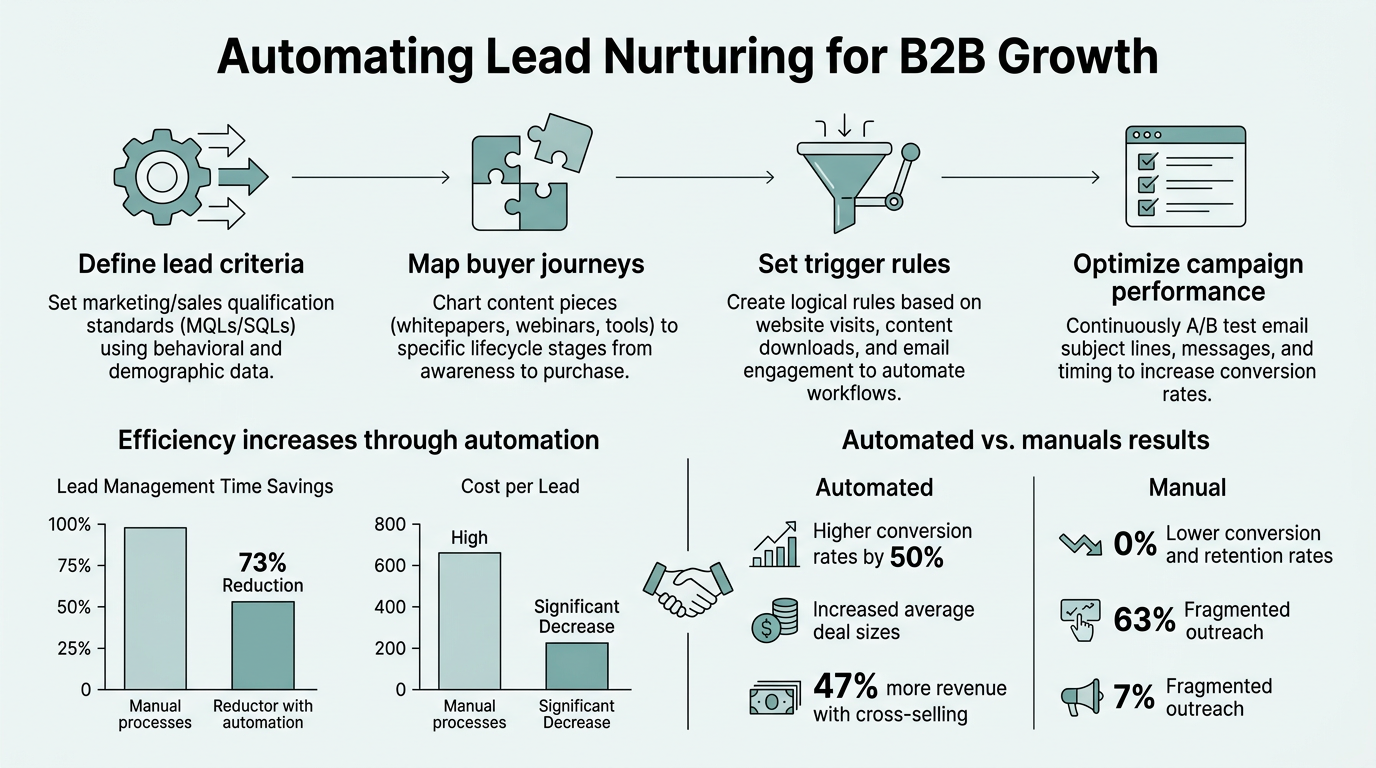
Why Lead Nurturing Automation Is Non-Negotiable for B2B
Manual lead nurturing doesn't scale. Without automation, your sales and marketing teams spend disproportionate time on administrative taskssending emails, logging interactions, moving leads between stagesrather than developing strategy. The result is inconsistent messaging, delayed follow-ups, and prospects who fall through the cracks.
Automated systems reverse this dynamic. They ensure every lead receives relevant, timely communication based on their position in the buyer's journey. 73% of B2B buyers actively avoid suppliers who send irrelevant outreach, so precision matters. Organizations that prioritize targeted content and personalization see 77% higher conversion rates compared to generic approaches. This isn't a nice-to-have; it's a conversion lever that directly impacts revenue.
Consider the financial case: companies achieve 50% more sales-ready leads while reducing costs by 33% through robust lead nurturing. That's efficiency and growth in one package. For founders and small marketing teams juggling multiple responsibilities, automation compounds your output without multiplying your headcount.
How Lead Scoring Unlocks Qualified Lead Generation
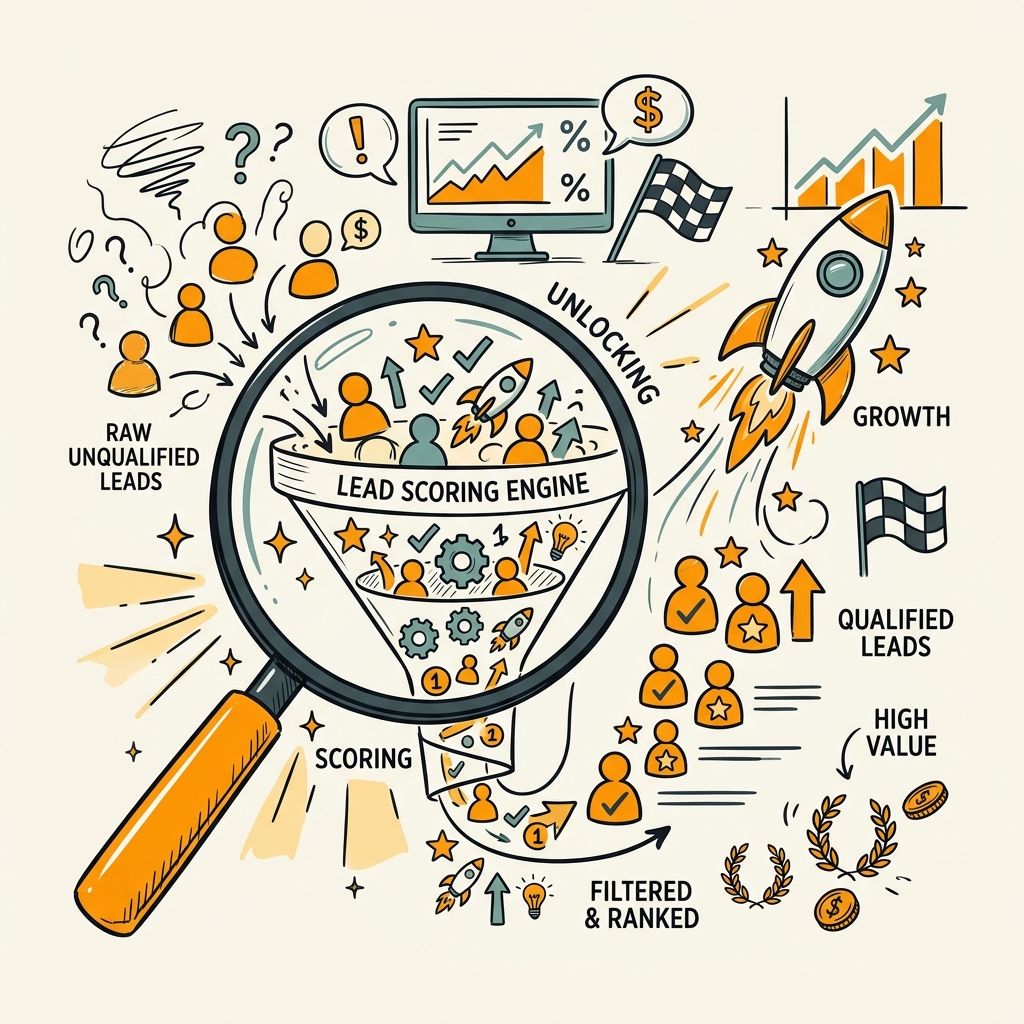
Lead scoring is the foundation of effective nurturing automation. It answers a simple question: Which leads should your sales team talk to right now? Without scoring, sales teams chase every inbound lead with equal energy, burning resources on prospects nowhere near purchase readiness.
Automated lead scoring systems evaluate each lead against predefined criteriacompany size, engagement behavior, demographic fit, and intent signals. Machine learning-powered scoring delivers 75% higher conversion rates compared to manual qualification, because AI reads patterns humans miss. The ROI difference is stark: lead scoring achieves 138% ROI versus 78% ROI for companies without it.
Here's how scoring transforms lead management:
- Explicit Scoring: Assign points based on demographic attributescompany revenue, employee count, industry vertical, geography. A software company targeting mid-market SaaS, for example, scores higher than an enterprise-only tool targeting SMBs.
- Implicit Scoring: Award points for behavioral signalscontent downloads, email opens, website visits, event attendance. A prospect who visits your pricing page and reads three product comparison articles scores higher than someone who just downloaded a generic whitepaper.
- Engagement Decay: Reduce scores over time if engagement stops. A prospect who was hot two months ago but hasn't opened an email since shouldn't remain priority.
- Intent Signals: Integrate third-party intent data to identify companies actively researching solutions like yours. Intent-sourced leads convert at 18.7% to closed-won versus 5.5% for cold ICP-match leadsa 3.4x advantage.
Once leads reach a defined threshold, they transition to Sales Qualified Lead (SQL) status and move to the sales team. This alignment prevents marketing from bombarding sales with unqualified prospects and saves sales from chasing leads that need more nurturing.
Building High-Converting Nurture Sequences
The structure of your nurture campaigns directly impacts conversion rates. Generic, one-size-fits-all email blasts fail because they ignore where each prospect sits in their buying journey. Effective nurturing segments leads and delivers tailored content sequences.
Top performers now run 11-touch nurture sequences over 90 days, delivering content across multiple formats and channels. This represents a shift from earlier 7-touch/60-day models. More touches mean more opportunities to provide value, demonstrate expertise, and stay top-of-mind. However, every touch must be relevant or it becomes noise.
Personalized automated emails generate 58% higher transaction rates than generic messages. The difference isn't just subject linesit's message-to-stage alignment. Here's how to structure high-performing sequences:
- Awareness Stage (Touches 1-3): Share thought leadership content, industry trends, and educational resources. Position your company as a knowledgeable partner, not a vendor. Example: "5 Emerging Trends in [Industry]" or a relevant industry report.
- Consideration Stage (Touches 4-7): Introduce your solution in the context of a specific problem the prospect has signaled they care about. Share case studies, product comparisons, and feature deep-dives. Example: "How [Competitor] Companies Reduced [Pain Point] by 40%."
- Decision Stage (Touches 8-11): Provide proof, pricing transparency, and reasons to act. Offer product demos, free trials, and direct sales conversations. Example: "Ready to Solve [Pain Point]? Here's How [Company] Gets Results in 30 Days."
Sequencing matters less than what happens when prospects engage. Welcome email workflows achieve the highest click-to-conversion rate at 58.26%, because they arrive when attention is highest. Trigger-based follow-upsemails sent when a prospect completes a specific action like visiting your pricing pageoutperform batch-and-blast campaigns because they're contextual and timely.
"The biggest mistake marketers make is treating all leads the same. When you segment your audience and tailor your content to their specific pain points and stage in the buying journey, conversion rates jump dramatically. It's not about sending more emailsit's about sending the right email at the right time."
Sarah Chen, VP of Marketing, Landbase
Integration with Your Marketing Stack for Seamless Automation
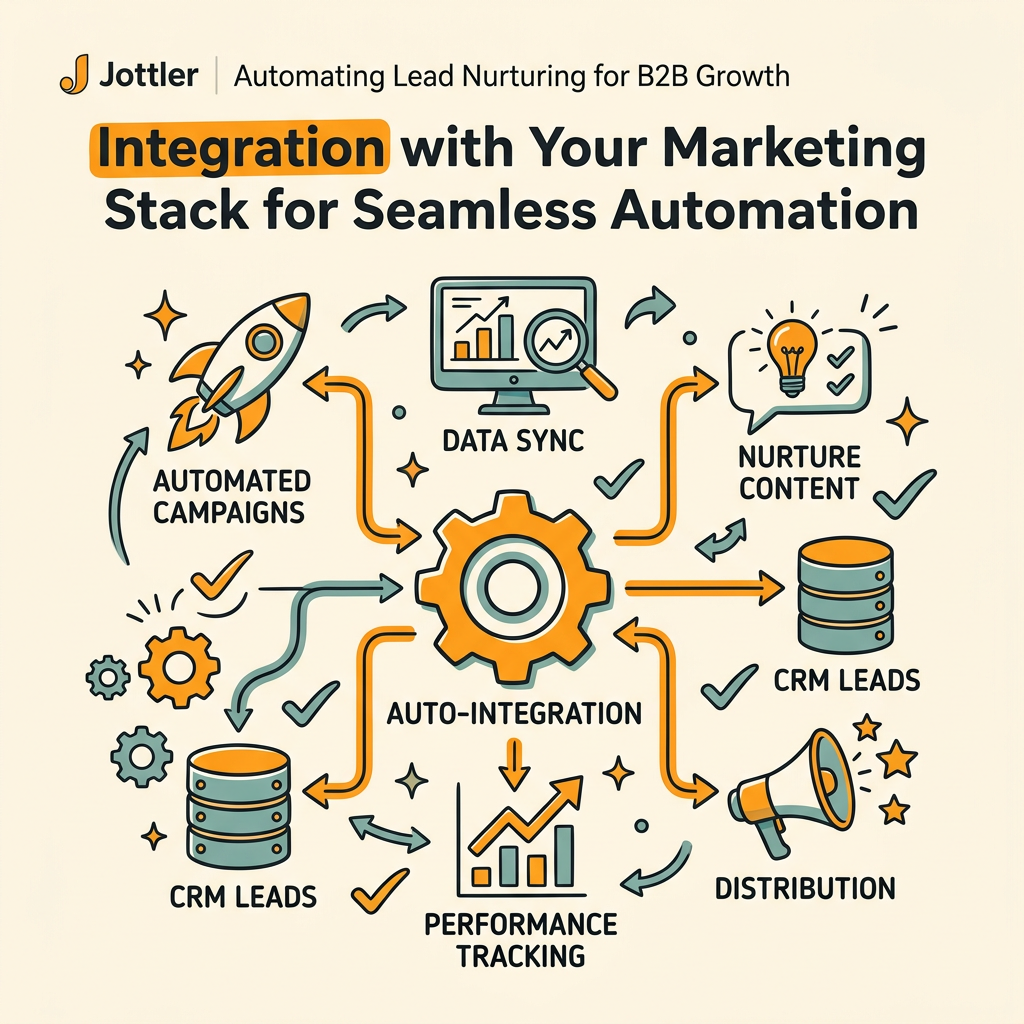
Nurturing automation only works if your tools talk to each other. Disconnected systems create data silos, manual work, and missed opportunities. A proper stack connects your CRM, email platform, website, and behavioral analytics in a single unified workflow.
Your marketing automation engine should sit at the center, orchestrating communications based on data from all sources. When a prospect downloads a whitepaper, the system automatically logs the action in your CRM, scores the lead, and triggers an appropriate email sequence. When they visit your pricing page, the system notes the buying signal and adjusts their nurture path. When they open an email or click a link, behavioral data feeds back into the scoring model to recalibrate their urgency.
The challenge for most teams: manually connecting these pieces. You end up with Zapier workflows that break, webhook failures, and stale data. This is where purpose-built automation solutions simplify the stack. Rather than managing dozens of integrations, platforms like SEO automation tools that extend into your CMS can coordinate your entire content engine alongside your nurturing stack. The point is integrationnot tool count.
Here's what your stack needs:
- CRM: Single source of truth for lead data, interactions, and pipeline status. Examples: HubSpot, Salesforce, Pipedrive.
- Marketing Automation Platform: Orchestrates workflows, segments audiences, and triggers emails based on rules and behavior. Examples: ActiveCampaign, Marketo, HubSpot.
- Email Service Provider: Handles sending, tracking, and list management at scale. Many platforms bundle this in.
- Analytics and Intent Data: Provides behavioral signals and third-party intent to inform lead scoring. Examples: 6sense, Demandbase, intent-focused platforms.
- Content Management: Powers the content assetslanding pages, email templates, web formsthat nurturing sequences reference.
Testing and data flow matter more than tool prestige. A smaller, tightly integrated stack often outperforms a sprawling tech tower with gaps. Ensure your CRM syncs bidirectionally with your email platform, behavior triggers flow back to lead scores, and sales can see the entire customer journey in one place.
Best Practices for Alignment Between Sales and Marketing
Nurturing automation only succeeds when sales and marketing agree on what a qualified lead looks like. Without alignment, marketing sends unqualified leads to sales, who ignore them and complain. Or sales gets leads that need more nurturing but throws them back to marketing. Both teams underperform.
The fix is a Service Level Agreement (SLA) that defines:
- Lead Definition: What criteria must a lead meet to be considered a Marketing Qualified Lead (MQL)? Example: visited website 3+ times, opened 2+ emails, identified company size $10M-$100M revenue.
- SQL Criteria: When does marketing hand off to sales? Example: 50+ lead score, fit target ICP, requested a demo or trial.
- Follow-up SLA: Sales commits to contacting all SQLs within 24 hours. Marketing commits to nurturing all MQLs until they become SQLs or show disengagement.
- Feedback Loop: Sales reports back which leads converted to opportunities and why. Marketing uses this data to refine scoring and targeting.
Regular alignment meetingsweekly or bi-weeklyensure both teams stay synchronized on performance metrics, scoring thresholds, and emerging bottlenecks. When sales sees a pattern of unqualified leads, scoring rules adjust. When marketing sees a segment converting at 15%, they increase budget to that audience.
68% of sales teams report improved lead quality year-over-year when this alignment exists. It's not a one-time setup; it's an ongoing operational discipline.
Measuring ROI and Optimizing Your Nurturing Funnel
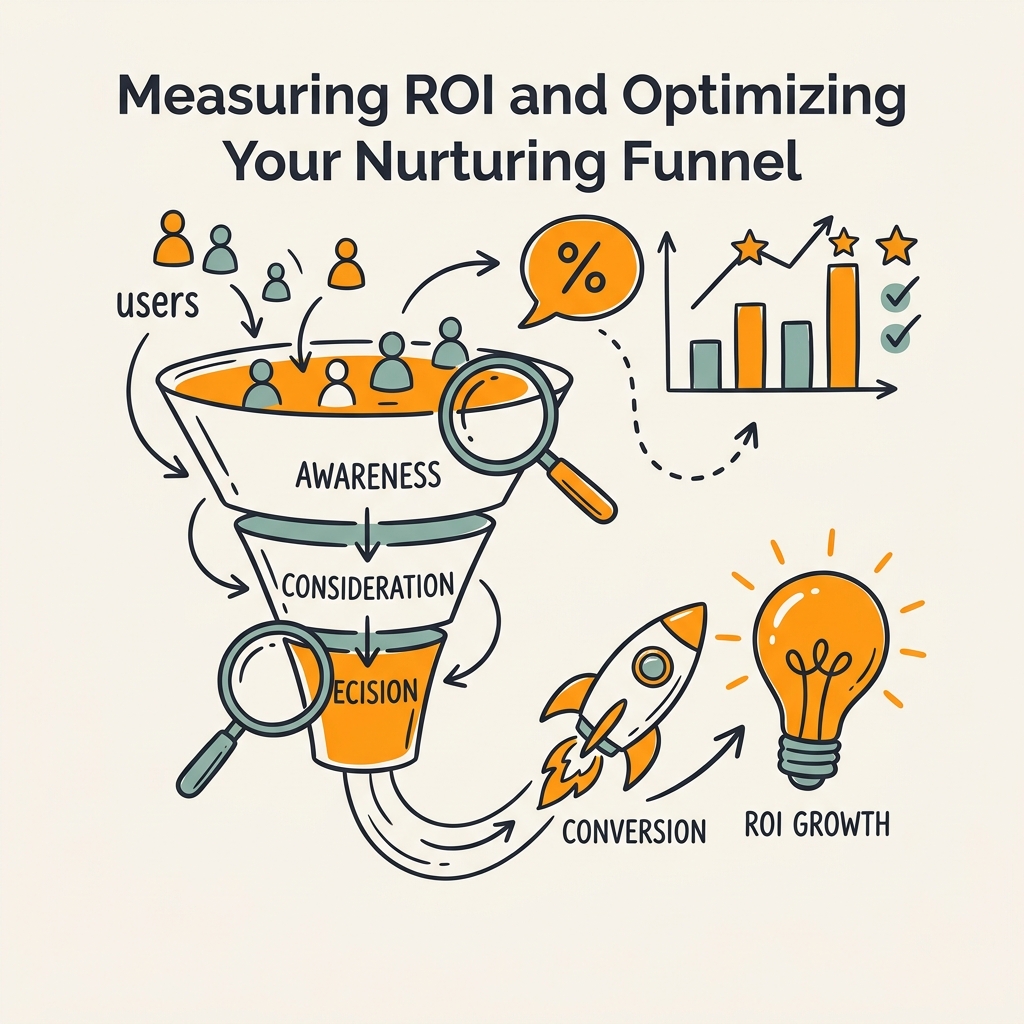
To justify continued investment in automation, you must measure what matters. Don't just count email opens or clicks. Track outcomes: leads that move to SQL, SQLs that convert to opportunities, and opportunities that close.
| Metric | Industry Average | High Performers | Measurement Method |
|---|---|---|---|
| Lead-to-SQL Conversion | 5-10% | 15-25% | SQLs / Total Leads × 100 |
| SQL-to-Opportunity Conversion | 20-30% | 40-50% | Opps / SQLs × 100 |
| B2B Conversion Rate (Lead to Close) | 3.2% | 6% | Closed Won / Total Leads × 100 |
| Email-Driven Conversion (Engaged) | 4.29% | 8%+ | Conversions / Email Opens × 100 |
| Cost Per Qualified Lead | $500-$2,000 | $250-$600 | Marketing Spend / Qualified Leads |
| Customer Acquisition Cost (CAC) | Varies by ACV | Payback in 12-18 months | Total Sales + Marketing Spend / New Customers |
Build a dashboard tracking these KPIs monthly. Look for trends: Is the lead-to-SQL rate declining? That signals a scoring calibration issue or declining lead quality. Is SQL-to-opportunity flat? Your nurture sequences may need refreshed content or different messaging by stage. Is cost per SQL rising while volume stays flat? Tighten your targeting to focus on higher-fit accounts.
$5.44 return per dollar spent on marketing automation is the benchmark. Most B2B SaaS companies see this return within 12-18 months of implementation. Some high performers, especially those leveraging AI-driven scoring and intent data, report 300-400% ROI in year one. Track your actual returns and adjust tactics based on data.
"The moment we tied our nurture sequences to actual sales outcomesnot just email metricseverything changed. We realized our high-engagement sequence was full of nice-to-know content that didn't move the buying decision. Cutting it from 14 touches to 9 and replacing generic content with stage-specific case studies increased our conversion rate by 31%."
Marcus Rodriguez, Sales Director, Revenue Memo
Avoiding Common Pitfalls in Lead Nurturing Automation
Most teams fail at automation not because the concept is flawed, but because execution breaks down. Here are the pitfalls that derail even well-intentioned programs:
- Dirty Data Garbage In, Garbage Out: If your CRM is full of incomplete records, duplicate contacts, or outdated information, scoring and segmentation fail. Invest in data hygiene before automating. Deduplicate contacts, validate emails, and clean up old records.
- Generic Content Sequences: Sending the same 9-email sequence to all leads regardless of industry, company size, or engagement pattern wastes time. Segment first, then sequence. A SaaS prospect needs different messaging than a services firm.
- Ignoring Disengagement: A lead who hasn't opened an email in 3 months needs a different strategy, not another automated touch. Build in re-engagement campaigns or graduation rules to move cold leads out of active sequences.
- No Integration Discipline: Manually logging leads, moving them between systems, or relying on spreadsheets defeats the purpose of automation. Ensure your tech stack connects end-to-end.
- Skipping the Sales Feedback Loop: Sales knows which leads converted and why. If marketing ignores this signal, scoring doesn't improve. Establish a weekly or bi-weekly sync where sales reports win/loss patterns.
Start small. Pick one nurture sequence, define clear entry and exit criteria, and measure the outcome. Once you nail the mechanics, expand to additional segments and use cases.
Scaling Lead Nurturing as Your Company Grows
Early-stage companies can nurture leads manually. As you scale, manual processes collapse. You need systems that compoundhandling 10 leads, 100 leads, or 10,000 leads with the same rigor and efficiency.
The path to scale follows a predictable progression:
- Foundation (Months 1-3): Set up your CRM, define lead scoring criteria, build your first email sequence. Goal: automate lead-to-MQL conversion for one segment (e.g., inbound prospects from a specific marketing channel).
- Expansion (Months 4-9): Add second and third nurture tracks for different segments. Integrate behavioral data. Implement lead scoring for intent signals. Hand off MQLs to sales with clear SQL criteria.
- Optimization (Months 10+): Refine scoring based on win/loss data. A/B test email subject lines and content formats. Expand to account-based marketing (ABM) for high-value targets. Add intent data and third-party enrichment.
For busy founders and marketing teams, outsourcing parts of the nurturing operation makes sense. Content creation, especially, is a bottleneck. Your nurture sequences only work if you have relevant, stage-specific content to reference. When content production becomes the constraintnot the automation platformconsider AI content generation tools that can produce blog posts, case studies, and comparison content at scale while maintaining SEO value. This compounds your nurturing output without requiring additional headcount.
Conclusion
Automating lead nurturing is no longer optional for B2B companies serious about growth. The data is conclusive: organizations implementing automation see 451% increases in qualified leads, 77% higher conversion rates, and $5.44 return per dollar spent. Lead scoring, multi-touch sequences, behavioral triggers, and CRM integration turn your marketing engine into a consistent revenue generator.
The foundational practices are clear: score leads by fit and intent, segment audiences and deliver stage-specific content, align sales and marketing on definitions and feedback loops, and measure outcomes obsessively. Start with one nurture sequence, measure its impact, and scale from there.
For busy founders who lack the time to manually manage content production alongside nurturing operations, automation extends across your entire marketing infrastructure. Platforms that combine content creation, SEO optimization, and nurturing workflows eliminate the bottleneck of content scarcity. Start your SEO agent today to compound both your content engine and lead nurturing output.
FAQs
What is the difference between lead nurturing and lead scoring?
Lead scoring is the classification systemit ranks leads by purchase readiness using demographic and behavioral criteria. Lead nurturing is the executionit delivers targeted content and communication to move leads forward. Think of scoring as the filter and nurturing as the movement. You score leads to identify who's ready, then nurture them to accelerate their buying decision. They work together: scoring tells you which leads to prioritize, and nurturing keeps all leads engaged while waiting for sales-ready status.
How long does it take to see ROI from automated lead nurturing?
Most B2B companies see positive ROI within 12-18 months of implementation, with average returns of $5.44 per dollar spent on marketing automation. However, early wins appear fasterimproved email open rates and engagement metrics show up within weeks. Sales conversion improvements and CAC reductions typically show within 3-6 months once you've refined scoring and segmentation. High performers using AI-driven scoring and intent data report 300-400% ROI in year one by focusing spending on the highest-fit prospects.
What tools should I use to automate lead nurturing?
Your stack needs three core pieces: a CRM to centralize lead data (HubSpot, Salesforce, Pipedrive), a marketing automation platform to orchestrate workflows (ActiveCampaign, Marketo, HubSpot), and behavioral analytics to feed scoring intelligence. Most small teams start with an all-in-one platform like HubSpot or ActiveCampaign that bundles CRM, email, and workflow automation. As you scale, add intent data providers (6sense, Demandbase) and content platforms that feed your sequences with fresh, stage-specific assets. The key is integrationtools must sync seamlessly so data flows automatically.