Balancing Brand Voice with AI-Generated Content
85% of marketers now use AI content creation tools, but most struggle with a critical problem: the output sounds generic. Your brand voice—the personality, tone, and values that make your messaging distinct—gets buried under AI's default corporate-speak. The cost? Companies with inconsistent brand messaging spend 45% more on media to achieve the same growth, according to recent data. Without a system to preserve your voice at scale, AI becomes a liability, not an accelerator. Here's how to keep your brand's personality intact while leveraging AI's power to multiply your content output.
Key Takeaways
- Hybrid AI + human workflows achieve 94% brand guideline adherence, outperforming pure AI (87%) or human-only (73%) approaches (2026, WorkFX AI)
- Consistent brand voice drives 23%–33% revenue lifts while reducing acquisition costs, making voice consistency a financial, not just creative, priority
- Marketing teams using formal brand voice governance test 3.7x more content variations while maintaining consistency, enabling faster iteration and optimization
- Build voice standards first, then train AI on your best-performing content to reduce generic language and preserve authenticity at scale
- The AI-Generated Content Authenticity Problem: Generic output erodes trust; 60% of marketing materials still fail to conform to brand guidelines even with AI tools available.
- Hybrid Content Workflows Are the Standard: AI drafts + human review outperform either approach alone, achieving 94% consistency with 45% faster production.
- Formal Brand Voice Governance Wins: Teams that codify tone, terminology, and approval workflows scale consistency and enable 3.7x more content testing.
- Train AI on Your Best Content: Feed style guides, customer stories, and top-performing pieces to your AI tools so they learn your distinct voice, not a generic average.
- Authenticity Becomes Competitive Advantage: As AI-generated content floods channels, distinctive human voice and real-world proof become more valuable to audiences and algorithms.
Why Brand Voice Matters More When Using AI
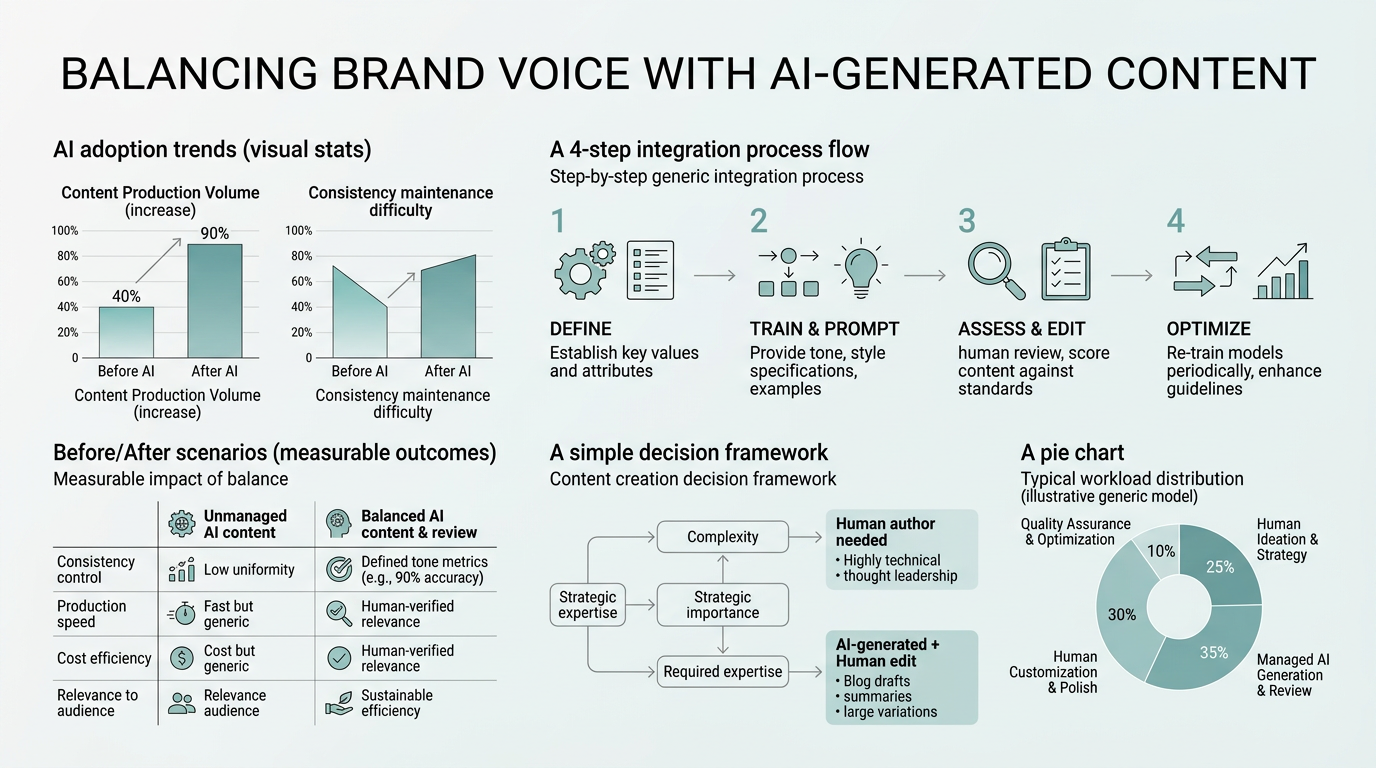
Your brand voice is the thread connecting every customer touchpoint. Without it, even accurate, well-written content feels like it came from a stranger. When companies lose brand consistency, they incur higher media costs to achieve the same growth trajectory, meaning your AI investment backfires if the output doesn't sound like you. The challenge is this: AI systems are trained on millions of pieces of generic content. By default, they replicate the average, not the exceptional. That's why the first move is understanding what makes your voice distinct and how to embed that into your AI workflows. Industry research confirms that teams with formal brand voice governance significantly outperform those flying blind.
"Your brand voice is the thread connecting every customer touchpoint. Without it, even accurate, well-written content feels like it came from a stranger."
- Trust erosion: Inconsistent tone signals to customers that nobody's paying attention; it reads as careless.
- Competitive invisibility: Generic language blends into the noise; distinctive voice cuts through.
- Missed revenue impact: Research shows consistent brands see 23%–33% revenue increases while inconsistent brands waste budget on higher acquisition costs.
- AI amplification risk: AI doesn't just write—it scales whatever patterns you feed it. Generic in, generic at scale.
The fix isn't to avoid AI. It's to make AI an extension of your brand, not a replacement for it. That requires a system.
How Hybrid Workflows Preserve Brand Voice at Scale
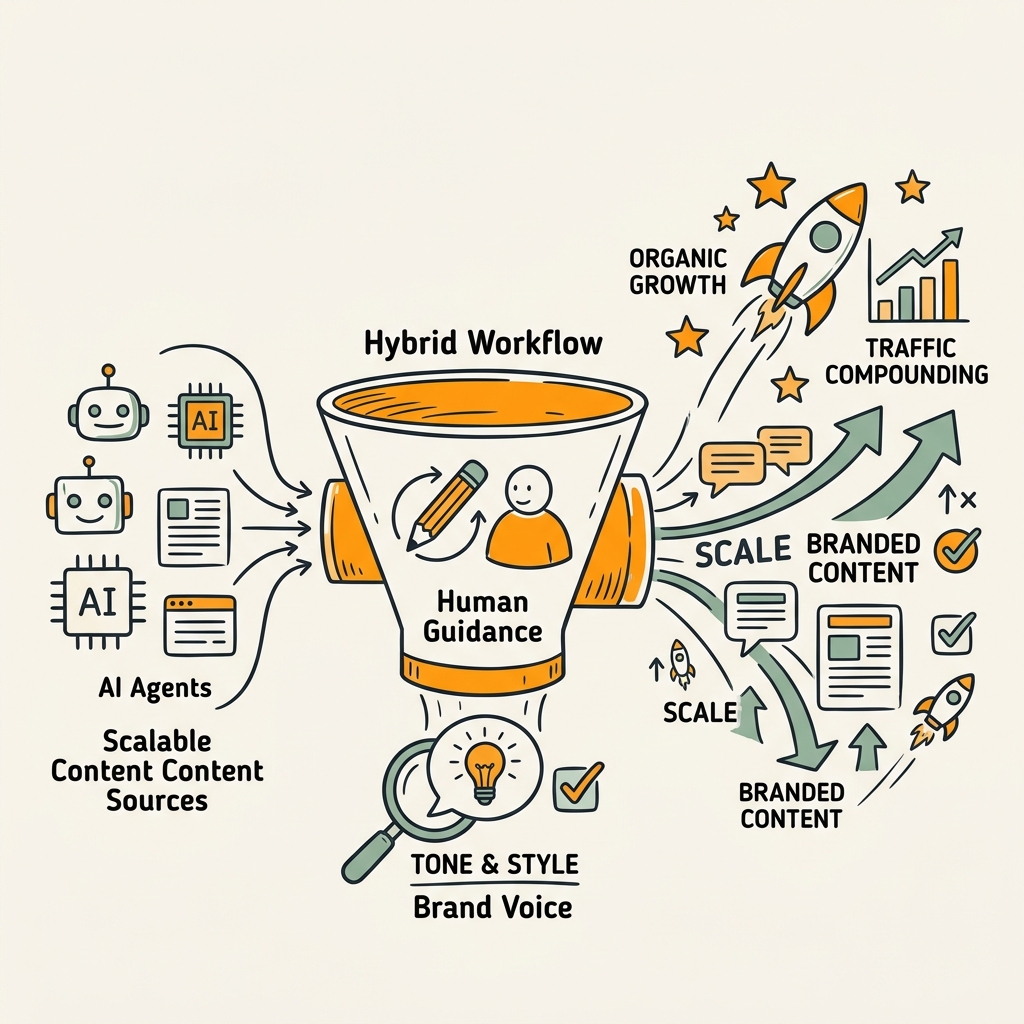
The evidence is clear: AI + human review achieves 94% brand guideline adherence, compared to 87% for AI alone and 73% for human writers working without AI tools. This isn't because humans are perfect—they're not. It's because the hybrid approach combines AI's speed with human judgment. Humans catch tone drift, cultural nuance, and brand personality that pure AI misses. AI, meanwhile, generates volume and variation that pure human teams can't sustain. The math favors hybrid.
"The hybrid approach combines AI's speed with human judgment. Humans catch tone drift, cultural nuance, and brand personality that pure AI misses."
The Three Layers of Hybrid Content Production
Layer 1: AI Draft Generation — AI creates the initial version based on your outline, keyword target, and brand guidelines prompt. Speed is the point here. Teams using AI drafting are 45% faster than teams waiting for human writers to start from blank. The draft doesn't need to be perfect; it needs to be fast and directionally correct.
Layer 2: Editorial Review for Brand Fit — A human editor checks the draft against your brand voice checklist: Is the tone right? Does it use your terminology correctly? Are there any clichés that sound generic? This layer is where your brand voice gets enforced. The editor isn't rewriting from scratch; they're calibrating what AI generated to match your distinct personality. This takes 30% of the time a full rewrite would.
Layer 3: Subject Matter Expert & Final QA — A subject matter expert validates facts, ensures compliance, and checks for originality. A final pass confirms the piece sounds on-brand and delivers the intended business outcome.
This three-layer approach is what most scaling content teams are adopting in 2026. It's not "AI writes everything"; it's "AI accelerates the first draft, humans enforce quality and brand fit, and specialists validate depth." Tools like AI-driven content strategy platforms that embed brand voice throughout their workflow make this layered review possible without overwhelming your team.
Why Pure AI-Only Content Creation Fails
Some teams assume that with better prompts, they can skip human review. They can't. AI adherence to brand guidelines maxes out at 87%, which means roughly one in eight pieces will drift from your standards. That's acceptable when you're publishing two pieces per month; it's a brand disaster when you're publishing ten per week. The consistency cost compounds.
Additionally, AI struggles with:
- Emotional resonance: Pure AI-generated content scores 68% on emotional impact; hybrid workflows reach 89%.
- Originality: Without human editing, AI tends to recycle common phrases, making content feel borrowed rather than authentic.
- Cultural relevance: AI doesn't understand your audience's humor, concerns, or values the way a human editor does.
- Brand differentiation: AI can write well, but without guidance, it writes generically.
Human-in-the-loop isn't overhead. It's quality control.
Building a Formal Brand Voice Governance System
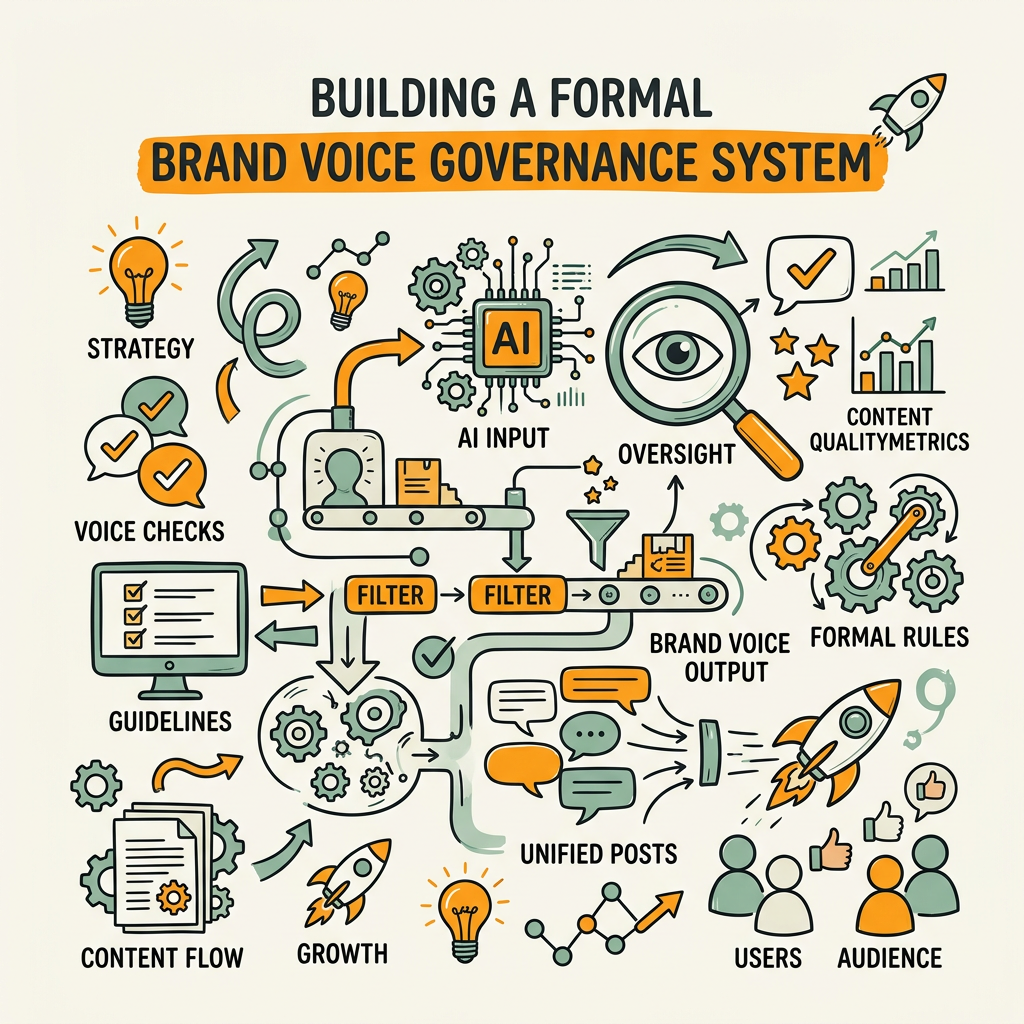
To scale hybrid workflows, you need to make brand voice rules explicit. Teams with formal brand voice governance test 3.7x more content variations while maintaining consistency. This might sound counterintuitive—shouldn't rules limit variation?—but what's really happening is that documented standards give AI and humans a clear target, enabling faster iteration. When everyone knows what "on-brand" means, you can try more ideas without worrying each one will drift.
The Four Components of Brand Voice Documentation
1. Tone and Personality Traits — Write down your brand's character in specific terms. Don't just say "professional"; specify whether you're formal or conversational, authoritative or approachable, humorous or serious. Give examples. A SaaS company might document: "Our tone is knowledgeable but not condescending. We use plain English, not jargon. We show we understand customer pain points without being melodramatic." Then provide 3-5 real examples from your best content.
2. Terminology and Language Rules — List approved terminology, key concepts, and phrases that must appear consistently. Also list prohibited language: clichés your brand avoids, jargon that's off-limits, or phrases that sound like competitors. For example, you might ban "leveraging" and "best-in-class" even though AI loves them. This is your lexicon. Feed it to AI as part of your prompt.
3. Approved Messaging Pillars — What are your core claims? If you're a project management tool, your pillars might be "simplicity," "collaboration," and "accountability." Every piece of content should ladder up to at least one pillar. This keeps output from wandering into irrelevant tangents.
4. Channel-Specific Guidelines — Your LinkedIn voice might be more formal than your Twitter voice, but both should sound like you. Document how tone shifts by channel without sacrificing identity. This is crucial when using AI; it tells the tool how to adapt your voice for different contexts. Many teams pair this documentation with SEO automation tools that enforce brand guidelines across all published content.
Codifying Brand Voice into AI Prompts
Once you've documented your voice, translate it into a reusable prompt template that every AI tool uses. The prompt should include:
- Your brand voice summary (the one-paragraph version of your personality)
- Tone examples (quote 2-3 sentences from your best content)
- Terminology rules (approved and banned phrases)
- Audience insight (who this is for, what they care about)
- The specific task (e.g., "Write a 1,500-word blog post on X for our LinkedIn audience")
Tools that embed brand voice governance into their workflow force this discipline by default. You set it once, and every piece of content generated respects it. This is why many scaling teams prefer automation platforms that make voice management a core feature rather than adding it as an afterthought.
Training AI on Your Best Content
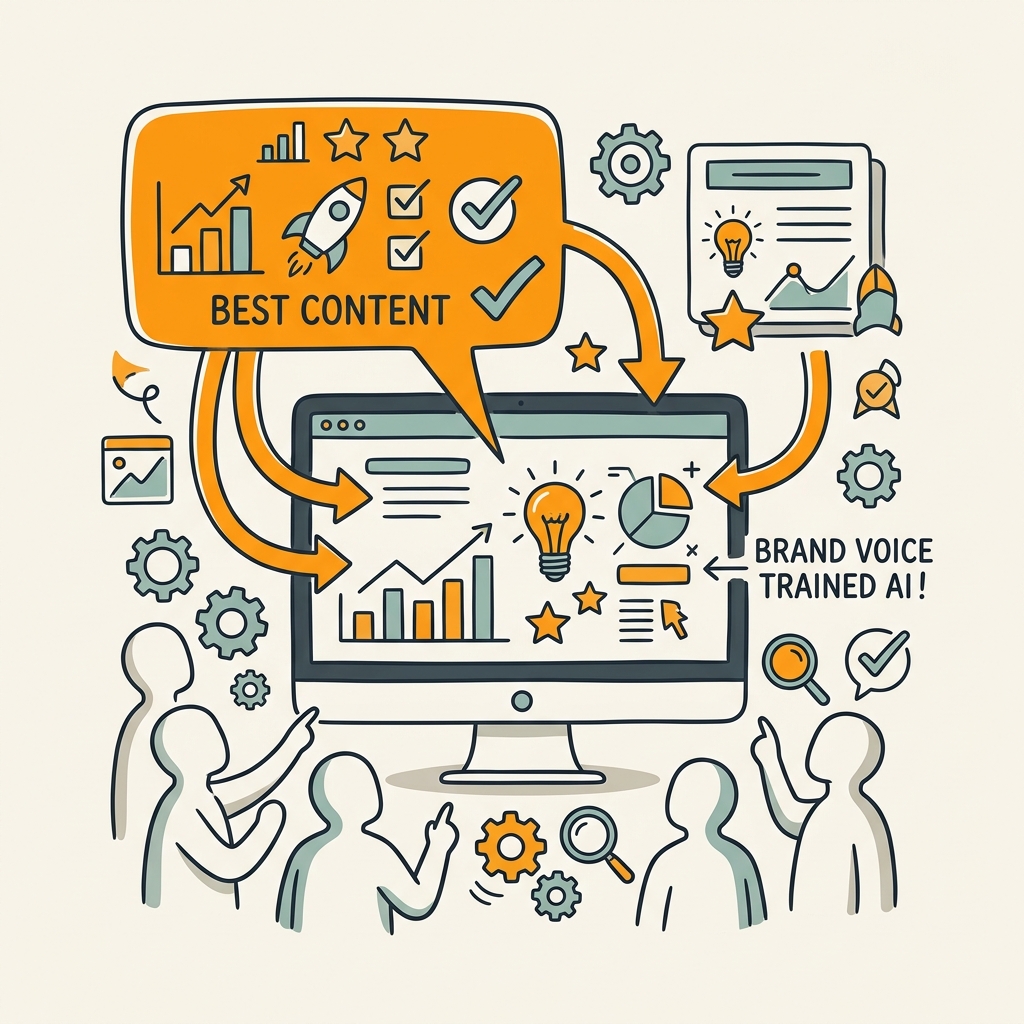
AI learns from what you feed it. If you dump generic best practices into your prompts, AI will spit out generic content. If you train on your own high-performing, on-brand pieces, AI will learn your actual voice and replicate it. This is the difference between okay AI outputs and great ones. Research from Envive shows that companies using AI-trained on their own content achieve significantly higher consistency rates.
"If you train on your own high-performing, on-brand pieces, AI will learn your actual voice and replicate it. This is the difference between okay AI outputs and great ones."
Which Content to Use for AI Training
Prioritize content that meets these three criteria:
- On-brand: It sounds unmistakably like you.
- High-performing: It drove traffic, engagement, or conversions. Use your analytics to identify winners.
- Diverse in format: Include blog posts, email copy, social media, and product descriptions. Variety teaches AI to adapt your voice across contexts.
Avoid training on:
- Mediocre content that performed okay but doesn't exemplify your voice
- Old content from a previous brand era (if you've evolved)
- Competitor content (even to "learn what not to do")
The most effective approach is to ingest your site's top content, your messaging docs, and your brand voice guidelines into your AI system, then generate new content using that foundation. Instead of starting from a generic AI model, the system learns specifically from your track record. This compounds the effectiveness of your brand voice because every new piece builds on what already works.
Continuous Refinement Through Feedback Loops
Training isn't a one-time upload. The best scaling teams build feedback loops: whenever an editor rewrites an AI draft to better match brand voice, that rewrite becomes a new example for future AI generations. Over time, AI gets better at matching your voice because it's learning from your actual editorial decisions, not just initial guidelines. This iterative refinement is how you move from "AI that needs heavy editing" to "AI that needs light calibration."
Measuring and Auditing Brand Voice Consistency
You can't manage what you don't measure. Many teams implement AI content generation but never measure consistency, which means drift happens invisibly. 60% of marketing materials still fail to conform to brand guidelines, often because consistency isn't being actively monitored. Set up a simple audit. Content marketing automation teams that measure consistency regularly outperform those that don't track it.
Brand Voice Audit Checklist
Every week, score a random sample of your published content on this scale (1-5, where 5 is fully on-brand):
- Tone Match: Does it sound like your brand?
- Terminology Accuracy: Does it use your approved language?
- Authenticity: Does it feel original or recycled?
- Audience Fit: Does it speak to your actual customers, or sound generic?
- Compliance: Are there any legal, policy, or factual errors?
Content scoring below 4 gets flagged for editorial improvement before publishing. Patterns that emerge—"all our product descriptions are scoring 3.2 because they're too salesy"—tell you where to adjust your prompts or training data.
Benchmarking Against Your Performance Data
The strongest audit ties brand voice consistency to business outcomes. Track which content pieces rank highest, convert best, or generate the most engagement. Are your most consistent pieces outperforming less consistent ones? In most cases, yes. This gives you evidence that investing in brand voice consistency pays off, and it justifies budget for editorial review layers.
Authenticity and the Human Element in an AI-Driven World
As AI-generated content floods every channel, authentic human voice becomes scarcer and more valuable. Industry leaders now emphasize that when you're competing for attention and trust, distinctive voice carries outsized weight. This doesn't mean "don't use AI." It means: don't let AI be the only voice your audience hears.
Balancing Scale with Authenticity
The winning strategy is to use AI for volume and variation while preserving a human-facing, original voice element. For example:
- 80% of your content can be AI-generated and edited: blog posts, how-to guides, industry analysis, product features.
- 20% should be human-originated: founder essays, customer stories, original research, behind-the-scenes narratives, expert interviews.
This mix keeps your output high-volume while maintaining the authenticity that algorithms and audiences increasingly reward. The human content anchors your brand in real proof and personality; the AI content compounds your reach.
Real-World Proof as a Consistency Anchor
Brands that couple AI content with original research, customer testimonials, and first-person storytelling create a consistency that's hard to fake. When readers encounter an AI-generated piece on your blog, then see a real customer case study, then watch a founder video explaining your philosophy, the brand voice becomes reinforced across modalities. That's durable consistency—not enforced by rules, but earned by authentic proof.
This approach also solves what many teams struggle with: AI search systems increasingly reward sources that cite and link to trusted originals. If all your content is AI-generated, you have less original proof to cite. By maintaining an authenticity layer, you give AI search systems reasons to trust and amplify your content.
Brand Voice Consistency Comparison
| Approach | Brand Guideline Adherence | Production Speed | Emotional Impact | Best For |
|---|---|---|---|---|
| Pure AI-Generated | 87% | Fastest | 68% | High-volume commodity content |
| Human-Only Writing | 73% | Slowest | 89% | Brand-critical, original content |
| Hybrid (AI + Human Review) | 94% | 45% faster than human-only | 89% | Scaling brand voice at volume |
Conclusion
The question isn't whether to use AI for content generation. 85% of marketing teams already do. The question is whether you'll preserve your brand voice or let it dissolve into generic corporate language. The evidence is unambiguous: hybrid workflows achieve 94% consistency while delivering 45% faster production. Teams with formal brand voice governance test 3.7x more variations, enabling faster learning. And companies with consistent messaging see 23%–33% revenue lifts—making voice preservation a financial priority, not a nice-to-have.
The system is straightforward: document your voice, train AI on your best content, build human review into the workflow, measure consistency continuously, and anchor your output with authentic proof. This is how you scale without sounding like everyone else. Start with your brand voice documentation today. Tomorrow, use it to train your first batch of AI content. Next week, audit a sample and refine your prompts based on what you learn. By month two, you'll have a system that multiplies your content output without diluting your identity.
FAQs
How do I maintain my brand voice when using AI content tools?
Document your brand voice in specific, measurable terms: tone, terminology, messaging pillars, and audience values. Then feed these guidelines into every AI prompt before generation. Train the AI on your best-performing, on-brand content—not generic examples—so it learns your actual voice rather than an average. Finally, build human editorial review into your workflow; hybrid AI + human workflows achieve 94% consistency while pure AI tops out at 87%. The key is making voice rules explicit and enforceable, not hoping AI will guess your personality.
What percentage of AI-generated content should we have reviewed by humans?
All of it, at least once. Every published piece should pass through a brand voice checklist before it goes live. That doesn't mean a full rewrite—most AI drafts need only 20-30 minutes of editorial polish to ensure tone fit and terminology accuracy. If you're publishing high-volume content (10+ pieces per week), use a tiered review: quick tone check for standard formats (how-tos, guides), deeper review for thought leadership and customer-facing content, and full editorial review for brand-critical pieces. This balances quality control with operational efficiency.
How do I know if my AI content is maintaining consistency with my brand?
Audit a random sample of published content weekly using a simple scorecard: tone match (1-5), terminology accuracy (1-5), authenticity (1-5), audience fit (1-5), and compliance (1-5). Content below 4 gets improved before publishing. Track which high-consistency pieces outperform low-consistency ones in your analytics; consistent brands see 23%–33% higher revenue lifts, so the data will show whether your effort is paying off. Also monitor customer feedback—if readers comment that your voice feels off, consistency is drifting and you need to adjust your prompts or training data.