Batch Processing SEO Updates at Scale
Most SEO teams spend weeks manually updating content across their site. Individual page refreshes, metadata tweaks, internal link adjustments — all done one at a time, with no coordination or visibility. The cost? 75% report significant reductions in manual tasks after switching to batch automation, according to Opinly. Yet 86% of SEO professionals still use manual workflows for at least half their updates. The gap between those doing batch processing at scale and those stuck in one-off edits is widening fast. Your competitors are already publishing 47% more content monthly using automation. Here's how to catch up.
Key Takeaways
- Batch processing reduces SEO update time by 75% and enables teams to publish 47% more content monthly while maintaining quality. (Opinly, 2026)
- 84% of SEO professionals automate keyword research, and 66% use automated SERP monitoring as standard practice.
- Content refreshes done through batch automation increase organic traffic by 27% on average, making it the highest-ROI SEO task.
- Batch Workflow Automation: Process hundreds of page updates simultaneously with QA gates and scheduled publishing to eliminate manual bottlenecks.
- Content Refresh at Scale: Automate metadata optimization, internal linking, and freshness updates on high-performing pages to compound organic CTR by 27%.
- End-to-End Publishing Pipeline: Research, writing, fact-checking, and CMS publishing in a single orchestrated batch eliminates handoff delays and human error.
- AI-Driven Keyword Clustering: Process thousands of keywords at once, grouping semantically related terms for topic-cluster architectures without manual spreadsheet work.
- Scheduled Delta Runs: Set daily core updates and weekly delta checks to catch ranking drops, broken links, and content gaps in real-time across your entire domain.
What Is Batch Processing in SEO Context?
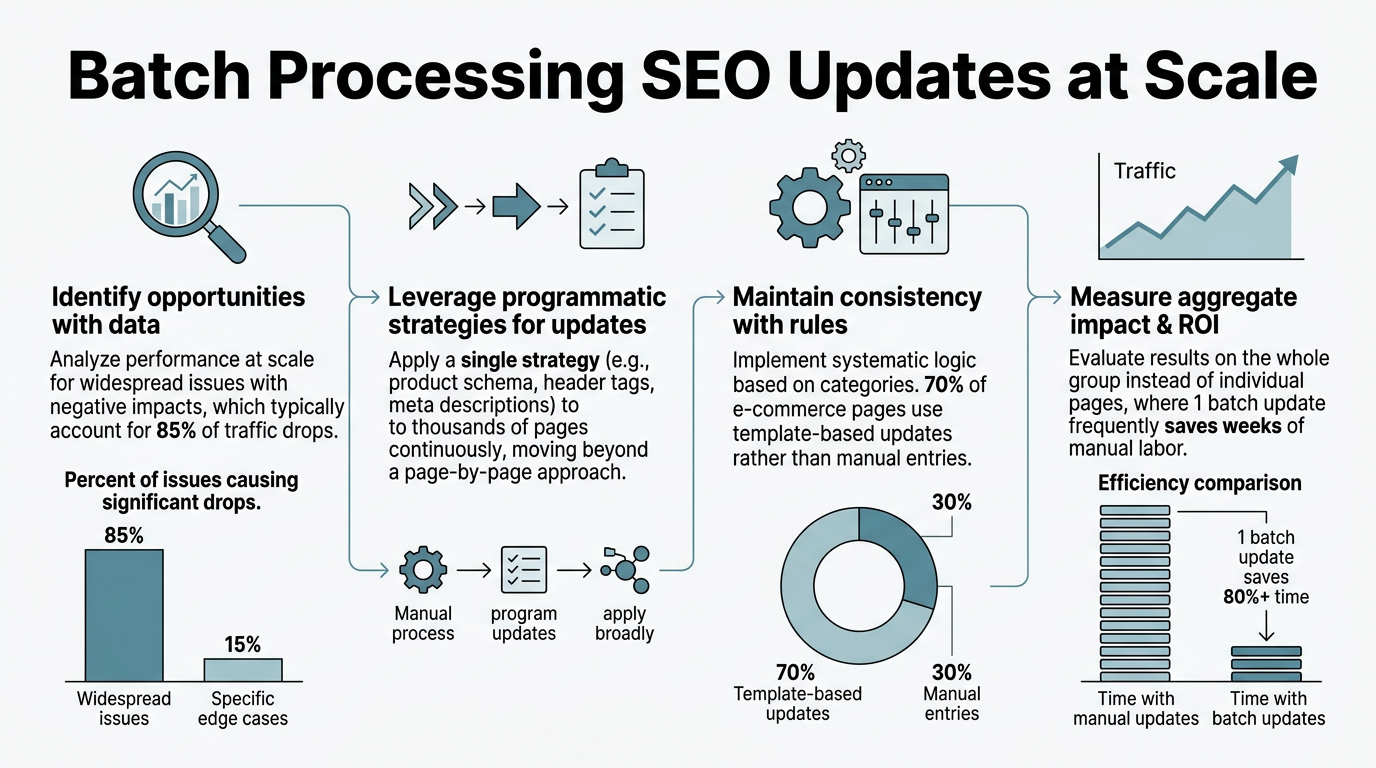
Batch processing in SEO refers to automating multiple content, metadata, and technical updates simultaneously rather than managing them individually. Instead of refreshing one page at a time, batch systems process hundreds of updates in coordinated waves — research, writing, optimization, fact-checking, internal linking, and publishing all orchestrated together. 65% of marketers now automate at least half their SEO tasks, with batch workflows as the backbone of that automation. The pattern is clear: teams moving to batch pipelines report higher output, fewer errors, and faster time-to-publish.
Why Batch Matters More Than Individual Updates
Manual, one-off updates create bottlenecks. A single person researches a keyword, drafts content, waits for approval, publishes, then links it internally. That cycle takes days. Batch systems collapse that timeline to hours. You define your update rules once — freshness thresholds, metadata patterns, internal linking logic — then apply them to hundreds of pages simultaneously. KeyGroup recommends combining daily automated rank-tracking with topic clustering to surface opportunities and refresh at scale. The result: organizations see +34% organic CTR, -28% content production costs, and +41% faster rankings (Opinly, 2026).
"Batch systems collapse the timeline from days to hours by defining update rules once and applying them to hundreds of pages simultaneously. This is the difference between reactive and proactive SEO teams."
Batch vs. Real-Time vs. Scheduled Updates
Three approaches exist. Real-time updates respond to each signal individually — slow and prone to cascading errors. Scheduled batch runs process updates at set times (daily, weekly) with QA gates before publishing. Delta runs (weekly or monthly deep checks) catch issues real-time automation missed. The best teams use a hybrid: daily batch core updates for metadata and freshness, weekly delta runs for deeper link analysis and competitor gaps, and real-time alerts for critical issues (ranking drops, site errors). This layered approach avoids thrashing your site while maintaining freshness.
How Does Batch Processing Handle Content Updates at Scale?
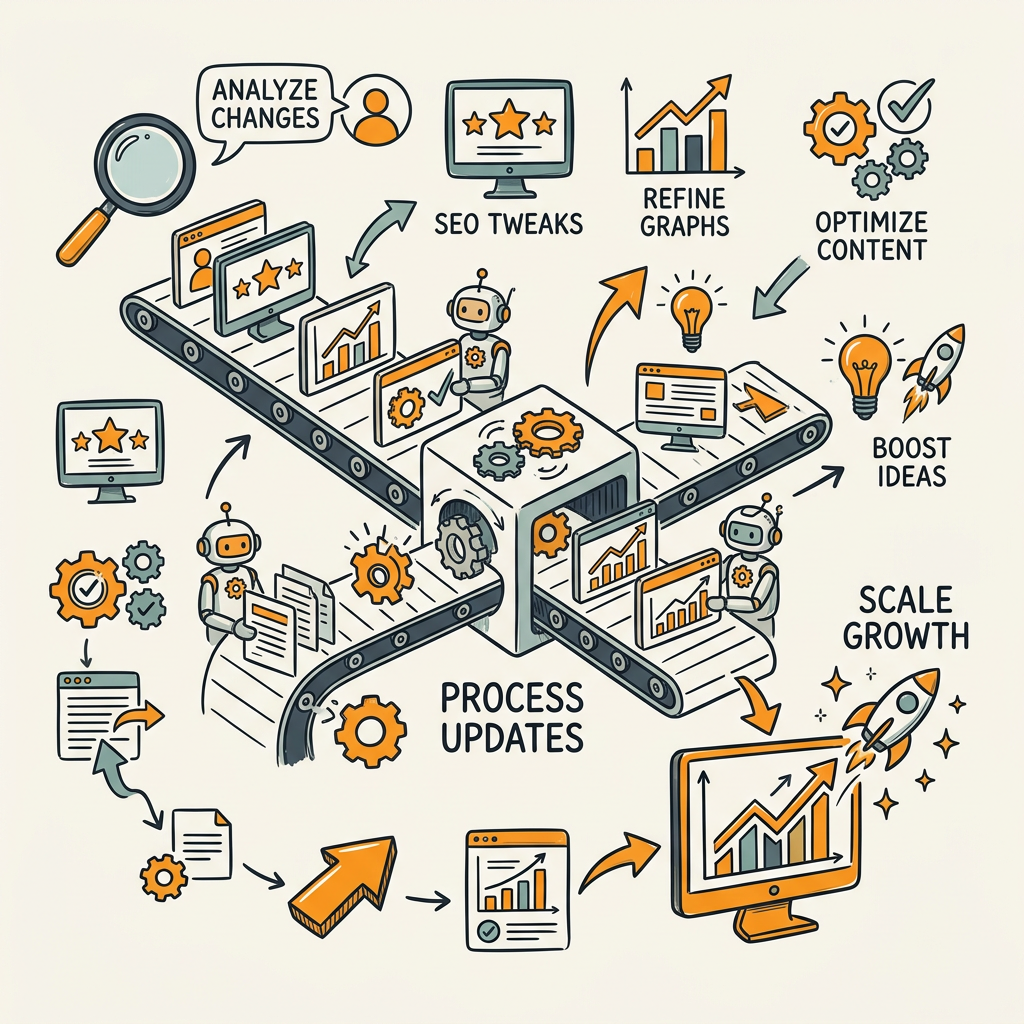
Content batch updates follow a defined pipeline: identify underperforming content, refresh with new data and keywords, rewrite sections, add internal links, fact-check, and publish — all in parallel for hundreds of pages. 62% of marketers automate on-page content optimization for existing blog posts using this model. Tools orchestrating this workflow use AI to detect what needs updating, generate optimized text, validate facts, and push directly to your CMS without human handoff delays.
Identifying Content Eligible for Batch Refresh
Not every page deserves a refresh — that wastes resources. Smart batch systems prioritize based on rules: traffic volume (refresh your top 100 performers first), ranking position (pages ranking 4–10 benefit most from updates), freshness (content over 12 months old on fast-moving topics), and intent mismatch (SERP has shifted; your content hasn't). Opinly's 2026 analysis shows that content refreshes increase organic traffic by 27% on average. Tools like Jottler automate this scoring — connecting to your Google Search Console data, analyzing performance trends, and creating a refresh queue ranked by ROI impact.
Key criteria for batch refresh eligibility include:
- Traffic volume from organic search (pages with 100+ monthly visits)
- Ranking position between 4–10 for primary keywords (highest lift potential)
- Content age over 180 days (freshness signal)
- SERP intent shift (competitor content now ranks that didn't before)
- Missing or weak internal linking structure
Orchestrating Research and Writing in Batches
Once you've identified pages to refresh, batch systems pull fresh data simultaneously: updated keyword trends, SERP analysis for each target term, competitor content snapshots, and fact-check sources. Instead of one writer researching one article over a day, the batch system researches 50 articles in parallel, then passes structured briefs to AI writers who generate optimized content in hours. AI-generated headlines win 46% of A/B tests (Opinly, 2026), meaning automated writing isn't a compromise — it's competitive. The critical difference: batch systems fact-check at scale too, validating every claim against authoritative sources before publishing.
"Instead of one writer researching one article over a day, batch systems research 50 articles in parallel with structured briefs and AI writers generating optimized content in hours. This is where 47% more monthly output comes from."
Publishing and Internal Linking Automation
The last mile is where most teams fail. Content sits in drafts waiting for manual approval and publishing. Batch systems eliminate this: once content passes QA gates (fact-check, link validation, keyword density, readability scores), it publishes automatically to your CMS on schedule. Internal linking happens in the same batch — the system identifies related articles across your site, adds contextual links to each updated page, and maintains a link map to avoid orphaned content. This creates topical authority without weeks of manual linking work. Jottler automates the entire pipeline from research through fact-checking to CMS publishing and internal link building, enabling teams to publish 3,000+ words daily without adding headcount.
What Infrastructure Do You Need for Batch SEO Updates?
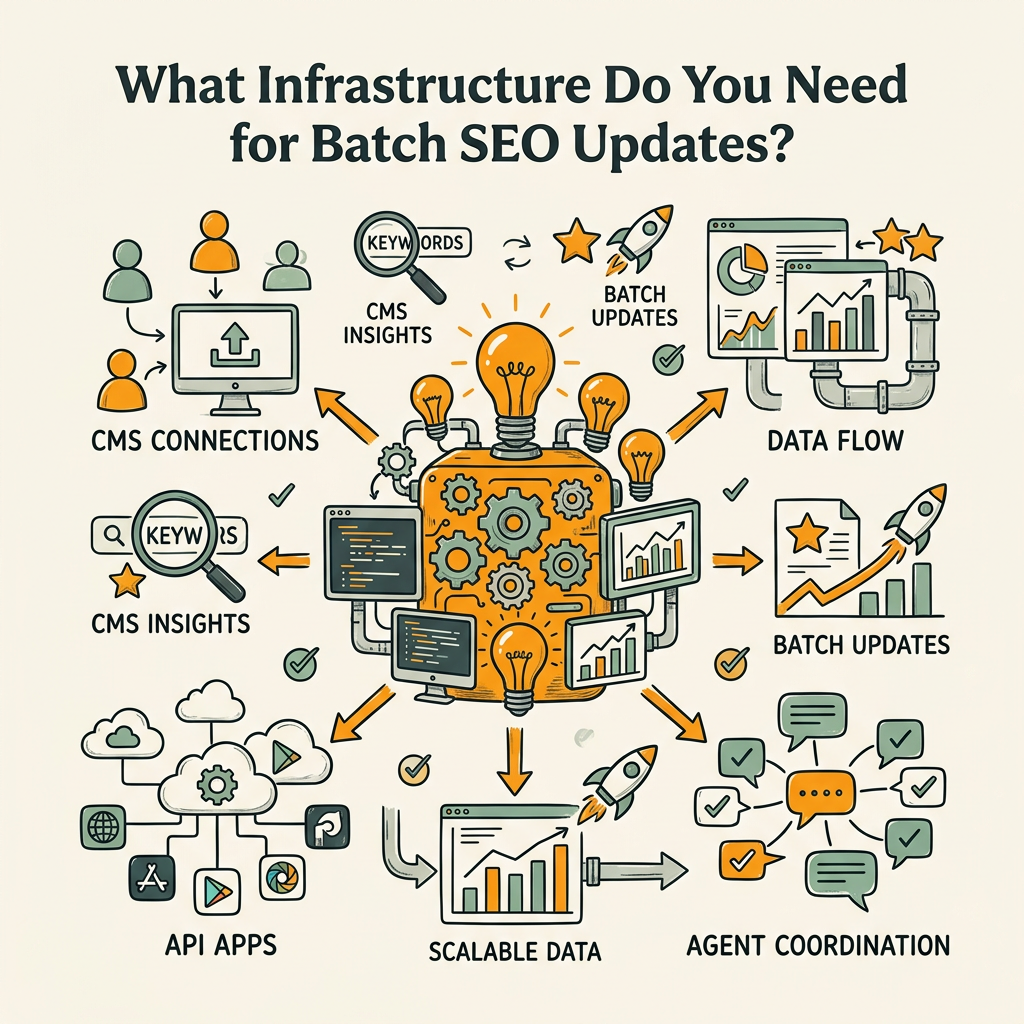
Batch processing requires three layers: data integration (connecting your SEO tools, CMS, and analytics), orchestration (defining workflows and scheduling), and execution (AI agents or automation pipelines doing the work). The modern SEO stack covers keyword discovery, briefs, drafting, on-page optimization, technical audits at scale, rank tracking, dashboards, and fully automatic publishing. Building this in-house takes 6–12 months. Buying a platform takes a weekend.
Integrations: Data Connectors and API Pipelines
Your batch system needs read/write access to multiple systems. Google Search Console feeds ranking and CTR data. Google Analytics feeds traffic and engagement. Your CMS API accepts published articles and metadata. Keyword research tools expose discovery data. Competitor tools expose SERP snapshots. Without these integrations, you're copying data manually — defeating the purpose. Tools like Narrareach highlight end-to-end automation stacks that integrate research, drafting, optimization, and publishing in one workflow. Jottler handles 14+ research sources, connects directly to WordPress/Webflow/custom CMSs, and syncs data back to your dashboard for tracking.
Critical integrations for batch systems include:
- Google Search Console (ranking data, CTR, impressions)
- Google Analytics (traffic, engagement, conversion signals)
- CMS API (WordPress, Webflow, custom platforms)
- Keyword research tools (SEMrush, Ahrefs, Moz)
- Competitor analysis tools (SimilarWeb, ContentStudio)
- Fact-checking sources (databases, news APIs, authoritative references)
Orchestration: Workflow Rules and Triggers
Define once, execute forever. Your batch system needs rules: "Refresh any page ranking 4–10 for its primary keyword if it's over 90 days old." "Publish new articles Monday–Wednesday to avoid weekend crawl delays." "Run a deep audit Friday night during low-traffic hours." "Flag any article with factual claims that fail verification." These rules trigger workflows automatically. A scheduler fires the batch job, workers process in parallel, QA gates validate output, and publishing happens on schedule. No human babysitting required. 44.1% of SEO tasks were already being handled by AI tools by 2025, showing this model is production-ready.
Execution: AI Agents vs. Traditional Automation
Traditional automation = predefined scripts doing the same task every time. AI agents = intelligent systems that adapt. AI agents read your top-ranking competitor content, understand intent nuance, generate briefs specific to your brand voice, write drafts optimized for the latest SERP, and handle edge cases humans would miss. They're slower than scripts initially but faster overall because they cut rework and approval cycles. Byword and similar tools handle up to 100 articles per month with auto-publishing, while tools like Jottler push to 3,000+ words daily by combining 12 specialized AI agents (research, writing, fact-checking, linking, publishing) in a coordinated pipeline.
| Tool/Platform | Batch Capacity | CMS Integration | Fact-Checking | Internal Linking | Best For |
|---|---|---|---|---|---|
| Jottler | 3,000+ words/day | WordPress, Webflow, custom | 14+ sources verified | Smart topic clustering | Autonomous, hands-off scaling |
| Byword | 100 articles/month | WordPress, Webflow | Limited | Manual | Programmatic SEO templates |
| theStacc | 30–80 articles/month | WordPress only | Limited | Limited | Budget autopilot blogs |
| Koala.sh | 100 articles/month | WordPress, Medium | Limited | None | AI writing at scale |
| Surfer AI | Batch limited (point solution) | Various (plugin-based) | None | None | On-page optimization layer |
What Common Pitfalls Derail Batch SEO Updates?

Batch systems fail when teams ignore human oversight, skip fact-checking, or batch work that shouldn't be batched. The biggest risk: publishing 50 poor-quality articles hoping some rank, only to see organic traffic drop and Google penalties spike.
Over-Automating Without Editorial Control
Batch processing isn't set-and-forget. It requires guardrails. Every batch should run through QA: Do the facts check out? Is the brand voice consistent? Are claims sourced? Are internal links contextual? Teams that skip QA in pursuit of speed publish thin, generic, sometimes incorrect content that Google downranks within weeks. 58% of content teams use automation to identify gaps and optimization opportunities — but the smart ones add human review before publishing. Jottler's fact-checking layer validates every claim against authoritative sources, reducing editorial friction while catching errors before they hit SERP.
Quality gates that protect your batch system include:
- Fact-checking validation against 14+ authoritative sources
- Brand voice and tone consistency checks
- Internal link contextuality and anchor text review
- Readability and keyword density scoring
- Metadata uniqueness and SEO title optimization
- Human editorial review (15-minute final gate)
Batching the Wrong Content Types
Not every piece benefits from batch automation. High-stakes content — flagship guides, thought leadership, product announcements — still needs human expertise and brand voice nuance. Batch works best for: refreshing evergreen content, metadata optimization, internal linking, competitive analysis updates, and templated pages (category pages, location pages, product pages). Trying to automate a CEO's strategic insight essay will fail. Know your content categories and batch accordingly.
Ignoring Site Crawl Budgets and Server Load
Publishing 100 articles in one day can hammer your server. Large batches can also overwhelm Google's crawl budget — if your entire site changes simultaneously, Google may delay indexing. Spread batches across windows: core updates Monday–Wednesday, delta runs Friday evening, one big monthly audit during low-traffic times. Monitor your server load and crawl stats in Search Console. A well-tuned batch schedule actually improves crawl efficiency by letting Googlebot discover fresh content at a manageable pace.
How to Implement Batch Processing for Your SEO Team
Moving from one-off updates to batch workflows takes planning, but the payoff is massive: time saved, quality improved, organic traffic compounded. The best teams treat batch SEO like a software release — with pipelines, testing, and rollback plans. Content marketing automation frameworks help teams stay consistent while scaling output. Start with these steps.
Step 1: Define Your Update Rules and Priorities
Start by auditing your current content. Which pages drive the most traffic? Which rank 4–10 and could move to top 3 with a refresh? Which are over a year old? Create a prioritization matrix: high-traffic + low-rank = batch first. Build rules: "Every page older than 180 days gets a freshness refresh. Every high-traffic page gets seasonal updates. Every competitor mention gets tracked and compared." These rules become your batch system's logic.
Step 2: Choose a Platform (or Build One)
Build-vs.-buy decision. Building takes 3–6 months and a full-time engineer. Buying a platform like Jottler takes a weekend to set up. Most growing companies buy — Jottler connects to your CMS, pulls data from your search tools, sets publishing frequency (1–5 articles per day), and handles the rest. The alternative is a Zapier + Airtable + custom script hybrid, which works but requires ongoing maintenance. SEO automation platforms are designed specifically for this workflow, eliminating integration risk.
Step 3: Start Small and Measure
Don't batch your entire site on day one. Pick a pilot: 50 high-traffic evergreen pages. Refresh their metadata, internal links, and publish updated content. Track rankings, CTR, and traffic for 30 days. Once you see organic CTR lift (expect +10–15%), expand to the next 200 pages. Measure always: baseline your KPIs before batch, track them weekly after. You need proof that your batches are working.
Step 4: Layer in Quality Gates and Human Review
Add checkpoints. Every batch pulls reports showing readability, keyword density, fact-checking results, and link health. Someone (could be a junior marketer, not necessarily an expert) reviews in 15 minutes and approves publish. This catches 90% of issues without slowing the system down. As batches mature and you gain confidence, lighten the review. But never eliminate it entirely.
Measuring Success: Batch Processing Metrics
Traditional SEO metrics (rankings, traffic) still matter. But batch processing enables new measurements: how many pages did you update? How much time did you save? What was the cost per page? Did traffic grow faster after batch implementation?
Traffic and Ranking Gains
The ultimate metric. After implementing batch refresh workflows, track: organic CTR (expect +15–27% lift), organic traffic (compound growth from more content + higher CTR), average ranking position across batched pages (target: top 5), and conversion rates from organic. Don't expect instant results — content ranking changes take 2–4 weeks. But by month 2–3, the compounding effect becomes visible.
Operational Efficiency Gains
Time and cost per page. If you were spending 4 hours on a single page refresh, and batch processing cuts that to 30 minutes per page (including human review), you've freed up 80% of labor. With a team publishing 100 pages a month through batch, that's 350 hours saved monthly — equivalent to hiring two full-time writers. Calculate the labor cost saved and reinvest it in link building or traffic-driving content.
Content Volume and Freshness Metrics
Track how many pages you're refreshing monthly. Target: at least 10% of your content database per quarter. Also track "freshness score" — what percentage of your content is under 180 days old? Aiming for 70%+ ensures Google sees active maintenance and freshness signals. Content refreshes done through automation increase organic traffic by 27% on average, so freshness is a direct driver of growth.
Conclusion
Batch processing SEO updates at scale is no longer optional — it's the baseline for competitive organic traffic growth. Teams publishing 47% more content while cutting production costs by 28% are doing it. Organizations seeing +34% CTR gains are doing it. Your competitors are doing it. The infrastructure needed is mature: AI agents handle research and writing, fact-checking tools catch errors, CMS integrations handle publishing, and scheduler automation keeps everything on track. The path forward is clear: define your batch rules, choose a platform (or build one), start with a pilot, measure relentlessly, and scale. Every week you delay is organic traffic left on the table. Start today.
Start your SEO agent to automate batch content updates, fact-checking, and publishing. Jottler researches, writes, and publishes 3,000+ words daily with smart internal linking and zero manual overhead. Your team focuses on strategy. The AI handles the pipeline.
FAQs
How long does it take to publish 100 pages through batch processing?
With a fully automated batch system like Jottler, 100 pages take 2–4 days from research through publishing, depending on content depth and fact-checking rigor. That's about 30–45 minutes per page start-to-finish, including AI research, writing, fact-checking, internal linking, and CMS publishing. Manual approaches take weeks for the same volume. The time savings alone justify automation investment.
Can batch SEO updates hurt your rankings if done wrong?
Yes. Publishing thin, low-quality content in bulk can trigger Google penalties. Publishing 100 pages with duplicate metadata, broken internal links, or unsourced claims will tank rankings. The fix is rigorous QA before publishing. Fact-check every claim, validate internal links, check metadata uniqueness, and test readability. Tools like Jottler automate these checks, catching errors before they hit SERP. Batch processing done right improves rankings; done wrong, it tanks them. Quality gates are non-negotiable.
What's the minimum team size needed to manage batch SEO updates?
One person can manage batch updates if using a platform like Jottler. You define publishing frequency once, the system handles research through publishing, and you spend 15 minutes weekly reviewing QA reports. For larger sites (5,000+ pages), add a second person for strategic planning and competitive analysis. The key is that batch automation doesn't require a big team — it allows a small team to punch above its weight.