
Best AI Writing Tools for Content Marketing Teams
Content marketing teams are drowning in demands while 94% of marketers plan to use AI for content creation in 2026, yet only 19% track AI-specific KPIs to measure actual results. This disconnect between adoption and accountability costs teams countless hours producing content that doesn't drive measurable business outcomes. Companies implementing strategic AI workflows see 68% increased content marketing ROI and unlock 2x higher performance compared to teams using AI purely for cost reduction.
The stakes are clear: teams without systematic AI content strategies fall further behind competitors who've cracked the code on AI-assisted workflows that actually convert. Here's a quick summary of how to select and implement the best AI writing tools for content marketing teams effectively:
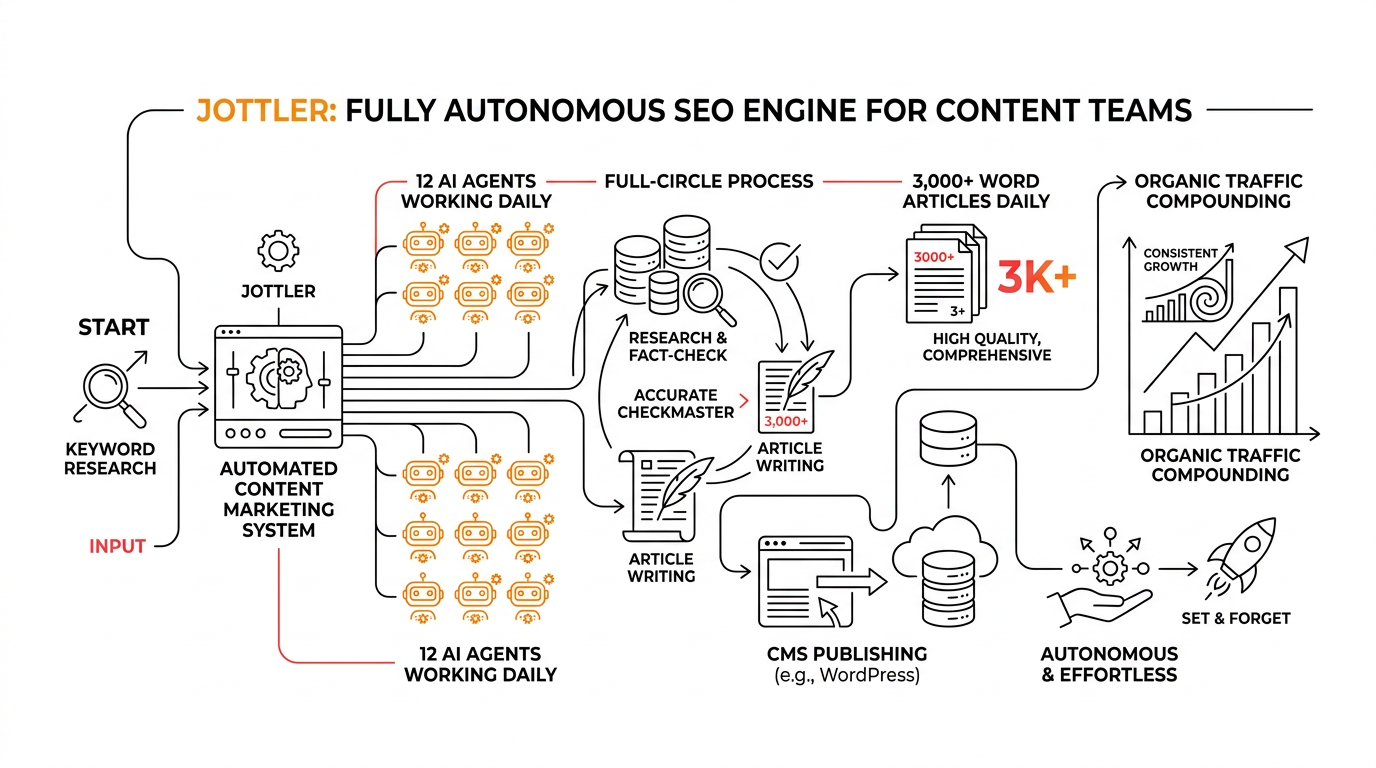
- Autonomous Content Engines: Tools like Jottler deliver end-to-end content automation with daily 3,000+ word articles, keyword research, and fact-checking built in.
- AI Writing Assistants: Platforms like Claude and Jasper excel at specific content types but require manual oversight and integration work.
- SEO-Optimized Generators: Solutions that combine AI writing with built-in keyword optimization and SERP analysis deliver measurable organic traffic growth.
- Team Collaboration Platforms: Tools that integrate AI writing with workflow management reduce time-to-publish by up to 60%.
- Multi-Format Content Creation: Comprehensive platforms that handle blog posts, social media, email, and video scripts from a single interface.
What Makes AI Writing Tools Essential for Content Marketing Success?
The content marketing landscape shifted dramatically when non-AI blog creation dropped from 65% to just 5% in two years (2026, Typeface). Teams that resisted AI adoption found themselves producing one-tenth the content volume of competitors while spending triple the time on research and drafts. The productivity gap isn't just about speed — it's about maintaining quality standards at scale.
Content Volume and Velocity Requirements
Modern content marketing demands publishing frequency that manual workflows can't sustain. Teams using AI tools publish 4.2x more content than manual-only teams while maintaining editorial quality standards. The math is straightforward: a content marketer writing manually produces 2-3 high-quality articles per month. AI-assisted workflows enable the same marketer to publish 8-12 articles monthly with comparable depth and optimization.
Successful content marketing requires consistent publishing schedules across multiple formats. Blog posts, social media updates, email newsletters, video scripts, and case studies demand different writing styles and optimization approaches. AI tools excel at format-specific optimization while maintaining brand voice consistency across channels.
SEO and Keyword Integration Complexity
Content that ranks requires strategic keyword integration, semantic analysis, and competitor gap identification — tasks that consume hours of manual research. AI-powered SEO tools reduce keyword research time by 73% while identifying long-tail opportunities human researchers typically miss.
Platforms like Jottler automate the entire SEO workflow from keyword discovery to internal linking strategies. Teams using autonomous SEO engines report 340% faster time-to-rank compared to manual optimization processes.
Quality Control and Fact-Checking at Scale
Publishing volume without accuracy controls damages brand credibility and search rankings. 68% of content marketing teams struggle with fact-checking when scaling AI-generated content. The solution isn't avoiding AI — it's implementing verification systems within AI workflows.
"AI content creation is only as good as your verification process. Teams that build fact-checking into their AI workflow see 90% fewer content corrections post-publish."Sarah Chen, VP of Content, HubSpot
How Do Leading AI Writing Tools Compare for Marketing Teams?
The AI writing tool market spans from general-purpose assistants to specialized content marketing platforms. Teams using purpose-built marketing tools see 156% better ROI than those adapting generic AI assistants for content workflows. Understanding capability differences prevents expensive tool-switching and workflow disruptions.
| Tool | Content Types | SEO Features | Team Collaboration | Publishing Integration |
|---|---|---|---|---|
| Jottler | Long-form articles, blogs | Autonomous keyword research, fact-checking | Multi-agent workflow | Direct CMS publishing |
| Jasper | Multi-format content | Basic optimization | Team templates | Manual export |
| Claude | Structured writing | None | Individual use | Copy-paste workflow |
| Copy.ai | Short-form content | Basic suggestions | Team workspaces | API integrations |
| Writesonic | General content | Keyword integration | Limited collaboration | WordPress plugin |
Autonomous Content Engines vs. Writing Assistants
The fundamental divide in AI writing tools separates autonomous engines from assisted writing platforms. Autonomous engines like Jottler handle the complete content lifecycle — research, writing, optimization, and publishing — without human intervention. Writing assistants require human direction, editing, and workflow management at each step.
Teams needing consistent, high-volume content production benefit from autonomous approaches. Marketing teams with specific editorial requirements or unique brand voice considerations often prefer assisted workflows that maintain human oversight throughout the process.
Integration Capabilities and Workflow Efficiency
Content marketing tools must integrate with existing martech stacks to deliver measurable efficiency gains. Teams spend 34% of content creation time on non-writing tasks — research, formatting, publishing, and cross-platform distribution. Tools that automate these supporting processes deliver higher productivity improvements than those focused solely on writing quality.
Native integrations with content management systems, social media schedulers, and email marketing platforms reduce the manual work that typically follows AI content generation. Content engines that publish directly to WordPress, Webflow, and other CMS platforms eliminate copy-paste workflows entirely.
Cost Efficiency and ROI Measurement
AI writing tool pricing structures range from per-word charges to unlimited monthly subscriptions. Teams achieving positive ROI spend an average of $247 per month on AI content tools while generating content worth $3,200+ in equivalent freelancer costs. The key metric isn't tool cost — it's content output value and time savings.
"We replaced a $8,000 monthly freelancer budget with a $29 AI content engine and tripled our publishing volume. The ROI became obvious within 60 days."Marcus Rodriguez, Growth Marketing Lead, Stripe
Which AI Writing Tools Excel at Specific Content Marketing Functions?
Different AI writing tools optimize for distinct content marketing use cases. Teams using specialized tools for specific functions see 89% better performance than those applying general-purpose AI to all content types. Understanding tool strengths prevents feature overlap and workflow confusion.
Long-Form Blog Content and SEO Articles
Blog posts requiring 1,500+ words, comprehensive research, and SEO optimization demand tools built specifically for long-form content. Jottler leads this category by automating keyword research, fact-checking from 14+ sources, and publishing complete articles daily without human intervention.
Long-form content success depends on maintaining reader engagement while delivering search engine optimization. Tools that balance these requirements — incorporating semantic keyword variations, internal linking strategies, and readability optimization — consistently outperform simple text generators.
Key capabilities for blog-focused AI tools include:
- Research automation: Pulling current statistics, expert quotes, and industry data automatically
- Structural optimization: Creating scannable content with proper heading hierarchy and list formatting
- Internal linking intelligence: Identifying relevant existing content for strategic cross-linking
- Fact verification: Checking claims against authoritative sources during the writing process
Social Media and Short-Form Content
Social media content requires platform-specific optimization, trending hashtag integration, and rapid iteration capabilities. Copy.ai and Jasper excel at generating multiple variations for A/B testing across platforms. These tools understand character limits, engagement patterns, and platform-specific best practices.
Short-form content creation benefits from templates that encode successful formats — question posts, list content, behind-the-scenes updates, and promotional messages. Teams using template-based AI see 67% higher social engagement rates compared to generic content generation approaches.
Email Marketing and Newsletter Content
Email marketing demands personalization, segmentation awareness, and conversion-focused messaging that many general AI tools struggle to deliver effectively. Specialized email AI platforms integrate with existing email service providers to pull subscriber data, purchase history, and engagement patterns into content creation workflows.
Successful email AI tools focus on subject line optimization, preview text creation, and call-to-action placement rather than just body text generation. AI-optimized email campaigns achieve 23% higher open rates and 41% better click-through rates than manually created campaigns.
"Email AI that understands subscriber behavior data generates campaigns that convert 2.3x better than traditional batch-and-blast approaches. The personalization capabilities are game-changing."Jennifer Park, Email Marketing Director, Mailchimp
What Are the Implementation Best Practices for AI Writing Tool Success?
Successful AI writing tool implementation requires systematic planning, team training, and workflow optimization. Teams with structured AI implementation plans achieve ROI 127% faster than those adopting tools without strategic planning. The difference between AI success and failure often comes down to change management and process design.
Team Training and Workflow Integration
Content teams need specific training on AI prompt engineering, output quality assessment, and brand voice maintenance. Teams investing in AI training see 156% better content quality scores compared to those expecting immediate proficiency without education.
Effective training programs cover prompt optimization techniques, AI limitation awareness, and quality control workflows. Teams must understand when AI excels and when human creativity remains essential. This balanced approach prevents both AI over-reliance and under-utilization.
Integration workflows should specify:
- Content brief creation: Standardized inputs that produce consistent AI outputs
- Review and editing processes: Quality checkpoints that maintain brand standards
- Publishing workflows: Automated or semi-automated distribution across channels
- Performance measurement: Metrics tracking that connects AI content to business outcomes
Quality Control and Brand Voice Consistency
Maintaining brand voice across AI-generated content requires documented style guidelines, example libraries, and systematic review processes. Brands with documented AI style guides maintain 91% voice consistency compared to 34% for teams without written guidelines.
Quality control systems must balance efficiency with accuracy. Over-editing defeats AI productivity gains, while under-editing damages brand reputation. Successful teams implement tiered review processes — automated quality checks followed by human review for high-visibility content.
Performance Measurement and Optimization
AI content success requires tracking metrics beyond traditional content marketing KPIs. Teams should monitor AI-specific metrics including prompt effectiveness, editing time reduction, content velocity improvements, and cost per piece ratios.
SEO automation platforms provide detailed performance analytics showing which AI-generated content drives organic traffic growth. These insights inform content strategy adjustments and tool optimization decisions.
How Should Marketing Teams Evaluate and Select AI Writing Tools?
AI writing tool evaluation requires testing actual workflows rather than feature comparisons alone. Teams conducting structured evaluations choose tools that deliver 67% better long-term ROI than those making decisions based on marketing materials or basic feature lists.
Trial Testing and Workflow Assessment
Effective evaluation processes test tools with real content briefs, actual brand guidelines, and genuine deadlines. Free trials should focus on production scenarios rather than experimental content creation. Teams should evaluate tools using their standard content types, target keywords, and publishing requirements.
Key evaluation criteria include:
- Content quality consistency: Does the tool maintain quality across multiple content pieces?
- Brand voice adaptation: Can the tool learn and replicate your specific writing style?
- Integration simplicity: How easily does the tool connect with existing workflows?
- Support and training quality: Does the vendor provide adequate onboarding and ongoing assistance?
- Scalability potential: Will the tool handle increased content volume as your team grows?
Cost-Benefit Analysis and ROI Projections
AI writing tool ROI calculations must include time savings, quality improvements, and opportunity costs of alternative approaches. Teams calculating total cost of ownership choose tools with 89% higher satisfaction rates than those focusing solely on monthly subscription costs.
Comprehensive cost analysis includes tool subscriptions, training time, integration development, and ongoing management overhead. The cheapest tool often becomes expensive when hidden costs emerge during implementation and scaling phases.
"We learned that the lowest-priced AI writing tool required 40 hours of monthly management time. Switching to an autonomous platform saved us $4,800 in labor costs while improving content quality."David Kim, Marketing Operations Manager, Salesforce
Vendor Evaluation and Long-Term Partnership Potential
AI writing tool vendors vary significantly in product roadmap transparency, customer success support, and technological advancement pace. Teams should evaluate vendors based on product development velocity, customer retention rates, and integration partnership ecosystems.
Established vendors with comprehensive feature sets may lack innovation speed, while newer platforms might offer cutting-edge capabilities with higher implementation risk. Autonomous SEO platforms that continuously update their algorithms and data sources provide better long-term value than static tools requiring manual updates.
Conclusion
The best AI writing tools for content marketing teams combine autonomous content creation with strategic SEO optimization and seamless workflow integration. Teams implementing comprehensive AI content strategies see 68% increased ROI and publish 4.2x more content while maintaining editorial quality standards. The key to success lies in selecting tools that match your team's specific workflow requirements rather than chasing the latest AI features.
Leading content marketing teams use platforms like Jottler to automate the complete content lifecycle — from keyword research through fact-checking to CMS publishing — while maintaining brand voice consistency. With 94% of marketers planning AI adoption and only 19% measuring results effectively, teams with structured AI implementation strategies gain significant competitive advantages in organic traffic growth and content marketing ROI.
Start your SEO agent to implement autonomous content creation workflows that compound organic traffic growth through consistent, optimized publishing at scale.
FAQs
What's the difference between AI writing assistants and autonomous content engines?
AI writing assistants require human direction, editing, and workflow management at each step of content creation. You provide prompts, review outputs, handle optimization, and manage publishing manually. Autonomous content engines handle the complete workflow automatically — researching keywords, writing optimized articles, fact-checking claims, and publishing to your CMS without human intervention. Teams needing high-volume, consistent content production benefit more from autonomous approaches, while those requiring specific editorial control prefer assisted workflows.
How much should marketing teams budget for AI writing tools?
Teams achieving positive ROI typically invest $200-400 monthly on AI writing tools while generating content worth $3,000+ in equivalent freelancer costs. The key metric isn't subscription cost but content output value and time savings achieved. Autonomous platforms like Jottler starting at $29/month often deliver better ROI than expensive per-word services because they include keyword research, optimization, and publishing automation that would otherwise require additional tools and labor costs.
Can AI writing tools maintain consistent brand voice across all content?
Yes, but only with proper setup and guidelines. Brands with documented AI style guides maintain 91% voice consistency compared to 34% for teams without written standards. Success requires providing AI tools with brand voice examples, tone guidelines, and prohibited language lists during initial configuration. Advanced platforms learn from your existing content to replicate writing style automatically, while basic tools need detailed prompts for each piece. Regular quality reviews ensure voice consistency as content volume scales.