Best Marketing Automation Platforms for SaaS
The SaaS marketing landscape has fundamentally shifted. Teams are no longer managing campaigns manually—they're orchestrating complex, multi-channel customer journeys that need to run continuously without constant human oversight. Yet 95% of enterprise marketing teams now use at least one marketing automation platform, and the challenge isn't adoption—it's choosing the right one. The average SaaS company evaluates dozens of options, each claiming to solve similar problems but delivering vastly different results. For busy founders and marketing leaders stretched across hiring, product launches, and revenue targets, the wrong platform choice costs thousands in wasted budget and months in lost productivity. The right platform compounds growth automatically.
Key Takeaways
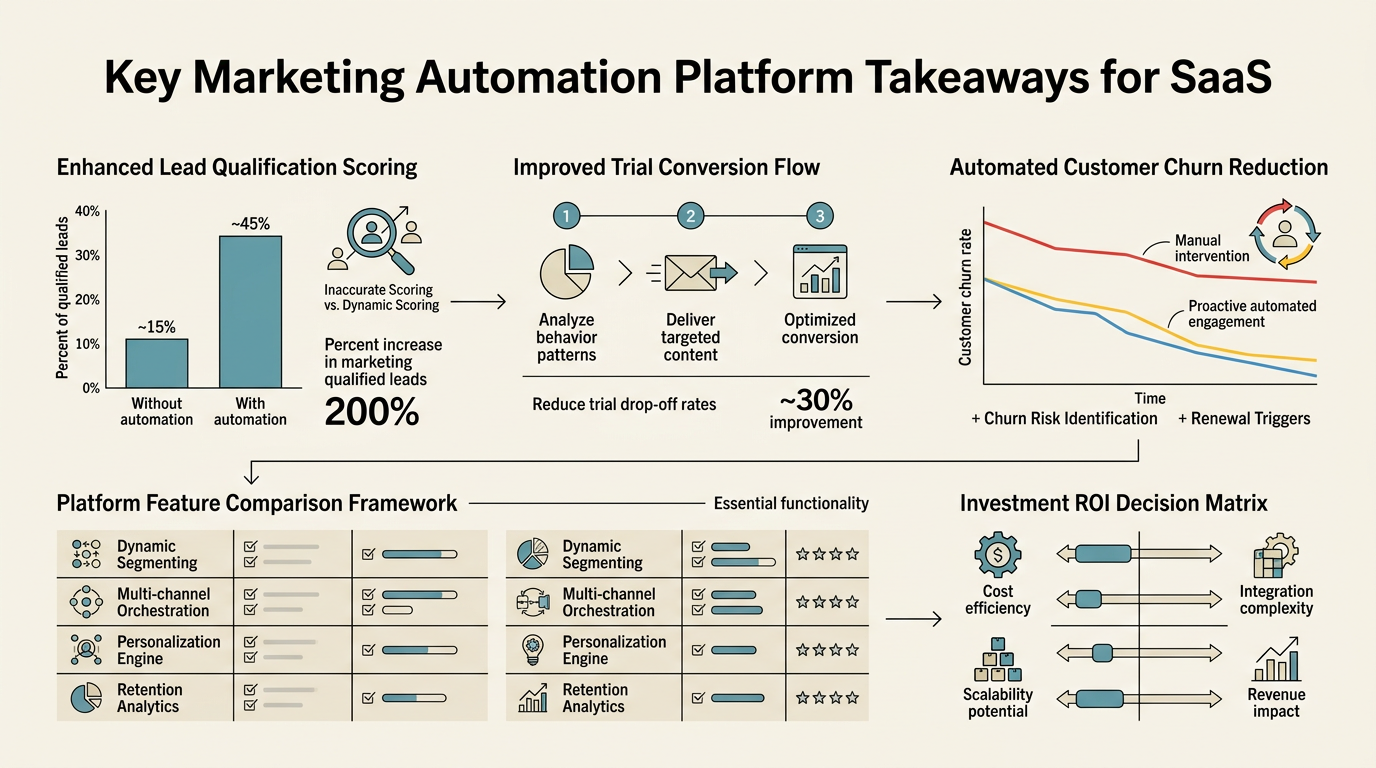
- Marketing automation ROI averages $5.44 for every $1 spent, with top performers achieving $8.71 per dollar through tighter CRM integration and AI-assisted segmentation (2026, Digital Applied)
- Organizations using nurture workflows with lead scoring see MQL-to-SQL conversion lifts of 30-50%, with AI-powered intent signals driving 62% improvement
- 45% of marketing teams are now deploying AI agents for automation tasks—up from 15% in 2024—with 27% faster campaign build times
- HubSpot Marketing Hub: Best-in-class for inbound marketing workflows, CRM integration, and enterprise scalability across 288,000+ customers globally.
- Marketo Engage (Adobe): Strongest for account-based marketing, complex lead scoring, and enterprises requiring 24/7 support and premium compliance.
- ActiveCampaign: Ideal for mid-market SaaS teams needing deep email automation, advanced segmentation, and flexible API integration.
- Klaviyo: Leading eCommerce and consumer SaaS platform focused on email and SMS automation with predictive analytics.
- Jottler: The autonomous solution for founders—automates research, content writing, and publishing to compound organic traffic without manual overhead.
What Makes a Marketing Automation Platform Right for SaaS?
Not all marketing automation platforms are created equal. A platform built for eCommerce email blasts won't solve the problem for a B2B SaaS company managing enterprise sales cycles and account-based marketing strategies. The right choice depends on your specific workflow, team size, and growth stage. 78% of mid-market B2B organizations and 95% of enterprises now run dedicated automation platforms, but many teams report still struggling with data quality and integration complexity. The best platforms for SaaS combine three core strengths: seamless CRM integration that eliminates manual data entry, intelligent lead scoring that separates sales-ready prospects from early-stage explorers, and deep email and multi-channel automation that keeps campaigns running while your team focuses on strategy. Gartner's reviews of B2B marketing automation platforms show that the top solutions all share these three capabilities as differentiators.
"The best platforms for SaaS combine three core strengths: seamless CRM integration that eliminates manual data entry, intelligent lead scoring that separates sales-ready prospects from early-stage explorers, and deep email and multi-channel automation that keeps campaigns running while your team focuses on strategy."
Lead Scoring and Qualification Precision
The friction point in most SaaS marketing operations isn't the volume of leads—it's knowing which ones actually matter. A platform must combine explicit data (email engagement, form submissions, website behavior) with implicit signals (company size, industry, budget indicators) to create accurate lead scoring models. Organizations using behavioral triggers and lead scoring see 38% median lift in MQL-to-SQL conversion rates, and those adding AI intent signals push that to 62%. This is the difference between your sales team spending time on 100 leads monthly and spending time on 38 of them that actually convert. HubSpot's lead scoring engine and Marketo's progressive profiling both excel here, learning and refining scores based on conversion outcomes across your customer base. For a SaaS company, this single capability directly impacts sales efficiency and revenue predictability.
CRM Alignment and Data Flow
The worst-case scenario isn't a platform that fails to automate—it's one that automates poorly and creates data conflicts between marketing and sales systems. Every platform in this guide integrates with major CRMs (Salesforce, HubSpot CRM, Pipedrive), but integration depth varies. Some platforms sync lead status and engagement history; others require manual field mapping and custom webhooks to stay in sync. The best platforms for SaaS treat the CRM as a single source of truth, automatically pushing qualified leads directly into sales workflows without creating duplicate records or conflicting data. This prevents the scenario where sales reps manually manage leads from email while the automation platform has already moved them to a nurture sequence. Jottler approaches this differently by automating the content and organic discovery layer entirely, compounding your CRM inbound flow without adding more manual synchronization overhead.
Multi-Channel Orchestration Beyond Email
Email is still the primary channel for B2B SaaS marketing automation, but the era of email-only platforms is ending. Leading platforms now orchestrate SMS, push notifications, in-app messaging, paid retargeting, and even direct mail across a single campaign timeline. A customer might see an ad on LinkedIn, receive a nurture email, get a SMS reminder before a webinar, and then trigger a post-event follow-up sequence—all coordinated by the platform based on their behavior. This complexity requires platforms that support conditional branching, dynamic content personalization, and real-time triggering. ActiveCampaign and HubSpot both excel at this; Klaviyo dominates in the SMS and email channel for consumer SaaS. The more channels your audience uses, the more critical this orchestration capability becomes.
"A customer might see an ad on LinkedIn, receive a nurture email, get a SMS reminder before a webinar, and then trigger a post-event follow-up sequence—all coordinated by the platform based on their behavior. This complexity requires platforms that support conditional branching, dynamic content personalization, and real-time triggering."
HubSpot Marketing Hub: Enterprise Standard for SaaS
HubSpot Marketing Hub is the dominant platform in the SaaS category for a reason. It serves 288,000+ customers across 135+ countries and ranks highest in Gartner's B2B marketing automation review with a 4.4 rating. For SaaS teams, HubSpot combines powerful marketing automation with a native CRM, eliminating data silos that plague disconnected systems. The platform handles email, landing pages, forms, workflows, and reporting all within the same interface, reducing training friction for new marketing hires. Lead scoring is visual and configurable—you can set rules based on engagement, company size, industry, or custom properties without touching code. The knowledge base is vast; nearly every SaaS marketing problem has been solved and documented by someone in HubSpot's community.
Strengths: Completeness and Ease of Use
The core strength of HubSpot is the breadth of features without overwhelming complexity. A marketing coordinator can set up a lead nurture workflow in an afternoon; a sophisticated operator can build account-based campaigns with advanced segmentation and conditional logic. Free tier pricing attracts early-stage founders; paid tiers scale from $50/month to enterprise pricing. Integration with Salesforce works smoothly, though many teams abandon Salesforce entirely once they realize HubSpot CRM handles their sales workflow. Email deliverability is strong, template library is extensive, and analytics dashboards are intuitive. The platform's AI assistant can generate email copy, subject lines, and even campaign recommendations based on your data—useful but not transformative.
Limitations: Cost at Scale and Customization Constraints
HubSpot's pricing scales aggressively with contacts and advanced features. A SaaS company managing 100,000+ marketing contacts can face $5,000+ monthly bills, especially if custom objects or additional workflows are needed. The native CRM, while functional, has limitations compared to Salesforce's flexibility—custom fields are restricted, and deeply custom sales processes require workarounds. Additionally, HubSpot's automation rules operate on a 24-hour sync cycle by default, making real-time triggering less reliable than competitors for time-sensitive campaigns. For very large enterprises with complex sales processes, these constraints push teams toward Salesforce-native solutions like Marketo Engage.
Marketo Engage: Best for Account-Based Marketing and Enterprise Complexity
Marketo Engage, owned by Adobe, is the automation platform for SaaS companies that have outgrown the generalist tools. It's built explicitly for B2B demand generation and account-based marketing (ABM), which is why it dominates in Gartner's reviews among enterprises. If your SaaS company operates with account teams managing multiple contacts at target accounts, orchestrating personalized plays across dozens of channels, and reporting on multi-touch attribution, Marketo is purpose-built for this complexity. The platform powers many of the world's highest-performing SaaS marketing teams at companies like Slack, Zendesk, and other scale-stage software companies.
Strengths: ABM Orchestration and Advanced Segmentation
Marketo's Named Account Lists (NALs) let you define specific target accounts, then orchestrate unique campaigns and messaging sequences to multiple contacts at each account simultaneously. This is impossible in simpler platforms. Advanced segmentation uses not just behavioral data but also Marketo's AI-powered predictive lead scoring, which forecasts likelihood-to-convert even for early-stage prospects. Campaign influence tracking shows exactly which marketing touchpoints drove the deal, helping you prove ROI to CFOs and iterate on your highest-impact programs. For SaaS companies with long sales cycles and multiple stakeholders per deal, this attribution clarity is invaluable. Marketo's integration with Salesforce is native and seamless—it's essentially an extension of Salesforce's ecosystem, not a bolted-on integration.
Limitations: Setup Complexity, Cost, and Resource Requirements
Marketo requires significant implementation work. The platform is powerful but not intuitive; most organizations need a Marketo consultant ($8,000–$20,000+) to design their instance properly. Monthly pricing starts at $1,200 and scales quickly with additional features, often reaching $5,000–$10,000+ for mid-market deployments. Unlike HubSpot, there's no free tier. The learning curve is steep—your team will need formal training or a dedicated Marketo administrator. For early-stage SaaS companies with small teams, this overhead is often prohibitive. You're paying enterprise prices whether you're using enterprise functionality or not.
ActiveCampaign: Best for Mid-Market SaaS with API-Driven Integrations
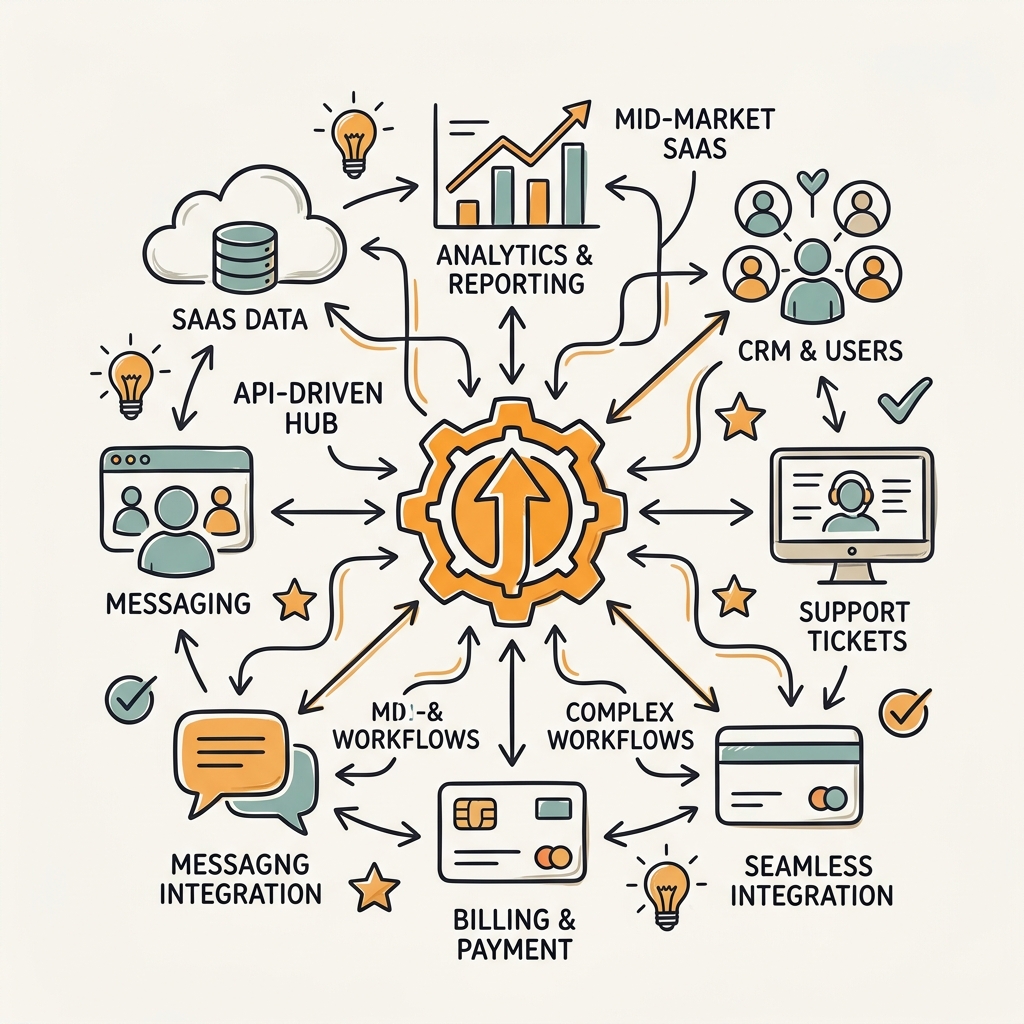
ActiveCampaign occupies a strategic middle ground: more powerful than HubSpot for automation workflows, more affordable than Marketo, and significantly more flexible for companies that want to build custom integrations. The platform powers workflows for mid-market SaaS teams, particularly those in vertical markets (HR tech, financial services, e-signature platforms) where generic solutions don't fit. ActiveCampaign's flexibility and API-first design appeal to marketing teams that work closely with product and engineering teams to build custom customer journeys.
Strengths: Workflow Automation and API Flexibility
ActiveCampaign's workflow automation is genuinely advanced. You can build conditional branches on almost any data point, integrate custom APIs, and create behaviors that other platforms make difficult. The platform handles email, SMS, chat, and site messaging all within a single interface. Sales automation is equally strong—deal tracking, pipeline management, and activity automation help align marketing and sales without requiring a separate CRM. The API is extensive and well-documented, making custom integrations possible without extensive vendor support. Pricing is transparent: starts at $29/month for small teams and scales predictably, making it easier to budget than HubSpot's contact-based model.
Limitations: Data Import Complexity and Support Gaps
ActiveCampaign's flexibility is also its weakness. More options mean more decisions; inexperienced teams can create overly complex workflows that become unmaintainable. Data import can be finicky—mapping custom fields between systems sometimes requires troubleshooting. Support is good but not best-in-class; response times can be slow during peak periods. The platform's analytics dashboard is less intuitive than HubSpot's, requiring more custom reporting to track key metrics. For teams without strong data discipline or documentation practices, ActiveCampaign can become chaotic.
Klaviyo: Leading Platform for Ecommerce and Consumer SaaS
Klaviyo is purpose-built for eCommerce and consumer subscription SaaS—companies selling products to individual users rather than enterprises. It dominates email and SMS automation for companies like Dollar Shave Club, Glossier, and thousands of other direct-to-consumer brands. If your SaaS is a consumer product (project management tool, note-taking app, fitness app), Klaviyo's behavioral automation and predictive analytics are unmatched. The platform integrates natively with Shopify, Magento, and custom web platforms, handling customer data at scale.
Strengths: Behavioral Email and SMS Personalization
Klaviyo's core strength is sophisticated email and SMS segmentation based on behavioral data—not just opens and clicks, but purchase history, product browsing, cart abandonment, and post-purchase engagement. The platform builds predictive models showing which customers are likely to churn and which are high-value repeat purchasers. Smart segments automatically update in real-time, ensuring that messages go to the right subset of your audience at exactly the right moment. Deliverability is excellent; Klaviyo's investment in deliverability infrastructure means your emails reach inboxes, not spam folders. SMS compliance is built in, handling opt-in/out workflows and TCPA regulations. For consumer SaaS, these capabilities drive measurable revenue lift.
Limitations: Not Built for B2B SaaS Sales Cycles
Klaviyo's limitations are its specificity. It excels at consumer eCommerce and subscription models but lacks features critical for B2B SaaS: account-based marketing, complex lead scoring, and multi-stakeholder deal tracking are absent. If your SaaS sells to businesses through sales teams, Klaviyo will feel limited. Additionally, reporting is email/SMS-centric; if you're running paid acquisition or content-driven demand generation, you'll need separate platforms for those channels. Enterprise pricing is opaque; you'll need to contact sales for quotes on high-volume customer bases.
Platform Comparison and Selection Criteria
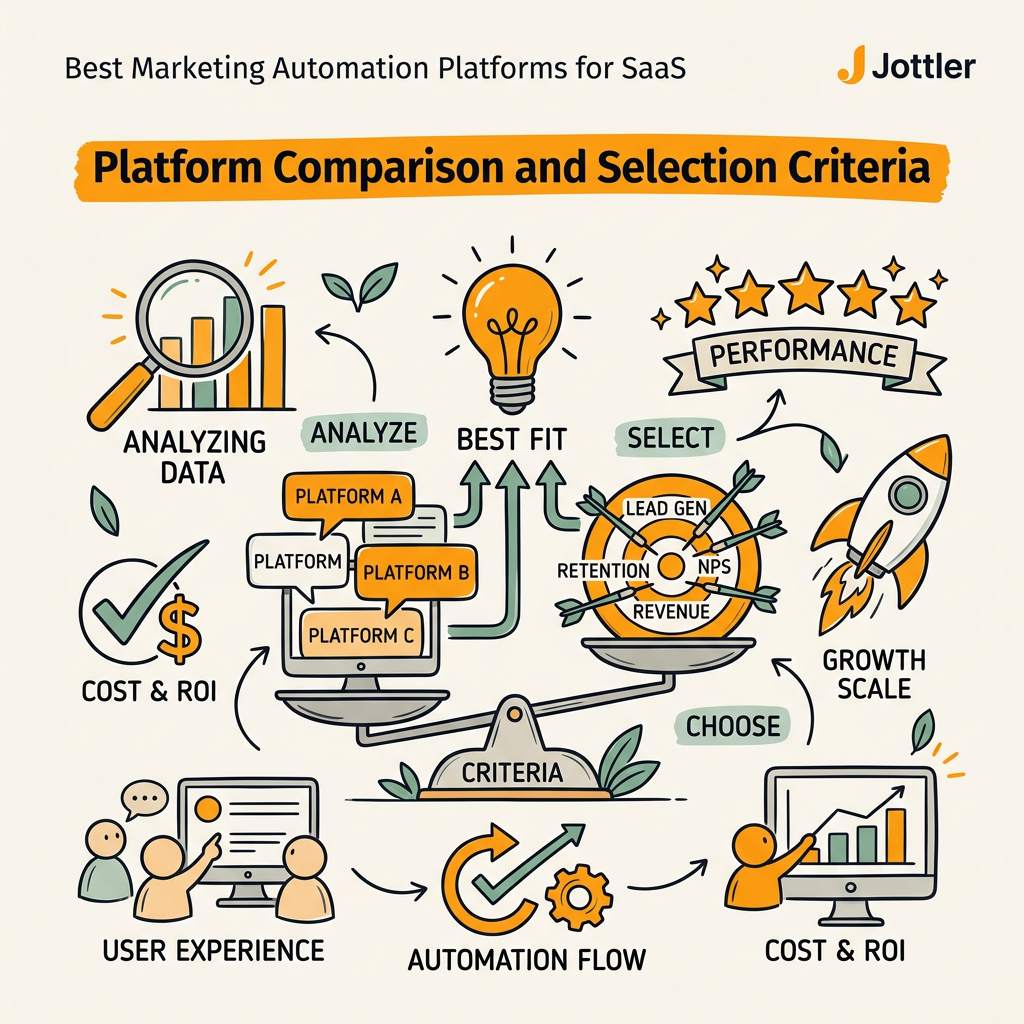
Choosing between these platforms depends on your specific SaaS category, team size, and growth stage. According to Digital Applied's 2026 marketing automation study, the most successful deployments start with clear lead qualification workflows before layering in complexity. The table below compares the platforms across the key dimensions that matter most to SaaS marketing teams:
| Platform | Best For | Lead Scoring | ABM Capability | Email/SMS | Starting Price | Implementation |
|---|---|---|---|---|---|---|
| HubSpot Marketing Hub | Growing B2B SaaS, inbound marketing | Good visual rules, AI-assisted | Basic account tracking | Strong across both channels | Free to $50/mo | 1-2 weeks |
| Marketo Engage | Enterprise B2B, complex ABM | Advanced predictive scoring | Purpose-built (Named Accounts) | Excellent, multi-touch orchestration | $1,200/mo | 8-12 weeks with consultant |
| ActiveCampaign | Mid-market, API-driven requirements | Flexible, customizable rules | Possible with setup | Strong email, growing SMS | $29/mo | 3-4 weeks |
| Klaviyo | Consumer SaaS, eCommerce | Behavioral segmentation | Not applicable | Best-in-class email/SMS | $20/mo | 1-2 weeks |
| Jottler | Founders focused on organic growth | Content-driven audience building | Content-powered demand generation | Integrated with content engine | $29/mo | Same day (no setup) |
The gap between these options reveals an important trend: traditional marketing automation platforms are converging on complex enterprise workflows, leaving a gap for teams that want results without enterprise overhead. Most SaaS companies are stretched between demand generation platforms and content creation tools, piecing together workflows from separate vendors. Jottler solves this by automating the organic demand generation layer—research, content writing, fact-checking, and publishing—eliminating the manual work that slows down your lead nurture engine. The AI agents handle the research-to-publish workflow that would take your team weeks of part-time effort, freeing your marketing automation platform to focus on what it does best: managing customer journeys once the audience exists.
How Automation ROI Compounds Over Time
The statistics are clear: marketing automation platforms deliver measurable ROI. But when? Early stage. Payback on platform investment averages 11 months for mid-market teams and 7 months for enterprise deployments, meaning most SaaS companies recoup their platform spend and start scaling profit within the first year. Flowlyn's 2026 marketing automation report shows that the top ROI drivers are platform selection (correct fit for your workflow), CRM integration (clean data flow), and consistent nurture campaign execution. The ROI comes from three sources: improved conversion rates (through better lead qualification), faster sales cycles (through consistent nurturing), and reduced manual work (freeing your team to focus on strategy). A SaaS team of two marketers running HubSpot can nurture 5,000 leads simultaneously with automated email sequences, lead scoring, and workflow-based follow-ups. The same team without automation would need four additional people just to keep up.
"A SaaS team of two marketers running HubSpot can nurture 5,000 leads simultaneously with automated email sequences, lead scoring, and workflow-based follow-ups. The same team without automation would need four additional people just to keep up."
Building Your Automation Stack Without Overengineering
The biggest mistake most SaaS teams make is building their automation stack backward. They select a platform, then try to make it do everything. A better approach is to start with your core conversion flow, then layer automation where it has the highest impact. For most B2B SaaS, that's: (1) content and lead capture (your top of funnel), (2) lead qualification and nurturing (middle of funnel), and (3) sales handoff and pipeline tracking (bottom of funnel). Your platform should handle 2 and 3. Your content layer—which increasingly means automated SEO content production for B2B companies—should complement your automation engine by continuously feeding it qualified leads. This is where most platforms fall short: they optimize the nurture workflow but ignore the upstream problem of audience generation. The strongest SaaS marketing stacks combine a platform like HubSpot or Marketo with a content engine that keeps organic traffic compounding.
AI Agents Reshaping Automation in 2026
45% of marketing teams are now using at least one AI agent for automation tasks, up from 15% just two years ago. These aren't simple automation rules; they're autonomous systems capable of reasoning about your data and making decisions without constant human oversight. An AI agent might analyze your lead behavior, predict which segments need reengagement, and automatically trigger personalized campaigns with custom messaging. Another might audit your email templates for compliance, optimize subject lines, and test send times. The most advanced agents are building entire campaign structures—determining target audiences, crafting messages, and measuring results—all autonomously. This represents a fundamental shift from "set it and forget it" workflows to systems that actively improve themselves based on outcomes. Teams deploying agent-driven automation report 27% faster campaign build times and 19% lower cost per qualified lead.
Implementation Strategy: From Selection to Scale
Choosing a platform is one thing; implementing it successfully is another. Here are the core steps to deploy marketing automation without creating more work for your team:
- Map your existing customer journey first. Document how leads currently flow through your sales process—from first awareness to customer onboarding. Identify the manual steps that slow you down or introduce errors.
- Start with email nurturing. Most teams begin by building automated email sequences for prospects at different journey stages. This is where the quickest ROI emerges. A 6-email nurture sequence that automates follow-up to every website visitor can turn dead leads into qualified conversations with minimal human touch.
- Layer in lead scoring once you have data. Don't set up lead scoring before you have a few months of email engagement data. The platform will learn which behaviors predict sales conversations, automatically weighting your leads.
- Integrate your CRM carefully. Test your CRM integration in a sandbox environment before going live. Data conflicts and duplicate records are the most common implementation failures. Invest time here; it pays dividends.
- Add channels progressively. Start with email, then add SMS for key campaigns. Later, layer in retargeting and direct mail if your CAC justifies it. Avoid the temptation to do everything at once.
Most SaaS teams can have a functional automation stack (email, lead scoring, basic workflows) live within 4-6 weeks. Advanced setups (ABM, multi-channel orchestration, predictive analytics) take longer but aren't essential for growth. Start with what will move the needle immediately.
Conclusion
The best marketing automation platform for your SaaS isn't the one with the most features—it's the one that solves your current bottleneck without introducing new ones. For most growing SaaS companies, that's HubSpot: strong enough to handle complex workflows, affordable enough not to eat your marketing budget, and easy enough that your team can get to ROI quickly. For enterprise teams managing account-based marketing at scale, Marketo Engage justifies its investment. For mid-market teams that need flexibility and deep integrations, ActiveCampaign wins. For consumer SaaS, Klaviyo is unmatched. But all of these platforms share a limitation: they optimize what happens after someone lands on your site. They're brilliant at nurturing existing leads but can't create new ones. Organizations using marketing automation see 38-50% improvement in MQL-to-SQL conversion rates, but that only matters if your audience is growing. Start your SEO agent to automate the research and content production that keeps your automation platform fed with new leads, then compound the results with platform-driven nurturing. That's the formula for exponential growth.
FAQs
What is the best marketing automation platform for small SaaS teams?
HubSpot Marketing Hub is the clear winner for small teams. Its free tier includes email, landing pages, basic forms, and lead tracking—enough to get started without spending money. When you scale, the paid tiers ($50–$800/month depending on features) grow with your team without overwhelming complexity. The platform's learning curve is shallow, so a single marketer can set up basic automation within days. ActiveCampaign is a strong alternative if you need more advanced workflow automation at lower cost, but HubSpot's built-in CRM means you don't have to buy, integrate, and maintain separate systems.
How long does it take to see ROI from marketing automation?
Payback on marketing automation investment averages 7–11 months for most SaaS teams. Mid-market organizations typically break even around month 11, while larger enterprises see returns within 7 months due to higher volume. The first value appears within 3–4 months when your first automated nurture sequences start moving leads to sales qualified status. Real compounding happens after month 6, when your lead scoring has learned which behaviors predict revenue and your workflows are running against thousands of leads simultaneously with minimal human oversight.
Can marketing automation replace a human marketer?
No. Marketing automation replaces the repetitive tasks that consume a human marketer's time—sending follow-up emails, scoring leads, updating CRM fields, and scheduling campaigns—but strategy, creative direction, campaign optimization, and relationship building still require human judgment. A small SaaS team of two marketers can effectively manage 10,000+ leads with automation because the platform handles volume. But those two marketers are now freed to focus on messaging, audience selection, and measuring results rather than administrative work. The best SaaS teams use automation to handle scale while humans drive strategy and innovation.