Brand Voice Consistency: How AI Tools Keep It On-Brand
Maintaining a consistent brand voice across dozens of channels, teams, and content types used to require armies of editors and brand managers. Today, consistent brand messaging increases revenue by 23–33%, according to Lucidpress research—yet 85% of marketers are now using AI content creation tools, often without proper brand voice guardrails in place. The disconnect is real: AI accelerates content production at scale, but without the right safeguards, it erodes the very consistency that drives revenue. This is where purpose-built AI tools change the game. Instead of shipping fragmented copy that damages brand credibility, modern AI platforms let you define your voice once and enforce it across every output—automatically.
Key Takeaways
- Consistent brand messaging increases revenue by 23–33% and brands with low consistency need 1.75x more media spend to achieve the same growth (Lucidpress, 2025)
- 85% of marketers use AI content tools, making brand voice governance critical to maintain message integrity at scale
- AI tools with brand voice training, style guides, and approval workflows reduce tone drift and keep all outputs aligned with company identity
- Why Brand Voice Consistency Matters: Revenue lift of 23–33%, reduced media waste, and 3.5x better brand visibility for consistent brands.
- The AI Consistency Problem: Uncontrolled AI generation produces generic, off-brand copy unless trained on company voice and governed by guardrails.
- Building a Brand Voice System: Document tone attributes, create approval workflows, and train AI on your best existing content.
- AI-Powered Enforcement: Modern platforms use brand voice profiles, terminology libraries, and automated QA to catch tone drift before publishing.
- Scaling Across Channels: Adapt voice consistently by channel without losing core identity through channel-specific guidelines and templates.
Why Inconsistent Brand Voice Costs You Revenue
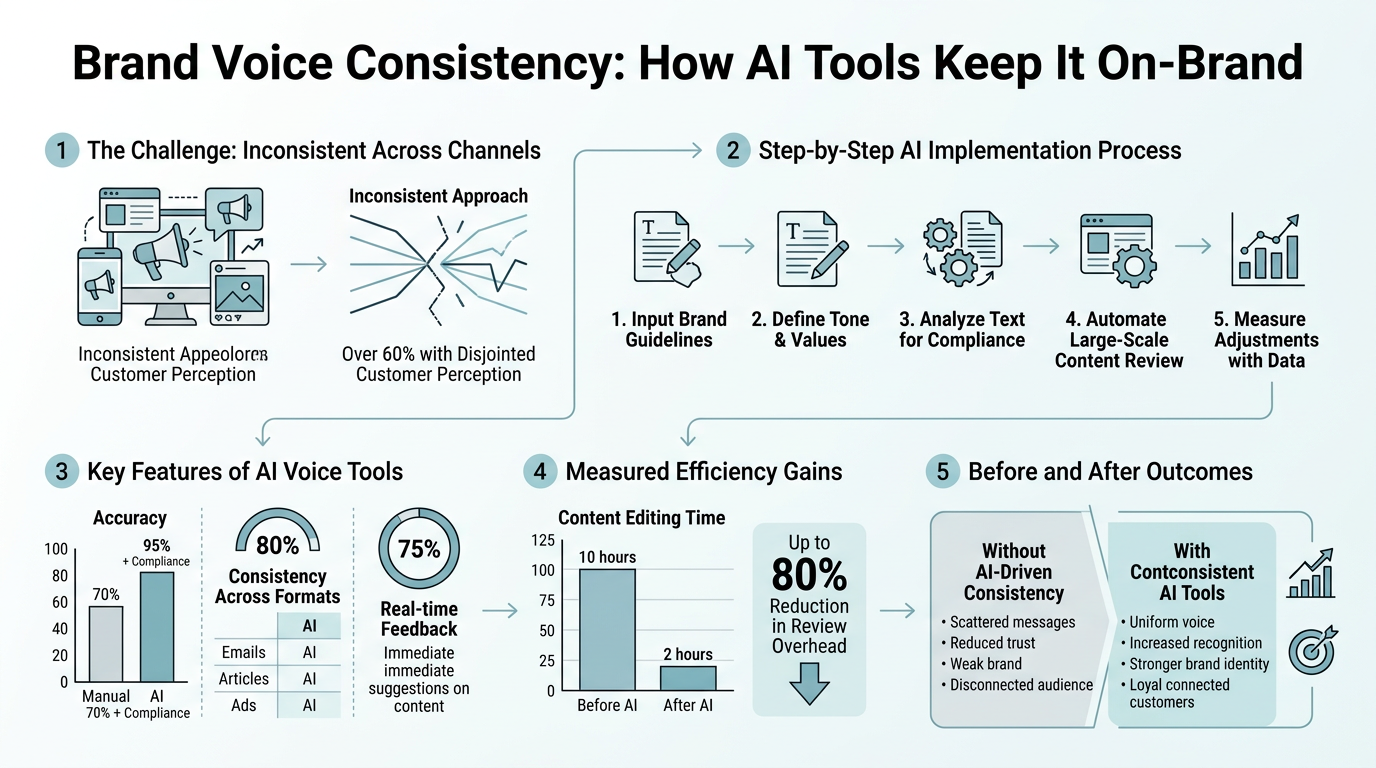
Brand inconsistency is a silent revenue killer. 68% of companies report that consistent brand messaging contributed to revenue growth of 10% or more, while inconsistent brands hemorrhage customer trust and media budget. When your email sounds different from your website, your blog differs from your ads, and your social posts clash with your product copy, customers perceive your brand as unprofessional, fragmented, and untrustworthy.
"Inconsistent brands need 1.75x more media spend to achieve the same growth as consistent competitors. That $43K annual win per campaign compounds across every channel—a silent tax on fragmented messaging that most growing companies never quantify."
The cost is measurable. Inconsistent brands need 1.75x more media spend to achieve the same growth as consistent competitors. That means if you're spending $100K on ads without message unity, a consistent brand achieves the same revenue with $57K—a $43K annual win per campaign. For a growing company producing content across email, blog, social, ads, and docs, the accumulated waste is hundreds of thousands of dollars.
What makes the challenge harder? 60% of millennials demand consistent brand experiences, yet only 8% of retailers feel they've mastered omnichannel execution. Your audience expects seamlessness. They notice when your brand voice breaks. Research from Envive on brand voice consistency shows mobile users are 5x more likely to abandon tasks on inconsistent sites.
The Multi-Channel Fragmentation Problem
Most growing companies don't have a single author anymore. You have a founder, a content marketer, a copywriter, a social media manager, maybe a contractor or two. Each person interprets your brand voice differently. One writes long-form, educational copy. Another writes punchy, benefit-driven headlines. A third uses industry jargon; another avoids it. Without a unified system, your brand voice splinters across channels.
Add staff turnover into the mix, and you lose institutional knowledge of how your brand actually talks. New hires don't know the unwritten rules. They write in their own voice, not yours. By the time you catch it, off-brand content has already shipped.
Why Manual Enforcement Doesn't Scale
Traditional brand voice management relies on style guides—static PDFs that live in Notion and get updated once a year. They sit on shelves. Writers skim them. Editors have to manually audit every piece for tone, terminology, and message alignment. With one or two articles per week, this works. With one or two articles per day—the pace required to compete in content marketing—manual quality assurance becomes a bottleneck.
That's where AI-powered brand voice systems become essential. They automate the enforcement layer.
How AI Tools Train On Your Brand Voice
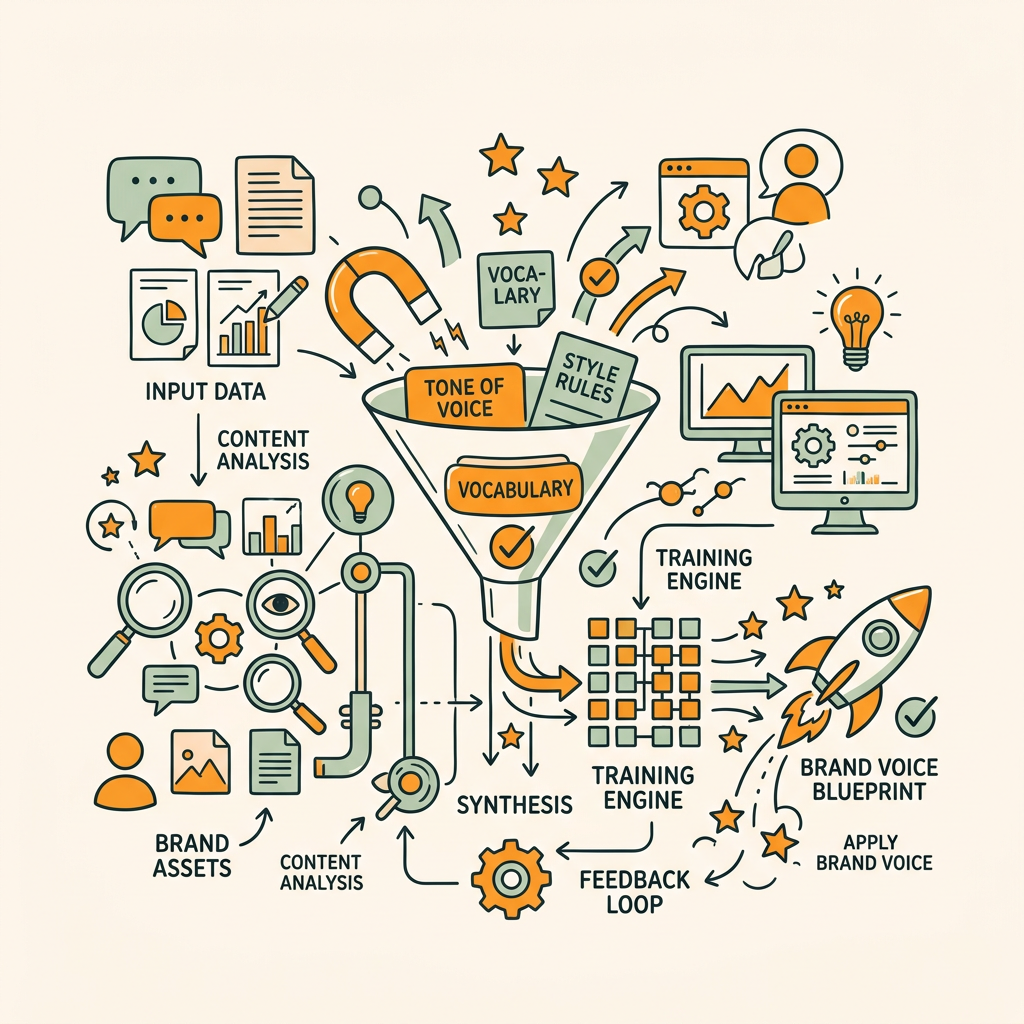
The first generation of AI content tools treated brand voice as optional. You'd feed ChatGPT a prompt and hope it sounded right. Modern systems—tools built for enterprise content at scale—treat brand voice as a core feature. They train on your actual company voice and use it to shape every output, automatically.
Brand Voice Training: Teaching AI to Sound Like You
Purpose-built AI platforms let you upload examples of your best content and teach the model what "on-brand" looks like. You might feed the system:
- Approved blog posts: 3–5 high-performing articles that exemplify your tone, depth, and style.
- Email campaigns: Samples of your best-performing email copy to capture tone in customer-facing messaging.
- Product documentation: Your actual documentation to preserve technical precision and your brand's approach to explanations.
- Social media: A month of your Twitter/LinkedIn posts to teach the system your rhythm and personality.
- Company messaging: Press releases, About page copy, founder interviews—anything that embodies your brand voice at its best.
The AI analyzes these examples and learns patterns: your vocabulary preferences, sentence structure, tone (authoritative vs. friendly), formality level, use of jargon, humor style, and emphasis. It builds a profile—essentially a compressed model of how your brand speaks. From then on, every piece of content generated through that system carries that voice.
Terminology Libraries and Approved Language
Brand voice isn't just tone. It's also vocabulary. Maybe you say "users" not "customers." Maybe you say "dashboard" not "control panel." Maybe you avoid certain words or phrases entirely. Professional AI tools let you maintain a terminology library—a list of approved terminology, synonyms to avoid, and context-specific language rules.
"When your brand has disciplined terminology, customers instantly recognize your content—even without seeing your logo. Vocabulary consistency is the invisible thread that ties your entire brand together, and AI tools make it enforceable at scale."
When the AI generates copy, it checks against this library. If it uses a term you've flagged as off-brand, the system either corrects it or flags it for human review. This prevents the slow decay of vocabulary that happens when teams grow and new people introduce their own language.
Style Guides as System Inputs
Upload your existing brand style guide—whether it's a formal PDF or a Notion page—and the AI tool parses it into structured rules. Tone descriptors ("warm but authoritative," "witty but professional") get translated into algorithmic guardrails. Format requirements (sentence length, paragraph structure, heading style) become templates. The system uses these rules to shape generation in real-time.
This is fundamentally different from static PDFs. A human editor reads a style guide and tries to remember it. An AI system enforces it in every output.
Building the Systems That Keep AI On-Brand
Effective brand voice consistency with AI isn't about choosing the right tool—it's about building the right system around it. That system has four components: definition, governance, enforcement, and feedback. When teams at scaling companies use a unified AI content strategy, they see faster time-to-consistency because the platform handles voice enforcement automatically.
Step 1: Define Your Brand Voice Clearly (Before Using AI)
You can't teach AI to sound like you if you don't know how you sound. Start by documenting your brand voice as a system, not a slogan.
- Tone attributes: List 4–6 adjectives that describe your brand voice. Example: "direct, expert-backed, accessible, data-driven, confident."
- Tone by context: Does your voice shift depending on the audience or channel? A fintech company might sound formal in regulatory docs but warm in onboarding emails. Document these shifts.
- Vocabulary: What words or phrases are core to your identity? What terms do you avoid? Example: "We use 'segments' not 'clusters'. We say 'build' not 'create'. We avoid passive voice."
- Examples of good and bad: Show the AI (and your team) what on-brand looks like and what doesn't. Include real examples of copy you love and copy you'd reject.
This document becomes the input for your AI tool. The clearer and more specific you are, the better the AI performs.
Step 2: Set Up Brand Voice Training in Your AI Tool
Upload your brand voice documentation and examples into your AI platform. Most enterprise tools—like Jasper, Adobe GenStudio, and similar systems—provide a brand voice setup wizard. Feed it:
- Your brand voice document
- 5–10 examples of on-brand content
- Your terminology library
- Any regulatory or compliance requirements specific to your industry
The system trains a brand-specific model. From that point forward, when you generate copy, it's shaped by your voice from the first draft.
Step 3: Create Channel-Specific Guidelines
Your brand voice is consistent, but it adapts by channel. Your LinkedIn voice is more formal than your Twitter voice. Your blog posts are longer and more detailed than your email subject lines. Define these adaptations in channel guidelines.
For each major channel (blog, email, social, ads, docs), document:
- Tone adjustments: How does your voice shift here? More conversational? More formal?
- Content format: Blog posts vs. tweets vs. emails have different structures.
- Length targets: How many words? How many sentences per paragraph?
- Calls-to-action: What's your standard CTA voice across channels?
- Taboo elements: What should NEVER appear on this channel?
Input these into your AI tool as channel templates or presets. When you select a channel, the AI adapts your core voice to fit—without losing your identity.
Step 4: Implement Approval Workflows and Human Review
AI makes the first draft. Humans make it perfect. Set up a review workflow where generated content flows through human editors before publishing. The best systems:
- Flag tone deviations: Automatically highlight passages that drift from your trained voice.
- Require approval for sensitive topics: Content mentioning competitors, pricing, or compliance issues gets routed to a subject-matter expert.
- Track edits: When humans change AI-generated copy, log those changes so the system learns from them.
- Feed feedback back to the model: Over time, your AI gets better at matching your voice because it learns from human corrections.
This human-in-the-loop approach is standard at companies that use enterprise AI content tools and other governance-first platforms. It's how you scale without sacrificing quality.
AI Tools That Enforce Brand Voice Consistency at Scale
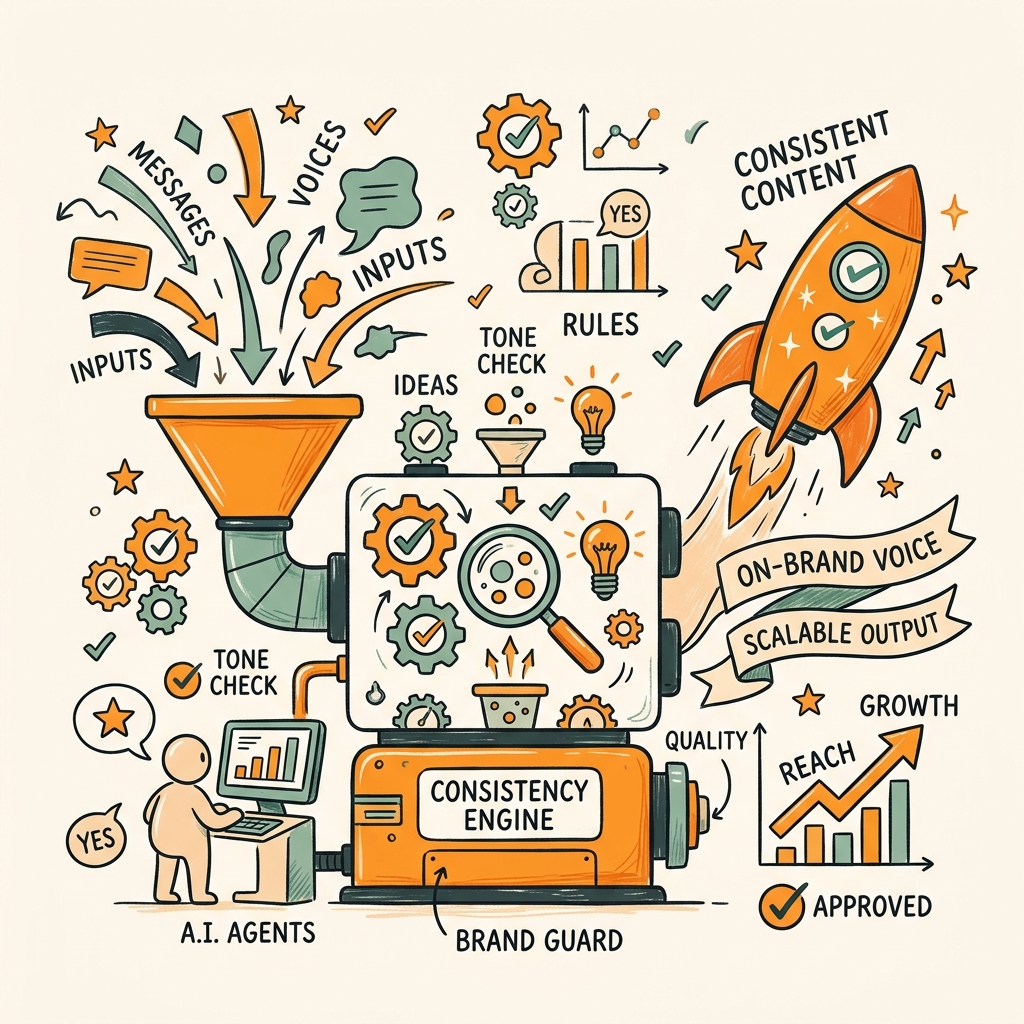
The market has evolved fast. Early AI writing tools ignored brand voice entirely. Today's leaders have turned it into a core feature. Here's how the main categories work and which solve the consistency problem best for growing companies.
Enterprise Content Platforms with Governed AI
Tools like Jasper, Adobe GenStudio, and Smartcat are purpose-built for teams that need brand governance at scale. They offer:
- Brand voice training with document uploads
- Terminology libraries and style guide enforcement
- Approval workflows with role-based access
- Multi-language support with terminology consistency across translations
- Audit logs so you can see who changed what and why
The trade-off? These tools are pricier ($500–$5,000+ per month depending on use) and require more setup. They're built for marketing teams with multiple people, multiple channels, and compliance needs. If you're a founder shipping one article a day with a lean team, they might feel over-engineered.
Mid-Market AI Writers with Voice Profiles
Tools positioned between simple chat and enterprise platforms—like Jottler—offer a middle path. They include:
- Brand voice training (though sometimes simpler than enterprise tools)
- Automated research and fact-checking built in
- Higher-quality output trained on ranking content, not just generic writing
- Lower pricing ($29–$500/mo depending on scope)
- Focus on content at scale without requiring a dedicated brand ops team
Jottler, for instance, trains its research and writing pipeline on your brand voice and SEO requirements, then produces 3,000+ word articles daily while maintaining your voice. The system handles keyword research, multi-source fact-checking, internal linking, and CMS publishing—all while keeping your tone consistent because the AI agents are trained on your voice from day one. For teams building SEO automation at scale, this integrated approach eliminates the friction of managing separate tools.
General-Purpose AI Tools (With Manual Brand Controls)
ChatGPT, Claude, and similar LLMs are flexible but require heavy hand-holding for brand voice. You can:
- Paste your brand voice guide into each prompt
- Use custom instructions to set system-level tone rules
- Manually audit every output for consistency
This works if you're generating a few pieces of copy per week and you're personally reviewing everything. At scale, it breaks down. You'd spend more time editing than the AI saves in writing.
| Platform Type | Brand Voice Training | Approval Workflows | Terminology Enforcement | Price Range | Best For |
|---|---|---|---|---|---|
| Enterprise (Jasper, Adobe, Smartcat) | Full document upload, multi-example training | Role-based approvals, audit logs | Built-in glossaries, automated flags | $500–$5,000+/mo | Large teams, regulated industries, multi-channel compliance |
| Mid-Market (Jottler) | Brand voice profiles, SEO + voice training | Human review before publishing, feedback loops | Integrated into generation, style guide support | $29–$500/mo | Busy founders, growing teams, daily content volume, SEO-focused |
| General-Purpose (ChatGPT, Claude) | Prompt-based only, no persistent training | None built-in, manual review required | Manual checking, no automated enforcement | Free–$20/mo | Ad-hoc drafting, brainstorming, low publication volume |
Why Purpose-Built Tools Beat Manual Enforcement
A spreadsheet, a Notion doc, and a sharp eye used to be enough to keep brand voice consistent. That approach breaks at scale. When you're producing articles daily, you need AI that understands your voice well enough to maintain it without constant human intervention.
The difference shows up in two metrics: output speed and rework rate. Manual brand enforcement means checking every piece of copy against your style guide and rewriting passages that sound off. With an AI tool trained on your voice, most outputs ship with minimal edits. The AI has already internalized your tone. Your editor spends time improving, not correcting. Research from Avintiv Media on AI and brand strategy confirms that governance-first AI platforms reduce editorial rework by 40–60% versus general-purpose tools.
Avoiding Voice Drift: Monitoring and Feedback Loops
Even with a trained AI system, tone can drift over time. New features get added to platforms. The model gets updated. External inputs change. Maintaining consistency requires active monitoring and feedback. Teams using content marketing automation platforms benefit from built-in monitoring that catches voice drift automatically.
Regular Audits for Tone Consistency
Set up a monthly or quarterly audit of AI-generated content across all channels. Pull a random sample of 10–20 articles, emails, and social posts published in the past month. Read them as a reader would. Do they all sound like your brand? Are there passages that feel off?
Document issues and feed them back to your AI system. Most modern tools allow you to mark specific passages as "off-brand" and use them as training data for the next generation.
Establish a Feedback Loop Between Editors and the AI
When your team edits AI-generated copy, log the changes. Create a simple feedback mechanism: "This phrase was changed by [editor]" or "This paragraph was rewritten for tone." Over time, these corrections train the AI. It learns from human judgment.
Tools that integrate SEO content generation with brand voice allow for this kind of feedback because the research, writing, and publishing pipeline is unified. Changes made in the CMS or editor get fed back into the model, tightening voice consistency over time.
Monitor for Terminology Drift
Terminology is easier to track than tone. Run a quarterly search on your published content for terms you've marked as off-brand. If your AI system ever generates "user" when your brand says "customer," catch it and correct it. These searches take 10 minutes. They prevent slow vocabulary decay that customers notice.
Scaling Brand Voice Across Multiple Channels
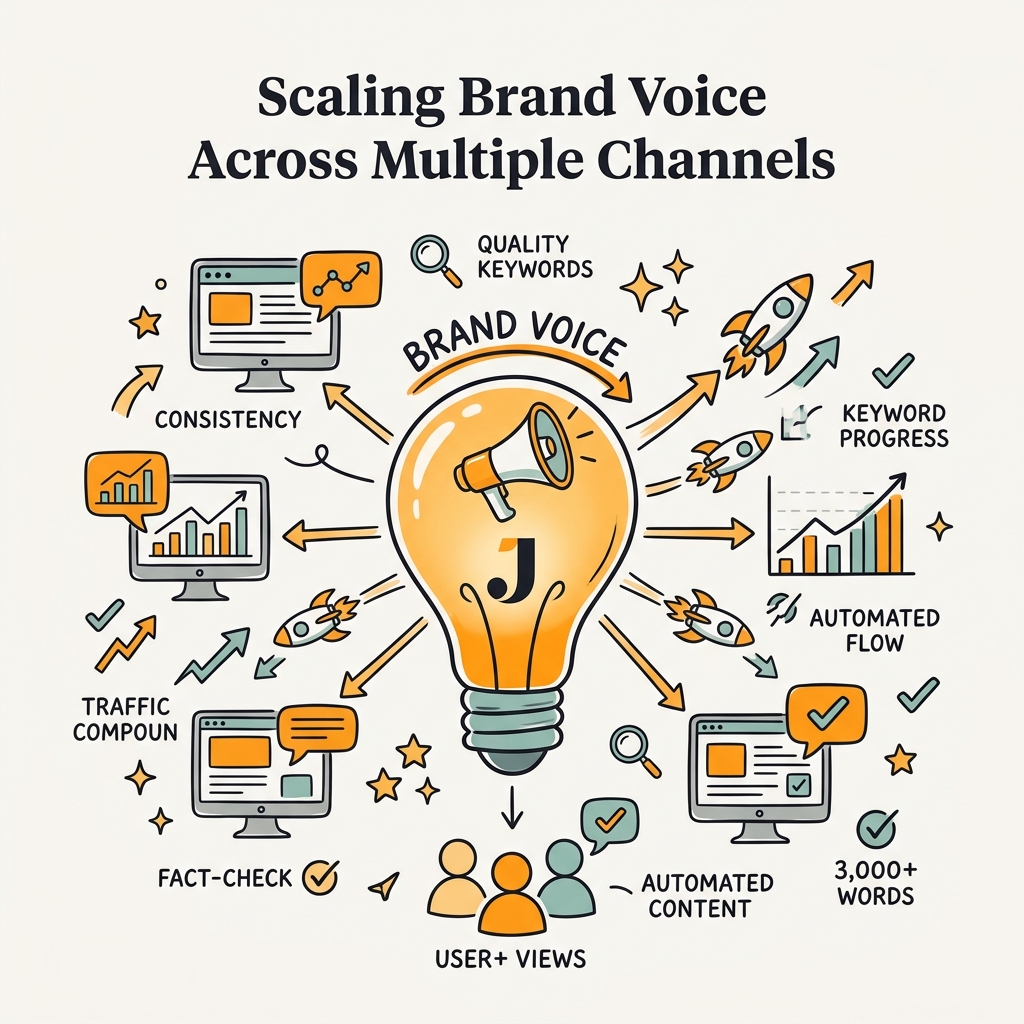
Consistent brand voice doesn't mean identical copy everywhere. It means your voice adapts intelligently by channel while keeping core identity intact. This is where many AI systems fall short—they produce generic content that sounds the same everywhere.
One Voice, Multiple Channels
The most sophisticated AI systems let you define a core brand voice, then specify how it shifts by channel:
- Blog: Long-form, expert-driven, educational tone.
- Email: Conversational, benefit-focused, scannable structure.
- Social (Twitter): Punchy, personality-forward, trending-relevant.
- LinkedIn: Professional, thought-leadership-oriented, industry-aware.
- Product docs: Precise, jargon-acceptable, structure-driven.
Without guidance, AI will write your blog post in the same voice as your tweet. With channel guidelines, it adapts intelligently. The underlying brand voice stays constant—the same vocabulary, the same values, the same perspective—but the expression changes to match where the audience is consuming the content.
Templates and Workflow Consistency
Templates enforce consistency better than instructions alone. Create templates for:
- Blog post structure (intro, key takeaways, sections, FAQ format)
- Email format (subject line tone, body length, CTA style)
- Social post structure (hook + value + CTA)
- Product description format (benefits-first structure, feature calling)
When you ask an AI system to generate content, you're not just saying "write a blog post." You're saying "write a blog post using the [Blog Template]." The template locks in structure, tone targets, and format. The AI fills in the unique content. The result is consistent because the template is consistent.
Measuring Brand Voice Consistency
You can't improve what you don't measure. Most companies measure content volume (articles per month) but not consistency. Here's how to quantify it:
Tone Consistency Scoring
Some tools now offer automated tone consistency scoring. The AI reads your published content and assigns a consistency score (0–100). The score measures how closely each piece matches your trained brand voice. A score of 85+ means strong alignment; 70–84 means good with some editorial notes; below 70 flags pieces that need review.
Track your consistency score monthly. As your team gets better at using the tool and the tool gets better at learning your voice, the score should climb.
Human Perception Testing
Have team members rate random samples of published content on consistency. Use a simple scale: "Does this sound like our brand? (1–5)." Aggregate the responses. If your score averages 4.2/5, you have strong voice consistency. If it's 3.1/5, you need tighter training or better templates.
Customer Feedback
Monitor brand sentiment in customer feedback, reviews, and surveys. Look for comments about "voice" or "tone." If customers say, "Your marketing sounds disjointed," that's a consistency problem worth addressing. If they say, "I always recognize your content," that's confirmation your consistency is working.
Conclusion
Brand voice consistency is no longer a nice-to-have. It's a revenue lever. Consistent brands earn 23–33% higher revenue and need 1.75x less media spend to achieve growth. With 85% of marketers using AI content tools, the question isn't whether to use AI—it's how to use it without letting your brand voice fragment.
The answer is a system: define your voice clearly, train your AI tool on it, set up approval workflows, and monitor for drift. The right tool makes this automatic. Jottler trains on your brand voice from day one as part of its core research and writing pipeline, then handles research, fact-checking, internal linking, and publishing while keeping every article aligned with your identity. With the right system in place, you can publish at scale without losing the consistency that builds trust and drives revenue.
Start by documenting your brand voice as a system. Then choose a tool that treats voice governance as a core feature, not an afterthought. The investment in clarity upfront compounds into consistency that grows with your content. That consistency becomes competitive advantage. Start your SEO agent today and begin producing consistent, on-brand content at scale.
FAQs
How can I ensure my AI-generated content stays on-brand?
Train your AI tool on examples of your best content and your brand voice guidelines before generating at scale. Upload your style guide, approved terminology, and 5–10 on-brand content samples so the AI learns your exact tone, vocabulary, and structure. Then implement a human review workflow where editors check generated content against your voice before publishing. Most modern AI tools include brand voice training as a built-in feature. Feed the system feedback when editors make changes—this teaches the AI to match your voice more accurately over time, reducing rework and speeding up publication.
What's the difference between brand voice and brand tone?
Brand voice is your consistent personality—the vocabulary, perspective, and values that make your brand recognizable. Think of it as your accent and way of speaking. Brand tone, by contrast, is your emotional delivery in a specific moment. Your voice stays the same across all channels; your tone shifts by context. A friendly, expert brand might use a warm, encouraging tone in an onboarding email but a confident, reassuring tone in a security announcement. The personality (voice) is consistent. The emotional inflection (tone) adapts. Both matter for consistency, which is why AI tools that support tone templates by channel outperform those that don't.
How often should I audit AI-generated content for brand consistency?
Audit monthly at minimum, quarterly if you're publishing heavily. Pull a random sample of 10–20 pieces published in the past month and read them as your audience would. Check for tone drift, terminology misalignment, and voice inconsistency across channels. Document issues and use them to refine your brand voice guidelines and AI training. As your system matures and the AI learns your voice better, audits may shift to spot-checking. Use consistency scoring tools if available—they automate this process and flag tone deviations before publication, saving your editorial team hours of manual checking.