Broken Link Building for B2B Authority
Broken link building isn't a shortcut—it's a precise, high-leverage tactic for B2B companies willing to invest strategic time. Yet 78.1% of SEO professionals report positive ROI from link building campaigns, and B2B SEO as a channel averages 748% return on investment. The bottleneck isn't the tactic itself. It's execution: generic cold outreach yields only 1–2% conversion, while campaigns with perfect 1:1 content replacement achieve 20% success rates. Most teams fail because they chase volume over relevance. Here's how to build authority links that compound your domain credibility and organic reach.
Key Takeaways
- B2B SEO delivers 748% ROI, and broken link building converts at 20% when content replacement is a perfect match (2026, Linkbuildinghq)
- Success requires 3–5 hours per acquired link and rigorous vetting of prospects with Domain Rating 40–60
- Digital PR is now the #1 link-building tactic (48.6% of SEOs), but broken link building remains critical for sustainable authority
- What Broken Link Building Is: A white-hat tactic to identify broken external links on authority sites, create superior replacement content, and earn backlinks by solving a webmaster's problem.
- Why It Works for B2B: Industry resource sites and niche directories are link curators—they maintain broken link lists and respond to personalized, high-value replacement pitches.
- The 5–8% Baseline: Well-executed campaigns achieve 5–8% conversion on cold outreach; optimized campaigns with content-audience fit hit 12–15%.
- Time Investment Reality: Expect 3–5 hours per acquired link; focus on 20–30 high-quality prospects rather than 100 mediocre targets.
- The Outreach Crisis: Cold email reply rates collapsed to 3.43% (down from 8.5% in 2022), making personalization and prospect vetting non-negotiable.
- AI-Powered Outreach Lift: AI-generated personalized emails achieve 4.19% response rates vs. 2.60% for non-AI, a 61% improvement.
What Is Broken Link Building and Why B2B Teams Should Care
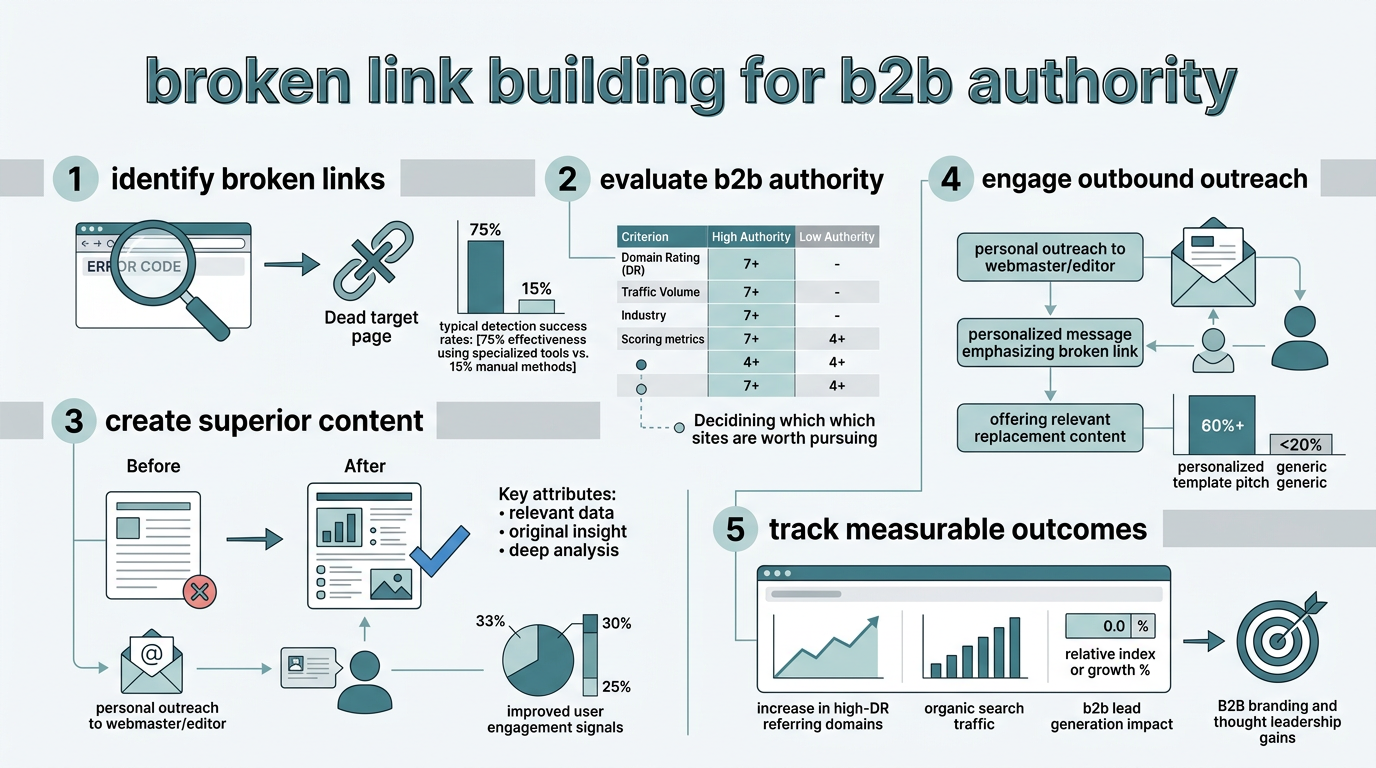
Broken link building is a white-hat SEO tactic where you identify broken external links (404 errors) on authority websites, create superior replacement content, then pitch webmasters to update their links. The psychology is straightforward: webmasters maintain link integrity as a matter of site health. A dead link provides zero value to their readers. By alerting them to the problem and offering a high-quality replacement, you solve their issue while earning a backlink.
"Broken link building sidesteps inbox fatigue because your pitch solves an immediate, specific problem—a broken link on their site. It's not 'Here's why you should link to my content.' It's 'Your resource page links to a dead site. Here's a better replacement.' This specificity translates to conversions that generic outreach simply cannot match."
For B2B specifically, this tactic is powerful because your target prospects—industry directories, trade associations, research hubs, and educational institutions—actively curate link lists. These sites exist partly as link resources. A webmaster at an industry directory isn't just interested in link quality; they're custodians of valuable curated content. A well-executed pitch that solves their maintenance problem gets traction.
Why Broken Link Building Beats Generic Cold Outreach
Cold outreach in 2026 is brutal. General cold outreach achieves only a 3.43% reply rate, down 60% from 2022. The reason? Inboxes are flooded with AI-generated pitches. Broken link building sidesteps this problem because your pitch solves an immediate, specific problem—a broken link on their site. It's not "Here's why you should link to my content." It's "Your resource page links to a dead site. Here's a better replacement."
This specificity translates to conversions. When replacement content is a perfect 1:1 match for the broken resource, campaigns achieve 20% success rates—10x the generic baseline. For B2B companies building topical authority, that's the difference between sustainable link growth and wasted effort.
The B2B Context: Why Authority Compounds Over Time
B2B buying journeys are long. Prospects research vendors 5–7 times before engagement, and research typically begins with an organic search. A B2B SEO lead has a 14.6% close rate, compared to 1.7% for outbound/traditional marketing leads. Link authority compounds this advantage. Each authority link signals to Google that your content is trusted by established players in your space. Over 6–12 months, this compounds into ranked positions on high-intent keywords that drive qualified pipeline.
"Each authority link signals to Google that your content is trusted by established players in your space. Over 6–12 months, this compounds into ranked positions on high-intent keywords that drive qualified pipeline. For B2B companies, this connection between link authority and qualified lead generation is direct and measurable."
Broken link building is particularly suited to B2B because:
- Long content lifecycle: B2B assets (guides, case studies, research reports) don't expire. A guide published 2 years ago can still earn broken link replacement links.
- Niche specificity: B2B niches have dense link curator communities. Association sites, industry forums, and research hubs actively link to authoritative resources.
- Lower competition per niche: While broad topics (e.g., "marketing automation") have 500+ companies competing, specific B2B niches (e.g., "construction CRM software") may have 5–10 active competitors doing link building. Your 1:1 content match stands out.
How to Find High-Quality Broken Link Opportunities
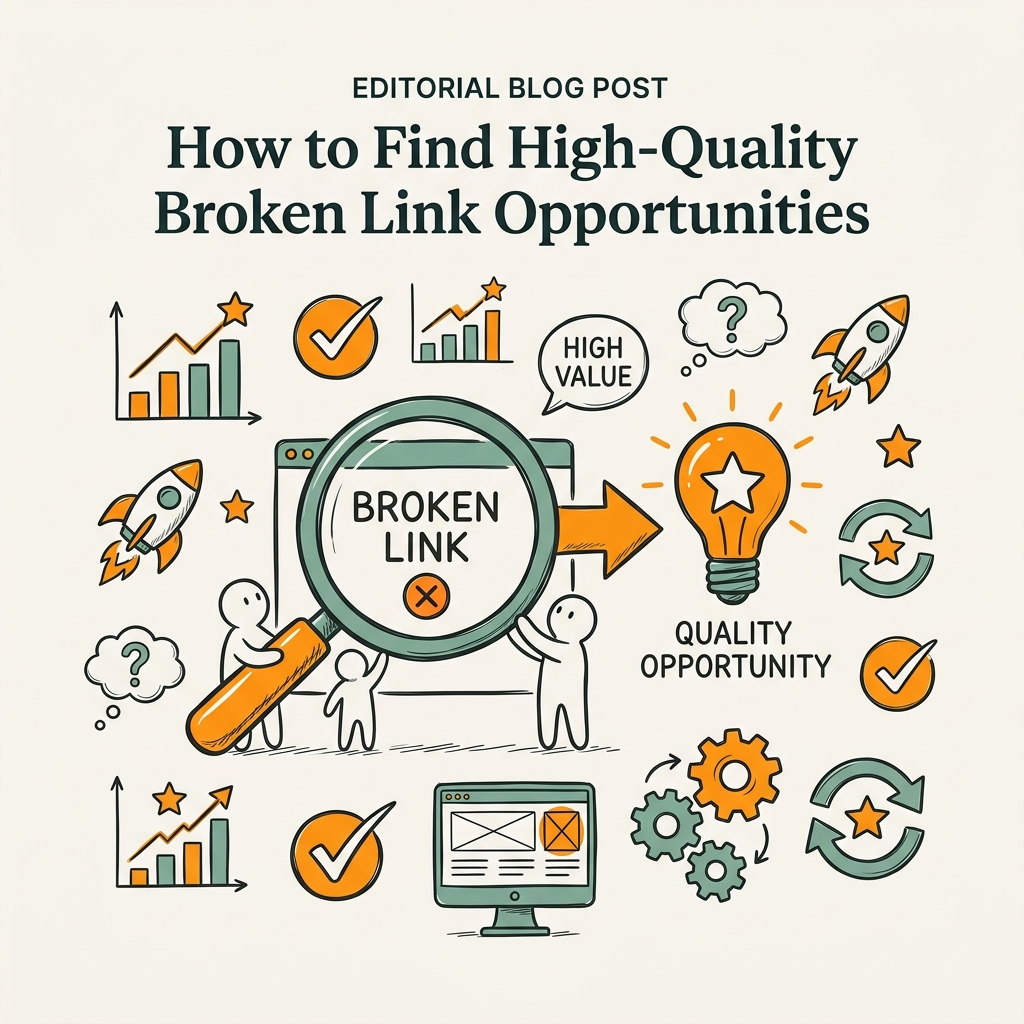
The quality of your broken link opportunities determines your conversion rate. Finding 100 mediocre targets is worse than finding 20 high-quality ones. Strategic teams invest time upfront to identify opportunities with high linking-domain authority, strong topical relevance, and webmaster responsiveness.
Identify Competitor Backlink Targets Using SEO Tools
Start by analyzing where your top 3–5 competitors earn links. Tools like Ahrefs, SEMrush, or Moz reveal the linking domains, anchor text, and Domain Rating (DR) of each link. The intelligence here is directional: if a DR 55 industry directory links to your competitor's guide on "SaaS sales methodology," that same directory likely links to other methodological content. That's a target prospect.
Filter by Domain Rating. Aim for DR 40–60 for most B2B niches. DR 20–40 links dilute your effort. DR 60+ sites are valuable but are typically gatekept and less responsive to cold outreach. DR 40–60 is the sweet spot: meaningful authority without the gate-keeping friction.
Search for Broken Links Within Topic Clusters
Use a broken link checker (Screaming Frog, BrokenLinkCheck) to crawl competitor sites and high-authority industry resources. Target resources like:
- Industry directories and resource libraries: "Best SaaS tools for [vertical]," "[Industry] resource hub," "[Niche] recommended reading."
- Association and trade websites: Many trade associations maintain resource pages that aggregate industry links. These pages are updated irregularly, creating broken link opportunities.
- Educational institutions and research centers: Universities and research hubs publish resource pages with external links. Faculty retirement, site migrations, and outdated content create broken links.
- Authoritative blogs and publications: Industry publications (e.g., Harvard Business Review, industry-specific publications) publish roundup articles with external links. Some links decay.
Vet for Relevance and Audience Alignment
A broken link on a high-DR domain is worthless if the audience doesn't match your buyer. Before outreach, ask: Does this linking domain's audience overlap with my ideal customer profile? A link from a construction industry directory is a win for a construction CRM. It's noise for a marketing automation tool.
Relevance filters apply at three levels: domain-level relevance (right industry), page-level relevance (right topic), and content-level relevance (right problem solved). If all three align, your 1:1 replacement content becomes compulsory for the webmaster. If only one aligns, you're a spray-and-pray pitch.
Create Superior Replacement Content That Webmasters Can't Ignore

This is where most campaigns fail. Teams find a broken link, then pitch existing content that tangentially relates. Wrong. Webmasters update links only when you offer measurably superior replacement. Your content must be better than what broke.
Understand What the Broken Resource Solved
Use the Wayback Machine to see what the broken page contained. What was its title, structure, and core claim? If it was "The 23 Best B2B Sales Methodologies," your replacement should be comprehensively better: "The 35 Best B2B Sales Methodologies for SaaS (2026)." More comprehensive, more recent, more useful. If the broken page was a case study, your replacement should be a deeper, more recent case study with additional metrics.
Create a one-to-one match on value and depth. A webmaster will update a link only if the replacement is demonstrably better, or if it's equally good but updated. "I found a guide on your site linking to [old broken page]. I published a newer, more comprehensive guide on the same topic. Would you consider updating the link?" This is compelling.
Build Linkable Assets: Research, Data, and Frameworks
For B2B authority, the best replacement content combines original research, data, and proprietary frameworks. Consider assets like:
- Original survey data: "We surveyed 500 B2B marketers on [topic]. Here are the results."
- Industry benchmarks: "Here's what SaaS sales teams in your vertical actually achieve on [metric]."
- Proprietary frameworks: "Our 5-step framework for [outcome]" backed by case studies and evidence.
- Comprehensive guides with primary research: 3,000+ word guides that cite original sources, not just regurgitated content.
Tools like AI-powered SEO agents can accelerate the research and drafting phase, allowing teams to produce 1:1 replacement assets faster. But the quality bar is non-negotiable: generic content won't move the needle.
Craft Outreach Pitches That Convert at 12–15%
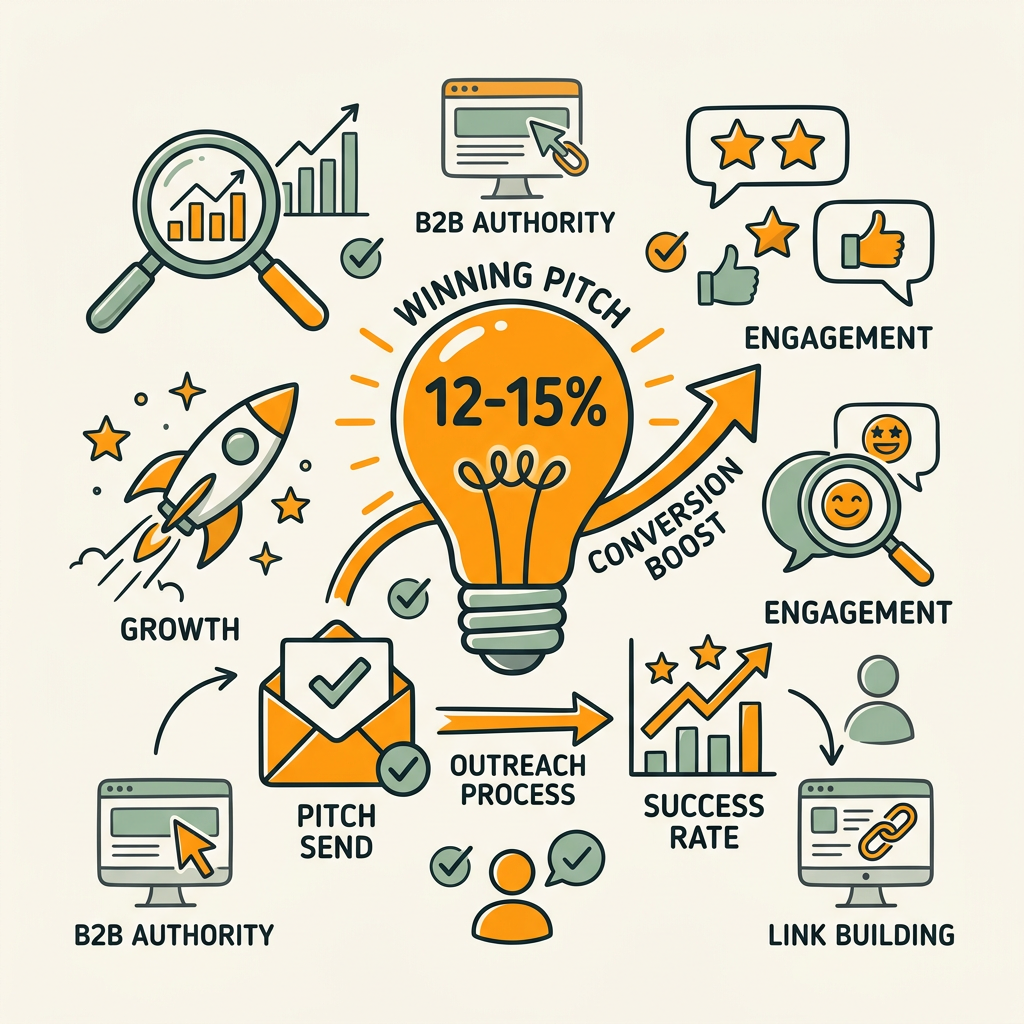
Personalization is now table stakes. The 3.43% reply rate for generic cold email has created an opportunity: hyper-personalized pitches stand out. AI-generated personalized outreach achieves a 4.19% response rate, a 61% lift over non-AI emails. But personalization has to be real, not automated spray-and-pray.
Structure the Perfect Broken Link Pitch
A high-converting broken link pitch follows this structure:
- Lead with the insight, not the ask: "I noticed your [resource type] on [topic] links to a page that's now returning a 404."
- Show you've researched the page: Reference specific content from the Wayback Machine. "It looks like it used to cover [specific claim]."
- Offer a direct replacement: "I published [asset name] on the same topic. It covers [specific improvements]."
- Keep it short: 75–100 words max. Respect their time.
- Include proof: Link to the asset with a brief descriptor. If it's a comprehensive guide with data, mention the data point count ("Data from 500+ respondents").
- Make the ask simple: "Would you be open to updating the link?" Don't demand or presume.
Avoid generic openings ("Hey, I hope this finds you well"). Avoid soft commitments ("I hope we can work together"). Lead with insight. Make the replacement obvious. Respect their decision.
Implement Follow-Up Sequences
Most successful campaigns require 4–6 weeks from initial outreach to backlink placement. First reply rates peak at day 3–5. If no response by day 7, a single, concise follow-up lifts response rates by 20–30%. A second follow-up (day 21) captures procrastinators. Anything beyond three touches reads as harassment.
Follow-up content should be brief and add new information. Second email: "Quick follow-up on [asset]. We've added [new data/update] that might be relevant." Third email: "Last check-in: [asset] is live and updated. Link in case it's useful for [resource page]."
Position Your Authority Links as Part of a Larger Content Strategy
Broken link building is highest-leverage when embedded in a larger content strategy. If you're publishing one article per month, broken link building will yield 2–3 links per quarter. If you're publishing 15 high-quality articles per month, you'll identify 30–50 broken link opportunities per month and secure 8–12 links per quarter.
Scale Content Production Without Compromising Quality
The limiting factor for most B2B teams is content production velocity. Broken link building requires a steady stream of high-quality replacement assets. This is where many teams hit a wall. They can create 4–6 quality pieces per month, but identify 30+ broken link opportunities. The supply-demand gap means missed opportunities.
Teams solving this bottleneck adopt SEO automation platforms that handle keyword research, content drafting, and publishing. This allows in-house teams to systematically create replacement assets for broken link campaigns while maintaining the publishing frequency required to rank on authority keywords.
The math is straightforward: if you produce 3 quality articles per week and achieve an 8% conversion rate on broken link outreach, you'll secure 1–2 new authority links per week. Over 12 months, that's 50–100 new high-quality backlinks, compounding into measurable domain authority gains.
Build Internal Linking Networks Alongside Authority Links
External links from authority sites compound when paired with strategic internal linking. Each new authority link is an opportunity to link back to related content on your site. A link from a high-authority directory to your "SaaS Sales Methodologies" guide should trigger internal links from that guide to related assets: your sales methodology framework, your sales team case studies, your pricing strategy guide.
This internal linking strategy amplifies the SEO value of each external link. Google's crawlers follow the internal link network to discover related content. Topically related content gains ranking benefit from a single external authority link.
Track Conversions, Attribution, and ROI
Most teams never measure broken link building ROI because the attribution is indirect. A link takes 4–12 weeks to move ranking positions. Rankings take 8–16 weeks to drive meaningful organic traffic. Traffic takes 6–12 months to convert into qualified leads. The cause-and-effect chain is long, which is why many teams abandon the tactic prematurely.
| Metric | Broken Link Building | Digital PR | Guest Posting |
|---|---|---|---|
| Average DR of Links | 45–55 | 55–70 | 30–45 |
| Conversion Rate | 8–15% | 12–25% | 3–8% |
| Time per Link | 3–5 hours | 8–20 hours | 2–4 hours |
| Cost per Link | $150–$350 | $400–$1000 | $100–$250 |
| Sustainability | High (repeatable) | Medium (requires news hooks) | Medium (declining authority perception) |
Measure Link Value, Not Just Link Count
A single high-DR link (DR 50+) from an authority site is worth 5–10 links from low-authority sites. Don't optimize for volume; optimize for link quality. Track:
- Domain Rating of acquired links: Aim for 70% of links from DR 40+ domains.
- Organic traffic uplift: Use Google Analytics 4 to track the content that received the backlink. Over 12 weeks, a high-quality link should drive 10–50 organic sessions per month to that asset.
- Ranking improvements: Use SEMrush or Ahrefs to track ranking movements for primary keywords in the replaced content.
- Cost per link: At 3–5 hours per acquired link, your internal cost is $150–$350 per link (depending on team labor rates). Compare that to the $508.95 average willingness-to-pay for a quality link in the current market.
Benchmark Against Competing Tactics
Broken link building is most valuable when competing against digital PR, guest posting, and general content marketing. Digital PR is the #1 tactic by consensus (48.6% of SEOs rate it as most effective), but it requires newsworthy hooks and media relationships. Guest posting is lower-barrier but declining in authority perception. Broken link building sits in the middle: more accessible than PR, more authoritative than guest posting, and more sustainable than cold outreach.
For B2B teams with mature content strategies and strong topic authority, broken link building returns 5–8% consistently. For teams just starting, invest in foundational content first. For teams with 50+ quality assets, broken link building is a 2–3 link per week tactic if executed systematically.
Conclusion
Broken link building is not a shortcut to B2B authority. It's a precision tactic that yields 20% success rates when content replacement is a perfect 1:1 match, compared to 1–2% for generic cold outreach. The B2B context makes it particularly valuable: industry-specific directories, trade associations, and research hubs are actively curated, and webmasters maintain these resources as link custodians. A well-executed pitch that solves their maintenance problem gets traction.
Success requires three non-negotiables: finding high-quality opportunities (DR 40–60, topically relevant), creating superior replacement content that demonstrably outperforms what broke, and implementing personalized, research-backed outreach sequences. Expect 3–5 hours per acquired link and a 4–6 week timeline from outreach to placement. Scale the tactic by increasing your content production velocity. A team publishing 3+ quality articles per week can systematically identify 30+ broken link opportunities and secure 8–12 new authority links quarterly.
Start now: Start your SEO agent to automate the research, content creation, and linking workflows that broken link building requires. Build the content supply chain first. Then systematically convert broken link opportunities into authority links.
FAQs
What is broken link building and does it actually work in 2026?
Broken link building is a white-hat SEO tactic where you find broken external links (404 errors) on authority websites, create superior replacement content, then pitch webmasters to update their links. It absolutely works in 2026, but success rates vary dramatically. Generic cold outreach yields 1–2% conversion, while campaigns with perfect 1:1 content replacement achieve 20% success rates. The difference is execution: teams that find 20–30 high-quality prospects with relevant broken links, create demonstrably better content, and send hyper-personalized pitches see consistent results. Teams that spray-and-pray with generic content across 100 targets waste time. For B2B specifically, the tactic is powerful because industry directories, trade associations, and research hubs are active link curators who maintain broken link lists and respond to personalized replacement pitches.
How much time does it take to acquire one backlink through broken link building?
Expect 3–5 hours of work per acquired backlink. This breaks down across five stages: finding high-quality broken link opportunities (1 hour per 10 prospects), vetting for relevance and linking domain authority (30 minutes per prospect), creating or adapting replacement content (1–2 hours depending on whether the content already exists), crafting personalized outreach (15–30 minutes per pitch), and managing follow-up sequences over 4–6 weeks (30 minutes per campaign). The time investment is front-loaded: outreach and follow-up combined is only 1–2 hours. The bulk of time goes into finding qualified prospects and ensuring your replacement content is genuinely superior. If your success rate is below 5%, analyze whether your prospect vetting is weak or your content quality isn't compelling enough. The 3–5 hour benchmark assumes 8% conversion. At 2% conversion, the cost-per-link becomes prohibitive and you should reallocate effort.
Should I focus on broken link building or digital PR for authority links?
Prioritize digital PR first if you have newsworthy research or data. Digital PR is rated the #1 link-building tactic by 48.6% of SEOs because it generates earned media attention and high-authority mentions. However, digital PR requires newsworthy hooks and media relationships, which take time to build. Broken link building is more accessible for teams without PR experience or media connections, and it's more sustainable long-term because it leverages existing link equity. The ideal strategy is running both in parallel: invest in digital PR for flagship research assets and newsworthy launches, while systematically converting broken link opportunities into authority links from industry-specific directories and trade associations. For most B2B teams with 20–50 quality assets, broken link building yields 2–3 new links per week once execution is systematized. Digital PR is higher-leverage per link (often DR 60+) but takes longer to produce results.