Building a Data-Driven AI Content Strategy
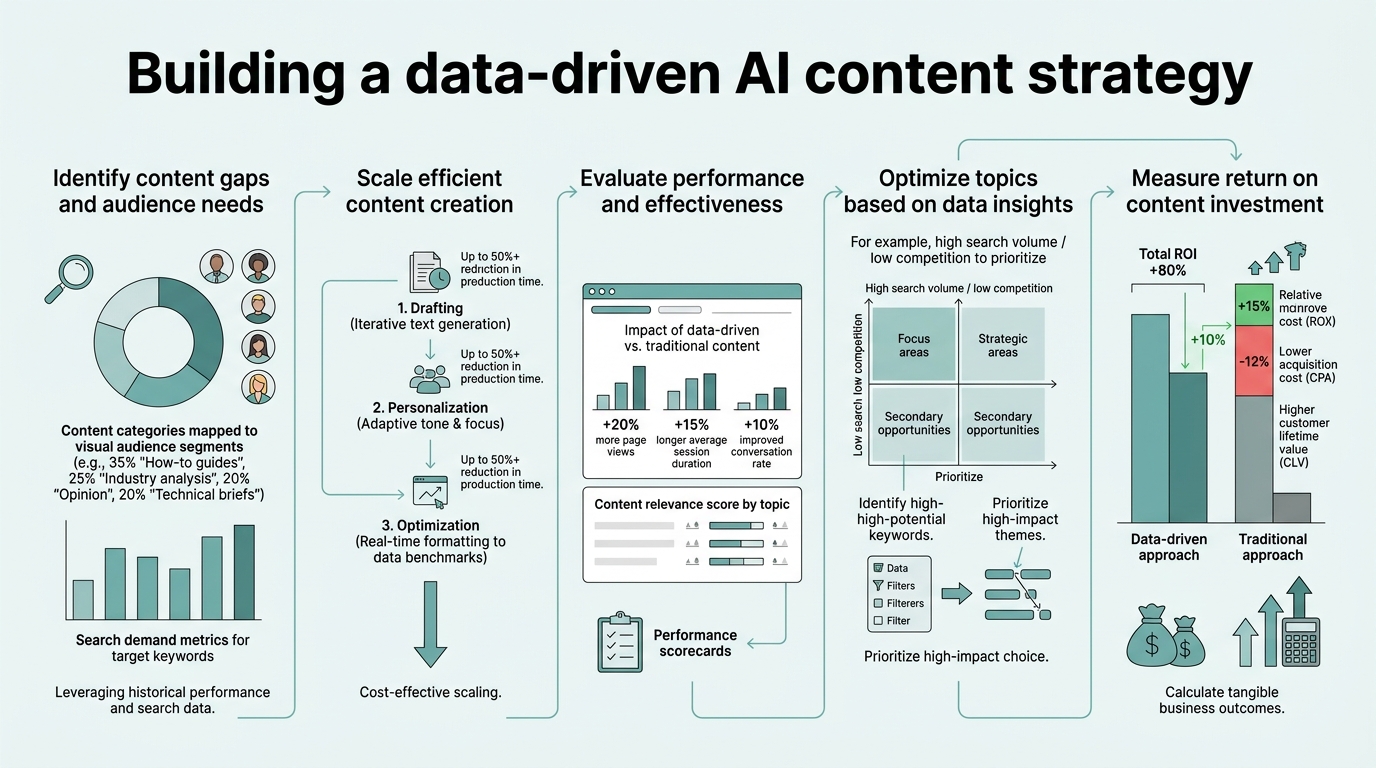
88% of marketers are using AI tools for content creation in 2026, yet only 25% report meaningful results. The difference? Strategy. Most teams treat AI as a writing tool instead of a system for compounding organic traffic. A data-driven AI content strategy transforms how you research, create, and publish—replacing scattered tools with a coherent framework that connects every piece to business outcomes. Here's how to build one that actually delivers.
Key Takeaways
- 88% of marketers use AI for content creation, but only 25% see meaningful results (Averi, 2026)—the gap is strategic alignment, not tooling.
- AI-optimized content ranks in Google's top 10 2.6x more frequently and generates 42% more organic backlinks (Semrush, 2026).
- Organizations that track AI-specific KPIs achieve 2.4x better content ROI than those that don't (Digital Applied, 2026).
- Hybrid human-AI content generates 5.44x more traffic than purely automated output (Averi, 2026).
- Define Your AI Success Metrics: Only 19% of content teams track AI-specific KPIs—this measurement gap costs organizations millions in unrealized ROI.
- Align Content to Business Outcomes: Data-driven strategy links every piece of content to conversion goals, ensuring AI scales output that matters.
- Optimize for AEO, Not Just SEO: AI systems like ChatGPT now cite content differently than Google—clarity, schema, and factual rigor matter more than keyword placement.
- Hybrid Your AI Workflow: Let AI handle 60% of the work (research, drafting, structure), but reserve 40% for human refinement of tone, depth, and brand voice.
- Automate Publication and Internal Linking: Manual publishing and link building waste hours daily—orchestrated systems connect content to multiply traffic compounding effects.
How Does a Data-Driven Content Strategy Differ From Intuition-Based Approaches?
Intuition-based content strategies rely on educated guesses about what readers want. Data-driven strategies measure what they actually need and whether it converts. The shift is dramatic: organizations with documented, measurement-focused strategies generate 3x more leads per dollar spent than those relying on instinct (Digital Applied, 2026). AI accelerates this advantage by enabling real-time feedback loops—you publish, measure, refine, and republish within hours instead of weeks.
"Data-driven teams ask what their audience will search for and whether it moves them toward purchase. The first creates content. The second builds engines."
The core difference is accountability. A data-driven approach answers three questions before writing anything:
- What does the search intent data say? Are users looking for definitions, comparisons, or how-to guides?
- Which content gaps exist in your niche? What are competitors ranking for that you're missing?
- What metrics define success? CTR, conversion rate, time-on-page, or backlink growth?
Intuitive teams ask, "What should we write about?" Data-driven teams ask, "What will our audience search for, and will it move them toward purchase?" The first creates content. The second builds engines.
What Does a Data-Driven AI Content Strategy Framework Look Like?
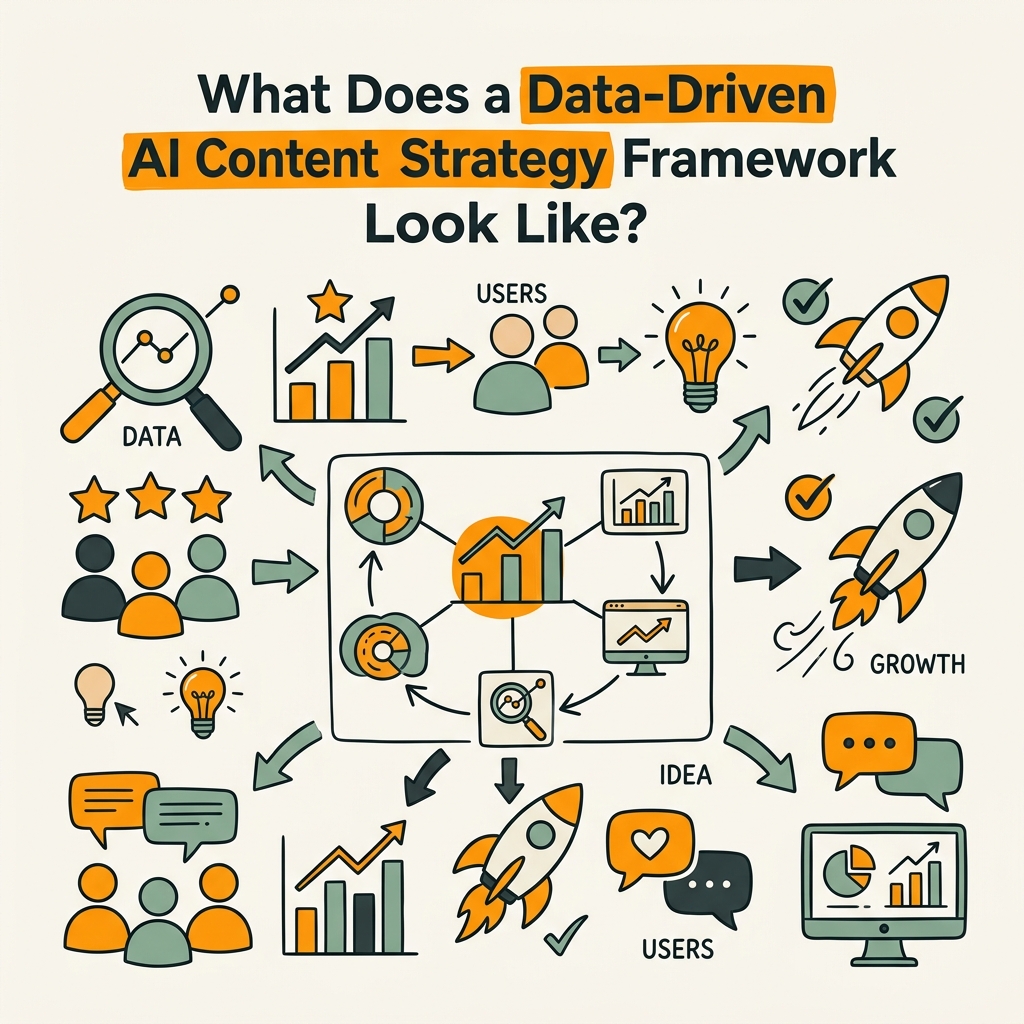
The framework has five interlocking components: research, planning, creation, optimization, and measurement. Each step feeds data back into the previous one, creating compounding improvements. Tools like autonomous SEO agents orchestrate this entire pipeline—from keyword analysis to internal linking to CMS publication—eliminating manual bottlenecks that slow most teams down.
Research: Keyword and Audience Intelligence
Data-driven research starts with quantified intent. You need to know not just what keywords exist, but their search volume, difficulty, and commercial intent. This tells you whether a topic is worth writing about. A keyword with 100 monthly searches and 10 difficulty is a fast win. A keyword with 50,000 monthly searches and 85 difficulty requires an authority position you don't yet have.
Beyond keywords, you need audience data: What pain points do they describe in forums and Reddit? What competing solutions do they compare? What questions follow their first search? Digital Applied reports that 67% of content teams now use AI daily, and the difference between high-performing teams and others is their use of "People Also Ask" data and Q&A forums to uncover secondary topics that expand ranking reach.
Planning: Topic Clusters and Content Mapping
Once you've identified keywords and intent, organize them into topic clusters. A cluster has a pillar (the broad topic) and satellites (specific variations). For example, "AI content strategy" is the pillar, and "AI content strategy for SaaS," "building a data-driven AI content strategy," and "AI content strategy tools" are satellites.
"The best practice is to map each cluster's internal link network before writing—this ensures every piece of content supports others, multiplying the traffic flow across the domain."
The data you need here is internal linking architecture. Which existing content can support new pieces? Where are your content gaps? Planning your link structure in advance multiplies organic reach and consolidates topical authority.
- Pillar Topic: Broad, authoritative piece (3,000+ words) that answers the core question.
- Satellite Topics: Specific variations (1,500–2,500 words) linked back to the pillar for topical authority.
- Internal Link Anchors: Pre-planned to reinforce keyword relevance and distribute page authority.
Creation: AI-Assisted Hybrid Writing
Here's where most teams go wrong: they hand off content creation entirely to AI. The data says hybrid content (AI-drafted, human-refined) generates 5.44x more traffic than fully automated pieces (Averi, 2026). The breakdown is roughly 60% AI, 40% human. AI handles research aggregation, structural outlining, fact-gathering, and first-draft prose. Humans refine tone, verify claims, add nuance, and ensure brand voice consistency.
This partnership is faster than either alone: AI-assisted teams publish content 3.7x faster (1.4 hours vs. 6.2 hours per piece) than traditional teams, and the quality metrics are stronger. AI-optimized content scores 31% higher on readability and ranks in the top 10 2.6x more frequently (Semrush, 2026).
Optimization: AEO vs. SEO
The search landscape shifted in 2026. AI overviews, ChatGPT, and Perplexity now intercept traditional organic queries. Traditional organic traffic dropped 15–64% for most domains, but the remaining traffic converts at 4.4x the rate of old traffic (Averi, 2026). This requires a new optimization framework called AEO (AI Experience Optimization).
AEO prioritizes clarity over keyword stuffing. AI models extract and cite content based on factual precision and structural clarity. Use:
- Schema Markup: Structured data helps AI systems understand and extract your content for citations.
- Clear Headings and Bullet Points: Models prefer content broken into logical chunks over dense paragraphs.
- Factual Accuracy: AI systems penalize contradictions and cite sources that are verifiable.
- Frequent Updates: Fresh content signals authority; older content loses citation priority.
Measurement: AI-Specific KPIs
Here's the metric gap: only 19% of content marketers track AI-specific KPIs, yet organizations that do see 2.4x better ROI (Digital Applied, 2026). You can't improve what you don't measure. Define these metrics for every piece:
- Click-Through Rate (CTR): AI-optimized content outperforms traditional by 38% (Nielsen & Persado, 2026).
- Conversion Rate: Measure how many visitors from each piece became leads or customers—a 29% uplift is typical with AI optimization (Nielsen & Persado, 2026).
- Time to Publish: Track production speed; AI should cut it from hours to under two hours.
- Organic Backlink Growth: Quality content earns links; AI-assisted pieces generate 42% more backlinks (Semrush, 2026).
- Ranking Velocity: How fast does content rank? Top 10 ranking frequency should improve measurably.
Set a baseline for each metric before launching AI-driven content. Track weekly. Adjust strategy monthly based on what's working. This feedback loop is what separates content factories from content engines.
How Should You Structure Your AI Content Workflow?
Workflow structure determines whether your AI investment scales or becomes a bottleneck. Most teams start with fragmented tools: keyword research here, writing there, publishing elsewhere. Data flows in silos, and nobody sees the full picture. An integrated workflow consolidates these functions so data moves seamlessly from research to publication to measurement.
The Four-Stage Pipeline
Stage 1: Research and Planning – Automated keyword research, competitor gap analysis, and topic mapping. AI identifies clusters and high-intent keywords. Tools pull data from search volume, difficulty, and intent signals. Output: prioritized topic list with internal linking architecture.
Stage 2: Brief and Outline – AI generates content briefs including target keywords, outline structure, search intent analysis, and fact sources. This takes 30 minutes instead of 4 hours. A human reviews and adjusts for brand voice and strategic priorities. Output: approved outline ready for writing.
Stage 3: Writing and Editing – AI generates the full first draft (2,000–3,000 words) in under 10 minutes. It cites sources, includes data, and structures for readability. A human editor refines tone, verifies facts, adds examples, and ensures brand consistency. This stage compresses from 6 hours to under 90 minutes. Output: final publishable draft.
Stage 4: Publication and Linking – Content publishes directly to your CMS with optimized metadata (title tags, meta descriptions, H1). Internal links are inserted automatically based on pre-planned architecture. Tracking codes are applied. This eliminates manual publication errors and ensures consistent internal linking across your domain. Output: live, linked, and tracked content.
Where Manual Handoffs Break Efficiency
Most teams lose speed at handoff points. Research sits in spreadsheets. Briefs are emailed around. Drafts wait in Google Docs. Publication is manual. Linking is an afterthought. Each handoff introduces a 12–24 hour delay. A tool like Jottler orchestrates all four stages automatically—researching, writing, and publishing 3,000+ word articles daily without requiring human oversight for routine pieces. Strategic pieces still get human review, but repetitive work flows unobstructed.
What Metrics Should You Track to Prove Content ROI?
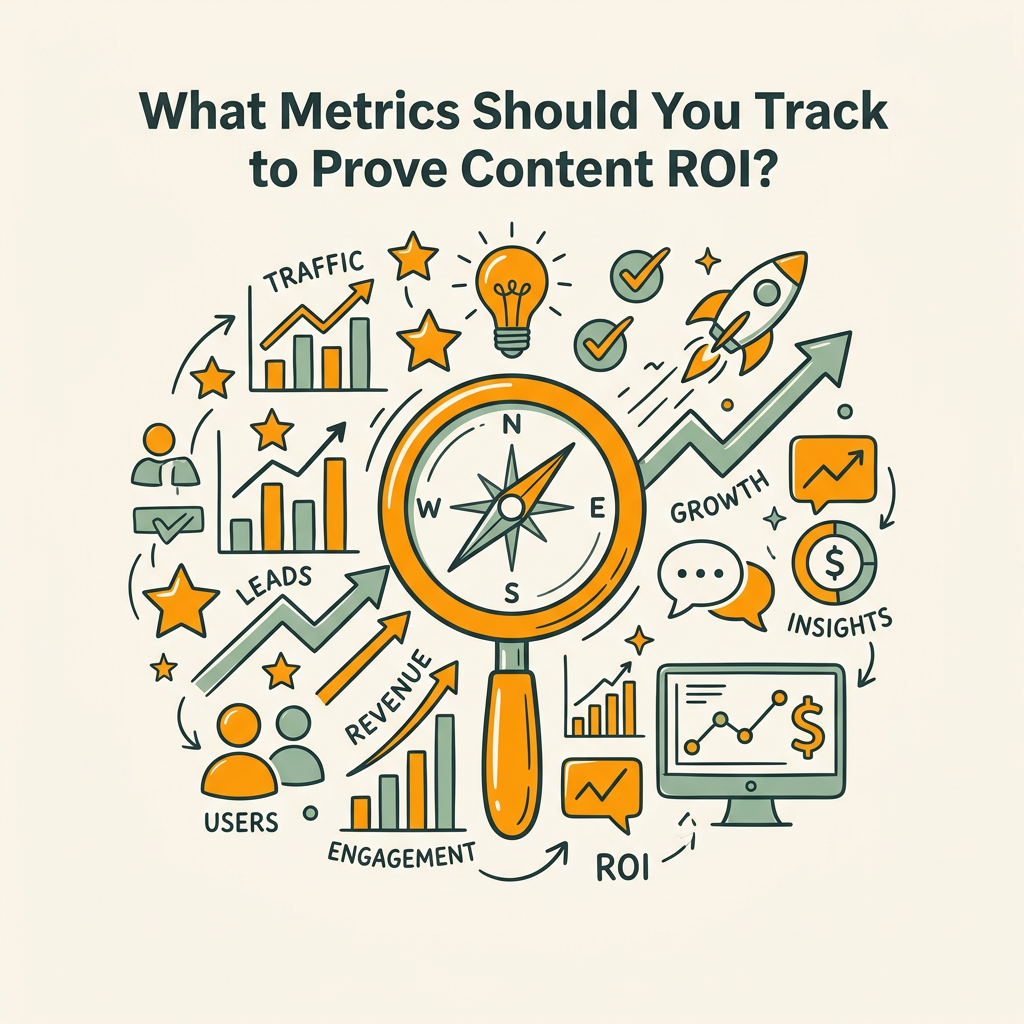
Content ROI is misunderstood. Most teams track volume: "We published 30 articles this month." That's output, not outcome. True ROI connects content to revenue. This requires tracking a specific set of metrics that show how content moves leads through your funnel.
Top-of-Funnel Metrics: Awareness and Traffic
These measure whether your content reaches your target audience:
- Organic Sessions: Raw traffic from organic search. Set a baseline and track month-over-month growth. AI-driven teams typically see 40–80% growth in year one.
- Ranking Positions: Track how many keywords you rank for in positions 1–10. This is your competitive moat. AI optimization should improve this by 20–30% annually.
- Click-Through Rate from SERPs: Not all top-10 rankings drive clicks; CTR depends on title, description, and snippet formatting. AI typically improves CTR by 38%.
Mid-Funnel Metrics: Engagement and Conversion
These show whether content persuades readers to engage deeper:
- Average Session Duration: Longer engagement signals valuable content. Aim for 2+ minutes per session; 5+ minutes indicates content your audience genuinely values.
- Pages Per Session: Do readers navigate from your content to other parts of your site? This shows internal linking effectiveness.
- Lead Conversion Rate: What percentage of visitors become leads? Track this per content piece. Content that converts at 3%+ is pulling heavy load.
Bottom-Funnel Metrics: Revenue Attribution
This is where most content teams fall short. You need to connect content reads to actual sales:
- Sales Influenced by Content: Use UTM parameters and CRM integration to track how many deals were influenced by organic content. Many teams find 30–40% of closed deals touched organic content at some point.
- Content ROI: Divide revenue influenced by content by the cost to produce it. If you spent $10,000 on content and it influenced $100,000 in deals, your ROI is 10:1. Content marketing typically delivers 3–5x better ROI than outbound—and AI makes it faster to achieve.
- Cost Per Lead (CPL) from Content: Track the all-in cost to acquire a lead through organic content (research time, writing, editing, publishing). Compare this to your CAC from paid channels. Content leads are typically 50–70% cheaper.
The teams seeing the biggest payoff are those that obsess over these metrics. Organizations that track AI-specific KPIs achieve 2.4x better content ROI than those that don't. You can't manage what you don't measure.
How Should You Balance AI Automation With Human Oversight?
The temptation is to fully automate content creation: let AI write everything and publish directly. The data warns against it. Hybrid models—where AI handles 60% and humans 40%—generate 5.44x more traffic than fully automated content (Averi, 2026). The human 40% is critical. It's not about volume; it's about depth and authenticity.
"One human editor working with AI output can oversee the equivalent of three traditional writers' output. That's where the 3x-to-5x ROI multiplier comes from."
Where Human Judgment Matters Most
Strategy and voice. AI can't decide which topics matter for your business or maintain authentic brand voice across 100+ pieces. Humans must:
- Approve Topic Selection: AI identifies keywords, but humans decide which rank on your strategic roadmap. A topic might be high-volume but off-brand or misaligned with your market position.
- Verify Fact Claims: AI generates accurate content 85–90% of the time, but that 10–15% error rate is unacceptable. A human spot-checks key claims, sources, and statistics.
- Refine Tone and Depth: Generic content underperforms. A human adds examples, storytelling, and industry nuance that AI can approximate but not authentically create.
- Make Linking Decisions: AI can suggest internal links, but a human ensures they're contextually relevant and support navigation intent.
Where You Can Safely Automate
The 60% of work AI should own:
- Research and Fact-Gathering: AI aggregates 10+ sources faster than humans. Humans verify the synthesis.
- Structural Outlining: AI creates hierarchical outlines that guide the writing flow. Humans adjust for brand fit.
- First-Draft Writing: AI writes the initial prose, including examples and explanations. Humans edit and refine.
- Metadata and Tagging: AI generates title tags, meta descriptions, and H1s. Humans validate and adjust if needed.
- Routine Publishing: Once final content is approved, publication and linking happen automatically through your CMS.
This division of labor is what makes data-driven AI content strategy work. You're not replacing writers; you're multiplying them. One human editor working with AI output can oversee the equivalent of three traditional writers' output. That's where the 3x-to-5x ROI multiplier comes from.
What Common Mistakes Derail Data-Driven AI Strategies?
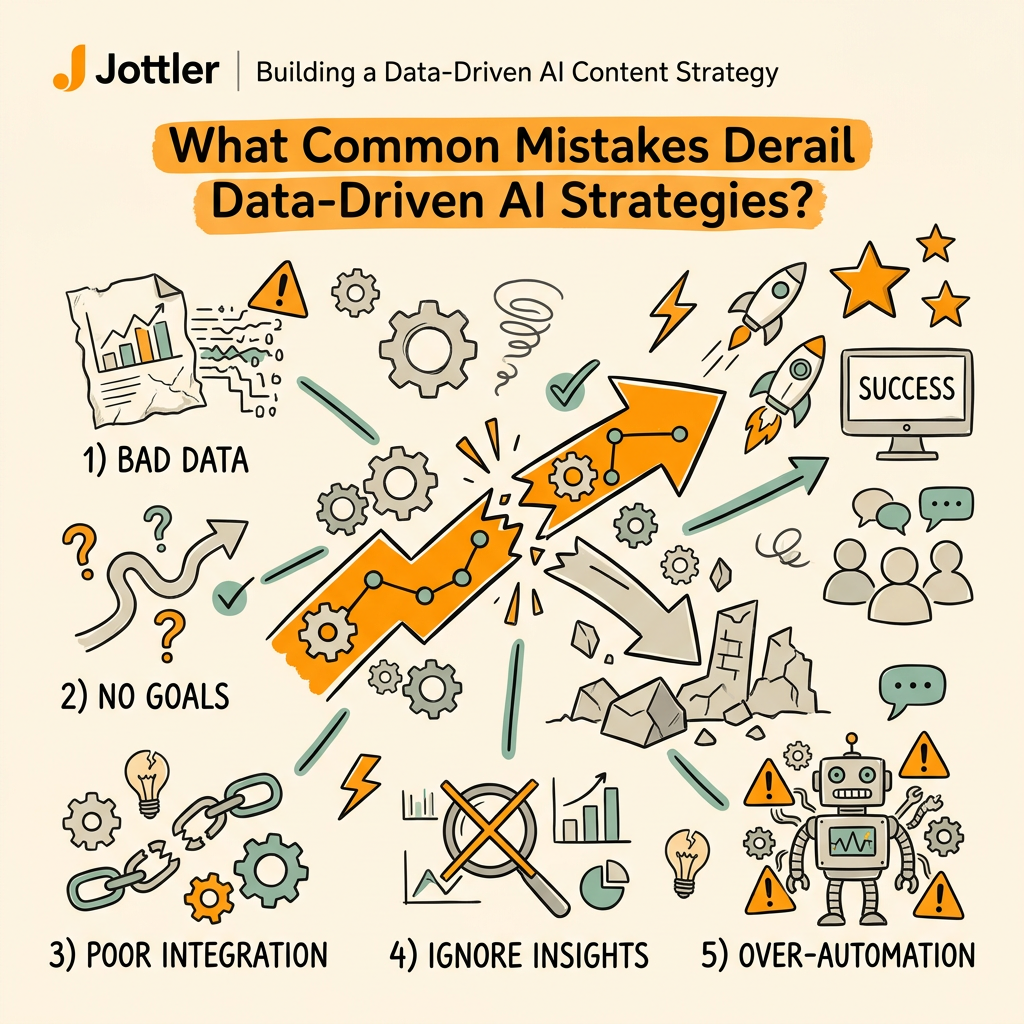
The most costly mistakes are avoidable. Most teams know better but skip steps because they feel slow.
Skipping the Research Phase
Teams jump directly to writing based on assumed topics. "Our industry needs a guide on X." Assumption, not data. The result: content nobody searches for. Spend two weeks on research. Quantify intent. Identify gaps. The two weeks save six months of wasted output.
Measuring Volume Instead of Outcome
Publishing 50 articles a month sounds impressive. If three of them drive leads, it's a failure. You're measuring effort, not impact. Measure conversion, traffic growth per piece, and revenue attribution. Volume should be a secondary metric, not the primary one.
Publishing Without Internal Linking Strategy
Each piece stands alone instead of supporting others. You've built 100 articles, not a network. Internal links consolidate page authority, improve ranking for competitive keywords, and compound traffic growth. Without linking strategy, you're leaving 40–60% of your organic potential on the table.
Not Updating Content Regularly
You published an article in 2024. It ranks. You move on. Six months later, a competitor updates their version with newer data. Their ranking passes yours. AI makes updates fast and cheap. Refresh top-performing content quarterly. Add new data. Update examples. This keeps your content the freshest source in results.
How Do You Build This Into a Scalable System?
A data-driven strategy is only valuable if it scales. You can't manually orchestrate this for 100+ articles per year. You need systems. That means: structured processes, defined roles, and tools that automate the routine work so humans focus on strategy and quality control.
Define Roles and Responsibilities
Avoid unclear ownership. Define who is responsible for each stage:
- Content Strategist: Owns research, topic prioritization, and KPI tracking. Decides what gets written and why.
- AI Content Manager: Runs the content generation workflow, manages briefs, monitors AI output for errors, and guides publication.
- Editor/Brand Owner: Reviews drafts, verifies claims, refines tone, ensures brand consistency. Approves for publication.
- Publisher/Operations: Handles CMS publication, internal linking, metadata, and tracking setup.
One person can hold two roles in smaller teams, but the responsibilities must be clear.
Automate the Repetitive Work
Manual tasks that repeat should be automated. Examples:
- Keyword research and gap analysis (use AI keyword tools)
- Outline generation and fact-sourcing (AI agents)
- First-draft writing (AI content generators)
- CMS publication and metadata insertion (automation APIs)
- Internal linking based on pre-planned architecture (automation or CMS plugins)
- Tracking setup (UTM parameters, GA4 events)
Tools like SEO automation platforms orchestrate this entire pipeline, handling research through publication. The human role shifts from execution to strategy and quality review. One strategist can now oversee content production that used to require three.
Track System Performance, Not Just Content Performance
Build a dashboard that shows:
- Content published this month (volume)
- Average time-to-publish (speed)
- Average article ranking position (quality)
- Organic traffic from new content vs. total organic (growth)
- Leads and revenue influenced by organic content (outcome)
- Cost per piece published (efficiency)
This dashboard is your feedback loop. If time-to-publish is increasing, your workflow has a bottleneck. If ranking positions aren't improving, your AI output quality or keyword selection needs adjustment. If leads aren't growing, your content isn't resonating with your market.
Comparison: Data-Driven vs. Intuition-Based Content Approaches
| Metric | Data-Driven Strategy | Intuition-Based Strategy |
|---|---|---|
| Lead Generation | 3x more leads per dollar spent | Baseline (1x) |
| Time to Publish | 1.4 hours per piece (with AI) | 6.2 hours per piece |
| Top 10 Ranking Frequency | 2.6x more frequent | Baseline |
| Organic Backlinks | 42% more backlinks | Baseline |
| Content ROI | 2.4x better (with KPI tracking) | Unmeasured |
| Traffic from Hybrid Content | 5.44x more traffic | Baseline (fully human) |
| KPI Tracking | 19% adoption (leading edge) | Minimal measurement |
Conclusion
Building a data-driven AI content strategy is not about publishing more articles faster. It's about building a system that converts audience awareness into revenue, compounding your organic advantage year after year. The data is clear: organizations with documented content strategies generate 3x more leads per dollar spent, and AI-optimized content ranks 2.6x more frequently in the top 10, while organizations tracking AI-specific KPIs achieve 2.4x better ROI (Digital Applied, Semrush, 2026).
The competitive advantage belongs to teams that systematize their content: they research with data, plan with architecture, create with AI-human hybrids, optimize for AI discoverability, and measure with ruthless precision. Every piece of content feeds the next, compounding traffic and revenue growth.
If you're managing content manually or publishing without a measurement framework, you're leaving 60–80% of your potential on the table. Start your SEO agent and let AI handle the execution while you own the strategy. The ROI multiplier happens fast once your system is running.
FAQs
How much faster can AI produce content than human writers?
AI-assisted teams publish content in approximately 1.4 hours per piece, compared to 6.2 hours for traditional teams—a 3.7x speed increase (HubSpot, 2026). This doesn't mean 1.4 hours of pure AI writing. It accounts for research, drafting, editing, and publication combined. A human editor still invests 30–45 minutes per piece for quality control, but the AI handles the heavy lifting of research aggregation, structural outlining, and first-draft prose.
What percentage of content should be written by AI versus humans?
The optimal split is 60% AI and 40% human for maximum ROI (Averi, 2026). AI should own research, sourcing, structural drafting, and metadata generation. Humans should own strategy decisions, fact verification, tone refinement, and brand voice consistency. This hybrid approach generates 5.44x more traffic than fully automated content. Fully human-written content is slower but can still outperform if strategy is strong; fully automated content is fast but typically underperforms due to tone, authenticity, and strategic misalignment.
How do you measure whether a data-driven AI content strategy is working?
Track these core metrics: organic sessions, ranking positions for target keywords, click-through rate from SERPs, average session duration, lead conversion rate per piece, and revenue influenced by organic content. Organizations that track AI-specific KPIs achieve 2.4x better ROI than those that only measure volume (Digital Applied, 2026). Set baseline metrics before launching AI-driven content, track weekly performance, and adjust strategy monthly. If organic traffic isn't growing, either your keywords aren't aligned with market demand or your content quality needs improvement. If leads aren't converting from organic, your messaging may not resonate with your target buyer.