Building Evergreen Content for Sustainable SEO
Most marketing teams chase seasonal spikes. They publish campaign-specific content, then watch traffic plummet when the moment passes. The cost of this approach compounds: new content dies after weeks, forcing teams to constantly recreate what they've already built. Yet there's a better way. Evergreen content generates 3.5x more traffic six months after publication compared to time-sensitive pieces. When designed properly, evergreen content becomes a self-sustaining traffic engine that compounds over months and years, requiring minimal maintenance after the initial investment.
Key Takeaways
- Evergreen content generates 3.5x more traffic six months post-publication than news-based content (OwlClaw, 2025), making it the backbone of sustainable SEO
- Mobile users represent 63% of global traffic in 2026, requiring evergreen content optimized for speed and responsiveness across devices (DataReportal, 2026)
- Strategic content clusters with internal linking boost topical authority while reducing the effort required to launch new pages with immediate rankings
- Defining Evergreen Content: Timeless, answerable topics that remain relevant across years with minimal updates, naturally accumulating backlinks and search traffic.
- Core Architecture Strategy: Organize content into hub-and-spoke clusters where pillar pages anchor topic authority and supporting content builds semantic depth.
- Maintenance & Freshness: Update high-performing pages every 12-18 months with fresh data, new insights, and optimized internal linking to pass equity to newer assets.
- Automation at Scale: Tools like Jottler enable teams to produce consistent, research-backed evergreen content without manual bottlenecks, compounding traffic gains exponentially.
- Quality Over Volume: Focus on information gain and search intent alignment rather than keyword density; Google rewards depth, and users reward utility.
What Makes Content Truly Evergreen?
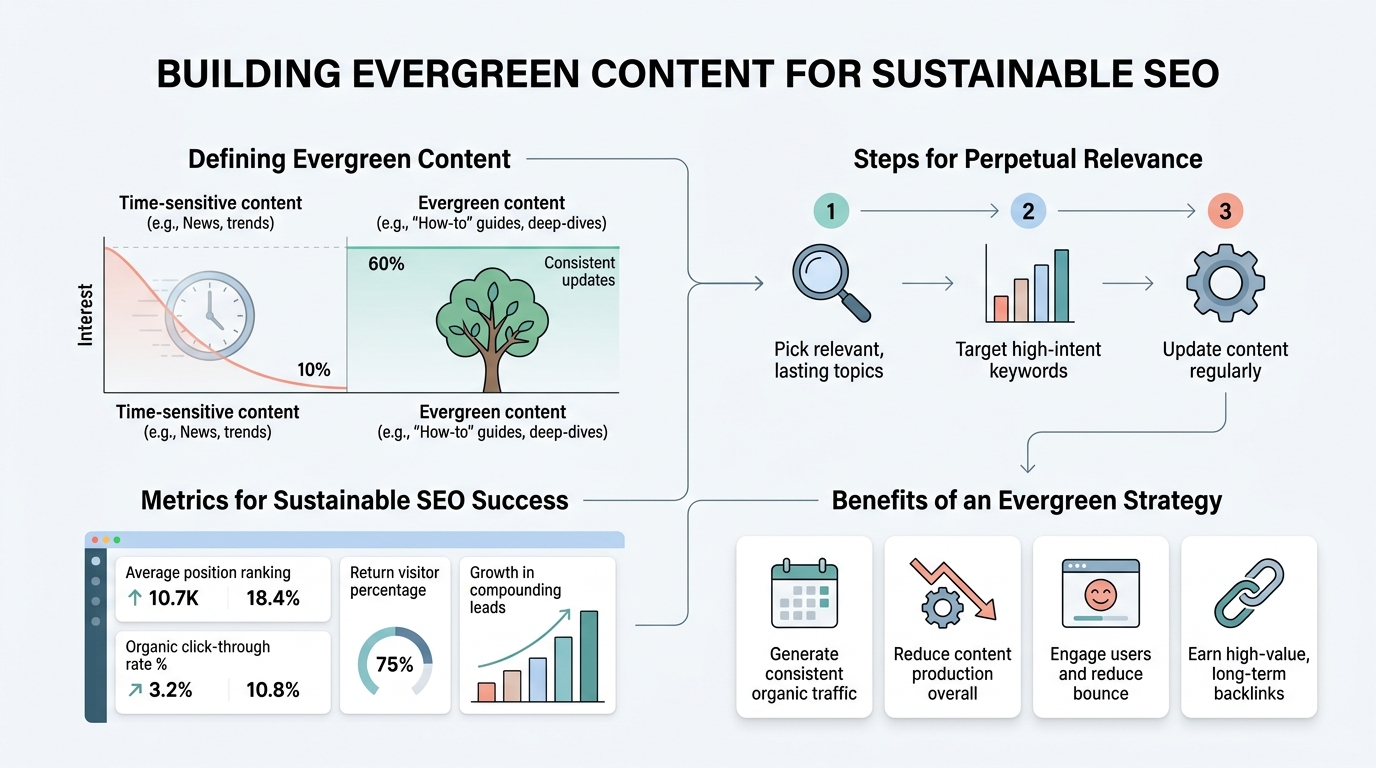
Evergreen content is search-optimized material that remains valuable and relevant regardless of when it's read. Unlike seasonal or news-driven content, which loses relevance after a specific date or event, evergreen pieces answer fundamental questions your audience asks year-round. The distinction matters because evergreen content compounds: it accumulates backlinks, improves topical authority, and drives traffic incrementally over time.
The Core Characteristics of Evergreen Topics
True evergreen content must answer timeless questions with minimal updates required. A post titled "How to Write Effective Meta Descriptions" will stay relevant for years because the fundamentals don't shift. By contrast, "Best Social Media Trends for 2025" expires within months. The difference is semantic permanence.
Evergreen topics share five critical traits. First, they address recurring user intent: people ask the same questions repeatedly across years. Second, they're grounded in fundamental concepts rather than current events. Third, they require only data updates, not conceptual overhauls. Fourth, they maintain consistent search volume across seasons, indicating sustained demand. Fifth, they naturally attract links from newer content citing them as foundational references.
A how-to guide, tutorial, framework explanation, or comparison checklist typically qualifies as evergreen if it solves a problem people have every day. "Best CRM Software for Small Businesses" works because businesses launch continuously. "Top Holiday Gifts 2025" doesn't—the moment passes.
"Evergreen content follows a different arc. It starts slower, but after 6-12 months, momentum compounds. Backlinks accumulate. Topical authority signals strengthen. Organic clicks grow month-over-month without additional promotion."
Evergreen vs. News and Seasonal Content
The traffic difference between content types reveals why evergreen dominance matters for sustainable SEO. News content spikes sharply on publication day, then drops off a cliff as fresh news replaces it. Seasonal content rises around specific events—Black Friday, tax season, holiday prep—then flatlines.
Evergreen content follows a different arc. It starts slower: initial traffic builds gradually as Google indexes, ranks, and users discover it through search. But after 6-12 months, momentum compounds. Backlinks accumulate. Topical authority signals strengthen. Organic clicks grow month-over-month without additional promotion. A single evergreen piece can deliver thousands of cumulative visits over three years with minimal maintenance—whereas a seasonal post delivers the same traffic in three months, then nothing.
For busy founders and marketing teams, this asymmetry changes the economics of content marketing. One well-built evergreen post replaces ten short-lived campaign pieces in lifetime value delivery.
The Business Case: Why Evergreen Content Pays
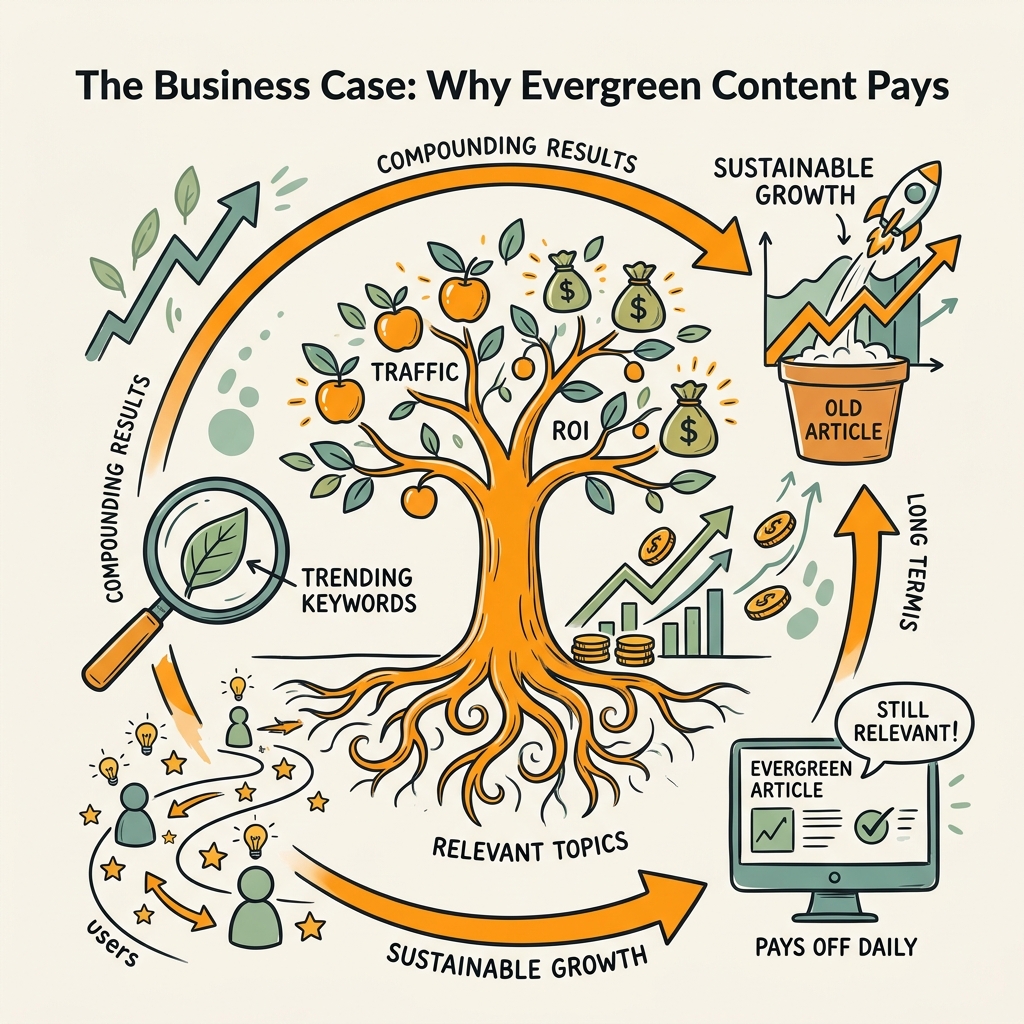
Building evergreen content requires upfront investment, but the ROI math is compelling. B2C organizations see approximately 2% conversion rates on guide pages (Search Engine Land, 2025). That means 1,000 visitors to a comprehensive guide generate roughly 20 conversions. Over a year, a single evergreen asset driving 5,000 visitors delivers 100 conversions—the lifetime value of which far exceeds the initial writing cost.
Traffic Compounding and Long-Term ROI
The sustainable part of "sustainable SEO" is measurable. Evergreen content delivers 3.5x more traffic six months after publication compared to time-sensitive content (OwlClaw, 2025). This multiple grows. A piece ranking for a high-intent keyword after a year can drive 500+ monthly organic visits indefinitely. At $50-100 per customer acquisition cost, that single asset returns hundreds of dollars monthly without additional spend.
The effort-to-reward ratio improves dramatically over time with minimal maintenance required after creation. A $2,000 freelance investment in a comprehensive 3,000-word guide, properly optimized and internally linked, can generate $10,000+ in attributed revenue over three years while your team focuses on new initiatives. Scale this to a library of 50-100 evergreen pieces, and you've built a passive traffic engine that compounds regardless of monthly campaign spend.
"A sustainable content strategy targets 8-12 core evergreen topics, each with 3-5 supporting subtopic posts, rather than 100 one-off articles. The difference is compounding authority and consistent traffic growth."
Backlinks and Topical Authority
Google's ranking systems value two signals above most others: domain authority and topical relevance. Evergreen content is a backlink magnet. When you publish a definitive guide on "SEO for E-commerce" or "How to Build a B2B Sales Funnel," other writers cite it. Newer content links to it. Industry news outlets reference your framework. These links compound over time.
Additionally, a cluster of interconnected evergreen content signals topical mastery. If you have 10 comprehensive guides covering different aspects of your core topic, Google recognizes your site as an authoritative reference. This signals the algorithm to rank your content higher for related queries, even before competing content launches.
How to Identify High-Value Evergreen Topics
Not every content idea qualifies as evergreen. Identifying the right topics requires understanding your audience, analyzing search behavior, and validating demand before investing writing effort.
Research Your Audience's Core Problems
Start by listing the fundamental questions your ideal customer repeatedly asks. These are almost always evergreen. If you sell project management software, founders ask: "How do I organize a remote team?" and "What's the difference between Agile and Waterfall?" constantly. These questions have stable demand.
Talk to your sales team. What objections recur in conversations? What setup challenges do new customers face? These pain points translate directly to evergreen content ideas. Document patterns across 20-30 customer conversations, and you'll have a list of topics that guarantee audience interest.
Validate Search Volume and Keyword Stability
Use keyword research tools to confirm your intuition. Tools like SE Ranking identify popular search terms with stable search volume, a hallmark of evergreen demand. Look for keywords with consistent monthly search volume across seasons. If search volume for a keyword fluctuates 300% between seasons, it's not reliably evergreen.
Prioritize keywords with:
- Consistent monthly volume: 500+ searches per month with minimal seasonal variance
- Informational or commercial intent: People are researching solutions or learning fundamentals, not chasing news
- Moderate competition: Winnable KD scores (under 50) where authoritative, comprehensive content ranks without massive backlink budgets
- Breadth potential: Topics you can expand into multiple related subtopics, enabling cluster strategy
A sustainable content strategy targets 8-12 core evergreen topics, each with 3-5 supporting subtopic posts, rather than 100 one-off articles.
Content Architecture: Building the Hub-and-Spoke Model
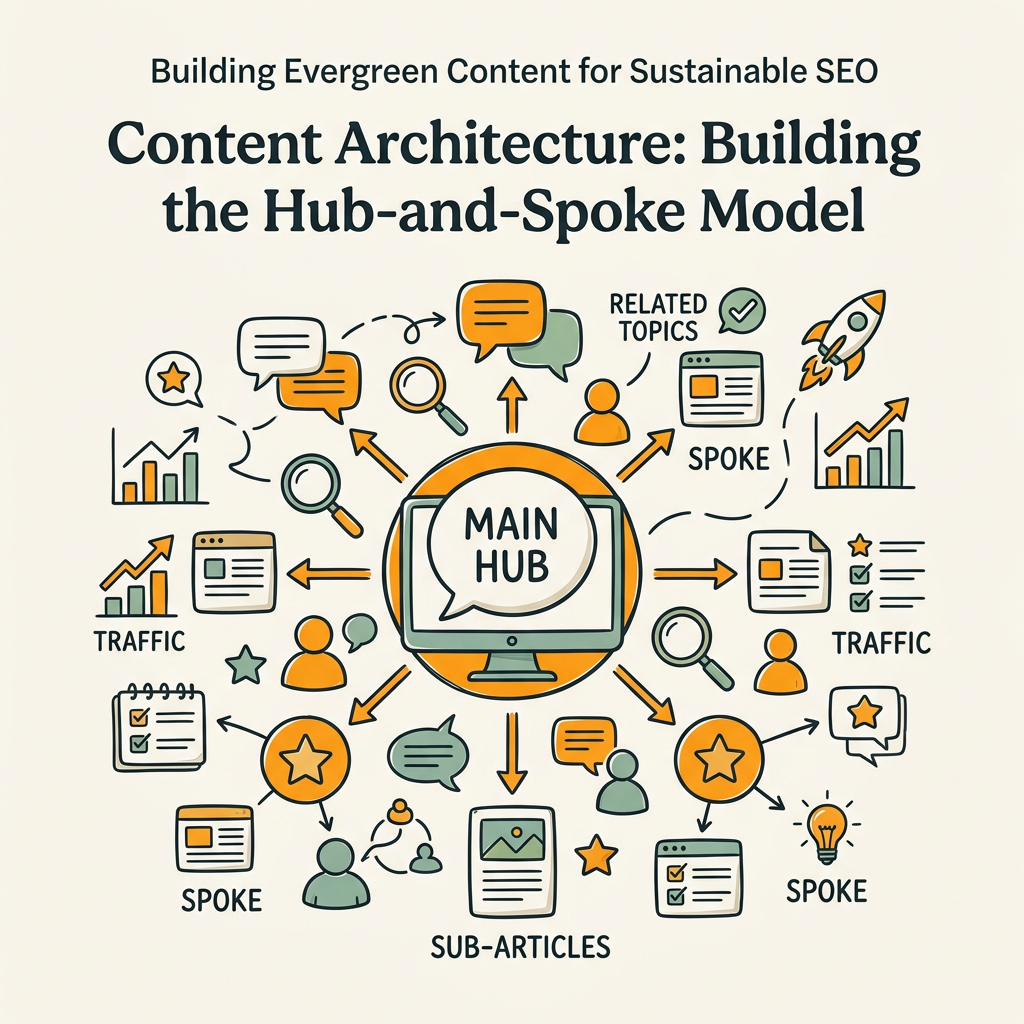
Evergreen content shouldn't exist in isolation. The highest-performing sustainable SEO strategies organize content into topic clusters—a hub-and-spoke structure where one pillar page anchors authority and supporting pieces build semantic depth.
Pillar Pages: The Authority Anchors
A pillar page is a comprehensive, 3,000-5,000 word guide covering a broad topic with strategic depth. It's not designed to rank for the most competitive keyword, but rather to become the definitive internal reference for a topic cluster. Pillar pages anchor topical relevance, signaling to search engines that your site is a niche expert.
Example pillar pages include: "The Complete Guide to Content Marketing," "B2B Lead Generation: A Comprehensive Framework," or "SEO Fundamentals for Software Companies." These cover the topic broadly, reference all subtopics, and link internally to supporting content.
Each pillar page should deliver real value independently. Don't skimp on depth or research. Readers should finish the pillar and feel they've solved their core problem, with supporting pieces offering specialized depth on particular angles.
Supporting Content: Semantic Subtopics
Supporting pages address specific questions nested within the broader topic. If your pillar is "Content Marketing for SaaS," supporting pieces might cover "How to Write Product Comparison Content," "Building a Content Calendar for B2B Teams," or "Measuring Content Marketing ROI."
Each supporting page should be 1,500-2,500 words, fully answering a narrower question while linking back to the pillar and to related supporting content. This internal linking architecture serves two purposes: it helps readers navigate related content (improving time-on-site and reducing bounce), and it concentrates link equity around pillar pages, boosting their authority.
The Internal Linking Blueprint
Internal linking is the connective tissue of evergreen content strategy. Without it, individual pieces rank in isolation. With it, they compound. Each supporting page should link to:
- The pillar page once, early in the article, when context warrants it
- 2-3 related supporting pages where semantic relevance exists
- Newer articles from supporting pages, passing accumulated equity forward and speeding up ranking for new content
This isn't a manual process once content reaches scale. Platforms like Jottler automate internal linking strategies, analyzing your entire content library and intelligently connecting related pieces without manual overhead. For teams publishing 5+ articles monthly, this automation becomes critical to maintain topical cohesion.
Production at Scale: Sustainable Content Velocity
Identifying the right topics and architecting the right structure is strategically sound. But execution separates leaders from laggards. Producing high-quality, research-backed evergreen content consistently is where most teams fail. Manual workflows can't scale; the time investment per piece is too high.
The Bottleneck: Time and Resources
A proper evergreen piece requires 15-20 hours of work: topic research, keyword analysis, competitor assessment, outline creation, deep research across 10+ sources, writing, fact-checking, editing, and publishing. For a team of three, that's one article per person per week. Scale to weekly publication frequency, and you need to hire full-time writers—an option that's expensive and difficult to iterate on.
Additionally, keyword research and competitive analysis repeat for every piece. Without automation, every article starts from zero: manual competitor review, manual keyword research, manual source gathering. The compounding inefficiency is staggering.
The Automation Alternative
Solutions like Jottler eliminate these bottlenecks entirely. Instead of hiring writers or burning internal time, you connect your CMS and define target topics. Jottler's AI agents handle keyword research, competitive analysis, deep research from 14+ sources, outline generation, writing, fact-checking, and publishing—automatically generating 3,000+ word evergreen articles daily.
For busy founders and marketing teams, this changes the equation. Rather than a constraint, content production becomes a dial you adjust: 1 article daily, 3, or 5—all at consistent quality levels. Scale compound. A team publishing 60-150 evergreen articles monthly across a year accumulates a library of 720-1,800 pieces. The traffic and authority gains are exponential.
| Approach | Time per Article | Monthly Cost | Articles/Month | Scalability |
|---|---|---|---|---|
| Freelance Writers (In-house Team) | 15-20 hours | $8,000-12,000 | 4-8 | Limited (hiring friction) |
| Hybrid (In-house + Agency) | 8-12 hours | $5,000-8,000 | 8-15 | Moderate (coordination overhead) |
| AI Content Tools (Jottler) | 0.5 hours (review only) | $29-299 | 30-150+ | Unlimited (dial adjustment) |
The difference is transformational. A founder at a $2M ARR company who spends $500/month on Jottler can publish 60-90 evergreen articles monthly for years while competitors are still manually producing 5-10 pieces per month. By year two, the first team has 700+ evergreen assets compounding traffic. The second has 60-120. The winner isn't determined by strategy; it's determined by execution velocity and consistency.
Keeping Evergreen Content Fresh and Competitive
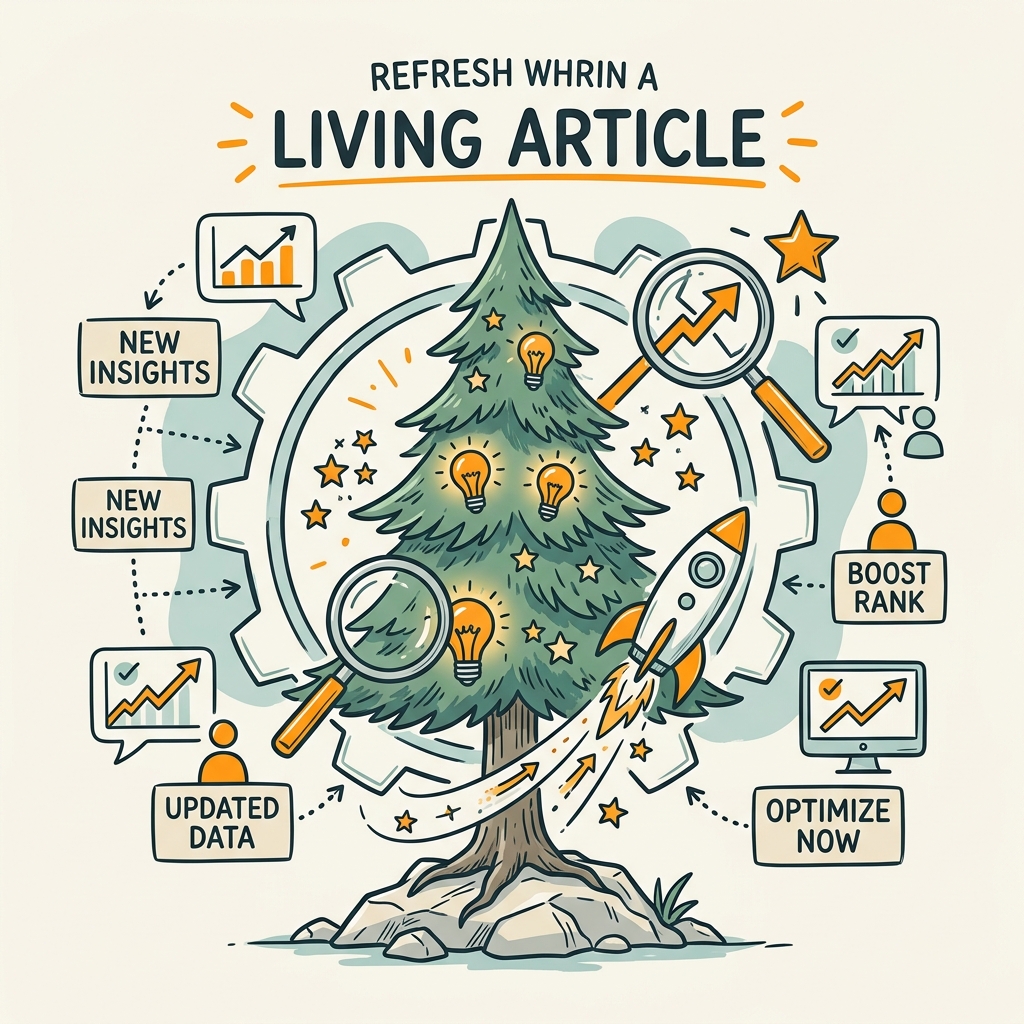
Evergreen doesn't mean "set and forget." Content degrades when its data becomes stale or competitors publish superior alternatives. Maintenance is the second lever of sustainable SEO.
The Update Cadence
High-performing evergreen pieces should be refreshed every 12-18 months. This isn't a full rewrite; it's surgical updating. Add new statistics. Refresh examples. Include emerging frameworks the market has validated. Optimize for new keyword opportunities. Update publishing dates so Google recognizes freshness.
Prioritize updates for pages experiencing declining traffic or ranking in positions 6-15 for your highest-value keywords. A piece that's driving 500 monthly visits and declining might jump to 1,000+ visits after a quality refresh and competitive repositioning.
Strategic Freshness and Internal Equity Redistribution
When you refresh an evergreen piece, update internal links to pass equity to your newest content. If you published five new supporting articles since the last update, add links to them where relevant. This accelerates ranking for new pieces while reinforcing topical clusters.
Additionally, Google's AI Overviews and generative AI search results typically cite sources published or updated within six months. If your evergreen content isn't refreshed regularly, it becomes invisible to AI-driven search. Maintenance directly impacts AI discoverability.
Measuring Evergreen Content Performance
You can't optimize what you don't measure. Evergreen content requires a measurement framework distinct from campaign-driven metrics.
The Right Metrics
Focus on three metrics that correlate with sustainable value:
- Organic traffic (rolling 3-month average): A single month can be noisy; rolling averages reveal true trend direction. Growing 3-month averages indicate momentum.
- Assisted conversions and microconversions: Most evergreen content doesn't drive direct conversions. Instead, track assisted conversions (pages visited before conversion) and microconversions (newsletter signups, downloads, demos scheduled). These lead indicators predict future revenue.
- Backlink growth: Use tools to track new links pointing to your evergreen assets. Growing backlink counts validate topical authority and predict future ranking improvements.
Avoid vanity metrics like impressions or Page 2 rankings. Instead, calculate ROI by content type. Factor in Customer Lifetime Value (CLV) rather than just initial purchase value for more accurate ROI representation, which surfaces true business impact of evergreen assets that drive long-term customer relationships.
The Role of AI in Evergreen Content Production
AI has fundamentally changed the viability of evergreen content strategy for small and mid-market teams. 92% of marketers already rely on measures that consider both traditional and AI-supported search engines (HubSpot, 2026). For those not leveraging AI, competitive disadvantage is real.
AI Agents as Research and Writing Infrastructure
Modern AI content platforms don't just write passively. They research actively. They validate claims against multiple sources. They identify information gaps. They apply SEO best practices systematically. This eliminates the most time-consuming parts of content creation.
For evergreen content specifically, AI shines because the topics are stable and research-able. Unlike breaking news or speculative content, evergreen topics have established frameworks, proven methodologies, and comprehensive source material. AI agents can synthesize this across dozens of sources faster and more comprehensively than human researchers.
"Modern AI content platforms eliminate the most time-consuming parts of content creation: research validation, information gap identification, and systematic SEO optimization. For evergreen topics with established frameworks, AI agents synthesize information across dozens of sources faster than human researchers."
Quality Control and Fact-Checking
The concern with AI-generated content is accuracy. The solution is fact-checking integration. Jottler's approach combines AI writing with automated fact-verification against verified sources, ensuring every claim is backed by real data. This is non-negotiable for evergreen content that will rank for years; a single incorrect statistic damages credibility and violates Google's Helpful Content guidelines.
For busy teams, this AI-driven accuracy is a force multiplier. You get the speed of automation with the rigor of human verification.
Common Evergreen Content Mistakes to Avoid
Even well-intentioned strategies fail when teams make preventable mistakes. Here are the most common:
Building on Untested Topics
Teams write beautiful, comprehensive content on topics nobody searches for. The fix is simple: validate demand before investing 15+ hours in research and writing. A 30-minute keyword research phase prevents 15 hours of wasted work.
Forgetting the Architecture
Individual evergreen articles rank better when clustered. Standalone pieces underperform. Organize your evergreen strategy as a library with pillar pages, supporting pieces, and internal linking, not as a collection of disconnected posts.
Neglecting Maintenance
Evergreen doesn't mean "never update." A piece ranking #8 for your target keyword might jump to #4 with a refreshed intro, new statistics, and updated examples. Treat top-performing evergreen content like a product: invest in regular improvements.
Chasing AI Trends Over Sustainability
The pressure to embrace new platforms and tools is constant. But evergreen strategy requires discipline. Those who use AI only for automated texts quickly become interchangeable (Leadership in SEO, 2026). The teams winning sustainable SEO are combining AI tooling with strategic thinking, topical authority focus, and consistent execution. The tool doesn't matter; the discipline does.
Conclusion
Building evergreen content is the antidote to the churn of campaign-driven marketing. While competitors spend resources launching seasonal content that expires, you're compounding. A library of 720-1,800 evergreen pieces published over a year generates 3.5x more traffic than time-sensitive alternatives, with minimal maintenance required after creation. The economics are clear: one evergreen asset returning $10,000 over three years outperforms ten campaign pieces returning $500 each.
The barrier to entry has never been lower. Tools compress content production from weeks to days, enabling even tiny teams to publish at scale. The only remaining variable is discipline: Will you commit to evergreen strategy for 12+ months, or will you revert to campaign chasing when monthly metrics disappoint? Sustainable SEO rewards patience and consistency. Start building your evergreen library today.
Start your SEO agent and let AI handle the production bottleneck while your team focuses on strategy.
FAQs
Is evergreen content good for SEO?
Yes. Evergreen content is foundational to sustainable SEO. It generates 3.5x more traffic six months after publication compared to time-sensitive content, compounds over years without ongoing investment, and naturally attracts backlinks as other writers cite it as a reference. The key advantage is consistency: while campaign content delivers traffic spikes followed by drops, evergreen pieces deliver steady, growing traffic across months and years. This consistent signal strengthens your domain's topical authority, which improves rankings across your entire site. For teams committed to long-term organic growth, evergreen content is non-negotiable.
How often should I update evergreen content?
Review and refresh high-potential articles every 12-18 months. Updates don't require complete rewrites; surgical refreshes work best. Add new statistics, update publication dates, include emerging frameworks, and optimize for new keyword opportunities your market has validated. Prioritize pieces experiencing declining traffic or ranking in positions 6-15 for high-value keywords. A quality refresh often jumps underperforming evergreen content from position 8 to position 3, significantly increasing traffic. Additionally, keep an eye on competitor content; if a competitor publishes superior content on your topic, competitive refreshes become urgent.
How can I produce evergreen content consistently without burning out?
Automation is the only scalable solution. Manual content production limits most teams to 4-15 pieces monthly. Automation platforms eliminate the bottleneck by handling keyword research, competitive analysis, multi-source research, writing, fact-checking, and publishing automatically—reducing production time from 15-20 hours to under 30 minutes per piece for review only. This enables consistent, high-quality publication without hiring expensive writers or burning internal resources. The result is sustainable velocity: 30-150+ evergreen articles monthly, each researched and fact-checked systematically, all feeding your topical authority and organic traffic compounding.