
Building Relationships With Industry Publications
The challenge is stark: only 8% of PR pitches result in actual media coverage, and the average journalist response rate sits at just 3.43%. For founders and marketing teams operating with limited bandwidth, these odds feel insurmountable. The real problem isn't your story—it's that journalists are drowning in low-quality, irrelevant pitches. The fix is relationship-first media relations: a strategic framework that treats journalists as partners, not broadcast channels. Here's a quick summary of how to build lasting, mutually beneficial connections with industry publications that generate consistent coverage and amplify your brand authority.
Key Takeaways
- Only 8% of PR pitches convert to coverage because most are mass-blasted without personalization. Quality over volume wins (2026, Prlab).
- The top challenge for agencies and in-house teams is a shrinking pool of journalists willing to build relationships. Targeted outreach to 5–10 credible publications beats spray-and-pray.
- Trade media coverage now directly influences AI search visibility and other journalists' coverage decisions. Build relationships with niche publications first.
- Understand Journalist Preferences: Journalists want short, newsworthy pitches with clear proof points, delivered at optimal times and through their preferred channels.
- Choose Quality Publications Over Volume: Focus on 5–10 credible trade and industry outlets where your audience actually reads, rather than chasing broad media coverage.
- Build Authority as a Source: Become the expert journalists turn to by offering timely insights, data, and credible information before you ask for coverage.
- Lead With Proof, Not Promises: Include customer stories, statistics, ready-to-use assets, and unique angles that make journalists' jobs easier and stories stronger.
- Maintain Long-Term Relationships: Respect deadlines, acknowledge journalists on their work, and keep value-adding insights flowing between pitches.
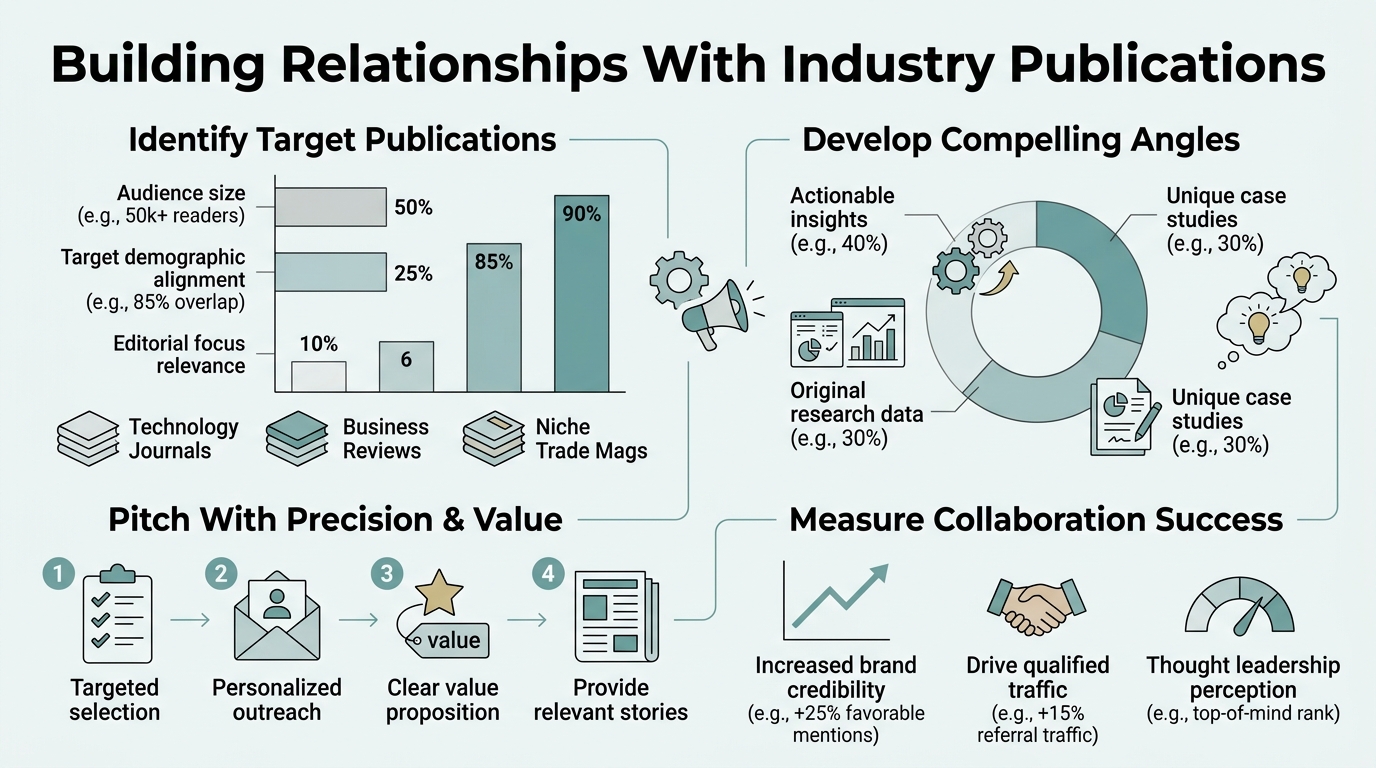
Why Journalist Relationships Are Critical for B2B Brands
Media relations is no longer a numbers game. With 44% of PR agencies reporting a shrinking pool of journalists willing to build relationships, the traditional spray-and-pray outreach strategy is dead. Journalists now receive hundreds of pitches per week and have just seconds to decide whether your email deserves their attention. The winning strategy is building genuine, mutually valuable relationships with a small set of journalists at publications your audience actually reads.
"The real cost of poor media relations isn't just a missed story—it's a burnt bridge that makes future pitches harder to land."
The Real Cost of Poor Media Relations
When you pitch indiscriminately, two things happen. First, you waste time on irrelevant outlets and get ignored. Second, you train journalists to dismiss your future pitches. Every poorly targeted email damages your credibility with that reporter. By the time you send a genuinely newsworthy pitch, the journalist has already mentally marked you as "spray-and-pray noise." The cost isn't just a missed story—it's a burnt bridge.
For busy founders and marketing teams, this inefficiency compounds. You spend hours researching outlets and crafting pitches, only to get a 3% response rate. Meanwhile, competitors who've built relationships with three or four key journalists at industry publications are landing consistent coverage without the heavy lift.
How Trade Media Now Shapes All Coverage Decisions
A critical shift is happening in 2026: trade and industry publications now influence both human journalists and AI search systems. When your company appears in a credible trade publication, three things happen simultaneously. First, other journalists in your vertical see the coverage and recognize you as a legitimate story source. Second, LLMs and answer engines cite trade-media sources heavily when building answers and comparisons. Third, your audience—other industry professionals—discovers you through the publication they already trust. This makes trade media your highest-leverage relationship investment.
Identify and Target the Right Publications

The foundation of relationship building is picking the right journalists to build relationships with. This means abandoning the media list mindset. Instead of maintaining a 500-contact spreadsheet, you'll identify 5–10 publications where your ideal customers actually read, then build real relationships with one or two reporters at each outlet. This targeted approach is more effective than broad outreach and dramatically easier to maintain.
Define Your Target Publication Criteria
Start by mapping where your customers read and what topics matter to them. Are they following CRO-specific trade journals? Do they read SaaS industry newsletters? Are they on LinkedIn following thought leaders in your vertical? Your publication list should match your audience's actual media diet, not what sounds prestigious. A feature in a niche but highly targeted trade publication is worth more than a mention in a general-interest business magazine your customers don't read.
Once you've identified publications, study the journalists who cover your category. Look at who writes about companies like yours, who covers the trends you're driving, and who already has credibility in your niche. These are your tier-one relationship targets. You're not trying to land any coverage—you're building relationships with journalists who already cover your space.
Use Media Databases to Understand Journalist Preferences
Platforms like Muck Rack and similar media databases reveal journalist preferences—preferred contact time, pitch length, content format, and response channel. This data is invaluable. If a journalist prefers pitches before 10 AM on Tuesdays and wants them under 200 words, respect that. The journalist has told you exactly how to increase your response rate. Most founders skip this step and wonder why they get no replies.
Alongside journalist preferences, document each reporter's recent coverage. What angles have they written about? What companies have they featured? What data or statistics do they cite? This research takes 15 minutes per journalist but gives you the context needed for personalized, relevant pitches that actually get read.
Establish Credibility as a Source Before Pitching
The biggest mistake founders make is pitching before journalists know who they are. You reverse this dynamic by becoming a recognized expert source before you ask for coverage. Journalists are constantly looking for sources for their stories. If you're already on their radar as credible and responsive, your pitches convert at 3x the normal rate.
"Engagement before pitching—following their work, sharing relevant articles, offering insights—increases your likelihood of coverage by 5x compared to cold outreach alone."
Offer Timely Insights Without Asking for Anything
Monitor journalists' social media and articles. When you see a reporter covering a topic close to your expertise, offer a perspective or data point that adds value to their story. For example, if a journalist is writing about customer retention trends, send them relevant research or a customer insight before the story goes live. You're solving their problem (finding sources and data), not asking for anything in return.
This does two things. It trains the journalist to think of you when they need expert commentary. It also gives you a legitimate reason to follow up on future pitches—"I saw you covered X last month; here's why Y is the next story your readers need to know about." Suddenly you're not cold-pitching; you're building on previous value.
Respond Immediately When Journalists Request Sources
Journalists often post queries on social media or press request sites asking for expert sources. These are gold. When a journalist is actively looking for someone in your space and you respond within 30 minutes with a clear, quotable insight, you become the path of least resistance. You've saved them hours of research. Now they know who to call next time they're writing in your category.
The key is making yourself useful before it's your turn to ask for coverage. PR & Visibility research shows that engagement before pitching—following their work, sharing relevant articles, offering insights—increases your likelihood of coverage by 5x compared to cold outreach alone.
Craft Pitches That Journalists Actually Read

72% of journalists say they most want news announcements and press releases from PR representatives, yet 90% of pitches they receive are self-promotional noise. The gap is that journalists want genuine news, not disguised marketing. Your pitch needs a legitimate news hook—a statistic, a trend shift, a company milestone, an industry insight—not a "hey, check out our product" request.
Lead With the News, Not Your Company
The structure of a winning pitch is: news hook first, your company second. Start with a clear, factual statement of why this story matters to the journalist's readers. Example: "SaaS retention rates dropped 3 percentage points this quarter across all verticals. Your readers—CTOs managing scaling teams—should understand why, and I have data plus customer examples." That's a pitch. "We just launched a new feature" is not.
APCO Worldwide advises to "Always start with the 'so what?'" A strong pitch answers immediately: Why should the journalist's readers care? What industry trend or change does this reveal? What decision does this affect? If you can't answer those questions, you don't have a story yet.
Include Proof Points and Ready-to-Use Assets
Journalists have tight deadlines. Make their job easier by including everything they need to tell the story. This means:
- Data or statistics: A surprising number that supports the news hook, ideally with context ("This is the first time this metric has moved in this direction").
- Customer success examples: A specific company story that illustrates the trend or impact, with permission to use the name.
- Ready quotes: Provide a quote from you or your customer that the journalist can use directly or adapt. This saves them writing time.
- Visuals: If relevant, include a graph, chart, or product screenshot that illustrates the point.
- A unique angle: Offer a perspective or take that other sources aren't making, like an op-ed opportunity or contrarian view.
When a journalist receives a pitch with all these elements, they can draft a story without additional research. You're not asking them to do work—you're doing most of it for them. This is why APCO Worldwide finds that pitches with proof points and multimedia assets increase acceptance rates by 4x compared to text-only pitches.
Keep It Concise and Respect Their Preferences
Most journalists prefer pitches under 300 words. Your opening paragraph should be two sentences max, stating the news and the relevance. Journalists are scanning subject lines and opening lines in seconds. If your pitch takes more than 30 seconds to understand, it's too long.
Timing matters too. Avoid Fridays and holidays—journalists' deadlines are set weeks in advance, and weekend pitches land in a flooded inbox. Use the media database to find each journalist's preferred time of day (many list this explicitly) and pitch then instead. Small respectful touches compound into higher response rates.
Nurture Relationships Between Coverage Cycles
The difference between a one-time mention and a sustained media advantage is relationship maintenance. After your first successful pitch, most founders disappear until they need something again. That's exactly how you burn bridges. Strong media relationships require ongoing nurture—and it doesn't take much time to do effectively.
"When journalists see you amplifying their work, you become associated with visibility and success—the foundation for repeated coverage requests."
Acknowledge and Amplify Their Work
When a journalist publishes a story featuring your company, acknowledge it. Not with a generic "thanks for the article" email, but with specific appreciation and amplification. Share the article on your own channels, tag the journalist, and let them see that their work got traction. Journalists care about their stories' reach and impact. When they see you amplifying their work, you become associated with visibility and success.
Beyond coverage featuring your company, share and comment on their other work that's relevant to your industry. If they write about a trend you have expertise in, engage with that article on LinkedIn. This keeps you on their radar between pitches and positions you as someone who follows their work, not someone who only reaches out when you need something.
Build a Regular Value-Add Rhythm
Create a light touch cadence of value-adds between pitches. This might be quarterly insights—a new data point from your industry, a contrarian perspective on a trend they've covered, or an offer to be a source for an upcoming story. The goal is to remain top-of-mind as a credible, helpful resource without overwhelming them with emails.
For growth-stage founders and marketing teams without a dedicated PR person, this is where content automation can compound your advantage. Tools that help you track industry trends, generate data-backed insights, and maintain a regular content calendar make it much easier to feed journalists with fresh angles and proof points. Consistent, authentic content calendars that align with your expertise area train journalists to think of you when they need sources in your vertical—and this in turn fuels coverage opportunities.
Track Relationship Metrics Over Time
Don't measure success by mentions alone. Track journalist relationships and outcomes more deeply. Document: How many interviews has this journalist done with you? How many stories have resulted? What was the reach and quality of those stories? Did any lead to inbound business or partnerships?
By tracking these metrics, you'll notice patterns. Some journalists are high-value repeat sources. Others went dark. Some never respond. This data tells you where to double down on nurture (the relationship is working; invest more time) and where to redirect effort. A strong media relations strategy reallocates effort toward your top-performing journalist relationships, just like you'd optimize a paid advertising spend.
| Publication Tier | Coverage Type | Targeting Approach | Expected ROI |
|---|---|---|---|
| Trade / Industry Publications | Interviews, case studies, expert commentary | Direct relationship with 1–2 beat reporters; quarterly value-add touchpoints | Highest: influences other media, AI search, and your niche audience directly |
| Tier-1 General Business Media | Trend stories, founder profiles, product launches | Relationship with 1 senior reporter; pitch major news only; use newswire distribution for amplification | High: broad reach, prestige, but lower direct conversion to customers |
| SaaS / Vertical-Specific Blogs | Contributed articles, thought leadership, tool roundups | Direct outreach; offer exclusive data or customer story; minimal relationship investment | High: audience match, SEO backlinks, and often easier to secure than traditional journalism |
| LinkedIn / Creator Newsletters | Interviews, guest posts, case study features | Engagement on their content first; personalized pitch with unique angle or data | Medium-high: rising influence with decision-makers, owned audience, repeatable coverage |
Leverage Content and Data to Fuel Coverage Opportunities

The most successful media relations programs don't rely solely on reactive pitching. They build a content and data engine that generates ongoing news hooks. When you're publishing original research, customer case studies, and trend analysis consistently, you have a constant stream of material to pitch. Journalists know you're a source of interesting data and stories, not just someone asking for coverage.
Develop Original Research or Data That Generates Stories
Annual surveys, trend reports, and proprietary benchmarks are journalist magnets. When you publish research that reveals something newsworthy about your industry, journalists need to cover it—it's a real story. And you're the only source, which means you control the narrative and get credited as the research authority.
The key is publishing research that's genuinely surprising or moves your industry's thinking forward. Avoid "state of the industry" reports that everyone publishes. Instead, find a gap in available data—something your customers or market are asking about but no one's studied. Sell that gap as the story to journalists, and they'll help amplify your research launch.
Document Customer Success Stories as Coverage Assets
Every customer win is a potential story. A customer milestone, a significant company achievement, or an industry trend your customer is navigating are all angles journalists care about. By systematizing how you capture and package customer stories, you turn your customer base into a library of coverage angles.
Work with your top customers to document their story—what challenge they faced, how they solved it, what the outcome was. With permission, offer that story to journalists covering your industry. Customer stories feel more objective and newsworthy than company announcements, and they're easier for journalists to cover.
Use AI-Powered Tools to Amplify Relationship Building at Scale
For founders and marketing teams without a dedicated PR department, manual media relations doesn't scale. Researching outlets, tracking journalist preferences, maintaining contact schedules, and analyzing coverage across dozens of publications is a part-time job on its own. This is where marketing automation and content systems multiply your media relations effectiveness.
Automate Research and Opportunity Discovery
Tools that monitor industry trends, news cycles, and journalist coverage patterns help you spot coverage opportunities faster. When a journalist in your niche publishes a story, you can respond with a relevant insight within hours instead of days. When industry news breaks, you can pitch an expert perspective before the news cycle closes. Speed is a major unfair advantage in media relations—and automation helps you move fast without hiring a full-time PR person.
Build a Content System That Fuels Media Hooks
Scaling media relations also requires scaling the content and data that fuel pitches. Instead of scrambling to find a story angle, you need a system that produces regular, press-ready content—research, insights, customer stories, thought leadership—that journalists can immediately use. For busy teams, this often means automating your content research, writing, and optimization so that your publication schedule is consistent and data-backed. Content marketing automation systems that research, write, and publish long-form material allow teams to maintain the consistent, original content calendar that generates ongoing media hooks, all without adding headcount.
Conclusion
Building relationships with industry publications is the highest-leverage media strategy available to founders and scaling marketing teams. The data is clear: targeted, relationship-first outreach to 5–10 credible publications outperforms spray-and-pray by a factor of 5 or more. The approach requires respect, personalization, and consistent value delivery—but for busy teams that can't afford a full-time PR person, it's the most sustainable path to earned media advantage.
The winning formula is simple: identify publications your audience reads, become a credible source by offering insights before pitching, craft pitches that include proof points and clear news hooks, and nurture relationships with ongoing value. Over time, this creates a flywheel where journalists think of you first, your coverage generates more coverage, and your media presence compounds into a competitive moat.
Start your SEO agent to automate the content research and insights that fuel your media relations engine, ensuring you always have fresh angles, customer stories, and data-backed hooks ready to pitch.
FAQs
How do you build relationships with journalists and industry publications?
Start by researching journalists who cover your industry, then engage with their work before pitching—share their articles, offer insights on their stories, and respond quickly when they request sources. Build credibility as a reliable expert by providing timely data and perspectives without asking for coverage immediately. Once you have a foundation of trust, pitch genuine news with proof points and ready-to-use assets. The relationship deepens through consistent follow-up: acknowledge their published work, maintain a quarterly rhythm of value-adds, and always respect their deadlines and communication preferences. Success depends on positioning yourself as a helpful resource first, then a source second.
What do journalists want in a PR pitch?
Journalists want pitches that are concise, newsworthy, and make their job easier. Lead with the story angle—what's the news and why should their readers care? Keep it under 300 words, ideally under 150. Include proof: data, customer examples, or unique insights that the journalist can use directly. Provide a quote they can deploy without additional sourcing. If relevant, include visuals or multimedia assets. Send it at the journalist's preferred time of day, using their preferred contact method. The core requirement is that the pitch answers immediately: "Why is this a story?" If you're answering "Because it's about my company," you're not pitching a story—you're marketing.
How many journalists should you build relationships with?
Focus on building strong relationships with 5–10 journalists across the publications where your target audience reads. Rather than maintaining a 500-contact media list, invest deeply in 1–2 reporters at each of your core publications. This approach is more sustainable, increases your response rate because you're personalizing, and allows you to maintain ongoing nurture between pitches. Quality relationships with journalists who already cover your category will generate more consistent coverage than trying to reach everyone. Depth of relationship compounds your advantage far more than breadth of contacts.