Comparing AI Content Generators for Blog Posts
71% of organizations now use generative AI regularly in business functions, yet most teams still manually produce blog content. The bottleneck isn't capability—it's consistency. Busy founders and marketing teams know content compounds organic traffic, but lack the bandwidth to publish 3+ posts weekly. AI blog post generators promise to solve this gap, but 82% of businesses using AI for content creation struggle with tool selection and implementation quality. The question isn't whether to automate blog writing anymore. It's which generator actually delivers SEO-ranking content at scale.
Key Takeaways
- 77% higher content output volume achieved by businesses using AI writing tools (Firewire Digital, 2026)
- Content creation ranks as the primary AI use case, with 55% of marketers citing it as their dominant application
- Generative AI market for content creation is projected to grow to $143.09 billion by 2035 from $24.08 billion in 2026
- Autonomous generators that handle research, fact-checking, and internal linking deliver 3+ hours of time savings per article
- Autonomous AI engines: Fully automated research, writing, and publishing across AI agents—best for hands-off scaling
- Assisted writing platforms: AI co-writers that draft content quickly but require human editorial oversight and SEO optimization
- Template-based generators: Pre-built workflows for specific content types—fastest for simple blog posts but limited for depth
- Prompt-driven tools: General-purpose AI models like ChatGPT that need heavy prompt engineering and fact-checking
- SEO-integrated generators: Tools combining keyword research, outline generation, and on-page optimization in one platform
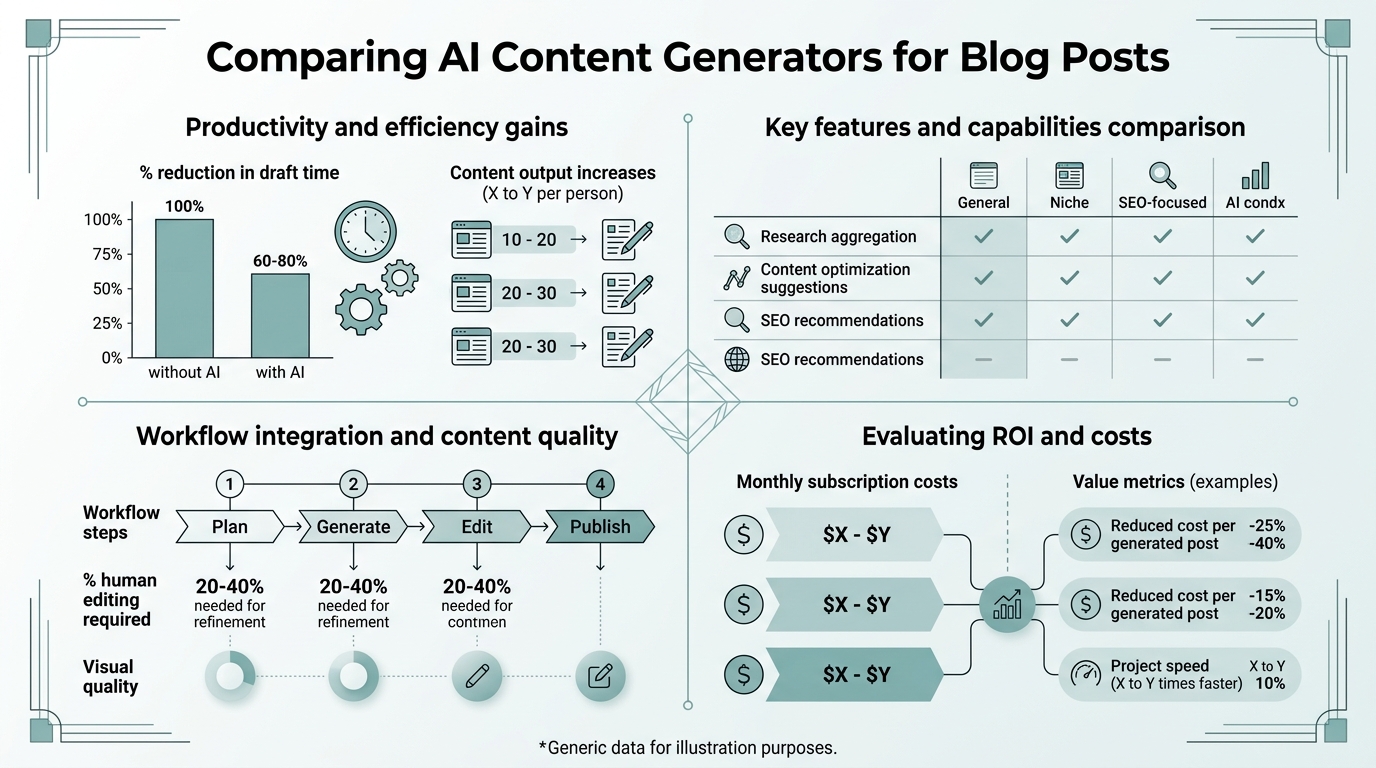
What Are AI Content Generators and How Do They Work?
AI blog post generators are software tools that use large language models to automatically draft, edit, and sometimes publish written content. Unlike a human writer who researches a topic, synthesizes information, and writes from experience, these tools process input parameters (keyword, topic, word count, tone) and generate output text based on patterns learned from training data. 59% faster content creation is the typical result—but speed without accuracy wastes time.
The Core Architecture of Modern Generators
Most AI content generators operate on a similar foundation: a large language model (typically GPT-4 or equivalent) that accepts structured input and produces text output. The sophistication lies in the wrapper—the systems and safeguards around that model. Entry-level generators ask you to paste a keyword and hit "generate." Enterprise-grade generators research sources, verify claims, optimize for search intent, and handle publishing to your CMS directly.
"Autonomous generators like Jottler take this further by deploying multiple AI agents working in parallel. One agent researches 14+ sources, another synthesizes data, a third fact-checks claims, and a fourth optimizes for SEO and internal linking. This multi-agent approach reduces hallucination and produces content that ranks because it's built on real data from the start, not polished afterward."
When implementing autonomous SEO agents, the difference is night and day compared to single-model generators.
Key Capabilities That Separate Good from Average
Not all generators are equal. Here's what distinguishes tools that produce ranking content from those that produce filler:
- Source integration: Does the tool pull from real, cited sources, or does it generate text from pure pattern matching?
- Fact-checking: Is there a verification layer that catches false claims before publishing?
- SEO optimization: Does it handle keyword research, internal linking, and on-page signals automatically?
- Publishing automation: Can it write and publish directly to WordPress, Webflow, or your CMS without manual steps?
- Depth and length: Can it produce 3,000+ word articles with research depth, or is it limited to 500-1,500 word snippets?
Comparing Major AI Content Generators: Features and Trade-Offs

The market offers three distinct tiers of AI blog generators, each optimized for different workflows and budgets. Understanding the trade-offs helps you pick the tool that matches your actual content needs—not the marketing promise. According to Precedence Research, the generative AI market is expanding rapidly, making this decision increasingly important.
Autonomous AI Engines vs. Assisted Writing Platforms
Autonomous generators like Jottler handle the entire content pipeline: research, writing, fact-checking, optimization, and publishing. You set desired topics or keywords, configure publishing frequency, and the system handles everything else. These tools cost more ($29-299/month) but deliver finished content ready for publishing, saving 3+ hours of manual work per piece.
"Assisted writing platforms like Jasper and Copy.ai are human-in-the-loop tools. They generate draft copy fast, but you must edit for accuracy, fact-check claims, optimize for SEO, and publish manually. The hidden cost is labor: 3 hours saved with autonomous tools becomes 1-1.5 hours with assisted platforms after editing overhead."
They cost less ($20-125/month) and suit teams with time to refine output.
ChatGPT and Free Alternatives vs. Specialized Tools
ChatGPT (free tier or $20/month Pro) is powerful for ideation and drafting but lacks SEO-specific features. You must manually research keywords, ensure factual accuracy, optimize for Google's algorithm, and link internally. 52% of consumers reduce engagement when they detect AI-generated content, and ChatGPT output often reads like AI because it hasn't been optimized for human-first, SEO-second content standards.
Specialized blog generators like Writesonic and GetGenie add SEO templates and keyword integration. This narrows the gap but still requires significant manual work to produce content that ranks. These tools occupy the middle ground: faster than pure ChatGPT, cheaper than autonomous systems, but slower and less automated than full-pipeline tools.
Speed vs. Depth Trade-Off
Template-based generators (Rytr, some Copy.ai workflows) produce drafts in minutes but sacrifice research depth. These are ideal for social media captions or short blog snippets. For SEO articles targeting competitive keywords, depth matters. Jottler's approach of researching from 14+ sources and producing 3,000+ word pieces ensures topical authority signals that help rankings—something a 500-word template can't deliver. For teams building long-form SEO-optimized content at scale, the difference is measurable in rankings and organic traffic.
| Generator Type | Time per Article | Research Depth | SEO Optimization | Publishing Automation | Typical Cost |
|---|---|---|---|---|---|
| Autonomous (e.g., Jottler) | 5 min setup + auto | 14+ sources verified | Keyword + internal links | Direct to CMS | $29-99/mo |
| Assisted Writing (Jasper, Copy.ai) | 15-30 min + editing | Light (LLM only) | Templates available | Manual export | $20-125/mo |
| ChatGPT | 5-10 min per piece | Training data cutoff | None built-in | Copy/paste | $0-20/mo |
| Template-based (Rytr) | 2-5 min | None (pattern matching) | Minimal | Manual | $7-29/mo |
How to Evaluate AI Blog Generators for Your Team
Choosing the right tool depends on three factors: volume goals, content depth requirements, and time availability. A founder with one blog post weekly has different needs than a marketing team targeting 5 posts per week. The wrong choice compounds—either you abandon the tool after struggling with poor output, or you invest heavily in editing work that defeats the automation benefit.
Assessing Your Content Volume and Publishing Frequency
Start by defining your realistic publishing cadence. One article per week is sustainable for most teams manually; three per week requires assistance; five per week demands near-full automation. 77% higher content output volume is achievable with AI tools, but only if the system matches your workflow.
If you target 3+ articles weekly, a manual writing process is a non-starter. You need either a writing agency (expensive, slow feedback loops) or an autonomous generator. Jottler's strength here is processing volume: the platform publishes 3,000+ words daily across multiple clients because it doesn't require human approval cycles. For teams publishing weekly, assisted tools like Jasper or ChatGPT workflows may suffice if you have time for editing. Building automated content marketing systems scales this volume exponentially.
Fact-Checking and Source Verification Needs
Autonomous generators that integrate source research and fact-checking are critical for regulated industries (finance, healthcare, law) or brands where credibility is non-negotiable. A misquote or false statistic can damage SEO rankings and user trust.
"Jottler's multi-agent approach includes a dedicated fact-checking layer that cross-references claims against source material before publishing. Tools like ChatGPT and assisted platforms offer no built-in fact-checking—the responsibility falls entirely on your editorial team. For SEO purposes, this matters: Google increasingly penalizes content with unverified claims, and a fact-checked article from 14 sources ranks more reliably than a ChatGPT draft with no source attribution."
SEO Optimization and Keyword Integration
Not all AI blog posts rank. The difference between a generator-produced article that ranks and one that languishes is SEO architecture: keyword targeting, internal linking strategy, content structure, and topical authority signals. Research from AmplifAI shows that properly optimized AI content delivers measurable ranking benefits.
Entry-level tools ignore SEO entirely. Mid-tier tools offer keyword templates. The best generators integrate SEO research and linking directly into the writing pipeline. Jottler handles this by combining AI keyword research (identifying search intent and volume), writing long-form content that addresses all intent variations, and automatically building smart internal link networks. This approach compounds—each new article links to prior topically-related posts, building topical clusters that Google rewards with higher rankings.
Real-World Use Cases: When to Use Each Generator Type
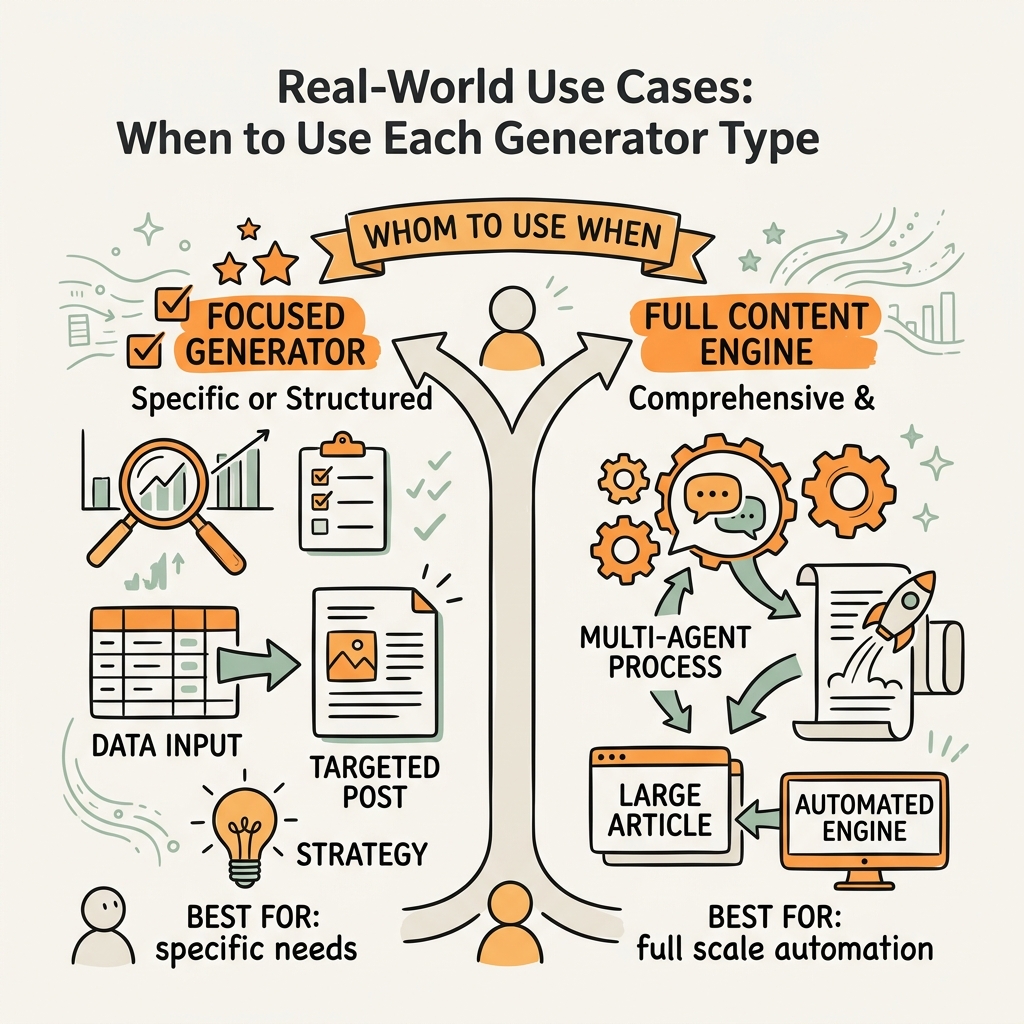
The right tool depends on your specific situation. Here's how different teams should approach AI blog generation based on realistic constraints.
Founder with One Blog Per Week
You have a limited budget and little time. Start with ChatGPT or Rytr for quick drafts, then spend 30 minutes editing for accuracy and SEO. If you find yourself investing 2+ hours per piece, upgrade to an assisted tool like Jasper. If your goal is ranking in competitive niches, the manual effort won't scale—an autonomous generator becomes necessary at this point.
Marketing Team Publishing 3+ Articles Weekly
At this volume, assisted tools create a bottleneck. Your team will spend more time editing AI output than writing original content. This is where autonomous generators like Jottler justify their cost. Allocate one person 2-3 hours weekly for topic strategy and quality review, and let the system handle the 15+ hours of research, writing, and publishing that would otherwise consume the team.
Enterprise or Agency with Strict Editorial Standards
Fact-checking, source verification, and compliance matter. ChatGPT is too risky. Assisted platforms require editorial overhead. An autonomous generator with built-in fact-checking layers (Jottler's multi-agent verification) reduces risk and ensures every article meets publication standards before going live.
Common Pitfalls When Comparing AI Generators
Teams often make one of three mistakes when evaluating tools: they optimize for cost instead of ROI, they confuse output volume with output quality, or they ignore the time investment required for editing and optimization.
Cost Optimization vs. ROI Optimization
A $7/month tool that requires 3 hours of editing work per article is more expensive than a $99/month tool that requires 15 minutes of review. Calculate the true cost per article by including labor. If your team's time is worth $50/hour, a $20 tool that takes 2 hours to process ($140 total) is pricier than a $99/month autonomous generator that publishes 20 articles monthly (roughly $5 per article, including tool cost).
Confusing Output Speed with Output Value
A tool that produces a blog post in 5 minutes looks efficient. But if the article doesn't rank because it lacks internal links, fact-checking, or SEO depth, those 5 minutes are wasted. Tools that take 30-60 minutes to produce a piece (including research and optimization) often deliver more ranking articles than tools that produce 5-minute drafts requiring 2 hours of post-work editing.
Underestimating Editorial Overhead
Most teams underestimate the time required to edit AI-generated content. Copy.ai claims "publish in minutes" but doesn't account for fact-checking, tone refinement, internal linking, and SEO optimization. These tasks typically consume 1-3 hours per article if done properly. Autonomous generators eliminate this overhead by bundling it into the AI pipeline itself.
Key Features to Prioritize When Selecting Your Generator
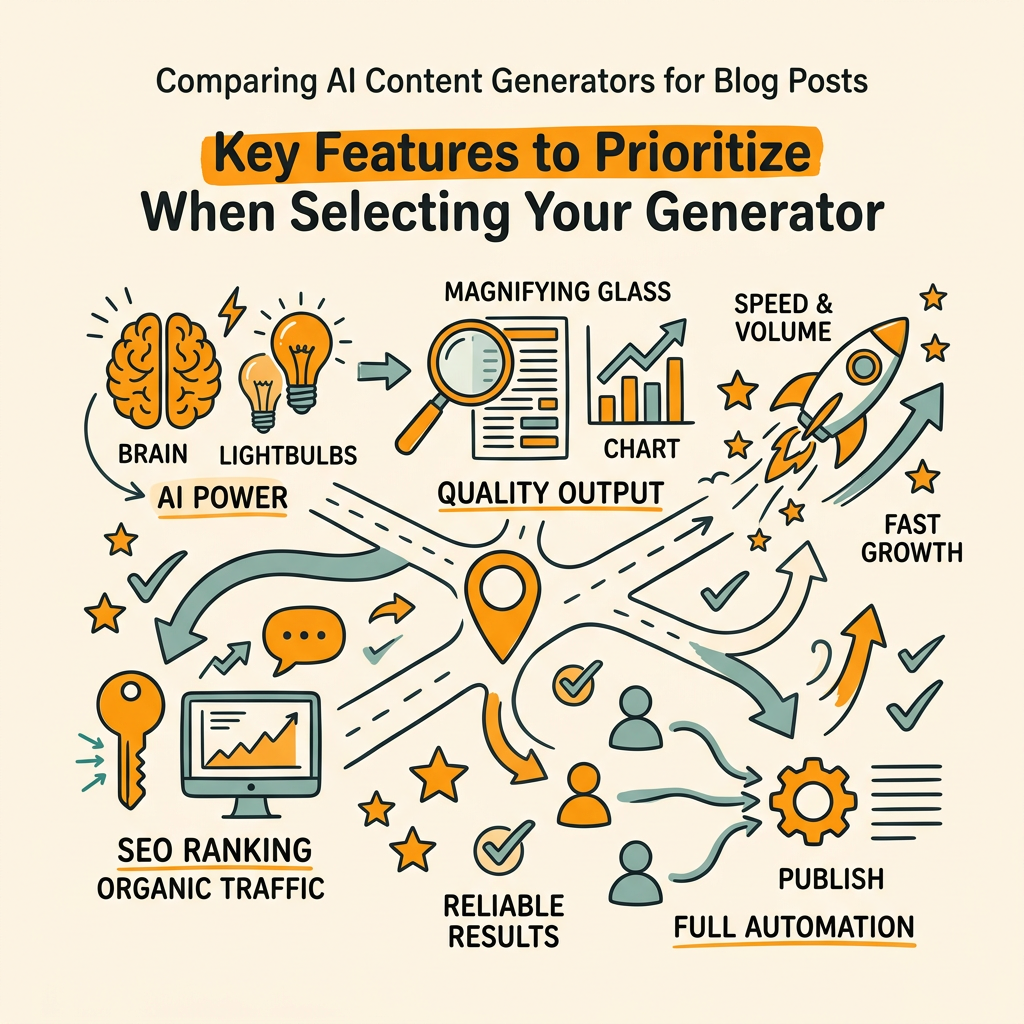
Not all features matter equally. Focus on the capabilities that directly impact ranking and reduce your team's workload.
- Keyword research integration: The tool should identify target keywords, search intent, and related queries automatically—not require you to input them manually.
- Source-backed research: Articles should cite real sources, not hallucinate facts. Verify the tool uses source integration and fact-checking.
- Long-form capability: Short articles rarely rank well. Choose tools that produce 2,500-3,500 word pieces for competitive keywords.
- Internal linking automation: Building topical clusters requires smart internal linking. Some generators claim to do this but only add random links—test the quality.
- CMS publishing: If the tool requires manual export and copy/paste, that's a hidden 10-15 minutes of friction per article. Direct CMS publishing saves time and reduces errors.
- Multi-format support: Blog posts, pillar pages, email content, social media—can the tool adapt to different formats, or is it locked into one?
Cost-Benefit Analysis: What You're Really Paying For
AI blog generators range from free (ChatGPT) to enterprise (Jottler and similar tools at $99-299/month). The price difference reflects capabilities, not arbitrary markup. Understanding what you're paying for helps justify the investment.
Comparing Monthly Costs Across Tiers
Free tier (ChatGPT, free Rytr): $0. Hidden cost is your time. Expect 3+ hours per article including drafting, fact-checking, SEO optimization, and publishing. At $50/hour, that's $150 per article in labor.
Starter tools ($7-30/month): Affordable, but output requires significant editing. Rytr, GetGenie, and budget-tier Copy.ai plans save drafting time (maybe 1 hour per article) but not editing time. You're paying for faster ideation, not scaled content production.
Mid-tier assisted tools ($40-125/month): Jasper, Copy.ai Pro, and Writesonic. These speed up drafting and add SEO templates, reducing per-article time to roughly 1.5-2 hours with editing. Suitable for teams publishing 1-2 articles weekly with active editorial involvement.
Autonomous generators ($29-99/month): Tools like Jottler automate the entire content pipeline, reducing hands-on time to 15-20 minutes per article for strategy and review. At this tier, you're buying time savings, not just output. Publishing 5+ articles weekly becomes feasible without hiring additional writers. Understanding SEO automation capabilities helps teams justify the investment.
ROI Calculation Framework
To determine if a tool is worth the cost, calculate its ROI against your content goals. If your goal is 3 hours saved per article with an autonomous tool, and your team's average hourly cost is $50, that's $150 saved per article. At $99/month for 20 articles, the cost is $5 per article, yielding $145 net savings per piece.
For SEO-driven goals, add ranking benefits. A well-optimized article that ranks in Google's top 10 for a medium-difficulty keyword might drive 100+ organic sessions monthly, converting to an average of $300 in customer lifetime value. One ranking article pays back the entire year's tool subscription.
Implementing Your Chosen Generator: Best Practices
Selecting the right tool is half the battle. Successful implementation requires clear workflows, quality standards, and metric tracking.
Setting Up Topic Selection and Keyword Targeting
The best generators produce output only as good as the input. If you feed a tool vague keywords and unclear topics, it generates vague content. Start with a strong keyword research process. Identify topics with real search volume (50+ monthly searches), clear intent, and moderate competition (KD under 60 for new sites).
Feed these topics to your generator systematically. Autonomous tools like Jottler accept keyword lists and topic clusters—define a monthly content calendar with 20-30 target keywords, and let the system handle the rest. Assisted tools require manual input per article, which is why they don't scale beyond 2-3 weekly posts.
Establishing Quality Checkpoints
Even autonomous generators benefit from human review before publishing. Allocate 15-30 minutes per article for quality checks: verify tone consistency with your brand, scan for errors, confirm internal links make sense, and check that statistics are properly attributed.
This checkpoint step is non-negotiable. An article with hallucinated claims or broken links damages your SEO and brand credibility. Autonomous tools handle most of this automatically, but spot-checking is still valuable.
Tracking Metrics and Optimizing Output
Measure what matters: search rankings, organic traffic, engagement, and content quality over time. Most teams track volume (articles published per month) but miss the important metric: articles that actually rank and drive traffic.
Review your top 10 ranking articles. What topics, lengths, and keyword targets did they share? Use those patterns to refine your generator's input parameters. Over time, you'll optimize the tool to your audience and niche, increasing the percentage of articles that rank.
Conclusion
The choice of AI blog post generator fundamentally shapes your content production efficiency and quality. Free tools like ChatGPT offer speed but cost your team 2-3 hours per article in editing and optimization. Mid-tier assisted platforms reduce this to 1.5-2 hours but still require active editorial involvement. Autonomous generators like Jottler compress that to 15-30 minutes by automating research, fact-checking, SEO optimization, and publishing—enabling teams to publish 77% more content without proportional time investment.
For busy founders and marketing teams at scaling companies, the equation is clear: autonomous generators justify their cost by enabling consistent, high-volume content production. The generative AI content creation market is projected to grow to $143.09 billion by 2035, and the tools winning market share are those that eliminate friction from the content pipeline, not just accelerate writing speed.
The best generator for your team isn't the cheapest or the flashiest. It's the one that matches your publishing volume, delivers source-backed fact-checked content, automates SEO optimization, and integrates directly with your workflow. If you're publishing weekly, ChatGPT may suffice. If you're targeting 3+ articles weekly with ranking goals, an autonomous solution eliminates the bottleneck. Start with a free trial, test the quality against your standards, and choose based on the true per-article cost—including your team's labor.
Start your SEO agent at https://jottler.co/auth/signup and automate your blog content pipeline from research to publishing.
FAQs
Which AI content generator produces the highest-quality blog posts for SEO?
Autonomous generators that integrate keyword research, source-based content creation, and fact-checking produce the highest-quality SEO blog posts. Tools like Jottler research from 14+ sources and handle internal linking automatically, delivering 3,000+ word articles optimized for search intent. ChatGPT and basic assisted tools like Rytr produce drafts that require significant editing and often lack the research depth and internal linking that help rankings. Quality in SEO content means source attribution, topical authority signals, and keyword optimization—features only autonomous platforms bundle into the writing process itself.
How much time do AI blog post generators actually save per article?
The time savings depend on the tool tier. ChatGPT saves drafting time (30 minutes) but requires 1.5-2 hours of fact-checking, SEO optimization, and editing, totaling 2+ hours per article. Assisted platforms like Jasper save roughly 1-1.5 hours of drafting but still demand 1 hour of editing. Autonomous generators compress the entire process to 15-30 minutes of review time by automating research, fact-checking, and SEO in the background. The largest time savings come from tools that eliminate the editing phase, not just the drafting phase—which is why autonomous solutions justify higher price tags for teams publishing multiple articles weekly.
Do I need to use a specialized AI blog generator, or is ChatGPT sufficient?
ChatGPT is sufficient for ideation and initial drafts but insufficient for production-ready SEO content. It lacks keyword research, source integration, fact-checking, and internal linking capabilities. You'll spend hours manually researching keywords, verifying claims, optimizing title tags and headers, and building internal link networks. If you publish one blog per month, this overhead is manageable. If you target weekly publishing or more, ChatGPT becomes a bottleneck. Specialized generators add SEO automation that ChatGPT cannot match, and autonomous solutions eliminate the manual work entirely, making consistent, high-volume publishing realistic for resource-constrained teams.