Content Automation Platforms: Feature Comparison for Marketing Teams
Marketing teams face a persistent bottleneck: producing consistent, high-quality content at the pace required to remain visible in search and social channels. 80% of marketers now use AI for content creation, yet most teams still manage fragmented workflows across content writers, designers, schedulers, and analytics tools. The result? Weeks spent on coordination instead of strategy. This article breaks down how content automation platforms solve this problem, comparing the features that matter most for busy marketing teams and the teams at growing companies who need to scale fast without losing quality.
Key Takeaways
- 95% of enterprise marketing teams now use at least one marketing automation platform, with adoption growing fastest in the SMB segment (2026, HubSpot).
- Content automation can save up to 30% of production cycle time while enabling personalization that increases engagement by up to 74%.
- The best platforms combine AI-powered creation, workflow automation, cross-channel publishing, and analytics integration in a single interface.
- All-in-One Platforms: Unified creation, scheduling, and analytics reduce tool sprawl and speed approval workflows by 40-50% compared to disconnected tools.
- AI-Powered Content Creation: Generative agents handle drafting, optimization, and SEO checks, cutting writer time per piece from 2-3 hours to 30 minutes.
- Cross-Channel Publishing: Single-click distribution to blogs, social, email, and CMSs eliminates manual reformatting and syncing errors.
- Workflow Orchestration: Automated approval routing, notification sequences, and deadline tracking eliminate email-based project management friction.
- Analytics Integration: Real-time performance tracking connected to creation dashboards so teams see which content drives ROI before writing the next piece.
What Content Automation Platforms Actually Do
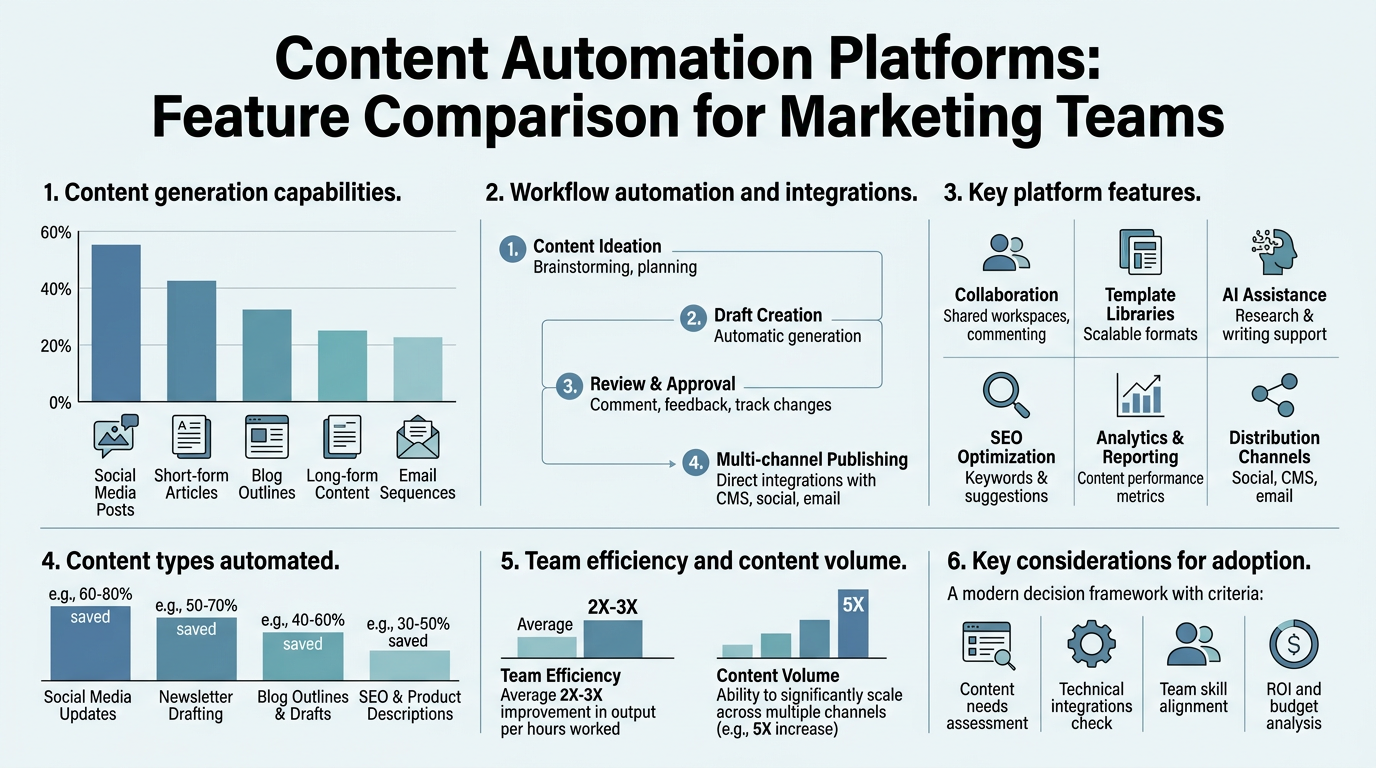
Content automation platforms consolidate the workflow between ideation and publication, removing manual friction at every step. 92% of marketers now use AI tools as part of their marketing workflows, yet most teams still toggle between separate systems for writing, scheduling, and analytics. According to HubSpot's 2026 marketing statistics, a proper content automation platform unifies these functions so that drafting flows directly into approval, publishing triggers distribution, and performance data feeds back into next-month's strategy.
The Three Core Layers of Content Automation
Every mature content automation platform stacks three capabilities: creation, orchestration, and intelligence. The creation layer includes AI drafting assistants, content templates, and SEO optimization checks. The orchestration layer automates approval routing, scheduling, and multi-channel publishing. The intelligence layer tracks performance metrics, surfaces high-ROI content types, and feeds insights back into planning.
"The practical difference is observable: teams without automation spend 30-40% of their time on logistics—sending drafts, chasing approvals, reformatting for channels. Teams with automation spend that time on strategy and creative direction instead."
Automation can cut content production cycles by up to 30% while improving output consistency. This efficiency gain compounds over time as teams publish more content without proportional increases in headcount.
How Platforms Differ on the Critical Features
Not all platforms weight these layers equally. Some emphasize creation (AI quality, templates, optimization), others prioritize orchestration (workflow flexibility, approval customization), and a few lead on intelligence (performance analytics, audience segmentation). Understanding your team's biggest pain point—whether it's writing volume, approval delays, or measurement—determines which platform delivers the fastest ROI.
For busy founders and marketing teams at growing companies, the best platforms automate the highest-friction tasks first: approval routing, social scheduling, and SEO checks. These are tasks that consume hours but require minimal judgment and can be systematized immediately.
How to Evaluate Content Automation Platforms
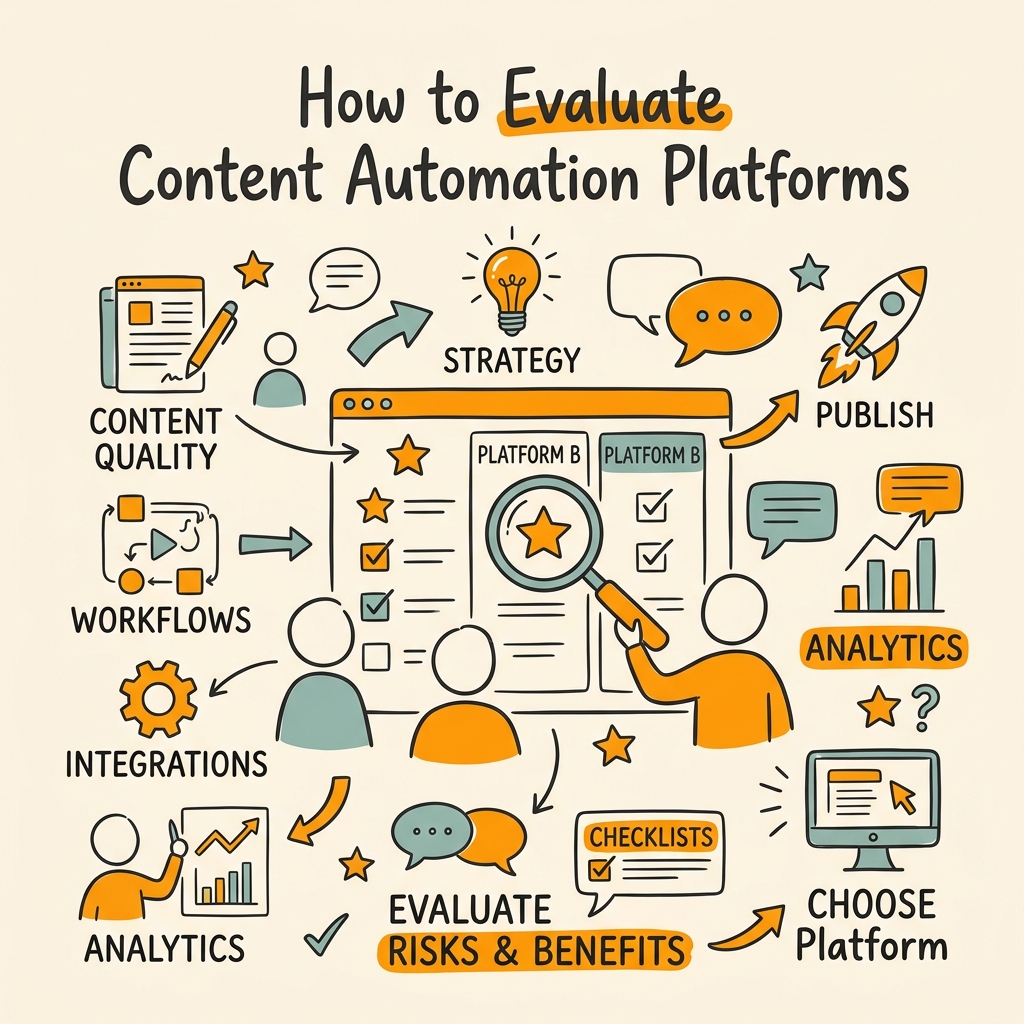
Picking the right platform requires clarity on three factors: your content output target (how many pieces per week), your approval process complexity (how many stakeholders must sign off), and your analytics needs (which channels drive the most revenue). Start by mapping your current workflow on paper, then score platforms on how much manual work they eliminate from the critical path.
Key Evaluation Criteria: Creation and Optimization
The creation layer separates beginner platforms from mature ones. Entry-level platforms offer templates and basic AI drafting. Advanced platforms include AI-powered content generation with SEO optimization built in, fact-checking workflows, and internal linking automation. The best platforms integrate keyword research, competitor analysis, and topical clustering so the AI understands your niche before writing.
"When evaluating, test the platform on your most common content type. Does the AI require heavy editing, or does it produce publication-ready drafts? Can it optimize for your target keywords without over-stuffing? These questions surface the quality gap between platforms that merely generate words and platforms that generate SEO-ready, on-brand content."
Key Evaluation Criteria: Workflow and Approval Automation
Approval bottlenecks kill content velocity. A platform that automates approvals—automatically routing drafts to subject-matter experts, surfacing feedback in-context, and notifying stakeholders when their input is required—can cut approval time from 3-5 days to 24 hours. Look for platforms that support:
- Conditional routing: Draft goes to Editor if word count > 1,500, CEO if it mentions competitors, Legal if it discusses compliance.
- Parallel approvals: Multiple stakeholders review simultaneously instead of sequentially, cutting round-trip time in half.
- In-document feedback: Comments and suggestions appear inline so reviewers don't have to compile feedback across email threads.
- Version history and rollback: Teams can revert to earlier drafts without losing tracked changes or creating version chaos.
For teams larger than 5 people, approval automation is non-negotiable. Without it, content production doesn't scale—you just hire more project managers to coordinate the chaos.
Key Evaluation Criteria: Cross-Channel Publishing and Distribution
A single blog post needs to appear on your website, get shared to LinkedIn and Twitter, drive an email campaign, and populate a newsletter. Manually reformatting, resizing images, and posting to each channel is repetitive friction that scales badly. The best platforms publish with one click to blogs, social networks, email systems, and external CMSs simultaneously, auto-adjusting format for each channel.
Advanced platforms also schedule posts to optimize timing by channel (emails send at peak open hours, social posts schedule around traffic peaks) and allow bulk scheduling weeks in advance so your team sets it once and stops thinking about it. Platforms like those with true SEO automation capabilities also handle internal linking automatically, ensuring each new piece links to relevant older content to build topical authority.
Comparing Content Automation Platforms: Feature Matrix
To help you isolate the real differences, here's how leading platforms stack up on the features that matter most for marketing teams at growing companies.
| Platform | AI Creation Quality | Workflow Automation | Cross-Channel Publishing | Analytics Integration | Pricing Entry Point |
|---|---|---|---|---|---|
| Jottler | Daily 3,000+ word articles with fact-checking, SEO optimization, and internal linking | Automated research, writing, and CMS publishing via AI agents | Direct CMS integration with smart internal link network building | Performance tracking tied to publishing pipeline | $29/month |
| HubSpot Content Hub | AI assistant for ideation and editing; templates for common formats | Approval workflows, email scheduling, content calendar | Email, blog, social scheduling integrated | Built-in analytics, CRM connection for lead tracking | $50/month (free tier available) |
| Marketo / Adobe | AI-assisted creation within Campaign framework | Advanced orchestration across email, landing pages, and ads | Email, landing page, social ad distribution | Robust analytics, attribution modeling, revenue tracking | $1,200+/month |
| Klaviyo | Email template AI, subject line optimization | Email workflow automation, segmentation rules | Email-primary, SMS and pop-up support | Email performance, subscriber lifetime value tracking | $35/month |
The table reveals a critical pattern: enterprise platforms (Marketo, Adobe) excel at attribution and revenue tracking but require significant setup and ongoing management. Mid-market platforms (HubSpot) balance breadth with usability but still require manual content creation. Lightweight platforms (Jottler, Klaviyo) excel at one core function (autonomous content generation for Jottler, email automation for Klaviyo) and scale efficiently. For teams at growing companies without 6-figure budgets, according to industry analysis at DemandGen Curated, a targeted content automation tool outperforms bloated all-in-one platforms.
Why Autonomous Content Agents Are Reshaping the Category
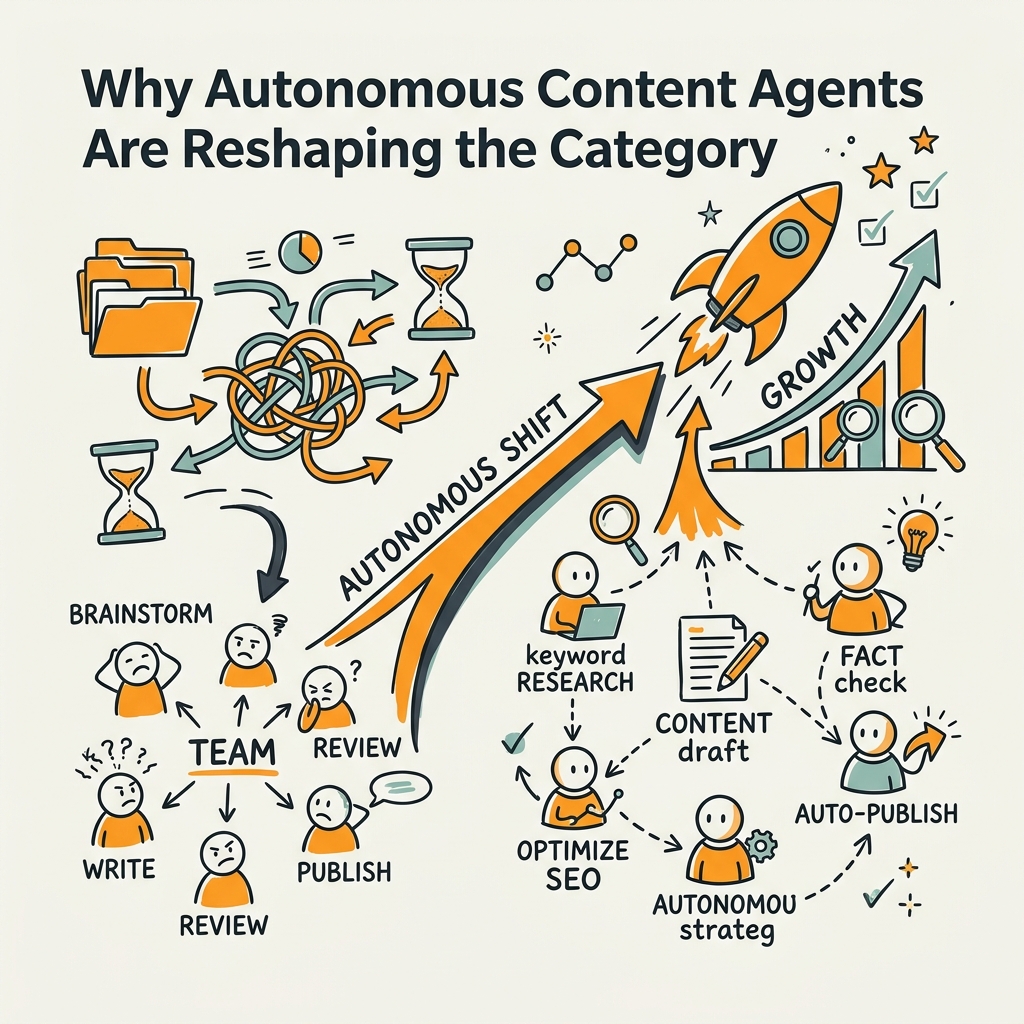
A new wave of platforms—known as autonomous content agents—handles the entire research-to-publish workflow without manual intervention. Rather than humans writing a draft and automation handling scheduling, these platforms research topics, write full articles, fact-check claims, optimize for SEO, and publish directly to your CMS. Autonomous workflows are cited by 27% of marketers as the #1 expected impact area for martech evolution, a significant shift from incremental efficiency gains to wholesale workflow replacement.
The Autonomous Model vs. AI-Assisted Models
Traditional AI-assisted platforms (ChatGPT, Jasper, Copy.ai) require humans to provide prompts, direction, and fact-checking. The human writes "Create a blog post about X," the AI generates text, and the human edits heavily. This is faster than starting from scratch but still bottlenecked by human attention. Autonomous content agents invert this: the system identifies topics worth writing about (based on keyword research and competitor gaps), writes comprehensive articles with citations from 14+ sources, fact-checks every claim, optimizes for your target keywords, and publishes to your CMS while building internal link networks. The human role shifts from writer to editor and strategy—review the final output, refine it if needed, and the system handles publication.
"For busy founders, this is transformational. Instead of allocating 6-8 hours per week to writing and editing, you allocate 1-2 hours to reviewing automated output. The platform compounds your content library over weeks and months, building SEO authority without burning team resources."
What Makes Autonomous Platforms Credible
Not all autonomous platforms deliver quality. The difference hinges on research depth, fact-checking rigor, and brand voice preservation. Mature autonomous systems like those built with 12+ AI agents handling specialized tasks assign different agents to research, outlining, drafting, SEO optimization, fact-checking, and internal linking. This specialization ensures each step meets high standards instead of one general-purpose model trying to do everything adequately.
When evaluating autonomous platforms, ask: Can I see examples of published articles? Do they include citations and source links? Are fact claims verifiable? Does the platform let me control topics or does it pick them automatically? Do I own the content or does the platform? These questions separate platforms designed for serious content marketing from novelty tools. According to marketing automation data from SQ Magazine, content personalization powered by automation increases engagement by up to 74%, making quality credibility non-negotiable.
Implementation: Getting Teams Started with Content Automation
Successful platform adoption follows a predictable pattern: start narrow (automate one content type or workflow), measure the impact (time saved, content quality, engagement), then expand. Teams that try to automate everything at once waste time integrating features they don't need and frustrate users with complexity.
Phase 1: Map Your Current Workflow and Identify the Biggest Bottleneck
Before choosing a platform, document how content moves from ideation to live. Where do delays happen? Is it writing? Review cycles? Scheduling across channels? Measurement? The answers point to which platform features deliver the fastest payback. A team waiting 1 week for approvals benefits most from workflow automation. A team struggling to write 4 posts per week benefits most from AI creation. A team publishing to 5 channels manually benefits most from multi-channel publishing automation.
Phase 2: Start with One Content Type and One Workflow
Pick your highest-volume content type (often blog posts or email campaigns) and one workflow step to automate. If you chose blogs, start by automating scheduling—write manually, but let the platform handle formatting and multi-channel distribution. If you chose email, start by automating send-time optimization and segment routing. Success here builds team confidence and clarifies what else to automate next.
Phase 3: Measure Before Scaling
Document baseline metrics: how long does it take to produce one piece end-to-end? How many pieces does your team publish per week? How does time breakdown across writing, review, scheduling, and publishing? After 2-4 weeks on the platform, remeasure. A platform delivering value should show measurable time savings (target: 25-40% cycle time reduction) and/or volume increase (same team, 30-50% more output) within the first month.
Why Most Teams Underestimate Content Automation's ROI
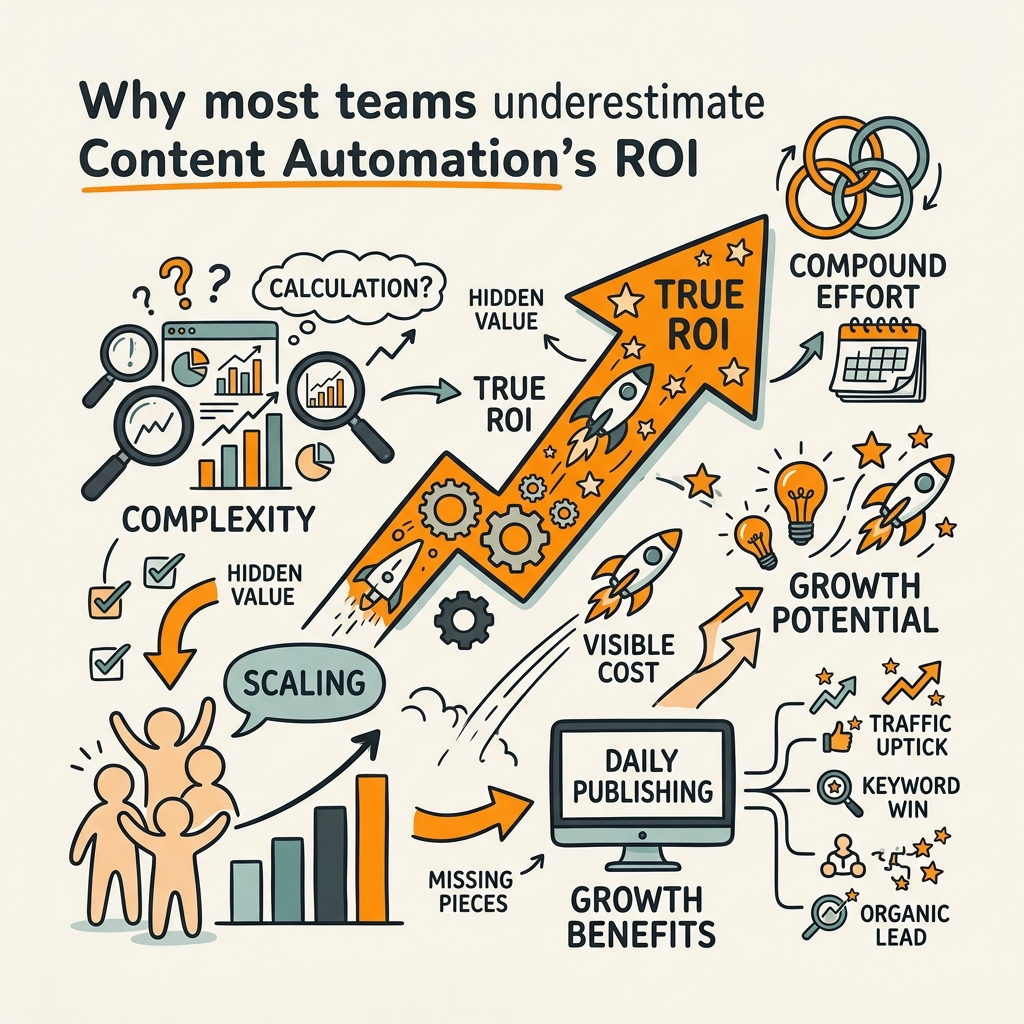
The business case for content automation isn't primarily about cutting editor headcount. It's about scaling output and quality without proportional headcount growth. Businesses using content automation report 13% higher ROI compared to manual processes, and personalization powered by automation increases engagement by up to 74%. These gains compound over months and years as your content library deepens, organic traffic multiplies, and each new piece builds on the authority of older pieces.
The Compounding Content Growth Advantage
A manual content operation publishes, say, 2-3 posts per week. An automated operation publishes 5-8. Over 6 months, that's the difference between 40-50 posts and 120-160 posts. Over a year, it's 100-150 posts vs. 250-400. Each new post targets keywords, attracts backlinks, and feeds internal links to your entire content library. The compound effect on organic traffic is significant—and it only works if your output velocity exceeds what human editorial teams can sustain.
Founders understand compounding in other contexts (SaaS growth, network effects, compound interest). Content automation applies the same principle to content marketing: automate to increase output velocity, and let the compounding effect drive organic traffic and lead generation over time.
The Hidden Costs of Staying Manual
Many teams choose not to implement content automation, assuming the learning curve and setup cost aren't worth it. This logic overlooks the invisible cost of manual workflows: context switching. A marketing manager juggling email, blog, social, and analytics spends an average of 15-20 minutes per task just to get back up to speed. Across a week, that's 5+ hours lost to context switching alone. Automation platforms eliminate this by consolidating tools, so one interface handles creation, approval, and publication.
Second, manual workflows don't preserve knowledge. When your one expert writer leaves, the documentation of how pieces get approved, who needs to sign off, and how they're published leaves with them. Automation systems codify these workflows, so the next hire can ramp faster and the process doesn't degrade when team members shift roles. This is why building an AI content strategy creates organizational resilience for teams scaling beyond founder-led content production.
Conclusion
Content automation platforms have evolved from nice-to-have productivity tools to essential infrastructure for marketing teams at growing companies. 95% of enterprise teams and 78% of mid-market B2B organizations now use at least one automation platform, and the gap between teams with and without automation is widening. The best platforms combine AI-powered creation (especially autonomous agents that research, write, fact-check, and publish independently), cross-channel distribution, and workflow orchestration so your team scales output without scaling headcount proportionally.
For busy founders and marketing teams under resource constraints, the calculus is simple: platform adoption compounds content output, which compounds organic traffic growth. The fastest ROI comes from platforms that automate the entire research-to-publish workflow, freeing your team to focus on strategy rather than logistics. Start your SEO agent today and see how autonomous content generation compounds your organic traffic. Within 3-6 months, your content velocity and SEO authority should be visibly higher than manual-only competitors.
FAQs
What is the difference between content automation and marketing automation?
Content automation focuses on the creation, optimization, and publishing workflow—researching topics, drafting articles, scheduling posts across channels, and analyzing performance. Marketing automation is broader, orchestrating entire customer journeys across email, ads, landing pages, and CRM. Content automation is a subset of marketing automation; it handles the production side while marketing automation handles the distribution and conversion side. Some platforms like HubSpot blur the line by bundling both, while specialized platforms focus purely on content creation and SEO optimization.
Can AI-generated content actually rank in search results?
Yes, but only if the content is factually accurate, well-researched, and optimized for your target keywords. Generic AI drafts without fact-checking or SEO optimization won't rank. The platforms that rank best combine AI drafting with deep research, fact-checking from multiple sources, and SEO optimization so the output meets search engine standards for E-E-A-T (experience, expertise, authoritativeness, trustworthiness). Autonomous platforms that assign specialized agents to research and fact-checking produce much higher quality output than single-model AI that trades accuracy for speed.
How long does it take to implement a content automation platform?
Simple platforms like Klaviyo take 1-2 days to set up and start publishing. Comprehensive platforms like HubSpot or Marketo typically require 2-4 weeks of configuration to connect all your tools and set up workflows. Autonomous platforms operate on a different model—you connect your website and set your publishing frequency, and the AI agents handle research, writing, and publishing automatically, with initial setup taking just a few hours. The payback window is typically 4-8 weeks; most teams see measurable time savings within the first month and output improvements by month three.