Content Automation Tools Comparison for Growing Teams
Content production is one of the highest-leverage activities for SaaS growth, yet most busy founders and marketing teams are stuck in a bottleneck. 92% of marketers are already using AI (2026, Moengage), but many rely on disconnected tools that force manual work at critical stages: keyword research, fact-checking, publishing, and internal linking. The cost of this fragmentation is real — it caps your organic traffic growth and burns out lean teams. The fix isn't hiring more writers. It's automating the entire content pipeline with platforms built for autonomous operation, not just AI-assisted writing.
Key Takeaways
- Marketing automation delivers $5.44 return per $1 spent (2026, Digitalapplied), with top performers achieving $8.71. Content automation compounds this by enabling 4.1x more output per marketer monthly.
- True content automation covers keyword research, deep web research, writing, fact-checking, and direct CMS publishing — not just AI writing assistants that require constant prompting.
- Growing teams save 6.1 hours per week on average, with senior practitioners reclaiming 8-10 hours weekly through fully autonomous platforms.
- The market is shifting rapidly toward agentic AI: 34% of enterprises now run autonomous agents in production, up from near-zero adoption in 2024.
- What You're Actually Solving: The manual work between idea and published SEO article — research, writing, optimization, and publishing — eats 70% of a marketer's week.
- Autonomous vs. Assisted: AI writing tools require constant direction; autonomous platforms run with minimal oversight, managing the entire workflow end-to-end.
- Feature Set That Matters: Look for deep research capabilities, fact-checking, SEO optimization, and direct CMS integration to avoid manual handoffs.
- Team Size & ROI: Tools break even in 2-4 months for teams publishing 20+ pieces monthly; gains compound as your content library grows.
- The Comparison Problem: Most reviews compare marketing automation platforms (email, CRM) with AI writing tools — different categories serving different needs.
What Content Automation Tools Actually Do
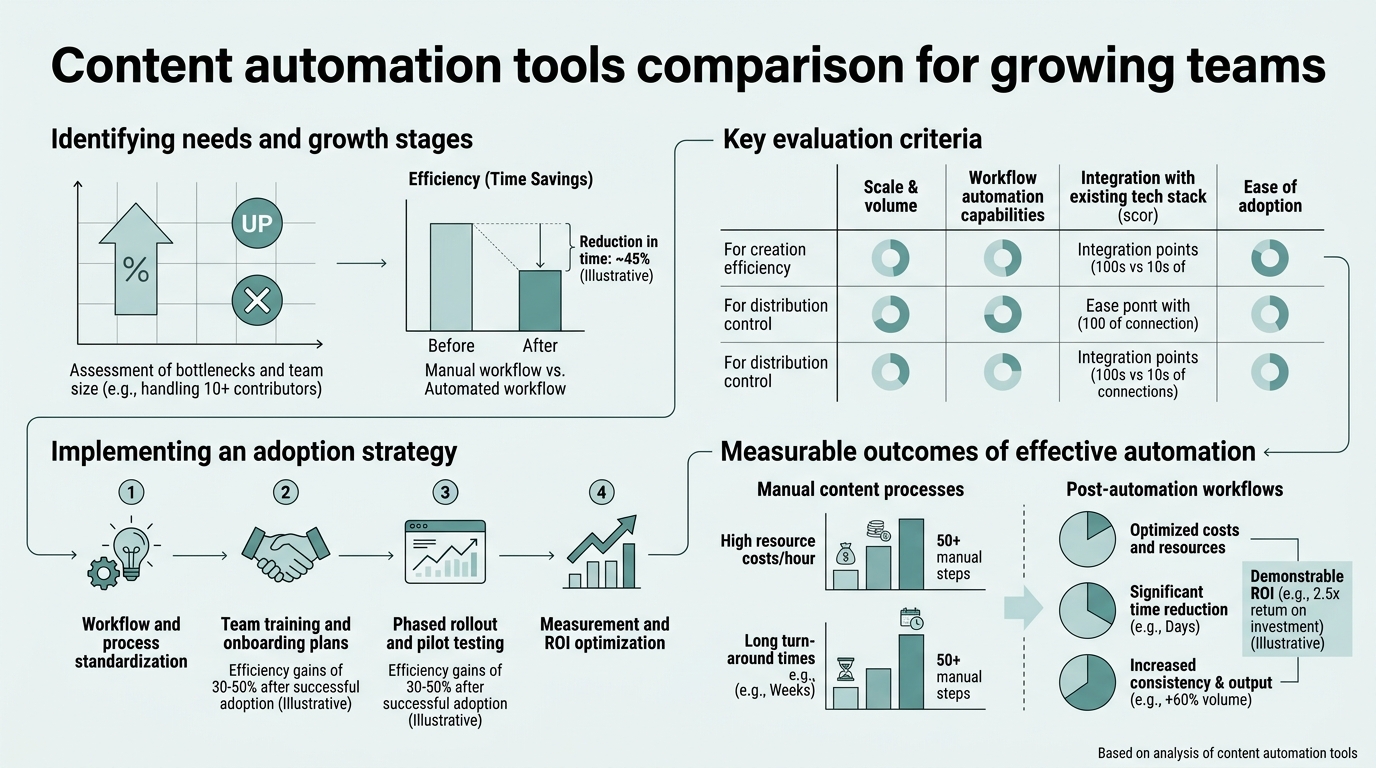
Content automation tools are not AI writing assistants. They're infrastructure that orchestrates the entire content lifecycle: from identifying what to write, researching it deeply, generating draft content, fact-checking claims, optimizing for search, and publishing directly to your CMS while building internal links. According to Sqmagazine, 76% of companies now use marketing automation (2026), but adoption of full content automation — where the research and publishing stages are also automated — remains lower, creating an opportunity for lean teams.
"The distinction between AI-assisted writing and autonomous content automation is the difference between a tool that requires a human at every gate and a system that works independently. A writing tool like ChatGPT requires a human to search for keywords, brief the AI with context, edit the output, verify facts, optimize titles and meta tags, upload to your CMS, and manually link it internally. An autonomous content automation platform does all of this without human intervention after the initial setup."
The Complete Content Automation Workflow
True content automation platforms orchestrate multiple AI agents to handle distinct tasks. A full autonomous SEO agent typically includes:
- Keyword Research Agent: Identifies high-volume, low-difficulty search queries relevant to your niche and publishing capacity.
- Research Agent: Pulls data from 10-15+ authoritative sources, fact-checking claims before they reach the writer.
- Writing Agent: Generates long-form content (2,000-3,500 words) in your brand voice, optimized for both search engines and reader engagement.
- SEO Optimization Agent: Ensures proper heading structure, keyword density, meta tags, and internal linking opportunities aligned with your topical authority.
- Publishing Agent: Connects directly to your CMS (WordPress, Webflow, Ghost, etc.) and publishes content on schedule with automated internal linking.
- Fact-Checking Agent: Validates statistics and claims against primary sources, reducing the risk of publishing false information.
Why Autonomous Operation Matters More Than Capacity
You can pay a freelancer to write 10 articles per month. But someone still has to brief them, fact-check, edit, and publish. Per Digital Applied, teams using autonomous platforms report 27% faster campaign build times (2026), because there's no back-and-forth, no human bottlenecks in the middle of the process. The platform researches, writes, checks, optimizes, and publishes without waiting for a human to push the next button. This becomes critical at scale: if you're publishing 5-10 articles per week, the administrative overhead of managing freelancers or AI writing projects is itself a full-time job.
"The administrative overhead of managing freelancers or AI writing projects becomes a full-time job itself. True autonomy means zero human handoffs after setup — the platform researches, fact-checks, optimizes, and publishes while you focus on strategy and growth."
How to Evaluate Content Automation Tools for Your Team
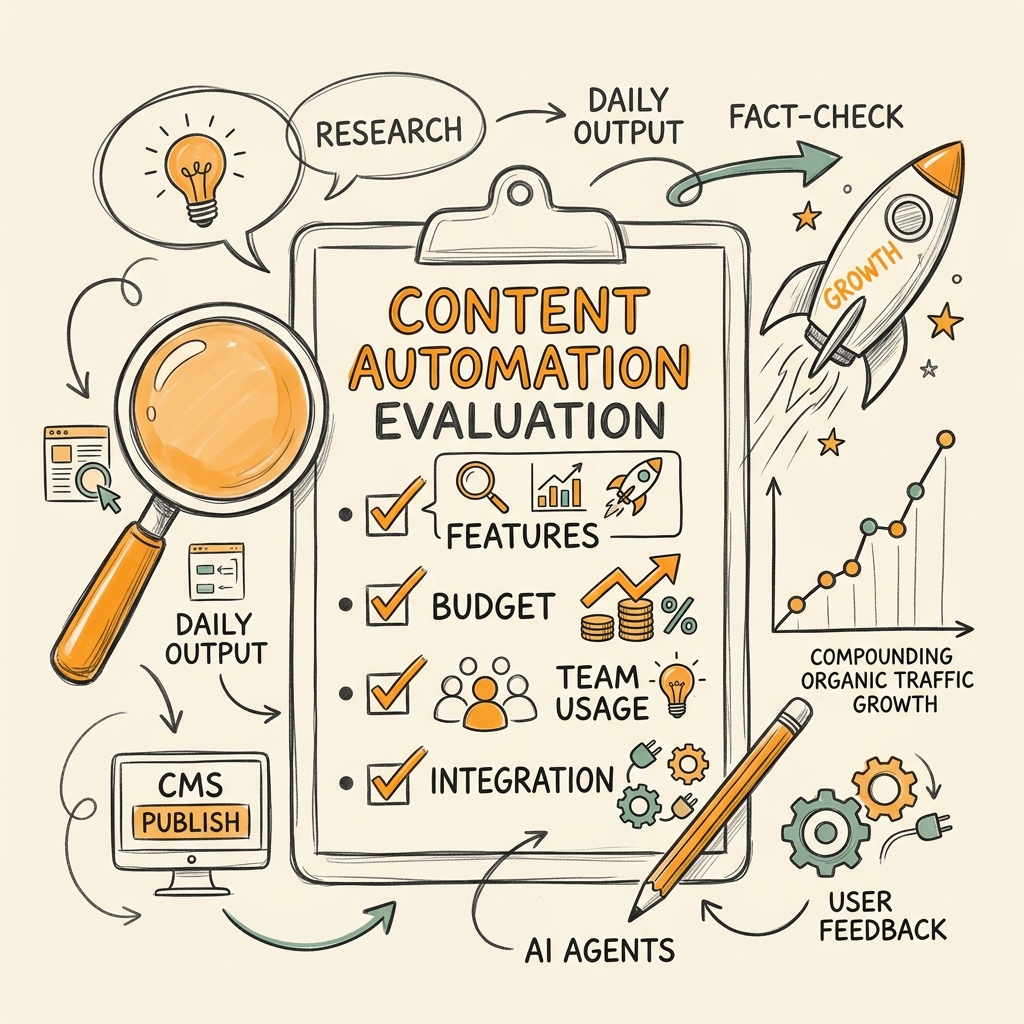
41% of AI-generated content requires significant revision (2026, Cited), meaning tool selection isn't just about capacity — it's about quality and the time you spend editing. When evaluating platforms, focus on the metrics that prevent rework rather than vanity numbers like "features" or "integrations."
Depth of Research and Fact-Checking
Not all AI writing tools do research equally. Some pull from general knowledge baked into their models (likely to be outdated). The best platforms source from recent, primary sources and cross-reference claims before writing. Ask vendors: How many sources do you pull per article? Do you fact-check statistics? What's your data recency — is it pulling from 2024 data, or real-time sources?
Jottler, for example, sources from 14+ authoritative sources per article and includes a fact-checking agent that validates claims against original research. This reduces the revision cycle dramatically — instead of editing false claims out of a finished piece, bad information is caught during the research phase.
SEO Optimization Depth
Generic AI writing tools optimize for readability and keyword density. True content automation platforms understand topical authority, internal linking strategy, and search intent. Teams producing 20+ pieces monthly see ROI breakeven in 2-4 months (2026, Cited), which only happens if each piece compounds with smart internal links and strategic keyword targeting. Look for tools that:
- Automatically suggest and insert internal links based on your existing content and topical clusters.
- Optimize for search intent beyond simple keyword matching (informational vs. commercial vs. transactional).
- Build topic clusters strategically rather than publishing one-off articles in isolation.
- Track keyword performance and adjust future content to capture gaps in your rankings.
CMS Integration and Publishing Automation
Manual publishing adds friction. Every hour spent on formatting, uploading, configuring metadata, and internal linking is an hour not spent on strategy. Platforms that publish directly to your CMS (WordPress, Webflow, Ghost, HubSpot, etc.) without human intervention save significant time. Verify that the platform:
- Connects natively to your CMS or via Zapier/Make if native integration isn't available.
- Publishes on schedule with proper formatting, images, metadata, and internal links already in place.
- Supports custom taxonomies and post types relevant to your content structure.
- Allows preview and approval workflows if you prefer human review before publication.
Content Automation Tools Comparison: Top Options for Growing Teams
The market offers several categories of tools, and comparing them requires understanding what job each one does. 68% of marketers expect automation budgets to grow in 2026 (2026, Moengage), yet many teams end up with a patchwork of point solutions. Below is a comparison of the leading platforms, organized by use case.
| Platform | Best For | Core Strength | Key Limitation | Starting Price |
|---|---|---|---|---|
| Jottler | Autonomous content production for busy founders | End-to-end automation: research, writing, fact-checking, SEO optimization, CMS publishing, and internal linking in one platform. Publishes 3,000+ word articles daily. | Newest entrant; smaller company than enterprise alternatives, but purpose-built for the specific problem of scaling content without overhead. | $29/mo |
| HubSpot Marketing Hub | Inbound marketing and lead nurturing with AI assistance | Tight CRM integration; AI content generator; email, landing page, and blog automation; strong reporting dashboard. | AI content generation is assisted, not autonomous. Requires human prompting and editing. Blog publishing is integrated but not fully autonomous. | €15/mo (basic) |
| Brevo | Email automation with basic AI and ecommerce integration | Low entry cost; unlimited contacts at higher tiers; predictive send time; decent email and SMS automation. | AI content generation is minimal. Strong on email automation, weak on SEO and long-form content. Not designed for content teams. | €20/mo |
| Marketo (Adobe) | Enterprise precision marketing and ABM | Account-based marketing; lead scoring; complex workflow automation; deep analytics and attribution. | Very high entry cost and steep learning curve. Designed for enterprises with dedicated ops teams. Overkill for bootstrapped SaaS or content-focused teams. | ~$895/mo |
| Copy.ai / Writesonic | AI-assisted copywriting and blog post generation | Fast content generation; easy-to-use interface; good for short-form copy and ad headlines. | No research or fact-checking. No CMS integration. Requires manual editing and publishing. Designed for writers, not for scaling with minimal overhead. | $15-50/mo |
Why Jottler Stands Out for Autonomous Content Scaling
The table reveals a clear gap in the market: most platforms excel at one part of the workflow — email marketing, CRM integration, or AI writing — but not the complete content pipeline. Teams produce 4.1x more content per marketer monthly using automation (2026, Digitalapplied), but only when they're not manually handling research, fact-checking, and publishing steps.
Jottler was purpose-built to fill that gap. Where HubSpot requires a human to brief the AI writer and then edit the output, Jottler's research agent pulls from 14+ sources, the writing agent generates 3,000+ word pieces optimized for search, the fact-checking agent validates claims, and the publishing agent uploads directly to your CMS with internal links already in place. The result is zero handoffs after the initial setup. Busy founders set their desired publishing frequency (1-5 articles per day), and the platform autonomously manages the rest.
The starting price of $29/month reflects this positioning: it's built for resource-constrained teams, not enterprises. SEO automation at that tier would typically cost $500+ elsewhere, or require hiring a full-time content manager.
When to Choose Marketing Automation vs. Content Automation
The comparison table hints at an important distinction. HubSpot and Brevo are marketing automation platforms — they excel at campaign management, lead nurturing, and email sequences. They're the right choice if your bottleneck is coordinating campaigns across channels.
Jottler and Copy.ai are content automation or AI writing tools — they solve the problem of producing written content at scale. They're the right choice if your bottleneck is SEO content production, organic traffic growth, and managing a publishing schedule. Content marketing automation differs from campaign-focused marketing automation in that it prioritizes building topical authority and organic reach.
Many growing teams actually need both: a content automation platform to feed your content engine, and a marketing automation platform to nurture the leads that content generates. But the purchasing decision should start with your biggest pain: Are you struggling to publish consistently? Use content automation. Are you struggling to convert traffic into leads? Use marketing automation.
How to Implement Content Automation Without Losing Quality
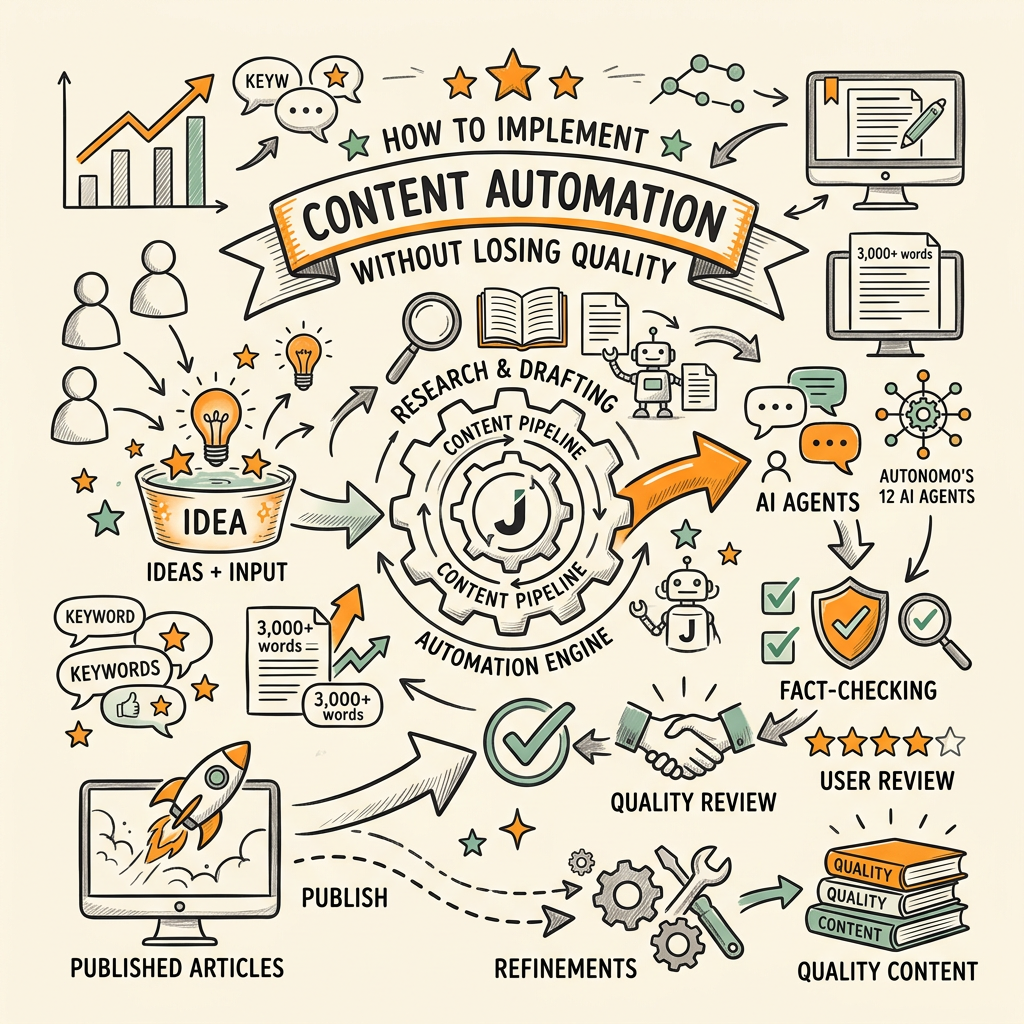
80% of leads generated through automation come from teams using documented content strategies (2026, Digitalapplied), meaning tool selection alone won't drive results. You need a framework to guide what the platform publishes.
Define Your Content Pillars Before Automating
Before you activate any automation platform, decide what topics matter for your business. A pillar is a core subject area you own authority in — for a SaaS product, that might be "SEO automation," "content marketing," "organic growth," etc. Your automation platform should cluster content around these pillars, not scatter across random keywords.
Set up your platform to prioritize pillar-adjacent keywords. If one pillar is "content automation," the platform should write about "content automation tools," "content marketing automation," "automated blog publishing," etc. — keywords that reinforce your authority in the main pillar. This topical clustering approach means each new article you publish strengthens existing content rather than competing with it.
Human Checkpoints, Not Human Bottlenecks
The goal of automation isn't to eliminate human oversight — it's to eliminate manual busywork. Set up a simple approval workflow:
- Initial Setup (takes 1-2 weeks): You brief the platform on your brand voice, content guidelines, and publishing schedule. The platform learns your preferences.
- Daily Operation (takes 5-10 minutes): Each morning, the platform publishes 1-5 articles depending on your setting. You spot-check a few headlines or sections if desired, but the platform has already fact-checked and optimized.
- Weekly Review (takes 30 minutes): Check which articles drove the most traffic. Use that insight to adjust the platform's topic selection for the following week.
- Monthly Strategy (takes 1-2 hours): Review topical authority gaps, identify new pillar-adjacent keywords, and feed that back to the platform.
This structure keeps you in the loop without making you the bottleneck. Compare that to managing freelancers: brief, edit, publish, link, promote — easily 8-10 hours per week.
Measure ROI by Content Cluster, Not Article
When you were publishing manually, you probably tracked each article's performance individually. With automation publishing 20-30+ pieces monthly, individual article tracking becomes noise. Instead, measure cluster-level ROI: "All articles in the 'content automation' pillar combined drove $X in demo requests this month."
This shifts your perspective from "Is this one article worth it?" to "Is this pillar compound-ing?" The answer is almost always yes after 90 days, because automated internal linking and topical authority mean early articles improve in ranking as supporting content publishes around them.
Avoiding Common Pitfalls When Automating Content
Content automation is not a set-it-and-forget-it solution. Three mistakes can undermine even the best platform:
Mistaken Identity: Confusing Output Volume with Topical Authority
Publishing 100 mediocre articles is worse than publishing 20 exceptional ones. Automation platforms can pump out volume, but they can't create authority without strategic direction. Topical authority requires a content strategy — a map of pillar topics and how they interconnect.
Before automating, document: What are your 3-5 core pillars? Which keywords reinforce them? What questions does your audience ask within each pillar? Feed that strategy into the platform. Without it, you'll publish a lot of articles that rank for nothing.
Skipping the Fact-Check Review
Even platforms with built-in fact-checking benefit from spot checks. Pick 10% of published articles each month and verify the claims. If you find errors, that's actionable feedback for the platform. Many tools allow you to flag specific sources as unreliable or update their knowledge base based on your corrections.
Publishing Without Internal Linking Strategy
Automation excels at internal linking because it can scan your entire content library and insert contextual links at scale. But the links only compound if your URL structure and naming make sense. Messy, non-descriptive URLs undermine even a smart linking strategy. Spend a day auditing your URL structure before activating automation. Clear, keyword-rich URLs mean the platform's linking works harder for you.
Calculating Your Content Automation ROI
Most teams see measurable ROI within 2-4 months when publishing 20+ pieces monthly. Here's how to calculate it for your situation:
- Current State: How many blog posts does your team publish per month? How many hours do those take to research, write, and publish?
- Time Reclaimed: With automation, those same pieces take 10% of the time (spot-checking vs. creating from scratch). Calculate the hourly value of that time: (current hours per article) × (articles/month) × (your hourly rate or salary cost).
- Volume Gain: How many pieces could you publish if the time cost dropped 90%? Multiply that volume by your average customer acquisition value from organic traffic. Even conservative estimates show 5-10x ROI within 90 days.
- Organic Compound Effect: After 6 months, your content library has 80-150+ new pieces with internal links, topical authority, and organic traffic flowing to old articles that rank better now that they have supporting content. This compounds monthly.
A team publishing 5 posts per month spending 8 hours each (40 hours/month total) might see breakeven in 60 days, and 3-5x ROI by month six. At $29/month for a tool like Jottler, the math is straightforward: eliminate 36 hours of manual work per month, and the platform pays for itself and your hired help combined.
Conclusion
The bottleneck for growing teams isn't writing capacity — it's operational friction. Marketing automation delivers an average $5.44 return per $1 spent, with top performers achieving $8.71 (2026, Digitalapplied), but that only scales when you remove manual handoffs in content research, fact-checking, and publishing. Content automation platforms that orchestrate the entire workflow — from keyword research through CMS publishing — let lean teams produce 4.1x more content monthly (2026, Digitalapplied) without scaling headcount.
The right tool depends on your bottleneck. If you're coordinating campaigns and nurturing leads, marketing automation (HubSpot, Brevo) is the answer. If you're struggling to publish SEO content consistently, autonomous content automation (Jottler) removes the work that blocks you. For most growing SaaS teams, the answer is both: use a content automation platform to feed your engine, then use marketing automation to convert the traffic that content generates.
Start by mapping your content pillars, then choose a platform that aligns with your publishing cadence and budget. The best time to begin was six months ago. The second-best time is now. Start your SEO agent at https://jottler.co/auth/signup and reclaim the hours spent on research, fact-checking, and publishing.
FAQs
What's the difference between content automation and marketing automation?
Content automation handles the creation and publishing pipeline: research, writing, fact-checking, SEO optimization, and CMS publishing. Marketing automation handles campaign coordination, email sequences, lead nurturing, and multi-channel workflows. Most growing teams need both — content automation fills your pipeline with SEO traffic, and marketing automation converts that traffic into leads and customers. Some platforms like HubSpot bridge both, but they often excel more at one than the other. Choose based on your biggest bottleneck: publishing consistently or nurturing prospects.
How long until I see ROI from content automation?
Teams publishing 20+ pieces monthly typically see time ROI (recovering the hours previously spent on research and publishing) within 2-4 months. Revenue ROI from organic traffic takes longer — usually 4-6 months as content compounds and ranks better with internal linking and topical authority. The fastest way to shorten this window is to publish consistently from day one — 3-5 pieces per week compounds faster than sporadic publishing. Starting with a documented content strategy (pillars and keywords mapped in advance) also accelerates results by ensuring each article reinforces your topical authority rather than scattering effort across unrelated keywords.
Can content automation tools produce high-quality articles, or will they need heavy editing?
It depends on the platform and your quality bar. Tools with deep research and fact-checking (like those with access to primary sources) typically produce higher-quality drafts that require minimal editing — usually just headline tweaks or format adjustments. Tools that rely on general AI models often produce pieces that need significant revision (41% require substantial rework). Look for platforms with built-in fact-checking, multi-source research, and SEO-specific optimization rather than generic AI writing tools. A platform designed for SEO content will produce better results for your use case than a general copywriting tool, even if both use AI under the hood.