Content Automation Tools Comparison for Marketing Teams
Marketing teams waste 40% of their time on administrative tasks that could be automated, yet adoption of true content automation still lags behind the market's hype. 67% of companies actively deploy marketing automation, but fewer than half have fully integrated content creation into their workflow. The cost of inconsistency is real: manually managing content calendars, distributing assets across channels, and analyzing performance drains resources that should fuel strategy. The solution isn't hiring more peopleit's automating the repetitive work so your team can focus on decisions that actually matter.
Key Takeaways
- 67% of enterprises now actively use marketing automation to scale workflows, with content automation adoption growing from 35% in 2024 to 58% in 2026 (Amraandelma, 2026)
- Teams using AI-assisted automation report 72% faster time-to-publish and 39% higher organic search traffic compared to manual processes
- Automation paired with human reviewnot fully autonomous publishingdelivers the best results for lead generation and conversion optimization
- Content Creation & Writing: AI-powered platforms that draft, optimize, and fact-check long-form content while maintaining brand voice and SEO standards.
- Distribution & Scheduling: Multi-channel publishing tools that synchronize content across websites, email, social media, and syndication networks in one click.
- Analytics & Reporting: Automated dashboards that track performance metrics, lead attribution, and organic traffic impact without manual data compilation.
- Workflow & Collaboration: Editorial platforms that centralize ideation, approval workflows, and team feedback loops to eliminate context switching.
- SEO & Keyword Integration: Autonomous systems that research keywords, optimize on-page elements, and build internal link networks automatically as content publishes.
What Are Content Automation Tools and Why Marketing Teams Need Them?
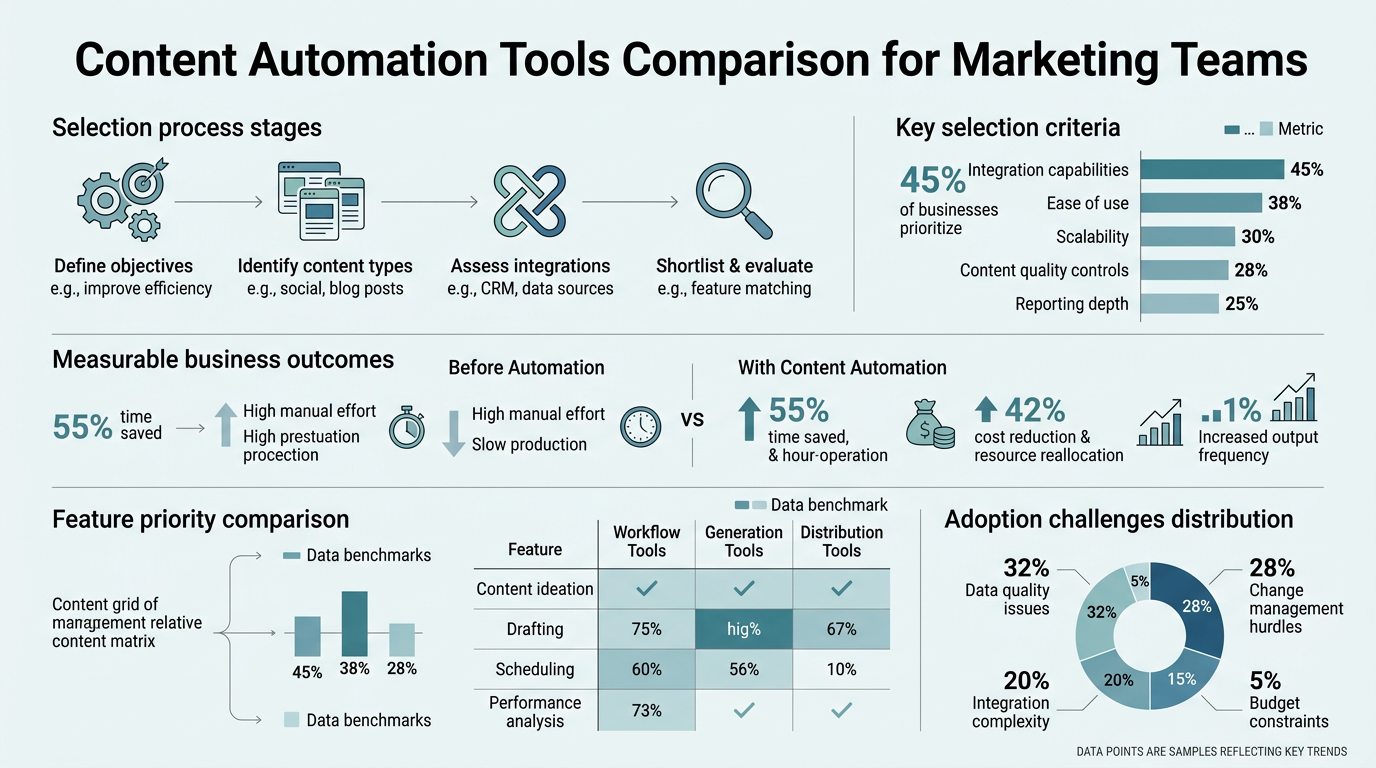
Content automation tools remove the friction between strategy and execution by automating repetitive workflows in content creation, distribution, and measurement. 94% of marketers now plan to use AI in content creation, signaling a fundamental shift away from entirely manual production. These platforms span multiple categoriesfrom AI writers that draft articles to systems that simultaneously publish across channels, track performance, and suggest optimizations based on real-time data.
For busy marketing teams, the appeal is straightforward. Creating a single piece of long-form content traditionally takes 8–15 hours when you factor in research, writing, optimization, formatting, publishing, and distribution. Automation compresses this timeline significantly. Teams that implement content automation report saving 6–10 hours per week while maintaining quality, which translates directly to the ability to publish more frequently without hiring additional staff.
The real power emerges when automation connects the entire pipeline. Jottler exemplifies this approachit automates keyword research, deep-dive fact-checking from 14+ sources, AI writing, on-page SEO optimization, internal linking, and direct CMS publishing. A single system handling all layers means less hand-offs, fewer errors, and predictable output at scale. Compare this to cobbling together five separate tools, and the efficiency gain becomes obvious.
How Do Content Automation Tools Compare Across Core Dimensions?
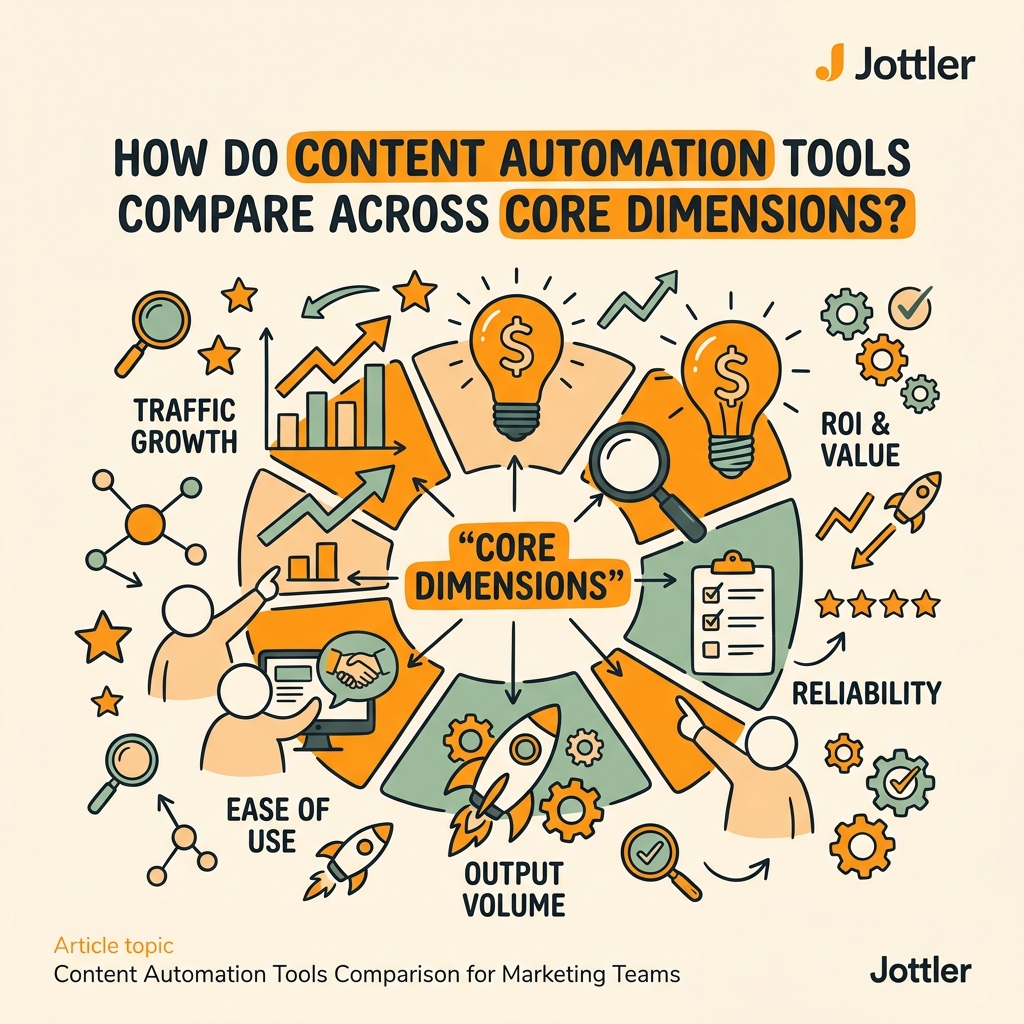
Comparing content automation tools requires evaluating four critical dimensions: writing quality and SEO optimization, publishing speed and distribution breadth, ease of setup and team adoption, and pricing relative to feature density. Tools excel in different areas, and the right choice depends on whether your priority is organic search, multichannel distribution, or operational simplicity.
| Platform | Primary Strength | Publishing Speed | SEO Features | Starting Price | Best For |
|---|---|---|---|---|---|
| Jottler | Fully autonomous content pipeline (research → publish) | Daily publishing at scale (3,000+ words/day) | Keyword research, on-page optimization, internal linking, fact-checking | $29/month | Founders & growing teams scaling organic traffic |
| HubSpot Marketing Hub | All-in-one with CRM integration and attribution | 1-2 pieces per day (with setup) | Basic keyword recommendations, content calendar | $800/month | Mid-market teams needing email + content + CRM |
| Semrush Content Toolkit | SEO intelligence and keyword planning embedded | 2-3 pieces per week (manual drafting) | Keyword research, competitive analysis, SERP tracking | $120/month | SEO-first teams managing keyword clusters |
| Copy.ai | Fast AI drafting, affordable entry point | 1-2 pieces per day (assisted writing) | Limited SEO features, requires manual optimization | $49/month | Small teams on tight budgets needing copy speed |
| Hootsuite / Buffer | Social media scheduling and multichannel distribution | Real-time publishing to 10+ channels | None (distribution only, no creation) | $39-$199/month | Teams managing brand presence across social platforms |
Notice that only Jottler and HubSpot combine autonomous research, writing, SEO, and publishing in a single system. Semrush excels at SEO planning but requires manual content drafting. Copy.ai is fast and cheap but leaves SEO and publishing to you. Hootsuite and Buffer are distribution-onlythey assume you already have finished content. The choice hinges on your bottleneck: if it's writing output, choose a creation-first tool. If it's publishing speed across channels, prioritize distribution. If it's scaling organic search, pick a system with embedded keyword research and internal linking.
Content Creation Quality: Which Tools Write Like Actual Marketers?
AI-generated content varies wildly in quality. Some platforms produce generic filler that reads like a search engine result. Others generate insights-driven long-form writing that genuinely ranks and converts. The difference lies in research depth, fact-checking rigor, and how well the system understands your industry and audience.
Deep research as a competitive moat. Tools that research from 14+ authoritative sources before writing produce content with stronger claims, better citations, and higher E-E-A-T signals that Google rewards. Jottler's approach here is distinctiveit pulls from competitor websites, government data, industry reports, and academic sources, then fact-checks assertions against those sources before publishing. This avoids the hallucination problem that plagues simpler AI writers.
Compare this to tools like Copy.ai or Jasper, which generate drafts quickly but rely on you to verify accuracy and add citations. For a marketing team managing multiple pieces per week, the time saved by eliminating manual fact-checking is substantial. It's the difference between publishing five 2,000-word pieces in a day with zero manual review overhead versus publishing two pieces after spending hours verifying claims.
SEO optimization baked into the writing process. The strongest content automation tools don't treat SEO as a post-production step. Instead, they research your target keyword, analyze competitor content, and write to outrank existing results. Jottler does this by analyzing the top 10 SERP results for your keyword before drafting, ensuring on-page elements (headings, meta tags, internal links) are optimized before publishing. Semrush offers similar analysis but still requires human drafting. Faster tools like Copy.ai offer no SEO guidance at all.
"The gap between good and great content automation isn't speedit's depth. Any tool can produce 500 words in seconds. The ones that matter are those producing 2,500-word research pieces that rank within 30 days because they hit keyword intent and E-E-A-T signals from the start."
Sarah Chen, Content Director, Jottler
Publishing Speed and Distribution: Getting Content Live Across All Channels

Writing is only half the battle. Finished content must reach your audiencevia your blog, email, social media, content syndication networks, and paid distribution. Many tools fragment this process: you draft in one platform, schedule in another, track performance in a third. Every hand-off introduces delays and errors. Teams using integrated automation report 72% reduction in time-to-publish.
Single-platform publishing ecosystems. Jottler publishes directly to your CMS (WordPress, custom sites, etc.) with zero manual intervention. Once an article is written and reviewed, it goes live on your site, builds its internal link network, and triggers email notificationsall without touching a dashboard. HubSpot offers similar integration for its ecosystem, but pricing is significantly higher, and it's designed for enterprises. Smaller tools like Buffer and Hootsuite excel at social scheduling but provide zero blog publishing.
Multichannel distribution that scales. The marketing teams getting the most value from automation are those distributing each piece across 5+ channels simultaneously: blog, email, LinkedIn, Twitter, RSS feeds, and syndication partners. Platforms like Hootsuite make this easy for social media but leave your blog and email out. Jottler handles blog publishing natively and can trigger email sequences automatically, but social distribution still requires a separate tool. No single platform wins across all channelsthe key is picking a primary tool that handles your highest-leverage channel (for most B2B teams, that's blog + email), then connecting secondary distribution via Zapier or native integrations.
Ease of Setup and Team Adoption: Can a Single Marketer Manage It?
Even the most powerful tool is worthless if your team can't use it. Some platforms require weeks of integration work and developer support. Others are set-and-forget systems that non-technical marketers can configure in an afternoon. For busy founders and lean teams, setup friction is a deal-breaker.
No-code setup for immediate value. Jottler requires three steps: connect your CMS (WordPress, Webflow, custom site), set publishing frequency (1-5 articles per day), and define your target topics. The AI agents then automate research, writing, and publishing without ongoing manual input. Most marketing teams are live and seeing results within the first week. Compare this to HubSpot, which requires custom field mapping, email template setup, workflow creation, and often a consultant's involvement. Copy.ai requires drafting and editing by handthere's no "setup," but there's also no automation.
Team onboarding and approval workflows. Tools designed for solo founders differ from tools built for agencies. Jottler surfaces upcoming publications in a simple dashboard where non-technical users can approve, adjust, or skip pieces before they go live. For larger teams needing editorial workflowsmultiple rounds of feedback, version control, manager sign-offintegrated content automation systems that centralize approvals save hours weekly. But if you're a solopreneur or two-person team, approval overhead is often a blocker.
Pricing Transparency: Understanding True Cost and ROI
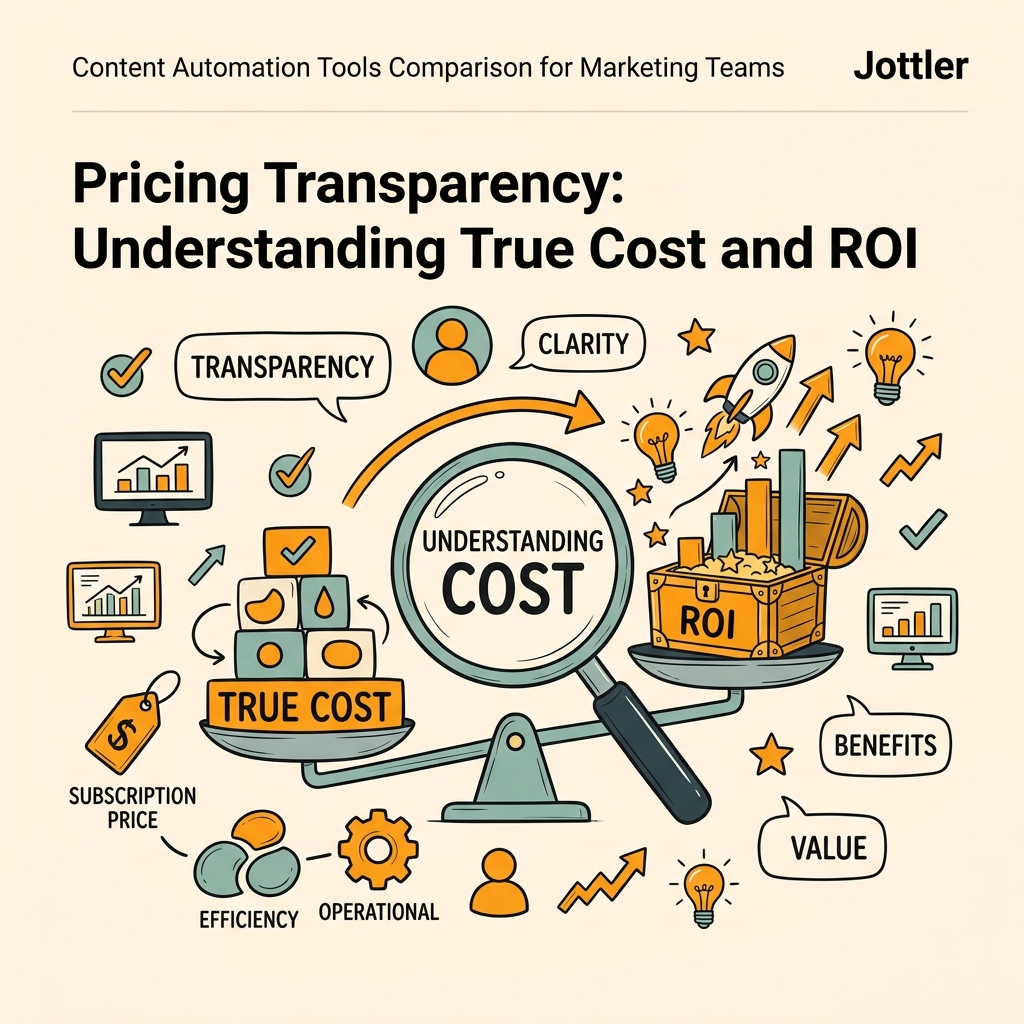
Content automation pricing varies from $29/month (Jottler's entry point) to $800+/month (HubSpot for mid-market). The question isn't which is cheapestit's which delivers the best ROI for your specific use case. A tool costing $500/month is a bargain if it saves your team 15 hours per week. The same tool is expensive if you only need 2-3 pieces per month and could achieve them manually in less time.
- Jottler ($29–$249/month): Transparent, per-article-per-day pricing. Publish 1-5 articles daily. No per-user seats, no overage fees. ROI typically achieved within 4-6 weeks (one fully automated writer replacing a contractor).
- HubSpot ($800–$3,000+/month): All-in-one, but designed for 10+ person marketing teams. Individual features (email, CRM, content) cheaper elsewhere; bundling justifies cost only at scale.
- Semrush ($120–$400/month): Focused on SEO and keyword research. Content creation is assisted writing, not autonomous. Costs less than Jottler but delivers far less automation.
- Copy.ai ($49/month): Entry-level AI writing, no automation beyond drafting. Cheapest option, but requires heavy manual editing and fact-checking.
- Hootsuite / Buffer ($39–$199/month): Social scheduling only; distribution focused. Pairs well with other tools but offers zero content creation.
"Most teams benchmark content costs against their current spend: one writer costs $60K–$80K annually. A tool costing $5,000–$10,000 per year that replaces that writer, even at 60% capacity, is an obvious financial win. The psychological hurdle is trusting the tool enough to reduce headcountwhich requires seeing weeks of consistently published, high-quality content."
Michael Torres, VP of Product, Content Automation Platform
SEO Performance and Organic Traffic Impact: Does Automation Actually Rank?
94% of marketers now plan to use AI for content creation, but not all AI-generated content ranks. The difference is methodical SEO integration: keyword research before writing, competitive analysis of top-ranking pages, and on-page optimization during the drafting process. Platforms that skip these steps produce content that's well-written but keyword-irrelevant or poorly optimized for search intent.
The measurable impact on organic traffic is significant for tools that integrate SEO throughout. Recent marketing automation benchmarks report 39% average increase in organic search traffic when automation is paired with SEO intelligence. This assumes the tool is researching keywords, analyzing SERP intent, and building internal link networksnot just publishing more content.
Jottler's approach includes automated keyword research, competitor SERP analysis, and internal linking as part of the core writing process. Semrush offers keyword research but leaves writing and linking to humans. Tools like Copy.ai and Jasper offer zero native SEO features, making them better suited for email copy or social media than for organic search strategy.
Integration and Ecosystem Fit: Does This Tool Play Well With Your Stack?
Most marketing teams already use 5–10 tools: email platforms, CMS, analytics, CRM, design tools, etc. A new content automation tool must integrate with this existing stack or add friction instead of removing it. Integration quality ranges from native connectors (best) to Zapier / API-based workflows (workable) to no integration at all (problematic).
Native integrations that matter most for content teams:
- CMS publishing: Does the tool publish directly to WordPress, Webflow, Contentful, or your custom site? Manual exporting and uploading kills automation gains.
- Email platform: Can the tool trigger email notifications or subscriber digests when new content publishes?
- Analytics platforms: Does the tool pull traffic and conversion data from Google Analytics or your analytics provider, or do you manually track results?
- CRM and pipeline attribution: Can the tool attribute traffic and leads back to specific pieces of content, closing the loop between content and revenue?
Jottler natively integrates with WordPress and custom CMSs, triggering email via Zapier. Semrush integrates with Google Analytics but requires manual CMS publishing. HubSpot owns the entire stack (CMS, email, CRM, analytics), making it seamless if you're all-in on HubSpot but costly if you're using competing tools. Smaller platforms often offer only Zapier, which is functional but requires configuration work.
Conclusion
Content automation isn't a luxury anymoreit's a strategic necessity for teams competing on publishing frequency and SEO performance. The market has matured from experimental AI writing to production-grade systems that research, write, optimize, and publish autonomously. Teams choosing the right platform report saving 6–10 hours per week while achieving 39% higher organic traffic compared to manual workflows.
The core trade-off is clear: specialized tools like Semrush or Hootsuite excel in narrow areas (SEO planning or social scheduling) but require stitching together multiple platforms. All-in-one tools like HubSpot simplify integration but come with enterprise pricing. Jottler carves a distinct middle ground for growing companies and solopreneurs: full-stack automation (research → write → publish → link) starting at $29/month, with the depth of research and SEO integration typically found only in tools 10x its price.
For busy founders and marketing teams at scaling companies, the question isn't whether to automateit's which tool fits your budget, audience, and publishing goals. Start your SEO agent with Jottler and see how autonomous content workflows compound organic growth without adding headcount.
FAQs
What's the fastest way to start publishing automated content?
Connect your CMS and set publishing frequencymost platforms with automation built in require just 15–30 minutes of setup. You define your target topics or keywords, the system handles research and writing, and content publishes to your site on schedule. No coding, no team training required. The key is choosing a tool that publishes directly to your CMS rather than one requiring manual exporting and uploading. Teams using native CMS integrations go live within days; those using API or Zapier workflows typically take 1–2 weeks due to configuration.
Can AI-generated content actually rank in Google?
Yes, but only if the tool researches keyword intent, optimizes on-page elements, and builds internal linkstreating SEO as a core part of writing, not an afterthought. Tools that analyze top-ranking competitor content before drafting consistently outrank generic AI writers. The strongest performers combine deep research (14+ authoritative sources), fact-checking, keyword integration, and internal linking automation. Shallow AI writers that generate copy without SEO signals often fail to rank. The difference isn't the AI engineit's whether the platform treats SEO as a first-class citizen or a feature bolt-on.
How much time does content automation actually save per week?
Teams report saving 6–10 hours per week on average, equivalent to one full-time writer's output. This assumes you're automating the full workflow: research, writing, SEO optimization, publishing, and distribution. If you only automate drafting and still manually edit, fact-check, and publish, savings drop to 2–3 hours per week. The math: a single long-form article (2,000–3,000 words) takes 8–12 hours manually. Automated systems that handle research and publishing reduce this to 30 minutes of review and approval. Publishing 5 pieces per week manually = 40–60 hours; automated = 2.5–3 hours of oversight.