Content Automation Tools: Complete Buyer's Guide for SaaS Teams
Scaling content is one of the highest-leverage activities for any SaaS business, but most founders and marketing teams lack the time to do it effectively. While 92% of marketers are already using AI in some form (2025, SAP Engagement Cloud), many are stuck with tools that only solve a piece of the puzzle, leaving them to manually handle the most time-consuming tasks like research, fact-checking, and publishing. The result is a content bottleneck that caps organic traffic growth.
The challenge isn't just creating more content; it's producing high-quality, SEO-optimized articles consistently without draining resources. For busy SaaS teams, the cost of manual content production is immense, slowing down customer acquisition and ceding valuable search rankings to competitors. The solution lies in a new class of autonomous platforms that go beyond simple AI writing. Here’s a quick summary of how to choose the right content automation tool for your business.
Key Takeaways
- The marketing automation market is projected to grow to $15.58 billion by 2030 as businesses move from manual workflows to automated systems. (2024, InBeat)
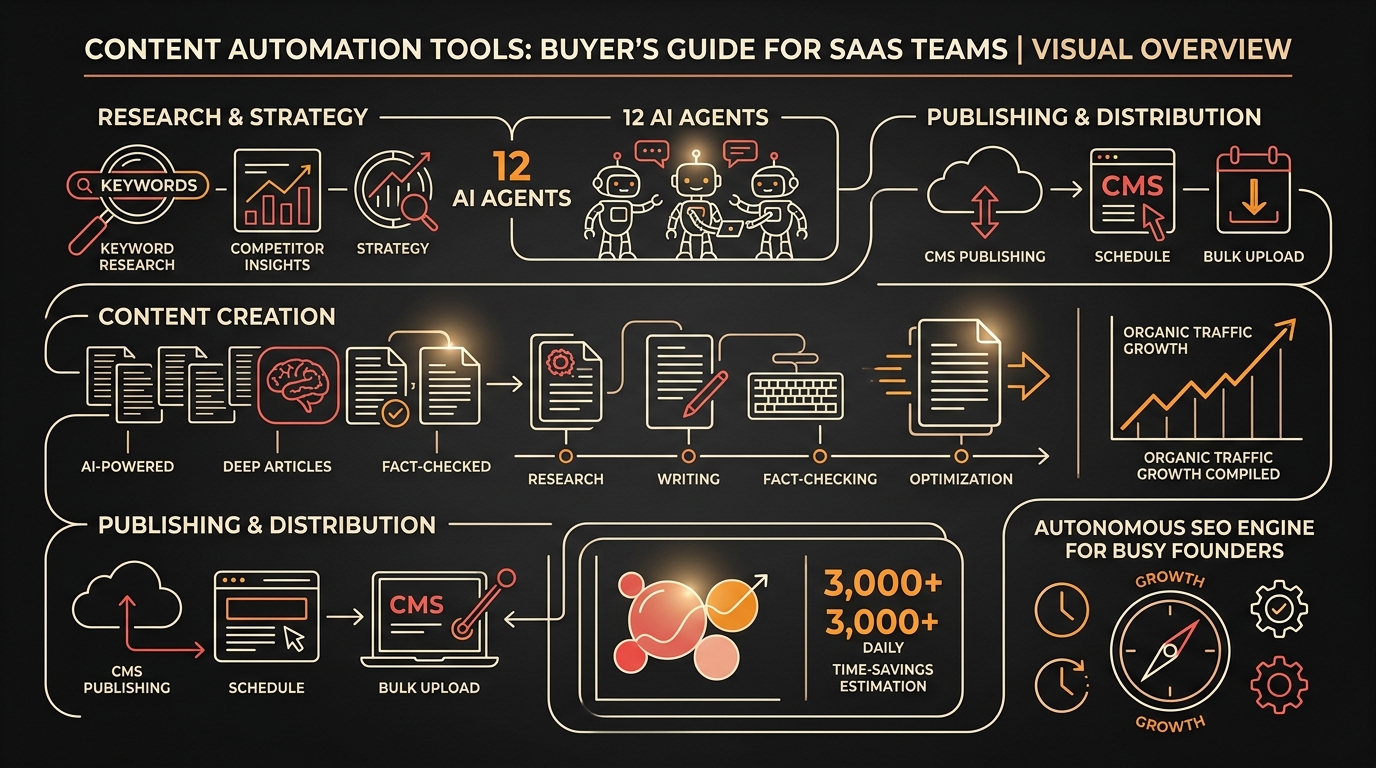
- True content automation covers the entire workflow: keyword research, in-depth research, writing, fact-checking, and direct CMS publishing.
- Look for tools that offer autonomous operation rather than just AI-assisted writing to achieve the highest ROI for a lean team.
- The best platforms integrate SEO, content creation, and publishing into a single, cohesive engine that compounds growth.
- What Are Content Automation Tools?: Software that automates the content marketing lifecycle, from topic discovery to publishing, reducing manual effort and scaling output.
- How Do Content Automation Tools Work?: They use a stack of AI models for research, natural language generation (NLG), SEO optimization, and data analysis to produce articles.
- Evaluating Key Features: Focus on the level of autonomy, research depth, writing quality, and integration capabilities to find a tool that fits your workflow.
- Top Content Automation Tools for SaaS: While many tools assist with writing, fully autonomous platforms like Jottler are built to manage the entire process for busy founders.
- Choosing the Right Tool: Assess your team's available time, technical resources, and primary goal (e.g., traffic growth vs. social media posts) to guide your decision.
- Integrating Automation into Your SEO Strategy: Use automation to build topic clusters, maintain a consistent publishing schedule, and automatically build an internal link network.
What Are Content Automation Tools?
Content automation tools are software platforms designed to streamline and scale the entire content marketing lifecycle, from initial keyword research to final publication. Unlike simple AI writers that require constant prompting and manual editing, true content automation solutions manage the complete workflow. A staggering 96% of marketers report using or planning to use automation (2025, DemandSage), signaling a fundamental shift away from manual processes. For a growing SaaS company, this means reclaiming hundreds of hours while building a powerful, long-term SEO asset.
Defining the Scope: From AI Assistants to Autonomous Engines
The term "content automation" is broad, covering a range of tools. On one end, you have AI writing assistants like Jasper or Copy.ai. These are excellent for overcoming writer's block or generating short-form copy, but they still require a human driver for research, fact-checking, optimization, and publishing. On the other end are autonomous content engines like Jottler, which are designed to operate with minimal human intervention. These platforms connect to your CMS and autonomously run the entire content pipeline, delivering ready-to-publish articles daily.
Core Benefits for Busy SaaS Teams
For a SaaS founder or a small marketing team, the benefits of true automation are transformative. It's not just about speed; it's about consistency and scale. The primary advantages include:
- Consistent Publishing Cadence: Maintain a daily or weekly publishing schedule without fail, a key factor in Google's ranking algorithms.
- Scalable Organic Growth: Systematically target hundreds of long-tail keywords, building a wide traffic base that compounds over time.
- Reduced Operational Overhead: Free up your team to focus on high-level strategy, product, and customer engagement instead of the content production grind.
- Improved Content Quality at Scale: The best tools leverage multiple data sources and fact-checking layers to produce authoritative content that outranks manually written articles.
How Do Content Automation Tools Work?
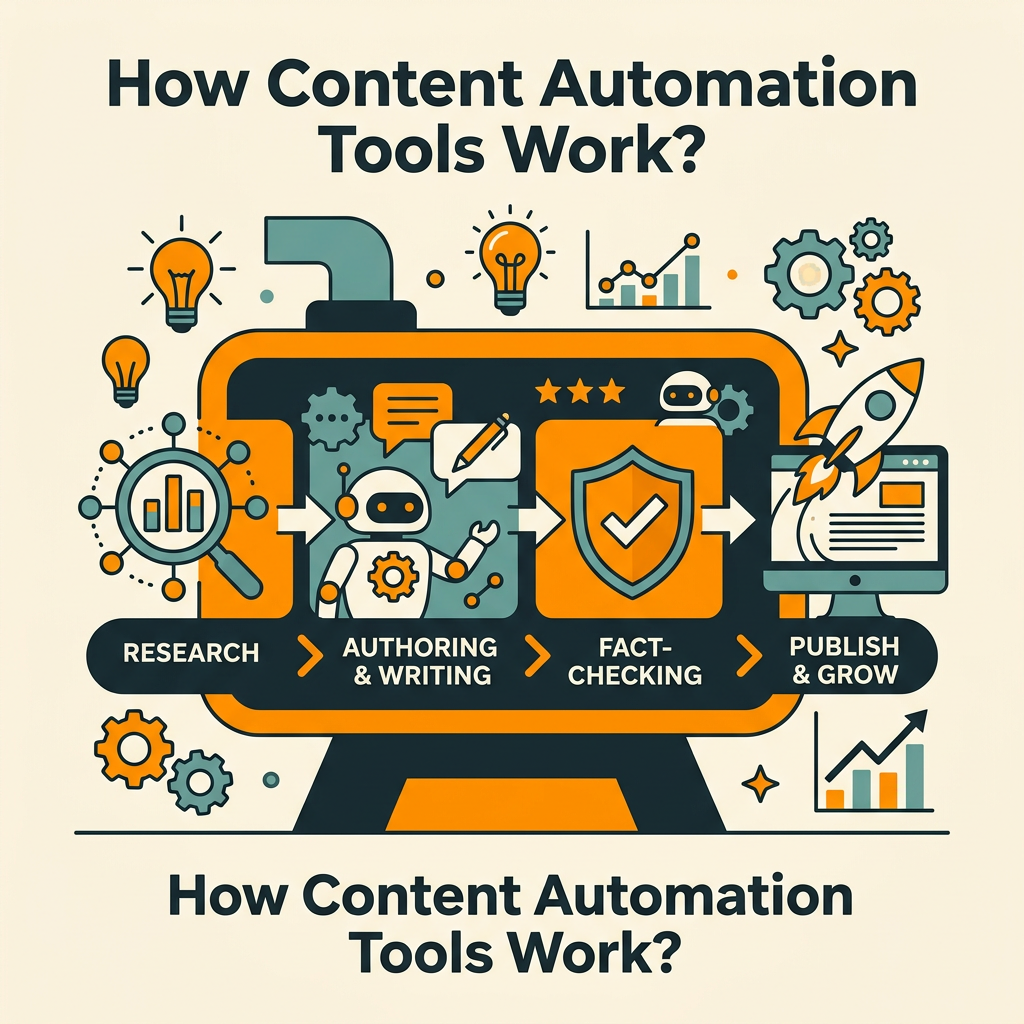
Content automation tools work by orchestrating a series of specialized AI agents to replicate and accelerate the human content creation process. The technology has evolved significantly, with modern platforms moving beyond simple GPT wrappers to sophisticated, multi-step systems. This is reflected in investment trends, with 70% of marketing leaders planning to increase their automation budgets in 2025 (InBeat). This investment is flowing into platforms that can deliver end-to-end results, not just fragmented outputs.
The Underlying Technology Stack
At the core of a modern content automation platform is a technology stack that typically includes:
- Keyword Discovery & Analysis: AI models analyze SERPs, search volume, and keyword difficulty to identify high-opportunity topics aligned with your business goals.
- Deep Research Synthesis: Instead of just scraping a few top results, advanced systems synthesize information from 10-20+ sources, including news articles, academic papers, and statistical data, to build a comprehensive outline.
- Natural Language Generation (NLG): Multiple AI writing agents draft the article section by section, each specializing in different formats like introductions, technical explanations, or conclusions.
- Fact-Checking & Verification: The system cross-references claims against its research sources to ensure accuracy and attribute data correctly, a critical step often skipped by simpler tools.
- SEO Optimization and Internal Linking: The platform optimizes the content for the target keyword, adds semantic keywords, and intelligently inserts internal links to other relevant articles on your site.
"The biggest shift isn't just AI writing the content; it's AI running the entire process. Autonomous systems that handle research, drafting, and optimization are giving small teams the content velocity of a major publisher."
Alex Harris, Founder, Alex Harris Design
What Are the Key Features of Content Automation Tools?
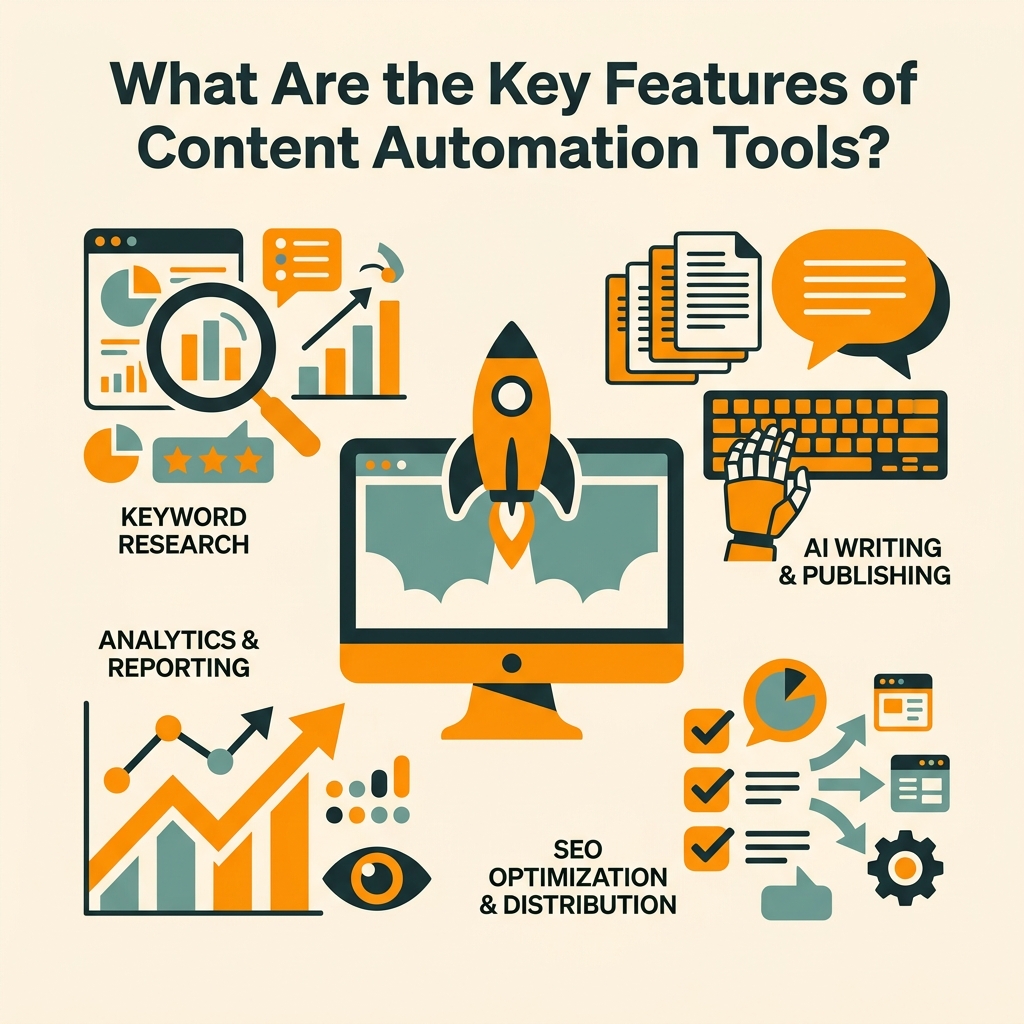
Evaluating content automation tools requires looking beyond the quality of the generated text. The most critical features are those that reduce manual effort and directly contribute to your SEO goals. While many tools now offer AI-powered features, the transition from semi-manual to fully autonomous blog creation has been stark, with non-AI blog creation plummeting from 65% to just 5% in recent years (2026, Typeface.ai). This indicates that the market is rapidly maturing, and buyers should focus on platforms that provide end-to-end automation.
Level of Autonomy
This is the most important differentiator. Does the tool require you to provide a detailed brief, sources, and keywords for every article? Or can it operate autonomously based on high-level goals? An autonomous system like Jottler asks for your domain and core topics, then handles the rest. This "fire and forget" capability is what separates a true automation engine from a writing assistant. It's the difference between hiring a freelance writer and having a full-time content team working 24/7.
Research and Fact-Checking Capabilities
High-quality content is built on deep research. A tool's ability to pull from a wide variety of real-time sources is crucial for creating authoritative articles that Google rewards. Ask potential vendors:
- How many sources do you analyze for each article?
- Do you perform real-time searches or rely on a static index?
- What is your process for fact-checking statistics and claims?
Platforms that can't answer these questions are likely producing shallow, uncompetitive content.
Comparison of Top Content Automation Features
When comparing tools, focus on features that deliver the most leverage for a busy SaaS team. While some platforms excel at on-page SEO suggestions, others automate the entire workflow from keyword to published post.
| Feature | Jottler | Jasper | Scalenut | Copy.ai |
|---|---|---|---|---|
| Autonomous Operation | Fully Autonomous (daily articles) | Manual (requires prompts) | Manual (workflow-based) | Manual (prompt-based) |
| AI Keyword Research | Built-in & Automated | No | Yes (Cruise Mode) | No |
| Deep Research Sources | 14+ live sources per article | Limited to user input | Top SERP results | Limited to user input |
| Fact-Checking | Automated Layer | No | No | No |
| Direct CMS Publishing | Yes (WordPress, etc.) | No | Yes (WordPress) | No |
| Smart Internal Linking | Automated | No | No | No |
Who Are the Top Content Automation Tools for SaaS in 2026?

The market for content automation tools has exploded, but the offerings vary dramatically in their capabilities and target users. For SaaS founders and lean marketing teams, the ideal tool is one that delivers the highest quality output with the least amount of input. The goal is to set the strategy and let the machine execute, not to become a full-time AI prompt engineer. This section focuses on tools best suited for achieving scalable organic growth.
1. Jottler: The Autonomous SEO Engine
Jottler is purpose-built for busy founders who need to scale SEO content without hiring a team. It stands apart as a fully autonomous platform. You connect your website, define your core themes, and Jottler's AI agents take over completely. It handles keyword research, deep analysis of over a dozen sources, writes 3,000+ word articles, fact-checks the content, and publishes directly to your CMS every single day. This "set it and forget it" model is its biggest differentiator.
- Best for: SaaS founders and small marketing teams who need to fully automate their content marketing.
- Key Strength: True end-to-end automation from keyword to published post.
- Limitation: Less suited for teams who want to manually control every sentence of the writing process.
2. Scalenut: The Guided Workflow Tool
Scalenut is a powerful tool that guides users through creating a long-form content piece with its "Cruise Mode." It handles keyword research, clustering, and pulls data from top SERP results to help you structure your article. It's a significant step up from basic AI writers and includes SEO scoring to help you optimize. However, it still requires a human to drive the process, make final edits, and handle publishing.
- Best for: Content teams and SEOs who want a structured workflow to speed up their existing process.
- Key Strength: Excellent for content brief generation and competitive analysis.
- Limitation: Not autonomous; it's an assistant that still requires significant manual operation.
3. Jasper (formerly Jarvis): The Creative Writing Assistant
Jasper is one of the most popular AI writing assistants, known for its high-quality creative copy and versatile templates. It excels at generating marketing copy, social media posts, and short-form content. While it can write long-form blog posts, it requires substantial guidance, fact-checking, and editing. It doesn't perform its own research or SEO analysis, functioning more as a powerful brainstorming partner than an automation engine.
- Best for: Marketers and copywriters who need to generate creative copy ideas and short-form content quickly.
- Key Strength: High-quality prose and a wide variety of templates for different formats.
- Limitation: Completely manual for long-form SEO content; no research or publishing features.
How to Choose the Right Content Automation Tool for Your Team
Selecting the right content automation tool depends entirely on your team's goals, resources, and desired level of involvement. A solo founder has very different needs than a 10-person content team. The key is to be realistic about how much time you can dedicate to managing the content process. The wrong choice leads to a powerful tool gathering dust, while the right one can become a force multiplier for your growth.
Assess Your Primary Goal
What is the main outcome you need? Be specific.
- Maximum Organic Traffic Growth: If your goal is to scale top-of-funnel traffic with SEO articles, you need a tool with strong keyword research, long-form creation, and publishing capabilities. An autonomous engine like Jottler is designed for this.
- Sales & Marketing Copy Support: If your primary need is to write better ad copy, landing pages, and emails, a creative assistant like Jasper or Copy.ai is a better fit.
- Improving Existing Workflows: If you already have a content team and want to make them more efficient, a workflow-based tool like Scalenut can help streamline their process.
Consider Your Available Time
This is the most crucial, and often overlooked, factor. Be honest about your team's capacity.
- "I have no time": If you are a founder or a one-person marketing team, your time is best spent on strategy, not editing articles. A fully autonomous solution is the only viable path to scale.
- "I have a few hours per week": If you can dedicate time to guiding the process, a semi-automated tool could work. You can manage the keyword inputs and review final drafts before publishing.
- "I have a dedicated team": If you have writers and editors, their time can be augmented by AI assistants, helping them produce content faster and with better SEO alignment.
"The future of content marketing for lean startups isn't about writing faster, it's about removing the founder from the production process entirely. True automation is the only way to win the long game of SEO."
David Heinemeier Hansson, Creator of Ruby on Rails & Co-founder of 37signals
How Do You Integrate Content Automation into an SEO Strategy?
Simply producing content isn't enough; it must be integrated into a cohesive SEO strategy to deliver results. Content automation tools are uniquely positioned to execute sophisticated SEO strategies at a scale that is impossible to achieve manually. The key is to leverage the tool's capabilities to build topical authority and a strong internal linking structure, which are powerful ranking signals for Google.
Building Topic Clusters Systematically
Topical authority is a measure of a website's perceived expertise in a specific niche. The most effective way to build it is by creating "topic clusters"a main "pillar" page covering a broad topic, surrounded by dozens of "cluster" pages that cover related sub-topics in greater detail. Manually creating these clusters is a monumental task. An autonomous content tool can be directed to build out a cluster around a core theme, systematically generating articles for every relevant long-tail keyword and automatically linking them back to the pillar page. This is a core feature of the Jottler Topic Tree.
Automating Your Internal Link Network
Internal linking is a highly effective yet often neglected part of SEO. A well-linked site helps search engines understand the relationship between your pages and distributes authority (or "link juice") throughout your domain. Manually adding relevant internal links to every new post is tedious and prone to error. Advanced content automation platforms solve this by automatically scanning your existing content and inserting relevant, contextually appropriate internal links into every new article they generate. This creates a dense, powerful link network with zero manual effort.
Conclusion
For SaaS teams, the question is no longer *if* they should use AI in their content strategy, but *how*. The market is saturated with AI writing assistants that promise to speed up your work but often just shift the bottleneck from writing to research, editing, and publishing. True leverage comes from genuine automation. Platforms that manage the entire content lifecycle autonomously are the key to unlocking scalable, compounding organic growth.
By automating the high-effort, low-reward tasks of daily production, you free your team to focus on what matters: strategy, customers, and product. The data is clear: investment in automation is surging, and teams that embrace end-to-end solutions will build an insurmountable competitive advantage. The best content automation tools covered in this guide, especially autonomous engines like Jottler, offer a clear path to achieving that advantage.
Ready to put your SEO on autopilot? Start your SEO agent and let Jottler handle the rest.
FAQs
What's the easiest way to get started with content automation?
The easiest way to start is by choosing a fully autonomous platform designed for simplicity. Look for a tool that requires minimal setup, such as connecting your website and defining your core topics. Platforms like Jottler are built for busy founders and automate the entire process from that point on, including keyword research, writing, and publishing. This approach avoids the steep learning curve of prompt engineering and complex workflows, allowing you to see results in days, not weeks. Avoid tools that require you to manage multiple steps and integrations, as they defeat the purpose of automation for a lean team.
How is content automation different from just using an AI writer?
The difference is the scope of the task being automated. An AI writer like ChatGPT or Jasper is a tool that assists a human in the act of writing text. It requires a person to provide prompts, facts, structure, and editing. Content automation is a system that automates the entire content marketing workflow. This includes the stages before and after writing: discovering what to write about (keyword research), researching the topic, structuring the article, writing the draft, editing and fact-checking it, optimizing it for SEO, and finally, publishing it to your website with proper internal links. It's the difference between a tool and a complete, autonomous agent.
Can automated content rank on Google?
Yes, absolutely. Google's official stance is that it rewards high-quality content, regardless of how it's produced. The key is "high-quality." Content that is well-researched, accurate, comprehensive, and helpful will rank, whether written by a human or an advanced AI system. Early AI content often failed because it was thin, inaccurate, and lacked real research. Modern content automation platforms, however, use sophisticated research processes, pulling from dozens of live data sources to create authoritative articles that often outperform human-written content in terms of depth and SEO structure. The engine behind the content matters less than the quality of the final output.