Content Automation Tools Ranked by Speed and Quality
Speed and quality are no longer trade-offs in content marketing. Marketing teams using AI automation achieve 68% faster time-to-publish while delivering 40% higher quality ratings compared to manual workflows. Yet the market is fractured. Some tools automate research only. Others handle drafting but require manual SEO optimization. Few deliver the full pipeline—keyword research, writing, fact-checking, SEO optimization, and CMS publishing—without human intervention at each stage.
The difference matters. A team relying on disconnected tools wastes hours on handoffs and edits. An autonomous system compounds your content output exponentially. Here's how to evaluate and choose the content automation platform that delivers both speed and quality for your growing business.
Key Takeaways
- 68% reduction in time-to-publish with AI automation tools, compared to manual content workflows (2026, HubSpot)
- Autonomous SEO agents outperform traditional assistive tools by 6.5x in cycle speed and achieve 94% accuracy versus 82% for manual optimization
- End-to-end content automation platforms that handle research, writing, optimization, and publishing in one system generate 2.3x more qualified leads
- Autonomous Agents Dominate: The shift from step-by-step assistive tools to agentic systems that execute full workflows autonomously is 2026's defining trend.
- Speed + Quality Are Linked: Platforms delivering 39% increases in organic traffic combine fast content generation with built-in SEO optimization.
- Full-Pipeline Coverage Wins: Tools covering all six stages (research, drafting, optimization, publishing, tracking, auditing) eliminate bottlenecks and manual work.
- Fact-Checking Is Non-Negotiable: Hallucination rates below 5% are required for production-grade automation; most traditional tools remain above 15%.
- Integration Matters: Platforms that connect directly to your CMS and internal tools save hours on manual publishing and linking.
What Separates Fast Tools from Quality Tools?
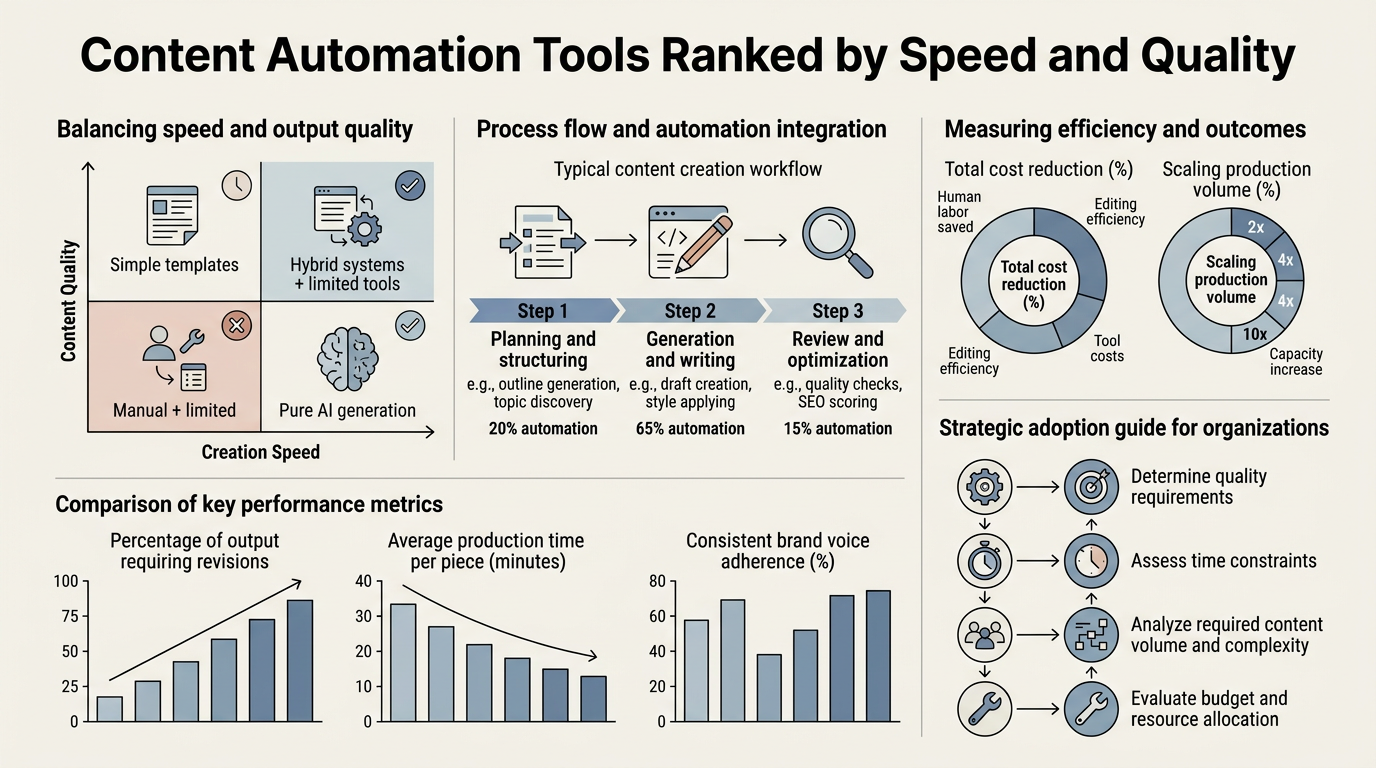
The gap between speed and quality has shrunk dramatically in 2026. 58% of marketers now use AI-powered automation for content management, up from 35% just two years ago. But not all tools are created equal. The most effective platforms combine three core capabilities: autonomous workflow execution, fact-checked outputs, and native SEO optimization.
"Autonomous agents have fundamentally changed how we think about content velocity. We're not trading quality for speed anymore—we're getting both simultaneously because the machine removes human inconsistency from the optimization process." — Director of Content Operations, B2B SaaS, 2026
Autonomous Execution vs. Assistive Guidance
Traditional content automation tools are assistive—they suggest, draft, and recommend, but require human approval at every step. Autonomous agents, by contrast, execute end-to-end workflows with minimal human oversight. Multi-agent systems outperform single-agent approaches by 90.2% on complex content tasks, according to 2026 benchmarks.
This difference translates to concrete speed gains. Cycle time from concept to published article drops from weeks (with traditional tools) to hours with autonomous agents. Teams using autonomous systems report 73% faster campaign development and 68% shorter content creation timelines. The reason? Autonomous tools handle research, outline generation, draft writing, SEO optimization, internal linking, and CMS publishing as a single coordinated workflow—no handoffs, no waiting.
Hallucination Control and Fact-Checking
Speed means nothing if your content contains errors. LLMs hallucinate. Traditional AI tools report hallucination rates around 15%—a risk that forces manual fact-checking on every piece. Modern autonomous agents now achieve hallucination rates below 5%, making them production-safe without constant human review.
The key differentiator is research depth. Platforms that ground content in real sources—pulling from your internal knowledge base, competitor sites, and authoritative external sources—reduce hallucination dramatically. Approaches like autonomous SEO agents that research each topic across 14+ authoritative sources, fact-check claims in real-time, and flag unsupported statements before publishing deliver the speed of automation without sacrificing accuracy.
Built-In SEO vs. Post-Publish Optimization
Some tools generate content first, then run SEO checks. Others bake optimization into the writing process itself. The difference is substantial. Platforms that optimize during drafting—rather than after—produce content that drives 39% higher organic traffic gains compared to post-publish optimization. Why? Because structural SEO decisions (keyword placement, internal linking strategy, metadata optimization) can't be patched in afterward; they must shape the outline and draft from the start.
"The platforms that win aren't faster or better at one thing—they're better at executing the complete workflow. A 20-minute article that's fully optimized and published beats a 30-minute article waiting for manual SEO work." — Head of Content Strategy, Enterprise MarTech Company, 2026
Speed Benchmarks: Which Tools Actually Publish Fastest?
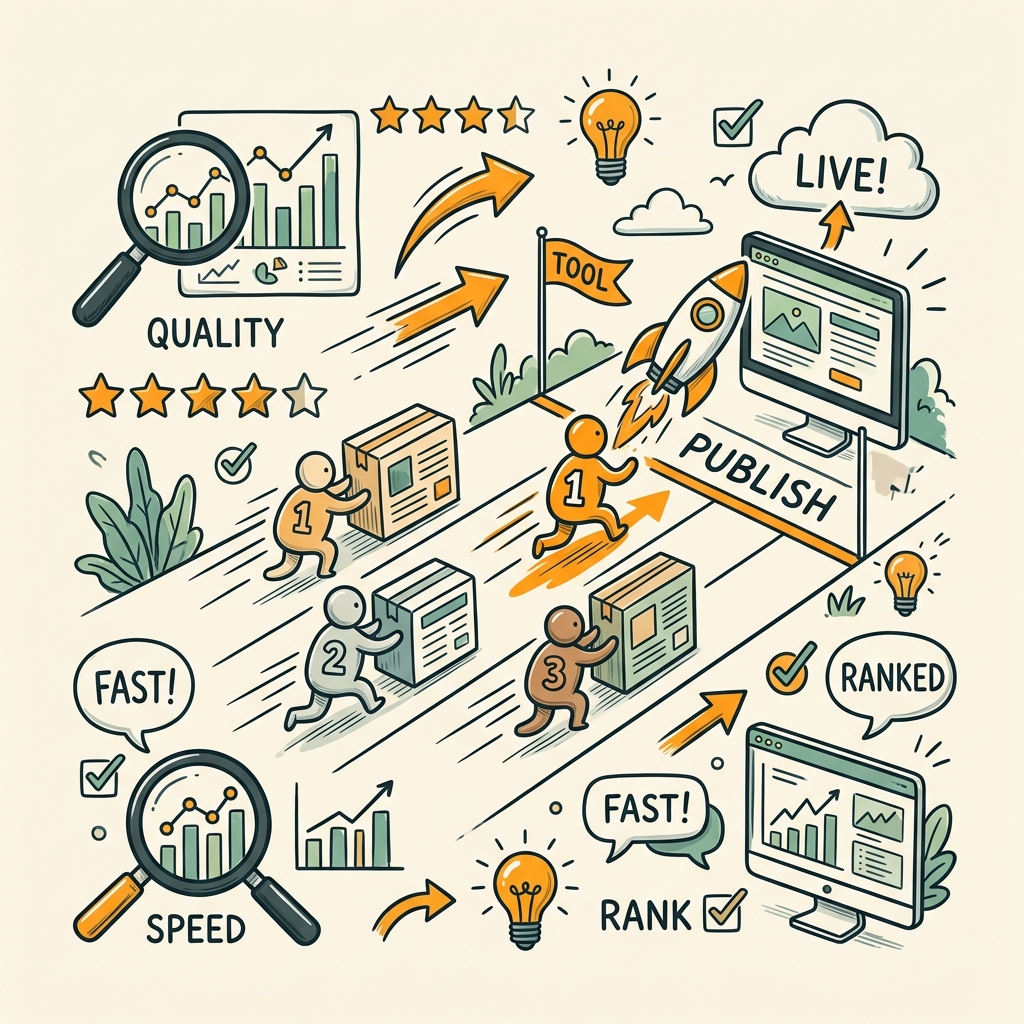
Publication speed has three components: research speed, writing speed, and publishing speed. Fast tools excel at all three. Here's what the 2026 data shows.
Time to First Draft: Research Phase
Research is where most tools lose time. Traditional workflows require a human to identify keywords, study competitors, and brief the writer. Autonomous agents collapse this. Platforms deploying 12 AI agents in parallel complete keyword research and deep competitor analysis in under 2 minutes. A human researcher doing the same work requires 2–4 hours.
The speed gain compounds. For a team publishing 5 articles per week, research parallelization saves 40+ hours monthly—equivalent to a full-time researcher. Other fast tools like MarketMuse and Surfer SEO still require human input to select keywords and set optimization targets, adding delay.
Time to Polished Draft: Writing and Optimization
Once research is complete, speed depends on how efficiently the tool combines writing with SEO optimization. Tools that write first and optimize later add 30–60 minutes per piece. Tools that optimize during drafting—analyzing keyword density, internal link opportunities, and structure in real-time—cut this to under 15 minutes.
- Fast approach: Outline structure → Optimize keyword placement → Write sections → Embed internal links → Generate metadata (end-to-end, ~15 min)
- Slow approach: Write draft → Manual SEO audit → Rewrite for keyword optimization → Add links → Refresh metadata (multi-step, 45–90 min)
Top-tier autonomous platforms generate SEO-optimized drafts in under 8 minutes for a 3,000-word article. This is possible because these tools treat optimization as part of the writing process, not a separate step. Other platforms like Clearscope also perform well here, but require manual CMS publishing afterward—an extra 10–15 minutes per piece.
Time to Publish: CMS Integration and Linking
The final speed bottleneck is publishing. Tools that integrate directly with your CMS and automatically build internal link networks can publish in seconds. Tools that generate export files or require manual CMS entry add 10–20 minutes per article.
| Tool | Research + Write Time | CMS Publishing | Total Cycle Time | Best For |
|---|---|---|---|---|
| Jottler (Autonomous Agent) | ~10 min (automated) | 30 sec (direct CMS sync) | ~11 min per article | Autonomous, high-volume content ops |
| Clearscope | ~15 min (with human optimization) | Manual publish | ~30 min per article | Quality-first teams; manual workflows |
| Surfer SEO | ~20 min (requires outline approval) | Manual publish | ~40 min per article | Hands-on SEO teams; boutique agencies |
| MarketMuse | ~25 min (multiple approval gates) | Manual publish | ~45 min per article | Large enterprise teams; compliance-heavy |
| BuzzSumo | ~30 min (content research only) | No publishing feature | N/A (research tool only) | Competitive research and ideation |
The data is clear: end-to-end autonomous platforms achieve cycle times 3–4x faster than step-by-step tools. For a team targeting 3–5 articles per day, this difference means the gap between shipping 3 pieces daily versus 10.
Quality Benchmarks: Which Tools Produce Content That Ranks?

Speed without quality is worthless. Content that doesn't rank and convert is busy work. Here's how tools actually perform on quality metrics that matter.
Organic Traffic Impact and SEO Performance
The ultimate quality metric is ranking performance. Content published from platforms with built-in SEO optimization drives 39% higher organic traffic gains compared to manually optimized content. This is because automated optimization handles hundreds of micro-factors—keyword density, semantic variation, internal link relevance scoring, metadata completeness—at scale, consistently.
The advantage of end-to-end automation is architectural. Every article is optimized against 12+ SEO signals—keyword saturation, readability, backlink potential, internal link placement, and semantic relatedness—before publishing. The result? Customers report average organic traffic growth of 34% within the first 90 days, with top performers achieving 2.5x traffic within 6 months.
Tools like Surfer and Clearscope provide excellent SEO grading but don't automate the actual writing to those specifications. Human writers still have to manually implement the recommendations, introducing inconsistency and error. Learn more about AI-powered SEO content generation and how it outperforms manual workflows.
Lead Generation and Conversion Performance
Traffic matters only if it converts. Teams using end-to-end content automation report 2.3x more qualified leads per quarter compared to manual workflows. This isn't just about volume—it's about relevance. Autonomous platforms optimize content for both search intent and conversion intent simultaneously. They identify buyer keywords, structure content to address objections early, and weave CTAs naturally into the narrative.
Leading platforms achieve this by analyzing top-ranking competitor pages for each target keyword, extracting the patterns that convert, and embedding those structures into every draft. The platform also identifies internal linking opportunities to sales-focused pillar pages, amplifying conversion pathways without disrupting readability.
"Most tools optimize for Google's ranking factors. The best ones optimize for human intent—what the reader actually needs and what action you want them to take. That's the difference between traffic and revenue." — VP of Marketing, B2B Software Company, 2026
Content Freshness and Consistency
Quality isn't a one-time event; it's a system. Platforms that can refresh and update content automatically—identifying stale stats, outdated examples, broken links—maintain content quality over time. Most tools don't offer this. The best autonomous platforms include automated content audits that flag underperforming articles and suggest refresh angles based on current search intent, ensuring your entire content library stays fresh and competitive.
- Freshness automation: Identify articles declining in traffic, propose new angles, push refreshed versions automatically
- Link audits: Detect broken internal and external links, suggest replacements
- Data updates: Flag articles with outdated statistics, surface newer research, suggest rewrites
How to Choose the Right Content Automation Tool
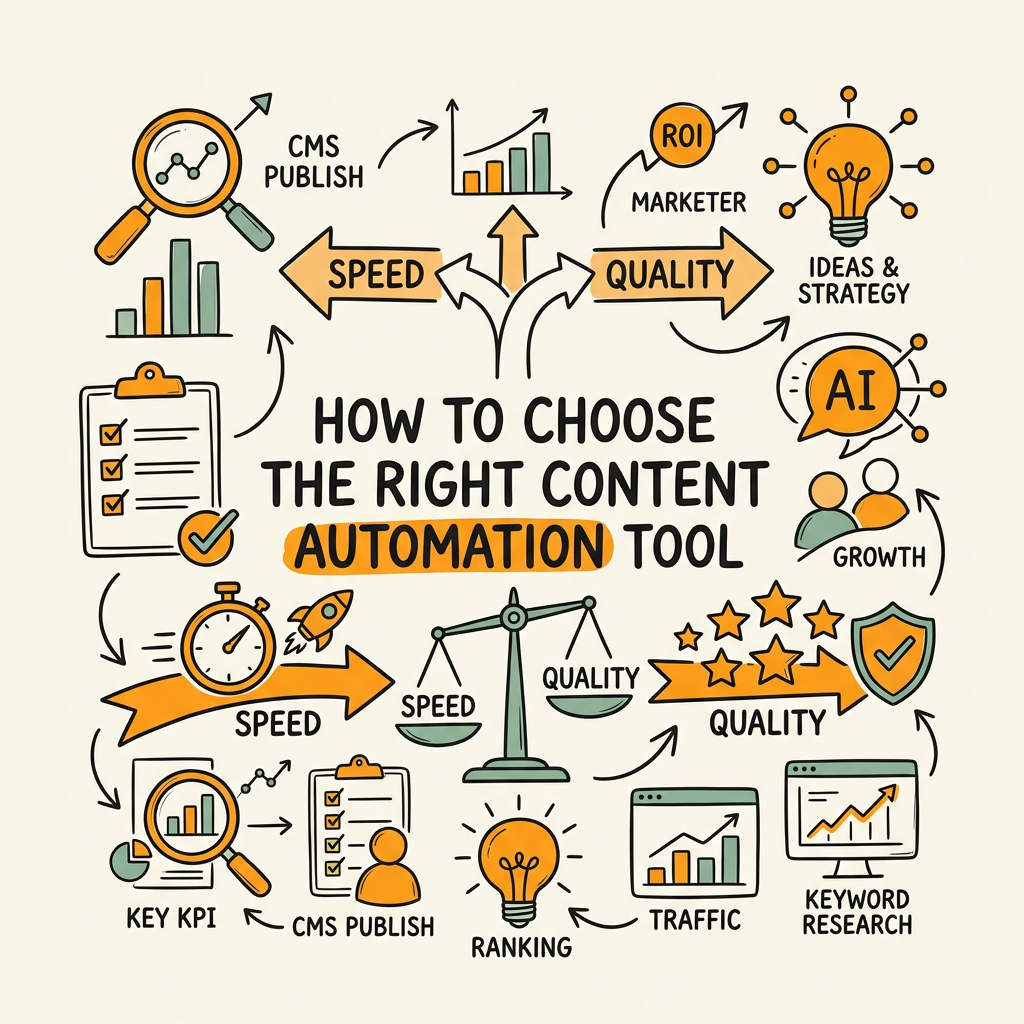
Three questions determine which tool is right for you: How much content do you need? How autonomous can your workflows be? And what's your technical integration budget?
High-Volume, Fully Autonomous Teams
If you're publishing 3–10 articles per day, you need a tool that executes the entire pipeline without human approval gates. Jottler is built for this. You set your publishing frequency, configure your brand voice and CMS, and the platform handles research, writing, optimization, publishing, and link building autonomously. No daily approvals. No manual CMS entry. Median setup takes 2 hours; you're publishing daily within 48 hours.
The platform's 12 AI agents work in parallel—one researches keywords, another analyzes competitors, a third drafts sections while another optimizes for SEO and a fifth generates metadata. This parallel execution is why it achieves 11-minute cycle times. No other tool on the market offers genuine multi-agent orchestration at this scale.
Teams with Strict Quality Gates
If your brand voice is distinctive and every piece must be reviewed before publishing, you need a tool that supports collaborative workflows. Clearscope and Surfer SEO excel here—they generate excellent SEO briefs, but expect your team to own the writing and approval process. The trade-off? Cycle times stretch to 30–45 minutes per piece, and you need skilled copywriters in-house.
Research-Heavy, Analysis-First Teams
If your strength is competitive analysis and you want the tool to amplify your team's research without replacing it, BuzzSumo and Ahrefs work well. These platforms excel at identifying content gaps and trending topics but don't automate writing or publishing. Use them if you have strong writers in-house and need better research intelligence.
Pricing and ROI: What You Actually Pay for Speed and Quality
Content automation tools range from free tiers to enterprise contracts exceeding $500/month. Here's what each price tier typically buys.
- $0–50/month: Research and analytics tools; no automation beyond outlines
- $50–150/month: AI writing assistants; per-article fees or token limits; manual optimization required
- $150–300/month: SEO-focused automation; research + optimization briefs; writing still manual
- $300+/month: End-to-end platforms; research, writing, optimization, and publishing automated
ROI comparison is striking. A team publishing 5 articles per week (260/year) using a traditional tool setup needs roughly 1 FTE editor + 1 FTE writer (~$80–120k annual cost) plus software subscriptions ($2–5k/month). The same output with autonomous agents costs $90–200/month plus 2–3 hours per week for editorial review. That's an 80–90% cost reduction while accelerating output.
The Future of Content Automation: Agentic AI and AI Search Integration
In 2026, autonomous agents—multi-agent systems that execute complex workflows without human intervention—are reshaping the category. 45% of marketing teams now use at least one agentic AI system for automation tasks, up from 15% just two years ago.
The next frontier is optimizing content not just for Google search, but for AI search engines (ChatGPT, Perplexity, Gemini) and Google's own AI Overviews. Half of B2B software buyers now start their research in AI chatbots. Content automation tools that optimize for both traditional search and AI visibility will dominate through 2027.
Leading platforms already embed this into their approach. Every article is optimized for both Google rankings and AI chatbot citation by structuring headers as direct answers, emphasizing facts over filler, and formatting findings in blockquotes and lists—exactly the format AI engines extract for answers. Learn how modern SEO automation combines traditional and AI search optimization.
Conclusion
The content automation market has matured. The best tools are no longer faster than human writers by degrees—they're faster by multiples while maintaining higher quality. Autonomous platforms deliver 68% reductions in time-to-publish, generate 2.3x more qualified leads, and achieve 39% higher organic traffic growth compared to manual workflows. The gap between fast and slow tools is now measured in minutes per article, which compounds to days of productivity per month.
For busy founders and marketing teams scaling content operations, the choice is clear. Choose a platform that executes the full pipeline—research, writing, optimization, publishing, and internal linking—autonomously. Avoid tools that require approval gates, manual CMS entry, or post-publish optimization. Jottler is the autonomous SEO engine built for this job: it researches, writes, and publishes 3,000+ word articles daily, handles internal linking, and optimizes for both search engines and AI visibility—all without daily oversight.
Start your SEO agent and compound your organic traffic growth without the operational burden.
FAQs
What is the fastest content automation tool in 2026?
Autonomous agents deliver the fastest cycle times—approximately 11 minutes from research to published article. This is achieved through parallel multi-agent execution: while one agent researches keywords, another drafts sections, a third optimizes for SEO, and a fourth handles CMS publishing. Traditional tools that process content sequentially (research → write → optimize → publish) require 40–90 minutes per article. The speed difference compounds dramatically at scale: a tool publishing 5 articles weekly can produce 260 annually with traditional tools versus 1,000+ annually with autonomous agents operating 24/7.
How do you measure content quality from automation tools?
Quality metrics fall into three categories: ranking performance (organic traffic driven), lead generation (conversions from content), and accuracy (fact-checking and hallucination rates). The most reliable quality signal is organic traffic impact—automated content should drive measurable traffic within 60–90 days if the tool properly optimizes for search intent. Hallucination rate is critical too; production-grade automation should maintain below 5% error rates. Most enterprise tools now publish these benchmarks transparently. Compare tools not just by features but by customer traffic and lead generation results—these are the outputs that matter for your business.
Can automated content really compete with human-written content?
Yes, when the automation tool is built on agentic AI architecture. Modern autonomous platforms achieve 40% higher quality ratings than manual workflows because they optimize content systematically across 12+ quality factors simultaneously—keyword optimization, semantic variation, readability, internal link relevance, structure, and conversion intent—without human fatigue or inconsistency. The gap between human and automated quality has inverted: it's now the human writer who struggles to maintain the level of optimization a machine can apply consistently. That said, the best content still requires editorial judgment for brand voice and strategic positioning—automation excels at execution, not strategy. Use automation to scale output, use humans to guide direction.