Content Batching Strategy for Automation Efficiency
Batching content is one of the fastest ways to scale production without burnout. Yet 94% of social media practitioners report feeling chronically online, constantly scrambling for ideas, struggling to maintain consistency, and watching creative time splinter across tasks. The problem is clear: creating content one piece at a time is a time hemorrhage. The solution is equally clear—batch strategically, then automate the workflow. Here's how to reclaim hours per week while compounding your organic reach:
Key Takeaways
- Content batching saves teams 5+ hours per week by reducing context switching and concentrating creative work into focused sessions (Sunsama, 2026)
- Teams using automation-enabled batching report 60% to 80% faster content production without sacrificing quality
- 40% of content creators had adopted multi-format batching by 2025, signaling mainstream adoption
- Define Your Batching Window: Protect 90-minute to 3-hour blocks for focused content creation, reducing the mental tax of constant task switching.
- Build Your Content Framework: Anchor batching around 3-5 core topics or pillars so each session produces cohesive, on-brand output.
- Separate Creation from Distribution: Draft multiple pieces in one session, then schedule and publish in another—maintaining quality while boosting speed.
- Automate the Approval Workflow: Use platforms that consolidate drafting, review, and scheduling to eliminate manual handoffs between team members.
- Measure Batch Productivity: Track completion rates, time per batch, and context-switching interruptions to quantify your efficiency gains.
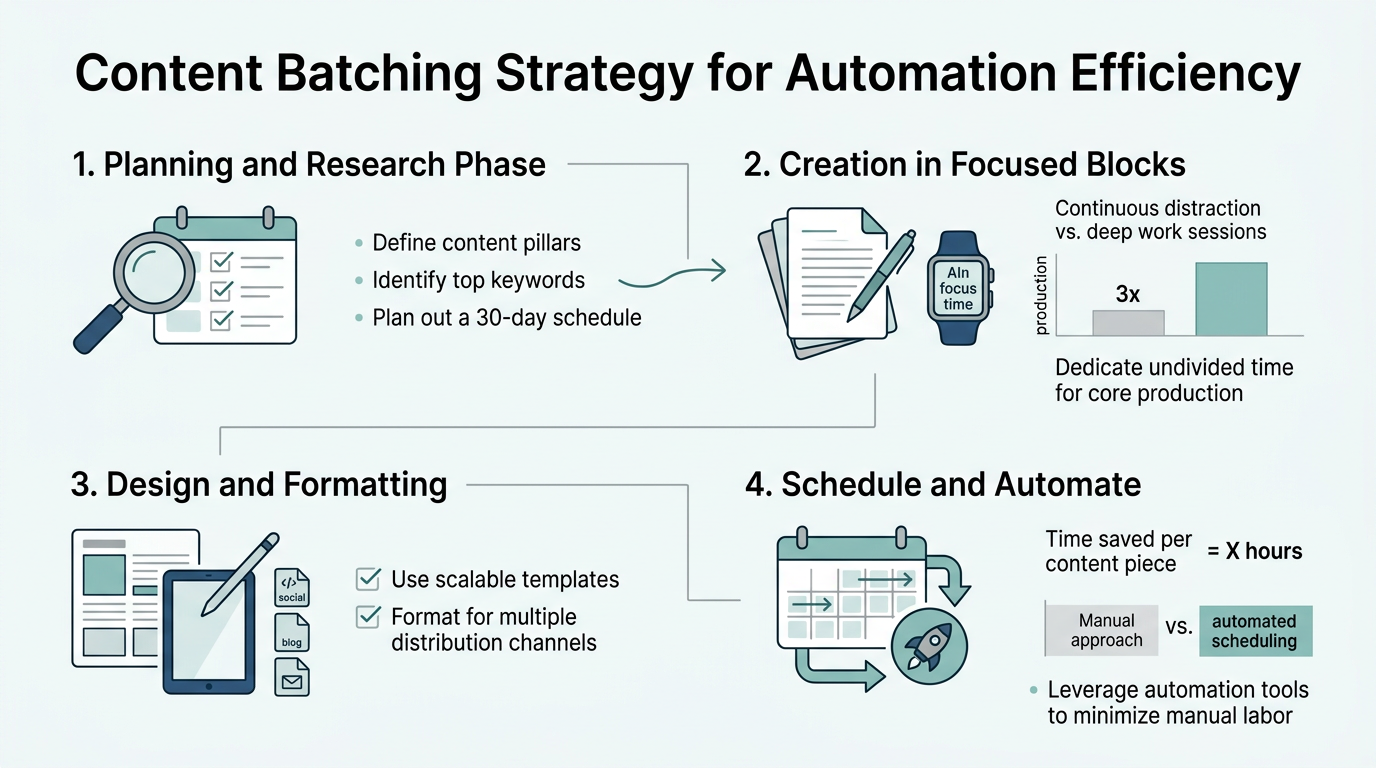
What Is Content Batching and Why Does It Matter?
Content batching is the practice of grouping similar work into dedicated time blocks rather than creating content on demand. Instead of writing a blog post today, designing a graphic tomorrow, and scheduling on day three, batching consolidates ideation, creation, editing, and scheduling into a single focused session. Organizations that batch report 25% overall productivity gains and cut context switching from 40 interruptions per day down to 15. The math is simple: context switching eats roughly 47% of your workday. Batching reclaims that time.
"When you're constantly creating on demand, you're perpetually 'on.' Batching creates structured, designated creative windows so the rest of your week is protected from that pressure."
For busy founders and marketing teams, batching solves a deeper problem than just efficiency—it prevents burnout. 33% of social media practitioners' greatest fear is burnout and creative fatigue. Batching is the operational defense against that. When you schedule creation into intentional windows, you protect yourself and your team from the constant pressure of always being available for content ideas.
The compounding effect is where the real value lives. A founder or marketer who batches content one day per week can produce 4-8 pieces across multiple formats, schedule them strategically, and then spend the remaining time on strategy, relationship-building, or other leverage activities. Scale that across a year, and you've gone from scattered, inconsistent output to a predictable content engine.
How Does Batching Reduce Context Switching and Save Time?
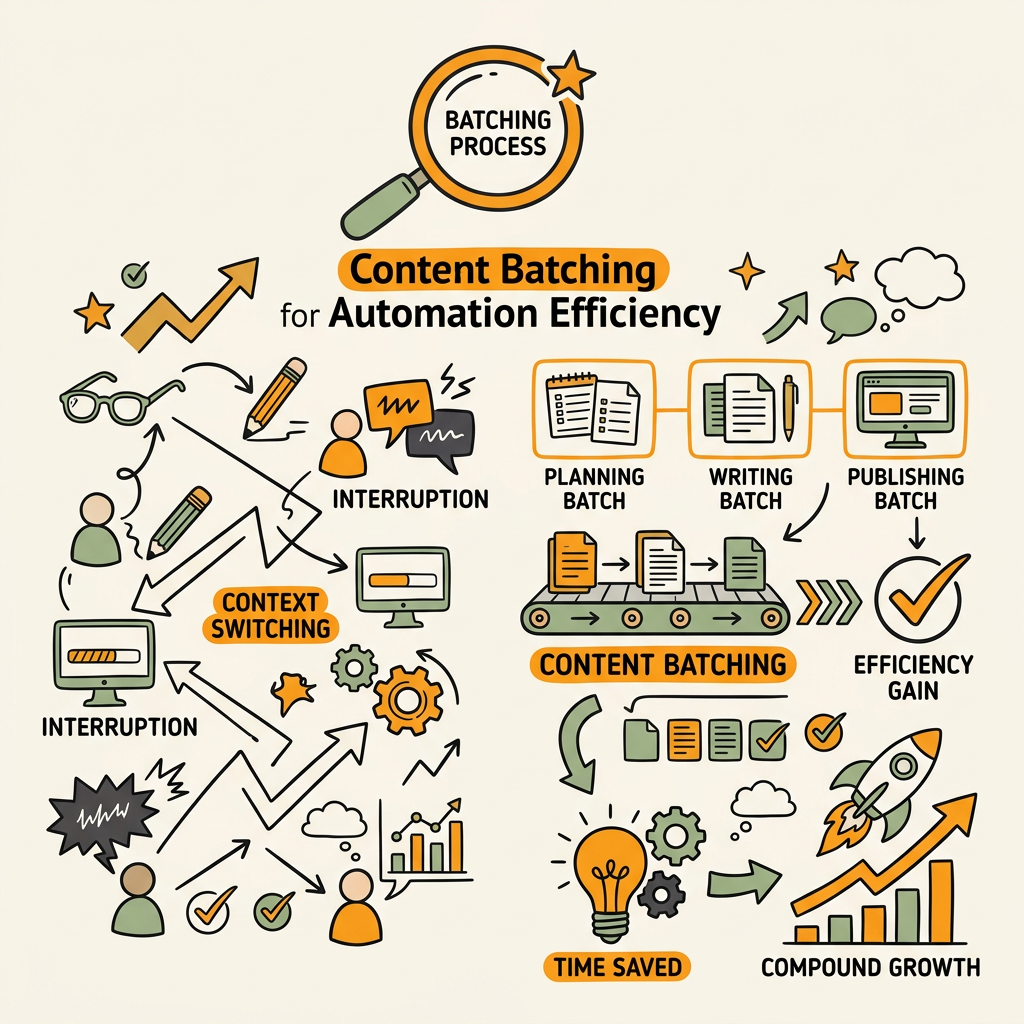
The science behind batching is cognitive. When you switch between different types of work—writing, then editing, then uploading—your brain pays a "switching tax." Research shows task batching reduces context switching from 40 times per day to just 15, yielding an average of 5 hours per week in reclaimed time. Your first 15 minutes of focused work on any task are consumed just reorienting to that task. Batch similar activities, and you pay that tax once, not repeatedly.
The Context-Switching Cost
Every time you shift between creation, editing, and distribution, you reset your mental model. You lose momentum. Your drafting brain is different from your editing brain, and both are different from your publishing brain. Most teams run these in parallel across individuals or days, multiplying the switching overhead. Batching locks in one mode at a time. During a drafting session, you write. During an editing session, you refine. During a publishing session, you schedule. Each person or block stays in flow state rather than context-hopping.
"Teams protecting 90-minute to 3-hour focused blocks report better creative output because deep work time is preserved. You're not pausing mid-thought to respond to Slack."
The result is both speed and quality. You're not starting fresh after an email interruption. You're in the work.
Batching Across Time Zones and Team Sizes
For distributed teams, batching also aligns production with asynchronous workflows. A team can batch content across Monday and Tuesday, then pass a shared folder of drafts to editors on Wednesday, then schedule everything Thursday. No real-time collaboration needed. No waiting for approvals. Each phase has owners and deadlines. This is especially powerful for SaaS teams spread across regions—batching lets you coordinate workflows without requiring everyone in the same Zoom call.
Building a Content Batching Framework for Your Team
Effective batching isn't random—it's structured around your content strategy. The strongest batching frameworks anchor production to 3-5 core content pillars or themes so each session produces strategically aligned output. Teams using content pillars report more consistent audience engagement because messaging stays cohesive across multiple pieces. Here's how to build your own framework:
Establish Your Content Pillars
Start by identifying 3-5 core themes your audience cares about. For a SaaS team, pillars might be: workflow automation, industry trends, customer success stories, technical how-tos, and company updates. During each batching session, you'll produce pieces across these pillars so the output is balanced and on-brand. Without pillars, batching becomes haphazard—you create whatever's top-of-mind instead of what your strategy demands.
Example: If you batch once per week and have 5 pillars, you might produce 1 piece per pillar per session. That's 5 pieces per week—or 20 pieces per month—without the mental load of daily ideation. The pillars do the thinking for you.
Design Your Batching Schedule
Protect a recurring time block for batching. Monday and Tuesday mornings work well for many teams because energy is high and the week is fresh. Mark it on the calendar. Block it from meetings. This is non-negotiable time. Monday recommends 90-minute to 3-hour blocks for deeper work—any shorter and you don't reach flow state; any longer and fatigue sets in. If your team has multiple writers, rotate who leads each session to distribute the creative load and prevent burnout.
For a small team or founder, one 3-hour batching session per week is a starting point. For larger marketing teams, consider a weekly ideation session (1 hour) followed by a dedicated production day (4-6 hours). The structure varies by team size, but consistency matters more than the exact duration.
Map Production to Publishing Timeline
Batching isn't just about creating; it's about linking creation to distribution. If you batch on Monday and Tuesday, schedule your editing for Wednesday and publishing/scheduling for Thursday. This separation keeps each phase focused. During creation days, nobody worries about publication dates or channel optimization—that comes later. During distribution days, nobody is expected to draft new material. The clarity prevents bottlenecks and rework.
How Batching Integrates with Automation Tools

95% of enterprise marketing teams and 78% of mid-market organizations now use at least one marketing automation platform, and those platforms are increasingly designed to support batching workflows. The strongest tools consolidate content drafting, collaborative review, approval workflows, scheduling, and multi-channel distribution in one interface. Jottler takes this further—it batches the entire research-to-publishing pipeline, researching topics, drafting long-form articles, fact-checking, and scheduling directly to your CMS daily, eliminating the manual batching friction entirely.
The Batching + Automation Multiplier
Organizations using AI-powered content tools report 60% to 80% faster content production without sacrificing quality. The reason is simple: automation handles the highest-switching-cost tasks. Instead of spending 5 hours on keyword research, a team spends 30 minutes configuring automated research and collecting the findings. Instead of 3 hours optimizing a page for SEO, 30 minutes. The freed hours scale batching further—instead of one 3-hour batching session per week, you can do two or three with the same team size.
Choosing an Automation-Ready Batching Platform
When evaluating tools for batching, look for platforms that support:
- Bulk drafting and scheduling: Create multiple pieces in one session, then schedule them across days or weeks without returning to the tool.
- Collaborative review workflows: Editors and approvers can comment, suggest changes, and approve batches without slowing creators down.
- Content calendars with pillar organization: See all batched content mapped to your pillars, dates, and channels in one view.
- Multi-channel distribution: Publish a piece once; the platform distributes it to your blog, email, social channels, and CRM simultaneously.
- Recycling and queue automation: Evergreen content automatically republishes on a schedule, so your batched work compounds over time.
Many teams attempt to batch using Google Docs and a calendar spreadsheet. It works for very small teams, but breaks quickly as volume grows. Purpose-built tools accelerate batching by removing the manual steps between creation, review, and publishing. Leading marketing automation platforms in 2026 now include AI-powered content generation alongside batching capabilities, so a single tool can handle research, drafting, scheduling, and performance measurement.
Implementing Your Content Batching System in Five Steps
Step 1: Audit Your Current Workflow and Establish a Baseline
Before batching, measure how much time you spend on content today. Sunsama recommends tracking work patterns for 1-2 weeks to identify where you're wasting time—context switching, waiting for approvals, or searching for past content are common culprits. Count how many times you switch between drafting, editing, and scheduling in a given day. That's your baseline. After implementing batching, you should see that number drop dramatically.
Step 2: Define Your Content Pillars and Publishing Cadence
Decide what topics you'll batch around and how often you'll publish. A healthy cadence for most growing teams is 1-3 new pieces per week, plus republished or repurposed content. Map those against your pillars. Example: Monday batching session produces 2 thought-leadership pieces (pillar 1), 1 how-to (pillar 2), and 1 customer story (pillar 3). The predictability of having a framework removes decision paralysis.
Step 3: Schedule Your Recurring Batching Block
Pick a day and time for batching and defend it. No meetings. No Slack. If this is a team exercise, ensure everyone participates—even if they're contributing research or outlines rather than full drafts. The consistency trains your brain and your team to enter batching mode. Week to week, batching becomes faster because you're not relearning the process.
Step 4: Set Up Your Batching Tools and Approval Workflow
If you're using a platform, configure it for batching: create content calendar templates, set up approval stages, and automate publishing to your channels. If you're batching research, create a template for research notes so batching sessions are faster. The goal is to remove friction—the less you think about process, the more you focus on quality.
Step 5: Measure Completion Rates, Velocity, and Batch Size Over Time
Track how many pieces you produce per batching session, how long each batch takes, and whether quality holds steady. After a month, you should see batching sessions getting faster as the team internalizes the rhythm. After three months, you should be producing 30-50% more content with the same headcount.
Batching Content for Different Formats and Channels
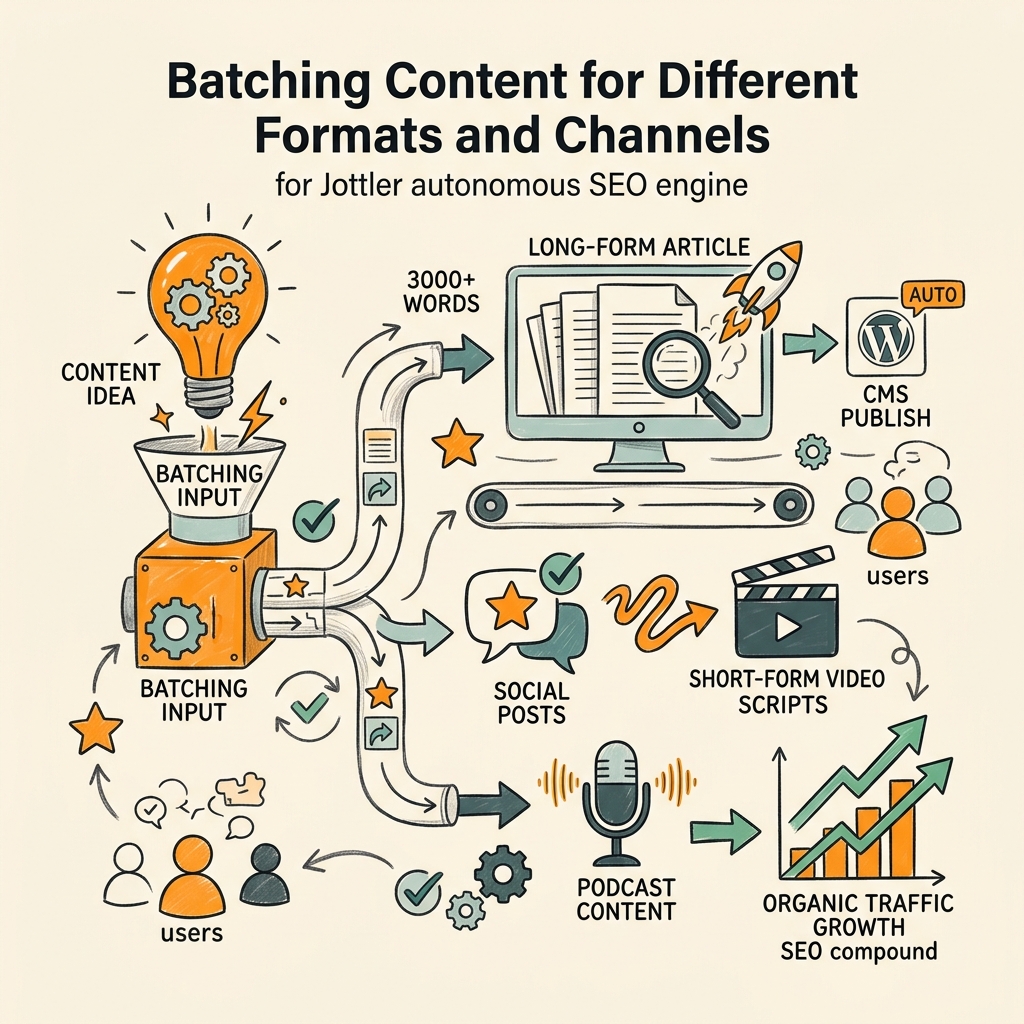
Batching works across all content types, but the mechanics shift. Blog articles, email campaigns, social posts, and video scripts all benefit from batching, yet each requires slightly different workflows.
Blog and Long-Form Content Batching
For SEO-driven content, batching amplifies the research advantage. Instead of researching one article, researching it thoroughly, and publishing, research 4-6 topic clusters in a single session. AI-powered content generation tools automate this—they research and write comprehensive articles using multiple sources, fact-checking and publishing directly to your CMS. But even for manual content teams, batching research across multiple articles means you're not duplicating effort. If your audience cares about "SEO automation," you batch articles on SEO automation tools, why it matters, implementation strategies, and case studies in one research window. The research compounds; the writing flows faster.
Email and Nurture Campaign Batching
Email batching works differently because sequences are linked. Batch the entire nurture sequence at once—welcome email, day 3 follow-up, day 7 value piece, day 14 pitch—in a single session. This ensures thematic consistency and tone throughout the sequence. You're not waiting 2 weeks to write the final email; it's done alongside the first. Scheduling is then a simple matter of uploading the batch and setting send times.
Social Media Content Batching
Social batching is where the time savings are most visible. Many teams batch 2-4 weeks of social content in a single session. Platform-specific scheduling tools (or native platform features) then automate publishing at optimal times. Batching social is also where cross-platform consistency emerges—Sprout Social recommends batching as a workflow that aligns ideation, production, editing, and scheduling so all channels reflect a single strategic push.
| Content Type | Ideal Batch Window | Expected Output per Session | Key Efficiency Lever |
|---|---|---|---|
| Blog / Long-Form (3,000+ words) | Half-day to full day | 2-4 pieces | Research consolidation; outlining templates |
| Email Sequences | 2-3 hours | 1 complete 5-email sequence | Template-based copy; approval once per sequence |
| Social Media Posts | 2-3 hours | 14-30 posts (mix of channels) | Content calendar; bulk scheduling tools |
| Case Studies / Interviews | Full day | 1-2 pieces | Interview scheduling; transcription automation |
| Product Updates / Announcements | 1-2 hours | 3-5 variations (blog, email, social, press) | Single source of truth; template repurposing |
Common Batching Mistakes and How to Avoid Them
Batching Too Much Too Soon
The most common mistake is trying to batch 8 weeks of content in one session. By hour 4, creative energy crashes. Quality suffers. Fatigue sets in. Batching 90-minute to 3-hour blocks produces better output than marathon sessions. It's better to batch weekly than monthly—consistency compounds faster and prevents the energy cliff.
Separating Creation from Strategy
If your batching session is only execution—writing without thinking about SEO, audience needs, or business goals—output becomes unfocused. Spend 15-20 minutes per batching session on strategy: What pillars are we covering? Who are we reaching? What keywords matter? Then execute. The thinking is part of batching.
Skipping the Approval Workflow
If you batch without a built-in approval stage, rework multiplies. Someone drafts, someone else has feedback, the drafter is already deep in the next piece, and iteration stalls. Build approval into your batching calendar: creation window, then review window, then scheduling window. This is where SEO automation platforms shine—they consolidate drafting, fact-checking, and approval stages so feedback loops are fast.
Ignoring Performance Data
Batching is only sustainable if you measure it. Track which batches produce the highest-performing content. Which topics resonate? Which formats convert? Use that data to shape the next batching cycle. Otherwise, you're batching for output, not impact.
Measuring Batching ROI
To prove batching's value, track three metrics: velocity, quality, and burnout prevention.
Velocity: Content Produced per Hour
Measure how many pieces you complete per batching session and how long each takes. Week 1 might be: 4 hours of batching, 3 pieces produced (45 minutes per piece). Week 8 might be: 3 hours of batching, 5 pieces produced (36 minutes per piece). As the team internalizes the rhythm, velocity increases. When you're producing more with less time, batching is working.
Quality: Engagement and SEO Performance
A batched article shouldn't rank lower than a carefully-sequenced one. Track average time-on-page, bounce rate, and search rankings for batched content. If quality is steady or improving, batching is working. If it's dropping, your approval workflow or research depth needs work.
Burnout Metrics: Context Switching and Team Satisfaction
Ask your team: How many times per day are you context switching? How stressed do you feel about content production? Batching should reduce both. Informal polling is fine—if the team reports feeling less frazzled, batching is delivering on the burnout prevention front.
Scaling Batching with Automation
Batching is powerful for teams of 1 to 10. Beyond that, automation becomes essential to prevent bottlenecks. Agentic AI systems (AI that runs autonomously rather than on-demand) can handle research, drafting, and variant generation so human batching focuses on review and strategy. Jottler is built on this model—it researches, writes, fact-checks, and publishes autonomously, freeing your team to batch reviews and strategy conversations instead of drafting from scratch.
The ROI compounds: instead of batching 3 articles per week manually, a team using Jottler can publish 15 articles per week, batch them, and focus batching time on internal strategy and performance analysis rather than creation.
Conclusion
Content batching is the operating system for sustainable content production. It cuts context switching, prevents burnout, and enables consistent output. Teams batching content report 5+ hours of recovered time per week, 25% productivity gains, and significantly lower stress. The strongest batching frameworks anchor production around content pillars, protect recurring batching windows, and integrate automation tools that eliminate manual scheduling and approval friction. When paired with AI-powered content automation, batching becomes compounding—your team produces more with less effort, and earlier batches continue to generate value through republishing and internal linking. Start by identifying your 3-5 core content pillars, scheduling a recurring 2-3 hour batching block, and measuring time saved and content velocity over a month. The momentum will compound from there.
Start your SEO agent today to experience batching at scale—Jottler researches, writes, and publishes daily without requiring your team to batch creation sessions.
FAQs
How much time can content batching actually save?
On average, teams save 5+ hours per week by batching content instead of creating on demand. The savings come from two sources: reducing context switching (which accounts for roughly 40% of lost time) and consolidating research and approval workflows. Some teams report 50–70% faster content production when batching is combined with automation tools. The exact figure depends on your baseline workflow—teams with many interruptions see larger gains than those with protected focus time already in place.
What's the best batching schedule for a small team?
For a small team or founder, one recurring 2-3 hour batching session per week is an excellent starting point. Block it on your calendar—Monday or Tuesday mornings work well when energy is high. During that session, focus on creating multiple pieces across your core content pillars. Then schedule distribution separately on a different day. This rhythm allows you to produce 4-8 pieces weekly without splitting focus. As you scale, add a second batching session or extend the block to 4 hours, but consistency matters far more than volume.
Should I batch my SEO content the same way I batch social media?
No—the batching mechanics differ by format. Blog and long-form content requires deeper research and longer creation windows (3-4 hours per batch), while social media content batches faster (often in 2-3 hours for 2-4 weeks of posts). The key is to batch strategically within each format's natural workflow. For SEO content, consolidate your research across multiple article topics in one session to avoid duplicate effort. For social, batch around themes or campaigns so messaging stays cohesive across posts. The principle is the same; the execution adapts to each channel's demands.