You can publish 100 blog posts and rank for almost nothing. Or you can publish 20 and dominate your category. The difference is strategy. Specifically, the difference between scattering content across random keywords and building it in clusters around core topics your audience actually searches for.
Content cluster strategy is how you stop wasting months of editorial effort on articles that never see search traffic. It is the operational framework that turns your blog from a content dumping ground into a ranked-position factory.
Key Takeaways
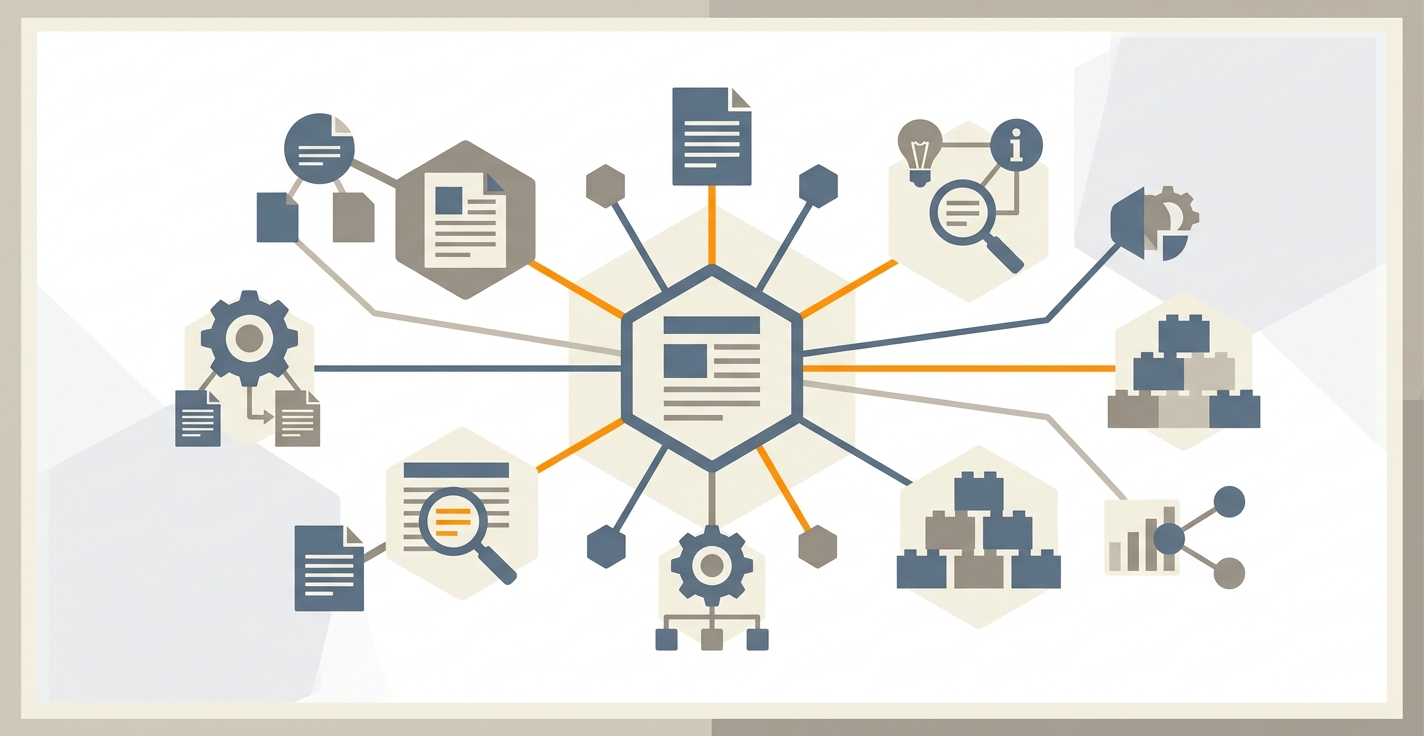
- A content cluster strategy groups articles around core pillar topics, with cluster articles addressing specific subtopics and internal links that distribute ranking power throughout the structure.
- Sites implementing pillar-cluster architecture see an average 40-63% increase in keyword rankings within 90 days, versus scattered one-off articles that fight for visibility alone.
- The tactical foundation is a five-element map: pillar content, 15-25 cluster articles, entity research, linking patterns, and a publication sequence that concentrates authority before expanding.
- Most teams fail not because they misunderstand clusters, but because they skip the mapping phase and start writing immediately, creating orphan articles that never link to anything.
The Core Elements of a Cluster Strategy
A content cluster strategy has five working parts. Each one serves a specific function in building topical authority.
Pillar pages are your broadest content pieces, typically 2,500 to 4,000 words, covering an entire topic at a surface level. A SaaS company might have a pillar on "sales automation" that explains what it is, why it matters, how it differs from CRM tools, and which problems it solves.
Cluster articles are narrower pieces that dive into one specific aspect of the pillar topic. Under "sales automation," you might have cluster articles on "sales automation for cold outreach," "automating follow-up emails," or "sales automation tools for enterprises." Each cluster article targets a different keyword and audience segment but connects back to the pillar.
Entity research is the list of companies, tools, people, methodologies, and frameworks that Google associates with your pillar topic. This determines what concepts your articles must reference to appear topically complete.
Internal linking structure is the intentional pattern of how pillar pages, cluster articles, and supporting content link to each other. This distributes ranking power and signals to Google that your site is comprehensively covering a topic.
Publication sequence determines the order in which you publish everything. Wrong sequencing kills topical authority because it delays the moment your pillar page has enough inbound equity to push cluster articles higher.
Phase 1: Define Your Pillar Topics
You cannot build a cluster strategy without first choosing what topics you will own. This is not a keyword research exercise—it is a strategic decision about which categories of search demand your product or service can address.
Start with 3 to 5 pillar topics. Do not start with 15. A tightly focused strategy that dominates three topics will outrank a scattered strategy that mediocrely covers ten topics.
For each potential pillar, ask these questions:
- Does my product or service solve problems within this topic?
- Does my target audience actively search for information about this topic?
- Do I have unique perspective, methodology, or data to contribute?
- Is the topic broad enough to support 15-25 related subtopics?
If the answer to any of these is no, remove the topic from your list. Weak pillars drain resources without returning ranking volume.
Use keyword data to validate volume. Search for your pillar topic in keyword research tools and check the search volume. A pillar topic with zero search volume is a waste. But also understand that pillar topics often have lower individual search volume than their cluster keywords combined. The value of the pillar is not its direct traffic but its ability to anchor and rank your entire cluster.
For example, "project management" might have 3,000 searches per month. But "agile project management," "project management for construction," "Jira tutorial," "sprint planning," and 40 other cluster keywords under that pillar might combine for 100,000+ searches. The pillar page's job is to intercept the broadest possible audience and link them into cluster content.
Phase 2: Map Your Subtopics (The Cluster Blueprint)
This phase determines what you will and will not write. Skip it and you will end up with orphan articles that never rank.
For each pillar topic, list every subtopic your audience might search for. Cast a wide net here. You are not filtering yet—you are cataloging.
Use these four sources:
-
Google search suggestions. Type your pillar topic into Google and note every autocomplete suggestion. These are real search queries people are typing.
-
People Also Ask boxes. Search for your pillar keyword and expand every "People Also Ask" result. These are the exact questions your audience has.
-
Competitor analysis. Find the top 5 ranking articles for your pillar topic and examine their table of contents and headings. What subtopics did they cover?
-
Customer research. Scan your support tickets, sales conversations, and audience feedback for questions people ask repeatedly. These are often subtopics competitors are not addressing.
Create a spreadsheet with three columns: Subtopic, Cluster Keyword, and Search Volume. This is your cluster map.
A cluster map for a "content marketing" pillar might include:
- Content marketing ROI (cluster keyword: "content marketing ROI")
- Content calendars and planning (cluster keyword: "content marketing calendar tools")
- Long-form versus short-form strategy (cluster keyword: "long form content strategy")
- Multi-format repurposing (cluster keyword: "content repurposing tools")
- Measuring content performance (cluster keyword: "content marketing metrics")
Aim for 15 to 25 subtopics per pillar. If you find fewer than 10, your topic is too narrow to build significant topical authority. If you find more than 30, consider splitting your pillar into multiple pillars.
Phase 3: Research Entities and Semantic Context
Google no longer just matches keywords to content. It maps entities—the people, companies, tools, methodologies, and frameworks associated with a topic—and measures whether your content is semantically complete.
Spend time reading the top 10 ranking articles for each of your cluster keywords. As you read, note every entity mentioned. Create a master entity list for your pillar topic.
For example, if you are building a pillar on "email marketing," your entity list might include:
- Tools: Mailchimp, HubSpot, ConvertKit, ActiveCampaign
- Concepts: segmentation, deliverability, list growth, compliance, automation
- People: Kath Pay (email marketing expert), Noah Kagan (growth strategy)
- Standards: CAN-SPAM, GDPR, best practices
Your cluster articles should reference many of these entities. If all the top-ranking articles mention Mailchimp and active list management, but your article ignores both, Google will perceive your content as less topically complete.
This is not about keyword stuffing. It is about ensuring your content answers the same semantic questions that Google's algorithms expect answers to.
Phase 4: Design Your Internal Linking Architecture
Internal linking is where cluster strategies fall apart. Many teams build great cluster articles but link them incorrectly, breaking the authority flow.
A proper cluster linking structure follows three rules:
Rule 1: Every cluster article links back to the pillar page. This is not optional. Every single cluster article should have one or more internal links pointing to the pillar page using keyword-rich anchor text like "read our guide to [pillar topic]" or "learn more about [pillar topic]."
Rule 2: The pillar page links to every cluster article. The pillar page should have a list section at the bottom titled "Explore our [pillar topic] guides" or "In this series," with links to every cluster article. This creates the hub-and-spoke topology that distributes ranking power.
Rule 3: Cluster articles link to each other contextually. If you are writing an article on "email list growth" and another article on "email segmentation" is relevant to the reader, link between them. Do not force cross-cluster links where they do not make sense. One to three contextual cross-links per cluster article is typical.
Practically, this linking pattern should be in place before you publish your first article. If you wait until later, you will forget cross-links and create a disorganized structure.
Use consistent, descriptive anchor text. Instead of "read more," use "learn how to [specific benefit]" or "[concept] best practices." This signals to search engines what topic each link targets.
Phase 5: Sequence Your Publishing (Authority Concentration)
Publication order determines how quickly your cluster gains ranking power. Most teams get this wrong.
The correct sequence is:
-
Publish the pillar page first. This gives the breadth-first foundation and becomes the hub your cluster articles will link back to. Do not publish cluster articles before the pillar—they will have nowhere to point and will dilute your authority signal.
-
Publish cluster articles in batches. Wait 2-3 weeks after the pillar page publishes before releasing the first batch of cluster articles (3-5 articles in a batch). Then release subsequent batches on a 2-3 week cadence. This concentrates your topic signal to Google rather than spreading it thin over months.
-
Prioritize high-volume cluster keywords first. Publish cluster articles targeting your highest-search-volume keywords first. These will rank faster and send the most authority back to the pillar page, which in turn boosts your lower-volume cluster articles.
-
Link the pillar page to cluster articles immediately upon publication. The moment a cluster article goes live, update the pillar page's link section to include it. Do not wait. This establishes the connection that powers the cluster.
Why does sequence matter? When cluster articles publish before the pillar page has established authority, each article starts from zero. They compete with each other for attention. When the pillar page publishes first and gains authority, every new cluster article inherits some of that authority through backlinks to the pillar. This is the compounding effect that makes clusters powerful.
A typical timeline for a pillar plus 20 cluster articles:
- Week 1: Publish pillar page (2,500-4,000 words)
- Week 3-4: Batch 1 (5 cluster articles)
- Week 6-7: Batch 2 (5 cluster articles)
- Week 9-10: Batch 3 (5 cluster articles)
- Week 12-13: Batch 4 (5 cluster articles)
Total rollout: 13 weeks. In that time, your pillar page gains ranking equity, your cluster articles start placing in search results, and your site's topical authority in that category compounds.
Tactical Considerations: Tools and Workflow
Building a content cluster strategy manually is possible but inefficient. Many teams use content planning tools to generate cluster maps automatically, which saves weeks of research.
The workflow looks like this:
- Input your pillar topic into a tool
- Tool generates subtopic suggestions with search volume data
- You review, approve, and refine the cluster map
- Tool creates an editorial calendar with publication sequence
- You or your writing team executes the calendar
For organizations using autopilot publishing, this entire process can run hands-free. The platform researches entities, drafts articles, builds internal links, and publishes on schedule. This removes the bottleneck of manual execution and lets you focus on strategy rather than tactics.
The alternative is building clusters manually: keyword research tools, spreadsheets, linking checks, publication coordination. This can take 2-3 months of heavy coordination work upfront, plus ongoing maintenance.
Avoiding Common Execution Mistakes
Teams that understand cluster strategy often still fail due to execution errors. Here are the mistakes that sabotage the most well-planned clusters:
Mistake 1: Publishing cluster articles as standalone pieces. You build a cluster map, get excited, and start publishing articles without ensuring they link back to the pillar. Now you have good content with zero structural advantage. The fix: lock your internal linking structure before publishing anything.
Mistake 2: Overcomplicating the linking structure. You try to build a knowledge graph where every article links to every other article. This creates linking confusion and dilutes authority signals. Keep it simple: cluster articles link to the pillar, the pillar links to clusters, optional cross-links only where topically relevant.
Mistake 3: Creating cluster articles before the pillar page ranks. You publish 20 cluster articles, then publish the pillar 6 months later. By then, your cluster articles are orphaned and the pillar page has no authority to share. Always publish the pillar first.
Mistake 4: Ignoring search intent mismatch. A cluster article targeting "content marketing tools" should not link to a pillar on "content marketing strategy"—the intents are different. Match your pillar to cluster intent carefully, or you create a confusing content experience.
Mistake 5: Skipping the entity research phase. You publish cluster articles that miss critical entity references your audience expects. Google sees your content as topically incomplete. The fix: spend 2-3 hours reading your top competitors' cluster-keyword articles and cataloging which entities, frameworks, and concepts they reference.
How to Measure Your Cluster's Success
After 90 days, evaluate whether your cluster strategy is working. Track these metrics:
- Ranking volume for the pillar keyword. Did it move?
- Ranking volume for cluster keywords. How many are now ranking in top 10, 20, 100?
- Internal traffic from pillar to clusters. Are readers following your internal links and visiting cluster articles?
- Pogo-stick rate. Are visitors staying on your site as they move between pillar and cluster content, or leaving?
- Search visibility score. Many SEO tools calculate total search visibility by combining ranking positions across all keywords. Did your cluster improve your visibility for the pillar topic and related queries?
If your cluster is working, you should see:
- Pillar page ranking for the primary keyword (or climbing toward it)
- 30-60% of cluster keywords ranking in top 50 within 90 days
- Measurable traffic flow between pillar and cluster articles
- Low pogo-stick rate (readers are not immediately leaving)
If you are not seeing these signals after 90 days, your cluster likely has a tactical flaw. The most common causes are:
- Linking structure is broken (check that pillar links to clusters and vice versa)
- Cluster keywords are too high-difficulty for your domain authority
- Cluster articles are orphaned or belong in multiple clusters (which means your pillar was too broad)
- Entity coverage is weak (competitors are referencing entities you are missing)
Frequently Asked Questions
How many pillar topics should I start with?
Start with 1 to 3. Building a full 25-article cluster takes 2-4 months. If you start with 5 pillars, you will dilute resources and finish none of them. Pick your strongest category, dominate it, then expand.
What if my pillar topic has fewer than 10 subtopics?
Your topic is too narrow. Consider broadening it or merging it with related topics. A cluster needs critical mass to show topical authority. Fewer than 10 articles does not register to Google as a concentrated expertise signal.
Can I have multiple pillar pages on the same topic?
Technically yes, but not recommended. Multiple pillars on the same topic create internal competition and confuse Google's linking signals. If you have two topics that closely overlap, merge them into one pillar or clearly segment them by intent.
How often should I update cluster articles after they rank?
Review and refresh your top 10 cluster articles every 6 months. Update statistics, add new entity references, and improve sections where competitors have gained ground. Do not let content stagnate once it ranks.
What if a cluster article targets a keyword my pillar page also targets?
Rewrite the pillar page or the cluster article to target different keywords. Keyword cannibalization kills your cluster's effectiveness. Each piece of content should target one primary keyword with unique intent.
How long before a cluster shows ranking benefits?
Pillar pages typically start ranking within 30 days if your domain has some authority. Cluster articles follow slower—expect 60-90 days for significant rankings. But the compounding effect happens fastest in weeks 60-120, when enough cluster articles rank to generate internal traffic that boosts remaining pieces.
Start Your Cluster Strategy This Month
Content cluster strategy separates teams that get lost in random article publishing from teams that execute a plan. The difference is not intelligence—it is process.
Begin by choosing one pillar topic, mapping 15-20 subtopics, and publishing on the sequence outlined here. Within 120 days, you will have data on whether clusters work for your business. If you see ranking gains and traffic flow, expand to your second and third pillars.
If you are managing multiple teams or publishing at volume, consider automating the research and writing phases with Jottler's topic tree, which generates cluster maps automatically and structures the internal linking for you. The platform turns 4 months of manual planning into a two-week setup process.
Your competitors are still publishing random articles. You will be building ranked-position factories.