Content Cluster Strategy: Dominating SERPs with Topic Authority
Most marketers treat content like a collection of isolated blog posts, hoping each piece ranks individually. The reality? Sites using topic clusters see 40% higher organic traffic within the first year (Digital Applied, 2026), and pages within well-structured clusters enjoy 2.5 times longer ranking retention (HireGrowth, 2025). The gap between scattered content and strategic clusters isn't a matter of writing better—it's about organizing smarter. Here's how to build clusters that signal topical authority to Google and capture traffic at every stage of the buyer journey.
Key Takeaways
- Topic clusters drive 40% organic traffic growth within the first year of implementation (Digital Applied, 2026)
- Pages within clusters retain rankings 2.5 times longer than standalone content (HireGrowth, 2025)
- The pillar-and-spoke structure signals semantic authority to search engines when internal linking is deliberate and descriptive
- What Content Clusters Are: Topic-organized content networks where a pillar page anchors multiple related articles, all linked strategically to establish topical authority and improve SERP dominance.
- Why They Work: Content clusters align with how Google interprets entity relationships and semantic relevance, rewarding comprehensive topical coverage with better rankings and longer-lasting visibility.
- Pillar-and-Spoke Framework: A broad pillar page (2,500–3,000 words) covers the main topic; supporting cluster pages (1,000–1,500 words) dive into subtopics, FAQs, use cases, and comparisons, all linked back to the pillar.
- Strategic Internal Linking: Every cluster page links to the pillar with consistent, descriptive anchor text; the pillar links to key supporting pages to reinforce topic relationships.
- Measuring Success: Track cluster-wide organic traffic, average rankings, backlink growth, and conversion impact—not just individual page metrics.
What Are Content Clusters and Why Do They Matter?
Content clusters organize your pages around core topics, not isolated keywords. A cluster consists of a pillar page (the authoritative hub) and multiple cluster pages (supporting spokes) that address subtopics, questions, and variations. This structure tells Google your site is a complete source of information on that topic—a critical signal for topical authority.
In 2025–2026, topical authority has become more important than simple keyword targeting alone (Velir, 2025). Marketers who shift from a flat keyword list to a hierarchical topic structure see measurable wins: better rankings, higher click-through rates, and faster ranking recovery after algorithm updates. The reason is straightforward: Google's systems now prioritize entity relationships and semantic depth, not just keyword matches. A cluster of pages that link to a central hub creates those entity signals.
"Topical authority isn't about keywords anymore—it's about demonstrating comprehensive knowledge through interconnected content that helps search engines understand your expertise across an entire topic area."
— Velir SEO Research, 2025
The Pillar Page: Your Topic Authority Hub
The pillar page is the cornerstone of a content cluster. It covers the broad topic comprehensively—typically 2,500 to 3,000 words—and serves as the central reference point. This isn't a landing page; it's a complete guide that addresses the main question and points readers to deeper resources.
A strong pillar page includes an overview of the topic, key definitions, core frameworks, a table of contents linking to cluster pages, and clear next steps. Every cluster page should link back to the pillar using consistent anchor text (e.g., "See our complete guide to [Topic]"). The pillar, in turn, links to key cluster pages, creating a two-way relationship that strengthens topical cohesion. The goal isn't to make the pillar answer everything—it's to position it as the authoritative hub that weaves the cluster together.
Cluster Pages: Depth Through Specificity
Cluster pages are focused articles (800–1,500 words) that dive into subtopics, answer specific questions, or explore use cases. Each cluster page should address one core query or topic and then link back to the pillar. Unlike generic supporting content, cluster pages have a specific mission: answer a reader's targeted question while reinforcing the pillar's authority on the broader topic.
Effective cluster pages cover: FAQs related to the main topic, comparisons between related approaches, step-by-step how-tos, case studies, advanced use cases, and tangential questions your audience asks. The key is relevance and interconnection. A cluster on "content strategy" might have pillar pages supported by cluster articles on audience research, content calendars, distribution channels, ROI measurement, and team workflows—each one linked back to the pillar.
Building Your Cluster: The Framework
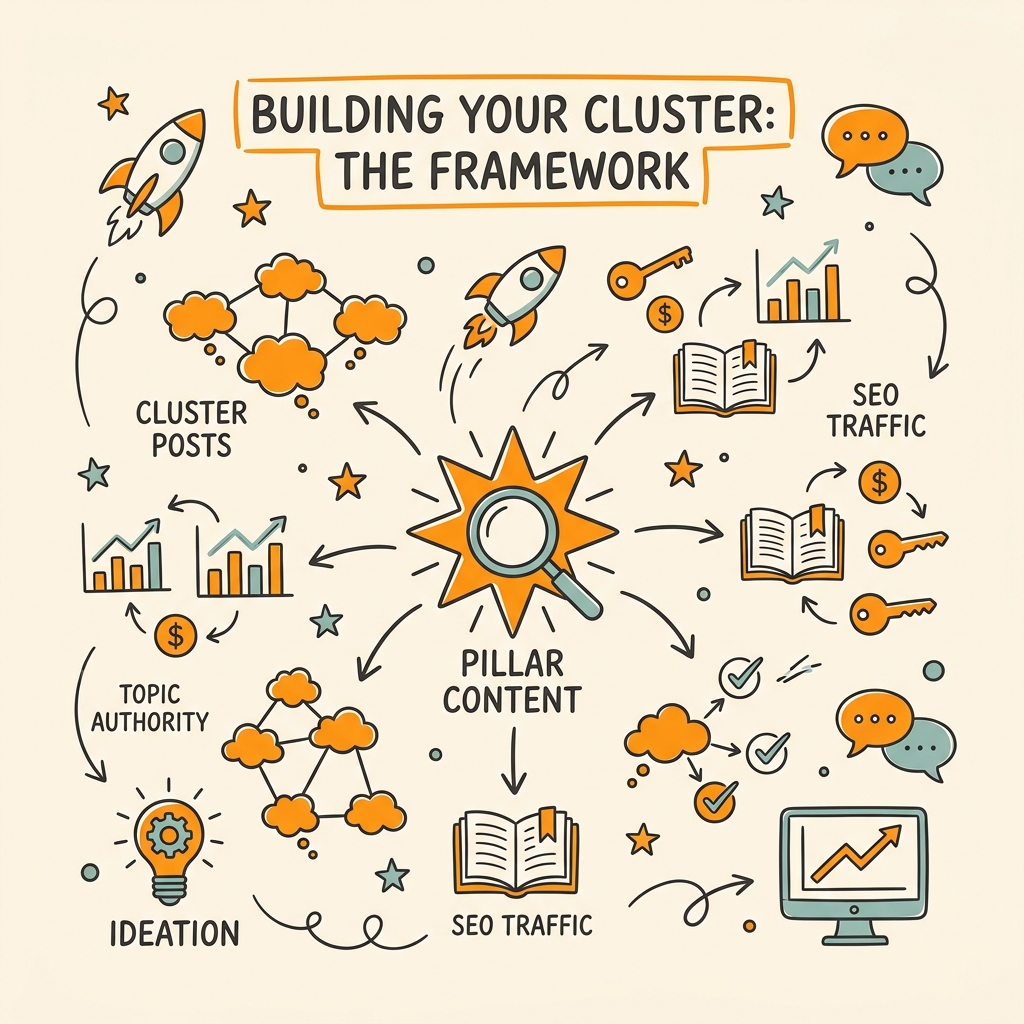
A strategic content cluster doesn't happen by accident. It requires deliberate planning, topic mapping, and a long-term content roadmap. Here's how to structure yours effectively.
Step 1: Audit and Identify Core Topics
Start by auditing your existing content. Which pages already have traffic, backlinks, or rankings near the top of page one? Which topics do your buyers actually care about? Choose 3–5 core topics aligned with your business goals and audience pain points—not generic keywords, but real subject areas your company owns.
For a SaaS platform, core topics might be: "lead management," "sales enablement," "conversion optimization," "team productivity," and "analytics." For each core topic, list all the subtopics your audience asks about. This inventory becomes your cluster roadmap.
Step 2: Map the Pillar and Spoke Structure
For each core topic, designate one pillar page and list 8–12 cluster pages that support it. Map the relationship: which cluster pages should link to the pillar, and which pillar content should link to specific spokes? Create a visual diagram—a mind map or spreadsheet—showing the hierarchy and connections.
The pillar should feel like a table of contents for the cluster. Its internal navigation should guide readers to relevant cluster pages. When the pillar is live, search engines can crawl the entire network and understand the topical relationships—a signal that's especially powerful when combined with external backlinks to the pillar.
Step 3: Write and Link Strategically
Write the pillar first. Once it's published, write cluster pages one at a time, ensuring each links back to the pillar using natural, descriptive anchor text. Consistent anchor text—e.g., "See our guide to X"—helps search engines understand that each page belongs to the same topic cluster (HubSpot, 2025). The pillar should then link to key cluster pages in its body or conclusion.
Here's where many teams stumble: they link without intention. Use internal linking as a deliberate signal of topical relationships, not just navigation. Every link should have a reason and use an anchor that reinforces the semantic connection.
"The difference between scattered content and a cluster isn't the quality of individual articles—it's the intentionality of the connections between them. Clusters compound authority; scattered posts don't."
— HubSpot Content Strategy Research, 2025
How Content Clusters Impact Your SERP Rankings
The SERP impact of content clusters isn't just about individual page rankings—it's about cluster dominance. When done right, a well-structured cluster can hold multiple top-10 positions for related keywords, making your domain the obvious choice for any search around that topic.
Stronger E-A-T Signals for Google
Google's ranking systems evaluate topical expertise using E-A-T: expertise, authoritativeness, and trustworthiness. A content cluster demonstrates all three. When Google crawls a network of interlinked pages that each cover a subtopic thoroughly, the system infers: "This site knows what it's talking about on this topic."
This E-A-T boost is compounding. The first cluster page might rank moderately; by the time you've published 8–10 supporting pages, the entire pillar ranks higher because Google sees a pattern of expertise. External backlinks amplify this effect—a single backlink to the pillar passes authority to the entire cluster.
Semantic Understanding and Entity Recognition
Google's systems model topics as entities with relationships. A content cluster naturally creates these relationships. When you link cluster pages using consistent anchor text and semantic language, you're teaching Google's systems how your topic network is structured. This entity-based approach helps your site rank for related and long-tail variations because search engines understand that your content is semantically related, not just keyword-matched.
Longer-Lasting Rankings with Cluster Authority
One of the most compelling benefits of content clusters is ranking stability. Standalone articles may rank briefly, then fade. Pages within a well-maintained cluster tend to rank longer and recover faster after algorithm updates. The reason: your topical authority acts as a buffer. Even if one page loses traction, the cluster's overall authority keeps it anchored in the SERPs.
Cluster pages also benefit from shared authority. When you update or expand the pillar page, the SEO value ripples through the cluster. This flywheel effect means less constant optimization pressure on individual pages and more cumulative authority growth.
"Cluster pages don't just rank faster—they rank longer. The topical authority from a mature cluster acts as a buffer against volatility, meaning your rankings recover quicker after algorithm updates and maintain stability across the cluster."
— HireGrowth Ranking Stability Analysis, 2025
Content Clusters vs. Keyword-Driven Content Strategy
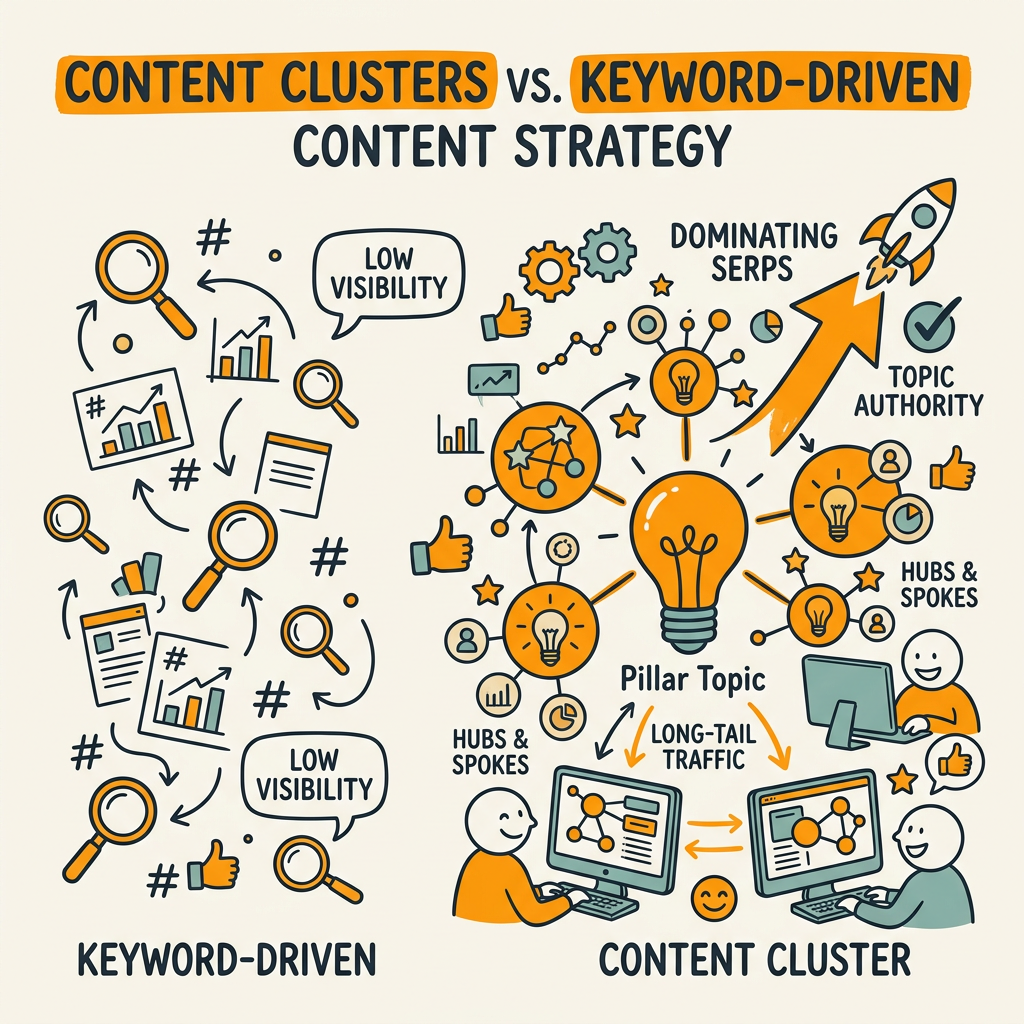
Traditional keyword-driven strategies focus on targeting individual keywords with individual articles. You create a blog post for "lead scoring," another for "lead nurturing," another for "lead qualification"—each one fighting for its own ranking. They rarely link to each other because they're built in isolation.
| Strategy Dimension | Keyword-List Approach | Content Cluster Approach |
|---|---|---|
| Organization | Flat list of keywords; each post targets one keyword | Hierarchical; pillar anchors 8–12 related subtopics |
| Internal Linking | Minimal; links scattered or based on relevance alone | Strategic; every cluster page links to pillar using consistent anchor text |
| Topical Depth | Wide coverage, shallow per topic; many single-post topics | Deep coverage per topic; 10,000+ words of interconnected content per cluster |
| SERP Dominance | 1–2 rankings per topic; high churn | 3–5+ rankings; longer retention; faster recovery post-update |
| Content Velocity | More posts needed to maintain ranking pressure | Fewer, higher-quality posts with greater collective impact |
| Maintenance | Updating individual posts; high overhead | Refresh pillar to refresh entire cluster; centralized maintenance |
The difference compounds over time. After 12 months, a keyword-list strategy may have 30–40 blog posts scattered across different topics, each with moderate rankings. A cluster strategy might have 4–5 pillars (one per core topic) with 40–50 supporting pages, all heavily interlinked and dominating the SERPs for their topics. The second approach produces more organic traffic with less ongoing effort.
This is why teams using content automation platforms that understand cluster structure gain a compounding advantage. Instead of manually mapping topics, writing in isolation, and remembering to link pages, automated systems can generate cluster-aware content that's interlinked from the start, accelerating topical authority growth.
Implementing Content Clusters at Scale
Building one cluster is manageable. Building five clusters while maintaining a publishing schedule and managing updates is where most teams hit friction. Here's how to scale without burnout.
Prioritize by Business Impact, Not Volume
Don't create clusters around every topic. Start with 3–5 core topics tied to your highest-LTV products, key buyer pain points, or categories where you have genuine expertise. A SaaS company selling to enterprise sales teams might prioritize clusters around "sales methodology," "pipeline management," and "revenue forecasting" over generic marketing topics.
Each cluster should connect to your business model. If you can't sell into a topic, or your audience doesn't care about it, it's diluting your topical authority. Depth in five topics beats breadth across twenty.
Audit Before Building: Find Quick Wins
Before writing new cluster pages, audit your existing content. You likely have pages already ranking for cluster-related keywords—pages you didn't deliberately group together. Identify these, consolidate weak pages into strong ones, and build cluster links backward. This gives you fast wins and reduces the volume of new content you need to create.
A page with 500 views and a page-2 ranking on a related keyword is a candidate for expansion and linking to your pillar. Two hours of work linking and updating existing content often beats writing something new from scratch.
Automate the Repetitive Work: Linking and Updates
The most time-consuming parts of cluster maintenance are remembering to add links, keeping track of what's been linked, and updating old pages. Content automation tools can handle this. Once you've defined your cluster structure, automated systems can ensure every new cluster page links to the pillar with consistent anchor text. When you update the pillar, automated tools can refresh supporting pages or flag them for updates.
The result: your team focuses on strategy (which topics matter) and content quality (is this accurate and helpful), while the system handles mechanical consistency. This is where teams stop struggling with cluster maintenance and start winning with it.
Measuring Cluster Performance

You can't optimize what you don't measure. Tracking cluster performance requires looking beyond individual page metrics to understand cluster-wide impact.
Cluster-Level Traffic and Rankings
Set up a view or report in Google Analytics that groups all pages in a cluster under one label. Track total organic traffic to the cluster, average position of cluster pages, and traffic distribution. Is the pillar getting most of the traffic, or are cluster pages generating surprising wins? This distribution tells you where your content is strongest and where you need to adjust internal linking or content depth.
In Search Console, create a filter for each cluster and track total impressions, clicks, and average ranking. A healthy cluster should show rising impressions and clicks over time, with average position trending toward page one.
Backlink and Authority Growth
Clusters compound authority when external backlinks flow to the pillar. Track the number and quality of backlinks pointing to the pillar page versus individual cluster pages. Ideally, the pillar accumulates most external links, and you gain some authority transfer to supporting pages through your internal linking structure.
Use tools to monitor domain rating, referring domain growth, and backlink velocity for your cluster pages. A spike in backlinks to the pillar should correlate with improved rankings across the cluster within 4–8 weeks.
Conversion and Revenue Impact
The final measure: does the cluster drive business results? Track how cluster pages contribute to pipeline. Which cluster pages do sales-qualified leads interact with before converting? Which cluster pages show the strongest conversion intent in product signups or demo requests?
This feedback loop helps you prioritize cluster expansion. If pages about your highest-margin product use case drive 3× more leads than others, deepen that cluster and reduce effort in lower-impact areas.
Common Mistakes That Derail Content Clusters
Even teams that understand the concept often execute poorly. Here's what to avoid:
- Weak or inconsistent internal linking: Linking cluster pages to the pillar only sometimes, using different anchor text, or forgetting to link the pillar back to spokes undermines the entire structure. Consistency is non-negotiable.
- Poor topic coherence: Forcing unrelated pages into a cluster because they're keyword-adjacent dilutes authority. Every cluster page must meaningfully support the pillar topic.
- Neglecting cluster maintenance: A cluster needs updates. Refresh the pillar annually, expand thin cluster pages, add new content to cover gaps, and refresh old pages to show Google the cluster is active. Stale clusters decay.
- Choosing too many topics at once: Building five clusters simultaneously creates maintenance chaos. Pick two or three core clusters, mature them over 6–12 months, then expand. Depth beats breadth.
- Not aligning clusters with business goals: A beautifully structured cluster around a topic your buyers don't care about is wasted effort. Clusters should map to revenue-driving use cases and audience pain points.
The Future of Content Clusters in SEO
Topical authority continues to gain importance as search engines shift from keyword matching to entity and semantic understanding. AI search engines like ChatGPT, Gemini, and Perplexity prioritize sources that demonstrate comprehensive coverage of a topic—which content clusters naturally provide.
One emerging trend: clusters as preparation for generative engine optimization (GEO). AI search systems cite sources that show deep topical knowledge. A well-structured cluster that covers multiple angles of a topic is more likely to be cited by AI systems than scattered single posts. Teams building clusters now are positioning themselves to win in AI search, not just Google's traditional SERPs.
Another shift: business alignment over volume. In 2026, winning clusters aren't massive—they're deeply integrated with product teams, sales processes, and customer journeys. The best-performing clusters we see connect to specific revenue outcomes, not arbitrary topic counts. Quality and relevance matter more than scale.
Conclusion
Content clusters are no longer optional for competitive SEO. Teams that organize content around topics instead of keywords see 40% more organic traffic within the first year and maintain rankings 2.5 times longer than those using traditional approaches. The shift requires thinking differently about how you structure, link, and maintain content—but the returns are substantial.
Start with one or two core clusters aligned to your highest-impact business topics. Build a pillar page, support it with 8–12 focused cluster pages, and commit to consistent internal linking and maintenance. Use automated tools to reduce manual overhead and ensure links stay consistent across your cluster network. Track performance at the cluster level, not just individual pages, and refine based on what drives real business results.
The companies dominating SERPs today aren't the ones publishing the most content. They're the ones publishing the right content, in the right structure, with the right internal links. Content clusters are that structure. Start your SEO agent today to automate cluster-aware content research, writing, and internal linking—turning your topical authority strategy from a months-long manual process into an automated flywheel that compounds organic growth without burnout.
FAQs
How long does it take to see results from content clusters?
Most teams see measurable organic traffic increases within 3–6 months of implementing a mature content cluster, though the timeline depends on competition and existing domain authority. A new site may take longer; an established site with backlink equity may see gains in weeks. The key is consistency: publish cluster pages on a regular schedule and ensure all internal linking is in place from day one. Clusters compound authority faster than scattered posts, but they still follow the natural SEO timeline of crawl, index, and rank.
What's the minimum number of pages needed for a content cluster?
A functional cluster needs at least a pillar plus 5–7 supporting pages. This creates enough interconnection to signal topical authority without spreading your effort too thin. A pillar with just two spokes is barely a cluster; Google doesn't yet see a pattern. That said, start with 5–7, then expand to 10–12 as your cluster matures. Quality matters more than page count—five deeply researched cluster pages beat ten thin ones.
Can I turn existing blog posts into a content cluster retroactively?
Absolutely. Audit your existing content for pages already ranking for related keywords or receiving traffic on similar topics. Group these pages as a cluster, designate the strongest as the pillar, and add internal links connecting them using consistent anchor text. This is often faster than building from scratch—you inherit existing traffic and rankings while strengthening the network through linking. Then fill gaps with new cluster pages to complete the structure.