Content Clustering Strategy for SEO Authority Building
Search engines increasingly reward websites that demonstrate topical authority — the credibility built by publishing interconnected, in-depth content around a single subject. 68% of marketers report that topical authority strategies improve their search visibility, yet most founders and marketing teams still rely on fragmented content siloes that dilute authority signals. Content clustering flips this model: instead of scattered blog posts, you build a hub-and-spoke architecture where a pillar page anchors comprehensive coverage, and cluster pages target subtopics, all connected through strategic internal links. This structure tells search engines and AI systems like Google's LLMs that your site is the trusted reference source on your topic. Here's how to architect and execute a content clustering strategy that compounds your SEO authority without burning out your team.
Key Takeaways
- Content clusters signal topical authority to search engines; sites with well-structured clusters rank for more keywords and appear more often in AI search results (2026, Digital Applied).
- Pillar pages should exceed 3,000 words with a clear table of contents and internal link structure linking to and from every cluster page.
- Use a 60/30/10 anchor text distribution: 60% semantic variations, 30% exact-match keywords, and 10% generic anchors to avoid over-optimization penalties.
- Pillar Pages as Authority Anchors: A single comprehensive guide (3,000+ words) covering the essentials of a topic, with internal links to every cluster page supporting it.
- Cluster Pages Targeting Subtopics: Detailed posts addressing long-tail keywords and specific user intents, each linking back to the pillar and to related cluster pages.
- Strategic Internal Linking: A bidirectional link network that reinforces topic relevance and passes authority signals throughout your content ecosystem.
- AI and Multimodal Optimization: Structuring clusters to rank in both traditional SERPs and generative AI search results, with varied content formats (video, infographics).
- Cannibalization Prevention: Identifying and eliminating keyword overlap between pages so your cluster pages compete with competitors, not each other.
What Is a Content Cluster and Why Does It Build Authority?
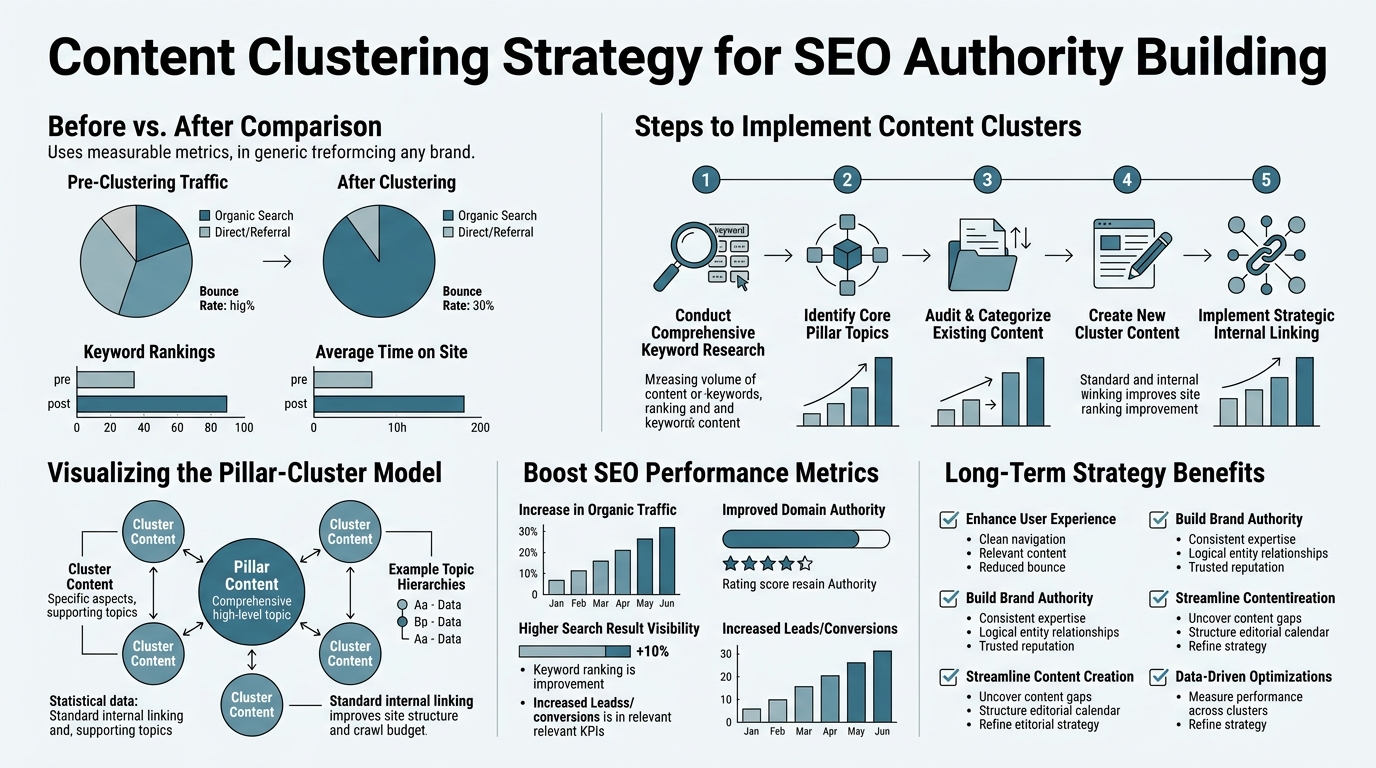
A content cluster is a network of interconnected pages built around a single broad topic. At the center sits the pillar page — a comprehensive, definitive guide covering the core subject. Radiating outward are cluster pages, which dive deep into specific subtopics, each linked back to the pillar and to related clusters. This architecture mirrors how humans think: one umbrella topic with many supporting details. Search engines interpret the same way. When you link cluster pages to a pillar, you're explicitly telling Google that the pillar is the central authority, and every cluster reinforces that signal.
Topical authority is what this structure builds. Instead of a site that ranks for a handful of scattered keywords, you build a site that ranks for dozens of related queries because Google recognizes you as the comprehensive expert. This matters because topical authority clusters directly improve rankings in both traditional search and AI search results, where language models reference your content as a trusted source.
"When you link cluster pages to a pillar, you're explicitly telling Google that the pillar is the central authority, and every cluster reinforces that signal. This is the foundation of topical authority in 2026."
The Hub-and-Spoke Model in Practice
Imagine a pillar page titled "The Complete Guide to Workplace Productivity." Your cluster pages might cover time management, deep work techniques, meeting efficiency, remote work tools, and procrastination psychology. Each cluster post is self-contained (1,500-2,000 words) and targets a specific long-tail keyword. The pillar includes a table of contents linking to each cluster; each cluster links back to the pillar and to 2-3 related clusters. This creates a web that signals interconnection.
The benefit: someone landing on your "procrastination psychology" post discovers the pillar and other clusters, increasing time-on-site. Google's algorithms reward this engagement. More importantly, the linking pattern tells ranking systems that your entire site speaks authoritatively on workplace productivity, not just individual posts.
Topical Authority vs. Keyword Ranking
Traditional SEO aims to rank for individual keywords. You write a post, optimize it, and hope it ranks. Topical authority flips this: you aim to own an entire topic, which naturally produces rankings for dozens of related keywords as a byproduct. A well-built cluster around "project management" might rank for "project management tools," "agile methodology," "Gantt charts," "resource allocation," and dozens more — all because you've signaled comprehensive expertise to search engines.
Semrush research on topic clusters shows that sites with mature clusters appear in AI search results more frequently because language models trust sites with depth and interconnection. This is critical as AI search continues to grow.
How to Map Your Topic Cluster Structure
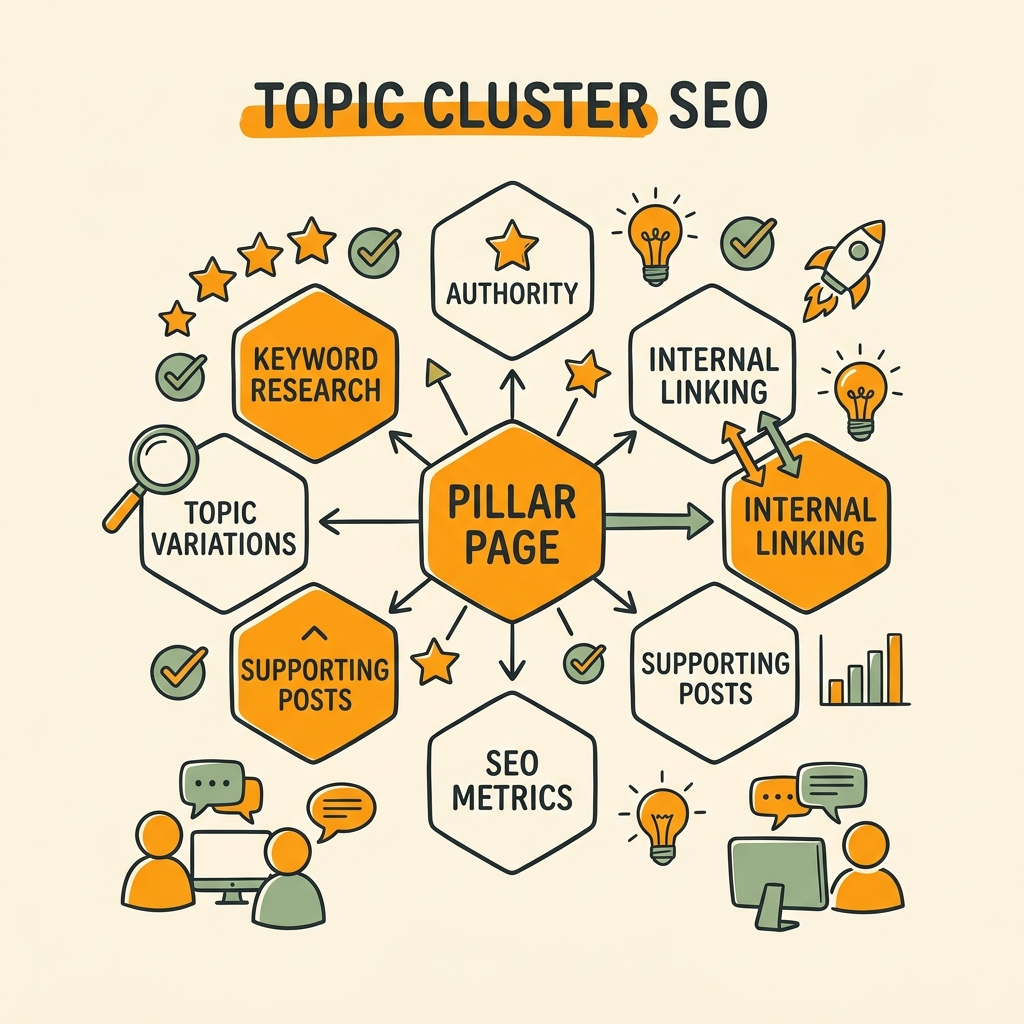
Before you write, you must map. A poorly planned cluster wastes time and confuses your linking strategy. Mapping ensures each page has a clear purpose and fits logically into the overall architecture. Start by identifying what your core audience wants to know, then work backward to define your pillar and cluster topics.
Conduct a Content Audit and Find Hidden Clusters
Your site likely already has clusters hiding in plain sight. You may have written 8 posts on "content marketing" over two years without realizing they should be interconnected. Begin by auditing all existing content using a spreadsheet. List every article, its primary keyword, current ranking position, and monthly traffic. Then group posts by topic. You'll find natural clusters — multiple posts on related keywords that simply lack linking strategy.
Next, identify content gaps. If your cluster has posts on "email marketing strategies," "email automation tools," and "email copywriting," but nothing on "email segmentation," you've found a gap. Gaps are ranking opportunities because you already have topical relevance — filling them compounds your authority faster than building clusters from scratch.
"Most clusters built hastily have 2-4 cannibalization pairs. Finding and fixing them typically results in improved content performance within 30 days — it's one of the highest-ROI audits you can run."
Map Keywords to Pillar and Cluster Pages
Use keyword research tools like Ahrefs, Semrush, or Google Keyword Planner to identify your pillar keyword and cluster keywords. The pillar keyword is your broadest, highest-intent term — usually high volume but competitive. Examples:
- Pillar keyword: "Email marketing" (high volume, broad intent)
- Cluster keywords: "Email marketing automation," "Email segmentation strategies," "Email list building," "A/B testing email campaigns" (medium volume, specific intent)
This structure ensures hierarchy. Your pillar ranks for the broadest term; clusters rank for specific subtopics. Together, they claim ownership of the entire topic.
Define Cluster Linking Paths
Before writing, sketch your linking architecture. Create a simple diagram showing the pillar at the center and cluster pages radiating outward, with arrows showing which pages link to which. Most clusters follow this pattern:
- Pillar page links to every cluster page (in a "Resources" or "Related Topics" section)
- Every cluster page links back to the pillar (usually in the intro or conclusion)
- Related cluster pages link to each other (if a reader is interested in "email segmentation," they might also want "email list building")
Define these paths now to avoid ad-hoc linking decisions later, which leads to inconsistency and missed opportunities.
How to Build a High-Authority Pillar Page
Your pillar is the centerpiece of your cluster. If it's weak, the entire structure suffers. A strong pillar page is comprehensive (3,000+ words), well-structured, and clearly establishes you as the expert. Most teams underinvest in pillars, treating them as just another post. That's a mistake.
Structure for Comprehensiveness and Navigation
Your pillar must cover the entire topic at a high level. If your pillar is "Email Marketing: A Complete Guide," it should address strategy, tools, tactics, automation, compliance, metrics, and best practices — all in one page. This isn't fluff; it's required breadth. A 3,000+ word pillar signals authority in a way a 1,500-word post never will.
Include a detailed table of contents at the top. This serves two purposes: it helps readers navigate (improving engagement), and it signals to search engines the depth of coverage. Each section in your TOC should link to a related cluster page, making the pillar a navigation hub for your entire cluster ecosystem.
Optimize for Core Topic Keywords
Your pillar targets the broadest version of your topic keyword. If your cluster is "content marketing," your pillar keyword is simply "content marketing," not "content marketing strategies for B2B SaaS." That's a cluster keyword. The pillar keyword should be simpler, broader, and higher-intent. This is intentional: the pillar ranks for the broadest search, and clusters capture the nuanced, long-tail variations.
Use your pillar keyword in the H1, within the first 100 words, and naturally throughout. Don't force it; natural language ranks better than keyword-stuffed copy. Aim for a keyword density of 0.5-1.5% for your pillar keyword.
Build Internal Linking Into Pillar Architecture
A pillar page should include a "Related Topics" or "Learn More" section that links to every cluster page using keyword-rich anchor text. For example, instead of "click here," use "Learn email marketing automation best practices" or "Discover email segmentation strategies." This approach:
- Gives readers a clear path to deeper content
- Distributes authority from the pillar to cluster pages via internal links
- Tells search engines that your clusters are relevant subtopics of the pillar
Position this section prominently — near the top or middle of the pillar — so readers actually discover it. Many teams bury internal links at the bottom where engagement is lowest.
How to Create Cluster Pages That Rank
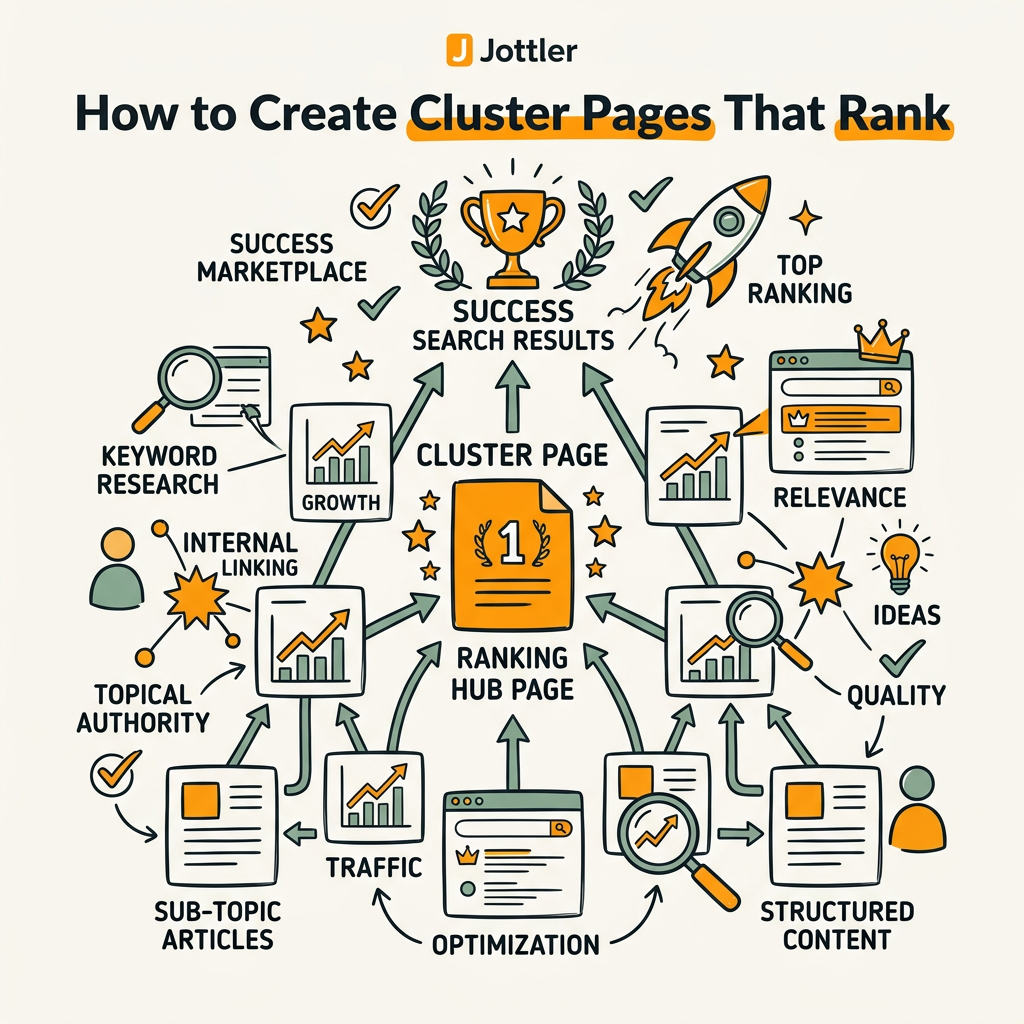
Cluster pages are where specificity wins. Each cluster page should target a single, well-defined intent and deliver expert-level depth on that subtopic. The goal isn't to rank for as many keywords as possible; it's to rank for the right keywords and funnel readers back to your ecosystem.
Target One Intent Per Cluster Page
This is the most common cluster-building mistake: one page targets too many intents. A page about "email marketing" combined with "email automation" and "email copywriting" confuses both readers and algorithms. Instead, create a page focused on "email automation platforms" that comprehensively covers that one intent, then create separate pages for copywriting and segmentation.
One page, one intent, 1,500-2,000 words. This depth allows you to rank for specific long-tail variations of your intent keyword while remaining focused. A reader searching "how to set up email automation" should land on your automation page and find exactly what they need, not a scattered overview of email marketing.
Write for Both Search Engines and AI Search
In 2026, your cluster pages must rank in both traditional Google search and generative AI results. These require slightly different optimization. Traditional SEO still rewards keyword matching and backlinks. AI search rewards comprehensive, well-structured content that answers questions clearly. Your cluster pages should:
- Answer the primary question directly in the first 100-150 words (AI systems extract this as the "answer")
- Use clear headings and lists (AI systems parse structured content better than paragraphs)
- Provide specific, cited data (both algorithms trust sources and numbers)
- Include related subtopic mentions naturally (helps both SEO and AI systems understand topic relationship)
This isn't a different strategy; it's writing cluster pages well. Clarity serves every algorithm.
Implement the 60/30/10 Anchor Text Rule
When linking from cluster pages to the pillar and related clusters, use varied anchor text. The 60/30/10 distribution is a proven framework: 60% semantic variations (natural phrases like "learn more about email marketing"), 30% exact-match keywords (e.g., "email marketing automation"), and 10% generic anchors (e.g., "related content"). This mix feels natural to algorithms and avoids over-optimization flags that trigger manual reviews.
Many teams slip into exact-match anchor text for every link, which screams over-optimization. Vary your anchors. It's faster than you think and signals that your linking is natural, not mechanical.
Building Strategic Internal Links Across Your Cluster
Your cluster lives or dies by its internal linking. Sloppy linking wastes the potential of well-written content; strategic linking amplifies authority across the entire network. This is where many teams lose momentum — they write great content but link randomly, if at all.
Create a Bidirectional Link Network
The foundation is simple: every cluster page must link to the pillar, and the pillar must link to every cluster page. But go deeper. Related cluster pages should link to each other, creating cross-connectivity. If your cluster covers "email marketing strategy," "email copywriting," and "email segmentation," someone on the email segmentation page might benefit from reading about copywriting. Link them. This creates the web effect: readers navigate deeper, time-on-site increases, and algorithms see interconnection.
Avoid over-linking within cluster pages. 3-5 internal links per cluster page is standard. More than that feels spammy and dilutes link juice.
Use Link Anchors That Reinforce Topic Relevance
Your anchor text (the clickable text of a link) should reinforce why the linked page is relevant to the current topic. Instead of "check out this resource," use "Discover how email segmentation improves campaign performance" or "Learn the fundamentals of email list building." This tells readers and algorithms exactly what they'll find, improving click-through and relevance signals.
When linking from a cluster page to the pillar, use the pillar keyword: "Read our complete guide to email marketing." When linking between clusters, use the target cluster's keyword. This consistency helps search engines understand the topic architecture.
Monitor and Update Cluster Links Regularly
Your cluster isn't static. As you add new cluster pages, you need to update existing pages to link to them. Set a quarterly review where you:
- Audit which cluster pages link to the pillar (should be 100%)
- Check the pillar links to all clusters (should be complete)
- Identify broken or outdated links
- Add cross-cluster links where relevant new content was published
This prevents clusters from becoming static and ensures new content benefits from the network immediately.
Automating Cluster Creation and Maintenance
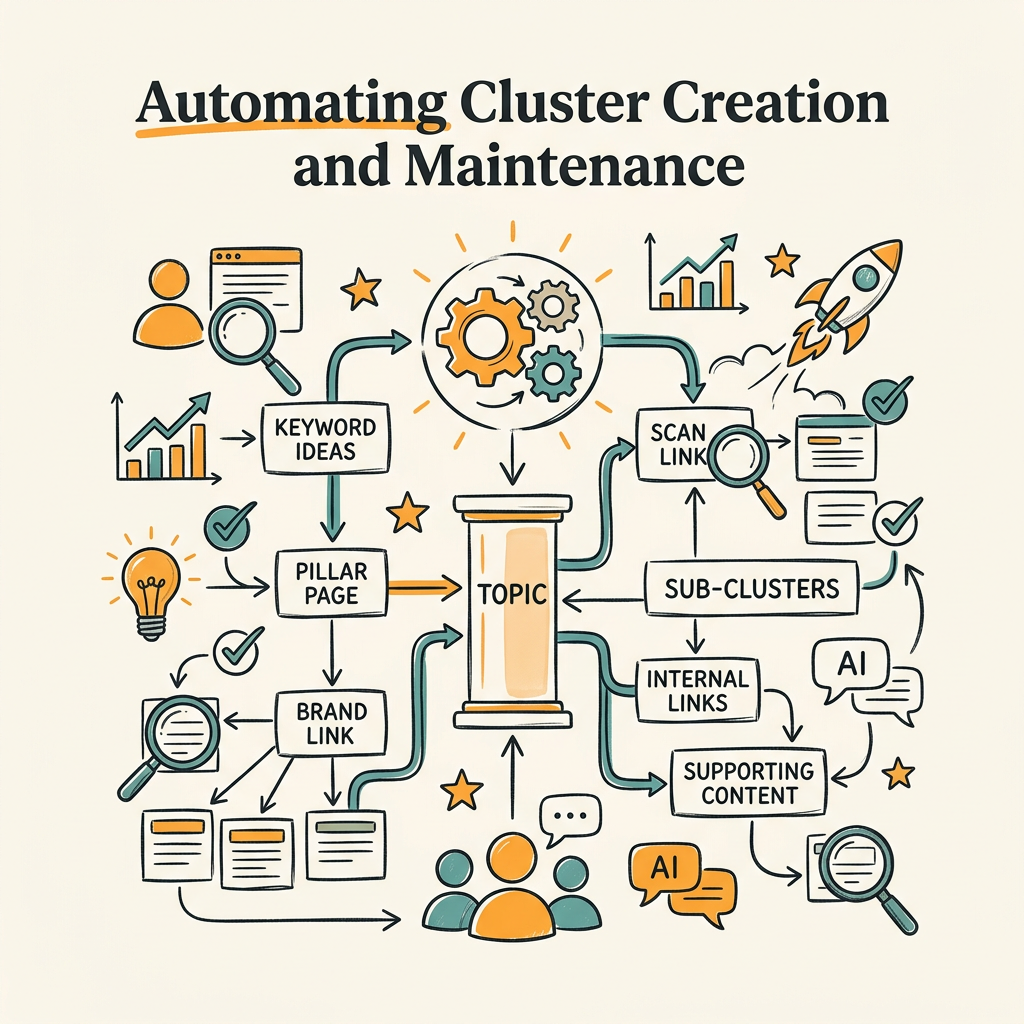
Building clusters manually is time-intensive. Keyword research, content planning, writing, linking structure, fact-checking, and publishing — each step requires human attention. For busy founders and marketing teams, this is where most cluster ambitions stall. You publish two cluster pages, realize the workload, and the project slows to a halt. Learn more about how to build topical authority systematically.
Automated content systems solve this bottleneck. Systems that publish 1-5 articles daily can build out a full cluster in weeks instead of months, and maintain it as new topics emerge. This removes the friction that kills most cluster strategies — the sheer volume of work required to sustain them. For teams without automation, you're left hiring full-time writers (expensive), freelancers (inconsistent quality), or agencies (high per-piece cost). Automation flattens that cost curve by handling research and fact-checking while your team focuses on strategy.
"The best teams in 2026 use systems that can research topics from 14+ sources, write comprehensive articles, implement internal linking, and publish directly to your CMS. This transforms clustering from an aspirational tactic into a sustainable, compounding strategy."
The best teams in 2026 use systems that can research topics from 14+ sources, write comprehensive articles, implement internal linking, and publish directly to your CMS. This transforms clustering from an aspirational tactic into a sustainable, compounding strategy. You set the publishing frequency, and the system handles the rest — making clusters feasible for teams without dedicated content infrastructure.
Identifying and Fixing Keyword Cannibalization in Clusters
Cannibalization occurs when two pages on your site compete for the same keyword, confusing search engines about which one should rank. This fractures your cluster authority. If your pillar and one cluster page both target "email marketing," Google doesn't know which to prioritize and may rank neither well.
Audit for Cannibalization Pairs
Review your cluster pages and pillar using an SEO tool (Ahrefs, Semrush, Google Search Console) to identify keyword overlaps. Look for:
- Exact-match cannibalization: Two pages both targeting "email marketing" (both targeting the same keyword)
- Semantic cannibalization: Two pages targeting similar intents like "email segmentation strategies" and "how to segment your email list" (slightly different phrasing, same intent)
Once identified, fix via:
- 301 redirect: If one page is weak, redirect it to the stronger page, consolidating authority
- Consolidation: Merge two weak pages into one comprehensive page
- Differentiation: Rewrite one page to target a different intent or keyword
Most clusters built hastily have 2-4 cannibalization pairs. Finding and fixing them typically results in improved content performance within 30 days.
Measuring Cluster Authority and ROI
Content clustering isn't a fire-and-forget tactic. You need to measure whether your cluster is actually building authority and driving business results. Track these metrics quarterly:
| Metric Category | Metric Name | What It Measures | Healthy Target |
|---|---|---|---|
| Authority | Total keyword rankings in cluster | Combined keywords ranking for pillar + clusters (top 100) | 50-100+ keywords |
| Authority | Pillar page ranking position | Primary keyword position for pillar | #1-3 |
| Authority | Cluster page average ranking | Average ranking across all cluster pages | #1-5 |
| Authority | Organic traffic to cluster | Combined monthly traffic from pillar + all clusters | Month-over-month growth |
| Engagement | Internal click-through rate | % of cluster pages with links getting clicked | High CTR (readers navigating) |
| Engagement | Time on site (cluster readers) | Average session duration for cluster visitors | Above overall site average |
| Engagement | Return visitor rate | % of cluster readers who return | Higher than non-cluster pages |
Authority Metrics
- Total keyword rankings in cluster: Count how many keywords your pillar + clusters rank for (top 100). Mature clusters often rank for 50-100+ related keywords.
- Pillar page ranking position: The pillar should hold position #1-3 for its primary keyword. If it's ranking #10+, your cluster isn't signaling authority effectively.
- Cluster page average ranking: Your cluster pages should rank #1-5 for their target keywords. Average ranking across all cluster pages shows cluster health.
- Organic traffic to cluster: Combined monthly traffic from pillar + all clusters. This number should compound monthly as you add new cluster content.
Engagement Metrics
- Internal click-through rate: What % of cluster pages link to other pages in the cluster and get clicked? High CTR indicates readers are discovering deeper content.
- Time on site (cluster readers): Users landing on cluster pages should spend more time on your site than typical readers because they're navigating between related content.
- Return visitor rate: Cluster readers often return because they've found your site helpful for a whole topic, not just one keyword.
Conclusion
Content clustering is the most effective SEO strategy for building topical authority at scale. Instead of chasing individual keyword rankings, you create an interconnected ecosystem of high-quality content that tells search engines and AI systems you're the expert on your topic. A mature cluster typically ranks for 50-100+ related keywords compared to 1-2 for isolated posts, compounding your organic traffic exponentially over time.
The architecture is simple: a pillar page provides comprehensive coverage; cluster pages dive into specific subtopics; bidirectional links reinforce the network. The execution requires consistency — mapping, writing, linking, updating. This is where most teams fail. They write the pillar, add 3 cluster pages, then stop because the workload exhausts them.
The solution is automation. Intelligent content systems can handle research, writing, linking, and publishing, removing the friction that halts cluster ambitions. For busy founders and marketing teams, this means clusters that compound month-over-month instead of stalling after initial effort.
Start with your highest-opportunity topic — the one your audience cares about most and competitors underserve. Build a pillar, add 5-8 cluster pages, and establish your internal linking structure. Within 3-6 months, you'll see rankings and traffic concentrate around that cluster. Then repeat for your next topic. This systematic approach builds topical authority that compounds for years.
Ready to scale your content clusters without the bottleneck? Start your SEO agent and begin publishing 3,000+ word cluster articles daily, with automatic keyword research, fact-checking, and internal linking built in.
FAQs
How many cluster pages should I create per pillar?
Most effective clusters contain 5-12 cluster pages per pillar, covering the major subtopics within your core topic. Starting with 5-8 cluster pages is realistic; you can expand over time. The goal isn't quantity — it's covering all the key user intents related to your pillar topic. A pillar on "email marketing" might have clusters on email automation, copywriting, segmentation, deliverability, and metrics. That's 5 core areas, each with dedicated depth. More clusters are fine if they serve distinct intents, but avoid creating thin, redundant cluster pages that cannibalize each other. Quality and specificity matter far more than the total count.
How long does it take to see results from a content cluster?
Expect your first cluster to show measurable results within 3-4 months. Newly published content usually takes 4-12 weeks to rank in Google, depending on domain authority and competition. During this window, the pillar page typically ranks first and cluster pages begin appearing in search results. Within 6 months, a well-built cluster usually shows a 15-30% increase in combined cluster traffic as your ranking positions improve and cross-cluster navigation boosts engagement. Mature clusters (1+ year old with consistent updates and linking) show 50-100% year-over-year traffic growth because your keyword count compounds as new content builds on existing authority.
Do I need to update cluster pages frequently to maintain authority?
Cluster pages benefit from periodic updates, especially in fast-changing topics, but they don't need constant maintenance. Most teams update cluster pages quarterly or semi-annually to refresh statistics, add new insights, improve internal links as new cluster content launches, and ensure technical accuracy. More frequent updates (monthly) are beneficial for highly competitive topics or news-driven industries, but for evergreen topics like "project management methodology," annual updates are usually sufficient. The real maintenance work is adding new cluster pages — your pillar's authority strengthens as you expand the cluster, so focus on growth rather than editing old pages unless they contain outdated or incorrect information.