Content Clusters: The Fastest Way to Boost Organic Traffic
Most growing teams approach SEO like they approach their inbox: piece by piece, one standalone article at a time. They publish a blog post on "email marketing tips," rank it, get some traffic, then move to the next topic. The cost of that scattered approach is steep. Websites using content clusters generate 3.5x more backlinks and see a 55% increase in organic traffic over 12 months, while traditional keyword-by-keyword strategies plateau. The real multiplier isn't in writing more content—it's in organizing it strategically so each page amplifies the others.
Key Takeaways
- Content clusters deliver 55% organic traffic growth in 12 months and generate 3.5x more backlinks than scattered keyword strategies (HubSpot, 2024).
- Semantic clustering achieves 31% higher average CTR and featured snippets appear 4x more frequently in cluster-based architectures (MIT & Semrush research, 2025).
- 72% of B2B marketers report content clusters as their most effective SEO tactic for establishing topical authority and compounding rankings.
- Pillar-and-Cluster Architecture: Central pillar pages link to targeted subtopic clusters, creating a semantic web that signals topical authority to search engines.
- Semantic Relevance Over Keyword Density: AI-powered search engines now reward how comprehensively you cover a topic, not just keyword frequency—clusters demonstrate that depth.
- Backlink Velocity: A unified topical presence attracts more inbound links because the entire cluster answers a broader question than any single page could.
- Internal Linking Compounding: Strategic hub-and-spoke linking multiplies ranking power across all pages in the cluster, not just the pillar.
- Faster Implementation: With the right automation, clustering doesn't require months of manual planning—systems like autonomous SEO agents build and interconnect clusters automatically.
What Is a Content Cluster and Why Does It Work?
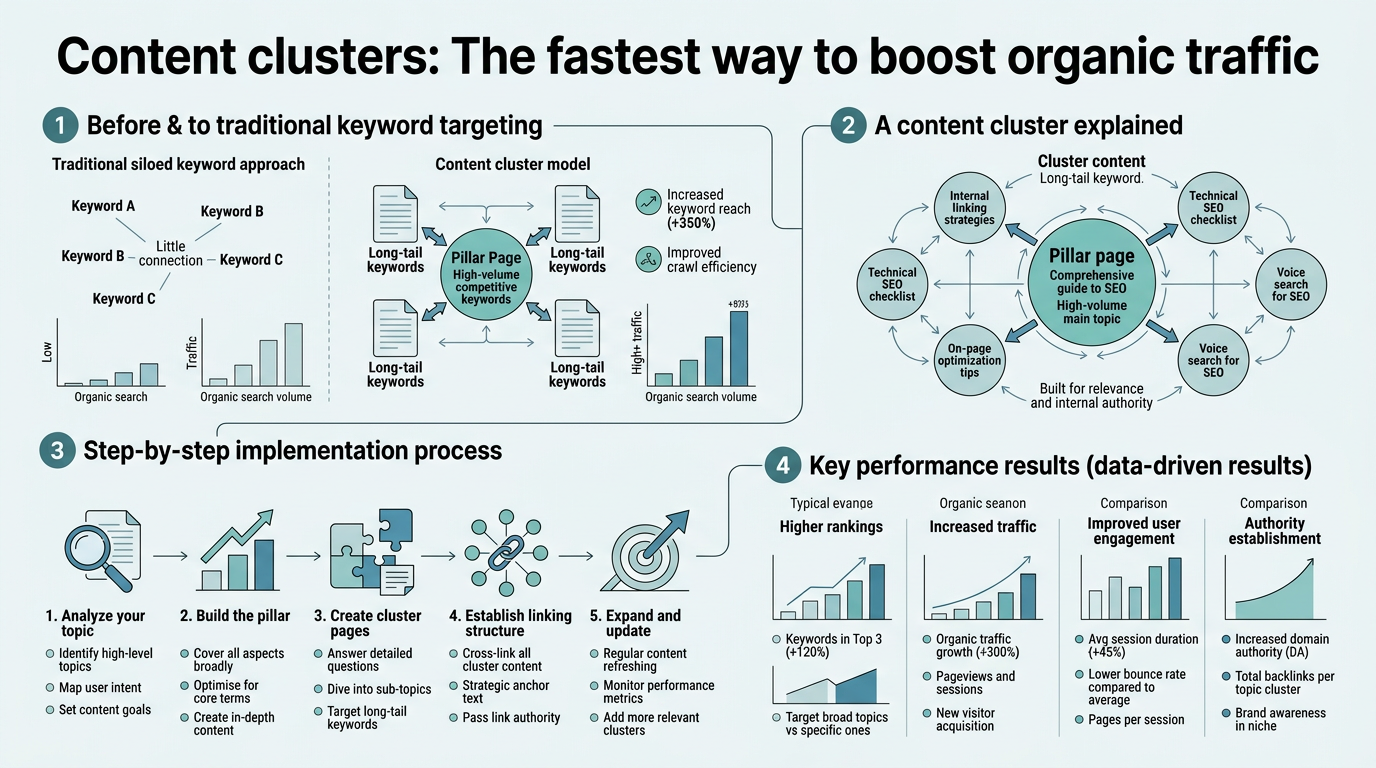
A content cluster is a strategically organized set of interconnected web pages that collectively cover a single broad topic from multiple angles. Semrush analysis of 500,000 domains shows sites with cluster architecture have a 2.3x higher crawl rate and obtain featured snippets 4x more frequently than traditional siloed structures. The structure itself—not the word count—is what powers the wins.
"Content clusters signal to search engines that you own a topic comprehensively. It's the difference between being a reference on one keyword versus being an authority on an entire ecosystem."
The Hub-and-Spoke Model Explained
Think of a cluster as a network, not a flat list. One central pillar page (the hub) addresses the topic comprehensively—usually 2,500+ words covering the full strategic landscape. Around it radiate cluster pages (the spokes), each diving deep into a specific subtopic with targeted keywords. All cluster pages link back to the pillar with descriptive anchor text, and the pillar links to each cluster. This architecture does two critical things: it tells search engines your site owns the topic, and it compounds ranking power across every page in the cluster instead of diluting it.
- Pillar Page: Broad, comprehensive, 2,500+ words. Example: "Email Marketing Strategy for B2B SaaS."
- Cluster Pages: Specific subtopics, 800-1,200 words each. Example: "Email Segmentation Tactics," "Welcome Series Best Practices," "Drip Campaign Automation."
- Internal Linking: Cluster pages link to pillar with keyword-rich anchor text. Pillar links to all clusters contextually.
Why Search Engines Prioritize Clusters
Search engines have evolved beyond keyword matching. Google and Bing now use entity recognition and semantic understanding to assess whether a site has genuine expertise on a topic. When you publish 4-5 deeply researched cluster pages linked semantically to a pillar, you're signaling institutional authority. MIT researchers found sites with semantic clustering achieve an average CTR 31% higher, with "topic coherence score" correlating directly with SERP positions at r=0.78. That's not a coincidence—it's how modern algorithms work.
"The pages that rank aren't competing on keywords anymore—they're competing on whether Google believes you understand the entire topic. Clusters prove understanding."
How Content Clusters Drive Ranking Improvements
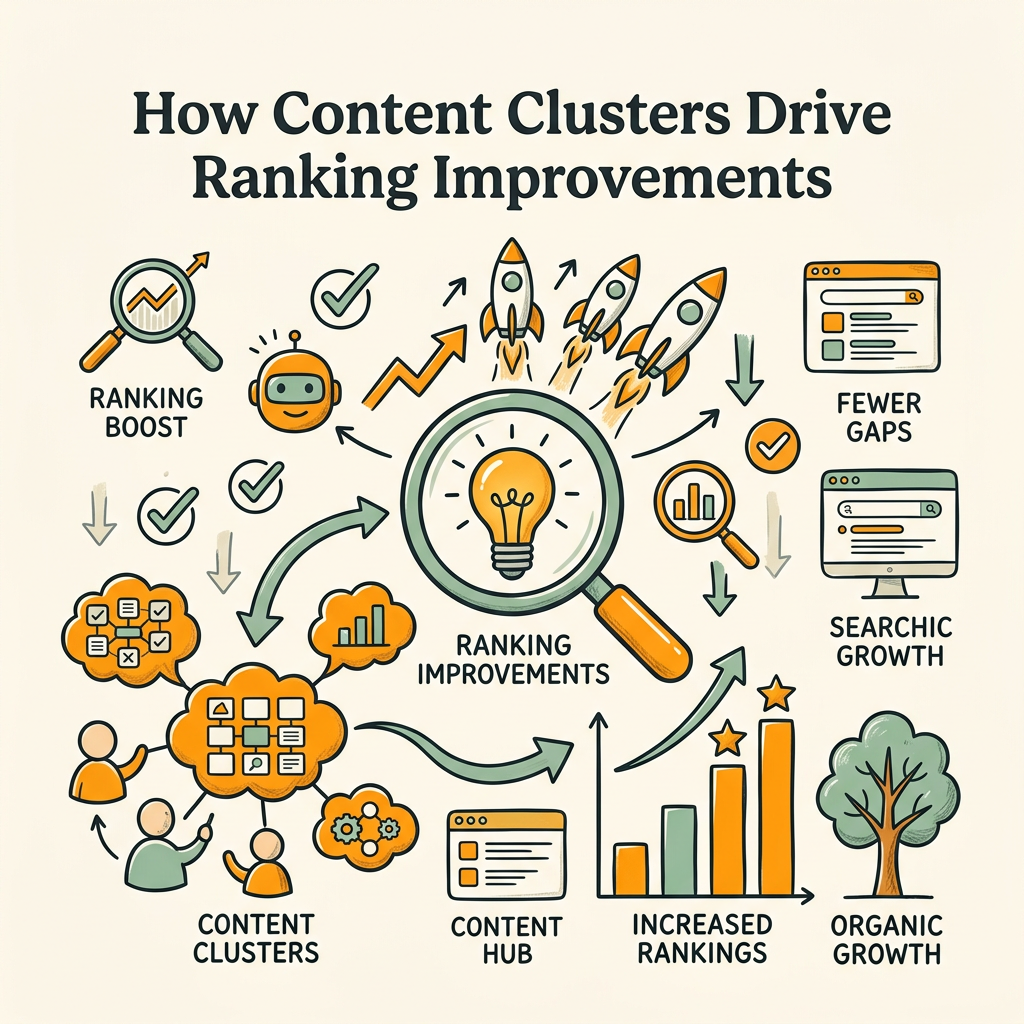
The SEO benefit of clusters compounds across three mechanisms: crawl efficiency, topical authority signals, and internal link juice distribution. Websites employing topic clusters see 10-20% improvement in SERP rankings compared to standalone keyword posts, according to HubSpot research cited across 2025 analyses. Let's break down each mechanism so you understand what's happening behind the scenes.
Crawl Efficiency and Search Engine Discovery
Search engine crawlers have limited budgets—they can't crawl every page on your site infinitely. A clustered architecture concentrates crawl attention where it matters most. The pillar, being the central authority hub, gets crawled more frequently. From there, Google's crawlers follow the strategic internal links to cluster pages, crawling them more efficiently than if they were orphaned islands. This means your cluster pages get indexed faster and their changes get indexed faster, a competitive advantage in fast-moving topics.
Topical Authority and Entity Recognition
Google's semantic search now understands entities—recognizing "email marketing" as a concept with related subtopics like "segmentation," "automation," and "personalization." When your cluster explicitly connects these concepts with descriptive anchor text and related content, you tell Google: this site understands email marketing holistically. Result? Google ranks you not just for individual keywords but for the entire topic. One cluster covering email marketing thoroughly can earn you visibility for 20+ related keywords instead of just one.
Backlink Consolidation and Authority Flow
When an external site links to your cluster, that authority flows to the entire network if the linking architecture is tight. A single backlink to a cluster page can amplify the ranking power of your pillar page and related cluster pages through strategic internal linking. This is the opposite of scattered publishing: instead of diluting authority across 20 unrelated pages, you concentrate it on a topic and let it compound. That's why clustered sites generate 3.5x more backlinks—they're easier to link to because they're easier to understand.
Building Your Content Cluster Strategy From Scratch
The theory is compelling, but execution is where most teams stumble. You need a systematic approach to identify topics, organize them into pillars and clusters, and then build them intelligently. V12 Marketing's research emphasizes that topic clusters beat keyword lists by aligning with how modern search engines understand the world—but only if you build them correctly.
Step 1: Identify Your Pillar Topics
Start with the core problems your audience solves, not random keywords. For a SaaS marketing tool, pillar topics might be "Email Marketing," "Content Marketing," "Sales Automation." For a financial services firm: "Retirement Planning," "Tax Strategy," "Investment Diversification." These are the 4-6 broad, strategic topics where you want absolute authority. Each pillar should address a category-level search intent—the kind of thing a prospect would search for when entering a new buying journey.
Don't choose pillars based on search volume alone. Choose them based on relevance to your business and alignment with how your customers think. A pillar that gets 500 searches per month but maps directly to your revenue streams is more valuable than one with 2,000 searches that attracts tire-kickers.
Step 2: Map Subtopics as Cluster Pages
Under each pillar, list 4-8 specific subtopics that your audience also cares about. These become your cluster pages. Use Google's "People Also Ask" section and your own customer conversations to discover them. If your pillar is "Email Marketing," your clusters might be:
- Email segmentation and targeting strategies
- Welcome series and onboarding automation
- Drip campaigns for lead nurturing
- Email personalization techniques
- A/B testing and optimization metrics
Each cluster page addresses a specific buyer question or use case. The key is that they're not random—they're semantically connected to the pillar and to each other. A cluster on "email personalization" overlaps with "segmentation" and "A/B testing," so your internal linking can make those connections explicit.
Step 3: Conduct Competitive Content Gap Analysis
Look at who ranks for your pillar topic and scan their content. What subtopics do they cover extensively? What gaps do they leave? Search Engine Land's 2025 guide to topic clusters emphasizes analyzing competitor content structures to find gaps you can own. If the top 3 ranking sites all cover "email segmentation" but none go deep on "advanced behavioral targeting," that's your gap. Fill it with a cluster page that becomes the definitive resource competitors can't match.
Step 4: Write and Interlink Strategically
Start with the pillar—the foundational 2,500+ word guide that introduces all the cluster topics but doesn't go too deep into any single one. It's a roadmap. From there, write cluster pages that go 3-4 levels deeper. Each cluster should include:
- A clear statement of the specific problem it solves
- Practical, actionable steps or frameworks
- Real examples or case studies
- A contextual link back to the pillar using keyword-rich anchor text
- Cross-links to related cluster pages where appropriate (but not forced)
The pillar links to all clusters naturally, using anchor text that signals topical relationship: "Learn more about email segmentation," not "click here." This creates the semantic web that search engines parse as authority.
Measuring Cluster Performance and Iteration

Publishing a cluster is the beginning, not the end. You need to track performance across all pages in the cluster and optimize based on data. Here's what to monitor to build genuine topical authority.
Track Metrics at the Cluster Level, Not Page-by-Page
Traditional SEO analytics treat each page as an island—you see rankings and traffic for each URL in isolation. But clusters should be measured as a system. Set up a Google Analytics 4 view or dashboard that shows combined metrics for your pillar + all cluster pages:
- Combined organic traffic: All cluster pages + pillar combined.
- Keyword rankings: Are you ranking for the pillar keyword, cluster keywords, and semantic variants?
- Backlinks: Both to the pillar and to cluster pages within the cluster.
- Click-through rate: Are impressions converting to clicks at the cluster level?
This gives you a true picture of cluster health. A cluster can show weak individual page performance but strong aggregate traffic if the architecture is working—users land on one cluster page, navigate to others, and spend more time on the site.
Identify Underperforming Cluster Pages and Refresh Them
Not all cluster pages will perform equally. Some will rank immediately; others will linger on page 3-4 for months. When a cluster page isn't moving, audit it against top-ranking competitors. Is your content shallower? Missing recent statistics? Lacking user intent signals like how-tos or frameworks? Refresh the underperformer with deeper research, updated data, and better structure. Often, the cluster itself is strong enough that a single refreshed page will see ranking improvement within 4-6 weeks.
Use Internal Linking to Boost Weak Cluster Pages
If a cluster page isn't ranking, sometimes the fix isn't the page itself—it's the linking architecture. Add contextual internal links to that page from your pillar and related cluster pages where relevant. Each strategic internal link passes authority and helps Google understand the page's relevance within the cluster. You're essentially saying: "This page is important to our topical authority strategy," and Google listens.
Content Cluster Automation: When Building Manually Becomes Inefficient
Building even a single cluster manually takes weeks. Topic research, competitive analysis, writing a 2,500-word pillar, then 4-5 cluster pages at 1,000+ words each—that's 6,000-8,000 words of research-backed content. For a team managing multiple clusters across 6-10 pillar topics, the workload compounds into months of writing and internal linking. This is where automation becomes not a luxury—it's a necessity for sustainable growth.
"The teams scaling fastest aren't writing more content—they're automating the entire cluster pipeline. What took a month now takes three days, and they're publishing 3-5 complete clusters monthly instead of one quarterly."
Tools that automate the entire clustering workflow—from identifying topically relevant subtopic clusters, to researching content gaps, to writing pillar and cluster pages with semantic internal linking already built in—compress weeks of work into days. Instead of spending 4 weeks building a cluster manually, you set the pillar topic and let AI agents handle discovery, writing, linking, and publishing. Your team reviews the output and hits publish, turning what would take a month into a 3-day cycle.
This accelerated approach is the fastest path to building true topical authority at scale. You can publish 3-5 complete clusters per month—something that would require a small content team working fulltime. The math of organic growth changes dramatically when you can compound topical authority this quickly and consistently.
Common Mistakes That Break Content Clusters
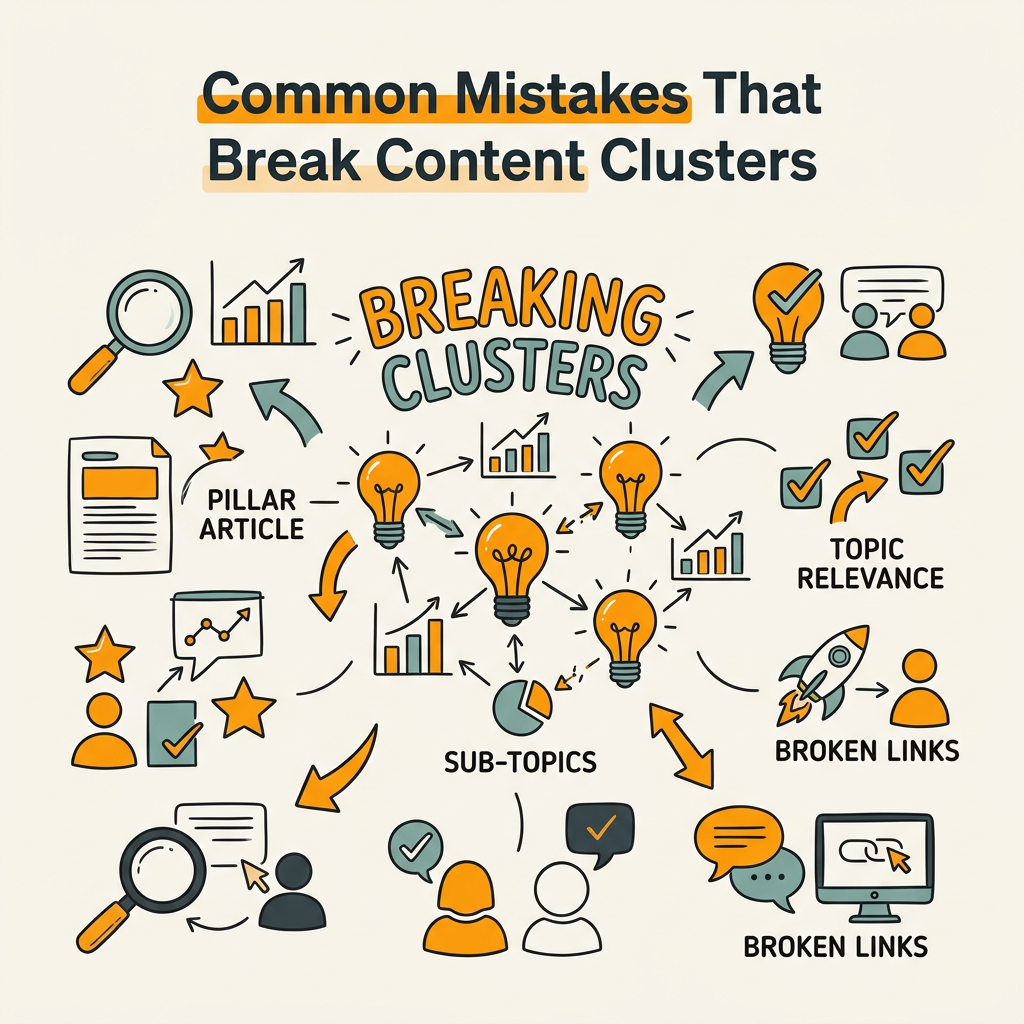
Knowing the theory isn't enough. Most teams sabotage their own cluster strategy with preventable mistakes. Here's what to avoid:
Mistake 1: Too Many Clusters, Too Few Pages Per Cluster
Teams often get excited about the architecture and create 10 pillar topics with only 2-3 cluster pages each. That's not a cluster—that's a shallow network. A proper cluster needs depth. 1 pillar + 5-8 cluster pages minimum. It's better to own 3 clusters deeply than to half-own 10. Google rewards comprehensive coverage, not scattered breadth.
Mistake 2: Weak Internal Linking or No Anchor Text Strategy
Some teams build the cluster pages but forget to link them back to the pillar, or they use generic anchor text: "See our article on email marketing" instead of "Learn advanced email segmentation strategies." Anchor text is a signal—use keyword-rich, descriptive language. If a cluster page is about "email list decay," link to it with anchor text that says something like "signs your email list is decaying," not "read this."
Mistake 3: Publishing the Entire Cluster at Once, Then Stopping
Some teams batch-create a full cluster and publish all pages in the same week. That's inefficient. Space your cluster page publication over 2-4 weeks. Publish the pillar first, then roll out cluster pages 3-4 days apart. This gives each page its own crawl cycle and allows you to test and adjust the linking based on how early cluster pages perform. It also looks more natural to Google—a continuous topical expansion rather than a sudden content dump.
Content Clusters vs. Traditional Keyword Targeting
The debate between topic clusters and old-school keyword-by-keyword strategies isn't academic—it affects your ROI directly. Here's how they compare in practice:
| Metric | Content Clusters | Keyword-by-Keyword Strategy |
|---|---|---|
| Organic Traffic Growth (12 mo) | +55% average (HubSpot 2024) | Baseline, ~5-10% without strategy compounding |
| Backlinks Generated | 3.5x more due to topical authority | Scattered, limited to individual page merit |
| Featured Snippet Capture | 4x more frequently (Semrush) | Occasional, depends on isolated page strength |
| Search Engine Crawl Rate | 2.3x higher (Semrush) | Standard, no efficiency benefit |
| Keyword Diversity Earned | 20-40+ ranking keywords per cluster | 1-3 keywords per page, limited spillover |
| Content Reuse & Depth | Subtopics allow deeper content repurposing | Single-angle content, limited expansion |
| Setup Time & Effort | 4-6 weeks per cluster (manual) | 1-2 weeks per post, but no compounding benefit |
The data is unambiguous: clusters win. The catch is execution. Keyword-by-keyword feels faster upfront because you can ship a single post in days. But over 12 months, a cluster strategy compounds while scattered posts plateau. By month 9-12, the gap is dramatic. A team publishing 2 clusters per month for a year will have built significant topical authority; a team publishing 2 standalone posts per week will have 100+ pages with minimal topical synergy and predictably flat results.
Conclusion
Content clusters are no longer a nice-to-have optimization—they're the foundational architecture of competitive SEO in 2026. Organizations that organize around topics instead of keywords are seeing 55% organic traffic growth, 3.5x more backlinks, and the ability to rank for entire topic ecosystems instead of isolated keywords. The fastest path to these results isn't writing more content. It's writing smarter content that's designed to compound.
Building clusters manually remains viable for small teams with patience, but at scale it becomes a bottleneck. The teams winning fastest are those using systems to automate research, writing, and strategic internal linking—turning a 4-week manual process into a 2-3 day execution. Start with one pillar topic where you have clear expertise and measurable customer need. Build 5-8 cluster pages around it over 4 weeks. Measure the combined traffic, backlinks, and keyword diversity after 90 days. Once you see the compounding effect firsthand, scale to 2-3 clusters simultaneously.
Ready to accelerate your topical authority? Start your SEO agent and let AI automate your cluster strategy while you focus on what matters.
FAQs
How long does it take to see results from a content cluster?
Most clusters show measurable results within 8-12 weeks, though the timeline depends on your domain authority and competition. Early-ranking cluster pages typically hit the first page of search results within 3-4 weeks if your domain already has foundational authority. Weaker pages in the cluster—those targeting more competitive keywords—may take 2-3 months. The real compounding effect appears at month 4-6 when Google realizes the cluster is a unified topical authority and starts ranking multiple pages in the same cluster for overlapping keywords. Track metrics at the cluster level, not individual page level, to see the true timeline.
Do I need a developer to build content clusters and internal links?
Not necessarily. If you're publishing to WordPress, Webflow, or any modern CMS, you can build clusters and internal links yourself. The pillar links to cluster pages through the standard internal linking UI—no code required. The complexity comes not from linking but from strategy: deciding which subtopics belong in the cluster, ensuring anchor text is descriptive, and maintaining consistency across pages. Many teams use spreadsheets to map the cluster architecture before publishing, making the execution straightforward. For teams scaling to multiple clusters monthly, automation tools streamline both the strategy and the linking.
What's the difference between a content cluster and a content silo?
Content silos and clusters both organize content hierarchically, but the linking strategy differs. Silos use one-way linking downward—the pillar links to cluster pages, but cluster pages don't link back to the pillar or to each other. Clusters use bidirectional linking and cross-cluster connections, creating a web instead of a tree. Clusters reward semantic relatedness across the entire topical network, while silos are stricter categorical boundaries. In practice, clusters tend to perform better for organic traffic growth because they signal deeper topical authority and allow Google to understand connections between subtopics. Modern SEO favors the flexibility and interconnectedness of clusters.