You spend $5,000 a month on blog posts, case studies, and distribution. Your CEO asks one question: "What's the return?" You open Google Analytics, stare at a dashboard full of page views and bounce rates, and realize you have no answer.
This is the content marketing ROI problem. And it affects the majority of teams. Only 36% of marketers say they can accurately measure the return on their content investment (Rank Tracker, 2025). The other 64% are spending blind.
Key Takeaways
- Content marketing ROI measures the revenue generated from content relative to its total cost, and the average return sits around $2.77 to $7.65 per dollar spent depending on the methodology.
- Most teams fail at ROI measurement because they track vanity metrics (page views, social shares) instead of revenue-tied outcomes like pipeline contribution and customer acquisition cost.
- A simple formula, (Revenue from Content - Cost of Content) / Cost of Content x 100, gives you a baseline, but attribution modeling across the buyer journey is what separates guesses from real data.
- Content marketing costs 62% less than traditional marketing while generating 3x more leads, making it one of the highest-ROI channels available to B2B and B2C teams alike.
What Content Marketing ROI Actually Means
Content marketing ROI is the percentage return you earn from money spent creating, distributing, and maintaining content. The formula is straightforward:
ROI = (Revenue Attributed to Content - Total Content Cost) / Total Content Cost x 100
If you spend $10,000 on content in a quarter and that content generates $35,000 in attributable revenue, your ROI is 250%. Simple math. The hard part is getting the inputs right.
Total content cost is not just your writer's fee. It includes strategy time, editing, design, distribution, tooling, and any paid amplification. Most teams undercount here, which inflates their ROI numbers and creates false confidence.
Revenue attribution is the bigger challenge. A prospect might read your blog post in January, download a whitepaper in March, and close in June. Which content gets credit? That depends on your attribution model, and picking the wrong one gives you misleading data.
Why Most Teams Measure It Incorrectly
The biggest mistake is treating page views as proof of value. A post with 50,000 views and zero conversions has a negative ROI. A technical guide with 800 views that drives 12 demo requests might be your most profitable asset.
Three measurement traps derail content ROI tracking:
- Vanity metric addiction. Page views, time on page, and social shares feel good in reports but tell you nothing about revenue impact. These metrics measure attention, not action.
- Last-click attribution bias. If you only credit the last touchpoint before a conversion, you miss every piece of content that influenced the buyer earlier in their journey. This makes top-of-funnel content look worthless when it is actually doing the heavy lifting.
- Ignoring compounding value. Paid ads stop generating returns the moment you turn them off. Blog content that ranks in search keeps driving traffic for months or years. Teams that measure ROI in 30-day windows miss the compounding effect that makes content marketing so powerful.
According to Genesys Growth (2026), businesses lose money on 80% of their content, but the remaining 20% generates returns above 500%. The problem is not that content marketing fails. It is that most content is produced without a data-backed plan.
The Metrics That Actually Tie Content to Revenue
Forget vanity dashboards. These are the numbers that connect content performance to business outcomes.
Pipeline Contribution
Track how many leads entered your pipeline after engaging with content. Use UTM parameters, gated assets, and CRM integration to draw a direct line between a blog post and a sales opportunity.
Customer Acquisition Cost (CAC)
Divide your total content spend by the number of customers acquired through content-driven channels. Content marketing costs 62% less than traditional marketing while generating 3x more leads (Demand Metric), so your content CAC should be significantly lower than paid channels.
LTV to CAC Ratio
Customers who find you through educational content tend to stick around longer. They arrive informed and they churn less. Track LTV by acquisition channel to prove that content-sourced customers are more valuable over time.
Assisted Conversions
In GA4, the conversion paths report shows every touchpoint before a conversion. Content rarely gets the last click, but it frequently assists. If your blog appears in 40% of conversion paths, it is generating real revenue, even if last-click attribution gives it zero credit.
Organic Traffic Value
Use your keyword research data to estimate what your organic traffic would cost if you had to buy it through Google Ads. A blog post ranking for a keyword with a $15 CPC that drives 500 monthly clicks is saving you $7,500 per month in ad spend, whether or not those visitors convert immediately.
A Simple Framework for Measuring ROI on Content
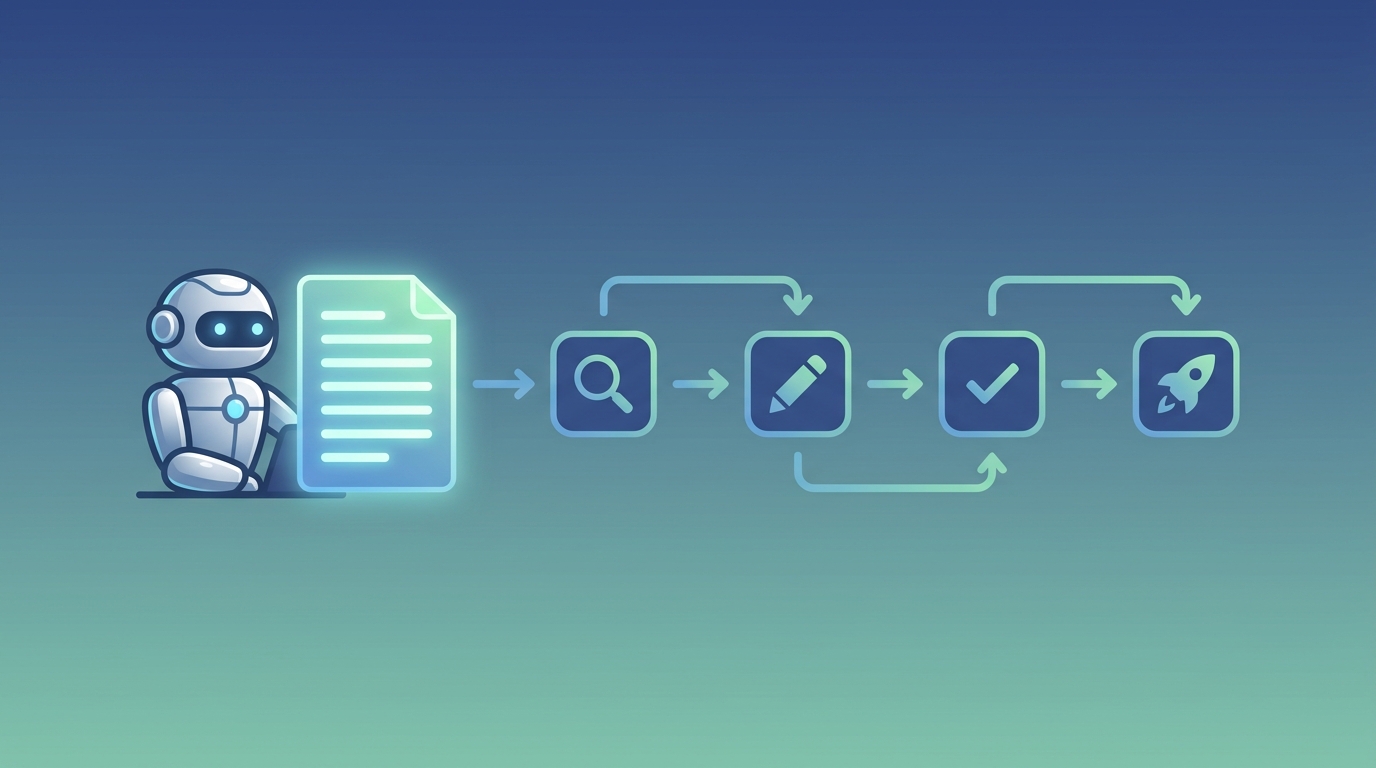
Stop guessing. Build a measurement system in five steps.
- Define your content cost baseline. Add up every expense: writer fees, editor time, design, tool subscriptions, distribution, and team hours. Underreporting costs inflates ROI and creates false confidence.
- Set up attribution tracking. Implement UTM parameters on every piece of distributed content. GA4's data-driven attribution model captures the full buyer journey better than last-click defaults.
- Connect your CRM to analytics. Tools like HubSpot or Salesforce link content engagement to closed deals. Without this connection, you are measuring traffic, not revenue.
- Calculate ROI per content asset. Know which content types produce the best returns so you can allocate future budget to what works.
- Measure over the right time horizon. Review performance at 90-day, 180-day, and 365-day intervals. A blog post published in January might not hit its ROI peak until July.
Teams running an AI-powered content strategy can automate much of this tracking by publishing content with built-in SEO optimization from day one.
What Good ROI Looks Like in 2026
Benchmarks vary by industry, but here is what the data says.
The average return on content investment in 2025 was $7.65 per dollar spent (Sender, 2025). For B2B SaaS companies specifically, three-year average ROIs can reach 844% when content is optimized for organic search (Averi AI, 2026).
By channel, SEO content delivers an average $22 return per dollar spent, while email marketing generates $42 per dollar (PPC Chief, 2026). Paid social, by comparison, returns about $1.80 per dollar.
The takeaway is clear: organic content, especially blog content that ranks, is the highest-ROI marketing channel available to most businesses. But only if you produce it consistently and measure it correctly.
This is where volume matters. Publishing one blog post per month will not build the topical authority that Google rewards. Teams using platforms like Jottler to automate content production at scale can reach the volume needed for compounding returns without proportionally scaling their team.
How to Improve Your ROI on Content
If your ROI numbers are underwhelming, the fix usually is not "make more content." It is "make the right content."
Start with keyword data. Every article should target a keyword with real search volume and a difficulty your domain can compete for. Publishing without this data is the content equivalent of running ads without targeting.
Audit existing content next. Most teams have posts ranking on page two or three. Updating these with fresh data, better structure, and stronger internal linking can push them to page one, where conversions actually happen.
Build content clusters, not isolated posts. A cluster of related articles covering measurement, benchmarks, and strategy signals topical depth to search engines. This is how you earn the SEO authority that drives sustainable traffic.
Finally, invest in automated content workflows that reduce your per-article cost. When production costs drop without sacrificing quality, your ROI improves mechanically.
Frequently Asked Questions
What is a good content marketing ROI?
Most benchmarks point to $2.77 to $7.65 returned per dollar spent. B2B SaaS companies with mature organic programs often see 3x to 8x returns over three years, with compounding gains as content ages and accumulates backlinks.
How do you calculate it?
Use the formula: (Revenue from Content - Cost of Content) / Cost of Content x 100. Count all costs (writing, editing, design, distribution, tools) and use multi-touch attribution to connect engagement to actual revenue, not just last-click conversions.
Why is it hard to measure?
Content operates across a long buying cycle with many touchpoints. A buyer might interact with five articles before converting. Most analytics tools default to last-click attribution, which undervalues top-of-funnel content that creates initial awareness.
How long does it take to see returns from content?
Most programs take 6 to 12 months to show meaningful ROI. Individual blog posts need 3 to 6 months to rank and reach traffic potential. Short measurement windows (30 or 60 days) almost always understate the true return.