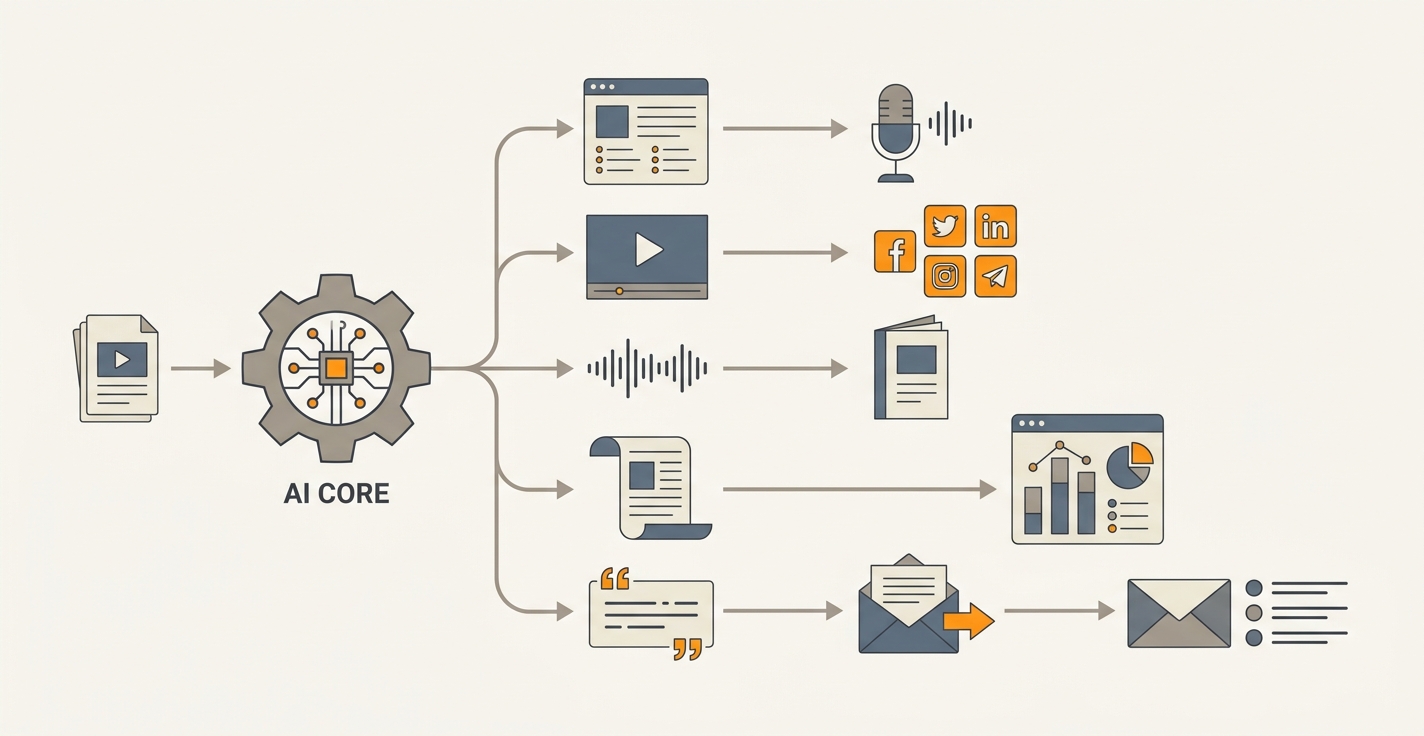
One blog post. One audience. One conversation. Then silence.
Most content teams write articles, publish them once, and move on. They get views from the initial push, then the traffic plateau hits hard. The post sits in your archive, invisible to new searchers, while you chase the next keyword.
But what if you could multiply the value of every article you write?
Key Takeaways
- Repurposing content with AI can generate 3-5x more organic traffic from the same research investment
- The best strategy combines topical clusters with multi-format distribution: blog to social, email, video scripts, and infographics
- AI handles 80% of the manual work, from format conversion to optimization for each platform
- Strategic repurposing increases topical authority by creating topic clusters and internal linking opportunities
- One 3,000-word pillar article can become 20+ pieces of content in a content distribution empire
Content repurposing is the antidote to content waste. Instead of writing 40 articles monthly and hoping they rank, you write fewer, better articles and transform each one into a content distribution empire.
The key difference: repurposing with AI is fast. No more manual transcription, reformatting, or rewriting. AI handles the heavy lifting. You get more traffic with less effort.
This matters because most content strategies fail at distribution. Teams spend 80% of their time researching and writing, then 20% on distributing the finished piece. That's backwards. The best content strategies flip it. You invest deeply in one piece of content, then distribute it relentlessly across channels. Repurposing makes relentless distribution possible without burning out your team.
1. Transform Blog Posts Into Email Series
Your blog post has research, examples, and insights. Your email subscribers want the same value in digestible chunks.
AI repurposing takes one 3,000-word blog post and converts it into a 5-part email sequence. Each email focuses on one key takeaway, with a CTA linking back to the full post. The result? Higher click-through rates and a reason for subscribers to visit your site repeatedly.
The AI process is straightforward. You feed the blog post, specify the number of emails, and the AI extracts the key ideas, reformats them for email, and adds personalized CTAs. No rewriting by hand. No worrying about consistency.
This strategy works because emails and blog posts serve different purposes. Blog posts answer questions. Emails deliver value directly to the inbox. Repurposing bridges both channels.
Why It Works
Email list subscribers are your warmest audience. They already opted in. Sending them repurposed content keeps them engaged and drives return visits to your blog. Unlike cold emails, there's no friction.
Timing matters here too. You publish a blog post on Monday. By Wednesday, the first email goes out. Each email in the sequence drops 2-3 days apart. Subscribers who missed the blog post on its launch day now see the core insights. This is part of a broader content distribution strategy that multiplies each piece of research you invest in.
2. Extract Key Insights Into Social Media Threads
One blog post contains 20+ shareable insights. Most get buried. AI extracts them into threads for LinkedIn, X, and Bluesky.
A numbered framework post works especially well here. Each point becomes a tweet or a LinkedIn post in a thread. AI pulls the exact supporting detail from the blog, reformats it for the platform, and adds hashtags or CTAs.
The beauty of this approach is speed. Instead of manually reading your blog post and crafting tweets from memory, AI does the extraction and formatting in seconds. You get 10+ ready-to-post threads from a single article.
This also solves a consistency problem. Many teams write great content but struggle with social promotion. With AI repurposing, promotion becomes automatic. Social gets the content it needs.
Measuring Impact
Social threads drive traffic back to the blog. They also build personal brand authority for writers and experts. When you post insights consistently, your followers recognize you as a source of knowledge.
AI repurposing makes consistency possible. Without it, social falls to the bottom of the priority list. With automation, every blog post automatically generates social content. Your profiles stay active, and referral traffic to your blog increases.
3. Convert Articles Into Video Scripts and YouTube Shorts
Video content gets 80% more engagement than static text. But writing a video script from scratch is slow.
AI takes your blog post and converts it into a video script. For longer-form content, it creates a YouTube video script. For shorter formats, it writes scripts for YouTube Shorts, TikTok, and Instagram Reels.
The AI approach maintains the structure of your blog post but rewrites it for spoken word. It adds natural pauses, emphasis cues, and B-roll notes. The result is a script that sounds conversational, not like someone reading a blog post aloud.
This is especially powerful for tutorial or how-to content. Your numbered framework becomes a video walkthrough. Step 1 becomes scene 1. You shoot the script, upload it, and now the same content ranks in YouTube search alongside Google organic results.
Why Video Repurposing Wins
Video content diversifies your traffic sources. A blog post ranks in Google. A video ranks in YouTube search and gets suggested in recommendations. You're no longer dependent on one algorithm.
Video also builds trust. Seeing a face and hearing a voice creates connection that text doesn't. Using AI-powered video repurposing, you can multiply that effect across formats without burning out your production team. This is especially valuable for teams building brand positioning through consistent visual content.
4. Create Infographics and Data Visualizations From Written Content
Data and lists in your blog post become visual assets. AI extracts the key statistics, frameworks, and comparisons, then generates infographics.
This approach works best for posts with clear data, like comparisons, frameworks, and listicles. Your "5 Content Repurposing AI Strategies" article becomes 5 separate infographics, one per strategy. Each graphic is share-worthy on social and useful as a referenced asset in future articles.
AI doesn't just convert text to visuals. It designs them. It chooses colors that match your brand, layouts that are easy to read, and formats that work on mobile and desktop.
Infographics also get indexed and ranked by Google Images. They become another traffic source. A well-designed graphic gets pinned on Pinterest, shared on Reddit, and linked from industry sites.
Building A Visual Library
Over time, this approach builds a library of branded assets. That library becomes a moat. Your competitors are publishing text. You're publishing text, video, social threads, and infographics from the same content investment.
Internal teams also benefit. Your sales team has visual proof points for pitches. Your marketing team has assets for presentations. Your customer success team has diagrams to explain your product.
5. Cluster Blog Posts Into Pillar-and-Cluster Topic Pages
The most advanced repurposing strategy is structural. Instead of repurposing one article into different formats, you repurpose multiple related articles into a topic cluster.
A pillar page is a complete guide on a broad topic. Cluster posts are narrower, related articles. Each cluster post links to the pillar, and the pillar links to each cluster. This creates topical authority and boosts rankings for the entire topic.
AI accelerates this process. You can take 5-10 related blog posts on your topic (like content repurposing, content distribution, or AI writing), feed them into an AI content planner, and the AI generates a pillar-and-cluster structure.
It recommends the pillar topic, suggests cluster headings, identifies gaps, and even rewrites existing posts to fit the structure. This usually involves condensing some posts, expanding others, and creating new ones to fill gaps.
Why This Matters
Pillar-and-cluster architecture signals to Google that you're an authority on a topic. You're not just publishing random articles. You're building a complete knowledge base on your subject. This is the foundation of topical authority.
This structure also increases average session duration. A visitor lands on a cluster post, reads it, clicks to the pillar, reads that, then clicks to another cluster post. Google sees these engagement signals and rewards you with higher rankings.
Repurposing with a pillar-and-cluster strategy is more work upfront, but it compounds over time. Every piece of content feeds the same topic. Traffic accumulates. Rankings compound.
The Tools That Make Repurposing Work
Repurposing at scale requires tools that handle extraction, reformatting, and platform-specific optimization. The best tools combine AI writing with data about what works on each platform.
Without automation, repurposing becomes a bottleneck. You're manually opening documents, copying passages, rewriting for each format, and uploading to different platforms. A single article can take 6-8 hours to fully repurpose across all channels. Multiply that by 40 articles per month, and you're looking at hundreds of hours of manual work.
Platforms like Jottler automate the entire process. You publish an article, and the platform automatically generates email sequences, social threads, video scripts, and visual assets. It uses AI to understand the core message of your content and adapt it for each channel.
This is different from hiring a team to manually repurpose. Manual repurposing is slow and introduces inconsistency. Automated repurposing maintains your voice, captures all the key insights, and saves weeks of work.
The other advantage: optimization. AI understands platform nuances. It knows that LinkedIn threads perform best with 5-7 parts. It knows that email subject lines need to be under 50 characters. It knows YouTube Shorts scripts need to fit under 60 seconds of voiceover.
Many repurposing tools also provide analytics. They track which repurposed pieces get the most engagement, which platforms drive the most traffic back to your site, and which formats resonate with your audience. Over time, this data trains the AI to create even better repurposing recommendations.
Frequently Asked Questions
How much more traffic can you get from repurposing content?
Studies show that repurposing content can increase traffic by 3-5x compared to publishing the same article once and moving on. This assumes you're distributing repurposed content to relevant audiences on their preferred channels. A blog post repurposed into email, social, video, and infographics reaches audiences you missed in the original distribution.
What content repurposes best?
Frameworks, lists, comparisons, and how-tos repurpose best because they have clear structure. A "5 Steps to X" post becomes 5 social posts, a video walkthrough, and an infographic. News-heavy or timely content doesn't repurpose well because it becomes dated quickly. Evergreen, strategy-focused content is ideal.
Is AI-generated repurposed content as good as manually repurposed content?
AI-generated repurposing is faster and more consistent, but it requires human review. AI might miss context or fail to adapt tone perfectly for a specific platform. The best approach is AI as a starting point, with human review before publishing. This keeps repurposing fast while maintaining quality.
Does repurposing hurt SEO or create duplicate content issues?
No, if done correctly. Internal repurposing (blog to email to social) doesn't create duplicate content because it appears on different platforms with different URLs. Distributing the same article to multiple blogs or publications does create duplication. As long as the canonical URL points to your original blog post, repurposing is SEO-friendly and actually boosts topical authority.
Can you repurpose content from other sources?
Yes, but with permission. If you cite and link to the original source, you can repurpose their insights and frameworks into your own format. This is called content curation or remixing. Always attribute the original source and link back to it. Don't copy the content word-for-word; instead, add your own analysis or framework around the borrowed insights.
Start Multiplying Your Content Value Today
One article should not equal one conversation. Content repurposing with AI lets you extract maximum value from every piece of research you invest in.
Start with one piece of content. Repurpose it into an email sequence, social threads, and a video script. Measure the traffic from each channel. Then scale the approach to your entire content library.
The teams that repurpose at scale become content distribution empires. They publish fewer articles but reach more people, build topical authority faster, and compound their traffic growth.
Start a free trial at Jottler and see how our content automation handles repurposing across channels automatically.