Crafting Content for Marketing Automation Workflows
Content teams publishing 20+ pieces per week across multiple channels face a silent productivity drain: 89% of marketers already use AI for content creation, yet most still manually coordinate approvals, scheduling, and distribution. The gap between creation speed and execution efficiency has become the real bottleneck. When your team can generate drafts faster than it can publish them, the problem isn't writing—it's workflow orchestration.
Crafting content specifically for marketing automation workflows means designing each piece with distributed systems in mind. Your emails need modular components for dynamic personalization. Blog posts must include metadata-ready headlines for social variants. Content calendars demand structured handoffs between writers, designers, and publishers. Most teams ignore these requirements, producing content that works standalone but fails in automated sequences.
Here's a quick summary of how to craft content that actually flows through automation workflows effectively:
Key Takeaways
- 94% of marketers plan to use AI in content creation, but successful automation requires deliberately structured content with modular components designed for personalization (2026, HubSpot)
- Automation users report $5.44 ROI for every $1 invested in workflow systems, with 451% more qualified leads and 320% higher revenue from automated campaigns
- Content crafted for automation workflows—short, message-focused pieces with clear CTAs—outperforms generic long-form copy in behavioral trigger scenarios
- Modular Content Architecture: Divide blog posts, emails, and landing pages into discrete, reusable components so automation systems can mix-and-match for personalization at scale.
- Behavioral Trigger-Ready Structure: Design messaging that responds to customer actions with short, answer-focused content instead of dense paragraphs that overwhelm triggered sends.
- Automation-First Metadata: Include SEO tags, social media variants, email subject lines, and CTA buttons as required content layers before publishing anything to your system.
- Cross-Functional Handoff Design: Build approval workflows directly into your content spec so writers, designers, and marketers know exactly which version goes where and when.
- AI-Powered Scaling: Tools like Jottler automate keyword research, content generation, and fact-checking while maintaining your brand voice and publishing directly to your CMS, transforming manual bottlenecks into compound growth.
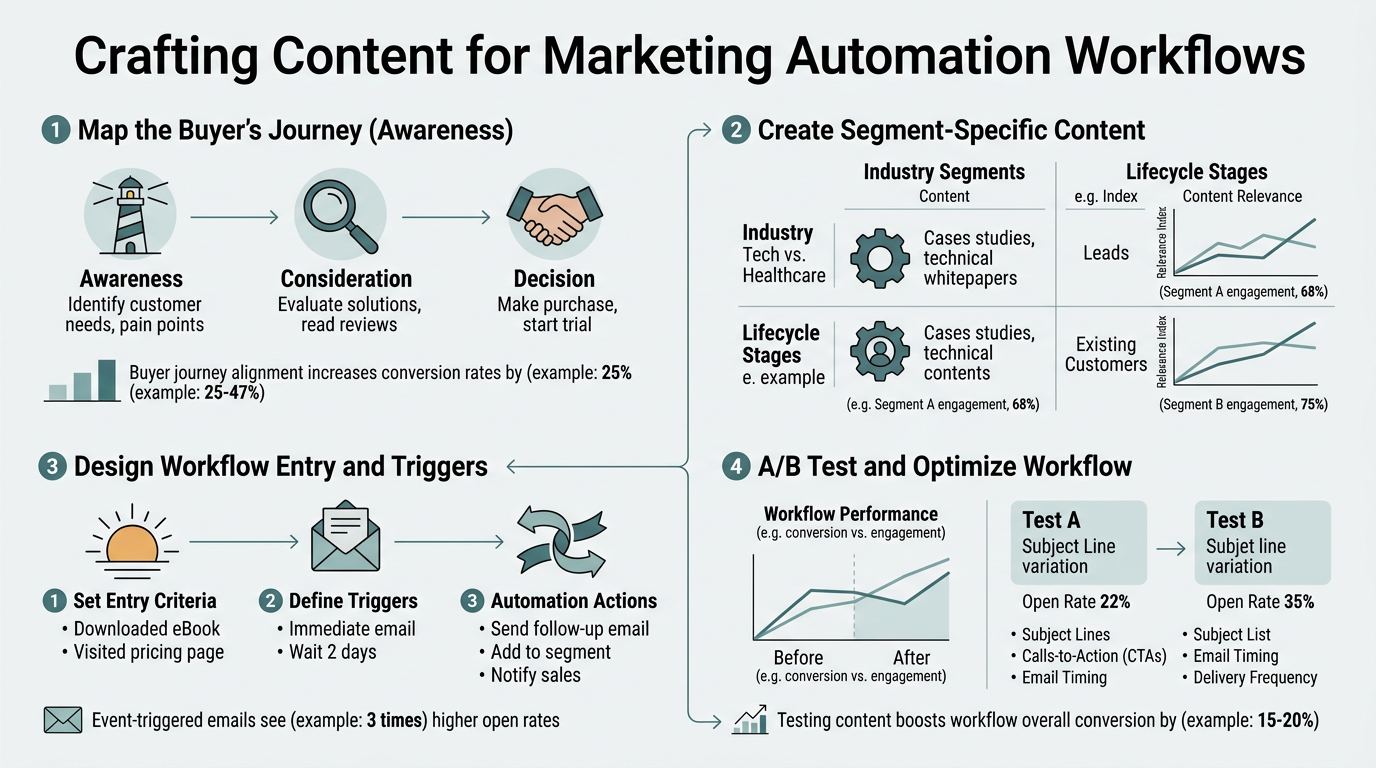
How Should Your Content Be Structured for Automation?
Automation systems cannot interpret intentionality. A blog post designed for manual publishing—with long narrative paragraphs, varied formatting, and embedded asides—breaks apart in automation workflows. Marketing teams using AI-powered automation achieve 27% faster campaign build times and 19% lower cost per qualified lead compared to manual approaches, but only if content is structured from the start to support that automation.
"The fix isn't writing less. It's designing content in layers: a primary message block, optional supporting details, pre-written CTA options, and social/email variants. Each layer should be independently functional yet combine into coherent sequences."
Creating Modular Content Components
Modular content separates concerns. A blog post about lead scoring, for example, should contain:
- Core explanation (300 words): The definition and business case for lead scoring, standing alone as a complete thought
- Methodology section (200 words): BANT, MQL, or behavioral approaches as independent modules
- Implementation checklist (50 words): 5-7 actionable steps, each self-contained for email or social repurposing
- CTA variants (3 options): Soft (guide download), medium (demo request), hard (trial signup)—automation chooses based on lead score
- Social assets: 3-5 quote blocks designed for LinkedIn, Twitter, or Instagram, each under 280 characters
This structure lets your automation system select, combine, and personalize without human intervention. Tools like Jottler's autonomous SEO agent handle the research and writing of modular, fact-checked content at scale, publishing directly to your CMS with internal links automatically distributed—eliminating the manual breakdown work that typically follows content creation.
Designing for Behavioral Triggers
Behavioral triggers improve personalization by enabling campaigns to respond to customer actions in real time, creating timely, relevant experiences. A user who downloads a "lead scoring guide" should receive content that answers their next logical question—not a generic nurture sequence.
This requires designing content backward from behavior. If a customer visits your pricing page, what question did they just ask? If they opened your email twice but didn't click, what doubt needs addressing? Structure each content block to answer one specific question in response to one specific behavior.
"Short, focused blocks work better than long narratives in trigger scenarios. A 100-word explanation with one CTA converts higher than a 500-word essay, because triggered messaging lives in email or SMS—channels where brevity drives action."
Building Metadata and Variant Requirements
Before a piece of content enters your automation system, it must include:
- SEO Title & Meta Description: The canonical version used for search, not a shortened variant
- Social Headlines (3 versions): LinkedIn (longer, professional), Twitter (under 280 chars), Instagram (conversational, shorter)
- Email Subject Lines (2-3 A/B pairs): Curiosity-driven vs. benefit-driven options for segmented sends
- CTA Buttons (minimum 3): Primary (most aggressive), secondary (educational), tertiary (minimal commitment)
- Internal Link Anchors: 3-5 keywords to relevant existing content so your automation can build topical clusters
This groundwork prevents your workflow from bottlenecking at distribution. Writers who add this layer upfront reduce publisher touch time by 60%, because the automation system has everything needed to place content across channels without rework.
What Content Formats Work Best in Automation Workflows?
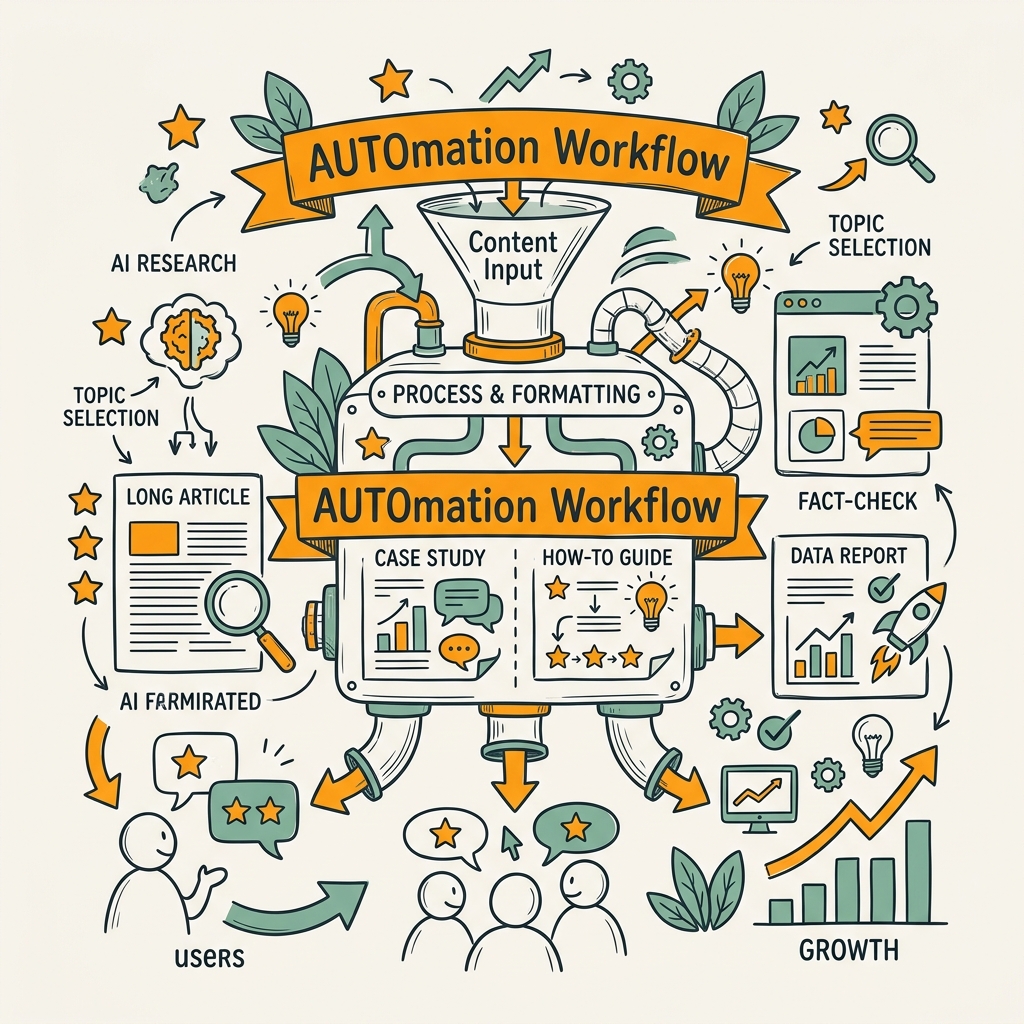
Not all content formats behave equally in automation systems. Blog posts delivered 22.26% ROI and remain the third most popular format for 2026, behind short-form video and long-form video, but they integrate most naturally into multi-channel workflows. Video demands separate editing pipelines. Podcasts require different distribution. Blog content is modular, searchable, evergreen, and repurposable into emails, social posts, and ad copy without format conversion friction.
| Format | Automation Strength | Typical ROI | Repurposing Ease |
|---|---|---|---|
| Blog Posts | Modular, searchable, evergreen | 22.26% | Very High |
| Email Sequences | Behavioral triggers, personalization | Up to 74% engagement lift | Medium |
| Social Variants | Distributed across channels | Channel-dependent | High |
| Video | High engagement | Highest | Low |
Blog Posts: Foundation of Automation Sequences
A blog post is the central asset in a mature automation workflow. It serves as the anchor: the primary SEO asset, the email campaign driver, the social proof element, and the lead magnet justification. Long-form blog content (1,500–3,000 words) ranks better for discovery, captures more context from AI systems, and enables more modular component extraction than shorter formats.
The structure should always be: quick answer first (the intro), then deeper context (H2/H3 sections), then specific examples or templates (the value layer), then clear next steps (the CTA section). This flow respects how automation distributes content—search engines and AI systems weight opening sections highest, while email automation needs to know the payoff quickly to decide which segment receives which piece.
Email Sequences: Breaking Content Into Triggered Sends
Email automation thrives on fragmented content. A 3,000-word blog post becomes a 5-7 email sequence: opening email (summary + primary CTA), follow-up 1 (first key insight + social proof), follow-up 2 (methodology deep dive), follow-up 3 (implementation checklist), follow-up 4 (case study or testimonial), follow-up 5 (final CTA variant).
Each email should include exactly one concept and one call to action. Multiple ideas in a single triggered send confuse the workflow and reduce engagement. Content personalization powered by automation increases engagement rates by up to 74%, but only when each message is tightly focused on a single customer pain point or question.
Social Variants: Micro-Content for Cross-Channel Distribution
Your automation system should extract 5-7 social assets from every blog post: 2-3 quote callouts (image or text), 1-2 statistics (shareable formats), 1 "did you know" insight, and 1 CTA-focused post. These live in your content management system as linked assets, so your social automation tool pulls them weekly without human intervention.
LinkedIn automation performs best when content includes: professional framing, industry-specific context, personal narrative, and explicit permission to comment. Twitter automation needs brevity, hooks, and conversation starters. Instagram works with storytelling and visual emphasis.
The mistake most teams make: writing one social version and hoping it adapts. Automation demands format-specific variants written at creation time.
How Do You Set Up Content Handoffs and Approvals in Workflows?

Manual approval workflows are the invisible killer of content automation. Teams believe they've "automated content production" when they've actually just automated publishing—the writing, editing, and approval still happen manually, in email threads, causing weeks of delays. According to SQ Magazine, marketing automation delivers ROI of $5.44 for every $1 invested, but only when handoff friction is eliminated at the process level.
Effective automation demands clear, documented workflows that move content forward without email ping-pongs.
Designing Approval Workflows Before You Automate
Start with an audit: who touches the content, in what order, and for how long? Map this as a swimlane: writer → editor → SME → designer → legal/compliance → marketer → publisher. Where do approvals stack up? Where does content wait the longest? Those are your automation targets.
For most content-driven teams, the sequence should be:
- Content creation (AI + human review): Writer or AI system drafts; human editor reviews for tone, accuracy, brand voice
- SEO + structure check: Verify keyword placement, heading hierarchy, internal links, meta tags
- Design handoff: Designer receives final copy and creates social variants, email templates, or visual assets
- Quality assurance: Fact-checker or SME verifies claims, links, and data points
- Publishing: Automation system publishes to CMS, schedules emails, queues social posts, builds internal link network
This sequence should take 3-5 days for a blog post, not 3-5 weeks. If it's taking longer, your team is adding unnecessary steps.
Using Dedicated Content Project Spaces
Rather than email threads, create a dedicated project space (Asana, Monday, Linear, or similar) for each piece of content. Include:
- Content brief with target keywords, target audience, desired outcomes
- Linked performance data (what similar past content ranked and converted)
- Assigned tasks for each phase: writer → editor → designer → publisher
- Due dates tied to publishing calendar (if you publish 5x per week, map backwards from publish date)
- Approval fields that lock tasks until previous phase completes
This visibility ensures your automation builders (the people setting up email sequences, social scheduling, etc.) know exactly when content is safe to use. Effective content marketing automation systems integrate this approval tracking directly into the platform, preventing the "where's the blog post?" emergency calls that derail publishing calendars.
Automation as a Guardrail, Not a Replacement
Automation should enforce consistency, not bypass judgment. A well-designed approval workflow uses automation to:
- Flag missing elements: If metadata, internal links, or CTA buttons aren't filled in, the system won't publish
- Route to the right reviewer: Content tagged "legal" auto-routes to compliance; content tagged "technical" routes to engineering review
- Notify stakeholders in real time: When a piece moves from draft to final, key stakeholders get pinged, not emailed lists
- Archive previous versions: Automation systems can compare drafts side-by-side, showing what changed and why, reducing approval confusion
The goal is predictability, not speed for speed's sake. A consistent 4-day approval cycle beats a chaotic 2-day rush where approvers haven't actually read the content.
What Role Does AI Play in Crafting Automation-Ready Content?

89% of marketers now use AI for content creation, with 87% reporting improved productivity and 80% seeing efficiency gains. But AI isn't a replacement for structured thinking—it's a multiplier. AI thrives when given clear, modular directives: "Write a 300-word explanation of lead scoring in B2B SaaS" or "Generate 5 social variants of this insight." It struggles when asked to guess at tone, target audience, or strategic intent.
AI as a Content Scaling Engine
The practical workflow is: human strategist defines the content architecture (sections, components, metadata requirements), then AI generates drafts that humans review, edit, and approve. 45% of marketing teams report using at least one agentic AI system for automation tasks in 2026, up from 15% in 2024, indicating rapid adoption of autonomous systems that can handle research, drafting, and fact-checking without constant human supervision.
"AI-powered content generation systems that combine research from 14+ sources, fact-checking verification, and direct CMS publishing are designed specifically for scale. Instead of asking your team to manually research topics, write initial drafts, and coordinate with designers, an autonomous system handles these steps simultaneously, publishing ready-to-distribute content daily while maintaining your brand voice and internal link strategy."
AI-powered content generation systems represent the evolution of this approach, automating keyword research, content generation, and fact-checking while publishing directly to your CMS.
Fact-Checking as a Non-Negotiable Layer
AI-generated content requires verification. 61% of marketers report trust and credibility as the top return from content marketing, which means every statistic, claim, and recommendation must be verified against the actual sources. This is where AI systems that include fact-checking capabilities become essential—not because they're foolproof, but because they reduce the manual verification burden by 70%.
Your team should spot-check 10-15% of AI-generated content, verifying claims against source documents, checking link destinations, and ensuring statistics are current (2025-2026, not recycled 2023 data). This hybrid approach—AI for production volume, humans for quality gates—is the realistic operating model for busy teams.
Maintaining Brand Voice Through AI Templating
The mistake teams make with AI content tools: they feed the system their website and hit "generate." This produces generic output that reads like every other AI-written piece online. Instead, feed your AI system examples of your best past content—actual pieces that ranked, converted, or resonated—and tell it explicitly what brand voice you want (formal vs. conversational, detailed vs. brief, data-heavy vs. story-driven).
This is easiest with systems that allow you to upload your brand guidelines, link to preferred published examples, and set voice parameters before publishing. The AI then has a template to match, rather than a blank canvas to fill.
Conclusion
Crafting content for marketing automation workflows isn't about publishing faster—it's about designing each piece with distributed systems in mind from the start. Modular components, behavioral trigger readiness, clear metadata, and streamlined approval handoffs transform content from a creation bottleneck into a reliable engine.
The numbers prove the opportunity: 72% of marketers say automation helps them scale content production, and teams using structured automation strategies report 13% higher ROI and 451% more qualified leads compared to manual workflows.
The teams winning right now are those treating content architecture as a technical requirement, not an afterthought. They design in modular layers, build approval workflows that enforce consistency rather than create delay, and use AI to amplify their output volume without sacrificing quality.
Ready to stop managing content workflows manually? Start your SEO agent with Jottler to handle the research and content production layer while you focus on strategy and approval workflows.
FAQs
How should content be formatted for email automation sequences?
Email automation demands fragmented, focused content. Break a single blog post or topic into a 5-7 email sequence, where each email addresses one specific question or pain point with one primary call to action. Each message should be 50-150 words, leading with the answer, then supporting detail. Automation systems can't interpret intentional structure, so spell it out: subject line variants, preview text, body copy, button CTA, and an optional fallback text link. Use behavioral triggers (downloading a guide, visiting pricing, opening twice without clicking) to determine which email in the sequence goes out next. This focus is why personalization-powered automation increases engagement by up to 74%—short, targeted messages win over generic long-form.
What metadata do I need to include before publishing content to an automation system?
Automation systems need complete metadata upfront to avoid bottlenecks. Before publishing, include: SEO title and meta description (for search), 2-3 social headline variants for LinkedIn/Twitter/Instagram, 2-3 email subject line options for A/B testing, minimum 3 CTA button variants (soft offer, demo, trial), internal link anchors (3-5 keywords pointing to related content), and author/publication date. Teams including this metadata upfront reduce publisher touch time by 60% because the system has everything needed for distribution without rework. Without this layer, your automation creates more manual work downstream as content requires reformatting before it can actually be distributed.
Can AI-generated content work in automated marketing workflows without human review?
AI content generation is production volume multiplied by risk. While 89% of marketers use AI for content creation, trust and credibility remain the top concerns—every statistic, claim, and link must be verified. AI should never bypass human approval gates; instead, use it to amplify throughput while humans verify. Spot-check 10-15% of AI-generated content, fact-checking claims against sources, verifying link destinations, and ensuring data is current. Feed your AI system examples of your best past content and explicit brand voice parameters (formal vs. conversational, detailed vs. brief) so it learns to match your style. The hybrid model—AI for production, humans for quality gates—is the realistic and safe approach for scaling content through automation without sacrificing credibility.