Creating Cold Email Sequences That Convert
Most cold email sequences fail because they're built like volume machines, not sales tools. Teams send generic follow-ups on rigid cadences, watch spam filters catch them, and watch reply rates plummet. The result: average cold email reply rates sit at 3.43%, while closed-deal conversion averages just 0.2% across most B2B programs (2026, Instantly). The fix isn't sending more emails—it's engineering sequences that feel personal, arrive reliably, and create genuine reasons to reply. Here's how to build cold email sequences that actually convert.
Key Takeaways
- Industry average cold email reply rate is 3.43%, with top performers reaching 8–12% through signal-based personalization (2026, Instantly).
- Subject lines under 40–50 characters with trigger-event references achieve 54.7% open rates, compared to generic lines (Autobound, 2026).
- Most conversions happen within the first follow-up; effective sequences use the "Widening Gap" cadence to avoid spam filters while staying persistent.
- Research-First Personalization: Building subject lines and opens around real business signals (funding, hiring, product launches) lifts reply rates by 45% vs. generic personalization.
- Subject Line Precision: Short (3–7 words), specific triggers with numbers or questions consistently outperform longer, generic alternatives.
- Cadence and Timing: The "Widening Gap" strategy spaces follow-ups to avoid spam filters while maintaining persistence—avoiding the robotic velocity pattern that gets flagged.
- Sequence Length and Steps: Most high-performing sequences run 3–5 steps for SMBs, 5–7 for enterprise, with the highest-converting reply often coming at step 2 or 3.
- Deliverability and Reputation: Domain health, sender authentication (SPF, DKIM, DMARC), and inbox placement are prerequisites—no sequence saves bad deliverability.
What Makes a Cold Email Sequence Convert?
A converting cold email sequence does three things at once: it lands in the inbox (not spam), it creates curiosity or urgency without feeling pushy, and it turns a cold stranger into a warm contact who actually wants to talk. Most sequences fail at step one—they get caught by spam filters because they trigger velocity patterns (too many from the same sender in a short period) or because the sender's domain reputation is already damaged. If your emails aren't getting delivered, conversion rate is irrelevant.
"Signal-based personalization—referencing a real business event like a funding round or leadership change—drives 45% higher reply rates than first-name-only personalization, meaning founders who take time to research their targets see dramatically better returns."
The modern expectation, especially for busy founders and scaling teams, is that sequences should work on autopilot. That's where many sequences break down. Generic templates and broad list-blasting don't scale. But signal-based personalization—referencing a real business event like a funding round or leadership change—drives 45% higher reply rates than first-name-only personalization, meaning founders who take time to research their targets see dramatically better returns (Cleanlist, 2026).
Why Most Sequences Fail
The biggest reason sequences don't convert is that they're treated as broadcast tools. Founders and marketing teams send the same five-email template to a list of 200 people, auto-space them 3–5 days apart, and hope volume creates conversions. What happens instead is that email providers like Gmail and Outlook see a robotic velocity pattern—the same sender pushing 200 identical follow-ups within a tight window. That triggers spam filters. Your domain reputation degrades. Open rates flatline, even for the people who do get them.
The second reason is weak subject lines. Most cold emails use first-name personalization ("Hi [FirstName]") or vague curiosity ("Quick question for you"). These don't stand out in a crowded inbox. Subject lines that include specific numbers see 113% improvement in open rates, and those that reference a trigger event (funding, job change, product launch) achieve 54.7% open rates—compared to 27.7% average for generic subject lines (Autobound, 2026). A sequence with a bad opening line dies in the preview pane.
Third is broken follow-up logic. When someone replies, most sequences keep sending. Some teams don't even pause the sequence—they send email #3 while the prospect is replying to email #1. That's how you lose deals. High-performing sequences track replies in real-time and pause or remove prospects who engage.
The Role of Deliverability in Conversion
No sequence converts if it lands in spam. This is the non-negotiable foundation. Deliverability depends on domain reputation, sender authentication (SPF, DKIM, DMARC records), email volume ramp (warming up new domains), and list quality. If you're sending to invalid or harvested addresses, spam complaints pile up fast and wreck your sending domain for future campaigns.
Many scaling teams overlook this step entirely. They build a great sequence, launch it to a list of 1,000 people, and watch delivery rates crater because they never authenticated their domain or because they're sending from a brand-new sender account with no reputation. The fix is to start small (50–100 warm emails to past contacts), verify authentication records are live, monitor for spam complaints, and gradually increase volume as reputation builds.
How to Structure a High-Converting Cold Email Sequence
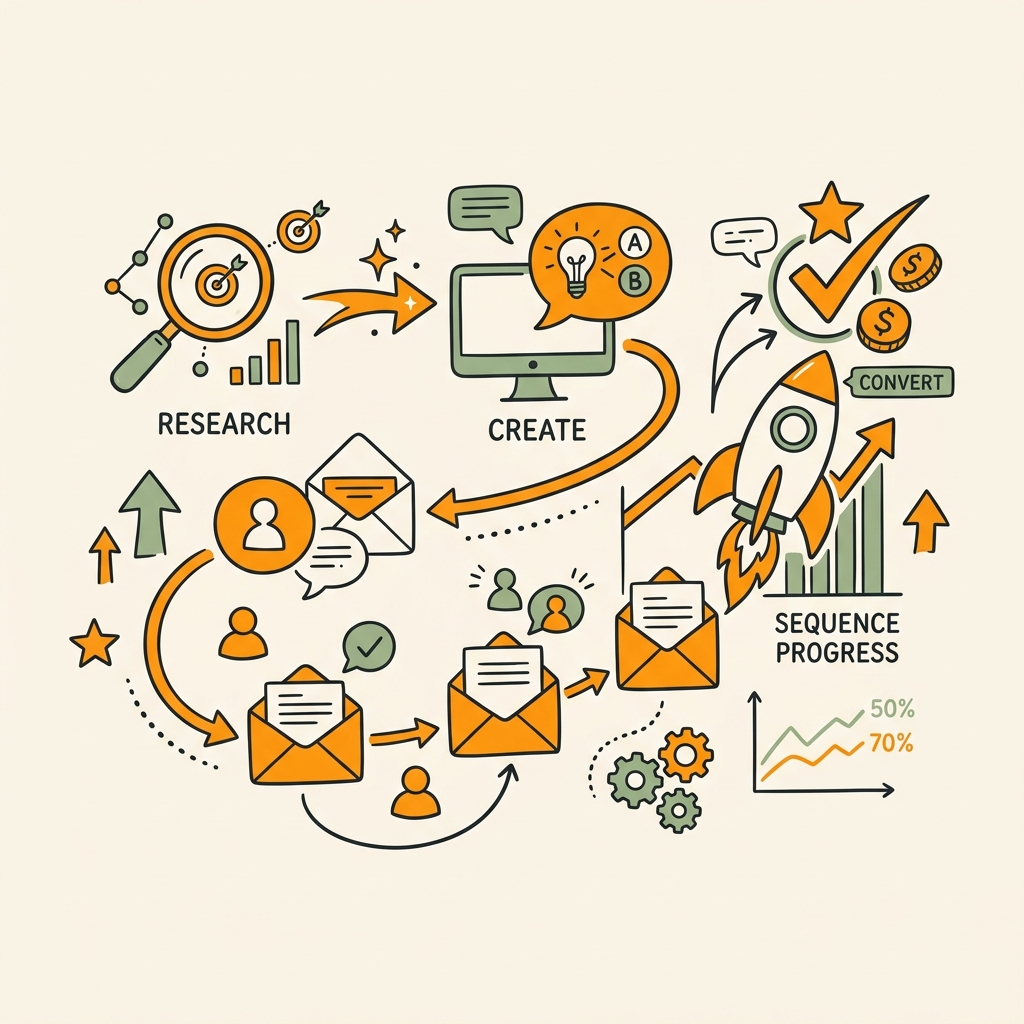
The best sequences aren't one-off broadcasts—they're engineered funnels with specific goals at each step. Email #1 should introduce value and context. Email #2 should address objections or reframe value. Email #3 should create mild urgency or switch tactics (a document, a specific insight). Most teams stop there for SMB targets; enterprise sequences often extend to 5–7 steps because decision cycles are longer and you have more stakeholders to reach.
"The Widening Gap cadence (3 days after initial send, then 5 days, then 7 days) prevents the robotic velocity pattern that spam filters catch. This strategy keeps you persistent without looking automated."
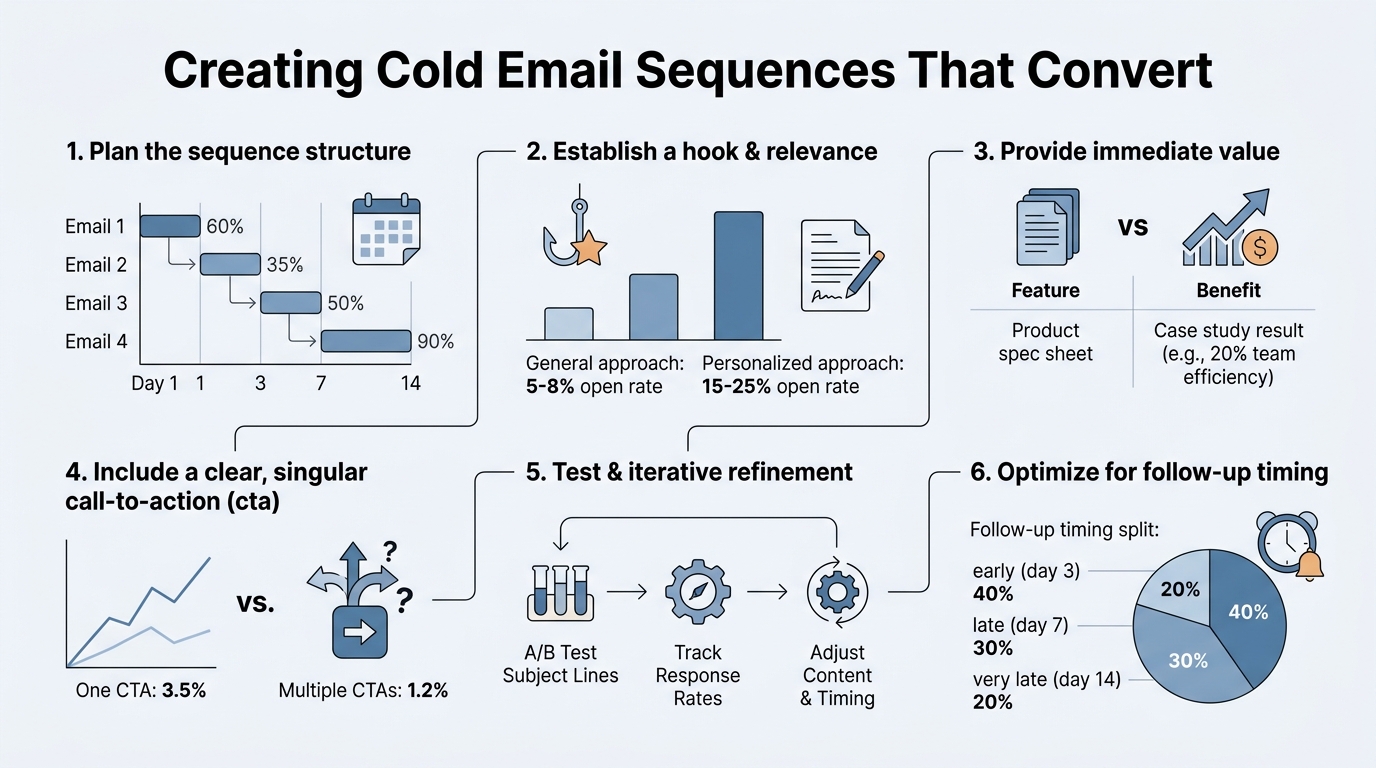
The timing between steps matters as much as the copy. The "Widening Gap" cadence (3 days after initial send, then 5 days, then 7 days) prevents the robotic velocity pattern that spam filters catch. This strategy keeps you persistent without looking automated. When executed properly, sequences work across SaaS content marketing and outbound channels simultaneously, compounding your lead generation efforts.
Step 1: The Hook Email
Your first email has one job: earn the second open. It should reference a specific, verifiable insight about the prospect's company—not their first name. This is the signal-based personalization that drives conversion. Examples: a recent funding round, a job posting you found, a product launch, a change in leadership, an earnings report, or even a social media post from the CEO.
The subject line should be short (3–7 words, under 40–50 characters), include the business signal, and avoid spam triggers. Good examples: "Congrats on the Series B," "Saw you hired for sales last week," or "Your new product, the X angle." Notice: no pitch. The subject line makes the recipient feel known.
The email body should be 3–5 sentences. Lead with why you're writing (the signal you found). Show understanding of their pain. Ask one question or suggest one specific insight. Close with a soft call-to-action: "If [specific outcome], I'd like to share how we've helped similar teams."
This email is not about features. It's about demonstrating that you've done homework. Prospects reply more often when they feel you've researched them as an individual, not just scraped them from a list.
Step 2: The Value Email
If email #1 got no reply, step 2 lands 3 days later with a different angle. This email shifts from "I know about you" to "Here's what we do that matters to your situation." Send a case study snippet, a one-page framework, or a specific insight (a tool comparison, a benchmark, a tactic). Something that answers the implicit question: "Why should I care?"
The subject line changes completely—don't repeat "Congrats on Series B" again. Try: "How [Company] scaled from $2M to $8M ARR" or "The X metric most teams miss." You're reintroducing yourself with fresh context.
Keep the body short: 2–3 sentences, then the asset or insight. Don't over-explain. Let the resource speak. "Attached: a framework we built for Series-B teams. Might apply to you. Let me know what you think."
Step 3: The Authority Email
This email (sent 5 days after step 2) changes tactics again. Instead of a personalized message or an asset, send a social proof angle: "Three other teams in your space just did X" or "Here's a data point I think you'll find useful: Y% of companies like yours improve Z metric by switching to [approach]."
The goal is to create light urgency or FOMO without being pushy. Social proof is more credible than pitching. Quote a benchmark, cite a study, reference a success metric. The subject line can be conversational: "Quick thought" or "One more thing." This email exists to nudge people who are sitting on the fence.
Step 4 (Optional for Enterprise): The Specificity Email
For longer enterprise sequences, step 4 can be a very targeted follow-up. Use data you've gathered about their company. "I noticed you're using X platform. We've helped teams migrate from X to Y without losing data. Should I put together a quick audit?" This proves you've been paying attention and makes the ask hyper-specific.
Spacing and Cadence: The Widening Gap
Don't send emails 2–3 days apart forever. That pattern flags as automated. Instead, use the "Widening Gap": email #1 on Day 1, email #2 on Day 4 (3-day gap), email #3 on Day 9 (5-day gap), email #4 on Day 16 (7-day gap). This spacing signals a real human choosing when to reach out, not an automation tool hammering a schedule.
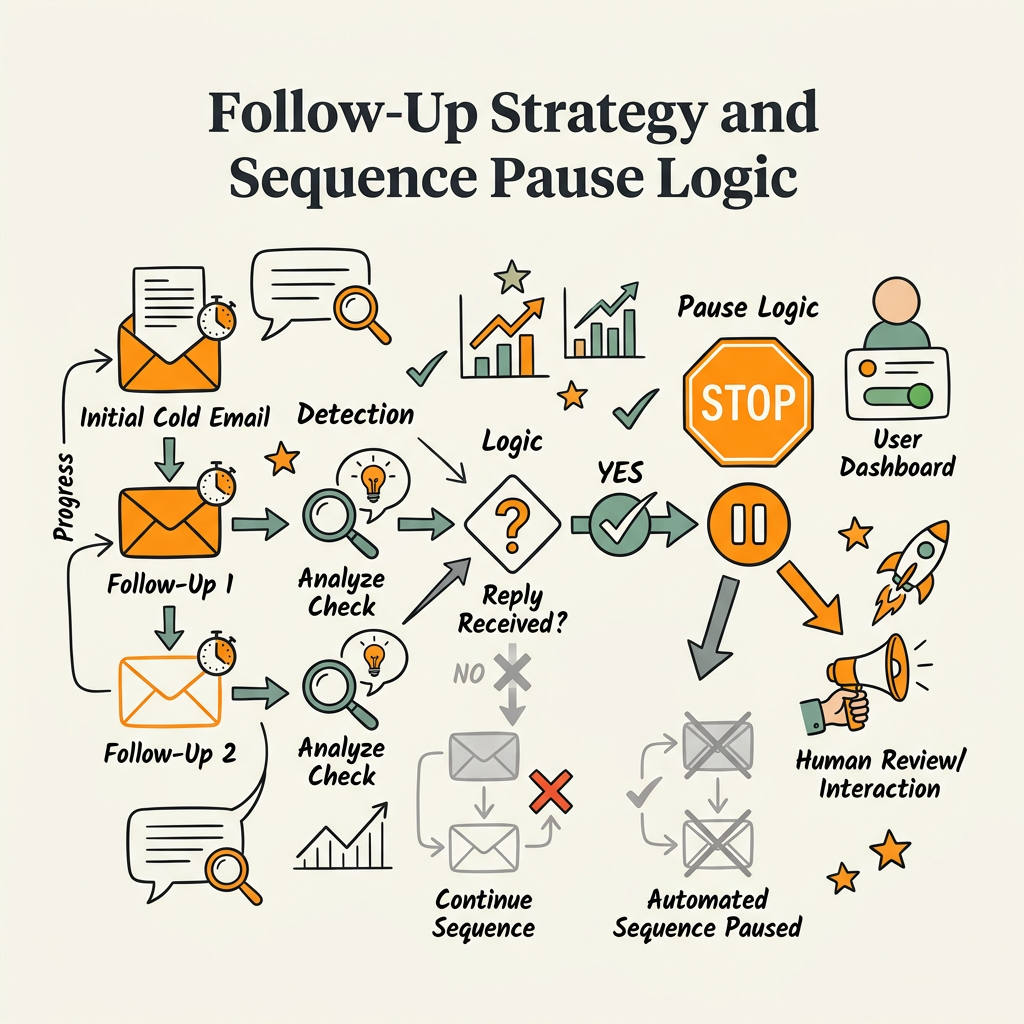
If a prospect replies at any step, pause the sequence immediately. Don't keep sending. Your CRM should automatically pause sequences on reply, but many teams still send through replies by mistake—an easy way to lose credibility.
Subject Lines That Unlock Higher Open Rates
Subject lines are your only chance to get the click before someone decides your email isn't worth their time. The best subject lines in 2026 break two rules that old-school email advice taught: they're short, and they're about the recipient's business, not about what you want to sell. Most high-converting cold emails use 3–7 words or under 40–50 characters so they display fully on mobile and scan quickly on desktop (Evaboot, 2026).
Signal-Based Personalization Over First-Name Personalization
Referencing a business trigger in your subject line lifts response rates dramatically. Instead of "Hi Sarah—quick question for you," try "Saw Acme Labs raised Series A." The second one is specific, acknowledges an event you researched, and gives the recipient a reason to open. Adding company name to a subject line boosts performance by 26% over first-name-only personalization, and referencing a mutual connection drives 45% higher reply rates (Cleanlist, 2026).
Good signal-based subjects:
- Funding angle: "Congrats on the $12M Series B"
- Hiring angle: "Saw you posted for a VP Sales role"
- Product or market angle: "Your new AI feature looks promising"
- Leadership change: "Welcome to [Company], [New Exec]"
- Earnings or milestone: "Impressive 40% YoY growth in Q4"
Keep It Short and Visible
Mobile email clients show roughly 30–40 characters before truncating with "…" Long subject lines get cut off. If you send "I've been following your company's growth in the SaaS space and I think we can help you scale even faster," a mobile user sees "I've been following your company's growth in the SA…" and deletes it immediately.
Aim for under 40–50 characters. This is tight, but it forces clarity. Test a few: "Series A trajectory" (18 chars) vs. "We helped 5 Series A companies scale from $2M to $8M ARR" (57 chars). The first is more likely to get a click because it's surprising and complete.
Use Numbers and Questions Strategically
Subject lines with numbers see 113% improvement in open rates, and those with questions improve opens by 21% (Autobound, 2026). A few patterns that work:
- Numbers + specificity: "3 ways to cut your sales cycle in half" or "The 2-week email automation that moves deals faster"
- Questions that mirror a pain point: "Why are your churn rates higher than competitors?" or "How are your competitors doing this?"
- Questions that create curiosity without being vague: Avoid "Want to win?" Instead try "Could your sales team close 40% faster?" (specific + question = higher intent).
Personalization Without Being Creepy
The line between smart personalization and stalker behavior is using public professional data only. Reference what you find in LinkedIn, company websites, earnings reports, SEC filings, and public social media posts. Never reference personal information like family status, hobbies, or private social content.
Smart personalization examples:
- "I noticed you've been in the VP Sales role at [Company] for 18 months. Most VPs in your spot focus on X, but I think Y is more critical."
- "Your company's careers page lists 12 open roles for engineers. That's a growth signal. Are you hiring for a specific product area?"
- "I read the latest earnings call transcript and noticed [CEO Name] mentioned expanding into [market]. We've helped three companies in that space succeed faster."
Creepy personalization (avoid this) includes:
- Mentioning someone's personal Facebook content or dating status
- Referencing family photos or private activities
- Vague comments like "I can tell you're ambitious from your profile" (assumes too much)
- Sending emails at odd times specifically because you discovered someone's daily habits
Follow-Up Strategy and Sequence Pause Logic
The highest-converting email in a sequence often isn't email #1—it's email #2 or #3. 70–80% of cold email replies happen after email #1, meaning the follow-ups are where the magic happens (Mailshake, 2026). Most recipients aren't ready to engage on the first touch. They need context, social proof, or a reframed angle. Understanding this dynamic is central to AI content strategy for outbound programs.
The trap is that many teams send follow-ups mechanically without checking if the prospect already replied. This is one of the fastest ways to lose credibility. If someone replies to email #1, pause the sequence immediately. If they say "Not interested," honor that. If they say "Not now, try me in March," set a calendar reminder instead of continuing the sequence.
Reply-to-Meeting Conversion
Once someone replies, your job shifts from getting a response to booking a conversation. Most outbound teams convert 15–30% of replies into booked meetings, while high-intent campaigns with quick follow-up achieve 30–45% conversion (Oppora, 2026). The difference is speed and clarity. If a prospect replies positively, you have a small window (sometimes hours) to move the conversation to a phone call or meeting.
Templates for reply sequences should be even shorter than cold emails. One question. One link to a calendar. No second pitch. Example: "Perfect—let's find a time to talk through this quickly. Thursday or Friday work for you? [Calendar Link]"
Common Mistakes That Destroy Conversion Rates
Beyond the basics, several patterns tank conversion rates for otherwise solid sequences:
- Sending multiple emails per day: This is an instant spam flag. One email per prospect per day, maximum.
- Using vague CTAs: "Let me know if you're interested" converts poorly. Instead: "Is Thursday a good time for a brief call? [Calendar]"
- Pitching too hard in email #1: Email #1 should feel like introduction, not sales. Save the pitch for email #2 or a follow-up call.
- Not testing subject lines: A/B test at least 3 subject lines across a small batch (20–30 people each) before full deployment.
- Forgetting about domain reputation: One batch of bad list data or a high complaint rate ruins your domain for weeks. Use verified list sources and monitor complaint rates daily.
- Ignoring reply-to-meeting lag: If someone replies positively and you take 24 hours to follow up, momentum dies. Set response time SLAs: aim for under 2 hours during business hours.
How to Measure and Optimize Sequence Performance
You can't improve what you don't measure. Most teams track open rate and reply rate, but those metrics alone hide problems. Mailshake recommends monitoring inbox placement, unique opens, positive replies, meeting booked rate, and revenue per 1,000 emails—not just raw opens.
Here's what each metric actually tells you:
- Inbox placement (% delivered to inbox, not spam): If this is low, you have a deliverability problem. Fix domain reputation before optimizing anything else.
- Unique opens (one person, one open): Repeated opens from the same person might mean curiosity, but it might also mean they're hesitating. Track this separately from total opens.
- Positive reply rate (replies that aren't unsubscribes or "not interested"): This is the real conversion metric. Average is 1–3% for cold; 4–5%+ is strong.
- Reply-to-meeting (% of positive replies that become booked meetings): This is where many teams leak. If your positive reply rate is good but meetings booked is low, your reply cadence is too slow or your CTA is weak.
- Revenue per 1,000 emails: The ultimate metric. It ties everything together—personalization, sequence design, follow-up timing, and deal size.
To optimize: Run small tests (100–200 prospects per variation). Test one variable at a time: subject line, email body length, value prop, cadence, CTA phrasing. Wait for statistically significant sample size (at least 30 replies per test) before rolling out to production. Track which subject lines, value angles, and follow-up timings produce highest positive reply rates in your specific market. This methodical approach mirrors how teams optimize automated SEO campaigns—data-first iteration.
Automating Sequences Without Losing the Human Touch
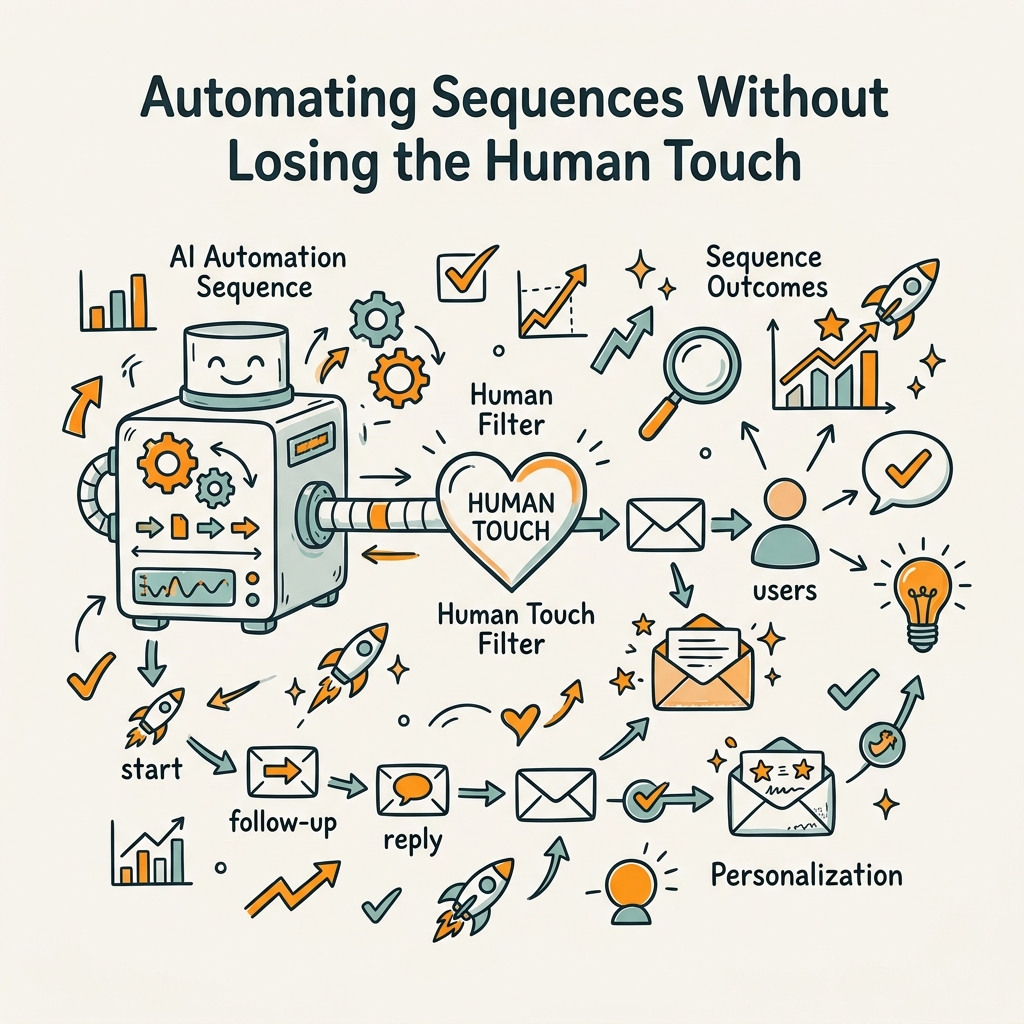
Busy founders and marketing teams need sequences to run on autopilot, but automation without intelligence kills conversion. The balance is smart rules and pause logic. Autobound's research shows that signal-based personalization—referencing concrete triggers like funding, leadership changes, or hiring surges—can reach 15–25% reply rates, versus 1–3% for generic cold outreach. Automation works best when it's applied to the research and personalization layer, not the messaging itself.
"The best approach: automate the research (who to contact, what signals to reference), but keep the email copy human-written with signal-based hooks. Use automation to track replies, pause sequences on engagement, and trigger next-step actions."
Tools that enable this include platforms that help teams research signals and scale outreach without sacrificing personalization. The best approach: automate the research (who to contact, what signals to reference), but keep the email copy human-written with signal-based hooks. Use automation to track replies, pause sequences on engagement, and trigger next-step actions (book meeting, send resource, change approach). This hybrid approach scales without feeling robotic.
Real-World Sequence Examples That Work
Here's a template sequence structure that works for most B2B SaaS and services teams:
| Email Step | Timing | Goal | Subject Line Pattern | Ideal Length |
|---|---|---|---|---|
| Email #1 (Hook) | Day 0 | Earn the second open using signal-based personalization | Signal reference: "Saw you [event]" | 3–5 sentences |
| Email #2 (Value) | Day 3 (3-day gap) | Introduce a resource or insight; shift to "here's what we do" | New angle: "How [Similar Co] scaled" | 2–3 sentences + resource |
| Email #3 (Authority) | Day 8 (5-day gap) | Add social proof or a new reason to engage | Soft urgency: "One more thought" | 2–3 sentences |
| Email #4 (Specific, optional for enterprise) | Day 15 (7-day gap) | Hyper-specific offer or reframe; increase pressure slightly | Direct: "[Specific offer] just for [Company]" | 3–4 sentences |
For SMB targets (companies under 50 people), stop after email #3. Most SMB decision-makers move fast, and three well-timed touches are enough. For enterprise targets (500+ employees), extend to 5–7 steps to account for longer decision cycles and multiple stakeholders.
Deliverability: The Silent Killer of Conversion
Great sequences with bad deliverability deliver nothing. If your emails land in spam, conversion rate doesn't matter. The foundation of deliverability is domain reputation, sender authentication, and list quality. Many scaling teams send cold emails from brand-new domains (or worse, free email accounts) and wonder why response rates crash.
Before launching any sequence:
- Verify SPF, DKIM, and DMARC records are live and correct
- Warm up new domains with small batches (20–50 emails per day) to past contacts or warm leads for the first week
- Use verified list sources (LinkedIn, company websites, manual research) instead of harvested lists
- Monitor complaint rates daily; keep them below 0.3%
- Set a daily sending cap relative to domain age: new domains, 50–100/day; established domains, 200–500/day
If your spam complaint rate climbs above 0.3% or your bounce rate (invalid addresses) exceeds 2%, pause the sequence and audit your list immediately. One bad batch can tank your domain for weeks.
Conclusion
Creating cold email sequences that convert comes down to three principles: research-first personalization (know your target), signal-based subject lines (earn the open), and smart cadence (stay persistent without sounding robotic). The industry average reply rate is 3.43%, but teams that implement signal-based personalization achieve 8–12% reply rates, and the best sequences see 30–45% of replies convert to booked meetings (Instantly, Oppora, 2026).
The fastest way to scale high-converting sequences is to remove manual work from the research and tracking layers while keeping the messaging human. Teams that blend signal-based automation with thoughtful, short email copy see the best results. For busy founders who can't spend hours personalizing 200 emails, the answer is to systematize the research (what signals to look for, where to find them) and then template the response around those signals.
Most scaling companies treat cold email as a cost center. The best ones treat it as a channel that compounds. Build one great sequence, optimize it over 3–4 months, and it becomes your predictable lead-generation machine. Start your SEO agent to compound your organic growth while your cold email sequences work in parallel.
FAQs
What is the average cold email conversion rate in 2026?
The industry average cold email reply rate is 3.43%, though this varies widely by personalization strategy and list quality. Deal conversion from emails sent averages 0.2% (roughly 1 deal per 464 emails), but companies using signal-based personalization—referencing funding rounds, hiring changes, or other business triggers—routinely achieve 4–5% reply rates or higher. High-intent campaigns with quick follow-up can convert 30–45% of replies into booked meetings, making the true bottleneck not the email itself but the speed of the follow-up and the clarity of the next step.
How long should a cold email sequence be to maximize conversions?
Most converting sequences run 3–5 steps for SMB targets (companies under 50 people) and 5–7 steps for enterprise (500+ employees). The majority of conversions happen between steps 2 and 3, meaning the initial email often doesn't close the deal—the follow-up does. The Widening Gap cadence (3 days, then 5 days, then 7 days between sends) prevents the robotic velocity pattern that spam filters catch. Longer sequences can work for enterprise, but only if each email has a distinct purpose and value proposition. Generic, repetitive sequences with more than 5 steps usually tank reply rates.
What makes a cold email subject line convert more replies?
Cold email subject lines that convert share three traits: they're short (3–7 words, under 40–50 characters), they reference a specific business signal (funding round, job posting, recent product launch), and they avoid generic personalization. Adding company name boosts performance 26% over first-name personalization, and referencing a business trigger drives 45% higher reply rates. Subject lines with numbers achieve 113% better open rates, and questions improve opens by 21%. The goal is to make the recipient feel you've researched them specifically, not that you're mass-blasting. Good examples: "Congrats on the Series A," "Saw you posted for VP Sales," or "Your new AI feature."