Decoding Your Organic Traffic Patterns
Organic search remains the single largest source of website traffic, but the dynamics of that traffic are fundamentally changing. 60% of Google searches now end without a click to any website, while AI Overviews appear in 13.14% of queries and cut click-through rates nearly in half. Meanwhile, median publisher traffic declined 10% year-over-year in the first half of 2025, even as total search volume climbs. The old metricssessions, bounce rates, average positionno longer tell the complete story. You need to understand what's actually happening beneath the surface of your analytics and how to respond strategically.
Key Takeaways
- Zero-click searches now account for 60% of Google queries, up from 58% in 2024 (2025, The Digital Bloom)
- Organic search remains the dominant channel, driving 53–61% of all trackable website traffic versus social and paid combined
- AI citation frequency, assisted conversions, and commercial impact are the new success metricsreplacing traditional traffic volume measures
- Segmentation by funnel stage, device type, and intent bucket reveals which content drives revenue versus which wastes resources
- Automated content platforms like Jottler handle daily keyword research, SEO-optimized writing, and internal linking to sustain organic growth without manual overhead
- The Zero-Click Phenomenon: Mobile searches hit 77% zero-click rates; you must optimize for AI visibility and citations, not just traditional rankings.
- Segmentation by Intent & Stage: Funnel-stage breakdowns reveal conversion patterns that flat traffic metrics hide completely.
- Commercial Metrics Over Vanity Stats: Shift from sessions and impressions to engaged sessions, assisted conversions, and close rate by source.
- Multi-Source Attribution: GA4 AI referrer segmentation isolates chatgpt.com and perplexity.ai traffic separately from traditional organic search.
- Content Authority & Proprietary Data: AI systems prefer citing unique, high-value sources; generic listicles lose visibility while research-backed content compounds traffic.
Why Traditional Organic Traffic Metrics Are Failing You
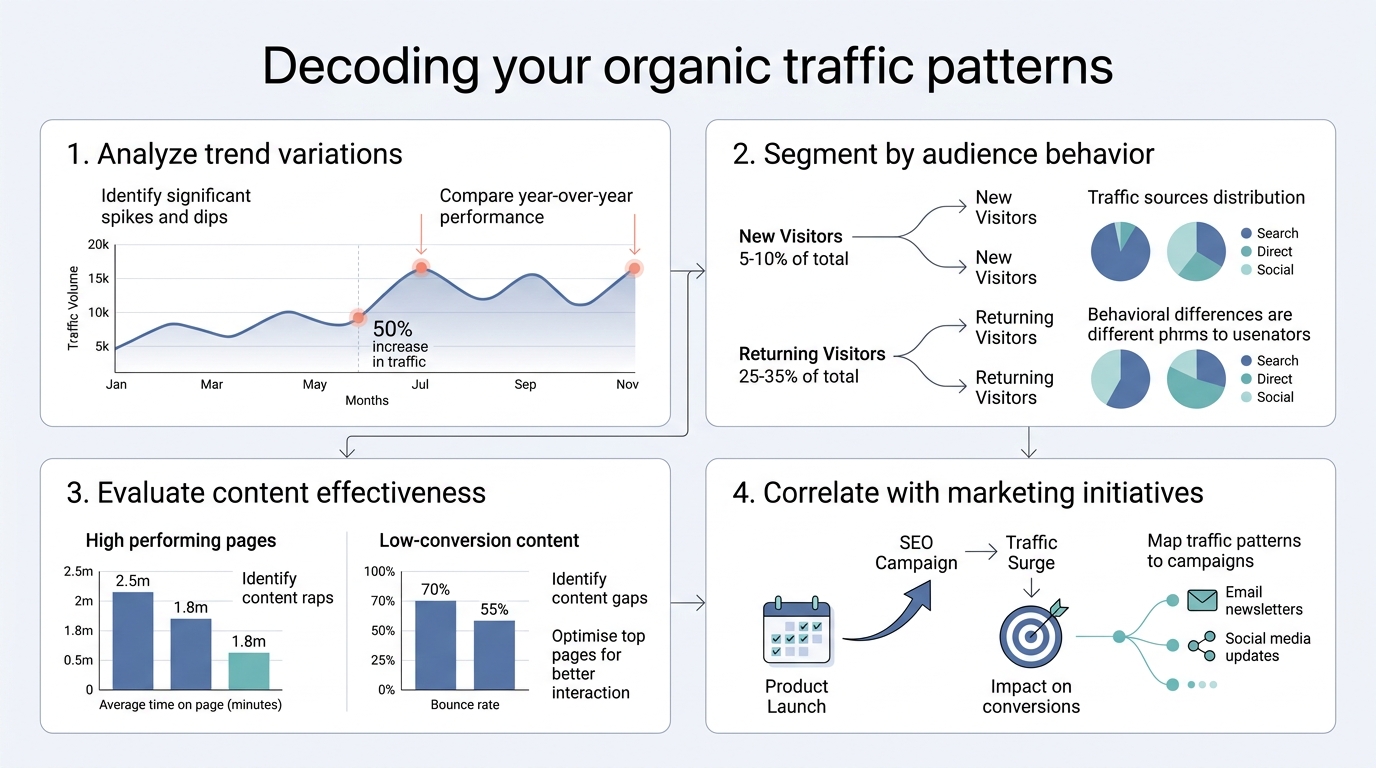
You're tracking sessions and bounce rate, but neither tells you whether your content drives revenue or just eyeballs. The shift from a click economy to a zero-click economy means your traditional metrics are measuring the wrong outcome. When 60% of searches don't generate a click at all, relying on session counts masks the real problem: AI is answering questions directly in search results, and you're not being cited. Even when clicks happen, they're increasingly fragmented across intent bucketsinformational queries that never convert, commercial queries that do, and branded queries that are pure top-of-funnel. Without segmentation, you're flying blind.
The Collapse in Click-Through Rates
AI Overviews have become a traffic killer for websites that compete for informational queries. When Google's AI answer box appears, click-through rates drop from 15% to just 8%. But here's the crucial insight: not all content is equally vulnerable. News content drops by 7% year-over-year, while non-news content sites drop 14%. Why? News articles update constantly and contain current events that AI summaries can't fully capture. Generic how-to content, product reviews, and FAQs are the first casualties. If your organic traffic leans heavily on these formats without proprietary angle or data, you're watching your traffic decline in real time. The solution isn't to abandon these topicsit's to add defensibility. Include original research, case studies, or proprietary tools that AI systems can't summarize in 2-3 sentences.
Why Sessions and Bounce Rate Miss the Picture
A 2000-word article on "how to do X" might drive 500 sessions but zero revenue. Another article driving 100 sessions generates your biggest customer. Without segmenting by funnel stage (top-of-funnel educational content versus bottom-of-funnel product-specific content), you can't allocate resources effectively. You'll continue writing content the algorithm rewards while ignoring content that actually converts. The same applies to bounce ratea visitor who lands on a pricing page, reviews it, and leaves without scrolling is not a bounce; they're a qualified prospect making a fast decision. Metrics designed for a click economy punish the exact behavior you want: intent-aligned, high-consideration users who know what they want and find it fast.
How to Segment Organic Traffic for Actionable Insights
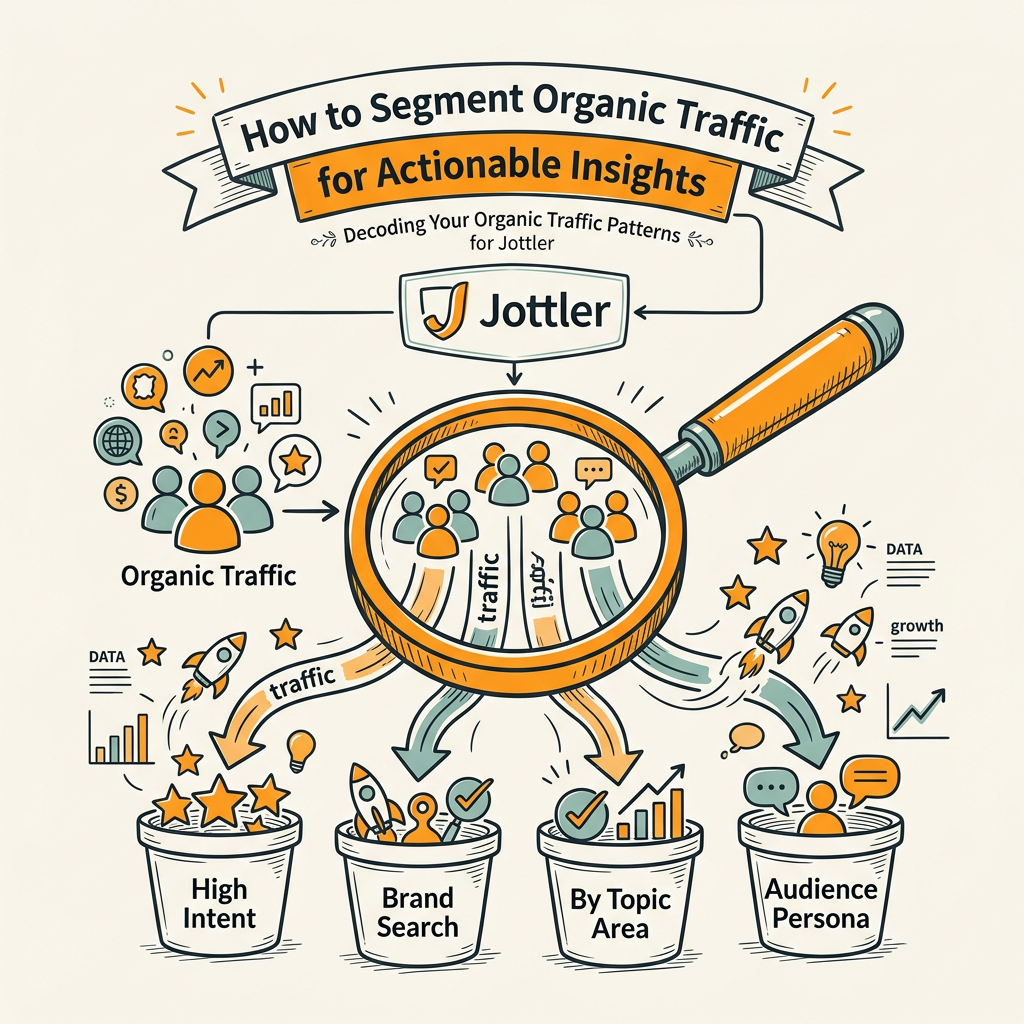
Segmentation transforms raw analytics into decision-making intelligence. Start with funnel stage, then layer in intent bucket and device type. Each segment behaves differentlytop-of-funnel readers scan and bounce, while bottom-of-funnel readers read deeply and convert. By separating these cohorts in GA4, you stop over-optimizing for engagement and start optimizing for the right outcome per stage. Tools like Animalz' SEO KPI framework recommend a three-layer approach: visibility tracking (can AI find you?), influence tracking (is AI changing buyer behavior?), and commercial tracking (revenue impact).
Funnel-Stage Segmentation in GA4
Divide your organic traffic into three categories: top-of-funnel (TOFUeducational guides, industry trends), mid-funnel (MOFUcomparisons, evaluations), and bottom-of-funnel (BOFUpricing, product guides). In GA4 Explore, segment by landing page and create a custom dimension for content type. Top-of-funnel content should drive awareness metrics: new users, engaged sessions, and scroll depth. Mid-funnel should drive consideration: time on page, page scrolls, and internal navigation to comparison or pricing pages. Bottom-funnel should optimize for conversion rate and cost per acquisition. When you compare these side-by-side, you'll see that your top-performer might not be your traffic leaderit's likely a bottom-funnel page with low traffic and 30% conversion rate. That's the page to double down on.
Intent-Based Segmentation and Zero-Click Defense
Google classifies searches into informational (learning), commercial (evaluating), and transactional (buying). Informational queries have the highest zero-click rate (up to 70%), while transactional queries maintain higher click-through because the intent is specific. Segment your GSC data by average position and click-through rate to identify which intent bucket your content ranks for. If 80% of your traffic comes from informational queries with 8% CTR, you're vulnerable to AI Overviews. Shift resources toward commercial and branded queries where zero-click rates are lower, or add proprietary angle to your informational content (original survey, exclusive data, interactive tool) that makes AI summaries incomplete without a click. Search Engine Land's analysis shows aggregate U.S. organic decline at 2.5% year-over-year, but marquee brands in vulnerable verticals see 40–80% dropsa divergence explained entirely by intent composition.
Performance Matrix: Plot Traffic vs. Conversion
Create a 2x2 matrix in GA4 or Looker Studio: plot each landing page by traffic (GSC clicks, x-axis) and conversion rate (GA4 conversions/sessions, y-axis). Four quadrants emerge: high-traffic/high-conversion (protect and double down), high-traffic/low-conversion (optimize or redirect), low-traffic/high-conversion (scale traffic), and low-traffic/low-conversion (deprioritize). Allocate 80% of your optimization effort to the top-right (grow these) and bottom-right (get more visitors to these gems). The bottom-left quadrant is where you find hidden goldpages converting at 10%+ with barely any traffic. These are often long-tail pages that rank position 6–15 for highly commercial keywords. Pushing them to position 3–4 could double or triple your revenue without adding content. This is where internal linking and E-E-A-T signals compound.
Measuring What Actually Matters: Beyond Clicks
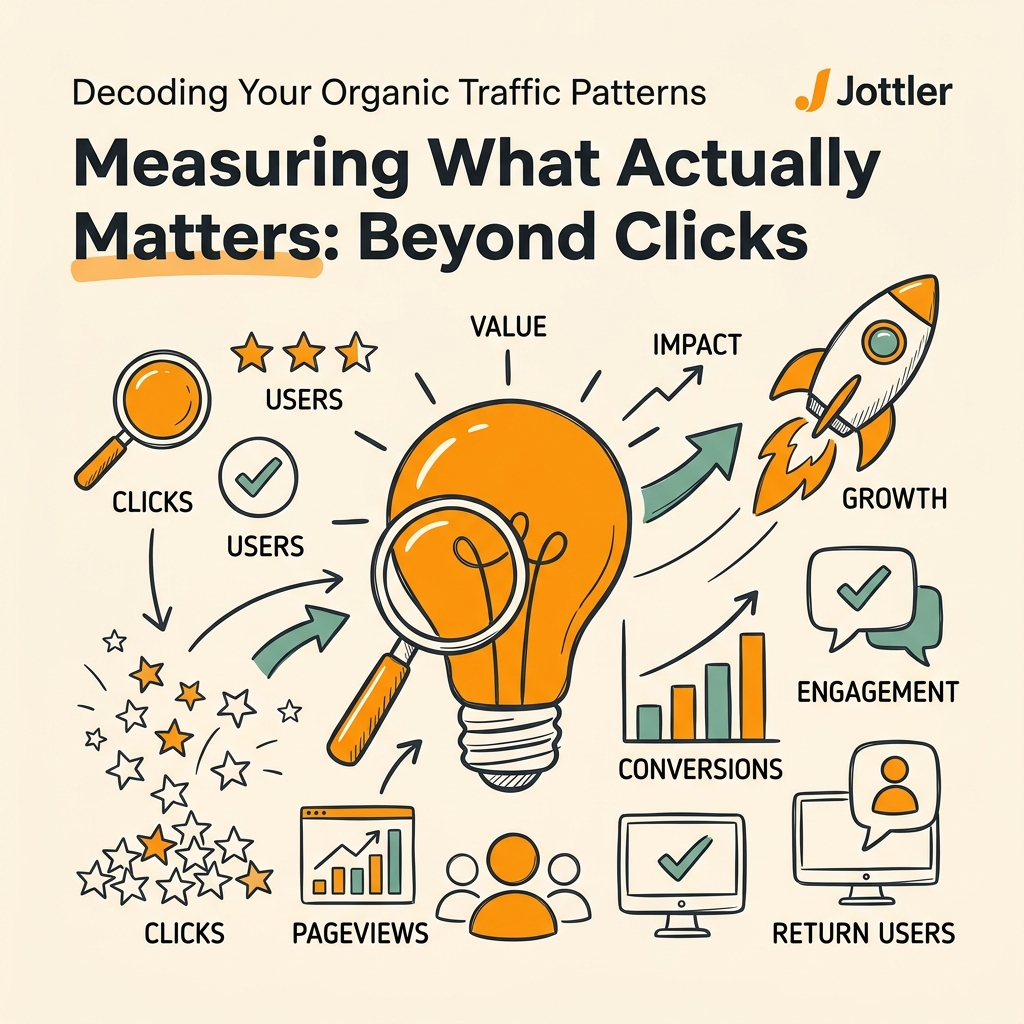
AI systems don't care about your click-through rate. They care about your authority, unique data, and whether your brand appears in the conversation at all. Modern organic success is measured by four commercial metrics, not one. These replace the old vanity stats and directly connect to revenue. AI citation frequency determines whether your content even enters the consideration set for AI-powered search and recommendations. If your competitors are cited by ChatGPT, Perplexity, and Claude while you're not, you're losing pipeline before your prospect ever reaches your site.
AI Citation Frequency and Visibility in AI Overviews
Start tracking which queries trigger an AI Overview in Google Search and whether your domain is cited in that overview. Manual audit weekly: search your top 20 branded and non-branded keywords, note which results show AI answers, and log whether your content appears in the summary. If your domain is absent from AI Overviews in your category, your authority signal is weak. AI systems learn what to cite from backlink patterns, mention frequency, and content quality. Build this flywheel: create proprietary data (original survey, market research), publish it, earn citations from journalists and publications, and those third-party citations boost your authority in AI systems' training data. Tools like Agencyanalytics recommend four core metrics for 2026: AI citation frequency, assisted conversions, close rate by source, and sales velocity. The first two are new. The last two are your revenue proof.
Assisted Conversions and Multi-Touch Attribution
Assisted conversions appear when organic search is not the final click but still contributed to the conversion path. In GA4, enable multi-touch attribution models to see the full journey. A prospect might discover you through organic search, explore your blog, and eventually convert via a paid ad retargeting them. In a last-click model, organic search gets zero credit for that $5,000 deal. With multi-touch attribution, organic gets 20–30% fractional credit, revealing its true pipeline impact. Create a custom metric in GA4: (organic assisted conversions + organic last-click conversions) / total traffic from organic. If this ratio is below 2%, your organic traffic is too high-funnel. If it's above 5%, you're capturing consideration effectively.
Sales Velocity: Track Revenue Per Source, Not Just Conversions
Not all conversions are equal. A freemium signup is worth $0 until they upgrade; a demo request is worth more; a trial-to-paid conversion proves product-market fit. In your CRM, tag every deal with its source: organic search, organic social, paid, affiliate, etc. Calculate average deal value, close rate, and average sales cycle by source. Organic-sourced deals often have higher close rates (50–70%) and faster cycles (30–45 days) than paid or affiliate because the prospect self-qualified through your content. A 100-session organic month that generates 2 conversions at $25K each (close rate 50%, deal value $50K) outperforms 5,000 paid sessions generating 20 conversions at $5K each (close rate 20%, deal value $25K). The former has 4x the revenue per session. Track this in a dashboard alongside trafficit's the metric that justifies continued organic investment to leadership.
| Metric | Old Approach (Vanity) | New Approach (Commercial) | 2026 Winner |
|---|---|---|---|
| Success Definition | Sessions up 20% | Assisted conversions up 20% | Commercial approach ties traffic to revenue |
| Data Source | GA4 sessions only | GA4 + GSC + CRM (multi-touch attribution) | Combined source reveals true impact |
| Content Optimization Focus | Maximize page views and engagement | Maximize intent alignment and asset creation | Intent-aligned content scales faster |
| Attribution Model | Last-click only | Multi-touch (fractional credit) | Multi-touch captures full conversion journey |
| Reporting Cadence | Monthly aggregate reporting | Weekly performance, monthly strategy | Weekly reporting sustains momentum and investment |
Building a Resilient Content Strategy for Zero-Click Era
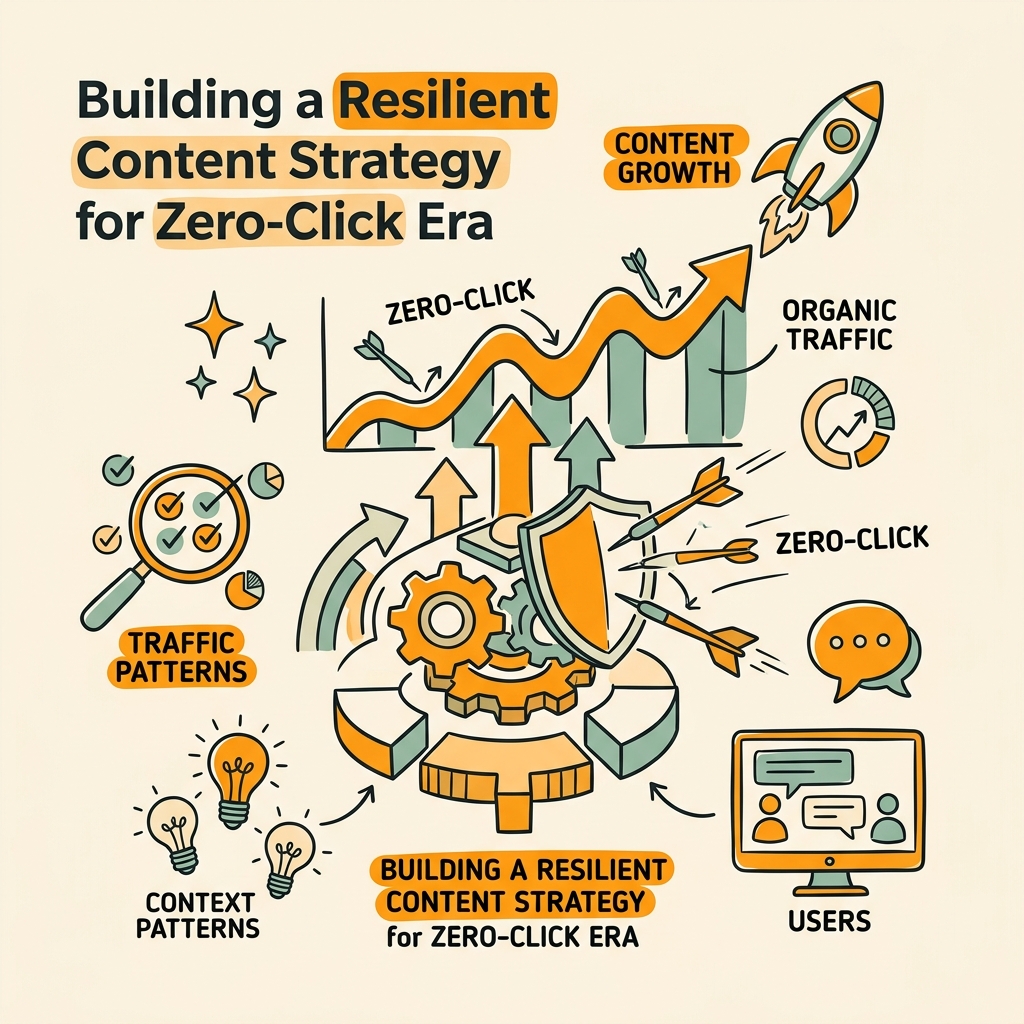
Knowing what to measure is half the battle. The other half is responding strategically. Zero-click doesn't mean zero-opportunity. It means opportunity has shifted. Instead of competing for clicks on generic queries, compete for authority and citations. Instead of writing once and hoping for rankings, create compound assets that grow in valueproprietary data that gets cited, interactive tools that drive backlinks, and topic clusters that become authoritative sources in your category. This aligns with content marketing automation best practices, which emphasize consistency, relevance, and compounding visibility.
Proprietary Data and Linkable Assets
Content that AI systems want to cite is content that cites original sourcesyour original sources. Conduct an annual industry survey (200–500 responses), publish detailed findings with percentages and comparisons, and you've created a linkable asset. Journalists quote it. Competitors cite it. AI systems reference it. Each citation is a backlink and authority signal. Alternatively, publish exclusive case studies with quantified outcomes: 5 SaaS companies reduced customer acquisition cost by 40% using your method. Give specific numbers, company names (with permission), and before/after metrics. Generic "how-to" advice ranks on volume alone; proprietary case studies rank on authority and get shared in newsletters, Slack, and via AI assistants. The compounding effect is dramatic: after 12 months, case study content drives 3x the traffic of how-to content in the same category, because it's the only source of that specific benchmark.
Topic Clusters and Semantic Authority
Instead of writing 50 standalone articles, organize content into pillar-and-cluster architecture. One pillar article ("Complete Guide to SaaS Onboarding") links to 8–12 subtopic clusters ("Mobile onboarding flows," "Freemium to paid conversion," "Activation email sequences"). Each cluster links back to the pillar. This signals semantic authority to Google and AI systems: you've thoroughly covered a topic from multiple angles. Search visibility improves, and so does AI citation probabilitysystems see you as the comprehensive source, not a surface-level explainer. When building a new content strategy, allocate 50% of effort to pillar expansion (deepening existing clusters) and 50% to new pillars. This replicates what successful digital marketing teams do at scaleconsistent, multi-month topic build-outbut it's unsustainable without automation. Autonomous SEO agents like Jottler research, write, and publish 3,000+ word articles daily while automatically building internal link networks, compounding topic authority without requiring manual keyword research or publishing overhead. For busy founders without a dedicated content team, this compressed execution cycle is the difference between a publishing cadence of 1 article per month and 5 per week.
Optimizing for AI Parsing and Answer Extraction
AI systems extract answers from clear, scannable content. Structure articles with descriptive headers that answer specific questions. Use bulleted lists, tables, and numbered steps. Include a "Key Takeaways" blockquote at the start. Data in tables is 3x more likely to appear in AI Overviews than data buried in paragraphs. Format case study results as: "Company X reduced churn from Y% to Z% by implementing [method]." Make the answer the first sentence of each section, not the third paragraph. When you optimize for AI parsing, you simultaneously optimize for human readers who scan. This creates a virtuous cycle: AI recommends your content more often, driving more citations; more citations drive more backlinks; more backlinks improve your domain authority; higher authority means AI prefers citing you in competitive categories. Your content becomes the reference source.
Automating Your Content Engine to Sustain Growth
Translating strategy into daily output is where execution breaks down. Creating one well-researched, internally linked, 3,000-word article per weekthe minimum for sustainable organic growthrequires 40–60 hours of human effort: keyword research (4 hours), outline creation (2 hours), writing (8–12 hours), editing (3–4 hours), fact-checking and sourcing (4–6 hours), and internal linking plus publishing (2–3 hours). Multiply that by 4 weeks and you've allocated 160–240 hours monthly for one person. Most busy founders and marketing teams don't have that bandwidth. Automation fills the gap. Jottler's autonomous SEO engine automates the entire pipeline: it researches trending keywords across your category, generates comprehensive articles optimized for AI parsing and internal linking, fact-checks content against live sources, and publishes directly to your CMS. Operating at 3,000+ words per day, it compounds topic authority and internal link networks month over month without manual overhead.
Automating Keyword Research and Content Planning
Keyword research alone is 4+ hours weekly if done properly. Tools like Semrush and Ahrefs identify opportunities, but someone must review volume, difficulty, intent, and fit. Worse, static keyword lists become outdated. Competitor keywords shift. User intent evolves. Search volume fluctuates seasonally. Automated systems re-run keyword research continuously, identifying emerging opportunities before competitors do. Jottler's AI agents research 14+ sources to identify high-intent, low-competition topics your audience actually searches for. The system generates a 12-week content roadmap, prioritizes by revenue potential, and queues articles by publish date. This eliminates the planning overheadno weekly strategy meetings, no "what should we write next?" debates. The roadmap emerges from data.
Fact-Checking and Source Attribution at Scale
Content credibility depends on accurate citations. Generic platforms generate plausible-sounding statistics with no sources. That kills credibility with readers and AI systems. Jottler's verification agents fact-check every statistic, confirm attribution, and cite live sources. When your article states "60% of Google searches are zero-click," the system verifies this claim against original research, links to the source study, and attributes it correctly. This builds domain authority fasterGoogle rewards citations backed by credible sources, and AI systems prefer citing content with transparent sourcing.
Smart Internal Linking to Compound Authority
Internal linking is the most underated SEO tactic. It distributes page authority, creates semantic clusters, and reduces bounce rate. But manually linking 50+ articles per month is tedious. Jottler's linking agents analyze your entire site's architecture, identify topic clusters, and automatically link new content to existing pillar pages and related subtopics. This creates the semantic authority graph you'd build manually over 6 months in 2 weeks. Every article compounds the authority of its cluster, accelerating rankings for all pages in the topic area.
Implementing Your Traffic Analysis Workflow
Decoding your organic traffic patterns isn't a one-time auditit's an ongoing diagnostic process. Implement a weekly reporting cadence: every Monday, pull GSC data (clicks, impressions, CTR) and GA4 data (sessions, engaged sessions, conversions) for the previous week. Segment by landing page, funnel stage, and device type. Plot your performance matrix. Identify which pages are in the "low-traffic, high-conversion" quadrant and flag them for traffic scaling. Identify which intent buckets are most vulnerable to zero-click and brainstorm proprietary angles or tools to defend them. Monthly, review AI citation frequency: search your top 20 branded and non-branded keywords and log which queries show AI Overviews and whether your content appears. Quarterly, reassess your content strategy: are topic clusters widening? Are case studies driving more backlinks than how-to content? Are assisted conversions trending up or down by source?
Setting Up GA4 for Segmentation
In GA4 Explore, create a custom segment for organic traffic: filter by "Session Medium = organic." Add dimensions: landing page, device category, and a custom dimension for content type (TOFU/MOFU/BOFU). Create a chart with sessions (rows), conversion rate (metric), and segment as color. This single view shows which content types convert best and on which devices. Save this as a templateyou'll run it weekly. Add a second exploration: filter by organic traffic, group by "source / medium," and add another dimension: geo. This reveals which geographies drive conversion from organiccritical if you're expanding to new regions.
GSC Segmentation by Intent and CTR
Export your GSC data (Google Search Console) into a spreadsheet. For each query, note: keyword, volume (impressions), clicks, CTR, average position, and intent (information/commercial/transactional). Filter by CTR ascending. Queries in the bottom 20% (CTR below 5%) are your zero-click hotspots. These are your defense opportunities. A query like "what is marketing automation" with 1,000 impressions and 2% CTR means an AI Overview is eating your clicks. Brainstorm proprietary angle: original survey of marketing automation tools, interactive comparison matrix, or exclusive case study. Revise that article with new angle and republish. Re-check CTR in 30 days. Many teams see CTR jump from 2% to 8% after adding proprietary elementthe AI Overview becomes incomplete without clicking your source.
Conclusion
Organic traffic patterns have fundamentally shifted. You're no longer measuring clicks; you're measuring authority, citation frequency, and commercial impact. Zero-click searches now represent 60% of all queries, but this is not a death knellit's a signal to change your game. Organic search still drives 53–61% of all trackable website traffic, more than 10x the volume of organic social, proving that organic remains the dominant channel. The teams winning in 2026 are segmenting traffic by funnel stage and intent, tracking assisted conversions over sessions, and building proprietary assets (data, tools, case studies) that AI systems want to cite. They're also automating the daily grind of keyword research, writing, and internal linking so they can sustain a 3,000+ word per week publishing cadence without burnout.
If you're a busy founder or marketer without a dedicated content team, sustainable organic growth requires consistent publishing and strategic internal linkingbut consistency is hard at human speeds. Start your SEO agent today and transform your organic traffic from a vanity metric into a revenue engine.
FAQs
Why is my organic traffic declining even though search volume is growing?
This phenomenon, called "The Great Decoupling," occurs because Google is capturing more traffic through AI Overviews and zero-click answers. 60% of searches now end without a click to any website, up from 58% in 2024. When AI Overviews appear (now 13.14% of queries), click-through rates drop from 15% to just 8%. Your rankings may not have changed, but fewer clicks reach your site because the answer is served directly in search results. The solution is to add proprietary angleoriginal data, case studies, interactive toolsthat AI summaries can't fully capture without clicking your source. Content with unique value compounds authority and maintains click traffic.
What metrics should I track instead of sessions and bounce rate?
Replace vanity metrics with commercial ones: assisted conversions (showing organic's full pipeline contribution), close rate by source (revealing which channels generate higher-quality leads), and sales velocity (comparing deal value and close speed by source). In GA4, segment by funnel stage (TOFU/MOFU/BOFU) and enable multi-touch attribution to see organic's fractional credit in the entire conversion path. Assisted conversions are especially valuable because they reveal organic's indirect influenceprospects who discover you via blog, return later via a retargeting ad, and convert, crediting organic search with 20–30% of the deal. Track these in a weekly dashboard alongside traffic volume.
How do I defend against zero-click searches and AI Overviews?
Build content AI systems want to cite: proprietary data (exclusive surveys or market research), original case studies with quantified outcomes, and interactive tools (calculators, comparison matrices). When your content includes data competitors can't easily replicate, AI summaries become incomplete without a click to your source. Optimize for AI parsing by using clear headers, bulleted lists, tables, and statement-first formatting (answer the question in the opening sentence). Track which queries show AI Overviews in your category and audit weekly to see if your domain is cited in those answers. Content with strong proprietary elements typically maintains 8–12% CTR even when AI Overviews appear, while generic content drops to 2–3%.