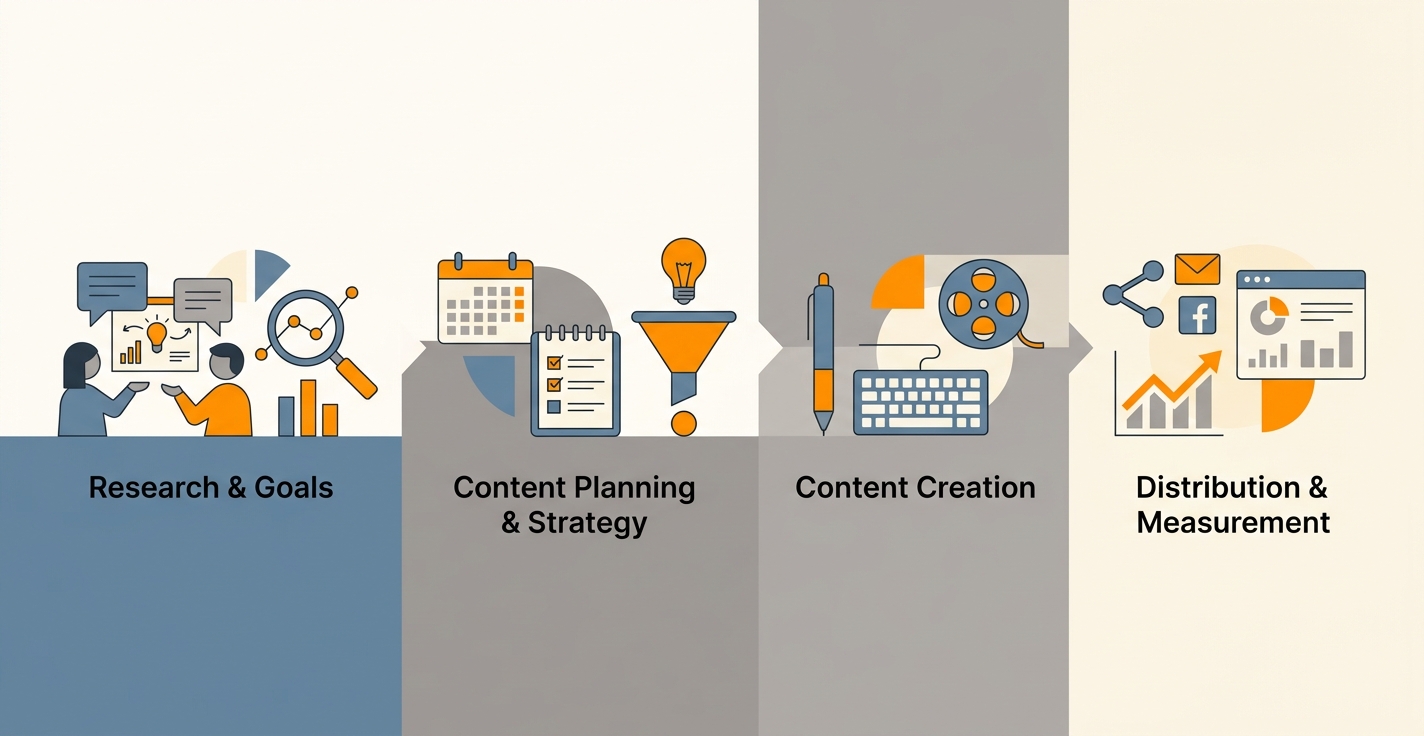
How to Build an Ecommerce Content Strategy
Ecommerce businesses chase traffic. They run ads, optimize listings, send emails. But the fastest-growing stores do something different: they become content hubs.
96% of retail companies have seen positive results from content marketing, according to Semrush. That's not luck. It's strategy. While paid ads deliver quick wins, content marketing compounds. Every article published months ago still attracts shoppers today. That residual traffic is what separates struggling stores from scaling ones.
Key Takeaways
- Ecommerce content marketing attracts shoppers before they search for ads or discounts
- Product guides, how-tos, and buying comparisons convert browsers at higher margins than paid traffic
- A content calendar tied to seasonal demand and buyer journeys multiplies ROI
- Automation tools like Jottler let you publish 40-100 articles monthly without a team
What Is Ecommerce Content Marketing?
Ecommerce content marketing is the creation and distribution of valuable content—blog posts, videos, buying guides, reviews—to attract potential customers and guide them toward a purchase decision. Unlike ads, which interrupt a shopper's day, content solves a problem they're actively searching for.
A customer googles "best running shoes for flat feet." Your guide appears. They read, learn, and click to your store. That's ecommerce content marketing.
It differs from general content marketing because every piece has one job: move the customer closer to a sale. The content isn't just informative. It's strategic.
Why Ecommerce Stores Need Content Marketing
Content serves three functions for online retailers: it ranks in search engines, it builds trust, and it drives repeat customers.
Search visibility is the first win. When you publish buyer's guides, product comparisons, and how-to articles, you capture searches that ads can't. A customer researching "how to organize a small bedroom" doesn't want an ad. They want answers. If your furniture store publishes that guide, Google ranks it, and organic traffic flows. This is especially powerful because it works across keyword clusters. One buying guide on winter coats lets you rank for "best winter coats," "waterproof winter coats," and "warmest winter coats" simultaneously.
Trust is the second. Shoppers compare prices across dozens of stores. They'll choose the one that educates them, not just the cheapest. A guide showing how to choose a mattress positions you as an authority, not a vendor. They remember you. When a customer reads your detailed buying guide and then buys from your store, you're no longer competing on price. You're competing on expertise.
Repeat business is the third. Content kept online works forever. An article you write once attracts customers for months. That compounding effect means lower customer acquisition costs over time. A blog post published six months ago is still answering customer questions and driving conversions. This is why content ROI improves over time. Each piece continues generating value, month after month.
Core Pillars of an Ecommerce Content Strategy
A working ecommerce content strategy has five pieces. Miss one and the system breaks.
1. Audience-First Planning
You can't write for "everyone." Build detailed buyer personas first. Who buys from you? What problems do they face before and after a purchase?
A pet supply store's audience isn't just "pet owners." It's new puppy parents researching vaccines, senior dog owners managing arthritis, and aquarists building their first tank. Each persona needs different content.
Map this across the buyer journey too. Early-stage shoppers need education. Late-stage shoppers need proof (reviews, comparisons). Content strategy means something different for each.
2. Keyword Research Tied to Intent
Not all keywords matter equally. An ecommerce store should focus on keywords that indicate buying intent or comparison behavior.
"Best outdoor speakers" (commercial intent, 2,340 monthly searches) beats "how do speakers work" (informational, high volume but low intent). You need both, but weight commercial and transactional keywords heavily.
Use tools like SEMrush, Ahrefs, or Jottler's keyword research feature to find product-adjacent keywords—ones that signal purchase consideration. Search volume + low competition is the target zone.
3. Content Variety Across Formats
Blog posts alone don't work. Shoppers consume content on different platforms and at different stages.
Publish:
- Product guides (comparison tables, expert picks)
- How-to articles (tutorials tied to your product use)
- Buying guides (size charts, material comparisons)
- Video content (unboxings, demos, customer reviews)
- Educational blog posts (trends, maintenance, best practices)
- User-generated content (customer reviews, photos, testimonials)
Each format serves a different learning preference and platform. A how-to video on Instagram reaches different people than a detailed guide on your blog.
4. SEO Optimization Without Keyword Stuffing
Content that ranks has two qualities: it's relevant to the search query and it answers better than competitors do.
Write for the reader first. Then optimize: clear H1 with the primary keyword, meta description that explains the benefit, internal links to product pages. Include keyword variations naturally. Never force them.
A buying guide about winter boots should include "best winter boots," "waterproof boots," and "insulated boots" because those are related searches shoppers make. But the article reads like a guide, not a list of keywords. This is where many stores go wrong. They write guides with awkward phrasing just to hit keyword targets. Google penalizes that now. The best approach is to write naturally, then review and add keywords only where they fit without sacrificing readability.
5. Publishing Frequency and Distribution
One article doesn't build authority. You need a schedule. Most ecommerce stores that see results publish 1-3 articles per week. For startups or small teams, that's impossible without help.
Publish to your blog first, then repurpose:
- Break it into LinkedIn posts
- Create a thread of tips for Twitter/X
- Turn it into a video script or short-form clips
- Add to your email nurture sequence
Consistent, multi-channel presence compounds.
Common Ecommerce Content Marketing Mistakes
Most stores fail because they skip strategy. They publish blog posts about random topics, expect traffic, then quit when nothing happens.
The most common mistakes:
Publishing without keyword research. Writing about "our top products" without knowing if anyone searches for it wastes time. Every article should target an actual search query with volume and intent.
Ignoring the buyer journey. Top-of-funnel (how-to, educational) and bottom-of-funnel (reviews, comparisons) content both matter. Stores that only publish product pages starve early-stage shoppers of information.
Not linking to products. A guide about leather care is worthless if there's no link to your leather conditioner. Every content piece should guide readers toward a purchase.
Publishing inconsistently. One article a month builds no authority. Google rewards consistency. Shoppers return to sites that regularly solve their problems.
Treating content as support, not marketing. If your content team reports to customer service and publishes only FAQs, you're missing the marketing opportunity. Content is a demand-generation channel, not a cost center.
How to Automate Ecommerce Content at Scale
A solo marketer can't write 40+ articles monthly. Most ecommerce teams can't either. This is where automation changes the equation.
The right tools let you research, write, publish, and track without manual work. Jottler's content engine, for example, handles the full pipeline: it researches keywords, writes articles based on your store's style, generates images, and publishes directly to WordPress or Shopify on a schedule you set.
Instead of spending 10 hours per week writing, you spend 2 hours setting up clusters and reviewing performance. The automation handles the output. For ecommerce stores specifically, this means you can publish 40-100 articles monthly without hiring a content team. At $149/mo for unlimited articles, that's a fraction of what a freelancer or agency would cost.
The power of automation for ecommerce content is that it removes the bottleneck. Without it, you pick 4-5 topics per month. With it, you can publish 20+ topics, covering every angle of your product categories.
Tools to consider include Surfer SEO for optimization (after you've written), Copy.ai for quick content snippets, and ChatGPT with a system prompt for bulk generation (though this requires more editorial oversight). But pure writing tools miss the SEO research and publishing parts. An integrated platform like Jottler is worth the investment if you're serious about scale.
Getting Started: Your First 90 Days
You don't need perfect. You need momentum. The stores that succeed with ecommerce content marketing are the ones that commit to a schedule and stick to it, not the ones that chase perfection with a single article per quarter.
Month 1: Build foundation. Define your audience personas, map the buyer journey, run keyword research for 20-30 target queries. Publish 4 pillar articles (one per buyer stage, one product category). These don't need to be long. A solid 1,500-word buying guide is enough to start.
Month 2: Establish rhythm. Publish 8-12 articles on a consistent schedule. Start repurposing content across email and social. Monitor which keywords are gaining traction in Google Search Console. Identify which topics drive clicks and conversions.
Month 3: Automate and scale. If manual publishing works, invest in a tool like Jottler to double or triple output. Use analytics to see which content drives revenue, then focus on similar topics. This is when you go from "testing content" to "content is a revenue channel."
By month four, you'll have 24-32 articles live. Early organic traffic is appearing. This is when you know it's working. Most stores see their first significant bump in organic-driven conversions between months 4-6.
Content Types That Drive Ecommerce Sales
Different content types serve different purposes in the ecommerce buyer journey. Understanding which types to prioritize helps you allocate resources better.
Buying guides are your highest-leverage content. They target commercial intent keywords (people actively considering a purchase) and have the highest conversion rates. A buying guide for "best headphones under $200" attracts shoppers ready to compare and decide. These guides should include side-by-side comparisons, pros and cons, and links to your best options.
How-to articles rank for informational keywords and build trust. A guide on "how to extend the life of your mattress" attracts budget-conscious shoppers and positions your furniture store as expert. Even if they don't buy immediately, you've earned their trust. Many will return when they're ready.
Product reviews and comparison articles have dual purpose. They rank for high-intent keywords and they directly support the sales process. A shopper reading your review of two competing coffee machines is making a decision. If your review is thorough and fair, they'll trust your recommendation.
Video content for ecommerce works best as unboxings, demos, and customer testimonials. These don't need to be highly produced. A phone recording of a customer explaining why they love your product often converts better than a polished commercial. Short-form videos perform especially well on social and YouTube.
Trend articles and seasonal guides tie content to your sales calendar. A "back-to-school shopping guide" in July captures seasonal demand. A "holiday gift guide by price point" in November captures Black Friday shoppers. These guides have shorter shelf lives than evergreen content but massive search volume during their season.
The mix matters. A balanced content calendar has 40% buying guides, 30% how-tos, 20% reviews, and 10% trending/seasonal content. This ensures you're capturing demand at every stage of the buyer journey.
Ecommerce Content Marketing vs. SEO Content
This post covers the broader content marketing strategy for ecommerce. If you're looking specifically for SEO-optimized product content, check out our guide on ecommerce SEO content, which dives into the technical side of ranking product pages and category pages.
Frequently Asked Questions
How long does it take to see results from ecommerce content marketing?
Results typically appear within 3-6 months if you're publishing consistently and targeting the right keywords. Organic SEO is slower than ads, but it compounds. After 6 months, well-written content often drives 30-40% of overall traffic for ecommerce sites.
Should ecommerce stores focus on blog content or product descriptions?
Both. Blog content attracts early-stage shoppers and builds SEO authority. Product descriptions convert shoppers who are already looking at your store. A strong strategy includes both, but many stores neglect blog content because product descriptions seem more immediate. That's a missed opportunity.
What's the ideal publishing frequency for ecommerce content?
1-3 articles per week is the sweet spot. Weekly publishing builds momentum without overwhelming your team. If you're using automation like Jottler, you can scale to 10+ articles per week without additional staffing.
How do you measure ROI from ecommerce content marketing?
Track these metrics: organic traffic to the blog, traffic that converts to revenue, email subscribers gained from content, and repeat customer rate. Revenue per organic visitor is the ultimate metric. If you publish $5,000 worth of content and it drives $50,000 in annual revenue, that's a 10x return.
How do you prevent ecommerce content from cannibalizing product page rankings?
Use distinct keywords. A product page targets "buy wool socks." A blog post targets "best wool socks for hiking" or "how to care for wool socks." They serve different search intent. Internal linking from blog to products is healthy, not harmful, as long as you're not competing for the same exact keywords.
Ready to scale ecommerce content? Building a content library manually takes months. With AI-powered content automation, you can publish dozens of guides, how-tos, and product comparison articles every month. Jottler's content engine handles the full workflow: keyword research, writing, image generation, and publishing to your store. Start a free 3-day trial today.