Email Sequences That Convert: Marketing Automation for SaaS
Email automation is the difference between a struggling SaaS pipeline and one that scales predictably. Yet most teams are still manually triggering campaigns instead of letting behavioral triggers do the work. The numbers tell the story: automated emails drive 37% of email-generated sales while representing just 2% of total email volume. That efficiency gap means thousands of dollars left on the table.
For busy founders and marketing teams at growing SaaS companies, the challenge isn't email itself. It's building sequences that actually respond to customer behavior in real time, without requiring daily manual oversight. That's where marketing automation transforms from "nice to have" to essential infrastructure.
This guide walks you through the anatomy of email sequences that convert, the patterns that work, and the automation setup that compounds your results without burning out your team.
Key Takeaways
- Automated emails generate 2,361% higher conversion rates than scheduled campaigns (Omnisend, 2026), making them the highest ROI channel available.
- Abandoned cart and welcome series sequences average 8.17% and 4.01% conversion rates respectively, far outpacing broadcast newsletters at 1.22% (Digital Applied, 2026).
- Email automation ROI reaches $36–$45 per $1 spent in 2026, compared to $2 for paid search and $2.80 for social ads.
- Trial Conversion Sequences: Drive the highest direct revenue impact, converting 15%–20%+ of trial users when structured as behavior-triggered milestones rather than time-based blasts.
- Onboarding Automations: Build the foundation for retention. Multi-touch sequences that guide users through activation reduce churn by up to 40% in the first 30 days.
- Abandoned Cart and Browse Automations: Recover lost revenue with $3.65 per recipient in lifecycle ecommerce flows compared to $0.11 for standard campaigns.
- Win-Back and Reactivation Flows: Warm, behavior-based messaging to dormant users costs nothing to trigger but recovers substantial revenue from your most familiar audience.
- Segmentation and Personalization: Behavioral segmentation lifts revenue by 760% compared to broadcast campaigns; AI-driven personalization adds another 17%–26% lift on top.
Why Email Automation Matters for SaaS Growth
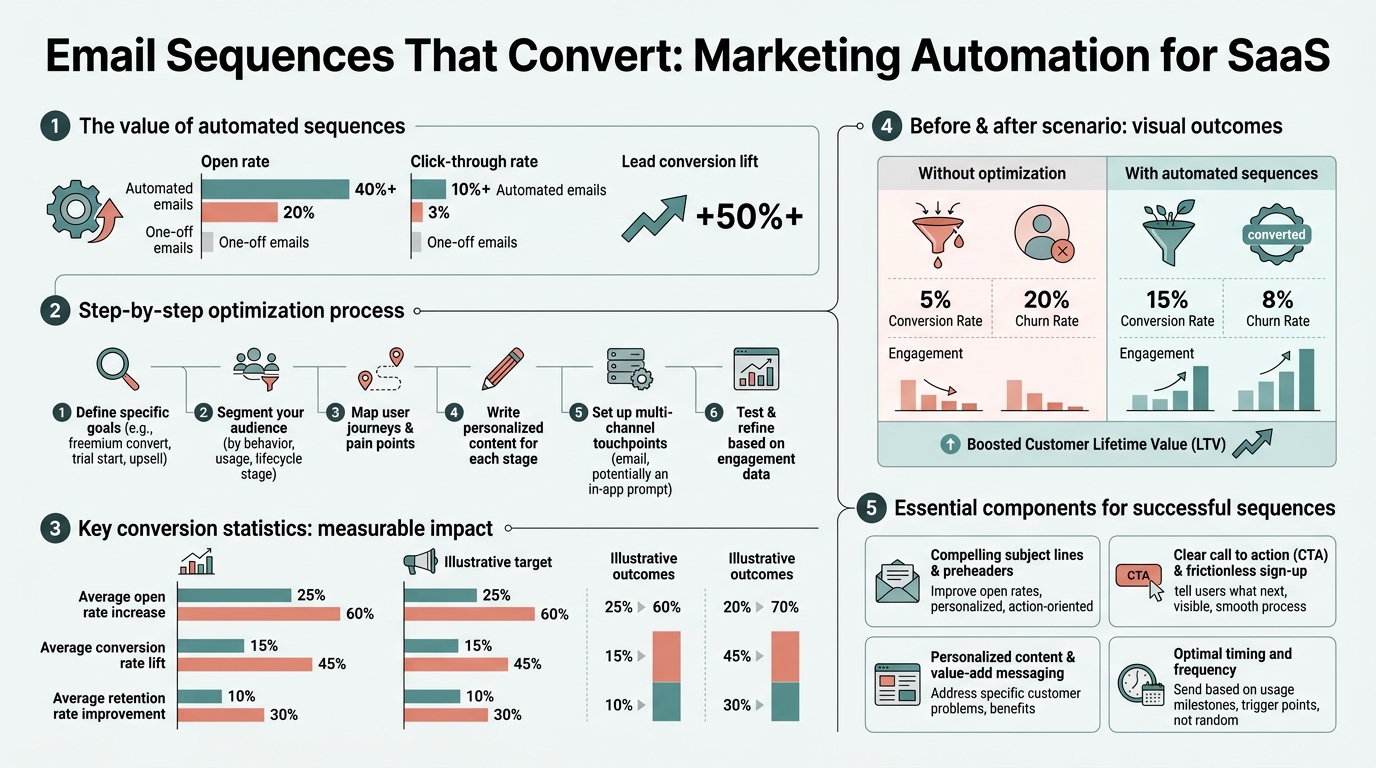
Email automation isn't about volume. It's about timing and relevance. Marketing automation users report 451% increases in qualified leads, 77% higher conversion rates, and 76% positive ROI within one year. The reason is simple: automated sequences fire when the customer is most receptive, based on their actual behavior, not when your sales team remembers to send.
For SaaS businesses, this matters because your sales cycle involves repeated micro-decisions. A prospect signs up for a trial. They log in twice, then disappear. They visit your pricing page three days later. Without automation, those signals go unnoticed. With automation, they trigger targeted messages that pull them back in.
The cost structure of email automation is also favorable. Unlike paid search or sales outreach, once sequences are built, they scale with zero marginal cost. Global email marketing market revenue in 2026 reached $15.81 billion, and the lion's share of growth is driven by automation, not static campaigns. According to recent email automation statistics, this growth reflects a fundamental shift in how SaaS teams approach customer engagement.
The Economics of Behavior-Based Messaging
A traditional SaaS email approach sends welcome emails to all new signups on Day 1, nurture campaigns on Day 7, and product updates when you release new features. These campaigns treat all users the same. Automation breaks that assumption and builds messages around actual behavior.
The financial impact is dramatic. Automated email flows generate $1.94 revenue per recipient versus $0.11 for standard campaigns. That's a 17.6x difference. For a SaaS with 10,000 new users per month, switching from broadcast welcome sequences to behavior-triggered onboarding workflows could mean the difference between $1,100 and $19,400 in monthly revenue from that cohort alone.
The gap widens with sophisticated sequences. Abandoned cart flows (triggered when a prospect visits pricing but doesn't sign up) generate $3.65 per recipient in hybrid SaaS/ecommerce models. Win-back sequences targeting dormant users cost nothing to send but often recover customers who were already paying you.
The Operational Reality: Why Manual Sequences Fail
Many SaaS teams build email sequences manually. A founder spends a weekend writing five emails in their email service provider. The team sends them whenever they remember. Triggers are approximated through manual segments. Testing happens sporadically, if at all.
The problem is compounding. Each week, new signups arrive. Each month, the list grows but the email logic stays static. Without ongoing automation refinement, older sequences get ignored. Newer sequences get set up but never optimized. Eventually, email becomes a low-priority side project instead of a revenue engine.
That's why infrastructure matters. Busy founders and marketing teams need email sequences that work automatically, respond to real-time signals, and improve based on performance data without constant manual intervention. Automation platforms that handle research, content, and segmentation eliminate the friction of sequence maintenance.
The Five Cornerstone Email Sequences Every SaaS Should Automate First
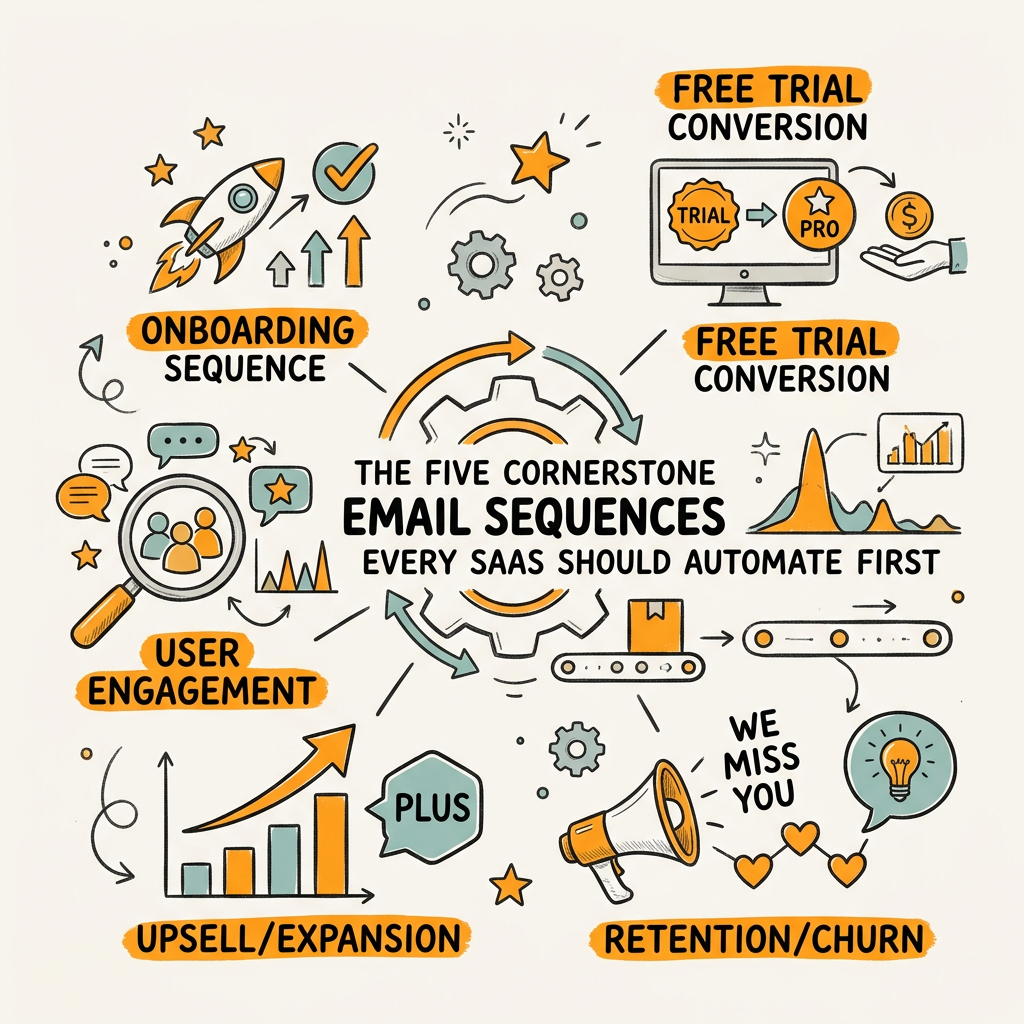
Not all email sequences are equal. Some drive immediate revenue. Others build long-term trust. For busy founders, the priority is sequences that deliver both quick wins and sustainable growth. Here are the five sequences that consistently outperform everything else.
1. Trial Conversion Sequences: The Direct Revenue Driver
A well-structured trial sequence increases conversion rates by 20%–30%, translating directly to recurring revenue. Trial conversion is the highest-impact sequence for SaaS because every trial user converted becomes a paying customer.
The anatomy of a high-converting trial sequence breaks down into three phases: activation, engagement, and urgency. The first email (sent within an hour of signup) shows the fastest path to value. A user downloads your software and immediately sees: "Here's the one thing to do right now." Not the complete feature tour. Not a link to documentation. One specific action that delivers immediate ROI.
The activation email for a project management SaaS might read: "Create your first project in 2 minutes." A billing automation SaaS: "Connect your first payment method." The goal is to move new users from "I have a free account" to "I've experienced value."
Days 2–4 follow up on engagement. These emails watch product usage. If a user completes the activation step, the second email teaches them the next feature. If they haven't, the second email removes friction: "Having trouble? Here's a 5-minute walkthrough video." This branching logic separates high-intent users from those who need extra support.
Days 5–7 introduce urgency. The trial is ending. This email positions the annual plan as the best value and includes a specific objection handler: "Not ready? Choose monthly to reduce risk." Conversion rates at this stage often exceed 20%, since users have already experienced value.
2. Onboarding Sequences: The Retention Foundation
Multi-touch onboarding automations reduce first-month churn by up to 40%. Onboarding is distinct from trial conversion because it targets users who have already become customers. The goal shifts from "prove value" to "ensure success."
A strong onboarding sequence spans 14–21 days and covers four stages: setup, early wins, advanced features, and community. The first three emails guide users through configuration. The fourth shows them how to get value from the platform in their specific workflow. Emails five through seven introduce advanced features or invite them to community channels.
The key is conditional triggering. If a user completes setup on Day 1, the next email moves them forward. If they don't, it offers support. This prevents overwhelming engaged users with repetitive "here's how to set up" emails while ensuring lagging users get the help they need.
Onboarding works best when tied to product events. "You added your first team member" triggers a different email than "You haven't invited any team members yet." That behavioral branching is what transforms onboarding from a broadcast sequence into a personalized journey.
3. Abandoned Checkout and Pricing Page Sequences: The Quick Revenue Recovery
Abandoned pricing-page sequences average 5.44%–8.17% conversion rates, making them among the highest-ROI automations. These sequences fire when a user shows purchase intent (visiting pricing, starting a trial, or adding items to cart) but doesn't complete the action.
The first email goes out within 1 hour, while intent is hot. The subject line references exactly what they viewed: "You were checking out the Pro plan." The email removes friction by addressing the most common objections: feature fit, pricing structure, or payment method issues.
A second email follows 24 hours later. If the first email was about features or pricing clarity, this one is about risk reduction: "Annual plans include our 60-day guarantee." A third email (48–72 hours in) introduces a limited-time incentive: "Get 2 months free if you start an annual plan today."
The conversion lift from these sequences is substantial because the audience has already decided they want your software. The emails are just removing the final barrier to purchase.
4. Win-Back and Reactivation Sequences: Recovering Dormant Users
Win-back sequences to lapsed users average 2.73% conversion rates, which is low in absolute terms but remarkable in context: these are users who stopped using your product, yet 2–3% come back when you remind them of value with the right message.
The advantage of win-back sequences is that they cost nothing to send. You're not acquiring new customers. You're recovering customers you already know. The messaging is personal and warm, not pushy.
The first email acknowledges the gap: "We noticed you haven't logged in since March. Here's what's new." It shows three major feature updates or wins from the last two months. This repositions your platform as constantly improving, not stagnant.
The second email (5 days later) offers a specific incentive: "Come back and get 3 months at 50% off." The third email (10 days later) is from the founder or CEO: "We miss you, and here's why we think [your use case] is more important now than it was before."
Win-back sequences work because they bypass the usual sales friction. The user already understands your product. They just need a reason to reinstall and log back in.
5. Expansion and Upsell Sequences: Growing Customer Revenue
Upsell sequences to existing customers are 200% more cost-effective than acquiring new customers. For SaaS businesses, these are often the highest-lifetime-value automations because customers are already paying and trust your platform.
Expansion sequences trigger when a user hits a usage threshold. "You've invited 15 team members" triggers a Team plan upsell. "You're running 50 automations" triggers an Enterprise plan conversation. These aren't arbitrary quotas. They're signals that the user has outgrown their current plan and needs more capacity.
The first email in an expansion sequence is purely educational. It shows the customer what becomes possible with the upgraded plan. Not features. Outcomes. "With the Team plan, you can delegate approvals, set role-based permissions, and run 20 simultaneous automations."
The second email introduces a special offer: "Existing customers upgrading this month get 3 months free." The third email (one week later) uses social proof: "15 customers in your industry upgraded this month. Here's what they're building."
Expansion sequences often have the highest revenue impact per email because the baseline customer lifetime value is already established. You're not trying to convince someone to try your platform. You're helping a paying customer get more value.
Structuring Sequences for Maximum Automation and Minimum Manual Overhead
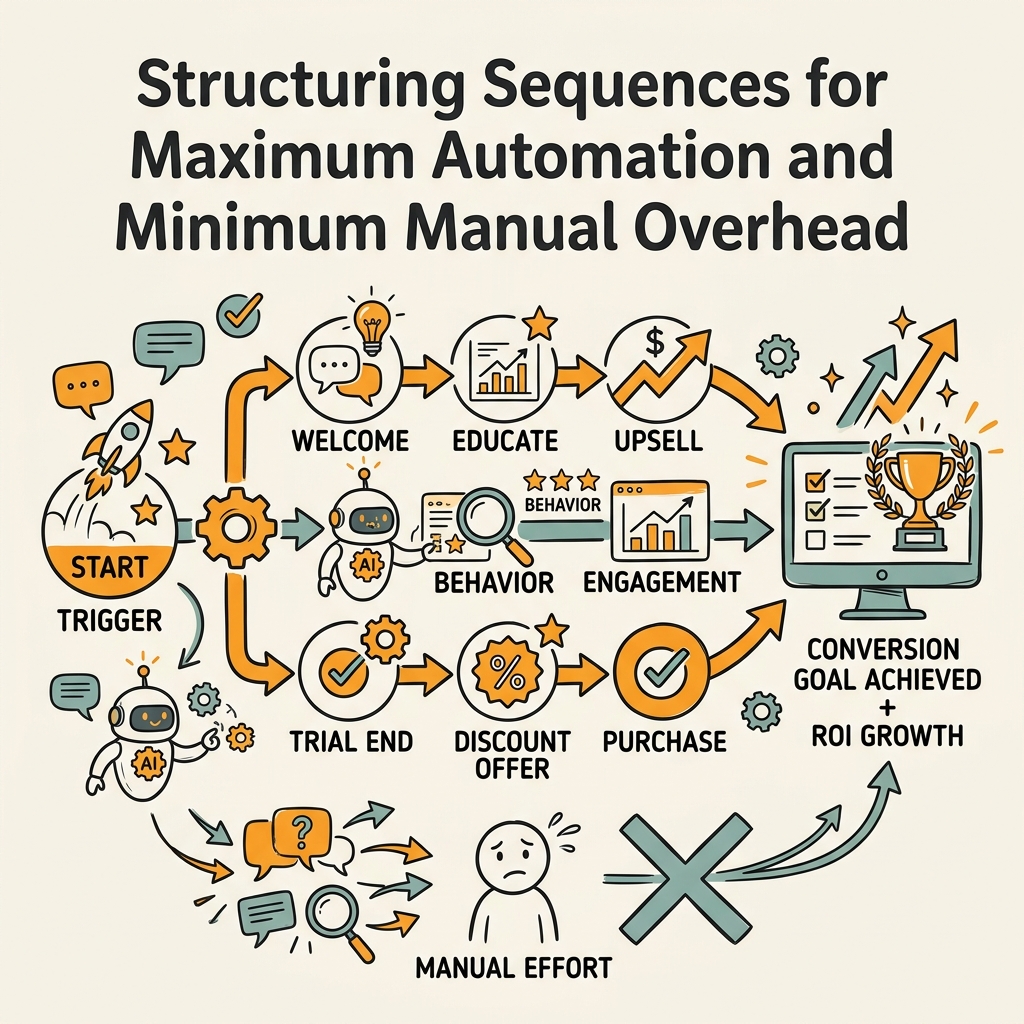
Building email sequences is one thing. Maintaining them without burning out is another. The difference between sequences that compound and sequences that stagnate is automation depth. This means sequences that adapt based on behavior, that branch based on engagement, and that improve based on performance data without requiring manual intervention every week.
Segmentation Strategy: From Generic Broadcasts to Behavioral Triggers
The first principle of automated sequences is: never send the same email to everyone. Segmentation is the foundational practice that unlocks sequence effectiveness. Research on email marketing ROI shows that behavioral segmentation and AI personalization are the core drivers of 2026 efficiency gains.
Most SaaS teams start with static segments: "All users who signed up in May" or "All customers in the tech industry." These segments are built once and rarely updated. Over time, they become outdated and irrelevant.
Behavioral segmentation works differently. Segments are dynamic and recalculate in real time based on product usage. A user automatically joins a "High-Engagement" segment when they perform key actions: logged in 3 times in 7 days, invited a team member, or created a custom report.
This distinction matters because dynamic segments let you send different messages to users based on their actual interaction with your product. Segmented campaigns lift revenue by 760% compared to broadcast campaigns. The compounding effect becomes visible when you combine behavioral segmentation with personalization.
The segmentation layers that drive the highest ROI are:
- Activation Status: Trial vs. Paying vs. Churned. Each segment gets completely different messaging and cadence.
- Usage Intensity: Power users vs. casual users. Power users get advanced features. Casual users get "here's the easy way to get started."
- Product Fit: Users who completed setup vs. those who didn't. Users who invited team members vs. solo users. This is the most predictive segment because it reflects user behavior, not stated preferences.
- Engagement History: Users who clicked your last three emails vs. those who opened none. Unengaged users get a re-engagement sequence. Engaged users get deeper content.
- Lifecycle Stage: New signups (first 7 days), early users (7–30 days), established users (30+ days), at-risk (haven't logged in 14 days). Each stage gets different messaging and send frequency.
Segmentation is the input layer to automated sequences. Personalization is the output layer.
Personalization Beyond the First Name Token
Generic personalization ("Hi [First Name]") used to work. Now, it's table stakes that barely moves conversion rates. Real personalization is behavior-based and predictive.
AI-driven personalization adds 17%–26% revenue lift compared to standard segmentation. The difference is that AI personalization doesn't just tailor the salutation. It tailors the entire message based on the customer's journey.
A user who visited your pricing page but didn't sign up gets a different email than a user who signed up but hasn't logged in. A power user who has invited 10 teammates gets upsell messaging. A casual user who is at churn risk gets win-back messaging.
The personalization layer in modern SaaS email includes:
- Product Usage Data: "You've created 23 automations. Try our advanced triggers to scale this further."
- Engagement Patterns: "You consistently open emails about security. Here's our new SOC 2 report."
- Cohort Behavior: "Customers in your plan tier are building workflows that save 10 hours per week. Here's how."
- Churn Signals: "We noticed you've logged in less frequently this month. Let's talk about what's missing."
- Predicted Next Action: "Based on your activity, you're ready to invite your team. Here's why collaboration matters."
The infrastructure to support behavior-based personalization is more complex than static segmentation. It requires product data (events), customer data (CRM), and email data (engagement) to synchronize. For teams without engineering capacity, this can feel like a barrier. But the ROI is dramatic enough to justify the complexity.
Send Frequency and Cadence Optimization
One of the biggest mistakes in email automation is over-sending. Teams build multiple sequences (welcome, onboarding, upsell, educational), all triggering independent of each other. A new customer ends up receiving 5–10 emails in their first week.
Email fatigue is real. Unsubscribe rates spike. Engagement drops. The sequences that were supposed to work actually hurt your sender reputation.
The solution is frequency capping. This is a foundational automation rule that many teams overlook: no more than one promotional email per day, and no more than one promotional plus one educational email per day. When sequences are triggered at the same time (e.g., welcome sequence and onboarding sequence both fire on Day 1), the email service provider should send the one with the highest predicted engagement and suppress the other until Day 2.
Frequency capping works best when you define priority ranks for your sequences. Trial conversion is high priority (send first). Onboarding is high priority. Educational content is medium priority. Promotional blasts are low priority. When multiple sequences collide, the high-priority sequence sends, and the low-priority one waits.
The other optimization is cadence. Trial conversion sequences often run daily or every-other-day because the trial is closing and time matters. Onboarding sequences can extend over 21 days with 2–3 emails per week. Win-back sequences might be 3 emails over 14 days. Matching the sequence cadence to the business urgency prevents fatigue while maintaining momentum.
Measuring and Optimizing Sequences for Continuous Improvement
Email sequences are not "set and forget." The sequences that compound are the ones that improve every month based on performance data. This means measuring the right metrics, analyzing what's working, and adjusting based on real results.
From Vanity Metrics to Revenue Metrics
Most email reports focus on open rates and click rates. These metrics are easy to measure but often misleading. A high open rate doesn't mean the email drove revenue. A low click rate doesn't mean the email failed.
Revenue metrics are harder to measure but infinitely more valuable. The metrics that matter for automated SaaS email sequences are:
- Revenue Per Recipient (RPR): Total revenue generated from a sequence divided by the number of recipients. Standard campaigns average $0.11 RPR. Automated flows average $1.94 RPR. Abandoned cart flows average $3.65 RPR.
- Conversion Rate: Percentage of recipients who completed the desired action (trial signup, paid upgrade, purchase). Trial conversion sequences average 15%–20%. Abandoned cart sequences average 8.17%.
- Sequence ROI: Revenue generated minus send costs, divided by send costs. Email automation typically returns 36:1 to 45:1 ROI.
- Customer Lifetime Value Impact: Do sequences that improve onboarding or engagement have lasting impact on churn and expansion? This requires tracking cohorts over 12 months.
- Pipeline Influence: For B2B SaaS, track how many leads from email sequences eventually convert to customers, not just immediate trial signups.
Revenue metrics require integration between email, product analytics, and CRM. But this integration is what separates sequences that feel effective from sequences that actually are.
A/B Testing Sequences at Scale
A/B testing can boost email automation ROI by up to 83%. Yet many SaaS teams run tests sporadically or not at all, leaving money on the table. Detailed email marketing statistics show that teams running continuous testing on sequences report higher conversion rates across all segments.
The sequences worth testing are the ones with the most volume and revenue impact. Trial conversion sequences should run continuous A/B tests on subject line, send time, and call-to-action. Welcome sequences should test email count (5 emails vs. 7 emails), cadence (daily vs. every-other-day), and messaging angle.
Testing methodology matters. Run A/B tests on a percentage of your audience (10–20%), not all users. Run tests long enough to collect meaningful data. For trial conversion sequences, one full trial cycle (7–30 days depending on your trial length). For onboarding sequences, run tests through the first month of the customer lifecycle.
The specific elements worth testing are:
- Subject Lines: Personalization vs. curiosity vs. urgency. Specific number vs. vague benefit.
- Send Times: Morning vs. afternoon. Weekday vs. weekend. Immediate trigger vs. 1-hour delay.
- Call-to-Action: Button text, placement, and action. "Upgrade Now" vs. "See Pricing" vs. "Book a Demo."
- Message Framing: Problem-focused vs. outcome-focused. Feature-led vs. narrative-led.
- Sequence Length: 3 emails vs. 5 emails vs. 7 emails. This is often overlooked but can have dramatic impact on both conversion and unsubscribe rates.
Once you identify winning variants, apply them across all similar sequences. If "What's new" outperforms "Important update" as a subject line in win-back sequences, use that learning in all reactivation emails.
Automation Health Checks: Preventing Sequence Decay
Sequences degrade over time without maintenance. Email lists grow stale. Product features change. Customer language shifts. A sequence that worked in Q1 may be outdated by Q4.
The solution is systematic health checks. Once per quarter, review your top 5 sequences and ask:
- Has the product changed? Do the features mentioned in the email still exist or have they been superseded?
- Has the customer changed? Are the objections we're addressing still the main concerns, or has the market shifted?
- Is the sequence still delivering results? Has conversion rate stayed flat, improved, or declined? If declined, why?
- Are there new behaviors or signals we should be triggering on? New features, new user segments, new use cases?
- Is the cadence still right? Have unsubscribe rates or bounce rates increased, indicating fatigue?
The most effective teams treat email sequences like living documents. They improve continuously based on data, not on gut feel or historical assumptions.
Building Sustainable Automation Without Overhead
The challenge for busy founders and marketing teams is that email automation requires ongoing attention. Each sequence needs testing, refinement, and monitoring. For teams with limited capacity, this can quickly become overwhelming.
The practical solution is to prioritize ruthlessly. Start with your highest-impact sequence: typically trial conversion. Build it, test it, optimize it until it's running on autopilot. Only then move to the next sequence. This prevents the "50 half-built sequences" problem that many SaaS teams fall into.
The other solution is to use automation platforms that handle the operational overhead. Email automation paired with content marketing automation lets you build sequences that feed into your broader customer journey without manual busywork. An AI content strategy that scales ensures your email sequences connect to landing pages, blog content, and nurture workflows all running on autopilot.
Conclusion
Email sequences that convert aren't built on gut feel or best-guess timing. They're built on behavior, tested continuously, and refined based on revenue data.
The five cornerstone sequencestrial conversion, onboarding, abandoned checkout, win-back, and expansiondeliver measurable, repeatable results when structured with automation depth. Teams that automate these sequences see 77% higher conversion rates, 451% increases in qualified leads, and $36–$45 return per $1 spent, compared to teams that rely on manual email campaigns.
The infrastructure to run these sequences sustainably doesn't require engineering expertise. It requires a clear understanding of your customer lifecycle, the behavioral signals that matter, and the discipline to test and iterate monthly.
For busy SaaS founders who understand that email automation is essential but lack the bandwidth to manage it manually, the answer is tools designed for this exact problem. Start your SEO agent and set up the automation infrastructure your team needs to compound results without burning out.
FAQs
What is the best email automation platform for SaaS companies?
The best platform depends on your specific workflow and customer journey. For B2B SaaS teams prioritizing CRM integration and sales pipeline visibility, HubSpot is the most common choice, though it carries higher total cost of ownership. For teams that need powerful automation without enterprise complexity, ActiveCampaign offers strong behavior-based workflows and faster deployment. For hybrid SaaS/ecommerce businesses, Klaviyo excels at revenue attribution and predictive analytics. The key is choosing a platform whose data model matches your primary growth motion, not just picking the most popular option.
How long should email sequences be to maximize conversions?
The optimal sequence length depends on the sequence type and business urgency. Trial conversion sequences work best at 5–7 emails delivered over 7–14 days because trials have hard close dates and momentum matters. Onboarding sequences typically run 7–10 emails over 14–21 days to guide users through setup and early wins without overwhelming them. Win-back sequences are shorter, usually 3–4 emails over 10–14 days, because you're trying to remind dormant users, not re-convince them. The rule is: match the sequence length to the business deadline and psychological readiness of your audience. Longer doesn't always mean better.
How often should you update or test your email sequences?
Run A/B tests on your highest-impact sequences continuouslyat minimum, one test per month for trial conversion and onboarding sequences, since these generate the most revenue and volume. Conduct quarterly health checks on all active sequences to catch decay from product changes or market shifts. Update sequence copy whenever you launch new features, adjust pricing, or discover new customer objections. The teams that see the biggest ROI improvements are the ones running tests constantly, learning from every 30-day cohort, and applying those learnings immediately. This is why ongoing sequence maintenance is non-negotiable for sustainable growth.