Free AI Writing Tools That Rival Premium Alternatives
The adoption of AI in content creation is no longer a niche trend; it's a core business function. With over 82% of businesses now using AI writing tools (Firewire Digital, 2026), the pressure is on to integrate these technologies or risk falling behind. However, this rapid adoption has created a new problem: a chaotic landscape of fragmented, single-purpose "free" tools that promise much but deliver little strategic value. Many marketing teams find themselves wasting more time juggling multiple free tools, editing mediocre outputs, and manually optimizing for SEO than they were spending before. The result is often more content, but not better results. Here's a quick summary of how to navigate this landscape and find a solution that truly scales:
Key Takeaways
- Over 67% of content marketers report using AI tools daily, yet most struggle with fragmented workflows that fail to produce strategic, SEO-optimized content. (Digital Applied, 2026)
- "Free" AI writing tools are best for single, isolated tasks like paraphrasing or brainstorming, but they lack the integrated capabilities for end-to-end content production.
- The true cost of free tools includes the manual time spent on editing, fact-checking, SEO optimization, and publishing, which an autonomous system eliminates.
- Autonomous SEO engines like Jottler represent the next evolution, automating the entire content lifecycle from keyword research to publishing, delivering strategic results, not just text.
- Understanding Free AI Tools: These tools typically perform one specific function, like rewriting text or generating short paragraphs, using publicly available AI models.
- Limitations of Top Free Tools: While useful for minor tasks, popular free AI writers lack the deep research, SEO integration, and automated workflows needed for creating high-ranking articles.
- The Hidden Costs of "Free": The time spent manually editing, optimizing, and publishing content from free tools represents a significant operational cost that undermines their value.
- Free Tools vs. Autonomous Engines: A direct comparison reveals that free tools are tactical gadgets, while autonomous platforms like Jottler are strategic business growth systems.
- Jottler as the Solution: For busy founders and marketers, Jottler automates the entire SEO content workflow, replacing a handful of free tools with a single, intelligent engine.
What Are Free AI Writing Tools and How Do They Work?
Free AI writing tools are applications that use artificial intelligence, primarily large language models (LLMs), to generate, rewrite, or enhance text at no cost to the user. These tools have become incredibly popular, with 95% of B2B marketers now using AI applications for tasks like content creation (Taboola, 2026). They typically work by taking a user prompta question, a command, or a piece of textand processing it through a pre-trained model to produce a relevant output. This can range from a newly worded paragraph to a list of blog post ideas or a summarized article.
The Technology Behind the Curtain
Most free AI writers leverage well-known foundational models like versions of OpenAI's GPT (the engine behind ChatGPT), Google's Gemini, or open-source alternatives. Their accessibility is their main draw. You can open a web page, type in a request, and get an instant result without a credit card or complex setup. These tools are trained on vast datasets of text and code from the public internet, allowing them to recognize patterns, mimic writing styles, and answer a wide array of questions.
Common Use Cases for Free Tools
For small-scale, isolated tasks, free AI writing assistants can be quite effective. Marketers and founders often use them for:
- Paraphrasing: Quickly rewriting a sentence or paragraph to avoid repetition.
- Brainstorming: Generating a quick list of ideas for a blog post, ad campaign, or social media update.
- Summarization: Condensing a long article or report into a few key bullet points.
- Drafting Short-Form Copy: Writing a first draft of an email, a social media caption, or a product description.
What Are the Best Free AI Writing Tools for Foundational Tasks?
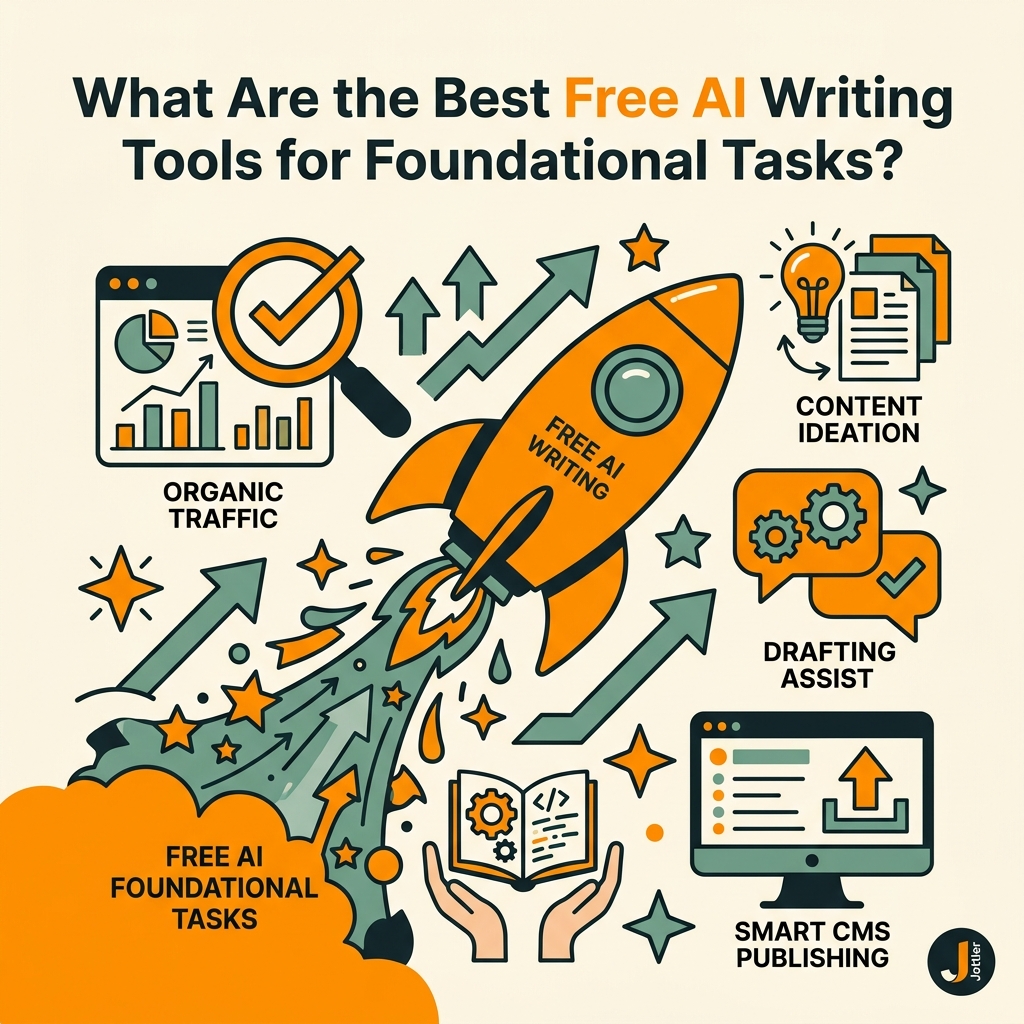
While no free tool can truly replace a strategic content workflow, some are effective for specific, foundational tasks. Organizations using AI report creating content up to 59% faster (Firewire Digital, 2026), and these tools contribute to that speed for small jobs. However, each comes with significant limitations that prevent them from being a scalable solution for serious content marketing. Here are a few popular options and where they fall short.
Category 1: The Paraphraser (e.g., QuillBot)
Tools in this category excel at rephrasing existing text. You can input a paragraph and get several alternative versions, which is useful for refreshing old content or improving clarity. The primary benefit is speed for a very narrow task. The downside? They don't create anything new. They are fundamentally derivative, incapable of generating original ideas, conducting research, or structuring a full article. They are editing assistants, not writers.
Category 2: The Generalist Chatbot (e.g., ChatGPT Free Tier)
The free version of ChatGPT is a powerful tool for brainstorming and drafting initial concepts. It can generate outlines, write short passages, and answer questions on nearly any topic. However, its knowledge is not real-time, and it has no built-in mechanisms for fact-checking or citing sources. More importantly, it lacks any native SEO capabilities. It cannot perform keyword research, analyze SERPs, or optimize content to rank, making its output a starting point that requires significant manual work from a skilled marketer.
Category 3: The Single-Purpose Generator (e.g., Headline Generators)
Dozens of free tools exist to perform one tiny function, like generating blog titles, meta descriptions, or email subject lines. While they can be handy in a pinch, they epitomize the fragmentation problem. A marketer might need to use five or six different "free" tools to assemble the basic components of a single blog post. This manual, copy-and-paste workflow is inefficient and a major source of the "hidden costs" associated with free tools. The context switching alone creates massive inefficiency, which is the exact opposite of what AI automation should provide.
Why "Free" Isn't Always Free: The Hidden Costs of Standalone AI Writers
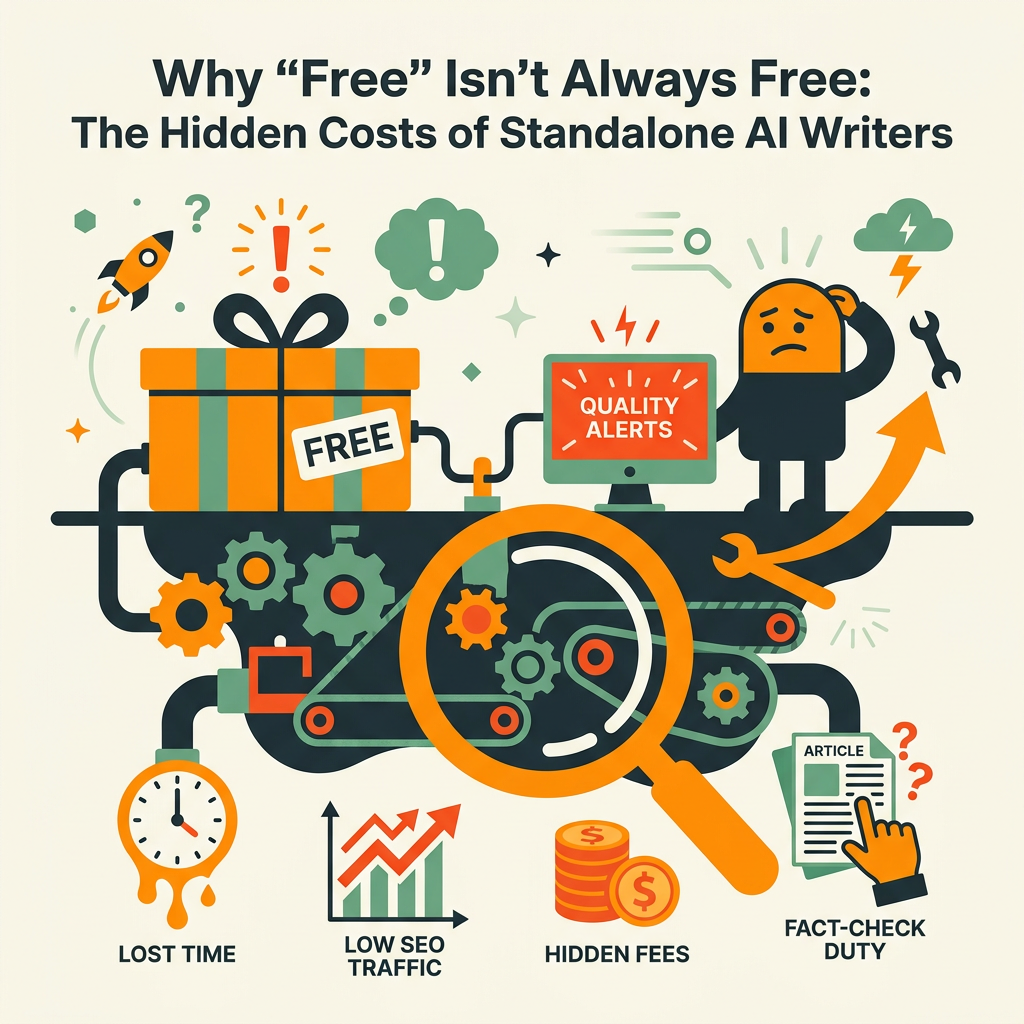
The appeal of free AI writing tools is obvious, but their true cost is measured in time, quality, and missed opportunities. For a busy founder or a lean marketing team, the hours spent wrestling with these tools often outweigh the benefit of their "free" price tag. Content marketing generates 3x more leads than outbound methods at a 62% lower cost (Digital Applied, 2026), but that ROI is only achieved with high-quality, strategic contentsomething free tools alone cannot produce.
The Time Cost of Manual Labor
A free AI tool might generate a 1,000-word draft in a minute, but that draft is rarely usable. It requires extensive manual labor:
- Fact-Checking: LLMs are notorious for "hallucinating" facts and sources. Every statistic and claim must be manually verified.
- Editing for Voice and Tone: The output is often generic and lacks a distinct brand voice, requiring a heavy editing hand.
- SEO Optimization: The draft isn't optimized for any target keywords. A marketer must manually perform keyword research, infuse the term naturally, and handle on-page SEO elements.
- Formatting and Publishing: The raw text needs to be formatted for a CMS, complete with images, links, and structured data, before being published.
The Quality Cost of Generic Content
Free tools pull from the same general internet data, leading to generic, undifferentiated content. They can't perform deep, multi-source research or synthesize unique insights from proprietary data. This results in articles that look and sound like thousands of others, failing to establish authority or capture reader interest. In a world saturated with AI-generated noise, quality and originality are paramount for ranking and engaging audiences. Relying on basic tools is a strategy for blending in, not standing out.
"The biggest mistake I see teams make is treating AI as a content vending machine. You can't just press a button and expect a strategy to come out. The value isn't in generating text; it's in automating the research, optimization, and workflow that turns text into a business asset."
Sarah Franklin, Head of Content, SparkGrowth
How Do Free AI Writing Tools Compare to an Autonomous SEO Engine?
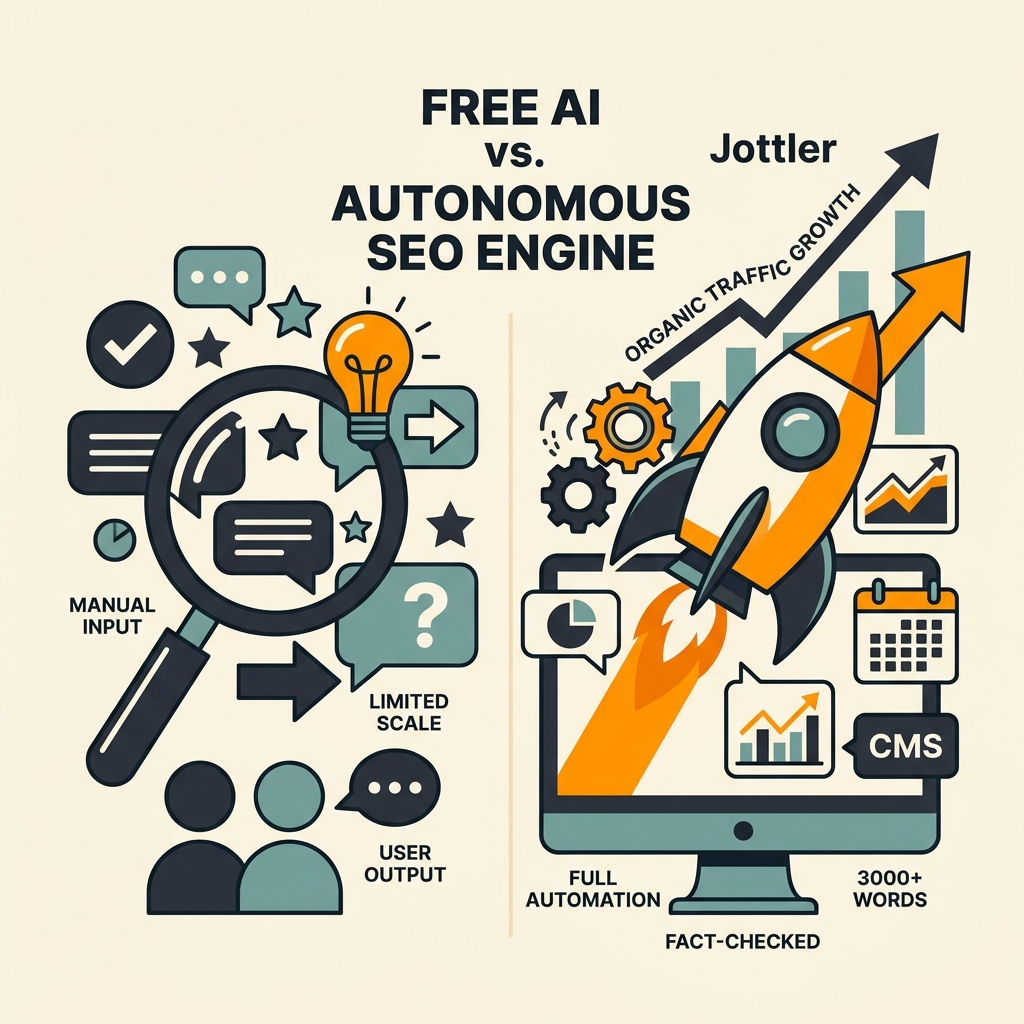
Comparing free AI writing tools to an autonomous SEO engine like Jottler is like comparing a screwdriver to a fully automated assembly line. While both are useful, they operate on completely different scales of capability and strategic impact. Free tools are tactical aids for writers; an autonomous engine is a strategic system for business growth. The most successful marketing teams recognize this distinction, with 62% of high-performers using a hybrid model where automation handles the heavy lifting, freeing up humans for strategy (Firewire Digital, 2026).
The table below breaks down the fundamental differences:
| Feature | Standard Free AI Tools | Jottler (Autonomous AI Engine) |
|---|---|---|
| Keyword Research | None | Automated, integrated analysis of topics and keywords |
| Content Generation | Short snippets, basic drafts | Full 3,000+ word, research-backed articles |
| Fact-Checking | Manual verification required | Automated verification across 14+ sources |
| SEO Optimization | Manual process | Built-in, from title to internal linking |
| CMS Publishing | Manual copy-paste and formatting | Direct, automated publishing to your website |
| Internal Linking | Manual process | Smart, automated network building |
| Scalability | 1-2 pieces of content with heavy manual work | 1-5 full articles published daily, hands-free |
The Shift from Task Automation to Workflow Automation
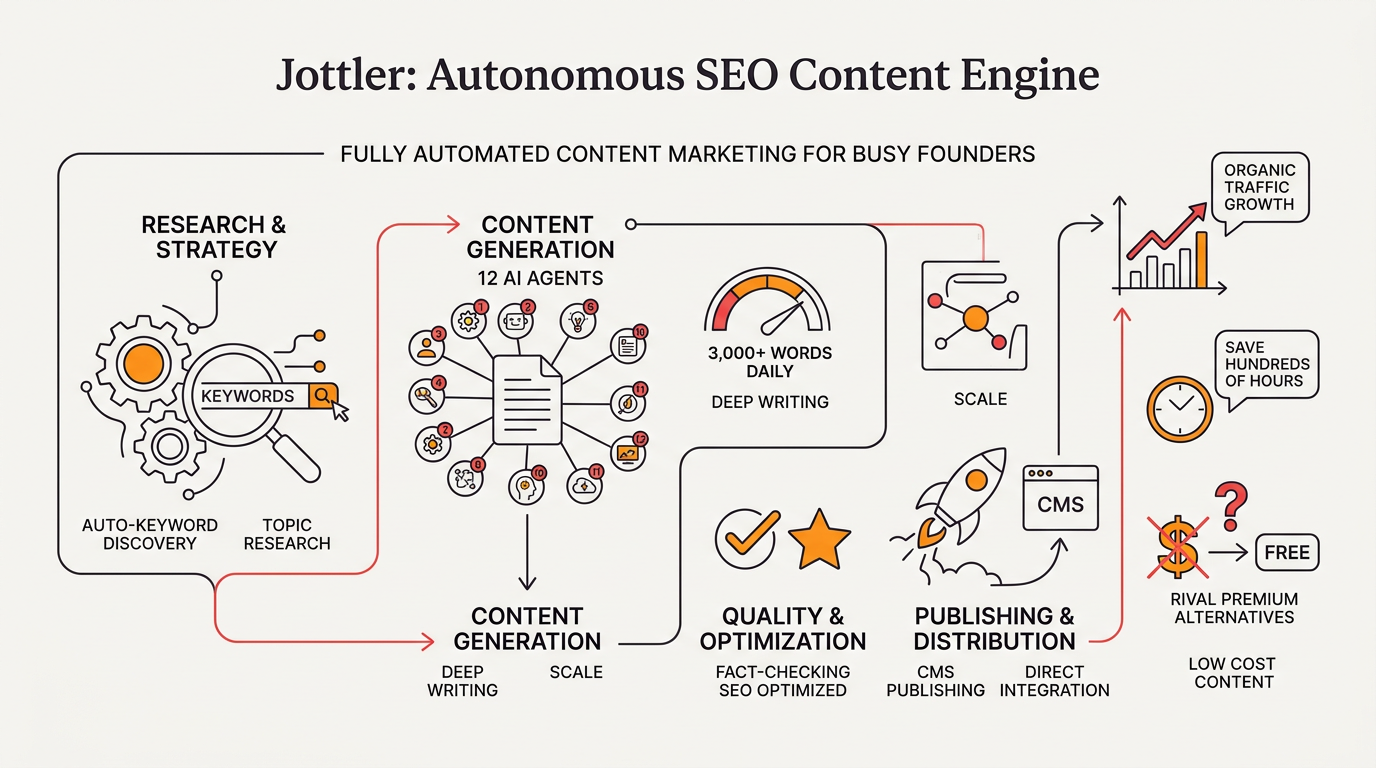
As the table illustrates, free tools focus on automating a single task, leaving you to manage the rest of the workflow. Jottler automates the entire workflow. It doesn't just write; it functions as a complete, autonomous SEO agent. It identifies high-potential keywords, conducts deep research, writes comprehensive and fact-checked articles, optimizes them for search engines, and publishes them directly to your blog, even building an intelligent internal link structure as it goes. This is the difference between getting a block of raw text and getting a compounding business asset delivered daily.
Jottler: The Smarter Alternative to Juggling Free AI Tools
For busy founders and marketing teams at scaling companies, the goal isn't just to create more content; it's to build a reliable engine for organic growth. This is where free AI writing tools fundamentally fall short and where Jottler's autonomous model excels. Jottler was built to solve the workflow and strategy problems that free tools create. It replaces a dozen manual steps and a handful of single-purpose tools with one intelligent, hands-free system.

Designed for Busy Founders, Not Hobbyists
You don't have time to play the role of editor, SEO specialist, and publisher for a machine. Jottler's 12 specialized AI agents handle the entire process.
- No more manual keyword research: Jottler's AI finds and targets keywords your audience is searching for.
- No more writer's block: It generates and publishes long-form, 3,000+ word articles daily.
- No more fact-checking worries: Every piece of content is fact-checked against more than a dozen sources.
- No more publishing bottlenecks: Articles are posted directly to your CMS, fully optimized and internally linked.
Conclusion
While free AI writing tools offer a tantalizing glimpse into the power of AI-driven content creation, they are ultimately tactical gadgets, not strategic solutions. They can help with isolated tasks, but they leave the most time-consuming and value-driving workresearch, optimization, fact-checking, and publishingsquarely on your shoulders. The initial appeal of "free" quickly gives way to the high cost of manual labor and missed strategic opportunities. For busy founders and marketers aiming for scalable, compounding growth, the answer isn't a patchwork of free tools. It's a single, autonomous engine that handles the entire SEO content lifecycle. By automating the full workflow, solutions like Jottler deliver what free tools can only hint at: a reliable, hands-free system for dominating search and driving business results.
FAQs
Which AI writing tool is truly 100% free?
Many tools offer a "100% free" tier, but they almost always come with significant limitations. For example, the free version of ChatGPT uses an older model and lacks real-time data access. Other tools like QuillBot or various headline generators impose strict character limits, usage caps, or feature restrictions that push you towards a paid plan. The most capable free tools are best viewed as limited demos for their more powerful, premium counterparts. True end-to-end content creation, including research and SEO, is not something you will find in a genuinely free product, as the computational costs are too high.
What are the limitations of free AI writing tools?
The primary limitations of free AI writing tools are a lack of integration and strategic capability. They typically perform only one task, like writing a paragraph or rephrasing a sentence. They do not conduct keyword research, analyze competitors, fact-check claims, or optimize content for search engine rankings. Furthermore, they require significant manual work to turn their raw output into a polished, publishable article. Their biggest limitation is that they automate a single task, not the entire content workflow, which means the user is still responsible for strategy, editing, and publishing.
Is it better to use a free tool or a paid, automated solution?
The right choice depends on your goal. If you need to rephrase a single paragraph or brainstorm a few quick ideas, a free tool is perfectly adequate. However, if your goal is to build a scalable, long-term content marketing engine that drives organic traffic and leads, a paid, automated solution is far superior. An autonomous system like Jottler provides a complete workflow automation that generates compounding returns on your investment, saving dozens of hours per month and producing higher-quality, SEO-optimized content. For any serious business, the ROI of an automated solution quickly surpasses the superficial appeal of a "free" tool.