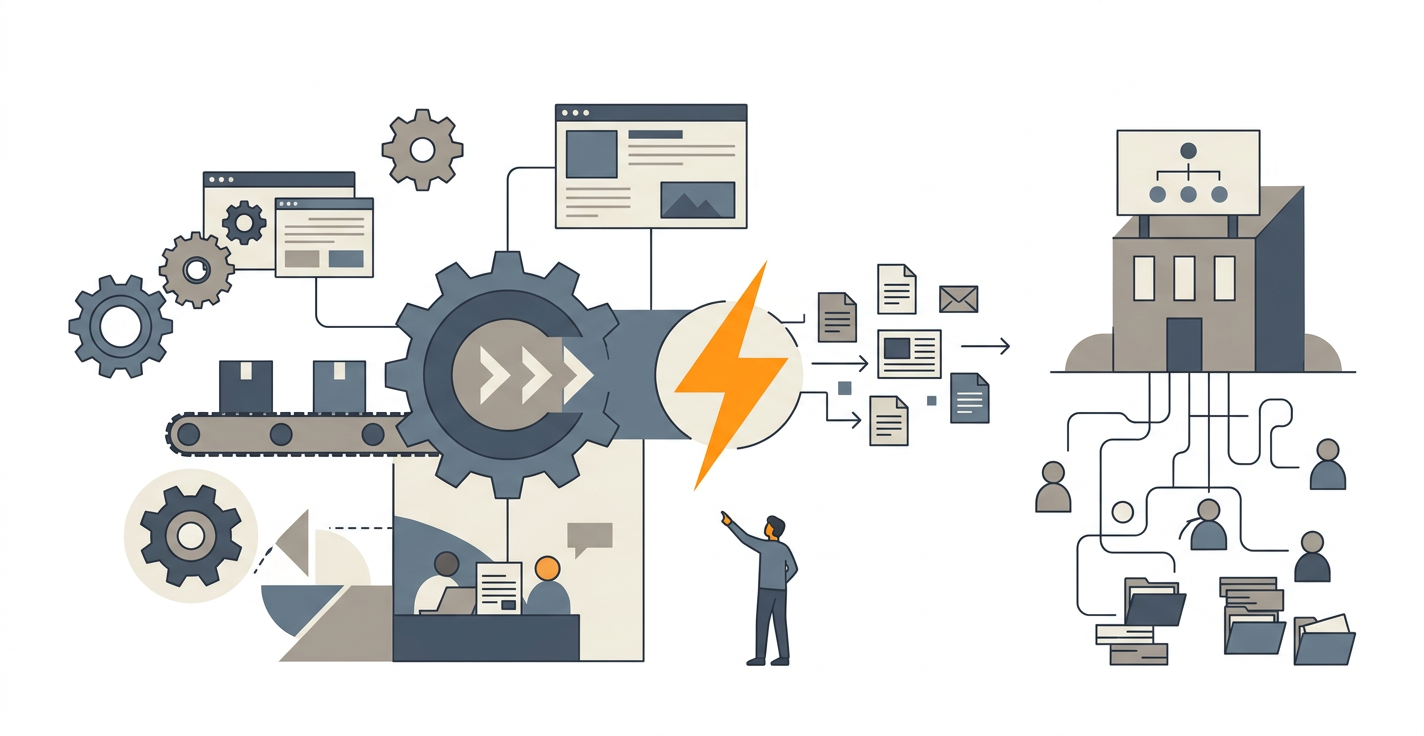
Why content engines beat content agencies in 2026
The average mid-market B2B company spends $4,000 a month on a content agency and gets four 1,500-word articles in return. Those articles take six weeks to land, they're written by a freelancer who's juggling nine other clients, and they're optimized for whatever keyword showed up in last month's Ahrefs export. By the time they publish, the intent has shifted.
A modern content engine — same cost, same calendar month — produces 100 articles. Each one is researched against live SERP data, fact-checked, internally linked across your entire archive, and published directly to your CMS. This post explains why the shift is happening, what it costs to run the new stack, and how to think about quality when volume goes up 25×.
Key Takeaways
- Content agencies price on labor hours, which caps output below what a modern SEO strategy needs.
- AI content engines price on compute, which scales linearly with ambition rather than with the number of humans in the loop.
- Quality is now a function of research depth and feedback loops, not "did a human type every word."
- The winning stack for 2026 is autonomous agents plus a human review step — not agencies, not pure ChatGPT.
What changed in the last 12 months
A year ago, AI-generated content was a risk. Today it's the default. The shift happened for two reasons. First, the models crossed a threshold — Sonnet 4 and GPT-5 produce copy that reads indistinguishably from a skilled human writer when you give them real research to work with. Second, Google quietly stopped caring. What Google cares about is whether the content answers the query deeply, is original, and carries proper citations. "Did a human write this" was never in their ranking model; that was a PR position, not an algorithm.
Most agencies are stuck in the old model. They sell retainers, bill hours, and charge premium rates for the prestige of "human-written." Their output ceiling is mechanical: one writer can produce maybe 4,000 words a week of quality work. Multiply that by your team size and you get your monthly cap.
The math that actually matters
Run the numbers on a typical B2B content program:
- Agency: $4,000/month, 4 articles × 1,500 words = $0.67 per word.
- In-house writer: $7,000/month salary, 6 articles × 2,000 words = $0.58 per word.
- Content engine: $300/month in AI API credits, 100 articles × 3,000 words = $0.001 per word.
That's a 600× cost reduction per word. The bottleneck shifts from "how much can we afford to write" to "how many high-value keywords exist in our space" — and most niches have at least 500 before running dry.
Where the quality actually comes from
The mistake people make with AI content is asking "did a human write it" instead of "what evidence did the writer use." Quality in 2026 looks like this:
- Live SERP research. Before drafting, the system pulls the top 10 ranking pages for the target keyword, extracts their H2s and H3s, and notes the gaps.
- Statistic backfill. Every claim that sounds like a fact triggers a web search; the agent won't finish a sentence it can't cite.
- Internal link graph. A crawler runs against your sitemap weekly; each new article auto-inserts 3–7 contextual links to your existing library.
- Human approval, not human typing. A person reviews the outline and final draft for 10 minutes. That's the last human touch — everything in between is automated.
The human's job shifts from "write" to "decide what to write and check that it's honest." That's a higher-leverage role.
What you can't automate
Two things still need people:
- Positioning. The difference between "cheap" and "premium" is a judgment call about who you want to attract. An agent will optimize for volume; a human has to set the brand voice.
- Original reporting. Interviews, proprietary data, internal case studies. If your whole moat is "we talked to 30 customers and here's what they said," that's still a human job. But that's not the bulk of content marketing — that's the peak 10%.
How to evaluate a content engine
Before you buy or build one, make sure it:
- Pulls real data from DataForSEO or an equivalent, not just makes up stats.
- Writes to a configurable word target (800 for skimmable, 3,000+ for pillar).
- Publishes directly to your CMS — WordPress, Webflow, Shopify, whatever — without a copy-paste step.
- Lets you review and approve before publish, or flip on autopilot once you trust it.
- Shows you its work in live logs, not a black box.
If it can't do those five things, you're paying for a ChatGPT wrapper.
What to do this week
If you're still on an agency retainer, here's the three-step migration:
- Pick a content engine. Run a pilot on 10 topics you'd have commissioned anyway. Compare the output to your agency's last batch.
- Cancel the retainer or renegotiate to only cover original reporting and positioning work.
- Redirect the agency budget into paid distribution or product. Content production should cost pennies on the dollar of what you were paying.
Frequently Asked Questions
Is AI-written content penalized by Google?
No. Google's stance since early 2023 has been that content quality is judged on merit, not origin. Their guidance explicitly says automation is fine when it produces "helpful, reliable, people-first content." What gets penalized is thin content, duplicate content, or anything that looks like keyword stuffing — those rules apply whether a human or an AI wrote it.
How much does it actually cost to run a content engine?
Most teams spend $100–$500 per month in API credits for 50–200 articles, depending on the word count and research depth per article. Compare that to $3,000–$10,000/month for a comparable human-team output. The software cost is negligible next to what you save on the humans.
What if our niche is too specialized for AI?
Niche depth is a research problem, not a writing problem. If the AI can pull specialized sources — trade journals, company reports, expert podcasts — it can write at depth. Where it struggles is when the only knowledge lives in one expert's head. That's the one case where a human interview still wins, and a good engine will flag it.
Will this hurt our brand voice?
Only if you don't configure it. A modern content engine supports tone guides, forbidden phrases, and example articles to mimic. Give it three sample articles that sound like you and it'll match the voice. If it can't, the tool is underpowered.