How to Build a Sustainable AI Content Calendar
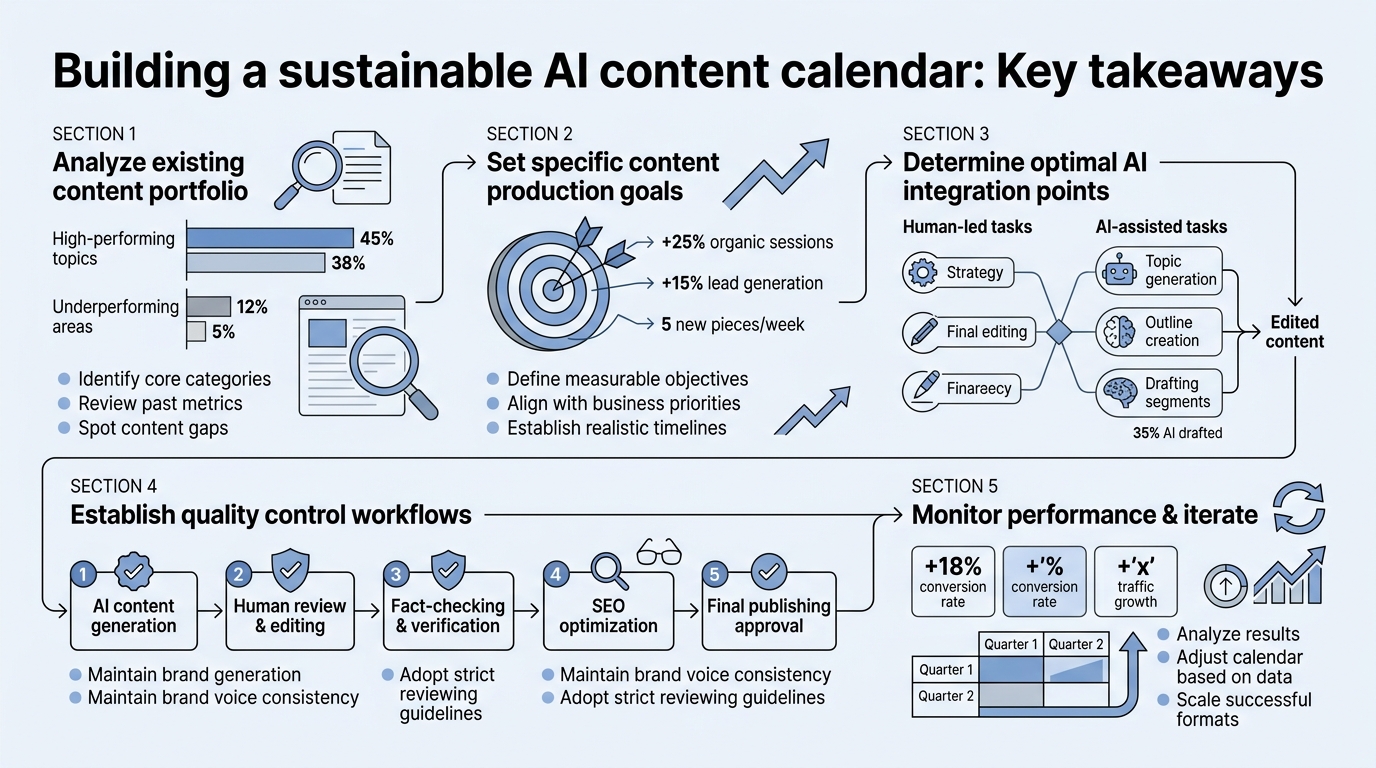
Most marketing teams still plan content manually, team meetings, spreadsheets, last-minute decisions. 85% of marketers now use AI for content creation, yet few have built sustainable calendars to manage that output. The cost of inconsistency is significant: missed publishing deadlines erode audience trust, fragmented topic coverage dilutes SEO authority, and manual refresh cycles mean content decays without updates. The solution is a structured AI content calendar that balances volume with quality, automates ideation and scheduling, and maintains freshness through quarterly review cycles.
Key Takeaways
- 85% of marketers use AI for content creation, but sustainable calendars require structured planning, not just tool adoption (2026, Digital Applied)
- Reserve 15–25% of weekly capacity for refreshing existing content rather than chasing net-new production; quarterly freshness cycles protect citation authority
- Set publishing cadence based on actual team capacity and review buffers, not output ambition, unrealistic schedules lead to burnout and abandoned systems
- Audit Existing Content and Capacity: Baseline your current library and production bandwidth to set a realistic, sustainable publishing rhythm.
- Structure Content Around Pillar Topics and Support Assets: Organize calendars by core themes, then schedule 8–15 supporting posts to compound authority over 60–90 days.
- Use AI for Ideation, Gap Analysis, and Keyword Validation: Automate the research phase to identify audience demand before scheduling topics.
- Define and Enforce Workflow Milestones: Every content item moves through brief, draft, review, SEO check, approval, and publication in a predictable, auditable sequence.
- Build Quarterly Refresh Cycles into the Calendar: Schedule substantive updates with fresh statistics, examples, and competitive comparisons to maintain relevance and AI citation potential.
- Measure and Iterate Using Monthly Performance Reviews: Track planned vs. actual publishing rate, organic traffic by content type, and ranking by cluster to adjust next quarter's plan.
Audit Your Existing Content and Set Realistic Capacity Targets
A sustainable content calendar is built on honest capacity assessment. Most teams overestimate what they can produce, leading to abandoned calendars and staff burnout. Start by auditing your existing content library and calculating how much your team can realistically produce, review, and publish each week without sacrificing quality.
Measure Your Current Production and Review Timeline
Track your content workflow end-to-end. Document how long it takes to brief a topic, draft (whether manually or with AI), edit for accuracy, perform SEO optimization, gain approval, and publish. Include buffers for unexpected delays. Most professional teams need 5–7 days from brief to publish for high-quality 2,000+ word articles. If you're planning to publish 3 articles per week with a 5-person team, account for 15–21 days of effort. That's feasible. Promising 5 articles per week on the same budget is not. Jottler automates much of this pipeline, research, drafting, SEO optimization, and internal linking, compressing the timeline dramatically. But even with automation, the review and approval gates take real time.
Calculate Your Refresh Capacity
Sustainable calendars allocate at least 15–25% of weekly effort to updating existing content rather than only chasing new articles. This percentage protects your existing assets from traffic decay and compounds authority over time. If your team produces 4 new articles per week, set aside 1 day for refreshing 3–5 older pieces with updated statistics, new examples, and fresh competitive comparisons. A quarterly refresh cycle is the benchmark: high-value pages updated every 12 weeks with substantive improvements.
Document Roles and Handoffs
Assign one owner per content item. Define who briefs, who drafts, who reviews for accuracy, who handles SEO optimization, and who has final approval before publishing. Clear ownership prevents items from stalling in workflows and keeps the calendar on track. Without defined milestones, "in progress" content accumulates and real momentum stops.
Structure Your Calendar Around Pillar Topics and Supporting Content
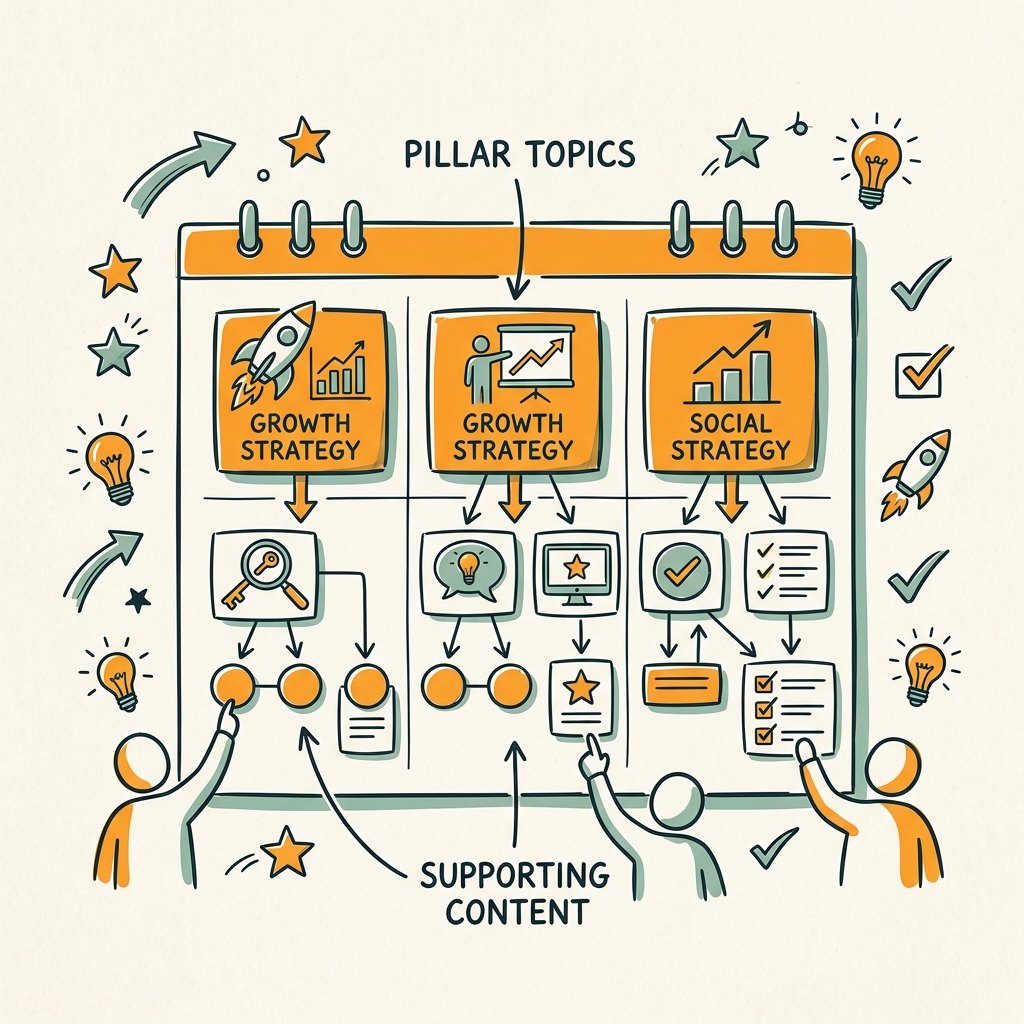
Topic clusters compound authority. Rather than publishing random articles, organize your calendar by core pillar topics. Each pillar gets a deep, authoritative article (3,000+ words), then schedule 8–15 supporting posts around that pillar over the following 60–90 days to reinforce topical expertise.
Identify Your Pillar Topics Based on Business Goals and Search Intent
Choose 4–8 pillar topics that align with your business model and have genuine search demand. For a SaaS company, pillars might be "AI Content Automation," "SEO Strategy," "Organic Growth," and "Content Marketing ROI." Each pillar should represent a product category or core audience pain point. Use AI to accelerate this process: feed your business description and target keywords into a content analysis tool, and identify gaps in your existing coverage versus competitor coverage. This gap analysis is where AI delivers immediate value, it surfaces underrepresented topics that your audience is already searching for.
Plan the Pillar-to-Support Cadence
Publish your pillar article first. Then, over the next 8–12 weeks, schedule supporting posts that branch from that pillar topic. Supporting articles address sub-topics, specific use cases, or related questions. Example: if your pillar is "AI Content Automation," supporting articles might cover "How to Choose an AI Content Tool," "Automating Internal Linking at Scale," "AI Content Fact-Checking Best Practices," and so on. Internal linking between the pillar and its support articles strengthens topical authority. Building a content cluster strategy with AI assistance makes this exponentially faster, the system can generate clusters automatically and suggest internal link relationships.
Distribute Content Across the Calendar Evenly
Rather than front-loading all content in month one, spread pillar articles across your calendar. Publish one pillar per month, then schedule its support articles in the weeks following. This ensures your calendar stays fresh, prevents feast-famine patterns, and gives you time to measure pillar performance before launching the next cluster.
Use AI for Ideation, Gap Analysis, and Keyword Validation
Manual topic brainstorming is the bottleneck. 94% of marketers plan to use AI in content creation processes in 2026, and the most effective teams use AI not just for writing, but for strategic ideation before a single word is drafted. AI can analyze competitor content, identify keyword gaps, validate search demand, and rank topic ideas by potential impact, all before you commit calendar space.
Run Competitor Gap Analysis to Find Unmet Audience Demand
Use AI to analyze the top 20 ranking articles in your main topic areas. What questions do competitors address? What angles are missing? What statistics are outdated or unused by the competition? AI tools can cross-reference competitor content against your existing articles and flag topics that competitors are ranking for but you aren't. Feed those gaps into your calendar as high-priority items. This approach is strategic, not reactive: you're building on proven demand rather than guessing what might rank.
Validate Every Topic with Keyword Research Before Scheduling
Before adding a topic to your calendar, validate it. Check monthly search volume, keyword difficulty, and intent (informational, commercial, or transactional). A topic might sound relevant, but if no one is searching for it, it won't drive traffic. AI tools can batch-check dozens of topic ideas against keyword data, then surface only the ones with real demand. This filter prevents wasted effort on topics that sound good in planning meetings but don't have an audience.
Identify Question-Based Topics Using "People Also Ask" Data
Google's People Also Ask section reveals real, low-funnel user questions. AI can scrape and organize these questions into topic clusters, showing you exactly what your audience wants answered. Many teams miss this goldmine: high-performing content calendars use People Also Ask data to identify underserved questions. Schedule articles around these questions directly, and you're building content against confirmed search demand.
Define Workflow Milestones to Keep Content Moving Predictably
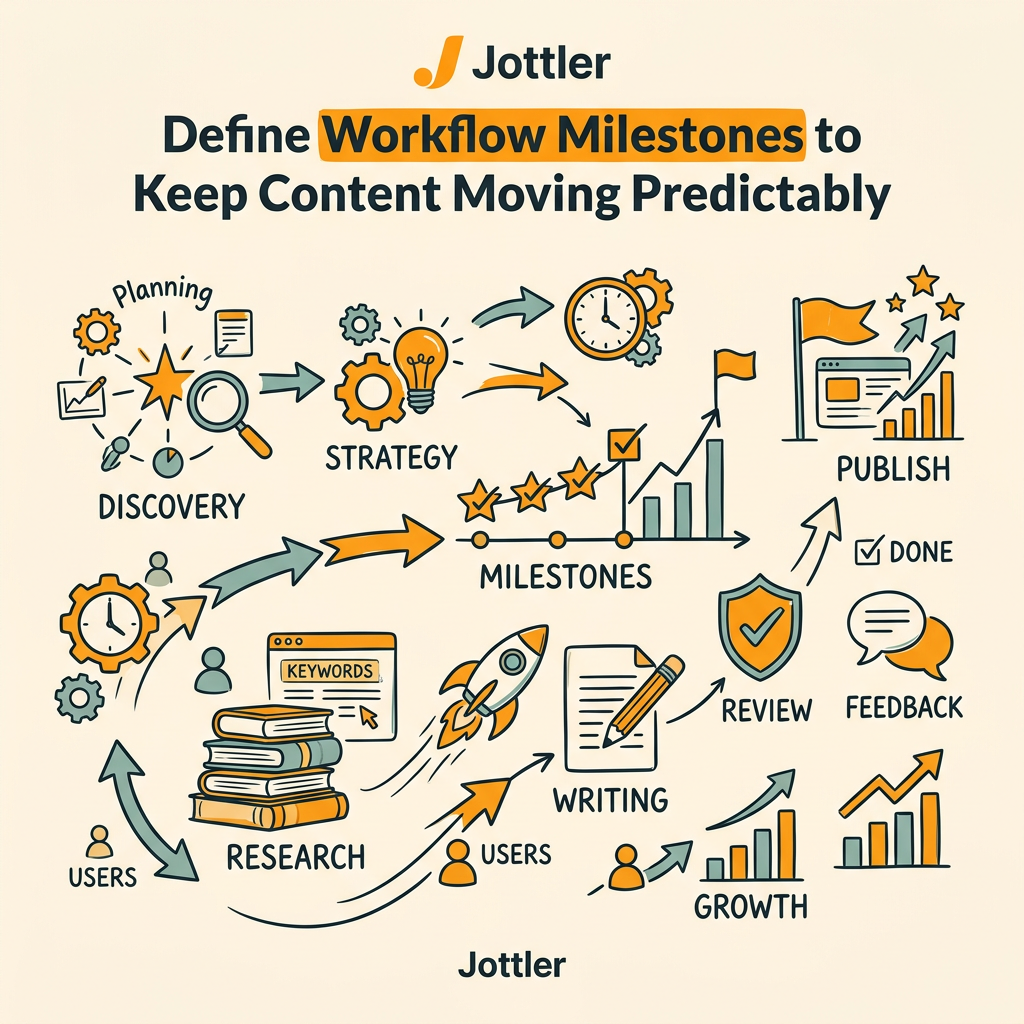
Content stalls when workflows aren't defined. Set standard milestones so every item moves through the pipeline in the same sequence: brief, draft, edit, SEO check, approval, publication. This predictability makes your calendar reliable and prevents bottlenecks.
Establish Clear Milestones and Ownership
Create a checklist for each content item:
- Brief (Day 1): Owner defines topic angle, target keywords, desired length, and source requirements.
- Draft (Days 2–3): Writer or AI system completes first draft with research, data, and outline.
- Editorial Review (Day 4): Editor checks clarity, tone, and brand alignment.
- SEO Optimization (Day 5): SEO owner optimizes title, meta description, headers, and internal links.
- Fact-Check and Approval (Day 6): Subject matter expert or compliance reviews accuracy and approves for publication.
- Publication and Distribution (Day 7): Content publishes to CMS and is shared via email, social, and other channels.
This 7-day timeline is realistic for high-quality content. Shorter timelines cut quality; longer ones stall momentum. Set it, stick to it, and measure your actual vs. planned publishing rate monthly.
Use Workflow Automation to Reduce Manual Handoffs
Automate the handoffs between milestones. When a draft is complete, trigger an automatic notification to the editor. When SEO optimization is done, notify the approver. Most teams lose track of content mid-pipeline because status updates are manual. Content marketing automation tools remove friction from the approval process, ensuring items move predictably through each stage without manual chasing.
Set Review Buffers to Handle Unexpected Delays
Build slack into your timeline. If you need content published by Friday, schedule the final approval for Wednesday, not Thursday. Unexpected revisions, fact-checking conflicts, or stakeholder feedback will consume that buffer. A calendar that assumes perfect execution is fragile. A calendar with built-in buffers survives reality.
Build Quarterly Refresh Cycles to Maintain Content Authority
Sustainable content calendars aren't just about new articles, they're about keeping existing assets fresh. Content citation authority decays without updates. Schedule quarterly refreshes of your highest-traffic, highest-authority articles. Add current-year statistics, update examples, refresh competitive comparisons, and add new research.
Prioritize Refreshes by Citation Potential and Traffic Impact
Not all content deserves equal refresh investment. Prioritize articles that are already ranking in the top 5 for high-volume keywords, articles already cited by AI systems, and articles generating the most organic traffic. Use AI visibility metrics like citation rate and Share of Model to identify refresh priorities. Pages already cited should be refreshed first, pages close to citation should be refreshed next, and lower-priority pages later. This is ROI-focused refresh strategy.
Make Refreshes Substantive, Not Cosmetic
A refresh isn't a typo fix. Replace outdated statistics with current data (use 2025 and 2026 sources exclusively). Add new examples or case studies. Update competitive comparisons with recent releases or pricing changes. Refresh the opening hook to reflect current market conditions. Substantive updates signal freshness to search engines and AI systems, protecting your article's visibility. Cosmetic edits don't move the needle.
Schedule Refreshes in Advance, Not Reactively
Block refresh time on your calendar quarterly. If you have 50 high-value articles, assign 5–10 refreshes per quarter (roughly 1–2 per week). This predictable allocation ensures refreshes actually happen instead of being pushed aside by new content crises. Assign ownership just like you do for new articles: one person per refresh, with a deadline and approval gate.
Track Key Metrics and Iterate Monthly
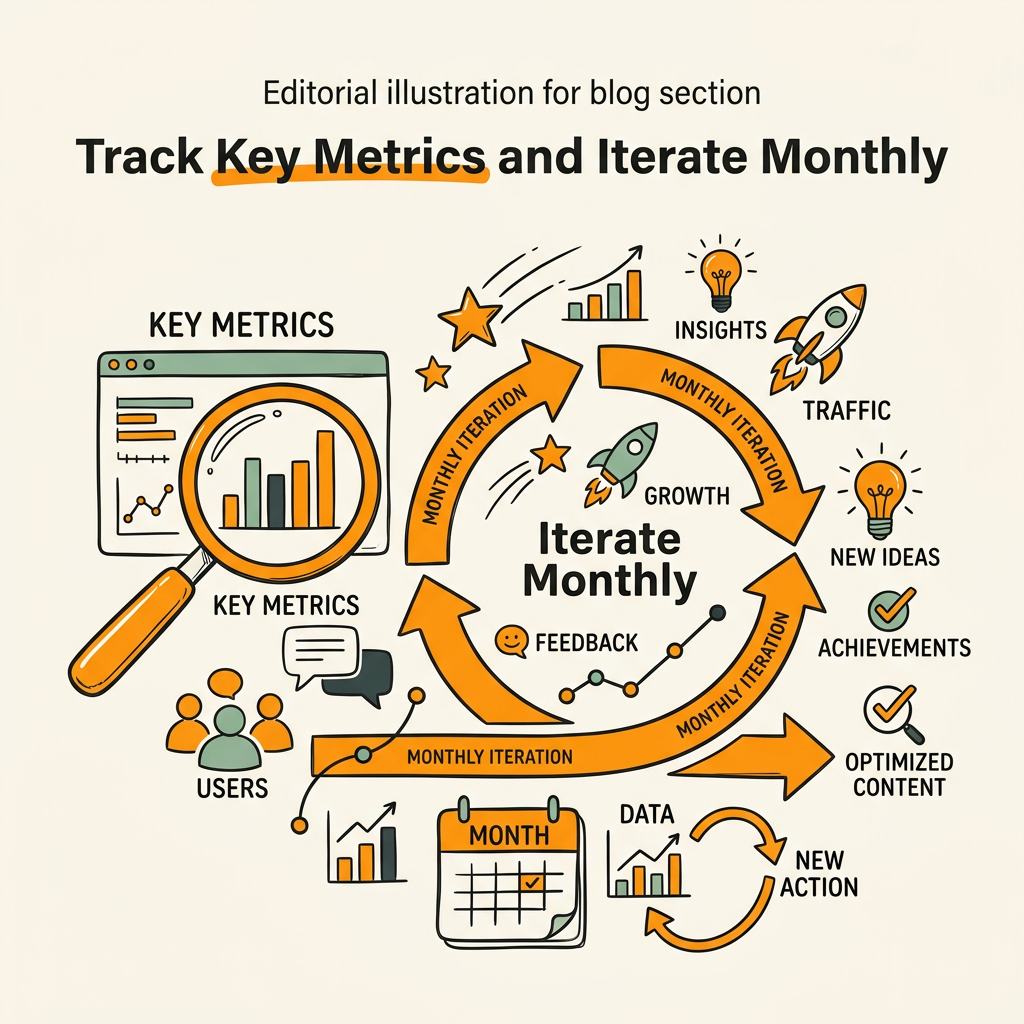
A sustainable calendar is data-driven. Monthly reviews let you measure what's working and adjust next quarter's plan accordingly. Track four metric categories: publication metrics, search performance, topical authority, and production efficiency.
Publication and Planning Metrics
Measure planned vs. actual publishing rate. Did you publish 4 articles this month as planned, or 2? Why? Were there bottlenecks in review? Did topics get deprioritized? This honest accounting prevents you from over-promising next month. Track which authors or teams are hitting deadlines and which are missing them. Identify workflow bottlenecks (e.g., "SEO check always adds 3 days") and fix them systematically.
Organic Traffic and Ranking Metrics by Content Type
Compare organic traffic by content pillar and type. Which pillar clusters are driving the most traffic? Which articles consistently underperform? Track average ranking position by topic cluster. If your "AI Content Automation" cluster averages position 8 while your "SEO Strategy" cluster averages position 15, invest more in SEO Strategy next quarter. Use this data to inform pillar selection and refresh prioritization.
Topical Authority and Internal Link Effectiveness
Count intra-cluster internal links. Are support articles linking back to the pillar? Is the pillar citing support articles? If not, your clusters aren't reinforcing each other. Measure topical authority by tracking rankings for 5–10 core keywords within each cluster. Clusters with strong internal linking and consistent updates typically show rising topical authority month-over-month.
Production Efficiency and Team Capacity
Track articles published per FTE (full-time equivalent) and per dollar spent. Are you getting faster? Are refresh cycles taking less time than they did last quarter? This efficiency baseline helps you forecast capacity and predict how much content you can sustainably produce going forward. It also shows when automation is delivering ROI.
Implement Smart Tools and Automation to Sustain Output
Manual processes don't scale. The teams building sustainable calendars use tools that automate research, drafting, optimization, and publishing. The strongest approach is a system that can research topics from multiple sources, draft SEO-optimized content, validate facts, suggest internal links, and publish directly to your CMS while your team focuses on strategy and quality control.
Choose Tools That Integrate Across Your Workflow
Your content calendar lives in a tool (Asana, Monday, Notion, etc.), but your AI writing, research, and publishing tools need to feed into and out of that calendar. If research and drafting are siloed in one tool and publishing is in another, you're creating friction. Jottler bridges this gap by automating the entire pipeline: it researches topics from 14+ sources, writes long-form SEO content, fact-checks and links internally, and publishes directly to your CMS, all automatically. This end-to-end automation removes the manual handoffs that slow calendars down.
Prioritize Tools That Support Fact-Checking and Quality Assurance
AI-generated content needs verification. Choose tools that include fact-checking, source citation, and accuracy review. Claims without sources hurt credibility. Tools that validate stats, cross-reference sources, and flag unsupported assertions save hours of editorial review and protect your brand authority.
Build for Internal Linking at Scale
Topical authority compounds through internal linking. Tools that automatically suggest and create internal links between related articles let you scale link building without manual grunt work. This is where sustainable calendars become multipliers: each new article reinforces existing content, and refreshed content gets new link opportunities automatically.
Adapt Your Calendar Based on Performance Data
Your first quarter's calendar is educated guessing. By month 3, you have real traffic and ranking data. Use it. If certain content types consistently underperform, deprioritize them. If a particular author's work ranks faster, assign them more flagship articles. If refreshes of older content outpace new content in traffic growth, shift more capacity toward refreshes.
Run Monthly Planning Reviews with Your Team
Dedicate 1 hour monthly to reviewing the data. Review planned vs. actual publishing (were you realistic?). Review traffic gains by article and topic (what's working?). Review production bottlenecks (what slowed us down?). Feed these findings into next month's calendar and cadence. This rhythm ensures your calendar stays aligned with reality and team capacity.
Adjust Cadence If Reality Diverges from Plan
If you planned 4 articles per week but consistently publish 2.5, stop planning for 4. Reset your baseline to 2.5, add your refresh allocation (15–25% of that, or roughly 8–10 hours per week), and build your calendar around the realistic rhythm. Honesty about capacity is the foundation of sustainability.
Conclusion
A sustainable AI content calendar balances ambition with realism. 85% of marketers use AI for content creation, yet most are still managing calendars manually and chasing volume over authority. The teams winning at organic growth use structured calendars built on honest capacity assessment, organized around pillar topics with supporting content, refreshed quarterly, and continuously improved through monthly performance reviews. Start with auditing your capacity, structure your first quarter around 4–8 pillar topics, and reserve 15–25% of weekly effort for refreshes. Measure your actual publishing rate against your plan, adjust your milestones based on bottlenecks, and iterate monthly. Within three quarters, your calendar will be self-sustaining, producing consistent, high-authority content without burnout or guesswork.
Ready to automate the research, writing, and publishing phases of your content calendar? Jottler handles keyword research, fact-checking, SEO optimization, and CMS publishing automatically, compressing a 7-day workflow into a predictable, auditable system. Your team focuses on strategy and refreshes; Jottler handles the pipeline. Start your SEO agent and build your first sustainable calendar this quarter.
FAQs
How often should I refresh existing content in my calendar?
Quarterly refreshes are the industry standard for high-value articles. Identify your top 10–15 highest-traffic, highest-authority articles and schedule substantive updates (new statistics, current examples, refreshed comparisons) every 12 weeks. Reserve 15–25% of your weekly production capacity for these refreshes rather than treating them as "nice-to-have" add-ons. The ROI of refreshes often exceeds new content production, especially for evergreen topics. Pages that receive quarterly updates maintain AI citation potential and organic visibility significantly better than articles published once and left stale.
What is a realistic publishing cadence for a small content team?
A 2–3 person team should target 2–3 high-quality articles per week (800–2,000 words each), plus 1–2 refresh updates weekly. This assumes no automation. With AI-assisted writing, research, and optimization, the same team can sustainably publish 3–4 articles per week plus 2–3 refreshes. The key is setting a cadence your team can hit consistently for 12+ months without burnout. An ambitious calendar abandoned after 6 weeks is worse than a modest calendar executed for a year. Focus on realistic rhythm over peak performance.
How do I measure whether my content calendar is sustainable?
Track your planned vs. actual publishing rate across 3 months. If you hit 90%+ of your target consistently, your calendar is sustainable. If you hit 60% or less, your cadence is too ambitious. Additionally, measure team satisfaction: sustainable calendars don't cause burnout, missed deadlines, or quality shortcuts. Review your team's feedback monthly. If they're consistently stressed or rushing, scale back. Measure organic traffic growth: sustainable calendars compound authority over time, so your traffic should show month-over-month gains (accounting for seasonality). If traffic is flat after 3 months, either your topic selection is misaligned or your content quality needs improvement, but your schedule might not be the bottleneck.